Hospitality Provision in Travel & Tourism: Sector Analysis
VerifiedAdded on 2024/06/07
|19
|4935
|125
Report
AI Summary
This report explores the hospitality sector's critical role within the broader travel and tourism industry. It begins by defining hospitality and highlighting its interdependence with tourism, emphasizing their shared goal of customer satisfaction. The report then analyzes the interrelationships between hospitality and various travel and tourism businesses, illustrating how hospitality services like accommodation and dining support tourism activities. It further examines the implications of integration within the hospitality industry, discussing both vertical and horizontal integration strategies and their potential impacts on individual hotels and the overall market. The report also uses the example of Marriott International hotels to discuss the benefits and disadvantages of integration. The document concludes by briefly mentioning the development of a hospitality business plan, emphasizing the operational requirements and human resource allocation within the hotel industry.
Hospitality Provision in Travel & Tourism Sector

Paraphrase This Document
Need a fresh take? Get an instant paraphrase of this document with our AI Paraphraser
Table of Contents
Introduction......................................................................................................................................3
Task 1...............................................................................................................................................4
Task 2...............................................................................................................................................7
Task 3.............................................................................................................................................10
Conclusion.....................................................................................................................................15
References......................................................................................................................................16
Introduction......................................................................................................................................3
Task 1...............................................................................................................................................4
Task 2...............................................................................................................................................7
Task 3.............................................................................................................................................10
Conclusion.....................................................................................................................................15
References......................................................................................................................................16
Introduction
As stated by the Oxford English Dictionary (dictionary.com, 2014), the entertainment and
reception of visitors, guests or strangers with goodwill is known as hospitality. It is made up of
two divergent services- the prerequisite of sustenance for those people who are eating away from
their homes, and the provision of accommodation for people who are staying away from their
homes. The hospitality and the tourism sector are considered the most developing sectors in
the present scenario. For every profit or non-profit seeking sector, it is essential to satisfy the
needs of its consumers, which can only be done by the integration, or group work of hospitality
and tourism sector. The industry of hospitality is widespread and detached starting from the
remote rural areas to metropolitan city areas. The term hospitality and tourism are inter-related
with each other. They cannot function without each other. Both the terms complement each
other. The focus of both the sectors is common that is satisfaction of their customers and return
on their investment made in the form of memorable experiences.
The given assignment is based on hospitality and tourism sector and is prepared by a junior
consultant of PKF Hotelexperts, a consultant body. The assignment is made on interrelationship
between the hospitality and tourism sector and its pros and cons. An article on hospitality and
tourism sector has been prepared, discussing the factors, which confirm the relationship between
both the sectors. Integration of hospitality sector along with its implication and effects have been
discussed. In the concluding task, a plan for hospitality business has been developed including
the operational requirements of the hotel industry in relation to allocation of human resource.
Rationale of the plan along with the justification of decisions made has been explained.
As stated by the Oxford English Dictionary (dictionary.com, 2014), the entertainment and
reception of visitors, guests or strangers with goodwill is known as hospitality. It is made up of
two divergent services- the prerequisite of sustenance for those people who are eating away from
their homes, and the provision of accommodation for people who are staying away from their
homes. The hospitality and the tourism sector are considered the most developing sectors in
the present scenario. For every profit or non-profit seeking sector, it is essential to satisfy the
needs of its consumers, which can only be done by the integration, or group work of hospitality
and tourism sector. The industry of hospitality is widespread and detached starting from the
remote rural areas to metropolitan city areas. The term hospitality and tourism are inter-related
with each other. They cannot function without each other. Both the terms complement each
other. The focus of both the sectors is common that is satisfaction of their customers and return
on their investment made in the form of memorable experiences.
The given assignment is based on hospitality and tourism sector and is prepared by a junior
consultant of PKF Hotelexperts, a consultant body. The assignment is made on interrelationship
between the hospitality and tourism sector and its pros and cons. An article on hospitality and
tourism sector has been prepared, discussing the factors, which confirm the relationship between
both the sectors. Integration of hospitality sector along with its implication and effects have been
discussed. In the concluding task, a plan for hospitality business has been developed including
the operational requirements of the hotel industry in relation to allocation of human resource.
Rationale of the plan along with the justification of decisions made has been explained.
⊘ This is a preview!⊘
Do you want full access?
Subscribe today to unlock all pages.

Trusted by 1+ million students worldwide
Task 1
1.1Discuss the interrelationships between hospitality and wider travel and tourism
businesses
The tourism and travel industry is a developing industry, which is continuously rising. The
development and growth of the hospitality industry is determined by its market. The term
hospitality sector is a wider term than tourism sector because it constitutes several dissections
like hotel industry, parks and restaurants whereas the tourism sector is only focused and
restricted to the activity of traveling of travelers (Wu, 2012). The industry of tourism has led to
the growth of numerous ancillary industries of the sector of hospitality. Intangible services are
provided to the users of hospitality industry in the form of comfort and ease. On the other hand,
the tourism sector relates to the visiting and travelling activities to their desired locations for
leisure, business or other purposes.
Inter-relationship between hospitality and travel and tourism businesses
The sector of hospitality and its dissection plays an important role in the industry of tourism. A
service in the industry of tourism usually helps in generation of revenue for the overall economy.
The hospitality business includes services like transportation amenities, services of
accommodation, lodging as well as many other services. For instance, the tourists use the service
of airways for reaching to their desired location. After arriving at the preferred location, the first
necessity of a traveler is accommodation services, which link both the tourism and hospitality
sector. The services of the hotel and restaurants come in the sector of hospitality as they offer
services to the consumers. To give maximum satisfaction to its customers, high quality service is
provided to them. Recreational activity also makes the vacation memorable.
The working staffs and diverse departments cater to the needs of their consumers. They assist
them for the purpose of carrying luggage to the rooms, various room services and their needs and
requirement. To give them a tremendous experience, the visitor’s favourite dishes are served to
them. Budget is an important consideration, which is always kept in mind by the hospitality
sector. They believe in providing high quality services at affordable prices. It also constitutes of
activities related to travelling of visitors. Therefore, it can be rightly interpreted that both the
1.1Discuss the interrelationships between hospitality and wider travel and tourism
businesses
The tourism and travel industry is a developing industry, which is continuously rising. The
development and growth of the hospitality industry is determined by its market. The term
hospitality sector is a wider term than tourism sector because it constitutes several dissections
like hotel industry, parks and restaurants whereas the tourism sector is only focused and
restricted to the activity of traveling of travelers (Wu, 2012). The industry of tourism has led to
the growth of numerous ancillary industries of the sector of hospitality. Intangible services are
provided to the users of hospitality industry in the form of comfort and ease. On the other hand,
the tourism sector relates to the visiting and travelling activities to their desired locations for
leisure, business or other purposes.
Inter-relationship between hospitality and travel and tourism businesses
The sector of hospitality and its dissection plays an important role in the industry of tourism. A
service in the industry of tourism usually helps in generation of revenue for the overall economy.
The hospitality business includes services like transportation amenities, services of
accommodation, lodging as well as many other services. For instance, the tourists use the service
of airways for reaching to their desired location. After arriving at the preferred location, the first
necessity of a traveler is accommodation services, which link both the tourism and hospitality
sector. The services of the hotel and restaurants come in the sector of hospitality as they offer
services to the consumers. To give maximum satisfaction to its customers, high quality service is
provided to them. Recreational activity also makes the vacation memorable.
The working staffs and diverse departments cater to the needs of their consumers. They assist
them for the purpose of carrying luggage to the rooms, various room services and their needs and
requirement. To give them a tremendous experience, the visitor’s favourite dishes are served to
them. Budget is an important consideration, which is always kept in mind by the hospitality
sector. They believe in providing high quality services at affordable prices. It also constitutes of
activities related to travelling of visitors. Therefore, it can be rightly interpreted that both the
Paraphrase This Document
Need a fresh take? Get an instant paraphrase of this document with our AI Paraphraser
hospitality and travelling services are interlinked to each other. The tourism and travel sector
render their services to the hospitality industry. The tourists normally take a tour for expertise of
the services o hospitality. Indirectly, the tourism industry relies on the hospitality industry for
their development and growth. The services like restaurant and accommodation of the industry of
hospitality assists in the promotion of activities of tourism. Several packages have been offered
to the tourist who starts from ticket bookings, trip planning, accommodation arrangements as
well as other recreational activities (Teng and Chang 2013). The different tour operators who
offer packages are Thomas cook and TUI.
The main responsibility of hospitality industry is to offer upright services to its visitors. They
ensure that they enjoy the trip. Under the industry of hospitality, the demands and needs of all
the consumers are served from their arrival to departure. Different problems of visitors like
meals provided, facilities of accommodation, and activities of travelling are resolved by the
hospitality sector. Another major responsibility is maintenance of hygienic conditions. The staffs
and employees preserve a healthy atmosphere so that the visitors return on being satisfied with
their services. It is necessary to train each employee of the hotel industry because these come in
direct contact with the consumers (Solnet and et al., 2015). The satisfaction level of the visitors
can be increased if provided better quality services.
Upon the basis of above discussions, it can be said that the tourism and hospitality industry are
interrelated as well as corresponding to each other. the decision of the visitors are taken after
considering several factors like food availability, service quality, bookings of the hotel and their
budgets. To attract better consumers it is essential for every sector to provide pre as well as post
services. Thus, the hospitality industry is promoted by the tourism industry. For the purpose of
generation of revenue, both the sectors depend upon each other. If the tourism industry fails, the
hospitality industry will fail or suffer too due to its interrelatedness.
render their services to the hospitality industry. The tourists normally take a tour for expertise of
the services o hospitality. Indirectly, the tourism industry relies on the hospitality industry for
their development and growth. The services like restaurant and accommodation of the industry of
hospitality assists in the promotion of activities of tourism. Several packages have been offered
to the tourist who starts from ticket bookings, trip planning, accommodation arrangements as
well as other recreational activities (Teng and Chang 2013). The different tour operators who
offer packages are Thomas cook and TUI.
The main responsibility of hospitality industry is to offer upright services to its visitors. They
ensure that they enjoy the trip. Under the industry of hospitality, the demands and needs of all
the consumers are served from their arrival to departure. Different problems of visitors like
meals provided, facilities of accommodation, and activities of travelling are resolved by the
hospitality sector. Another major responsibility is maintenance of hygienic conditions. The staffs
and employees preserve a healthy atmosphere so that the visitors return on being satisfied with
their services. It is necessary to train each employee of the hotel industry because these come in
direct contact with the consumers (Solnet and et al., 2015). The satisfaction level of the visitors
can be increased if provided better quality services.
Upon the basis of above discussions, it can be said that the tourism and hospitality industry are
interrelated as well as corresponding to each other. the decision of the visitors are taken after
considering several factors like food availability, service quality, bookings of the hotel and their
budgets. To attract better consumers it is essential for every sector to provide pre as well as post
services. Thus, the hospitality industry is promoted by the tourism industry. For the purpose of
generation of revenue, both the sectors depend upon each other. If the tourism industry fails, the
hospitality industry will fail or suffer too due to its interrelatedness.
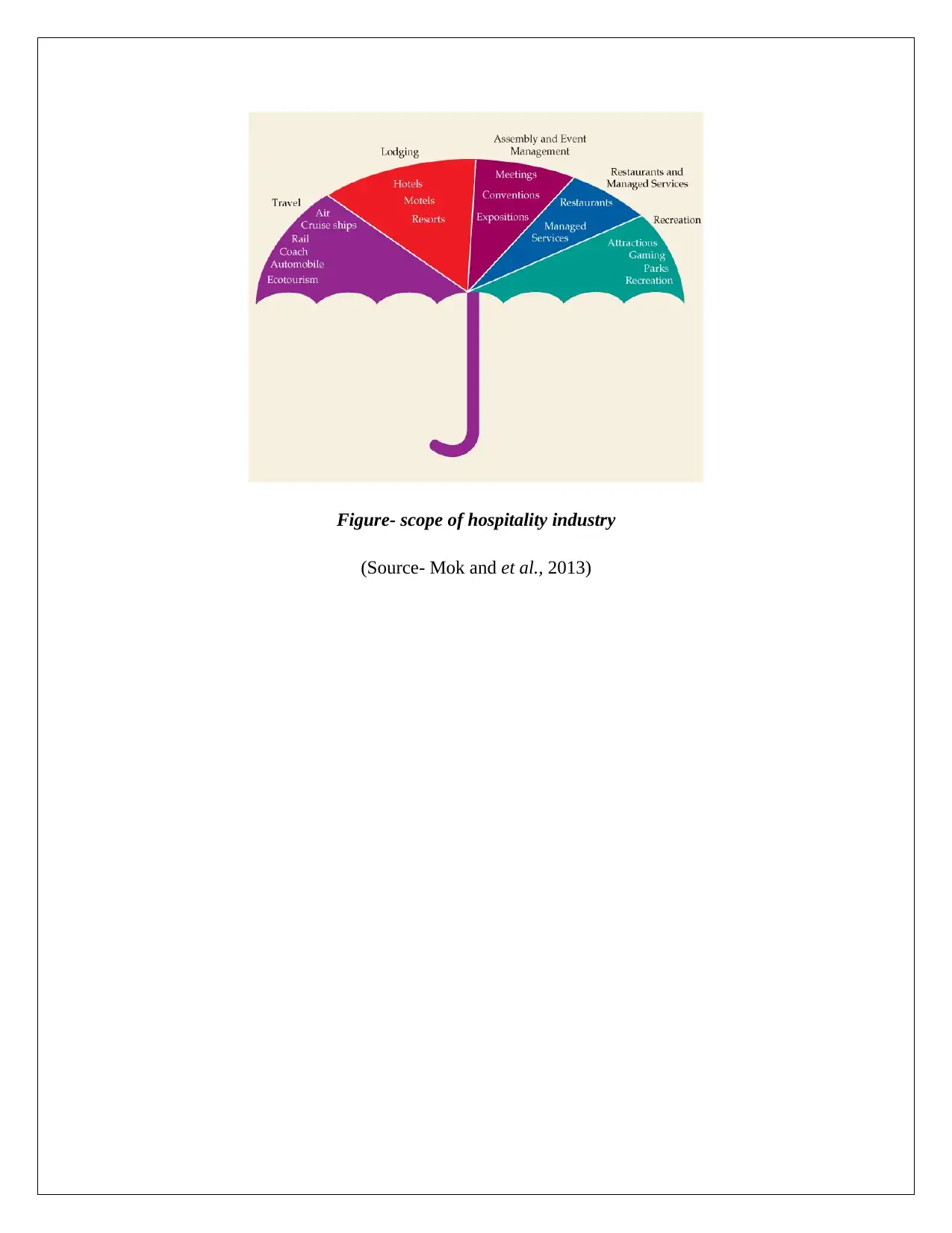
Figure- scope of hospitality industry
(Source- Mok and et al., 2013)
(Source- Mok and et al., 2013)
⊘ This is a preview!⊘
Do you want full access?
Subscribe today to unlock all pages.
Trusted by 1+ million students worldwide
Task 2
2.1 Analyze the implications of integration to the hospitality industry
Tough competition exists in the modern world, which results in integration of different small,
medium or large businesses. Integration can be defined as an art of combining two or more into
one. Integration is done when one unit is in need of either financial assistance or social assistance
(Law and et al., 2014). Funds can be generated easily if two or more units collaborate with each
other. Resources and skills can be combined which may result in effective integration. Various
tools and techniques are used in almost every sector for reducing their operational costs.
Outsourcing its major functions can help in improving the organisational structure of the
company. The higher level managers can focus on more required attention topics which mean the
issues which require solution from experienced people. Integration is also done to become a
leading body in the world of business by combining its resources with other leading businesses.
The tool of integration often proves beneficial as the cost of outsourcing is nil. There are two
methods of integration which are generally practised everywhere. They are as follows-
Vertical integration-the integration process which results in merging of two businesses
that are at diverse production stages are known as vertical integration (Horner and
Swarbrooke 2016). The benefits of vertical integration can be-
o Access to distribution channels
o Better and efficient planning
o Effective coordination between members
o Better scheduling of tasks and responsibilities Horizontal integration-the integration process which results in merging of two or more
businesses that are at the same production stage. This integration helps in reducing the
competition and manages the rivalry by collaborating with the competitors. The benefits
of horizontal integration can be-
o Comprehend economies of vending
o Wide range of products and services for consumers
o Reduces the competition
2.1 Analyze the implications of integration to the hospitality industry
Tough competition exists in the modern world, which results in integration of different small,
medium or large businesses. Integration can be defined as an art of combining two or more into
one. Integration is done when one unit is in need of either financial assistance or social assistance
(Law and et al., 2014). Funds can be generated easily if two or more units collaborate with each
other. Resources and skills can be combined which may result in effective integration. Various
tools and techniques are used in almost every sector for reducing their operational costs.
Outsourcing its major functions can help in improving the organisational structure of the
company. The higher level managers can focus on more required attention topics which mean the
issues which require solution from experienced people. Integration is also done to become a
leading body in the world of business by combining its resources with other leading businesses.
The tool of integration often proves beneficial as the cost of outsourcing is nil. There are two
methods of integration which are generally practised everywhere. They are as follows-
Vertical integration-the integration process which results in merging of two businesses
that are at diverse production stages are known as vertical integration (Horner and
Swarbrooke 2016). The benefits of vertical integration can be-
o Access to distribution channels
o Better and efficient planning
o Effective coordination between members
o Better scheduling of tasks and responsibilities Horizontal integration-the integration process which results in merging of two or more
businesses that are at the same production stage. This integration helps in reducing the
competition and manages the rivalry by collaborating with the competitors. The benefits
of horizontal integration can be-
o Comprehend economies of vending
o Wide range of products and services for consumers
o Reduces the competition
Paraphrase This Document
Need a fresh take? Get an instant paraphrase of this document with our AI Paraphraser
o Manages the rivalry by collaborating with the rivals
Implication of integration to the hospitality industry
Several integration processes took place in the past, which resulted in high profitability of the
hospitality Different takeovers like Marriott Int. took over Ritz-Carlton, Starwood hotels&
resorts and 54%of the hotel groups of renaissance hotel affected the hospitality sector. The
implications of integration to the hospitality industry can be explained as follows-
The integration should ensure that the individual hotels in the process of integration
do not lose their own identity. Plans are created by top managers which should be
focussed on maintain individuality of the hotels. The management team of hotel
experts should design their plans and enhance their services to improve their financial
conditions (Hall and Gössling 2013). At any cost the individuality of the hotel should
not be vanished.
The factors regarding globalization should also be considered by the integrated
companies. The globalization process has opened up the world which resulted in
improved relations between countries and activities of tourists. At the time of
collaborating, a policy should be planned which can attract both the local and
international consumers resulting in increased revenue.
The decisions made by both the integrating hotels should be consensus that means
they should agree on the same terms. Any conflict arising between them may result
either in no integration or ineffective integration. The opinion differences results in
an environment of distress.
High promotional activities of one hotel may affect the identity of the other. The hotel
with low level of income than the other looses their chance of maintaining
individuality.
Market reputation of the merging hotel should be critically analyzed before making
any decision. The decision once made cannot be altered due to commitments or
contractual obligations. Therefore all past activities and events of the merging hotels
should be kept in mind at the time of taking integration decision.
Implication of integration to the hospitality industry
Several integration processes took place in the past, which resulted in high profitability of the
hospitality Different takeovers like Marriott Int. took over Ritz-Carlton, Starwood hotels&
resorts and 54%of the hotel groups of renaissance hotel affected the hospitality sector. The
implications of integration to the hospitality industry can be explained as follows-
The integration should ensure that the individual hotels in the process of integration
do not lose their own identity. Plans are created by top managers which should be
focussed on maintain individuality of the hotels. The management team of hotel
experts should design their plans and enhance their services to improve their financial
conditions (Hall and Gössling 2013). At any cost the individuality of the hotel should
not be vanished.
The factors regarding globalization should also be considered by the integrated
companies. The globalization process has opened up the world which resulted in
improved relations between countries and activities of tourists. At the time of
collaborating, a policy should be planned which can attract both the local and
international consumers resulting in increased revenue.
The decisions made by both the integrating hotels should be consensus that means
they should agree on the same terms. Any conflict arising between them may result
either in no integration or ineffective integration. The opinion differences results in
an environment of distress.
High promotional activities of one hotel may affect the identity of the other. The hotel
with low level of income than the other looses their chance of maintaining
individuality.
Market reputation of the merging hotel should be critically analyzed before making
any decision. The decision once made cannot be altered due to commitments or
contractual obligations. Therefore all past activities and events of the merging hotels
should be kept in mind at the time of taking integration decision.
If integration takes place vertically among two hotel chains, there is a leeway that
hotel with more strength financially will have power over the other. It is beneficial
for the hotel to integrate with other sector but under the industry of hospitality.
2.2 Discuss how integration has affected a hospitality business
The main reason for integration either to expand or improve the current operations, in both the
cases the benefit is always for the business venture. The positive and negative impacts can be
analyzed by the integration methods by taking into consideration different outcomes of the
process of integration. In hospitality industry it is also similar Opportunities ( Stock, and
Seliger., 2016).
The JFK experts will analyze the situation for the particular hotel and suggest the proper
integration process that can be beneficial for the hotel (Schimmelfennig, et al.,2015.). The
Marriott international hotels in this case have utilized the integration to their benefit. The
benefits which can be seen after integration are as follows-
• The standards are improved to after the integration.
• The business can be diversified with the horizontal integration. Therefore the profitability
of the company can increase. The different service that is produced by the company will
also increase the brand value.
• The vertical integration on the other hand increases competitiveness and this also
increases the standard of the Marriott international hotels.
• These mergers help the hotels increase the market shares. They can control the better part
of the market.
• This vertical integration also decreases the costing of the operations which benefits the
hotels very much.
• The supply chain maintained is increased to by management which is another benefit of
the inte4gretions (Madsen and Walker., 2015).
With advantages, disadvantages are complementary. There are also some disadvantages of these
integrations which are discussed below:
• Vertical integration decreases the competitiveness.
hotel with more strength financially will have power over the other. It is beneficial
for the hotel to integrate with other sector but under the industry of hospitality.
2.2 Discuss how integration has affected a hospitality business
The main reason for integration either to expand or improve the current operations, in both the
cases the benefit is always for the business venture. The positive and negative impacts can be
analyzed by the integration methods by taking into consideration different outcomes of the
process of integration. In hospitality industry it is also similar Opportunities ( Stock, and
Seliger., 2016).
The JFK experts will analyze the situation for the particular hotel and suggest the proper
integration process that can be beneficial for the hotel (Schimmelfennig, et al.,2015.). The
Marriott international hotels in this case have utilized the integration to their benefit. The
benefits which can be seen after integration are as follows-
• The standards are improved to after the integration.
• The business can be diversified with the horizontal integration. Therefore the profitability
of the company can increase. The different service that is produced by the company will
also increase the brand value.
• The vertical integration on the other hand increases competitiveness and this also
increases the standard of the Marriott international hotels.
• These mergers help the hotels increase the market shares. They can control the better part
of the market.
• This vertical integration also decreases the costing of the operations which benefits the
hotels very much.
• The supply chain maintained is increased to by management which is another benefit of
the inte4gretions (Madsen and Walker., 2015).
With advantages, disadvantages are complementary. There are also some disadvantages of these
integrations which are discussed below:
• Vertical integration decreases the competitiveness.
⊘ This is a preview!⊘
Do you want full access?
Subscribe today to unlock all pages.
Trusted by 1+ million students worldwide
• It is also reduces flexibility.
• Every merger and acquisitions are very complex matter which is con in case of the hotels
and management.
All these have been impacts of the integration has been noticed in the acquisition of the
Starwood hotels and resorts by the Marriott international hotels. Marriott international
hotels have been valued almost 12.2 billion which is highest of its kind. Marriott
international hotels have also acquired the delta hotels and resorts for 135 billion. All
these acquirements make the company huge as abrand but bthe operational process are
now more complex than ever.
• Every merger and acquisitions are very complex matter which is con in case of the hotels
and management.
All these have been impacts of the integration has been noticed in the acquisition of the
Starwood hotels and resorts by the Marriott international hotels. Marriott international
hotels have been valued almost 12.2 billion which is highest of its kind. Marriott
international hotels have also acquired the delta hotels and resorts for 135 billion. All
these acquirements make the company huge as abrand but bthe operational process are
now more complex than ever.
Paraphrase This Document
Need a fresh take? Get an instant paraphrase of this document with our AI Paraphraser
Task 3
3.1 Develop a rationale for a selected project clearly justifying decisions linked to target
market
UK’s tourism industry is at its peak currently and there will be no better time to take advantage
for hospitality industry than this. 4% of UK’s GDP (Gross domestic product) is acquired by the
hospitality industry and that includes hotels, pubs, and leisure companies and many more. It is
developing at every span of time. It would be advantageous for opening restaurant chains in
London for generating revenue for the country. Therefore it is the best time to start a fine dining
restaurant chain in London and nearby locations. The UK tourism industry is 8th largest tourism
industry in the world more than billion people yearly visiting from around the world. It also
generates huge number of workforce in UK itself. This signifies that the resources are plentiful in
this industry from man power on ground level of management. Generation of employment will
help in increasing the per capita income for United Kingdom. There is also huge benefit for
hospitality industry if the business is based on London and nearby town, London being the heart
of UK tourism economy. The political stability is also important factor in this business plan.
BREXIT is likely going to play a part in this but not likely to harm the hospitality business
environment. The government policies in UK will be a favoring factor due to the revenue it
generates yearly being a booming industry currently. Other than travel industry the urban
consumers are a target demographic of hospitality industry. The urban consumers are always
looking for new and happening spots in the town. Therefore the scope of high profitability is
huge in the hospitality business currently. Our restaurant business is also a part of food industry
which is a very high profit sector. The market is diverse and not saturated and could be taken
advantage of before BREXIT happens, which may change the scenarios somewhat. All these
factors indicates that the starting a fine dining restaurant chain has scope of high profit. The
positive aspect outweighs the negatives in this industry. In addition, there is relatively less risk
factors. With a practical and achievable business plan this business will touch heights of success
very easily.
3.1 Develop a rationale for a selected project clearly justifying decisions linked to target
market
UK’s tourism industry is at its peak currently and there will be no better time to take advantage
for hospitality industry than this. 4% of UK’s GDP (Gross domestic product) is acquired by the
hospitality industry and that includes hotels, pubs, and leisure companies and many more. It is
developing at every span of time. It would be advantageous for opening restaurant chains in
London for generating revenue for the country. Therefore it is the best time to start a fine dining
restaurant chain in London and nearby locations. The UK tourism industry is 8th largest tourism
industry in the world more than billion people yearly visiting from around the world. It also
generates huge number of workforce in UK itself. This signifies that the resources are plentiful in
this industry from man power on ground level of management. Generation of employment will
help in increasing the per capita income for United Kingdom. There is also huge benefit for
hospitality industry if the business is based on London and nearby town, London being the heart
of UK tourism economy. The political stability is also important factor in this business plan.
BREXIT is likely going to play a part in this but not likely to harm the hospitality business
environment. The government policies in UK will be a favoring factor due to the revenue it
generates yearly being a booming industry currently. Other than travel industry the urban
consumers are a target demographic of hospitality industry. The urban consumers are always
looking for new and happening spots in the town. Therefore the scope of high profitability is
huge in the hospitality business currently. Our restaurant business is also a part of food industry
which is a very high profit sector. The market is diverse and not saturated and could be taken
advantage of before BREXIT happens, which may change the scenarios somewhat. All these
factors indicates that the starting a fine dining restaurant chain has scope of high profit. The
positive aspect outweighs the negatives in this industry. In addition, there is relatively less risk
factors. With a practical and achievable business plan this business will touch heights of success
very easily.
3.2 Develop a plan for a hospitality business including the operational requirements of the
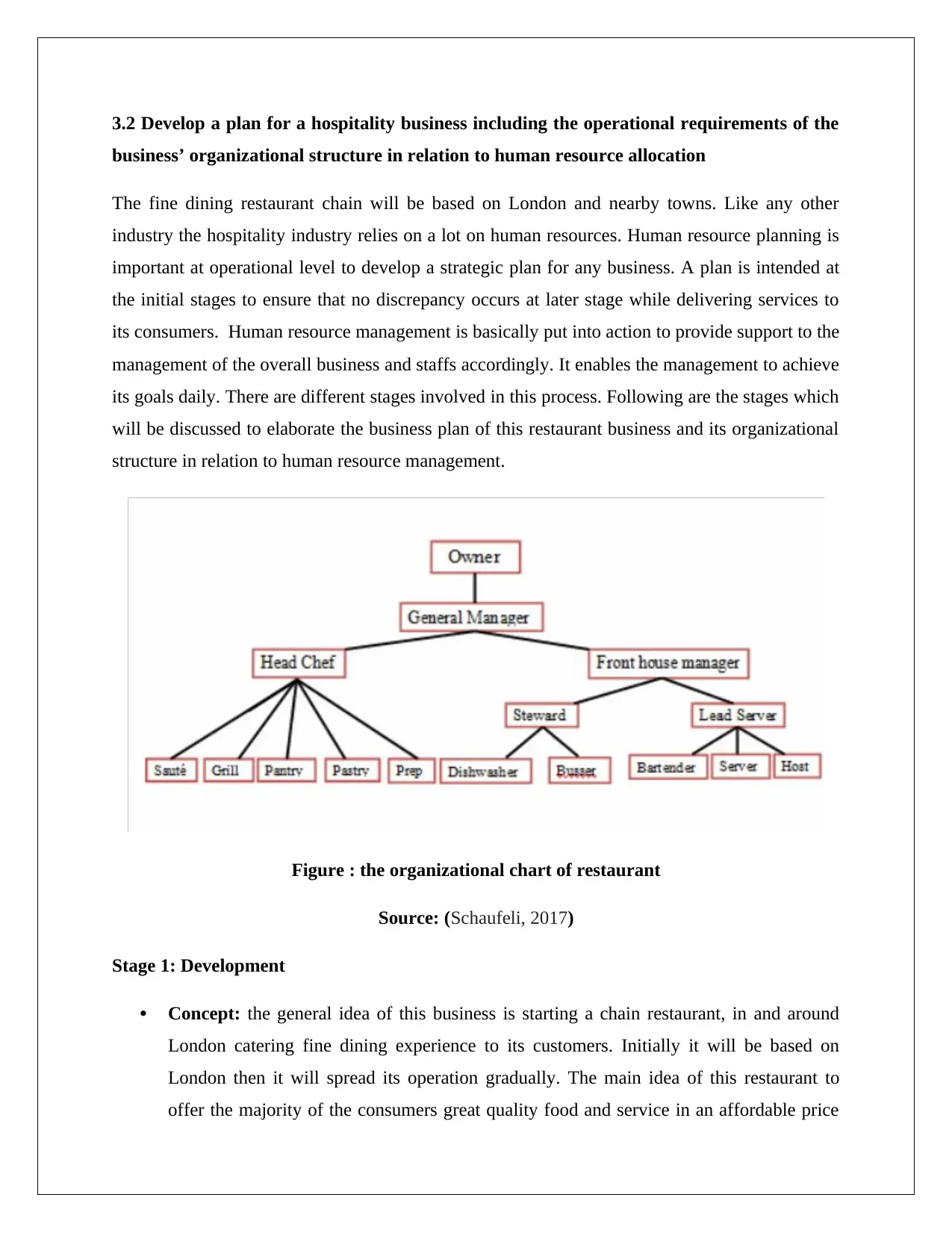
business’ organizational structure in relation to human resource allocation
The fine dining restaurant chain will be based on London and nearby towns. Like any other
industry the hospitality industry relies on a lot on human resources. Human resource planning is
important at operational level to develop a strategic plan for any business. A plan is intended at
the initial stages to ensure that no discrepancy occurs at later stage while delivering services to
its consumers. Human resource management is basically put into action to provide support to the
management of the overall business and staffs accordingly. It enables the management to achieve
its goals daily. There are different stages involved in this process. Following are the stages which
will be discussed to elaborate the business plan of this restaurant business and its organizational
structure in relation to human resource management.
Figure : the organizational chart of restaurant
Source: (Schaufeli, 2017)
Stage 1: Development
• Concept: the general idea of this business is starting a chain restaurant, in and around
London catering fine dining experience to its customers. Initially it will be based on
London then it will spread its operation gradually. The main idea of this restaurant to
offer the majority of the consumers great quality food and service in an affordable price
business’ organizational structure in relation to human resource allocation
The fine dining restaurant chain will be based on London and nearby towns. Like any other
industry the hospitality industry relies on a lot on human resources. Human resource planning is
important at operational level to develop a strategic plan for any business. A plan is intended at
the initial stages to ensure that no discrepancy occurs at later stage while delivering services to
its consumers. Human resource management is basically put into action to provide support to the
management of the overall business and staffs accordingly. It enables the management to achieve
its goals daily. There are different stages involved in this process. Following are the stages which
will be discussed to elaborate the business plan of this restaurant business and its organizational
structure in relation to human resource management.
Figure : the organizational chart of restaurant
Source: (Schaufeli, 2017)
Stage 1: Development
• Concept: the general idea of this business is starting a chain restaurant, in and around
London catering fine dining experience to its customers. Initially it will be based on
London then it will spread its operation gradually. The main idea of this restaurant to
offer the majority of the consumers great quality food and service in an affordable price
⊘ This is a preview!⊘
Do you want full access?
Subscribe today to unlock all pages.
Trusted by 1+ million students worldwide

1 out of 19


Related Documents


Your All-in-One AI-Powered Toolkit for Academic Success.
+13062052269
info@desklib.com
Available 24*7 on WhatsApp / Email
![[object Object]](/_next/static/media/star-bottom.7253800d.svg)
Unlock your academic potential
Copyright © 2020–2026 A2Z Services. All Rights Reserved. Developed and managed by ZUCOL.