TAE40116 Cert IV: Housekeeping Assistant LLN Evaluation Form

Verified

Added on  2023/06/18

|32
|4747
|361
Practical Assignment
AI Summary
This document presents a completed LLN (Language, Literacy, and Numeracy) evaluation form for a housekeeping assistant role, utilizing the Australian Core Skills Framework (ACSF) levels to assess various skills. The form evaluates learning, reading, writing, and numeracy skills within the context of the housekeeping role, providing comments and examples for each skill level. It covers different contexts, text complexities, and task complexities, ranging from highly familiar situations to broad and adaptable contexts. The reading skills section assesses the ability to follow instructions, interpret information, and analyze complex texts. The writing skills section focuses on completing forms, writing reports, and using technical vocabulary. This evaluation provides a structured approach to identify the LLN skill levels required for effective performance in a housekeeping assistant position. Desklib provides access to similar solved assignments and resources for students.
Document Page
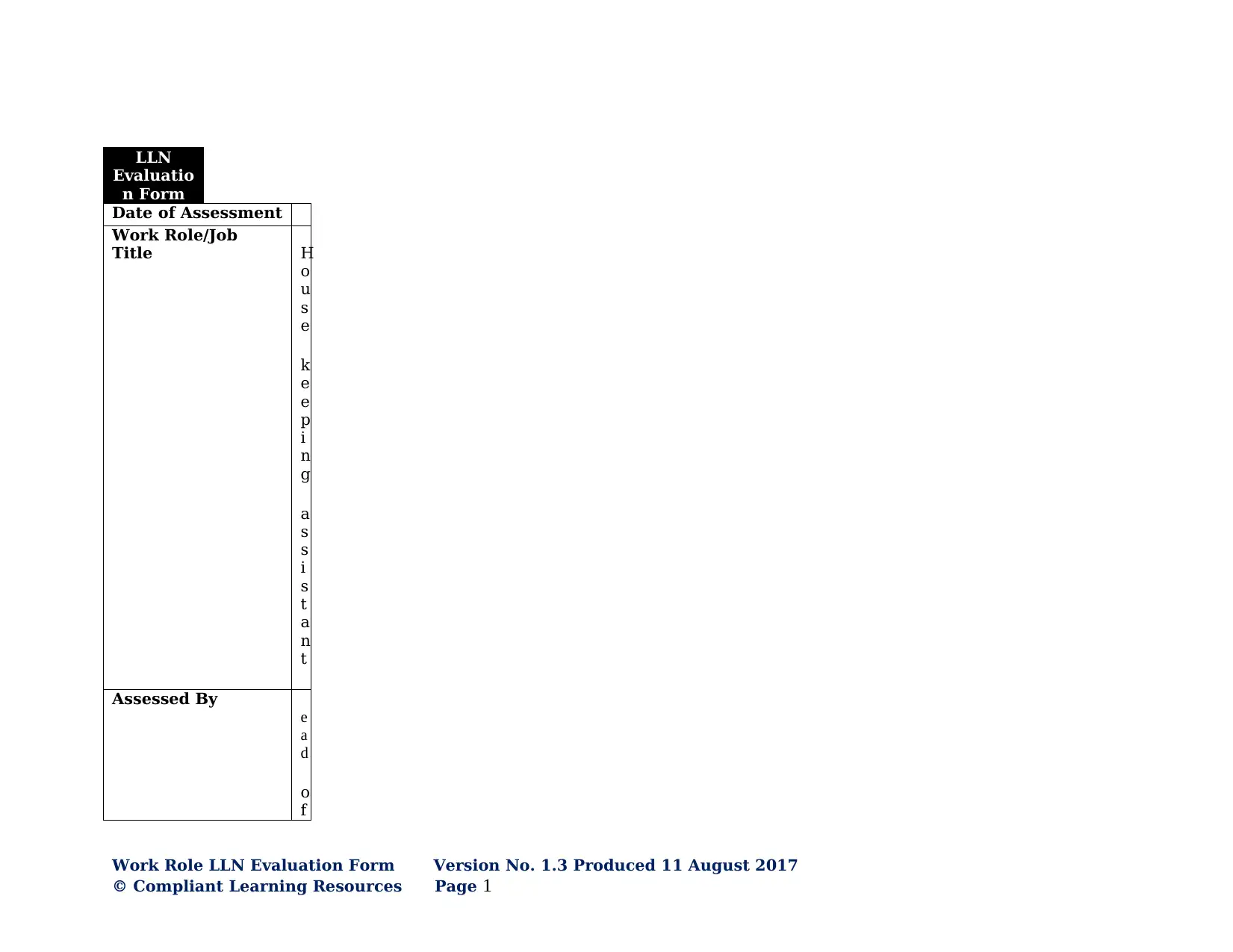
LLN
Evaluatio
n Form
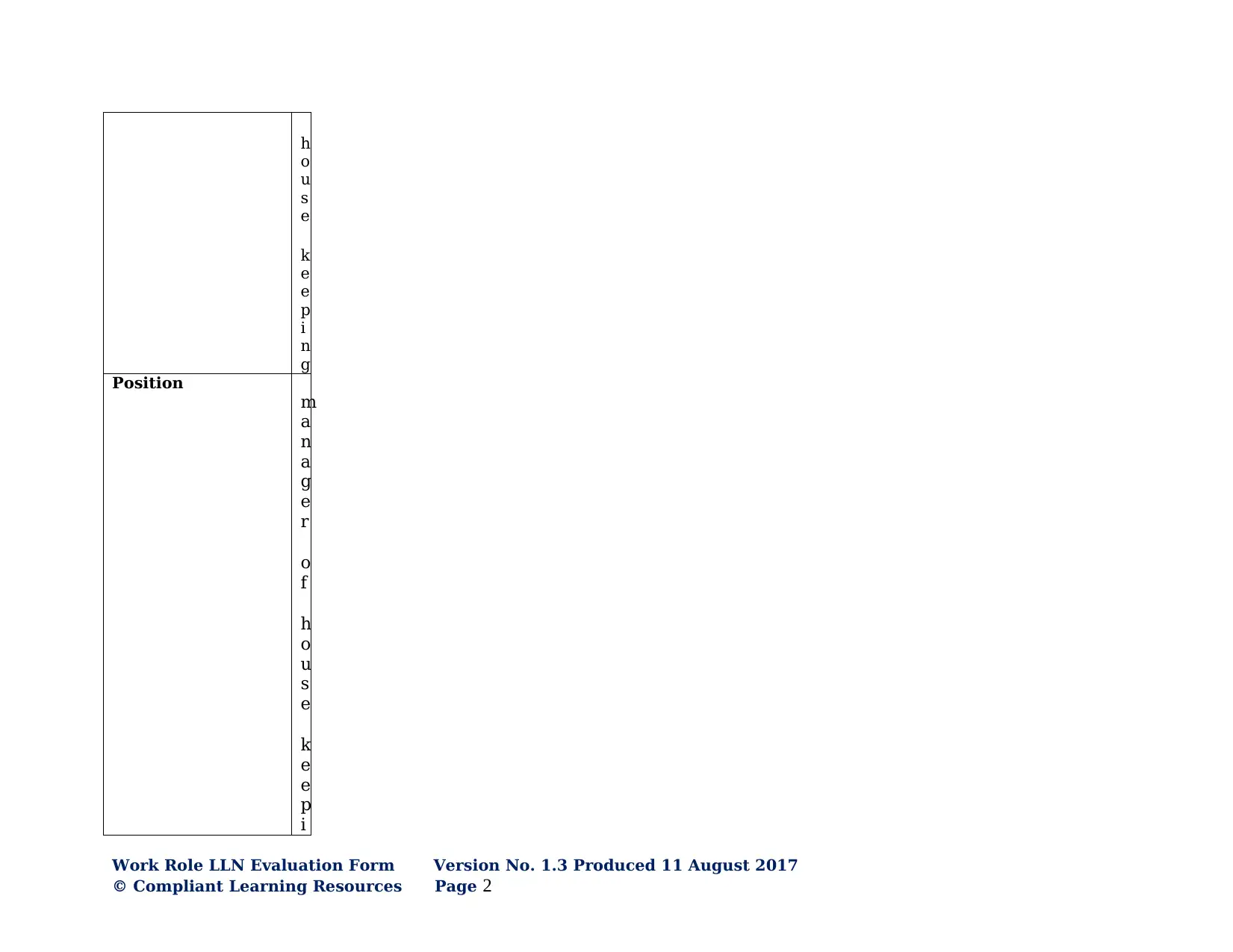
Date of Assessment
Work Role/Job
Title H
o
u
s
e
k
e
e
p
i
n
g
a
s
s
i
s
t
a
n
t
Assessed By
e
a
d
o
f
Work Role LLN Evaluation Form Version No. 1.3 Produced 11 August 2017
© Compliant Learning Resources Page 1
tabler-icon-diamond-filled.svg

Paraphrase This Document

Need a fresh take? Get an instant paraphrase of this document with our AI Paraphraser
Document Page
h
o
u
s
e
k
e
e
p
i
n
g
Position
m
a
n
a
g
e
r
o
f
h
o
u
s
e
k
e
e
p
i
Work Role LLN Evaluation Form Version No. 1.3 Produced 11 August 2017
© Compliant Learning Resources Page 2
Document Page
n
g
Signature
A
D
Work
Role
LLN
Require
ments
Learning Reading Writing Oral Numera
cy
Work Role Support Level ACSF
Level
C
o
m
m
e
n
t
s
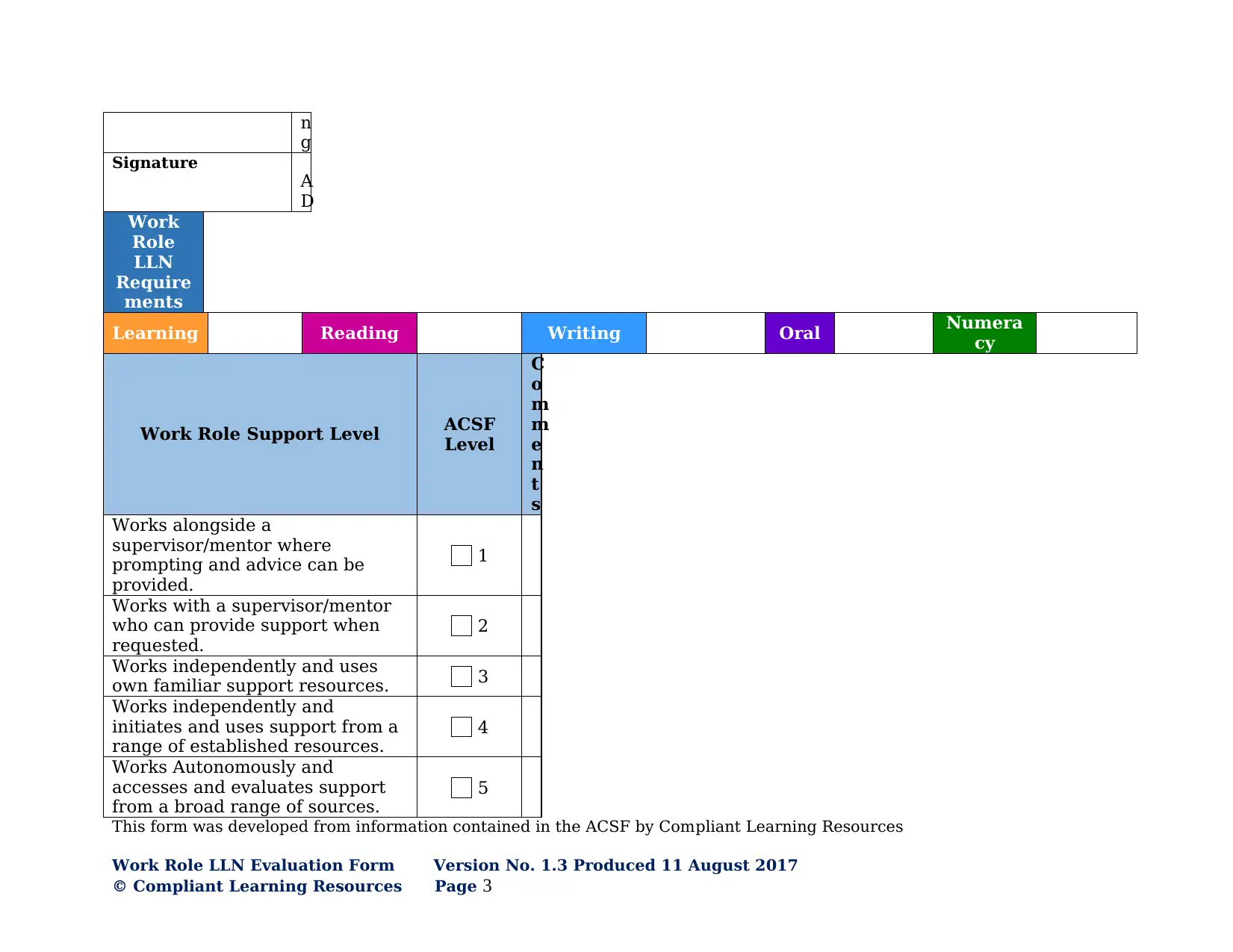
Works alongside a
supervisor/mentor where
prompting and advice can be
provided.
1
Works with a supervisor/mentor
who can provide support when
requested.
2
Works independently and uses
own familiar support resources. 3
Works independently and
initiates and uses support from a
range of established resources.
4
Works Autonomously and
accesses and evaluates support
from a broad range of sources.
5
This form was developed from information contained in the ACSF by Compliant Learning Resources
Work Role LLN Evaluation Form Version No. 1.3 Produced 11 August 2017
© Compliant Learning Resources Page 3
Document Page
Learning
Context Text Complexity Task Complexity ACSF Level Comments – Task
Details
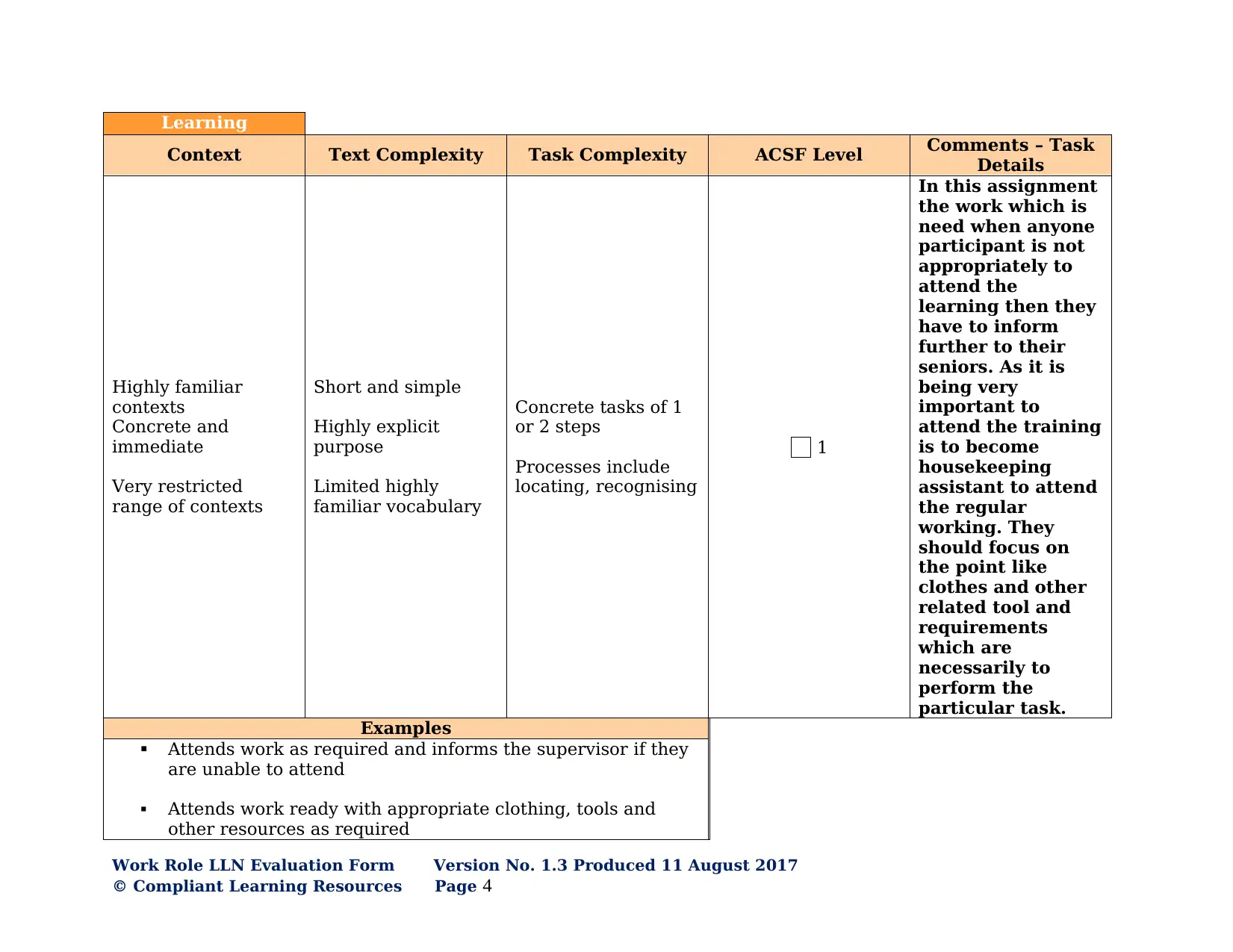
Highly familiar
contexts
Concrete and
immediate
Very restricted
range of contexts
Short and simple
Highly explicit
purpose
Limited highly
familiar vocabulary
Concrete tasks of 1
or 2 steps
Processes include
locating, recognising
1
In this assignment
the work which is
need when anyone
participant is not
appropriately to
attend the
learning then they
have to inform
further to their
seniors. As it is
being very
important to
attend the training
is to become
housekeeping
assistant to attend
the regular
working. They
should focus on
the point like
clothes and other
related tool and
requirements
which are
necessarily to
perform the
particular task.
Examples
Attends work as required and informs the supervisor if they
are unable to attend
Attends work ready with appropriate clothing, tools and
other resources as required
Work Role LLN Evaluation Form Version No. 1.3 Produced 11 August 2017
© Compliant Learning Resources Page 4
tabler-icon-diamond-filled.svg

Paraphrase This Document

Need a fresh take? Get an instant paraphrase of this document with our AI Paraphraser
Document Page
Context Text Complexity Task Complexity ACSF Level Comments – Task
Details
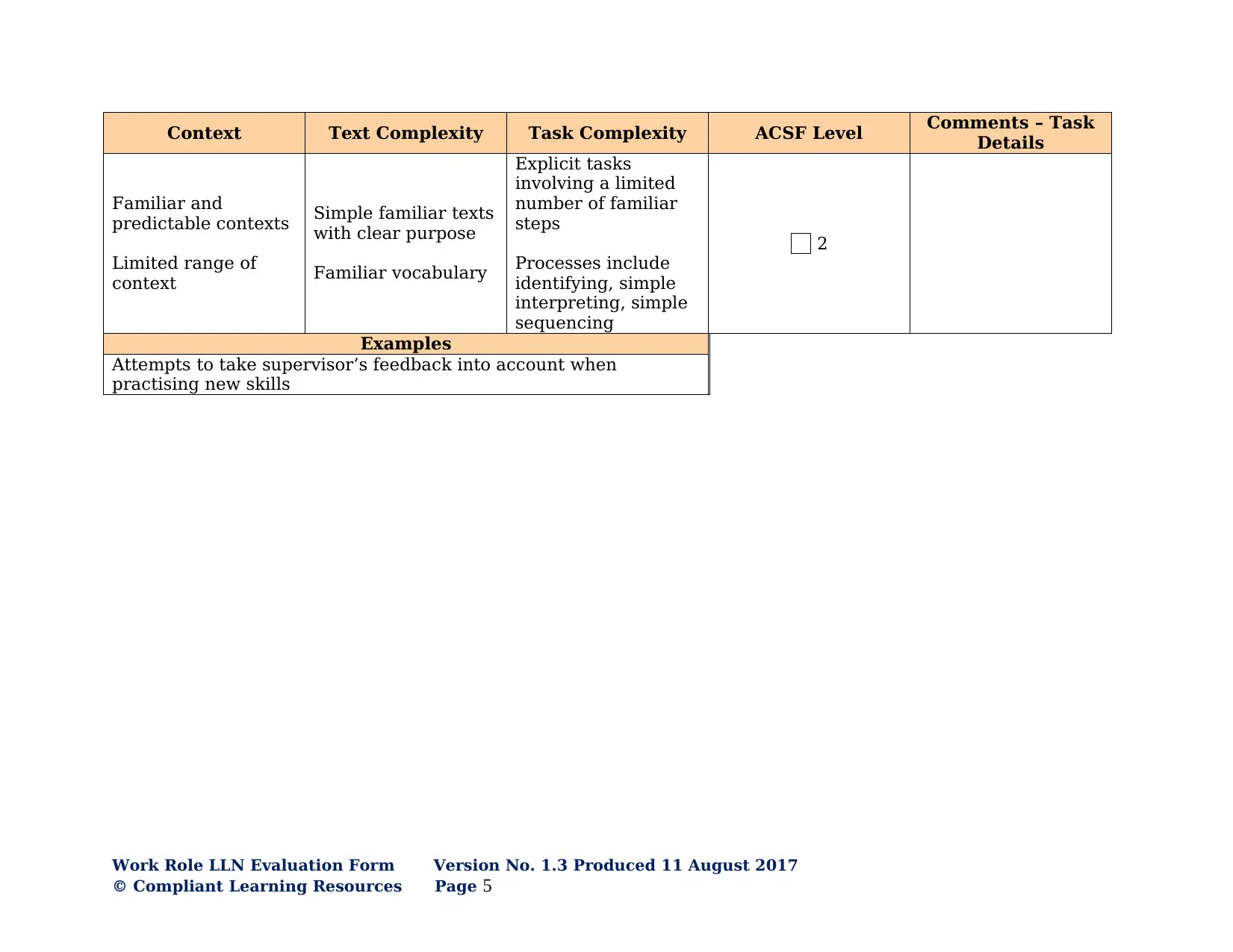
Familiar and
predictable contexts
Limited range of
context
Simple familiar texts
with clear purpose
Familiar vocabulary
Explicit tasks
involving a limited
number of familiar
steps
Processes include
identifying, simple
interpreting, simple
sequencing
2
Examples
Attempts to take supervisor’s feedback into account when
practising new skills
Work Role LLN Evaluation Form Version No. 1.3 Produced 11 August 2017
© Compliant Learning Resources Page 5
Document Page
Work Role LLN Evaluation Form Version No. 1.3 Produced 11 August 2017
© Compliant Learning Resources Page 6
Document Page
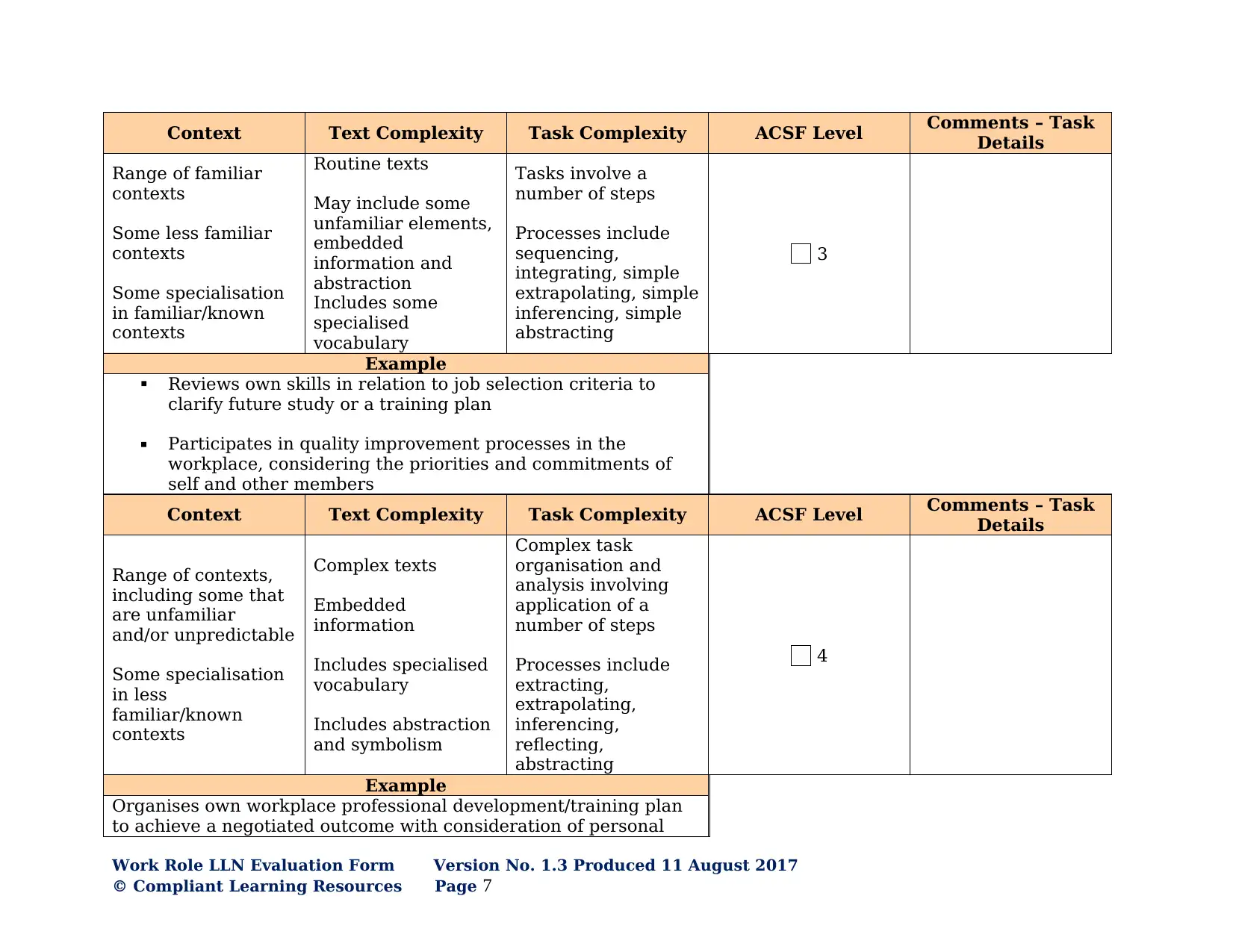
Context Text Complexity Task Complexity ACSF Level Comments – Task
Details
Range of familiar
contexts
Some less familiar
contexts
Some specialisation
in familiar/known
contexts
Routine texts
May include some
unfamiliar elements,
embedded
information and
abstraction
Includes some
specialised
vocabulary
Tasks involve a
number of steps
Processes include
sequencing,
integrating, simple
extrapolating, simple
inferencing, simple
abstracting
3
Example
Reviews own skills in relation to job selection criteria to
clarify future study or a training plan
Participates in quality improvement processes in the
workplace, considering the priorities and commitments of
self and other members
Context Text Complexity Task Complexity ACSF Level Comments – Task
Details
Range of contexts,
including some that
are unfamiliar
and/or unpredictable
Some specialisation
in less
familiar/known
contexts
Complex texts
Embedded
information
Includes specialised
vocabulary
Includes abstraction
and symbolism
Complex task
organisation and
analysis involving
application of a
number of steps
Processes include
extracting,
extrapolating,
inferencing,
reflecting,
abstracting
4
Example
Organises own workplace professional development/training plan
to achieve a negotiated outcome with consideration of personal
Work Role LLN Evaluation Form Version No. 1.3 Produced 11 August 2017
© Compliant Learning Resources Page 7
tabler-icon-diamond-filled.svg

Paraphrase This Document

Need a fresh take? Get an instant paraphrase of this document with our AI Paraphraser
Document Page
priorities and demands on time
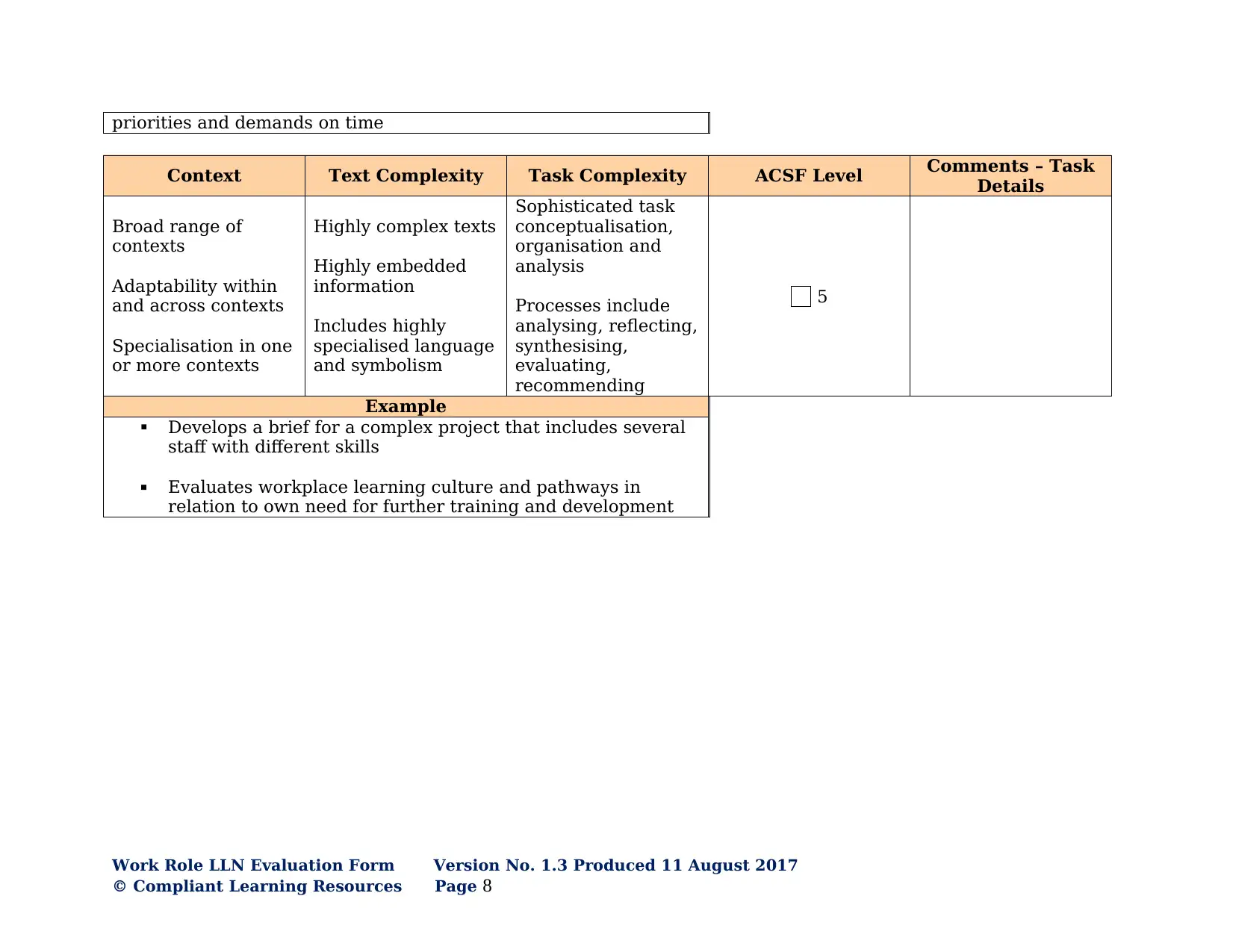
Context Text Complexity Task Complexity ACSF Level Comments – Task
Details
Broad range of
contexts
Adaptability within
and across contexts
Specialisation in one
or more contexts
Highly complex texts
Highly embedded
information
Includes highly
specialised language
and symbolism
Sophisticated task
conceptualisation,
organisation and
analysis
Processes include
analysing, reflecting,
synthesising,
evaluating,
recommending
5
Example
Develops a brief for a complex project that includes several
staff with different skills
Evaluates workplace learning culture and pathways in
relation to own need for further training and development
Work Role LLN Evaluation Form Version No. 1.3 Produced 11 August 2017
© Compliant Learning Resources Page 8
Document Page
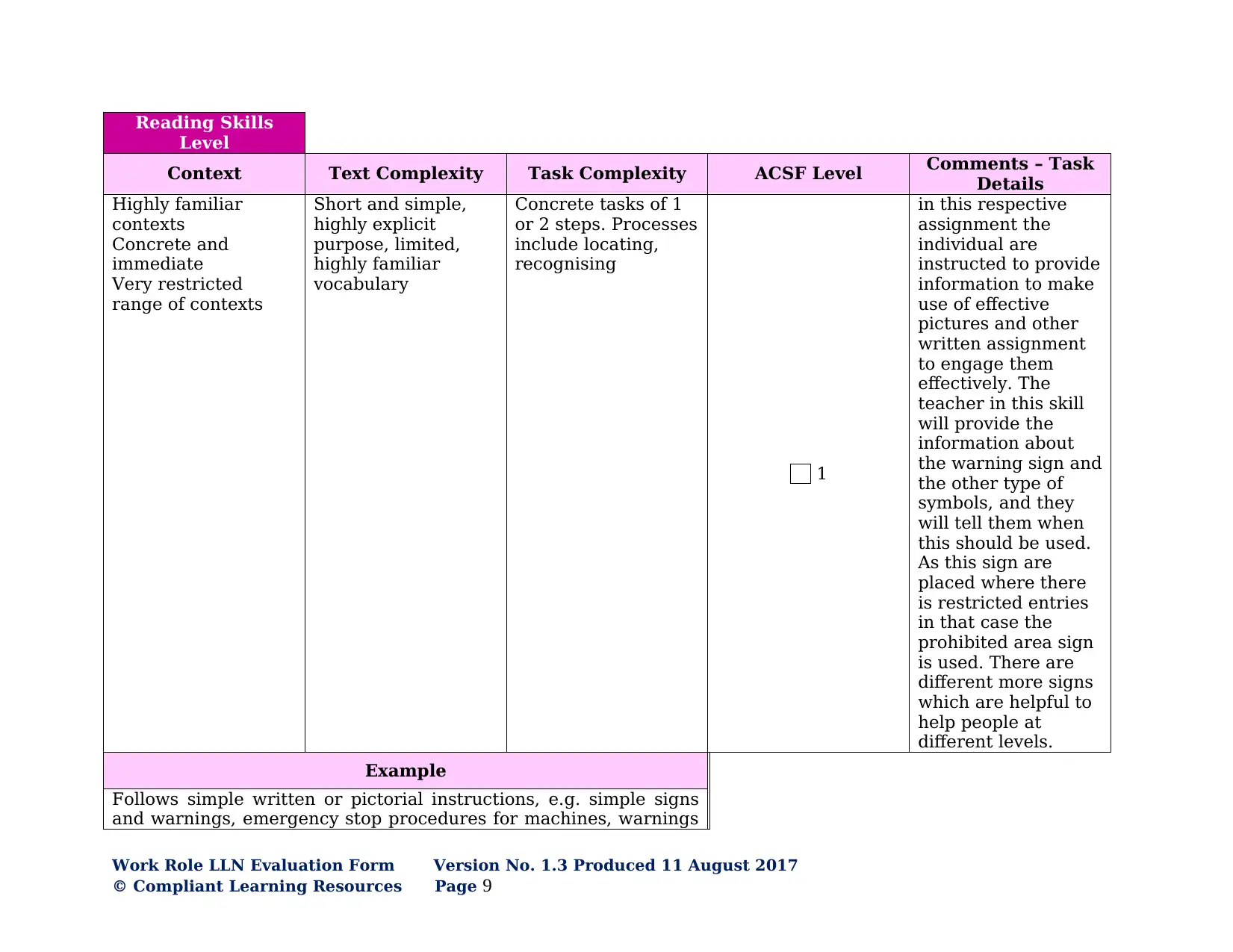
Reading Skills
Level
Context Text Complexity Task Complexity ACSF Level Comments – Task
Details
Highly familiar
contexts
Concrete and
immediate
Very restricted
range of contexts
Short and simple,
highly explicit
purpose, limited,
highly familiar
vocabulary
Concrete tasks of 1
or 2 steps. Processes
include locating,
recognising
1
in this respective
assignment the
individual are
instructed to provide
information to make
use of effective
pictures and other
written assignment
to engage them
effectively. The
teacher in this skill
will provide the
information about
the warning sign and
the other type of
symbols, and they
will tell them when
this should be used.
As this sign are
placed where there
is restricted entries
in that case the
prohibited area sign
is used. There are
different more signs
which are helpful to
help people at
different levels.
Example
Follows simple written or pictorial instructions, e.g. simple signs
and warnings, emergency stop procedures for machines, warnings
Work Role LLN Evaluation Form Version No. 1.3 Produced 11 August 2017
© Compliant Learning Resources Page 9
Document Page
such as 'prohibited area' and 'wash hands before entering' or
safety symbols on chemical containers.
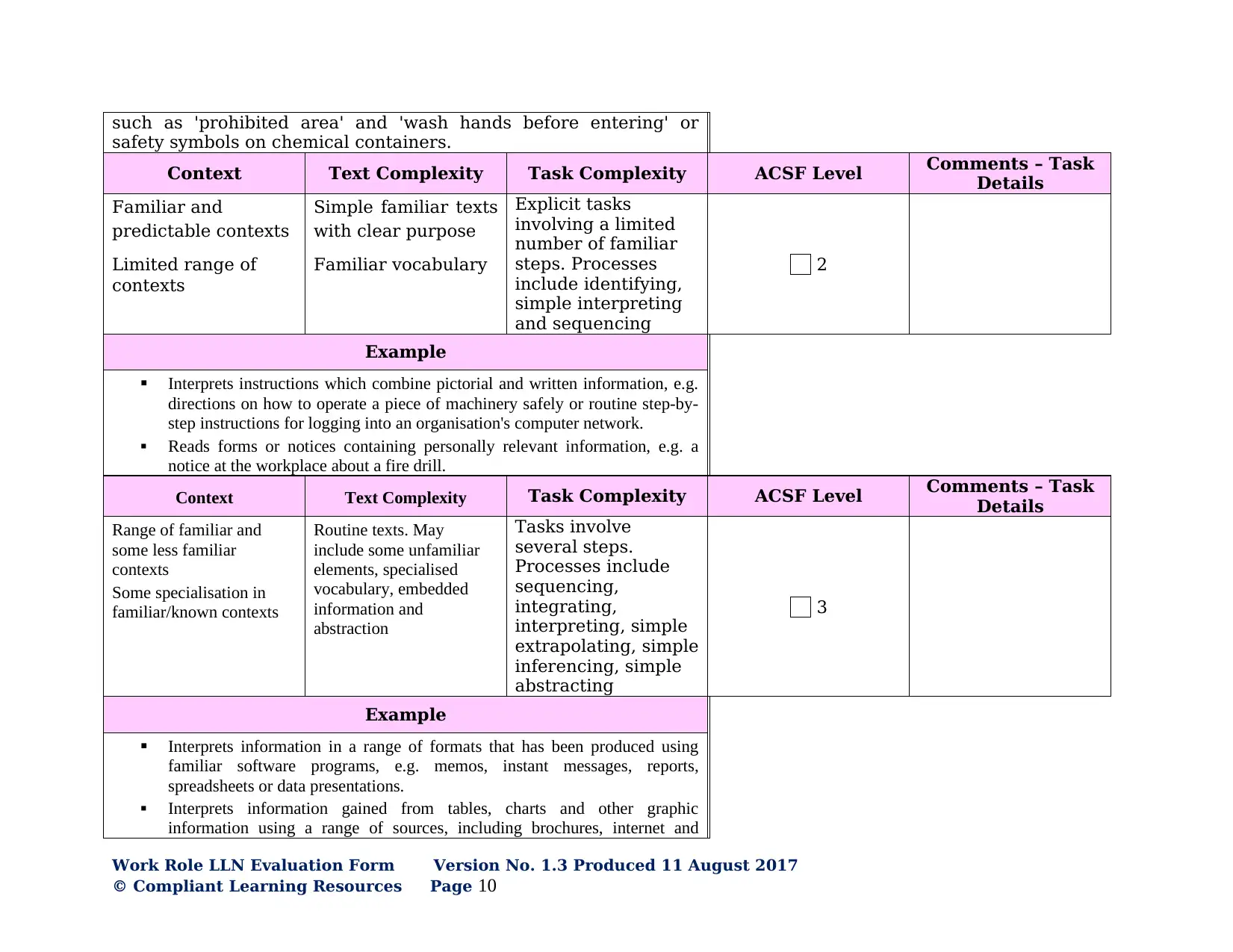
Context Text Complexity Task Complexity ACSF Level Comments – Task
Details
Familiar and
predictable contexts
Limited range of
contexts
Simple familiar texts
with clear purpose
Familiar vocabulary
Explicit tasks
involving a limited
number of familiar
steps. Processes
include identifying,
simple interpreting
and sequencing
2
Example
Interprets instructions which combine pictorial and written information, e.g.
directions on how to operate a piece of machinery safely or routine step-by-
step instructions for logging into an organisation's computer network.
Reads forms or notices containing personally relevant information, e.g. a
notice at the workplace about a fire drill.
Context Text Complexity Task Complexity ACSF Level Comments – Task
Details
Range of familiar and
some less familiar
contexts
Some specialisation in
familiar/known contexts
Routine texts. May
include some unfamiliar
elements, specialised
vocabulary, embedded
information and
abstraction
Tasks involve
several steps.
Processes include
sequencing,
integrating,
interpreting, simple
extrapolating, simple
inferencing, simple
abstracting
3
Example
Interprets information in a range of formats that has been produced using
familiar software programs, e.g. memos, instant messages, reports,
spreadsheets or data presentations.
Interprets information gained from tables, charts and other graphic
information using a range of sources, including brochures, internet and
Work Role LLN Evaluation Form Version No. 1.3 Produced 11 August 2017
© Compliant Learning Resources Page 10
tabler-icon-diamond-filled.svg

Paraphrase This Document

Need a fresh take? Get an instant paraphrase of this document with our AI Paraphraser
Document Page
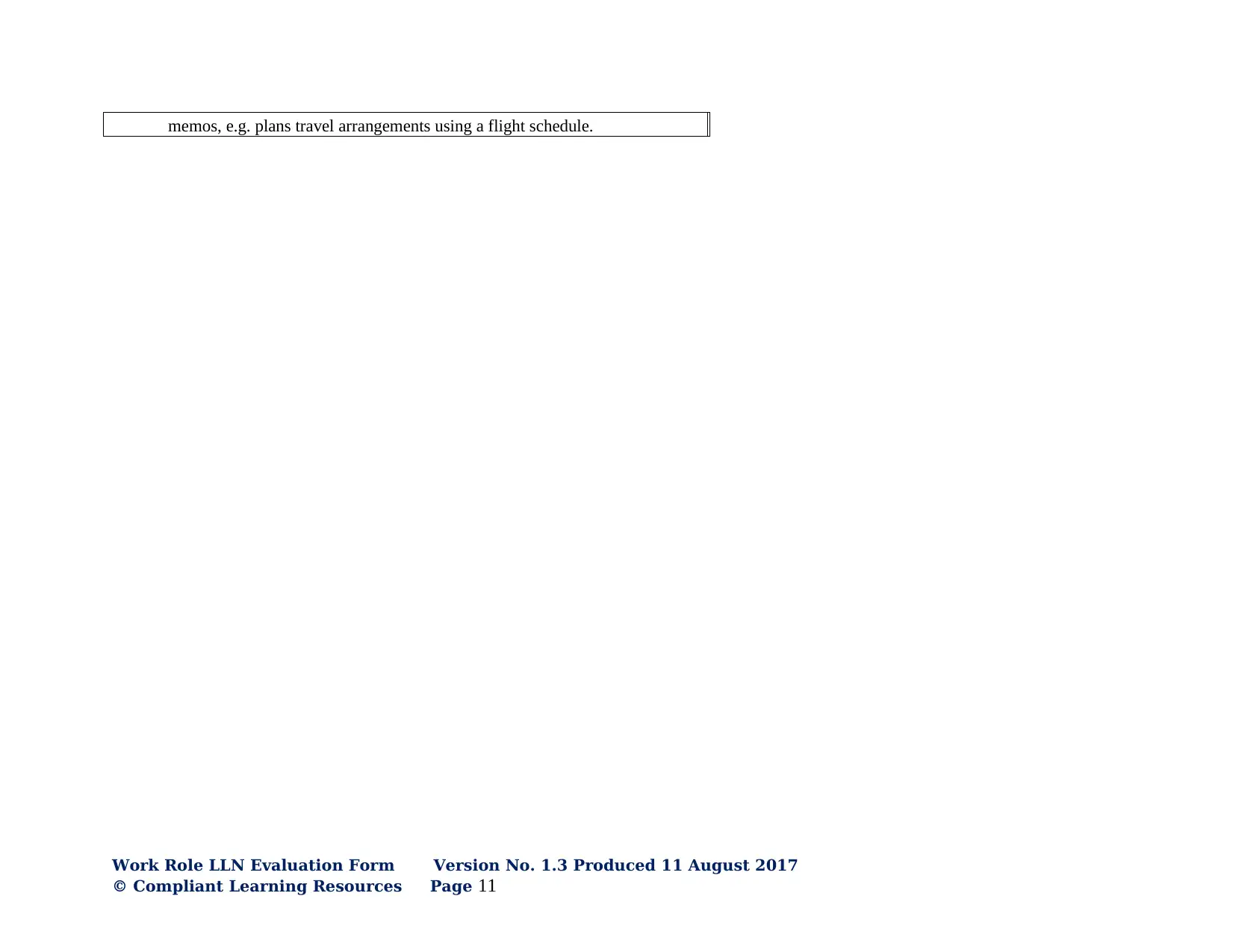
memos, e.g. plans travel arrangements using a flight schedule.
Work Role LLN Evaluation Form Version No. 1.3 Produced 11 August 2017
© Compliant Learning Resources Page 11
Document Page
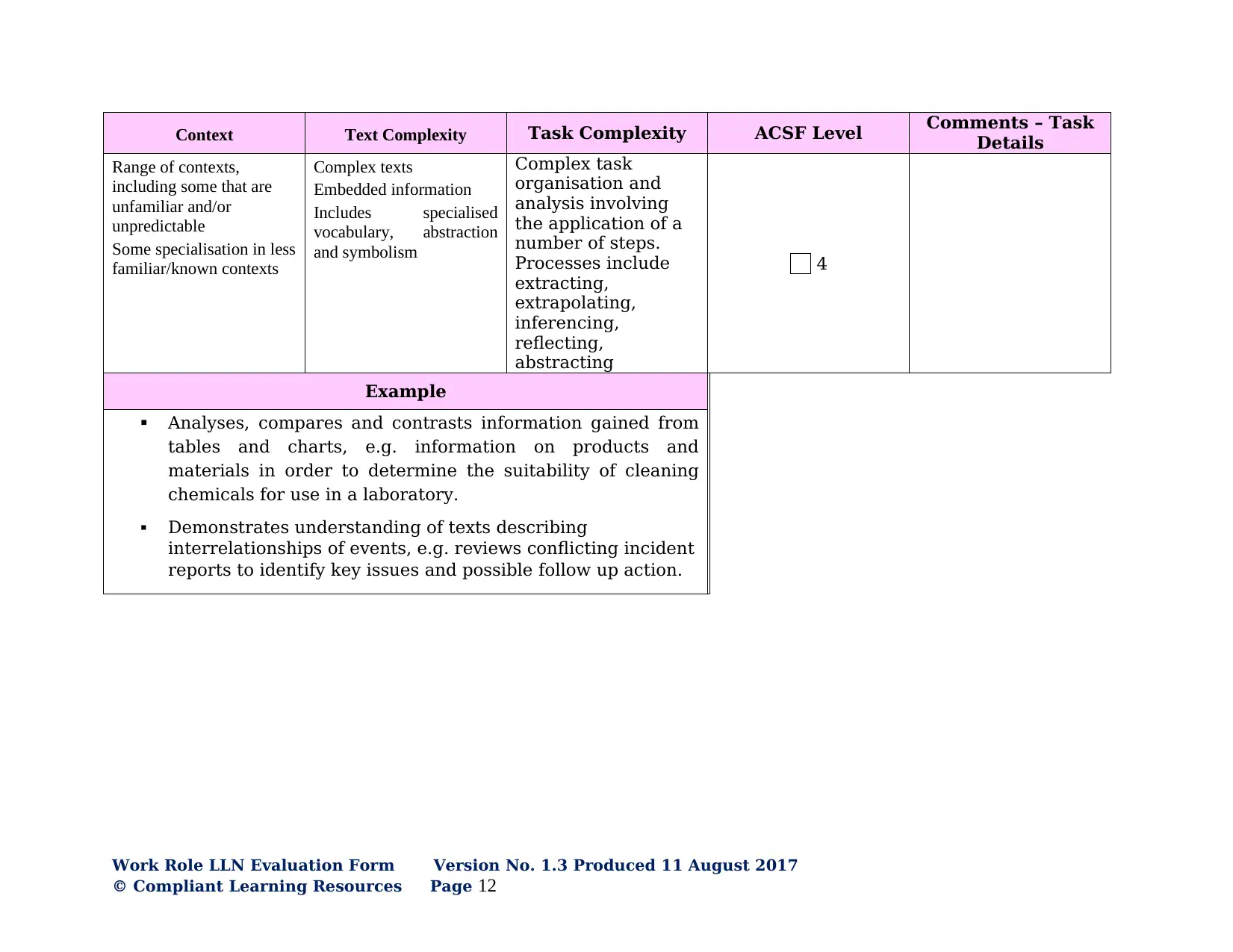
Context Text Complexity Task Complexity ACSF Level Comments – Task
Details
Range of contexts,
including some that are
unfamiliar and/or
unpredictable
Some specialisation in less
familiar/known contexts
Complex texts
Embedded information
Includes specialised
vocabulary, abstraction
and symbolism
Complex task
organisation and
analysis involving
the application of a
number of steps.
Processes include
extracting,
extrapolating,
inferencing,
reflecting,
abstracting
4
Example
Analyses, compares and contrasts information gained from
tables and charts, e.g. information on products and
materials in order to determine the suitability of cleaning
chemicals for use in a laboratory.
Demonstrates understanding of texts describing
interrelationships of events, e.g. reviews conflicting incident
reports to identify key issues and possible follow up action.
Work Role LLN Evaluation Form Version No. 1.3 Produced 11 August 2017
© Compliant Learning Resources Page 12
chevron_up_icon
1 out of 32
circle_padding
hide_on_mobile
zoom_out_icon
[object Object]