Housing Assessment: Tenant Participation, Benefits & Disadvantages
VerifiedAdded on 2024/05/16
|20
|4254
|77
Essay
AI Summary
This essay provides a comprehensive analysis of tenant participation in housing assessments. Part 1 delves into the concept of tenant participation, explaining its interrelation with Arnstein's Ladder of Participation, and discussing the potential benefits and disadvantages of tenant involvement. It highlights how tenant participation can lead to community development, improved housing management, and greater tenant satisfaction, while also acknowledging challenges like resource limitations and internal disagreements. Part 2 focuses on resident dissatisfaction with the handling of anti-social behavior and the negative impact of empty properties. It outlines an action plan and recommendations for Goldacre Housing Association to improve services and address these issues effectively. Desklib offers a wealth of resources for students studying similar topics.

[HOUSING ASSESSMENT]

Paraphrase This Document
Need a fresh take? Get an instant paraphrase of this document with our AI Paraphraser
Table of Contents
Part 1..........................................................................................................................................2
INTRODUCTION......................................................................................................................2
ARNSTEIN’S LADDER OF PARTICIPATION...............................................................................3
INTERRELATION BETWEEN TENANT PARTICIPATION AND LADDER OF PARTICIPATION.......6
POTENTIAL BENEFITS OF TENANT PARTICIPATION................................................................7
POTENTIAL DISADVANTAGES OF TENANT PARTICIPATION...................................................9
CONCLUSION........................................................................................................................10
PART 2......................................................................................................................................11
INTRODUCTION....................................................................................................................11
RESIDENTS ARE DISSATISFIED WITH THE WAY THAT ANTI-SOCIAL BEHAVIOUR IS
ADDRESSED..........................................................................................................................12
EMPTY AND BOARDED FLATS ARE MAKING THE ESTATE UNATTRACTIVE AND ATTRACTING
VANDALS..............................................................................................................................14
ACTION PLAN........................................................................................................................16
RECOMMENDATION AND CONCLUSION.............................................................................17
2
Part 1..........................................................................................................................................2
INTRODUCTION......................................................................................................................2
ARNSTEIN’S LADDER OF PARTICIPATION...............................................................................3
INTERRELATION BETWEEN TENANT PARTICIPATION AND LADDER OF PARTICIPATION.......6
POTENTIAL BENEFITS OF TENANT PARTICIPATION................................................................7
POTENTIAL DISADVANTAGES OF TENANT PARTICIPATION...................................................9
CONCLUSION........................................................................................................................10
PART 2......................................................................................................................................11
INTRODUCTION....................................................................................................................11
RESIDENTS ARE DISSATISFIED WITH THE WAY THAT ANTI-SOCIAL BEHAVIOUR IS
ADDRESSED..........................................................................................................................12
EMPTY AND BOARDED FLATS ARE MAKING THE ESTATE UNATTRACTIVE AND ATTRACTING
VANDALS..............................................................................................................................14
ACTION PLAN........................................................................................................................16
RECOMMENDATION AND CONCLUSION.............................................................................17
2

Part 1
INTRODUCTION
This part of assignment focuses on understanding the concept of tenant participation. It
includes explanation and interrelation between the tenant participation and ladder of
participation. This part of assignment includes the potential advantage as well as
disadvantage of tenant participation.
3
INTRODUCTION
This part of assignment focuses on understanding the concept of tenant participation. It
includes explanation and interrelation between the tenant participation and ladder of
participation. This part of assignment includes the potential advantage as well as
disadvantage of tenant participation.
3
⊘ This is a preview!⊘
Do you want full access?
Subscribe today to unlock all pages.

Trusted by 1+ million students worldwide
ARNSTEIN’S LADDER OF PARTICIPATION
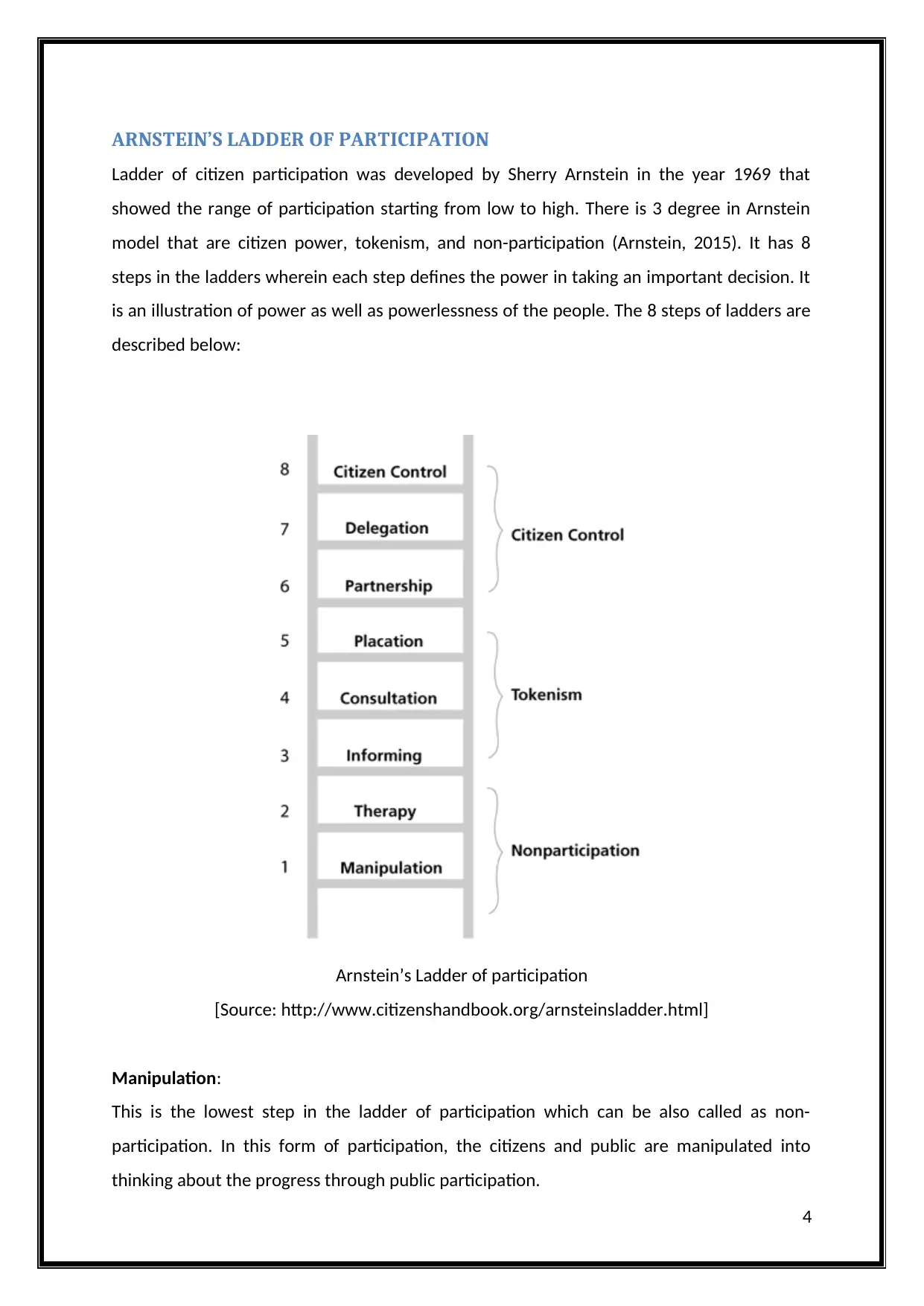
Ladder of citizen participation was developed by Sherry Arnstein in the year 1969 that
showed the range of participation starting from low to high. There is 3 degree in Arnstein
model that are citizen power, tokenism, and non-participation (Arnstein, 2015). It has 8
steps in the ladders wherein each step defines the power in taking an important decision. It
is an illustration of power as well as powerlessness of the people. The 8 steps of ladders are
described below:
Arnstein’s Ladder of participation
[Source: http://www.citizenshandbook.org/arnsteinsladder.html]
Manipulation:
This is the lowest step in the ladder of participation which can be also called as non-
participation. In this form of participation, the citizens and public are manipulated into
thinking about the progress through public participation.
4
Ladder of citizen participation was developed by Sherry Arnstein in the year 1969 that
showed the range of participation starting from low to high. There is 3 degree in Arnstein
model that are citizen power, tokenism, and non-participation (Arnstein, 2015). It has 8
steps in the ladders wherein each step defines the power in taking an important decision. It
is an illustration of power as well as powerlessness of the people. The 8 steps of ladders are
described below:
Arnstein’s Ladder of participation
[Source: http://www.citizenshandbook.org/arnsteinsladder.html]
Manipulation:
This is the lowest step in the ladder of participation which can be also called as non-
participation. In this form of participation, the citizens and public are manipulated into
thinking about the progress through public participation.
4
Paraphrase This Document
Need a fresh take? Get an instant paraphrase of this document with our AI Paraphraser
Therapy:
This is also another non-participative step that aims to educate the participants. Group
therapy is the lowest step on the ladder as it has both dishonest as well as arrogant and is
masked as citizen participation (Michels and De Graaf, 2010).
Informing:
This is the third step in the ladder of participation, which is the first most important step to
legitimate participation. It includes informing the citizen about their rights, options as well
as responsibilities. It includes the one-way flow of information which has no channel of
feedback or negotiation power.
Consultation:
This is another legitimate step used in citizen participation in which most frequent methods
used to consult people are public hearings, attitude survey and neighbourhood meetings. If
the opinions of the people are not considered then it is just window dressing rituals.
Placation:
This is the highest degree of tokenism which allows the selected citizens to advise or plan
but retain the power holders the right to judge the legitimacy of the advice (Arnstein, 2015).
One of the common examples of placation is the participation in Model Cities Advisory as
well as planning committees.
Partnership:
There is an equal distribution of power between the citizens and power holders where they
agree to share their responsibilities in planning as well as decision-making through different
structures such as joint policy boards, planning committees as well as mechanisms in order
to resolve deadlocks (Michels and De Graaf, 2010).
Delegated power:
In this step, the citizens hold the authority of taking a dominant decision over a particular
plan or program because of negotiation between citizens and power holders. Majority of
5
This is also another non-participative step that aims to educate the participants. Group
therapy is the lowest step on the ladder as it has both dishonest as well as arrogant and is
masked as citizen participation (Michels and De Graaf, 2010).
Informing:
This is the third step in the ladder of participation, which is the first most important step to
legitimate participation. It includes informing the citizen about their rights, options as well
as responsibilities. It includes the one-way flow of information which has no channel of
feedback or negotiation power.
Consultation:
This is another legitimate step used in citizen participation in which most frequent methods
used to consult people are public hearings, attitude survey and neighbourhood meetings. If
the opinions of the people are not considered then it is just window dressing rituals.
Placation:
This is the highest degree of tokenism which allows the selected citizens to advise or plan
but retain the power holders the right to judge the legitimacy of the advice (Arnstein, 2015).
One of the common examples of placation is the participation in Model Cities Advisory as
well as planning committees.
Partnership:
There is an equal distribution of power between the citizens and power holders where they
agree to share their responsibilities in planning as well as decision-making through different
structures such as joint policy boards, planning committees as well as mechanisms in order
to resolve deadlocks (Michels and De Graaf, 2010).
Delegated power:
In this step, the citizens hold the authority of taking a dominant decision over a particular
plan or program because of negotiation between citizens and power holders. Majority of
5

the seat in the committee are held by citizens with the delegated power to make decisions
as well as assure accountability of program or plan.
Citizen control: this is the topmost ladder in the citizen participation. This step advocates
the neighbourhood corporation with no intermediaries between them as well as sources of
funds (Arnstein, 2015). The degree of power is demanded by the people in order to govern
the program or an institution.
6
as well as assure accountability of program or plan.
Citizen control: this is the topmost ladder in the citizen participation. This step advocates
the neighbourhood corporation with no intermediaries between them as well as sources of
funds (Arnstein, 2015). The degree of power is demanded by the people in order to govern
the program or an institution.
6
⊘ This is a preview!⊘
Do you want full access?
Subscribe today to unlock all pages.
Trusted by 1+ million students worldwide
INTERRELATION BETWEEN TENANT PARTICIPATION AND LADDER OF
PARTICIPATION
Tenant participation is referred to the range of opportunities in order to share opinions and
views about the housing services. Tenant participation is considered as one of the essential
parts of working of a social housing organization by supporting communities (Suszyńska,
2015). Tenant participation is a two-way process where landlords consider it as value
engagement thereby recognised as an important component to improve the business.
The range of tenant participation is that has different levels starting from operational to
strategic. The interests, availability as well as the capacity of tenants are the basis of their
engagement at all the levels. It is noted that in order to effect delivery of services,
engagement at all level is equally important.
Tenant participation is related to the ladder of participation as it broadly represented as
information, involvement, consultation as well as a partnership (Kassela, et al. 2017). The
informing stage in the ladder of participation is a legitimate step where the tenants are
informed about the housing service with no channel of feedback as the emphasis is on one-
way information flow. Involvement in social housing result in selecting people onto the
committee by allowing them to advise or plan but the rights to judge the feasibility of advice
or plan is retained to the power holders.
Consulting the tenants by asking them to complete the surveys or provide the feedback on
the housing services for housing satisfaction (Ali, et al. 2015). The role of the tenant is
determined when the feedback provided by the tenant is responded by the landlord. Equal
distribution of power is done by negotiation between citizen as well as power holders. Joint
committees of landlords and tenants are formed where planning, as well as decision-making
responsibilities, are mutual.
7
PARTICIPATION
Tenant participation is referred to the range of opportunities in order to share opinions and
views about the housing services. Tenant participation is considered as one of the essential
parts of working of a social housing organization by supporting communities (Suszyńska,
2015). Tenant participation is a two-way process where landlords consider it as value
engagement thereby recognised as an important component to improve the business.
The range of tenant participation is that has different levels starting from operational to
strategic. The interests, availability as well as the capacity of tenants are the basis of their
engagement at all the levels. It is noted that in order to effect delivery of services,
engagement at all level is equally important.
Tenant participation is related to the ladder of participation as it broadly represented as
information, involvement, consultation as well as a partnership (Kassela, et al. 2017). The
informing stage in the ladder of participation is a legitimate step where the tenants are
informed about the housing service with no channel of feedback as the emphasis is on one-
way information flow. Involvement in social housing result in selecting people onto the
committee by allowing them to advise or plan but the rights to judge the feasibility of advice
or plan is retained to the power holders.
Consulting the tenants by asking them to complete the surveys or provide the feedback on
the housing services for housing satisfaction (Ali, et al. 2015). The role of the tenant is
determined when the feedback provided by the tenant is responded by the landlord. Equal
distribution of power is done by negotiation between citizen as well as power holders. Joint
committees of landlords and tenants are formed where planning, as well as decision-making
responsibilities, are mutual.
7
Paraphrase This Document
Need a fresh take? Get an instant paraphrase of this document with our AI Paraphraser
POTENTIAL BENEFITS OF TENANT PARTICIPATION
With effective tenant participation, every member such as tenants, staffs as well as
landlords is benefitted in terms of cost, effort and time. There are various potential benefits
of tenant participation such as providing better services that are improved in terms of value
for money, effective communication between staff and tenants, better connection between
the community as well as landlords, increased tenant satisfaction and also helps in removing
any mistrust (Malpass and Victory, 2010). Due to an increase of tenant participation in
housing organization, some of the major benefits of tenant participation are mentioned
below in management of their housing organization:
Community development: with the increase in the levels of tenant participation, there is
continuous improvement in skills of the tenants as well as improvement in social networks
in estates. There were positive consequences to every individual tenant due to joint working
or control and effective communication process.
Improvement in housing management: increase in tenant participation results in a better
decision due to minimisation of management problems as well as rapid identification of
issues in services delivery. It is viewed that tenant participation leads to improvement in
housing management quality (Rogers, 2011). The government of UK as well as housing
corporations have advocated the increase in tenant involvement in housing management
and have associated with the funding availability.
Greater tenant satisfaction: tenant participation helps in developing tenant satisfaction
through a sense of ownership as well as effective service delivery. It is observed that tenant
satisfaction is related to the quality of services offered as compared to tenant participation
(Manzi, 2010). If the result of tenant participation is satisfactory then only the tenant
participation will increase satisfaction. The outcome of the tenant participation either
increases or decreases the level of tenant satisfaction as there might be improvement or
deterioration in the services.
8
With effective tenant participation, every member such as tenants, staffs as well as
landlords is benefitted in terms of cost, effort and time. There are various potential benefits
of tenant participation such as providing better services that are improved in terms of value
for money, effective communication between staff and tenants, better connection between
the community as well as landlords, increased tenant satisfaction and also helps in removing
any mistrust (Malpass and Victory, 2010). Due to an increase of tenant participation in
housing organization, some of the major benefits of tenant participation are mentioned
below in management of their housing organization:
Community development: with the increase in the levels of tenant participation, there is
continuous improvement in skills of the tenants as well as improvement in social networks
in estates. There were positive consequences to every individual tenant due to joint working
or control and effective communication process.
Improvement in housing management: increase in tenant participation results in a better
decision due to minimisation of management problems as well as rapid identification of
issues in services delivery. It is viewed that tenant participation leads to improvement in
housing management quality (Rogers, 2011). The government of UK as well as housing
corporations have advocated the increase in tenant involvement in housing management
and have associated with the funding availability.
Greater tenant satisfaction: tenant participation helps in developing tenant satisfaction
through a sense of ownership as well as effective service delivery. It is observed that tenant
satisfaction is related to the quality of services offered as compared to tenant participation
(Manzi, 2010). If the result of tenant participation is satisfactory then only the tenant
participation will increase satisfaction. The outcome of the tenant participation either
increases or decreases the level of tenant satisfaction as there might be improvement or
deterioration in the services.
8
Helping councillors as well as board members: useful information can be provided through
tenant participation to local housing committee members as well as housing board
association. This helps them in early identification of issues in an effective manner thus
leading to improved services (Darcy, 2010) . Tenant participation results in open
communication regarding the issues experienced by the organization.
Therefore, it is essential to involve tenants in different levels as well as a variety of ways. It is
observed that involving tenants may be beneficial as it helps in providing quality services, as
well as create a sense of accountability to the tenant as well as local communities and build
social as well as community capacity.
9
tenant participation to local housing committee members as well as housing board
association. This helps them in early identification of issues in an effective manner thus
leading to improved services (Darcy, 2010) . Tenant participation results in open
communication regarding the issues experienced by the organization.
Therefore, it is essential to involve tenants in different levels as well as a variety of ways. It is
observed that involving tenants may be beneficial as it helps in providing quality services, as
well as create a sense of accountability to the tenant as well as local communities and build
social as well as community capacity.
9
⊘ This is a preview!⊘
Do you want full access?
Subscribe today to unlock all pages.
Trusted by 1+ million students worldwide
POTENTIAL DISADVANTAGES OF TENANT PARTICIPATION
There are various disadvantages of tenant participation which can be discussed below:
Lack of resources: in order to have an effective participation, it is essential to get hold of
various resources which may divert the group from its original purpose as well as take a
great deal of time as well as energy.
Lack of skilled support: it is essential for the tenant groups to possess the skills that support
in developing the services in the housing association (Suszyńska, 2015). Without skill, it is
difficult to identify the services and issues that need to be improved as well as resolve
effectively thereby by empowering them.
Internal disagreement: due to an increase of involvement of a large number of tenants, the
possibility of disagreement among them increases. Factionalism is rife amongst tenant
groups (Kassela, et al. 2017). It is essential to select an appropriate number of a tenant by
involving them in the activities of Housing Corporation to avoid its failure.
Loss of independence: the tenants may find that either each tenant or some of the tenants
are included in the structure of landlord which results in loss of independence (Darcy, 2010).
Communication issues: due to the involvement of a large number of tenants, there is an
increase in the issues regarding effective communication (Wiesel, 2014). A large number of
tenant participation leads to misunderstanding and other major issues which may affect the
quality of services due to lack of literacy and poor social as well as personal skills issues to
communicate effectively increases.
Therefore it can be said that excessive tenant participation might not only hamper the
effectiveness of current services but also affect the future improvement in the housing
services.
10
There are various disadvantages of tenant participation which can be discussed below:
Lack of resources: in order to have an effective participation, it is essential to get hold of
various resources which may divert the group from its original purpose as well as take a
great deal of time as well as energy.
Lack of skilled support: it is essential for the tenant groups to possess the skills that support
in developing the services in the housing association (Suszyńska, 2015). Without skill, it is
difficult to identify the services and issues that need to be improved as well as resolve
effectively thereby by empowering them.
Internal disagreement: due to an increase of involvement of a large number of tenants, the
possibility of disagreement among them increases. Factionalism is rife amongst tenant
groups (Kassela, et al. 2017). It is essential to select an appropriate number of a tenant by
involving them in the activities of Housing Corporation to avoid its failure.
Loss of independence: the tenants may find that either each tenant or some of the tenants
are included in the structure of landlord which results in loss of independence (Darcy, 2010).
Communication issues: due to the involvement of a large number of tenants, there is an
increase in the issues regarding effective communication (Wiesel, 2014). A large number of
tenant participation leads to misunderstanding and other major issues which may affect the
quality of services due to lack of literacy and poor social as well as personal skills issues to
communicate effectively increases.
Therefore it can be said that excessive tenant participation might not only hamper the
effectiveness of current services but also affect the future improvement in the housing
services.
10
Paraphrase This Document
Need a fresh take? Get an instant paraphrase of this document with our AI Paraphraser

CONCLUSION
Thus it can be concluded that tenant participation can be connected with the Arnstein’s
ladder of participation which will be helpful in deciding the degree of tenant participation.
Also, it is essential to balance the tenant participation in order to deliver effective and
quality housing services.
11
Thus it can be concluded that tenant participation can be connected with the Arnstein’s
ladder of participation which will be helpful in deciding the degree of tenant participation.
Also, it is essential to balance the tenant participation in order to deliver effective and
quality housing services.
11
PART 2
INTRODUCTION
This report is presented to the management board at Goldacre Housing Association. This
report includes the dissatisfaction of residents due to inappropriate addressing of anti-social
behaviours as well as empty and boarded flats attracting vandalism and sabotage. It also
includes the two elements in managing housing services. This report includes the SMART
plan in order to improve the services. Anti-social behaviour is referred to the conduct that
causes distress or annoyance to the local people, neighbours, employees as well as
contractors (Innes and Weston, 2010). This also includes the actions done by the tenant,
children, partner, or pets or anyone visiting the property.
12
INTRODUCTION
This report is presented to the management board at Goldacre Housing Association. This
report includes the dissatisfaction of residents due to inappropriate addressing of anti-social
behaviours as well as empty and boarded flats attracting vandalism and sabotage. It also
includes the two elements in managing housing services. This report includes the SMART
plan in order to improve the services. Anti-social behaviour is referred to the conduct that
causes distress or annoyance to the local people, neighbours, employees as well as
contractors (Innes and Weston, 2010). This also includes the actions done by the tenant,
children, partner, or pets or anyone visiting the property.
12
⊘ This is a preview!⊘
Do you want full access?
Subscribe today to unlock all pages.
Trusted by 1+ million students worldwide

1 out of 20


Related Documents


Your All-in-One AI-Powered Toolkit for Academic Success.
+13062052269
info@desklib.com
Available 24*7 on WhatsApp / Email
![[object Object]](/_next/static/media/star-bottom.7253800d.svg)
Unlock your academic potential
Copyright © 2020–2026 A2Z Services. All Rights Reserved. Developed and managed by ZUCOL.