HSE113 - AT2: The Impact of Exercises on Ageing and Associated Aspects
VerifiedAdded on 2022/11/27
|6
|2084
|172
Report
AI Summary
This report, prepared for HSE113, analyzes the impact of exercise on ageing, drawing from a video case study of an older adult. It examines the effects of ageing on physiological, cognitive, and physical aspects, including decline in strength, balance, and cognitive functions like attention and memory. The report then discusses the positive influence of an 8-month exercise program on the client's quality of life, improving dynamic balance, strength, and physical function. It details the type of exercises used, including weight-bearing activities and resistance exercises, and assesses their appropriateness for older adults, referencing WHO guidelines for physical activity. Furthermore, the report addresses osteoporosis, its causes, and the role of exercise in prevention and management, recommending weight-bearing and resistance exercises while cautioning against certain high-impact activities. The report concludes by emphasizing the importance of tailored exercise programs for older adults to enhance their health and well-being.
HSE113 - AT2 Student Number: xxxxxxx
Impact of Exercises on Ageing and Associated Aspects
Student Name:
Student Number:
Seminar group (day/time/tutor name):
Campus:
Date of completion:
Word Count: 1453
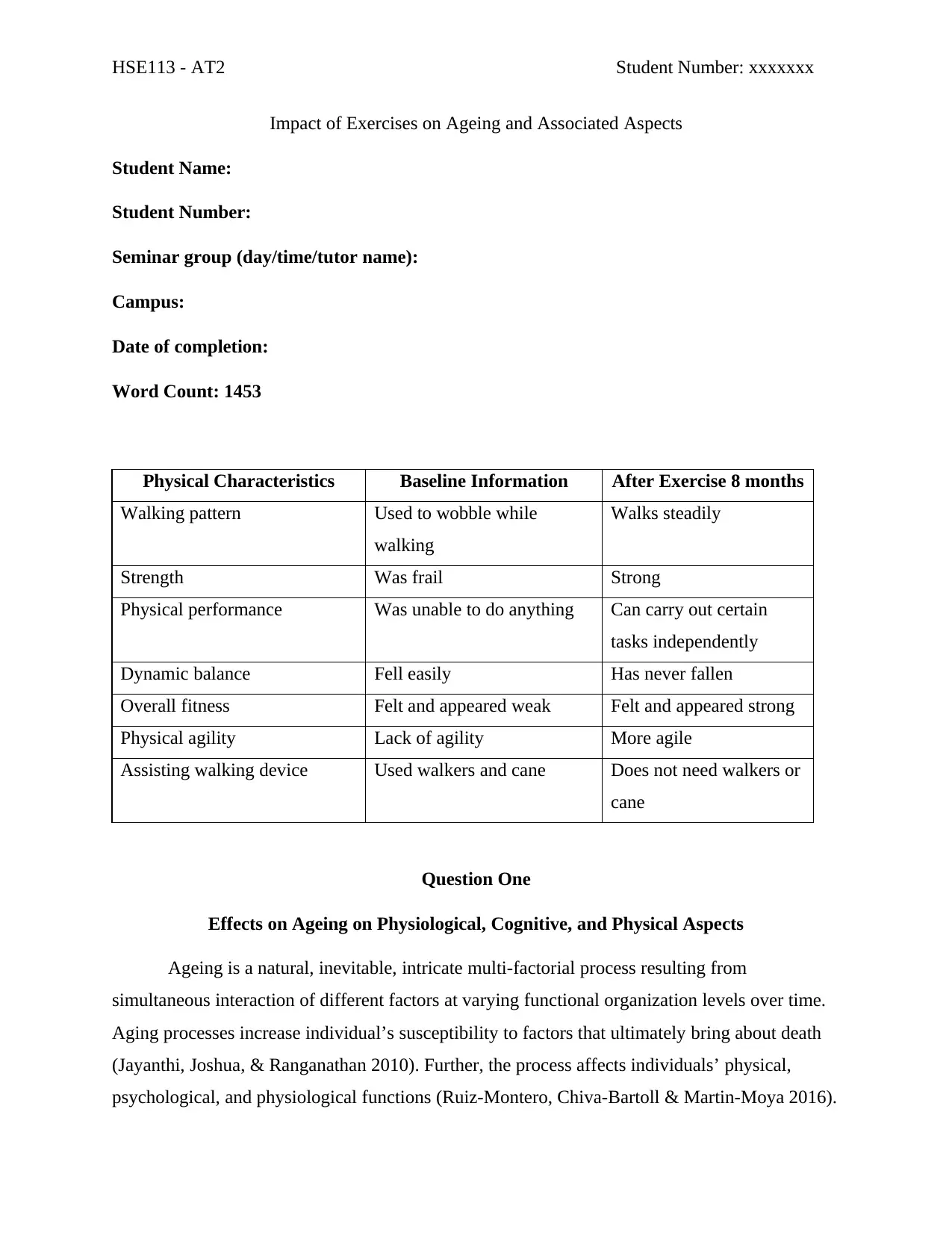
Physical Characteristics Baseline Information After Exercise 8 months
Walking pattern Used to wobble while
walking
Walks steadily
Strength Was frail Strong
Physical performance Was unable to do anything Can carry out certain
tasks independently
Dynamic balance Fell easily Has never fallen
Overall fitness Felt and appeared weak Felt and appeared strong
Physical agility Lack of agility More agile
Assisting walking device Used walkers and cane Does not need walkers or
cane
Question One
Effects on Ageing on Physiological, Cognitive, and Physical Aspects
Ageing is a natural, inevitable, intricate multi-factorial process resulting from
simultaneous interaction of different factors at varying functional organization levels over time.
Aging processes increase individual’s susceptibility to factors that ultimately bring about death
(Jayanthi, Joshua, & Ranganathan 2010). Further, the process affects individuals’ physical,
psychological, and physiological functions (Ruiz-Montero, Chiva-Bartoll & Martin-Moya 2016).
Impact of Exercises on Ageing and Associated Aspects
Student Name:
Student Number:
Seminar group (day/time/tutor name):
Campus:
Date of completion:
Word Count: 1453
Physical Characteristics Baseline Information After Exercise 8 months
Walking pattern Used to wobble while
walking
Walks steadily
Strength Was frail Strong
Physical performance Was unable to do anything Can carry out certain
tasks independently
Dynamic balance Fell easily Has never fallen
Overall fitness Felt and appeared weak Felt and appeared strong
Physical agility Lack of agility More agile
Assisting walking device Used walkers and cane Does not need walkers or
cane
Question One
Effects on Ageing on Physiological, Cognitive, and Physical Aspects
Ageing is a natural, inevitable, intricate multi-factorial process resulting from
simultaneous interaction of different factors at varying functional organization levels over time.
Aging processes increase individual’s susceptibility to factors that ultimately bring about death
(Jayanthi, Joshua, & Ranganathan 2010). Further, the process affects individuals’ physical,
psychological, and physiological functions (Ruiz-Montero, Chiva-Bartoll & Martin-Moya 2016).

Paraphrase This Document
Need a fresh take? Get an instant paraphrase of this document with our AI Paraphraser
HSE113 - AT2 Student Number: xxxxxxx
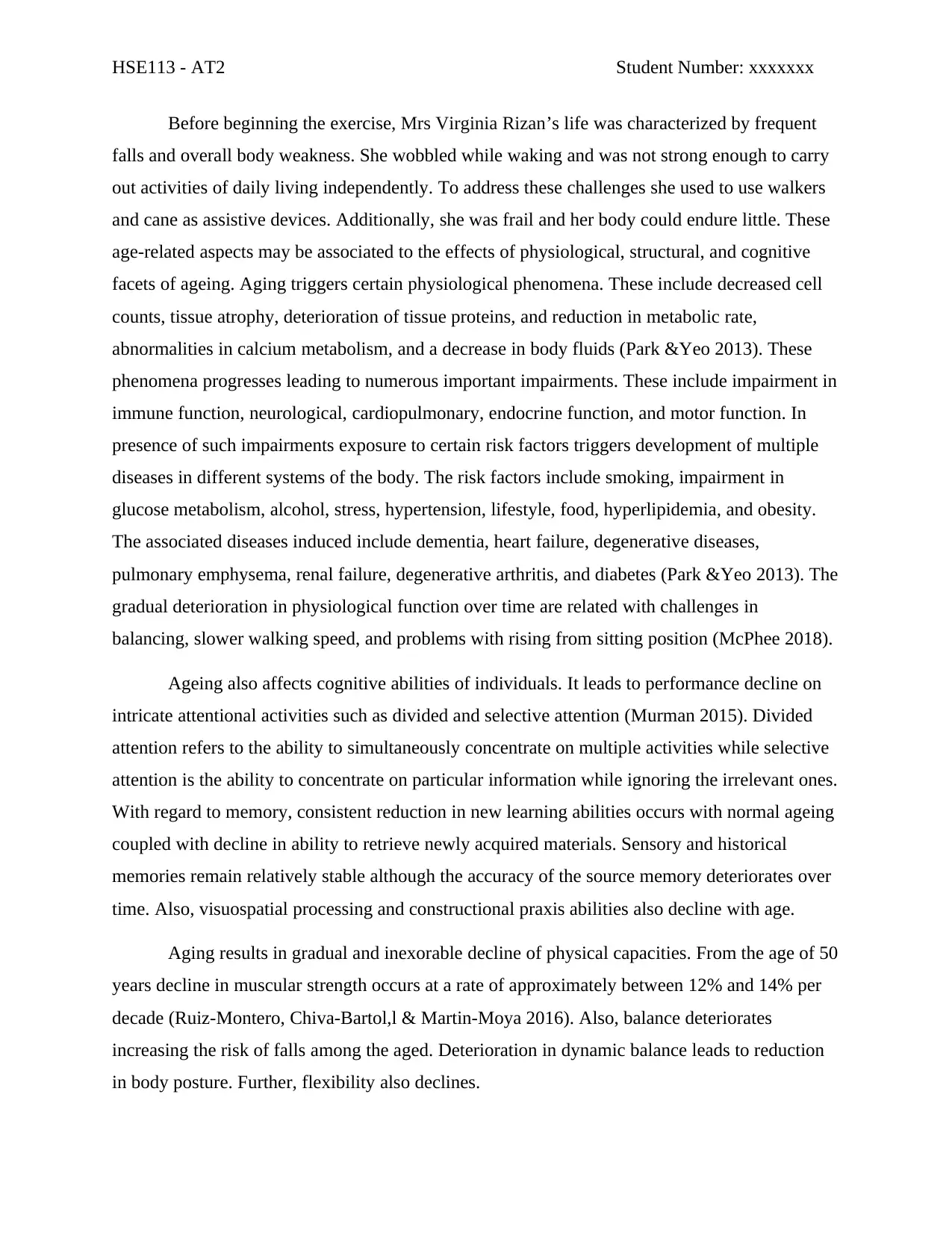
Before beginning the exercise, Mrs Virginia Rizan’s life was characterized by frequent
falls and overall body weakness. She wobbled while waking and was not strong enough to carry
out activities of daily living independently. To address these challenges she used to use walkers
and cane as assistive devices. Additionally, she was frail and her body could endure little. These
age-related aspects may be associated to the effects of physiological, structural, and cognitive
facets of ageing. Aging triggers certain physiological phenomena. These include decreased cell
counts, tissue atrophy, deterioration of tissue proteins, and reduction in metabolic rate,
abnormalities in calcium metabolism, and a decrease in body fluids (Park &Yeo 2013). These
phenomena progresses leading to numerous important impairments. These include impairment in
immune function, neurological, cardiopulmonary, endocrine function, and motor function. In
presence of such impairments exposure to certain risk factors triggers development of multiple
diseases in different systems of the body. The risk factors include smoking, impairment in
glucose metabolism, alcohol, stress, hypertension, lifestyle, food, hyperlipidemia, and obesity.
The associated diseases induced include dementia, heart failure, degenerative diseases,
pulmonary emphysema, renal failure, degenerative arthritis, and diabetes (Park &Yeo 2013). The
gradual deterioration in physiological function over time are related with challenges in
balancing, slower walking speed, and problems with rising from sitting position (McPhee 2018).
Ageing also affects cognitive abilities of individuals. It leads to performance decline on
intricate attentional activities such as divided and selective attention (Murman 2015). Divided
attention refers to the ability to simultaneously concentrate on multiple activities while selective
attention is the ability to concentrate on particular information while ignoring the irrelevant ones.
With regard to memory, consistent reduction in new learning abilities occurs with normal ageing
coupled with decline in ability to retrieve newly acquired materials. Sensory and historical
memories remain relatively stable although the accuracy of the source memory deteriorates over
time. Also, visuospatial processing and constructional praxis abilities also decline with age.
Aging results in gradual and inexorable decline of physical capacities. From the age of 50
years decline in muscular strength occurs at a rate of approximately between 12% and 14% per
decade (Ruiz-Montero, Chiva-Bartol,l & Martin-Moya 2016). Also, balance deteriorates
increasing the risk of falls among the aged. Deterioration in dynamic balance leads to reduction
in body posture. Further, flexibility also declines.
Before beginning the exercise, Mrs Virginia Rizan’s life was characterized by frequent
falls and overall body weakness. She wobbled while waking and was not strong enough to carry
out activities of daily living independently. To address these challenges she used to use walkers
and cane as assistive devices. Additionally, she was frail and her body could endure little. These
age-related aspects may be associated to the effects of physiological, structural, and cognitive
facets of ageing. Aging triggers certain physiological phenomena. These include decreased cell
counts, tissue atrophy, deterioration of tissue proteins, and reduction in metabolic rate,
abnormalities in calcium metabolism, and a decrease in body fluids (Park &Yeo 2013). These
phenomena progresses leading to numerous important impairments. These include impairment in
immune function, neurological, cardiopulmonary, endocrine function, and motor function. In
presence of such impairments exposure to certain risk factors triggers development of multiple
diseases in different systems of the body. The risk factors include smoking, impairment in
glucose metabolism, alcohol, stress, hypertension, lifestyle, food, hyperlipidemia, and obesity.
The associated diseases induced include dementia, heart failure, degenerative diseases,
pulmonary emphysema, renal failure, degenerative arthritis, and diabetes (Park &Yeo 2013). The
gradual deterioration in physiological function over time are related with challenges in
balancing, slower walking speed, and problems with rising from sitting position (McPhee 2018).
Ageing also affects cognitive abilities of individuals. It leads to performance decline on
intricate attentional activities such as divided and selective attention (Murman 2015). Divided
attention refers to the ability to simultaneously concentrate on multiple activities while selective
attention is the ability to concentrate on particular information while ignoring the irrelevant ones.
With regard to memory, consistent reduction in new learning abilities occurs with normal ageing
coupled with decline in ability to retrieve newly acquired materials. Sensory and historical
memories remain relatively stable although the accuracy of the source memory deteriorates over
time. Also, visuospatial processing and constructional praxis abilities also decline with age.
Aging results in gradual and inexorable decline of physical capacities. From the age of 50
years decline in muscular strength occurs at a rate of approximately between 12% and 14% per
decade (Ruiz-Montero, Chiva-Bartol,l & Martin-Moya 2016). Also, balance deteriorates
increasing the risk of falls among the aged. Deterioration in dynamic balance leads to reduction
in body posture. Further, flexibility also declines.
HSE113 - AT2 Student Number: xxxxxxx
Question Two
Impacts of Exercise on Aspects Associated with Aging
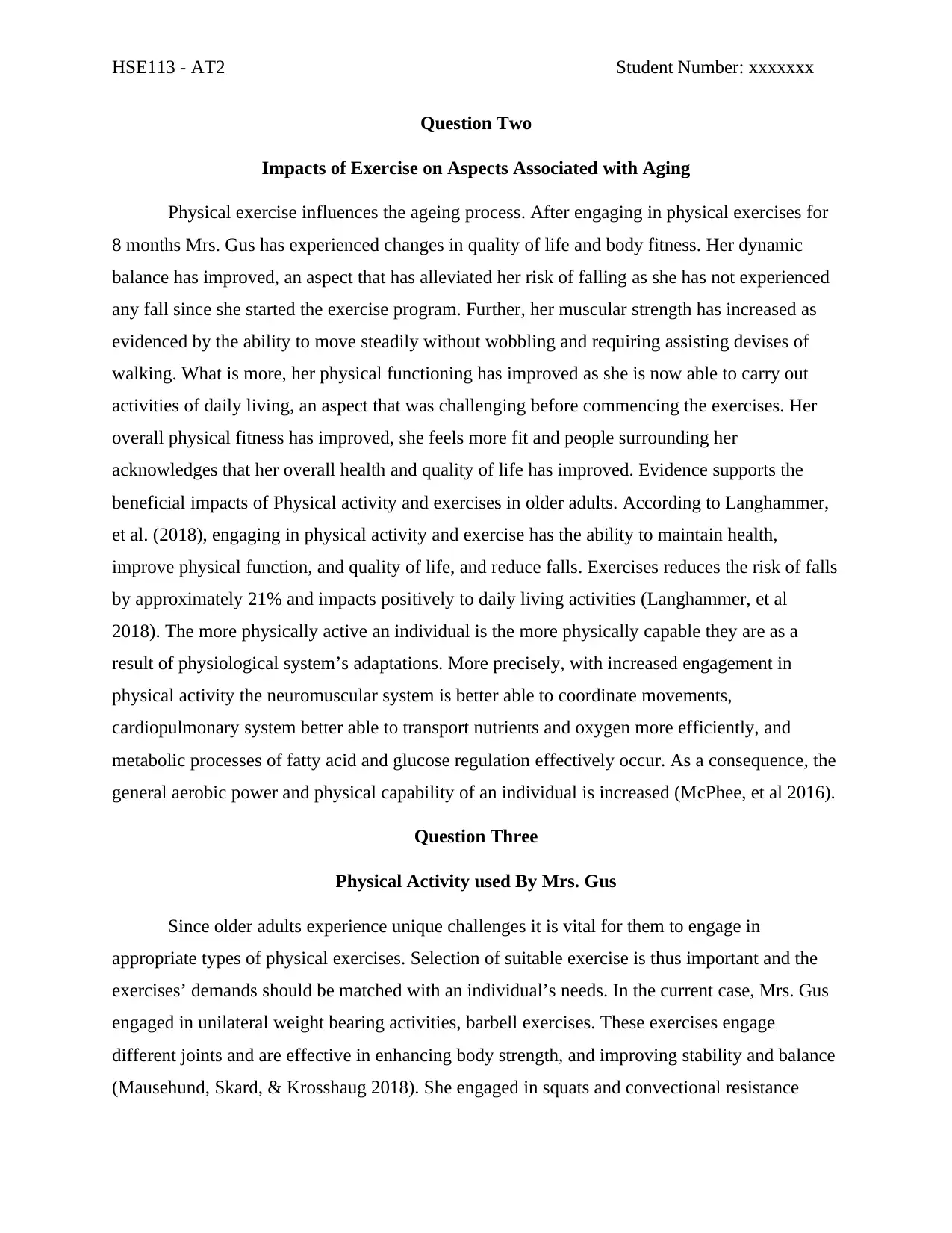
Physical exercise influences the ageing process. After engaging in physical exercises for
8 months Mrs. Gus has experienced changes in quality of life and body fitness. Her dynamic
balance has improved, an aspect that has alleviated her risk of falling as she has not experienced
any fall since she started the exercise program. Further, her muscular strength has increased as
evidenced by the ability to move steadily without wobbling and requiring assisting devises of
walking. What is more, her physical functioning has improved as she is now able to carry out
activities of daily living, an aspect that was challenging before commencing the exercises. Her
overall physical fitness has improved, she feels more fit and people surrounding her
acknowledges that her overall health and quality of life has improved. Evidence supports the
beneficial impacts of Physical activity and exercises in older adults. According to Langhammer,
et al. (2018), engaging in physical activity and exercise has the ability to maintain health,
improve physical function, and quality of life, and reduce falls. Exercises reduces the risk of falls
by approximately 21% and impacts positively to daily living activities (Langhammer, et al
2018). The more physically active an individual is the more physically capable they are as a
result of physiological system’s adaptations. More precisely, with increased engagement in
physical activity the neuromuscular system is better able to coordinate movements,
cardiopulmonary system better able to transport nutrients and oxygen more efficiently, and
metabolic processes of fatty acid and glucose regulation effectively occur. As a consequence, the
general aerobic power and physical capability of an individual is increased (McPhee, et al 2016).
Question Three
Physical Activity used By Mrs. Gus
Since older adults experience unique challenges it is vital for them to engage in
appropriate types of physical exercises. Selection of suitable exercise is thus important and the
exercises’ demands should be matched with an individual’s needs. In the current case, Mrs. Gus
engaged in unilateral weight bearing activities, barbell exercises. These exercises engage
different joints and are effective in enhancing body strength, and improving stability and balance
(Mausehund, Skard, & Krosshaug 2018). She engaged in squats and convectional resistance
Question Two
Impacts of Exercise on Aspects Associated with Aging
Physical exercise influences the ageing process. After engaging in physical exercises for
8 months Mrs. Gus has experienced changes in quality of life and body fitness. Her dynamic
balance has improved, an aspect that has alleviated her risk of falling as she has not experienced
any fall since she started the exercise program. Further, her muscular strength has increased as
evidenced by the ability to move steadily without wobbling and requiring assisting devises of
walking. What is more, her physical functioning has improved as she is now able to carry out
activities of daily living, an aspect that was challenging before commencing the exercises. Her
overall physical fitness has improved, she feels more fit and people surrounding her
acknowledges that her overall health and quality of life has improved. Evidence supports the
beneficial impacts of Physical activity and exercises in older adults. According to Langhammer,
et al. (2018), engaging in physical activity and exercise has the ability to maintain health,
improve physical function, and quality of life, and reduce falls. Exercises reduces the risk of falls
by approximately 21% and impacts positively to daily living activities (Langhammer, et al
2018). The more physically active an individual is the more physically capable they are as a
result of physiological system’s adaptations. More precisely, with increased engagement in
physical activity the neuromuscular system is better able to coordinate movements,
cardiopulmonary system better able to transport nutrients and oxygen more efficiently, and
metabolic processes of fatty acid and glucose regulation effectively occur. As a consequence, the
general aerobic power and physical capability of an individual is increased (McPhee, et al 2016).
Question Three
Physical Activity used By Mrs. Gus
Since older adults experience unique challenges it is vital for them to engage in
appropriate types of physical exercises. Selection of suitable exercise is thus important and the
exercises’ demands should be matched with an individual’s needs. In the current case, Mrs. Gus
engaged in unilateral weight bearing activities, barbell exercises. These exercises engage
different joints and are effective in enhancing body strength, and improving stability and balance
(Mausehund, Skard, & Krosshaug 2018). She engaged in squats and convectional resistance
⊘ This is a preview!⊘
Do you want full access?
Subscribe today to unlock all pages.

Trusted by 1+ million students worldwide
HSE113 - AT2 Student Number: xxxxxxx
exercises where she performs leg presses, standing barbell presses, barbell bench press, lat
pulldowns, and partial barbell deadlifts. There are three types of exercises appropriate for older
adults, namely strength and aerobic fitness, balance exercises, and incidental physical activity
(Taylor 2014). Therefore, the associated improvement in health and body fitness of Mrs. Gus can
be associated with engagement in appropriate type of physical activities.
Physical Activity Recommendations
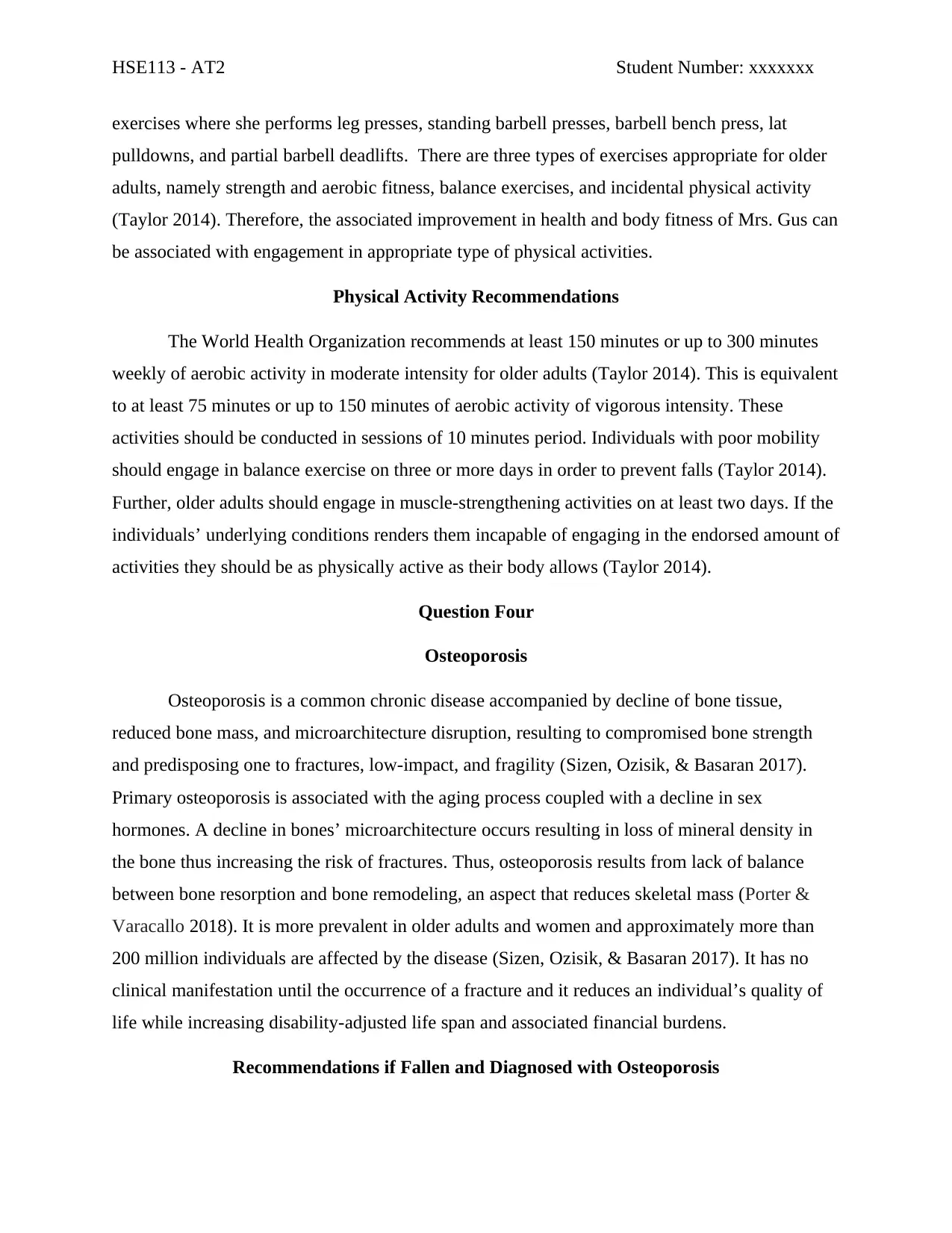
The World Health Organization recommends at least 150 minutes or up to 300 minutes
weekly of aerobic activity in moderate intensity for older adults (Taylor 2014). This is equivalent
to at least 75 minutes or up to 150 minutes of aerobic activity of vigorous intensity. These
activities should be conducted in sessions of 10 minutes period. Individuals with poor mobility
should engage in balance exercise on three or more days in order to prevent falls (Taylor 2014).
Further, older adults should engage in muscle-strengthening activities on at least two days. If the
individuals’ underlying conditions renders them incapable of engaging in the endorsed amount of
activities they should be as physically active as their body allows (Taylor 2014).
Question Four
Osteoporosis
Osteoporosis is a common chronic disease accompanied by decline of bone tissue,
reduced bone mass, and microarchitecture disruption, resulting to compromised bone strength
and predisposing one to fractures, low-impact, and fragility (Sizen, Ozisik, & Basaran 2017).
Primary osteoporosis is associated with the aging process coupled with a decline in sex
hormones. A decline in bones’ microarchitecture occurs resulting in loss of mineral density in
the bone thus increasing the risk of fractures. Thus, osteoporosis results from lack of balance
between bone resorption and bone remodeling, an aspect that reduces skeletal mass (Porter &
Varacallo 2018). It is more prevalent in older adults and women and approximately more than
200 million individuals are affected by the disease (Sizen, Ozisik, & Basaran 2017). It has no
clinical manifestation until the occurrence of a fracture and it reduces an individual’s quality of
life while increasing disability-adjusted life span and associated financial burdens.
Recommendations if Fallen and Diagnosed with Osteoporosis
exercises where she performs leg presses, standing barbell presses, barbell bench press, lat
pulldowns, and partial barbell deadlifts. There are three types of exercises appropriate for older
adults, namely strength and aerobic fitness, balance exercises, and incidental physical activity
(Taylor 2014). Therefore, the associated improvement in health and body fitness of Mrs. Gus can
be associated with engagement in appropriate type of physical activities.
Physical Activity Recommendations
The World Health Organization recommends at least 150 minutes or up to 300 minutes
weekly of aerobic activity in moderate intensity for older adults (Taylor 2014). This is equivalent
to at least 75 minutes or up to 150 minutes of aerobic activity of vigorous intensity. These
activities should be conducted in sessions of 10 minutes period. Individuals with poor mobility
should engage in balance exercise on three or more days in order to prevent falls (Taylor 2014).
Further, older adults should engage in muscle-strengthening activities on at least two days. If the
individuals’ underlying conditions renders them incapable of engaging in the endorsed amount of
activities they should be as physically active as their body allows (Taylor 2014).
Question Four
Osteoporosis
Osteoporosis is a common chronic disease accompanied by decline of bone tissue,
reduced bone mass, and microarchitecture disruption, resulting to compromised bone strength
and predisposing one to fractures, low-impact, and fragility (Sizen, Ozisik, & Basaran 2017).
Primary osteoporosis is associated with the aging process coupled with a decline in sex
hormones. A decline in bones’ microarchitecture occurs resulting in loss of mineral density in
the bone thus increasing the risk of fractures. Thus, osteoporosis results from lack of balance
between bone resorption and bone remodeling, an aspect that reduces skeletal mass (Porter &
Varacallo 2018). It is more prevalent in older adults and women and approximately more than
200 million individuals are affected by the disease (Sizen, Ozisik, & Basaran 2017). It has no
clinical manifestation until the occurrence of a fracture and it reduces an individual’s quality of
life while increasing disability-adjusted life span and associated financial burdens.
Recommendations if Fallen and Diagnosed with Osteoporosis
Paraphrase This Document
Need a fresh take? Get an instant paraphrase of this document with our AI Paraphraser
HSE113 - AT2 Student Number: xxxxxxx
Exercise plays a fundamental role in maintenance and building of bone strength.
Exercises are a preventive strategy for decreasing the risk of osteoporosis. For individuals
diagnosed with osteoporosis, two types of therapeutic exercises are known, namely, weight-
bearing aerobic activities and resistance or strength end exercises. Weight-bearing aerobic
exercises include impact activities in which feet, legs, and arms carry the weight. Such include
climbing the stairs, walking, jogging, and engaging in sports such as volleyball. On the other
hand, resistance or strength exercises are those in which joint are moved against certain types of
resistance. Recommendations require older adults to be involved in multi-component program
entailing resistance training coupled with balance training. Additionally, individuals with
osteoporosis should not involve in aerobic training with the exception of balance and resistance
training as certain types of activities may exert strong force on weak bones (Giangregorio, et al
2014). This is because for osteoporosis patients that exercise program should particularly target
coordination, posture, balance, gait, and hip and trunk stabilization. Dynamic abdominal
exercises such as extreme trunk flexion and sit-ups and twisting movements may lead to
vertebral crush fractures. Additionally, activities that involve high-impact and explosive or
abrupt loading are contraindicated. For the older adults with osteoporosis certain daily activities
like bending should also be avoided as they can cause vertebral fracture.
Exercise plays a fundamental role in maintenance and building of bone strength.
Exercises are a preventive strategy for decreasing the risk of osteoporosis. For individuals
diagnosed with osteoporosis, two types of therapeutic exercises are known, namely, weight-
bearing aerobic activities and resistance or strength end exercises. Weight-bearing aerobic
exercises include impact activities in which feet, legs, and arms carry the weight. Such include
climbing the stairs, walking, jogging, and engaging in sports such as volleyball. On the other
hand, resistance or strength exercises are those in which joint are moved against certain types of
resistance. Recommendations require older adults to be involved in multi-component program
entailing resistance training coupled with balance training. Additionally, individuals with
osteoporosis should not involve in aerobic training with the exception of balance and resistance
training as certain types of activities may exert strong force on weak bones (Giangregorio, et al
2014). This is because for osteoporosis patients that exercise program should particularly target
coordination, posture, balance, gait, and hip and trunk stabilization. Dynamic abdominal
exercises such as extreme trunk flexion and sit-ups and twisting movements may lead to
vertebral crush fractures. Additionally, activities that involve high-impact and explosive or
abrupt loading are contraindicated. For the older adults with osteoporosis certain daily activities
like bending should also be avoided as they can cause vertebral fracture.
HSE113 - AT2 Student Number: xxxxxxx
Reference List
Jayanthi P, Joshua E & Ranganathan K 2010, ‘Ageing and its implications.’ J Oral Maxillofac
Pathol. 14(2), pp. 48-51.
Park DC & Yeo SG 2013, ‘Aging.’ Korean J Audiol. 17(2), pp. 39-44.
Ruiz-Montero PJ, Chiva-Bartoll O & Martín-Moya R 2016, ‘Effects of ageing in physical
fitness.’ Occup Med Health Aff 4:241.
Langhammer, B, Bergland, A, &Rydwik, E 2018, ‘The importance of physical activity exercise
among older adults.’ Biomed Research international. 2018, article id 7856823
Taylor, D 2014, ‘Physical activity is medicine for older adults.’ Post Graduate Medicine
Journal. 90, pp. 26-32.
McPhee JS, French DP, Jackson D, Nazroo J, Pendleton N& Degens H 2016, ‘Physical activity
in older age: perspectives for healthy ageing and frailty.’ Biogerontology. 17(3), pp. 567-80.
Mausehund, L, Skard, AE & Krosshaug, T 2018, ‘Muscle activation in unilateral barbell
excercises: Implications for strength training and rehabilitation.’ Journal of Strength and
Conditioing Research. 00(00), pp. 1-10.
Sözen T, Özışık L& Başaran NÇ 2027, ‘An overview and management of osteoporosis.’ Eur J
Rheumatol. 4(1), pp. 46-56.
Giangregorio LM, Papaioannou A, Macintyre NJ, Ashe MC, Heinonen A, Shipp K, Wark J,
McGill S, Keller H, Jain R, Laprade J & Cheung AM 2014, ‘Too Fit To Fracture: exercise
recommendations for individuals with osteoporosis or osteoporotic vertebral
fracture.’ Osteoporos Int. 125(3), pp. 821-35.
Murman DL 2015, ‘The Impact of Age on Cognition.’ Semin Hear. 36(3), pp. 111-121.
Porter JL& Varacallo M 2018, Osteoporosis. Treasure Island (FL): StatPearls
Publishing Available from: https://www.ncbi.nlm.nih.gov/books/NBK441901/
Reference List
Jayanthi P, Joshua E & Ranganathan K 2010, ‘Ageing and its implications.’ J Oral Maxillofac
Pathol. 14(2), pp. 48-51.
Park DC & Yeo SG 2013, ‘Aging.’ Korean J Audiol. 17(2), pp. 39-44.
Ruiz-Montero PJ, Chiva-Bartoll O & Martín-Moya R 2016, ‘Effects of ageing in physical
fitness.’ Occup Med Health Aff 4:241.
Langhammer, B, Bergland, A, &Rydwik, E 2018, ‘The importance of physical activity exercise
among older adults.’ Biomed Research international. 2018, article id 7856823
Taylor, D 2014, ‘Physical activity is medicine for older adults.’ Post Graduate Medicine
Journal. 90, pp. 26-32.
McPhee JS, French DP, Jackson D, Nazroo J, Pendleton N& Degens H 2016, ‘Physical activity
in older age: perspectives for healthy ageing and frailty.’ Biogerontology. 17(3), pp. 567-80.
Mausehund, L, Skard, AE & Krosshaug, T 2018, ‘Muscle activation in unilateral barbell
excercises: Implications for strength training and rehabilitation.’ Journal of Strength and
Conditioing Research. 00(00), pp. 1-10.
Sözen T, Özışık L& Başaran NÇ 2027, ‘An overview and management of osteoporosis.’ Eur J
Rheumatol. 4(1), pp. 46-56.
Giangregorio LM, Papaioannou A, Macintyre NJ, Ashe MC, Heinonen A, Shipp K, Wark J,
McGill S, Keller H, Jain R, Laprade J & Cheung AM 2014, ‘Too Fit To Fracture: exercise
recommendations for individuals with osteoporosis or osteoporotic vertebral
fracture.’ Osteoporos Int. 125(3), pp. 821-35.
Murman DL 2015, ‘The Impact of Age on Cognition.’ Semin Hear. 36(3), pp. 111-121.
Porter JL& Varacallo M 2018, Osteoporosis. Treasure Island (FL): StatPearls
Publishing Available from: https://www.ncbi.nlm.nih.gov/books/NBK441901/
⊘ This is a preview!⊘
Do you want full access?
Subscribe today to unlock all pages.
Trusted by 1+ million students worldwide

1 out of 6


Your All-in-One AI-Powered Toolkit for Academic Success.
+13062052269
info@desklib.com
Available 24*7 on WhatsApp / Email
![[object Object]](/_next/static/media/star-bottom.7253800d.svg)
Unlock your academic potential
Copyright © 2020–2026 A2Z Services. All Rights Reserved. Developed and managed by ZUCOL.