Analysis of Human Development in Social Context: Report

Verified

Added on  2020/04/01

|4
|468
|396
Report
AI Summary
This report delves into the realm of human development within the context of social interactions and environments. It primarily focuses on the concept of self-concept, exploring how individual perceptions and understanding of themselves are shaped by societal influences and interpersonal relationships. The report emphasizes the reflexive nature of self-concept, highlighting the role of interactions and the broader social landscape in shaping an individual's moral, spiritual, social, and physical self. It examines the interplay between personal beliefs, societal policies, and relationships, illustrating how these elements collectively contribute to the formation and evolution of self-concept. The report also incorporates relevant psychological theories such as social psychological theory, Rokeach’s value theory, and attribution theory to analyze the dynamics of self-esteem, self-enhancement, and behavioral changes. The report underscores the importance of understanding these theories and their practical implications for personal growth and development within society. This report aims to provide a comprehensive understanding of how individuals navigate their social environments and how these environments impact their sense of self.
Document Page
Running head: HUMAN DEVELOPMENT IN SOCIAL CONTEXT
Human development in social context
Name of the Student:
Name of the University:
Author note:
tabler-icon-diamond-filled.svg

Paraphrase This Document

Need a fresh take? Get an instant paraphrase of this document with our AI Paraphraser
Document Page
1HUMAN DEVELOPMENT IN SOCIAL CONTEXT
Reflection
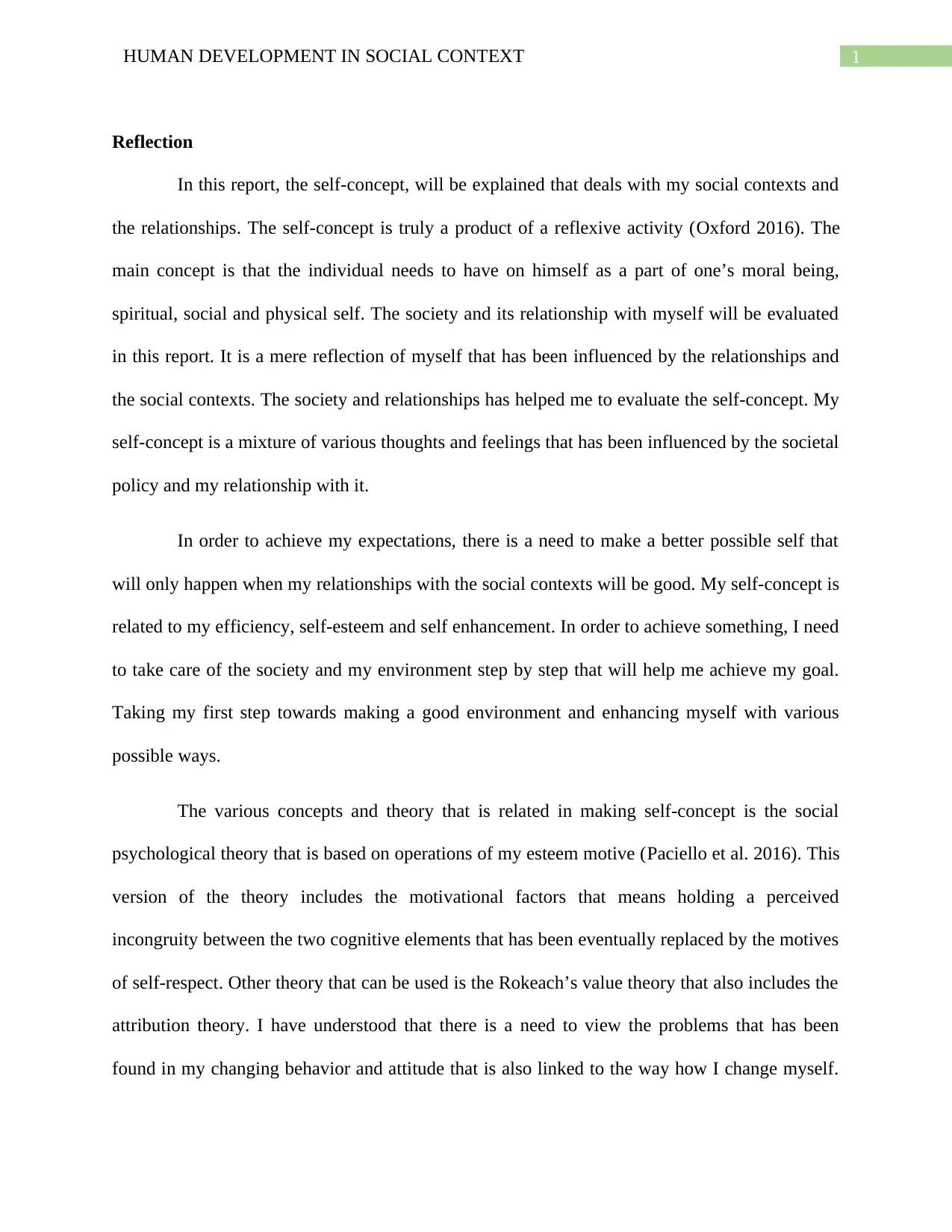
In this report, the self-concept, will be explained that deals with my social contexts and
the relationships. The self-concept is truly a product of a reflexive activity (Oxford 2016). The
main concept is that the individual needs to have on himself as a part of one’s moral being,
spiritual, social and physical self. The society and its relationship with myself will be evaluated
in this report. It is a mere reflection of myself that has been influenced by the relationships and
the social contexts. The society and relationships has helped me to evaluate the self-concept. My
self-concept is a mixture of various thoughts and feelings that has been influenced by the societal
policy and my relationship with it.
In order to achieve my expectations, there is a need to make a better possible self that
will only happen when my relationships with the social contexts will be good. My self-concept is
related to my efficiency, self-esteem and self enhancement. In order to achieve something, I need
to take care of the society and my environment step by step that will help me achieve my goal.
Taking my first step towards making a good environment and enhancing myself with various
possible ways.
The various concepts and theory that is related in making self-concept is the social
psychological theory that is based on operations of my esteem motive (Paciello et al. 2016). This
version of the theory includes the motivational factors that means holding a perceived
incongruity between the two cognitive elements that has been eventually replaced by the motives
of self-respect. Other theory that can be used is the Rokeach’s value theory that also includes the
attribution theory. I have understood that there is a need to view the problems that has been
found in my changing behavior and attitude that is also linked to the way how I change myself.
Document Page
2HUMAN DEVELOPMENT IN SOCIAL CONTEXT
The discrepancy in this theory is quite motivating to me that helps me to find out my self
enhancement and maintenance.
Document Page
3HUMAN DEVELOPMENT IN SOCIAL CONTEXT
References
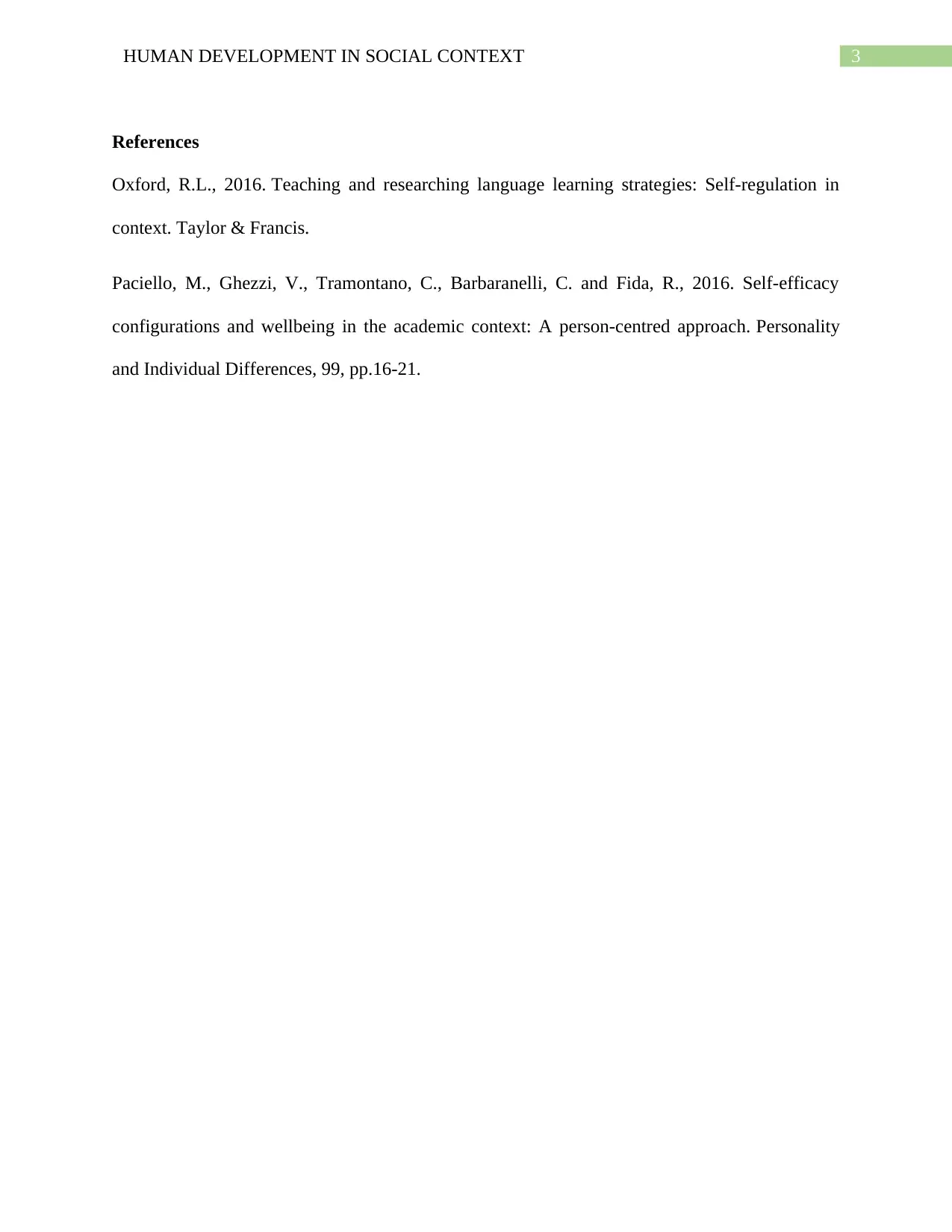
Oxford, R.L., 2016. Teaching and researching language learning strategies: Self-regulation in
context. Taylor & Francis.
Paciello, M., Ghezzi, V., Tramontano, C., Barbaranelli, C. and Fida, R., 2016. Self-efficacy
configurations and wellbeing in the academic context: A person-centred approach. Personality
and Individual Differences, 99, pp.16-21.
chevron_up_icon
1 out of 4
circle_padding
hide_on_mobile
zoom_out_icon
[object Object]