Sleep Quality Study: Literature Review, Analysis, and Critique
VerifiedAdded on 2020/05/28
|16
|4265
|252
Report
AI Summary
This report is a comprehensive study on sleep quality, encompassing a literature review and critical analysis. It begins with an introduction to sleep quality, defining it as a person's satisfaction with the sleep experience. The literature review explores the impact of light on sleep, examining how light, especially from electronic devices, disrupts the circadian clock and affects melatonin production. It also delves into the effects of shift work and jet lag, highlighting the challenges faced by individuals with altered sleep schedules and travel across time zones. Furthermore, the report investigates the influence of anxiety, pain, and other medical conditions, as well as the impact of chemical substances like caffeine and alcohol, on sleep patterns. A comprehensive critique of the research articles is provided, evaluating biases, validity, and reliability, along with comments on sample size and implications. The report concludes with a summary of the findings and the implications of the research.
Running head: INTRODUCTION TO RESEARCH
Sleep Quality Study
Name of the Student:
Name of the University:
Author Note:
Sleep Quality Study
Name of the Student:
Name of the University:
Author Note:

Paraphrase This Document
Need a fresh take? Get an instant paraphrase of this document with our AI Paraphraser
1INTRODUCTION TO RESEARCH
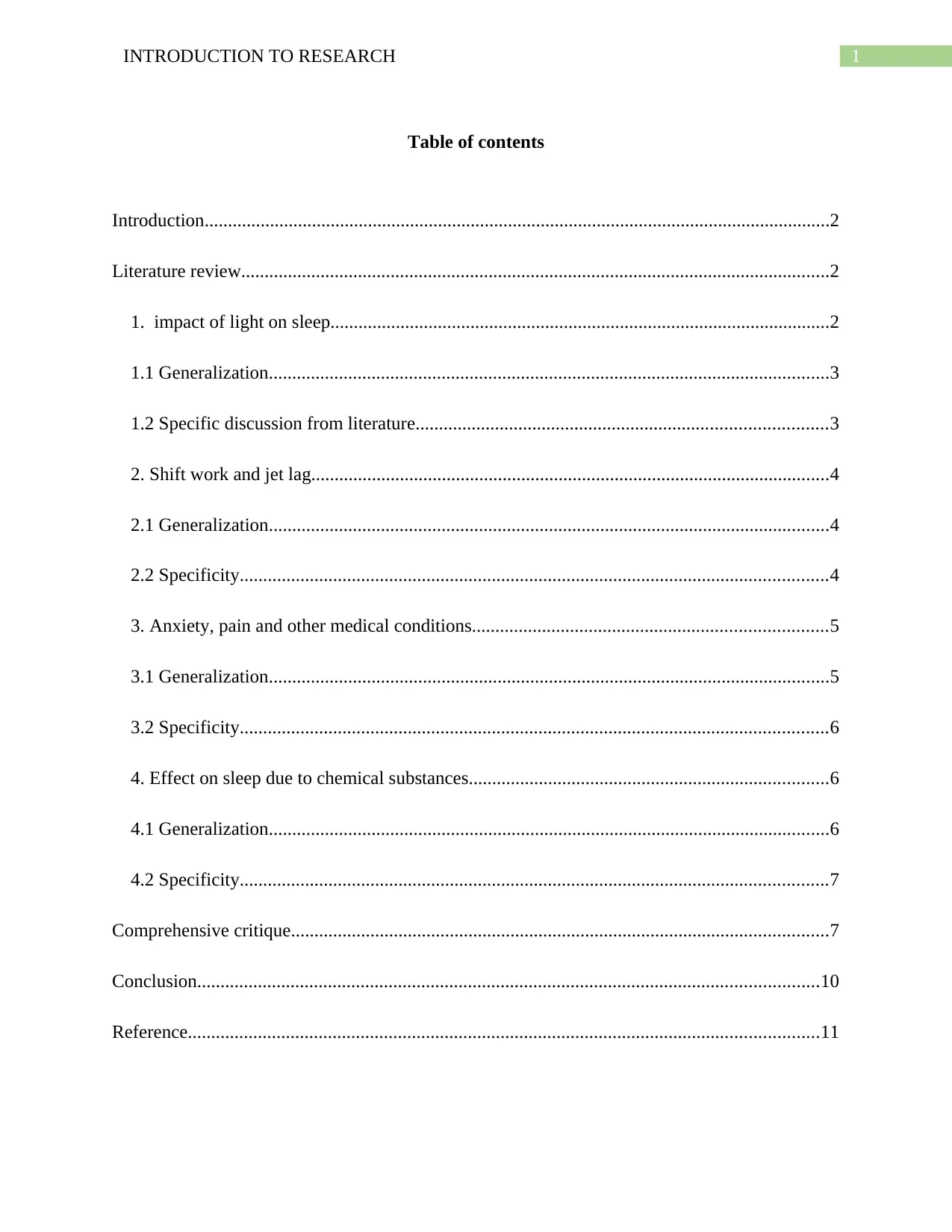
Table of contents
Introduction......................................................................................................................................2
Literature review..............................................................................................................................2
1. impact of light on sleep...........................................................................................................2
1.1 Generalization........................................................................................................................3
1.2 Specific discussion from literature........................................................................................3
2. Shift work and jet lag...............................................................................................................4
2.1 Generalization........................................................................................................................4
2.2 Specificity..............................................................................................................................4
3. Anxiety, pain and other medical conditions............................................................................5
3.1 Generalization........................................................................................................................5
3.2 Specificity..............................................................................................................................6
4. Effect on sleep due to chemical substances.............................................................................6
4.1 Generalization........................................................................................................................6
4.2 Specificity..............................................................................................................................7
Comprehensive critique...................................................................................................................7
Conclusion.....................................................................................................................................10
Reference.......................................................................................................................................11
Table of contents
Introduction......................................................................................................................................2
Literature review..............................................................................................................................2
1. impact of light on sleep...........................................................................................................2
1.1 Generalization........................................................................................................................3
1.2 Specific discussion from literature........................................................................................3
2. Shift work and jet lag...............................................................................................................4
2.1 Generalization........................................................................................................................4
2.2 Specificity..............................................................................................................................4
3. Anxiety, pain and other medical conditions............................................................................5
3.1 Generalization........................................................................................................................5
3.2 Specificity..............................................................................................................................6
4. Effect on sleep due to chemical substances.............................................................................6
4.1 Generalization........................................................................................................................6
4.2 Specificity..............................................................................................................................7
Comprehensive critique...................................................................................................................7
Conclusion.....................................................................................................................................10
Reference.......................................................................................................................................11
2INTRODUCTION TO RESEARCH
Introduction
Sleep quality can be described as a person satisfaction from the sleep experience which
includes initiation of sleep, sleep maintenance, quantity of sleep and refreshment after waking up
from sleep. Sleep quality is an important for the researchers and the clinicians due to the high
incidence of insomnia and sleep disorders and also the clear relation of proper functioning of
health (1). This study is divided in to two parts: the first part is based on literature review of the
sleep quality study; the second part focusses on the comparative analysis of two research articles
among and the comparative analysis includes biases, validity, reliability, limitations, and
comment on sample size, application or implication of research, and culture, religion and gender.
Literature review
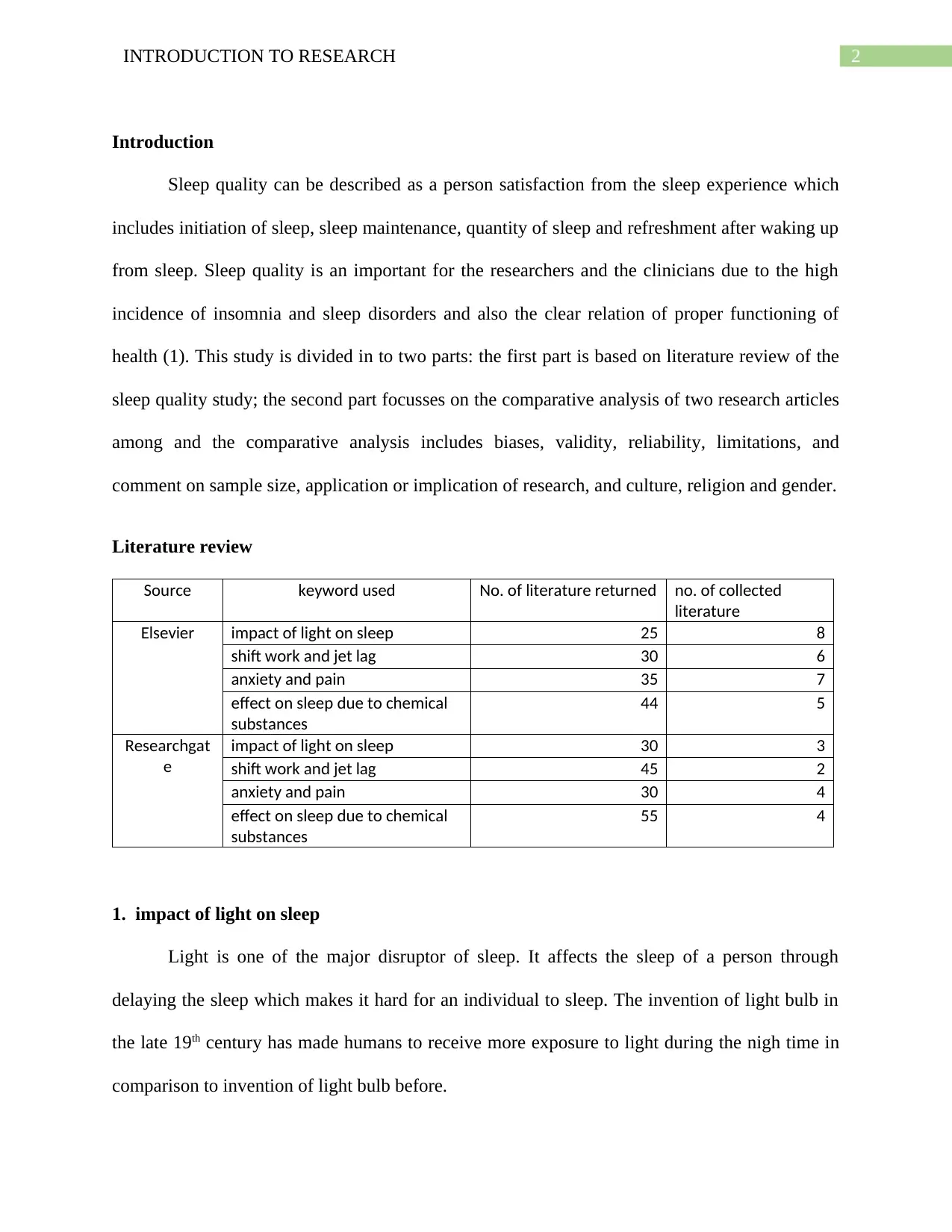
Source keyword used No. of literature returned no. of collected
literature
Elsevier impact of light on sleep 25 8
shift work and jet lag 30 6
anxiety and pain 35 7
effect on sleep due to chemical
substances
44 5
Researchgat
e
impact of light on sleep 30 3
shift work and jet lag 45 2
anxiety and pain 30 4
effect on sleep due to chemical
substances
55 4
1. impact of light on sleep
Light is one of the major disruptor of sleep. It affects the sleep of a person through
delaying the sleep which makes it hard for an individual to sleep. The invention of light bulb in
the late 19th century has made humans to receive more exposure to light during the nigh time in
comparison to invention of light bulb before.
Introduction
Sleep quality can be described as a person satisfaction from the sleep experience which
includes initiation of sleep, sleep maintenance, quantity of sleep and refreshment after waking up
from sleep. Sleep quality is an important for the researchers and the clinicians due to the high
incidence of insomnia and sleep disorders and also the clear relation of proper functioning of
health (1). This study is divided in to two parts: the first part is based on literature review of the
sleep quality study; the second part focusses on the comparative analysis of two research articles
among and the comparative analysis includes biases, validity, reliability, limitations, and
comment on sample size, application or implication of research, and culture, religion and gender.
Literature review
Source keyword used No. of literature returned no. of collected
literature
Elsevier impact of light on sleep 25 8
shift work and jet lag 30 6
anxiety and pain 35 7
effect on sleep due to chemical
substances
44 5
Researchgat
e
impact of light on sleep 30 3
shift work and jet lag 45 2
anxiety and pain 30 4
effect on sleep due to chemical
substances
55 4
1. impact of light on sleep
Light is one of the major disruptor of sleep. It affects the sleep of a person through
delaying the sleep which makes it hard for an individual to sleep. The invention of light bulb in
the late 19th century has made humans to receive more exposure to light during the nigh time in
comparison to invention of light bulb before.
⊘ This is a preview!⊘
Do you want full access?
Subscribe today to unlock all pages.

Trusted by 1+ million students worldwide
3INTRODUCTION TO RESEARCH
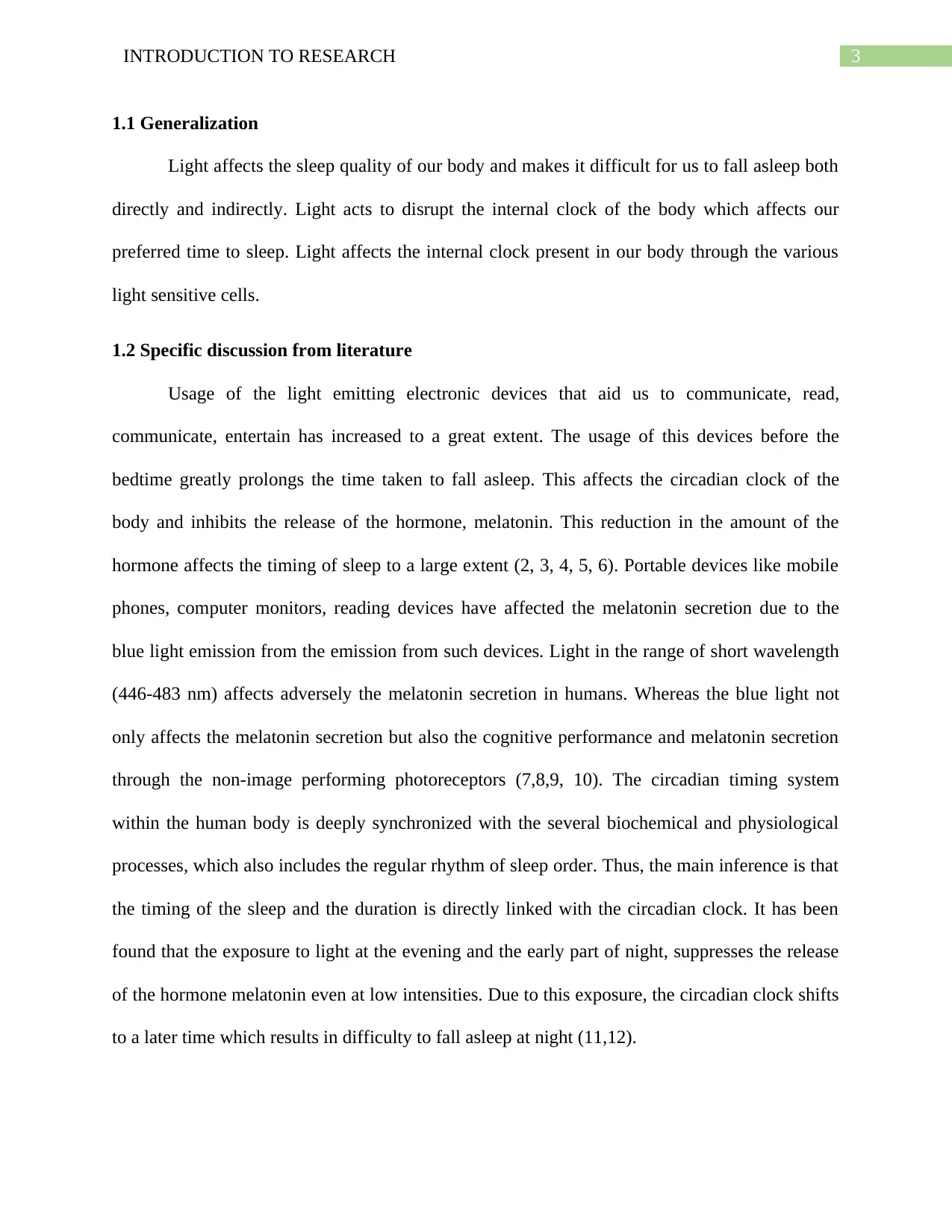
1.1 Generalization
Light affects the sleep quality of our body and makes it difficult for us to fall asleep both
directly and indirectly. Light acts to disrupt the internal clock of the body which affects our
preferred time to sleep. Light affects the internal clock present in our body through the various
light sensitive cells.
1.2 Specific discussion from literature
Usage of the light emitting electronic devices that aid us to communicate, read,
communicate, entertain has increased to a great extent. The usage of this devices before the
bedtime greatly prolongs the time taken to fall asleep. This affects the circadian clock of the
body and inhibits the release of the hormone, melatonin. This reduction in the amount of the
hormone affects the timing of sleep to a large extent (2, 3, 4, 5, 6). Portable devices like mobile
phones, computer monitors, reading devices have affected the melatonin secretion due to the
blue light emission from the emission from such devices. Light in the range of short wavelength
(446-483 nm) affects adversely the melatonin secretion in humans. Whereas the blue light not
only affects the melatonin secretion but also the cognitive performance and melatonin secretion
through the non-image performing photoreceptors (7,8,9, 10). The circadian timing system
within the human body is deeply synchronized with the several biochemical and physiological
processes, which also includes the regular rhythm of sleep order. Thus, the main inference is that
the timing of the sleep and the duration is directly linked with the circadian clock. It has been
found that the exposure to light at the evening and the early part of night, suppresses the release
of the hormone melatonin even at low intensities. Due to this exposure, the circadian clock shifts
to a later time which results in difficulty to fall asleep at night (11,12).
1.1 Generalization
Light affects the sleep quality of our body and makes it difficult for us to fall asleep both
directly and indirectly. Light acts to disrupt the internal clock of the body which affects our
preferred time to sleep. Light affects the internal clock present in our body through the various
light sensitive cells.
1.2 Specific discussion from literature
Usage of the light emitting electronic devices that aid us to communicate, read,
communicate, entertain has increased to a great extent. The usage of this devices before the
bedtime greatly prolongs the time taken to fall asleep. This affects the circadian clock of the
body and inhibits the release of the hormone, melatonin. This reduction in the amount of the
hormone affects the timing of sleep to a large extent (2, 3, 4, 5, 6). Portable devices like mobile
phones, computer monitors, reading devices have affected the melatonin secretion due to the
blue light emission from the emission from such devices. Light in the range of short wavelength
(446-483 nm) affects adversely the melatonin secretion in humans. Whereas the blue light not
only affects the melatonin secretion but also the cognitive performance and melatonin secretion
through the non-image performing photoreceptors (7,8,9, 10). The circadian timing system
within the human body is deeply synchronized with the several biochemical and physiological
processes, which also includes the regular rhythm of sleep order. Thus, the main inference is that
the timing of the sleep and the duration is directly linked with the circadian clock. It has been
found that the exposure to light at the evening and the early part of night, suppresses the release
of the hormone melatonin even at low intensities. Due to this exposure, the circadian clock shifts
to a later time which results in difficulty to fall asleep at night (11,12).
Paraphrase This Document
Need a fresh take? Get an instant paraphrase of this document with our AI Paraphraser
4INTRODUCTION TO RESEARCH
2. Shift work and jet lag
It is a normal phenomenon that our biological internal clock serves to work according to
the time zone to which a person resides. However, problems occur when body gets exposure to
light which changes depending to the sudden change in shift work or drastic change in time zone
due to travel across different time zones.
2.1 Generalization
Individuals that frequent travel across the different time zones experience two different
types of symptoms like insomnia when a person tries to stay awake when the internal clock
resists to sleep. The other symptom is that when a person tries to sleep when the internal clock
strongly forces the body to stay awake. This is a sort of an important concern for the society and
the individuals. Even the tendencies of distorted sleep are noticed in police, nurses, physicians,
air traffic controllers and airline pilots and public safety workers that have to work during the
night shifts. The results however may be critical.
2.2 Specificity
For about 2 decades, the research on the change in shift work and the has revealed that,
shift work has adversely caused fatigue and sleep disturbances among the workers. It has been
found that the shift workers have experienced both the lack and difficulties in sleep. This
difficulty on the other hand has resulted into excessive fatigue (13,14,15,16). Majority of the
shift worker have complained that, they have experienced sleep during the work hours. This have
adversely resulted into accidents and mishaps. The misalignment of the social sleep times (forced
work) along with the circadian clock is noticed in the shift workers. The reason is that their body
remains aligned with the natural clock of night and day cycles, but their work hours distorts the
normal functioning of the circadian clock (17, 18, 19). The consequences of the sleep distortion
2. Shift work and jet lag
It is a normal phenomenon that our biological internal clock serves to work according to
the time zone to which a person resides. However, problems occur when body gets exposure to
light which changes depending to the sudden change in shift work or drastic change in time zone
due to travel across different time zones.
2.1 Generalization
Individuals that frequent travel across the different time zones experience two different
types of symptoms like insomnia when a person tries to stay awake when the internal clock
resists to sleep. The other symptom is that when a person tries to sleep when the internal clock
strongly forces the body to stay awake. This is a sort of an important concern for the society and
the individuals. Even the tendencies of distorted sleep are noticed in police, nurses, physicians,
air traffic controllers and airline pilots and public safety workers that have to work during the
night shifts. The results however may be critical.
2.2 Specificity
For about 2 decades, the research on the change in shift work and the has revealed that,
shift work has adversely caused fatigue and sleep disturbances among the workers. It has been
found that the shift workers have experienced both the lack and difficulties in sleep. This
difficulty on the other hand has resulted into excessive fatigue (13,14,15,16). Majority of the
shift worker have complained that, they have experienced sleep during the work hours. This have
adversely resulted into accidents and mishaps. The misalignment of the social sleep times (forced
work) along with the circadian clock is noticed in the shift workers. The reason is that their body
remains aligned with the natural clock of night and day cycles, but their work hours distorts the
normal functioning of the circadian clock (17, 18, 19). The consequences of the sleep distortion
5INTRODUCTION TO RESEARCH
arising due to the high speed travel across time zones leads to psychological disorientation and
circadian disruption and as well as travel disorientation. When a person is moving from one-time
zone to another time zone. The body although acclimatized with the previous time zone remains
in the previous set synchronized with the internal clock of the body. This undergoes change
when the body shifts to a different time zone but still the internal clock stays in the previous time
zone. This disrupts the sleep patterns within the people that travel by airlines from one country to
another. When the internal clock forces the body to sleep but on the other hand external exposure
to light prevents a person to sleep. This creates a situation called jet lag (20, 21, 22).
3. Anxiety, pain and other medical conditions
Studies have shown that psychological and the medical conditions have an adverse
impact on the health as well as in sleep patterns. The several medical conditions which include
chronic pain arising due to arthritis and other several other medical complications involving the
premenstrual syndrome, gastroesophageal reflux. Like several other factors that disrupt the sleep
patterns, discomfort and pain also tend to reduce and limit the sleep depth and only allow a brief
period of sleep between awakenings.
3.1 Generalization
Individuals across all ages, experience the anxiety, depression and stress and it affects the
quality of sleep. When an individual gets affected by the anxiety, stress, and depression then the
sleep tends to be less deep. Body tends to react to such stimulus of pain because it is
programmed to react to pain and body react to such situation by waking up during sleep. On the
other hand, stress caused on a daily basis due to everyday work and exposure can also impact on
the sleep patterns and quality of sleep.
arising due to the high speed travel across time zones leads to psychological disorientation and
circadian disruption and as well as travel disorientation. When a person is moving from one-time
zone to another time zone. The body although acclimatized with the previous time zone remains
in the previous set synchronized with the internal clock of the body. This undergoes change
when the body shifts to a different time zone but still the internal clock stays in the previous time
zone. This disrupts the sleep patterns within the people that travel by airlines from one country to
another. When the internal clock forces the body to sleep but on the other hand external exposure
to light prevents a person to sleep. This creates a situation called jet lag (20, 21, 22).
3. Anxiety, pain and other medical conditions
Studies have shown that psychological and the medical conditions have an adverse
impact on the health as well as in sleep patterns. The several medical conditions which include
chronic pain arising due to arthritis and other several other medical complications involving the
premenstrual syndrome, gastroesophageal reflux. Like several other factors that disrupt the sleep
patterns, discomfort and pain also tend to reduce and limit the sleep depth and only allow a brief
period of sleep between awakenings.
3.1 Generalization
Individuals across all ages, experience the anxiety, depression and stress and it affects the
quality of sleep. When an individual gets affected by the anxiety, stress, and depression then the
sleep tends to be less deep. Body tends to react to such stimulus of pain because it is
programmed to react to pain and body react to such situation by waking up during sleep. On the
other hand, stress caused on a daily basis due to everyday work and exposure can also impact on
the sleep patterns and quality of sleep.
⊘ This is a preview!⊘
Do you want full access?
Subscribe today to unlock all pages.
Trusted by 1+ million students worldwide
6INTRODUCTION TO RESEARCH
3.2 Specificity
Rheumatoid arthritis is an autoimmune disorder that can be characterized by swelling and
joint pain. In addition, it has been seen in half of the patients suffering from rheumatoid arthritis
experience sleep disturbances. The rate is higher and is 2 to 3 times more found in general
population. several cross sectional researches have shown that sleep disturbances are closely
related with the disruption in sleep quality (23, 24,25). Mediational analysis has shown that,
depression acted as a main factor that significantly contributed to the sleep disorder. Also cross
sectional study has reported that depression and pain all together play a major role in the self-
reported sleep problems in patients suffering from rheumatoid arthritis (26, 27). Sleep disorders
also includes the other potential impactors like the depression and anxiety that lead to
neuropsychological impairment, suicidal tendencies and drug abuse. Studies have shown that the
effects of anxiety and depression are bidirectional. Which means sleep quality gets distorted due
to depression and stress and on the other hand, both the stress and depression leads to loss of
sleep (28, 29, 30 31).
4. Effect on sleep due to chemical substances
Several drugs and chemical substances both affect the quantity and quality of sleep.
These substances include antihistamines, nicotine, alcohol, caffeine. At the same time
antidepressants, alpha blockers and beta blockers tend to disrupt the sleep.
4.1 Generalization
Certain chemicals like adenosine starts to build up inside the brain when body starts to
become weak. This although partly, is responsible for the sleep drive. Interestingly, the caffeine
levels in the brain tend to stop the buildup of adenosine in brain.
3.2 Specificity
Rheumatoid arthritis is an autoimmune disorder that can be characterized by swelling and
joint pain. In addition, it has been seen in half of the patients suffering from rheumatoid arthritis
experience sleep disturbances. The rate is higher and is 2 to 3 times more found in general
population. several cross sectional researches have shown that sleep disturbances are closely
related with the disruption in sleep quality (23, 24,25). Mediational analysis has shown that,
depression acted as a main factor that significantly contributed to the sleep disorder. Also cross
sectional study has reported that depression and pain all together play a major role in the self-
reported sleep problems in patients suffering from rheumatoid arthritis (26, 27). Sleep disorders
also includes the other potential impactors like the depression and anxiety that lead to
neuropsychological impairment, suicidal tendencies and drug abuse. Studies have shown that the
effects of anxiety and depression are bidirectional. Which means sleep quality gets distorted due
to depression and stress and on the other hand, both the stress and depression leads to loss of
sleep (28, 29, 30 31).
4. Effect on sleep due to chemical substances
Several drugs and chemical substances both affect the quantity and quality of sleep.
These substances include antihistamines, nicotine, alcohol, caffeine. At the same time
antidepressants, alpha blockers and beta blockers tend to disrupt the sleep.
4.1 Generalization
Certain chemicals like adenosine starts to build up inside the brain when body starts to
become weak. This although partly, is responsible for the sleep drive. Interestingly, the caffeine
levels in the brain tend to stop the buildup of adenosine in brain.
Paraphrase This Document
Need a fresh take? Get an instant paraphrase of this document with our AI Paraphraser
7INTRODUCTION TO RESEARCH
4.2 Specificity
When the body tends to become weak, a chemical called adenosine builds up in brain.
The occurrence is similar when body get tired and exhausted. Due to such tendencies, adenosine
builds up in brain and taking caffeine reduces the levels of adenosine inside brain and acts as
stimulant. This increases alertness and at the same time reduces the sleepiness. The presence of
caffeine temporarily blocks the adenosine receptors in the specific parts of the brain (32,33,34).
Alcohol on the other hand enhances sleep, because consuming alcohol reduces the oxygen
carrying capacity of blood. When less oxygen reaches to the brain, the tendency of sleepiness
increases (35,36,37).
Comprehensive critique
Biases
Vandewalle et al. (8) selected 27 subjects genotyped for PER3 VNTR with known dependency
of brain response in darkness on circadian rhythm, sleep homeostasis and genotype (non random
sampling). This shows a limited scope of study that is targeted for a specific cohort based on the
genetic makeup, and not a generalized study. The study only analyses the effect of light of
different intensities and frequencies on brain activity, as studied by Functional Magnetic
Resonance Imaging (fMRI).
Chang et al (2) selected 12 subjects in a randomized crossover design, who fulfilled 2
conditions, 1) Reading e-books before sleep 2) Reading printed books before sleep, both in dimly
lit conditions, and analyzed the levels of melatonin in blood plasma, total sleep time, sleep
efficiency, and the length of each stage of sleep. However, the study limits itself to the effect of
4.2 Specificity
When the body tends to become weak, a chemical called adenosine builds up in brain.
The occurrence is similar when body get tired and exhausted. Due to such tendencies, adenosine
builds up in brain and taking caffeine reduces the levels of adenosine inside brain and acts as
stimulant. This increases alertness and at the same time reduces the sleepiness. The presence of
caffeine temporarily blocks the adenosine receptors in the specific parts of the brain (32,33,34).
Alcohol on the other hand enhances sleep, because consuming alcohol reduces the oxygen
carrying capacity of blood. When less oxygen reaches to the brain, the tendency of sleepiness
increases (35,36,37).
Comprehensive critique
Biases
Vandewalle et al. (8) selected 27 subjects genotyped for PER3 VNTR with known dependency
of brain response in darkness on circadian rhythm, sleep homeostasis and genotype (non random
sampling). This shows a limited scope of study that is targeted for a specific cohort based on the
genetic makeup, and not a generalized study. The study only analyses the effect of light of
different intensities and frequencies on brain activity, as studied by Functional Magnetic
Resonance Imaging (fMRI).
Chang et al (2) selected 12 subjects in a randomized crossover design, who fulfilled 2
conditions, 1) Reading e-books before sleep 2) Reading printed books before sleep, both in dimly
lit conditions, and analyzed the levels of melatonin in blood plasma, total sleep time, sleep
efficiency, and the length of each stage of sleep. However, the study limits itself to the effect of
8INTRODUCTION TO RESEARCH
electronic light on the sleep quality of individuals, and does not include the effect of different
frequencies of light as well as the time of exposure to light.
Validity
The validity of the study by Vandewall (8) can be attributed to the usage of fMRI to study the
brain activity of the subjects. This allows the mapping of activities to specific areas of the brain
like the cortical and sub cortical regions, as well as in fronto‐polar, laterals prefrontal and
premotor cortex, the intraparietal sulcus, insula, cerebellum and thalamus. However, the brain
responses were not mapped to behavioral outcomes that can show how the quality of sleep is
affected in the study. Instead, it uses the status of the brain activity as a measure of the effect of
exposure to light.
Validity of the studies by Chang et al. (2) can be attributed to the usage of the levels of melatonin
in blood, to understand the propensity of quality sleep in the subjects. This allows a direct
measurement of the possible sleepiness of the subjects, however, the total sleep time, sleep
efficiency, and the length of each stage of sleep values were self-reported, and hence can be
misreported by the subjects.
Reliability
Both the studies by Vanderwall et al. (8) and Chang et al. (2) utilize reliable methods in the
assessment of the values (fMRI to measure brain activity or blood melatonin to measure
propensity to sleep). These were both indirect approaches to understand how sleep quality can be
affected. Melatonin levels being positively correlated to sleep propensity or readiness and brain
activity or alertness being negatively correlated.
electronic light on the sleep quality of individuals, and does not include the effect of different
frequencies of light as well as the time of exposure to light.
Validity
The validity of the study by Vandewall (8) can be attributed to the usage of fMRI to study the
brain activity of the subjects. This allows the mapping of activities to specific areas of the brain
like the cortical and sub cortical regions, as well as in fronto‐polar, laterals prefrontal and
premotor cortex, the intraparietal sulcus, insula, cerebellum and thalamus. However, the brain
responses were not mapped to behavioral outcomes that can show how the quality of sleep is
affected in the study. Instead, it uses the status of the brain activity as a measure of the effect of
exposure to light.
Validity of the studies by Chang et al. (2) can be attributed to the usage of the levels of melatonin
in blood, to understand the propensity of quality sleep in the subjects. This allows a direct
measurement of the possible sleepiness of the subjects, however, the total sleep time, sleep
efficiency, and the length of each stage of sleep values were self-reported, and hence can be
misreported by the subjects.
Reliability
Both the studies by Vanderwall et al. (8) and Chang et al. (2) utilize reliable methods in the
assessment of the values (fMRI to measure brain activity or blood melatonin to measure
propensity to sleep). These were both indirect approaches to understand how sleep quality can be
affected. Melatonin levels being positively correlated to sleep propensity or readiness and brain
activity or alertness being negatively correlated.
⊘ This is a preview!⊘
Do you want full access?
Subscribe today to unlock all pages.
Trusted by 1+ million students worldwide
9INTRODUCTION TO RESEARCH
Limitations
Studies by Vanderwall (8) was limited to low levels of irradiation exposed to the subjects, in
addition to the non-inclusion of retinal rod cells in the con-classical response to light. The study
was also non ransom, aimed at a cohort of particular genotype.
Limitations in studies by Chang et al. (2) include the measurement of blood melatonin levels
only on the fifth and final evening in each reading conditions. Also, the duration of the evening
sessions of reading were limited to only 4 hours, which is significantly lesser than the average
amount of time spent by a teenager in activities before bedtime. Additionally, the brightness
setting of the eBook reader was preset at maximum brightness and the books were read in dimly
lit conditions, and hence did not analyze the effect of other brightness settings on sleep. Finally,
the study did not include the analysis of other electronic devices that emit lights of longer
wavelengths, thus failing to study the effect of different spectrum of light on sleep.
Sample Size
Sample size selected by Vandewall et al. (8) was limited to 27 subjects, while that of Chang et al.
(2) was limited to 12 subjects. Both the studies involved a small sample size.
Novelty Value
The novelty value of the study by Vandewall et al. (8) is the effect of light on brain activity and
cognitive responses, which shows how sleepy or alert an individual can be expected to exhibit,
under variant exposures to light, based on the circadian rhythm and sleep homeostasis.
The novelty value for the study by Chang et al (2) shows how light emitting electronic readers
can affect the circadian rhyme, and therefore the sleep quality of individuals.
Limitations
Studies by Vanderwall (8) was limited to low levels of irradiation exposed to the subjects, in
addition to the non-inclusion of retinal rod cells in the con-classical response to light. The study
was also non ransom, aimed at a cohort of particular genotype.
Limitations in studies by Chang et al. (2) include the measurement of blood melatonin levels
only on the fifth and final evening in each reading conditions. Also, the duration of the evening
sessions of reading were limited to only 4 hours, which is significantly lesser than the average
amount of time spent by a teenager in activities before bedtime. Additionally, the brightness
setting of the eBook reader was preset at maximum brightness and the books were read in dimly
lit conditions, and hence did not analyze the effect of other brightness settings on sleep. Finally,
the study did not include the analysis of other electronic devices that emit lights of longer
wavelengths, thus failing to study the effect of different spectrum of light on sleep.
Sample Size
Sample size selected by Vandewall et al. (8) was limited to 27 subjects, while that of Chang et al.
(2) was limited to 12 subjects. Both the studies involved a small sample size.
Novelty Value
The novelty value of the study by Vandewall et al. (8) is the effect of light on brain activity and
cognitive responses, which shows how sleepy or alert an individual can be expected to exhibit,
under variant exposures to light, based on the circadian rhythm and sleep homeostasis.
The novelty value for the study by Chang et al (2) shows how light emitting electronic readers
can affect the circadian rhyme, and therefore the sleep quality of individuals.
Paraphrase This Document
Need a fresh take? Get an instant paraphrase of this document with our AI Paraphraser
10INTRODUCTION TO RESEARCH
Application or Implications of the research:
The findings of the research can be applied in our understanding on how circadian rhythms can
be affected by exposure to light of varying duration and intensities, and how in turn that can
affect the quality of sleep, level of alertness or sleepiness, and hence as an indicator of
performance.
Conclusion
Therefore, from the study it can be concluded that, quality of sleep gets distorted due to
several factors. The major factors include the social jet lag, working hours, the intensity of light
and exposure to different wavelengths of light, chemicals, pain, anxiety and depression.
Although certain aspects of sleep disorders can be controlled and managed, while the other
factors remain unmanageable.
Application or Implications of the research:
The findings of the research can be applied in our understanding on how circadian rhythms can
be affected by exposure to light of varying duration and intensities, and how in turn that can
affect the quality of sleep, level of alertness or sleepiness, and hence as an indicator of
performance.
Conclusion
Therefore, from the study it can be concluded that, quality of sleep gets distorted due to
several factors. The major factors include the social jet lag, working hours, the intensity of light
and exposure to different wavelengths of light, chemicals, pain, anxiety and depression.
Although certain aspects of sleep disorders can be controlled and managed, while the other
factors remain unmanageable.
11INTRODUCTION TO RESEARCH
Reference
1. Turner JR, Gellman M. Encyclopedia of Behavioral Medicine. Springer; 2013.
2. Chang AM, Aeschbach D, Duffy JF, Czeisler CA. Evening use of light-emitting eReaders
negatively affects sleep, circadian timing, and next-morning alertness. Proceedings of the
National Academy of Sciences. 2015 Jan 27;112(4):1232-7.
3. van der Lely S, Frey S, Garbazza C, Wirz-Justice A, Jenni OG, Steiner R, Wolf S,
Cajochen C, Bromundt V, Schmidt C. Blue blocker glasses as a countermeasure for
alerting effects of evening light-emitting diode screen exposure in male teenagers.
Journal of Adolescent Health. 2015 Jan 31;56(1):113-9.
4. Cajochen C, Frey S, Anders D, Späti J, Bues M, Pross A, Mager R, Wirz-Justice A,
Stefani O. Evening exposure to a light-emitting diodes (LED)-backlit computer screen
affects circadian physiology and cognitive performance. Journal of applied physiology.
2011 Mar 17;110(5):1432-8.
5. Wood B, Rea MS, Plitnick B, Figueiro MG. Light level and duration of exposure
determine the impact of self-luminous tablets on melatonin suppression. Applied
ergonomics. 2013 Mar 31;44(2):237-40.
6. Chellappa SL, Steiner R, Oelhafen P, Lang D, Götz T, Krebs J, Cajochen C. Acute
exposure to evening blue‐enriched light impacts on human sleep. Journal of sleep
research. 2013 Oct 1;22(5):573-80.
7. Rahman SA, Flynn-Evans EE, Aeschbach D, Brainard GC, Czeisler CA, Lockley SW.
Diurnal spectral sensitivity of the acute alerting effects of light. Sleep. 2014 Feb
1;37(2):271-81.
Reference
1. Turner JR, Gellman M. Encyclopedia of Behavioral Medicine. Springer; 2013.
2. Chang AM, Aeschbach D, Duffy JF, Czeisler CA. Evening use of light-emitting eReaders
negatively affects sleep, circadian timing, and next-morning alertness. Proceedings of the
National Academy of Sciences. 2015 Jan 27;112(4):1232-7.
3. van der Lely S, Frey S, Garbazza C, Wirz-Justice A, Jenni OG, Steiner R, Wolf S,
Cajochen C, Bromundt V, Schmidt C. Blue blocker glasses as a countermeasure for
alerting effects of evening light-emitting diode screen exposure in male teenagers.
Journal of Adolescent Health. 2015 Jan 31;56(1):113-9.
4. Cajochen C, Frey S, Anders D, Späti J, Bues M, Pross A, Mager R, Wirz-Justice A,
Stefani O. Evening exposure to a light-emitting diodes (LED)-backlit computer screen
affects circadian physiology and cognitive performance. Journal of applied physiology.
2011 Mar 17;110(5):1432-8.
5. Wood B, Rea MS, Plitnick B, Figueiro MG. Light level and duration of exposure
determine the impact of self-luminous tablets on melatonin suppression. Applied
ergonomics. 2013 Mar 31;44(2):237-40.
6. Chellappa SL, Steiner R, Oelhafen P, Lang D, Götz T, Krebs J, Cajochen C. Acute
exposure to evening blue‐enriched light impacts on human sleep. Journal of sleep
research. 2013 Oct 1;22(5):573-80.
7. Rahman SA, Flynn-Evans EE, Aeschbach D, Brainard GC, Czeisler CA, Lockley SW.
Diurnal spectral sensitivity of the acute alerting effects of light. Sleep. 2014 Feb
1;37(2):271-81.
⊘ This is a preview!⊘
Do you want full access?
Subscribe today to unlock all pages.
Trusted by 1+ million students worldwide

1 out of 16


Your All-in-One AI-Powered Toolkit for Academic Success.
+13062052269
info@desklib.com
Available 24*7 on WhatsApp / Email
![[object Object]](/_next/static/media/star-bottom.7253800d.svg)
Unlock your academic potential
Copyright © 2020–2026 A2Z Services. All Rights Reserved. Developed and managed by ZUCOL.