Human Resource Development Report: Training Needs and Planning
VerifiedAdded on 2020/06/04
|16
|4951
|80
Report
AI Summary
This report provides a detailed analysis of human resource development, focusing on a case study involving 'People 'R' Us' consultancy and Sun Count Residential Homes. The report explores various learning styles (Kolb, cognitive), the role of the learning curve, and the importance of transferring learning to the workplace. It examines training needs at different management levels, compares training methods (technology-based, on-the-job, off-the-job), and discusses a systematic approach to planning training and development. Furthermore, the report covers the role of government in training, development, and lifelong learning, as well as the impact of the competency movement. The report emphasizes the importance of effective training and development for employee performance and organizational success, particularly in the context of providing care for the elderly. The report also examines the advantages and disadvantages of various training methods and provides insights into planning and designing effective learning events.

HUMAN RESOURCE
DEVELOPMENT
DEVELOPMENT

Paraphrase This Document
Need a fresh take? Get an instant paraphrase of this document with our AI Paraphraser
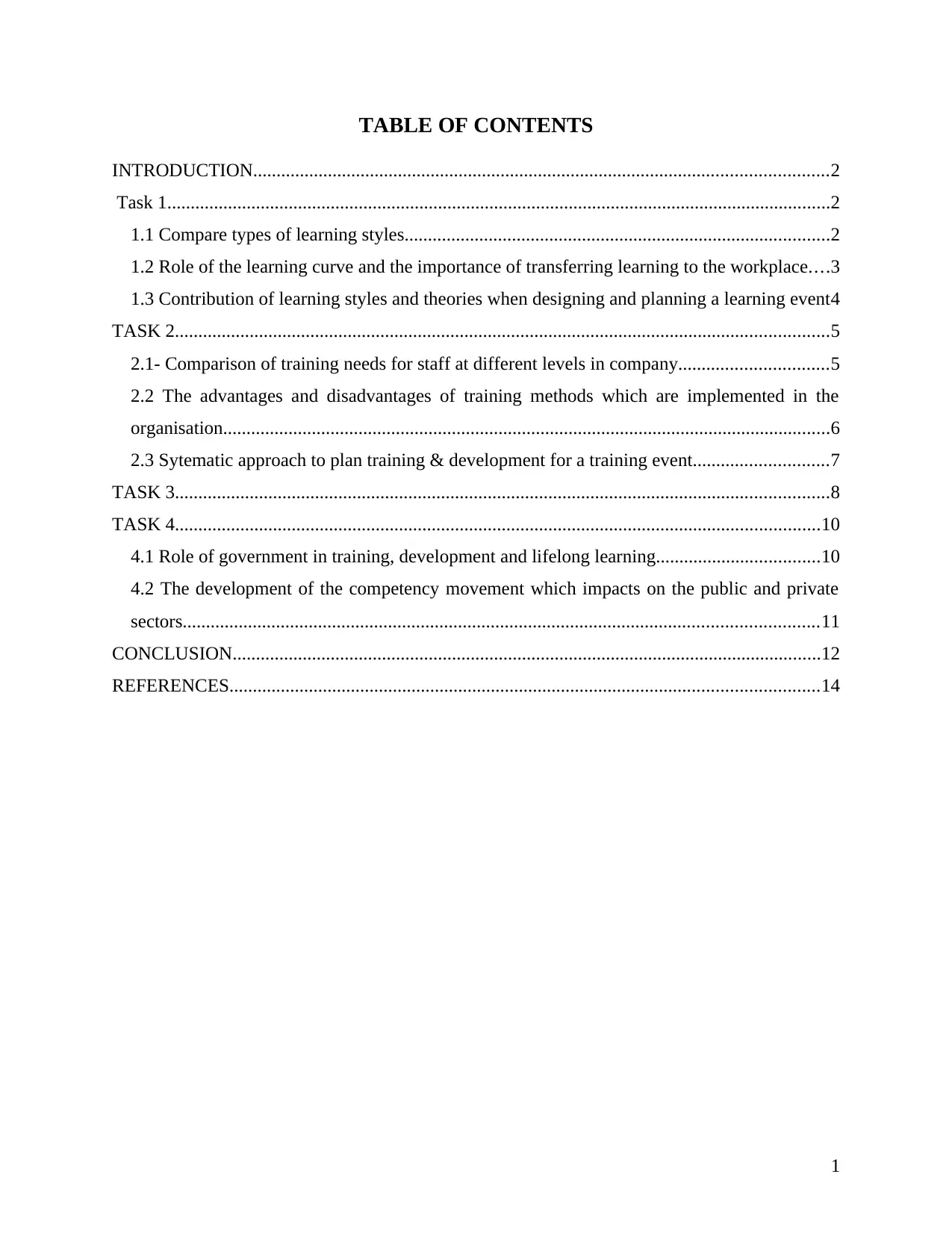
TABLE OF CONTENTS
INTRODUCTION...........................................................................................................................2
Task 1..............................................................................................................................................2
1.1 Compare types of learning styles...........................................................................................2
1.2 Role of the learning curve and the importance of transferring learning to the workplace....3
1.3 Contribution of learning styles and theories when designing and planning a learning event4
TASK 2............................................................................................................................................5
2.1- Comparison of training needs for staff at different levels in company................................5
2.2 The advantages and disadvantages of training methods which are implemented in the
organisation..................................................................................................................................6
2.3 Sytematic approach to plan training & development for a training event.............................7
TASK 3............................................................................................................................................8
TASK 4..........................................................................................................................................10
4.1 Role of government in training, development and lifelong learning...................................10
4.2 The development of the competency movement which impacts on the public and private
sectors........................................................................................................................................11
CONCLUSION..............................................................................................................................12
REFERENCES..............................................................................................................................14
1
INTRODUCTION...........................................................................................................................2
Task 1..............................................................................................................................................2
1.1 Compare types of learning styles...........................................................................................2
1.2 Role of the learning curve and the importance of transferring learning to the workplace....3
1.3 Contribution of learning styles and theories when designing and planning a learning event4
TASK 2............................................................................................................................................5
2.1- Comparison of training needs for staff at different levels in company................................5
2.2 The advantages and disadvantages of training methods which are implemented in the
organisation..................................................................................................................................6
2.3 Sytematic approach to plan training & development for a training event.............................7
TASK 3............................................................................................................................................8
TASK 4..........................................................................................................................................10
4.1 Role of government in training, development and lifelong learning...................................10
4.2 The development of the competency movement which impacts on the public and private
sectors........................................................................................................................................11
CONCLUSION..............................................................................................................................12
REFERENCES..............................................................................................................................14
1
INTRODUCTION
Development in human resource is important to learning and overall development of
employee with effective and efficiency. “PEOPLE 'R' US” small UK HR. consultancy. They
provide services to small and medium enterprises. The new contact is to find suitable solution
for Sun Count Residential homes limited. The firm provide up-market home care product, with
suitable atmosphere to old age person like 60+ age. The “People 'R' US” design a plan for
training and development of old age employee. The top management think that it is costly
activities, but on the other hand it is also compulsory for guidance. This study help out to find
advantages of training which needs to understand planning, development learning, skill
development etc. in it discussion upon learning styles and theories, design development and
training, government led skills development and other learning activities.
Task 1
1.1 Compare types of learning styles
Learning styles where an instructor use different styles to learn something. In it may be
audio, videos, body movement and other physical activities. There are some types of styles
which are:
Kolb learning styles
This model was published in 1984. This model focus on experience based learning
quality. this styles define four stages of learning
Concrete Experience
This is stage of learning where people learn from specific experience. Experience comes
from field work, lab work, assignment or any other thing which relevant to task. It may be our
experiences and engagement of current working experience (Werner and DeSimone, 2011).
Current working experience comes from caste study, role play, on-field work etc. in simple
world it is learning stage of employee.
Reflective observation
Concrete experience define learn from specific experience. We learned from our
experiences and it is reflected in our work. In this stage learner observe form others or make
observations bases on their own experiences.
2
Development in human resource is important to learning and overall development of
employee with effective and efficiency. “PEOPLE 'R' US” small UK HR. consultancy. They
provide services to small and medium enterprises. The new contact is to find suitable solution
for Sun Count Residential homes limited. The firm provide up-market home care product, with
suitable atmosphere to old age person like 60+ age. The “People 'R' US” design a plan for
training and development of old age employee. The top management think that it is costly
activities, but on the other hand it is also compulsory for guidance. This study help out to find
advantages of training which needs to understand planning, development learning, skill
development etc. in it discussion upon learning styles and theories, design development and
training, government led skills development and other learning activities.
Task 1
1.1 Compare types of learning styles
Learning styles where an instructor use different styles to learn something. In it may be
audio, videos, body movement and other physical activities. There are some types of styles
which are:
Kolb learning styles
This model was published in 1984. This model focus on experience based learning
quality. this styles define four stages of learning
Concrete Experience
This is stage of learning where people learn from specific experience. Experience comes
from field work, lab work, assignment or any other thing which relevant to task. It may be our
experiences and engagement of current working experience (Werner and DeSimone, 2011).
Current working experience comes from caste study, role play, on-field work etc. in simple
world it is learning stage of employee.
Reflective observation
Concrete experience define learn from specific experience. We learned from our
experiences and it is reflected in our work. In this stage learner observe form others or make
observations bases on their own experiences.
2
⊘ This is a preview!⊘
Do you want full access?
Subscribe today to unlock all pages.

Trusted by 1+ million students worldwide
Abstract Conceptualization
Reflection gives new idea but every idea get modification through abstraction.
Sun Count Limited focus on providing formal Human Resource Development.
Active Experimentation
In a learning stage logical approach is needed, when new employee apply idea and other
efforts to particular objective like Sun Count Limited, the task is to guide a segmented which is
weak both mentally and physically.
Cognitive approaches
The second learning theory is cognitive approaches. Cognitive approaches is based on
attitude of learning and approaches of learning (Knowles, And et.al, 2014). This theory was
designed for teacher and students learning behaviour. In Sun Count Limited training of employee
of old aged for care homes services. Cognitive approaches affect psychological behaviour like
thinking, remembering, learning and perception, attention and language using. It is scientific and
systematic study of mind for information processing.
1.2 Role of the learning curve and the importance of transferring learning to the workplace
Graphical represent of employee or worker performances on the basis of learning and
experience is termed as learning curve. First time it was used in 1885 by Hermann Ebbinghaus.
The main purpose of using the curve is to find product efficiency and forecasting the cost. It is a
process where employee improve their mistake by skill development. Learning curve play
important role in organization. It affects both internally and externally in organization(Guest,
2011). Internally it works for labour forecasting, scheduling, directing and established cost and
budget. Externally they help out for supply chain management. Sun count limited needs learning
curve in their organization, because they providing care home products and also provide
accommodation of old age people.
Due to external environment they face some issue like government and legal issue. The funding
of company done by local people and the funding income is decrease from 55% to 20%. in recent
times they have competition also and margin also reduces. They want to exit form it but
accommodation of old people are major issue. CEO decided that they train their worker
generalist to specialist.
3
Reflection gives new idea but every idea get modification through abstraction.
Sun Count Limited focus on providing formal Human Resource Development.
Active Experimentation
In a learning stage logical approach is needed, when new employee apply idea and other
efforts to particular objective like Sun Count Limited, the task is to guide a segmented which is
weak both mentally and physically.
Cognitive approaches
The second learning theory is cognitive approaches. Cognitive approaches is based on
attitude of learning and approaches of learning (Knowles, And et.al, 2014). This theory was
designed for teacher and students learning behaviour. In Sun Count Limited training of employee
of old aged for care homes services. Cognitive approaches affect psychological behaviour like
thinking, remembering, learning and perception, attention and language using. It is scientific and
systematic study of mind for information processing.
1.2 Role of the learning curve and the importance of transferring learning to the workplace
Graphical represent of employee or worker performances on the basis of learning and
experience is termed as learning curve. First time it was used in 1885 by Hermann Ebbinghaus.
The main purpose of using the curve is to find product efficiency and forecasting the cost. It is a
process where employee improve their mistake by skill development. Learning curve play
important role in organization. It affects both internally and externally in organization(Guest,
2011). Internally it works for labour forecasting, scheduling, directing and established cost and
budget. Externally they help out for supply chain management. Sun count limited needs learning
curve in their organization, because they providing care home products and also provide
accommodation of old age people.
Due to external environment they face some issue like government and legal issue. The funding
of company done by local people and the funding income is decrease from 55% to 20%. in recent
times they have competition also and margin also reduces. They want to exit form it but
accommodation of old people are major issue. CEO decided that they train their worker
generalist to specialist.
3
Paraphrase This Document
Need a fresh take? Get an instant paraphrase of this document with our AI Paraphraser
Transferring learning is important for organization. It is process of capacity to apply acquired
knowledge and skills in new situation. Sun count limited facing issue regarding training and
development. Prior knowledge is important for employee that they can change old learning into
new one. The other important part of it is, clearly identify learning goals means employee of
Sun Count limited knows about company vision and mission. Training of employee should be
included using example, case study, role play which helps to connect with real world(Shook and
Roth, 2011). Specific goals helps to employee that they know where they stand and where they
want to go. A specific goal also important because it makes a clear picture about organization
purpose. Sun Count Ltd. working on the development of employee with minimum cost. Sun
Count Ltd. have limited resources and using in proper manner also important.
1.3 Contribution of learning styles and theories when designing and planning a learning event
Learning is and area to find out how animals and human absorbs with nature or
experience. There are many techniques and styles available for learning. Every human learning
capability different from others. They learn by audio, video, physical movement and experience.
Learning theories are described as social, behavioural and cognitive approaches.
Social learning theory
The theory is based upon observation from each other. In it several steps included like
attention, reproduction and motivation (Vörösmarty and et.al., 2010). For an individual attention
is must because focus on employee and training for a purpose is important part of organization.
Behavioural approaches
This approach explains the concept of human brain. When a person born his mind is
blank and afterwards brain shaped by positive, negative and other environmental reinforcement
in it learning as define as change in behavioural.
Cognitive approaches
The cognitive approaches assumed that our mind is like information process. We see the
world according our perception, recognition, problem solving techniques etc. in it knowledge of
a person known as symbolic status of mind, and learning.
4
knowledge and skills in new situation. Sun count limited facing issue regarding training and
development. Prior knowledge is important for employee that they can change old learning into
new one. The other important part of it is, clearly identify learning goals means employee of
Sun Count limited knows about company vision and mission. Training of employee should be
included using example, case study, role play which helps to connect with real world(Shook and
Roth, 2011). Specific goals helps to employee that they know where they stand and where they
want to go. A specific goal also important because it makes a clear picture about organization
purpose. Sun Count Ltd. working on the development of employee with minimum cost. Sun
Count Ltd. have limited resources and using in proper manner also important.
1.3 Contribution of learning styles and theories when designing and planning a learning event
Learning is and area to find out how animals and human absorbs with nature or
experience. There are many techniques and styles available for learning. Every human learning
capability different from others. They learn by audio, video, physical movement and experience.
Learning theories are described as social, behavioural and cognitive approaches.
Social learning theory
The theory is based upon observation from each other. In it several steps included like
attention, reproduction and motivation (Vörösmarty and et.al., 2010). For an individual attention
is must because focus on employee and training for a purpose is important part of organization.
Behavioural approaches
This approach explains the concept of human brain. When a person born his mind is
blank and afterwards brain shaped by positive, negative and other environmental reinforcement
in it learning as define as change in behavioural.
Cognitive approaches
The cognitive approaches assumed that our mind is like information process. We see the
world according our perception, recognition, problem solving techniques etc. in it knowledge of
a person known as symbolic status of mind, and learning.
4
Learning event activity is based upon experience and what we observe from nature. Above we
discussed different learning theories. Planing and designing a event is based upon what
outcomes we want. Company vision and mission known to every one within the organization. In
it first we decided what outcomes we want (McKenzie and et.al., 2012). Every organization
works with specific goals or purpose. This is part of planing and designing. Planning is a
process where top management decided that what are their current status and where they want
to see in the future. Again in it planing for all resources company have means which are helpful
for organization. To learn air train an employee first organization allocate all available resources.
Resources are limited and using it in proper way is necessary. Always try to find real world
example in front of employee. It is easy to learn and they(employee) connect with real. Case
studies, presentation, chart presentation are the tools which help out this. For human resource
development some times need external forces to motivate some one like seminars, motivation
class, extra curricular activities etc.
TASK 2
2.1- Comparison of training needs for staff at different levels in company
Training is the learning process which polish our skills, knowledge and attitude. It has specific
goals, capacity, capability, productivity and performances. With help of it we can improve
working capability and productivity of an employee. Sun Court Ltd. Have 3 types of
management level, top, middle and lower level. Training in all level describe here.
Top level management
Top level management focus are to make strategy for company. They also focus of
functioning process of input of raw material to output of finished goods (Jiang and et.al., 2012).
In Sun Count Ltd. Company CEO try to improve strength of company. And make better relation
with clients. Maintain CRM is needed because it help to funding money from local public as well
government. The decision making also a part of top level management. Providing best service
with healthy environment is crucial thing for Sun Count Ltd.
Middle level management
Running all activities which made by top management are duty of middle level
management. They are work as mediator between top and lower level management. To find out
the best way which suitable to attain vision and mission of organization. Middle level managers
5
discussed different learning theories. Planing and designing a event is based upon what
outcomes we want. Company vision and mission known to every one within the organization. In
it first we decided what outcomes we want (McKenzie and et.al., 2012). Every organization
works with specific goals or purpose. This is part of planing and designing. Planning is a
process where top management decided that what are their current status and where they want
to see in the future. Again in it planing for all resources company have means which are helpful
for organization. To learn air train an employee first organization allocate all available resources.
Resources are limited and using it in proper way is necessary. Always try to find real world
example in front of employee. It is easy to learn and they(employee) connect with real. Case
studies, presentation, chart presentation are the tools which help out this. For human resource
development some times need external forces to motivate some one like seminars, motivation
class, extra curricular activities etc.
TASK 2
2.1- Comparison of training needs for staff at different levels in company
Training is the learning process which polish our skills, knowledge and attitude. It has specific
goals, capacity, capability, productivity and performances. With help of it we can improve
working capability and productivity of an employee. Sun Court Ltd. Have 3 types of
management level, top, middle and lower level. Training in all level describe here.
Top level management
Top level management focus are to make strategy for company. They also focus of
functioning process of input of raw material to output of finished goods (Jiang and et.al., 2012).
In Sun Count Ltd. Company CEO try to improve strength of company. And make better relation
with clients. Maintain CRM is needed because it help to funding money from local public as well
government. The decision making also a part of top level management. Providing best service
with healthy environment is crucial thing for Sun Count Ltd.
Middle level management
Running all activities which made by top management are duty of middle level
management. They are work as mediator between top and lower level management. To find out
the best way which suitable to attain vision and mission of organization. Middle level managers
5
⊘ This is a preview!⊘
Do you want full access?
Subscribe today to unlock all pages.
Trusted by 1+ million students worldwide
are responsible for day to day work(Cascio and Boudreau, J., 2010) . They also motivate their
subordinate,supervisor and lower level employee. Sun Count Ltd. Need to focus on this level
management because controlling and directing of employee is part of middle level management.
They work to make a healthy environment to employee as well as investor. The contribution
mangers make worker united.
Lower level management
Every company have their own mission and vision. The both thing achieve by lower level
management. If in an organization coordination between top management and lower
management is need because without it goal can't be achieve. Success of any company depend
upon lower level management. The main aim of lower management is to work to a specific target
which decided by top or middle level management.
2.2 The advantages and disadvantages of training methods which are implemented in the
organisation.
Sun Court Ltd. Facing issue due to training of there employee. Company feels that they must
need to work on it. Every organization work for achieve something. When they facing
competition in market, financial issue and legal and government issue. CEO of Sun Court Ltd
decided to trainee their employee but they also think that this activities may be cost consuming.
Now we discuss here pros and cons of training methods.
Technology based training
In it learning done through on technology. Main advantages of these this is cost effective
and time consuming techniques. We get the latest techniques in it (Avey and et.al., 2011). On the
other hand it has dis advantage also means to learn from technology is, first learner should be
aware about technology.
And it is costly techniques because equipped the latest technology is take too much cost.
On job training
On job training is to work on first day. Directly enter into working area, in it employee
learn manually by observation, experience and practices. The major advantages of it that it time
saving technique in it employee does not need of any instructor or supervisor. They learn by
him/her self. The disadvantages of this technique is it stressful technique because employee have
not knowledge about particular work. The chance of error in it is high. It also affects working
environment of company.
6
subordinate,supervisor and lower level employee. Sun Count Ltd. Need to focus on this level
management because controlling and directing of employee is part of middle level management.
They work to make a healthy environment to employee as well as investor. The contribution
mangers make worker united.
Lower level management
Every company have their own mission and vision. The both thing achieve by lower level
management. If in an organization coordination between top management and lower
management is need because without it goal can't be achieve. Success of any company depend
upon lower level management. The main aim of lower management is to work to a specific target
which decided by top or middle level management.
2.2 The advantages and disadvantages of training methods which are implemented in the
organisation.
Sun Court Ltd. Facing issue due to training of there employee. Company feels that they must
need to work on it. Every organization work for achieve something. When they facing
competition in market, financial issue and legal and government issue. CEO of Sun Court Ltd
decided to trainee their employee but they also think that this activities may be cost consuming.
Now we discuss here pros and cons of training methods.
Technology based training
In it learning done through on technology. Main advantages of these this is cost effective
and time consuming techniques. We get the latest techniques in it (Avey and et.al., 2011). On the
other hand it has dis advantage also means to learn from technology is, first learner should be
aware about technology.
And it is costly techniques because equipped the latest technology is take too much cost.
On job training
On job training is to work on first day. Directly enter into working area, in it employee
learn manually by observation, experience and practices. The major advantages of it that it time
saving technique in it employee does not need of any instructor or supervisor. They learn by
him/her self. The disadvantages of this technique is it stressful technique because employee have
not knowledge about particular work. The chance of error in it is high. It also affects working
environment of company.
6
Paraphrase This Document
Need a fresh take? Get an instant paraphrase of this document with our AI Paraphraser
Off the job training
Off the job training provided by externally or internally by specialist. In a individual
person trained employee for work. In it they using three method which are lecturers,
demonstration training centre and external classes (Chelladurai and Kerwin, 2017). The
advantages of this techniques is it is provide high quality of employee because it trained by
external. Employee also exchanges their ideas, views , opinion to others when they go for
training periods. Company working environment can not affect by it if external classes or
training providing. The major issue in it that it is costly activities. some internal employee
engaged with it they also affect working environment of organisation. Some times employee
learn new thing which company does not belong.
2.3 Sytematic approach to plan training & development for a training event
Sun Count Ltd. Serving market care home product. Recent time they facing internally
and externally issues. A systematic approaches need to define company overall development.
The approaches to training are measurable, realistic specific, observable and can be easily
defined. The major issue in it is human resource development. Under this step, the training
approach is been evaluated. This is beneficial in organising effective and efficient cost effective
training strategies. First we classified company into two groups. First groups is top and middle
level management and another one is lower level management. To consideration of firstly we
take manager groups and find what problems they facing. Every organization growth depend
upon company strategies and decision making skills. The both problems are handled by middle
level manger. Finding a way which resolve this problem is part of training and development of
employee(middle). Financial issue also solving by it (Sparrow, Brewster and Chung, 2016). To
know the best policy which attract to investor and government planning must needed. Second
stages analysis of lower level employee where find the behavioural and attitude toward the
organization. The proper training and development is needed to lower management. Overall
performance's evaluation on the basis of training event and other activities. It may be continuous
process where time to time testing of employee working ability on different parameters. This all
activities done under supervisor and top management employee. The overall development is
make a better and healthy environment of organization(Bamberger And et.al., 2014). Sun Count
Ltd. need to work on human resources. They can examine strength, weakness, opportunity and
threats(SWOT). A systematic approach is only tool implementation and successful design for
7
Off the job training provided by externally or internally by specialist. In a individual
person trained employee for work. In it they using three method which are lecturers,
demonstration training centre and external classes (Chelladurai and Kerwin, 2017). The
advantages of this techniques is it is provide high quality of employee because it trained by
external. Employee also exchanges their ideas, views , opinion to others when they go for
training periods. Company working environment can not affect by it if external classes or
training providing. The major issue in it that it is costly activities. some internal employee
engaged with it they also affect working environment of organisation. Some times employee
learn new thing which company does not belong.
2.3 Sytematic approach to plan training & development for a training event
Sun Count Ltd. Serving market care home product. Recent time they facing internally
and externally issues. A systematic approaches need to define company overall development.
The approaches to training are measurable, realistic specific, observable and can be easily
defined. The major issue in it is human resource development. Under this step, the training
approach is been evaluated. This is beneficial in organising effective and efficient cost effective
training strategies. First we classified company into two groups. First groups is top and middle
level management and another one is lower level management. To consideration of firstly we
take manager groups and find what problems they facing. Every organization growth depend
upon company strategies and decision making skills. The both problems are handled by middle
level manger. Finding a way which resolve this problem is part of training and development of
employee(middle). Financial issue also solving by it (Sparrow, Brewster and Chung, 2016). To
know the best policy which attract to investor and government planning must needed. Second
stages analysis of lower level employee where find the behavioural and attitude toward the
organization. The proper training and development is needed to lower management. Overall
performance's evaluation on the basis of training event and other activities. It may be continuous
process where time to time testing of employee working ability on different parameters. This all
activities done under supervisor and top management employee. The overall development is
make a better and healthy environment of organization(Bamberger And et.al., 2014). Sun Count
Ltd. need to work on human resources. They can examine strength, weakness, opportunity and
threats(SWOT). A systematic approach is only tool implementation and successful design for
7
training. In it work can be done systematically and logically, which give accuracy in training. In
training period working on both soft skills and hard skills of employee for overall development.
The motive of the system approach is enforced the phase to deliver the training program in order
to promote efficiency and effectiveness in an organisation.
TASK 3
3.1 Preparation of suitable techniques
The company seeks for consistency, accuracy and reliability in analysis process. The
goals and objectives of the company needs appropriate time, people and investment. Evaluation
process in the company seeks for the process which provides practical and relevant. Training
evaluation can be check earlier and later. Before the implementation phase evaluators check that,
techniques uses for skills and development is to find relevant for employee or not. Afterwards we
evaluate in process or during implementation, in it we ask to employee that what's going on and
how they feel about training period. A short test conducting also helping in evaluation. After
Completion of the Training, last stage of evaluating. In it overall performance calculated by
evaluator. It aims at providing employees effective training and development, and compare the
results (Cummings and Worley, 2014). Interviewing after and before employee, to check their
performance and changes in it.
Participation and Satisfaction reaction
The evaluation and satisfaction of training measures is done by trainer when it provides
survey report at the end of session to check the reaction of individuals on conducted training
session.
Knowledge acquisition
The second stage evaluation is knowledge acquisition. It is done when the management
analyses the loopholes and shortcomings which need to overcome in order to attain growth and
development. Moreover, the major advantage of this method is that in this the individual pays
more attention because after training the individual has to take part in discussion over topics
covered in training.
Behavioural application
The third level of evaluation is answer to all questions– it is the practical approach and in
this individual applies their learning on their work. In this custom training programs, analyses the
8
training period working on both soft skills and hard skills of employee for overall development.
The motive of the system approach is enforced the phase to deliver the training program in order
to promote efficiency and effectiveness in an organisation.
TASK 3
3.1 Preparation of suitable techniques
The company seeks for consistency, accuracy and reliability in analysis process. The
goals and objectives of the company needs appropriate time, people and investment. Evaluation
process in the company seeks for the process which provides practical and relevant. Training
evaluation can be check earlier and later. Before the implementation phase evaluators check that,
techniques uses for skills and development is to find relevant for employee or not. Afterwards we
evaluate in process or during implementation, in it we ask to employee that what's going on and
how they feel about training period. A short test conducting also helping in evaluation. After
Completion of the Training, last stage of evaluating. In it overall performance calculated by
evaluator. It aims at providing employees effective training and development, and compare the
results (Cummings and Worley, 2014). Interviewing after and before employee, to check their
performance and changes in it.
Participation and Satisfaction reaction
The evaluation and satisfaction of training measures is done by trainer when it provides
survey report at the end of session to check the reaction of individuals on conducted training
session.
Knowledge acquisition
The second stage evaluation is knowledge acquisition. It is done when the management
analyses the loopholes and shortcomings which need to overcome in order to attain growth and
development. Moreover, the major advantage of this method is that in this the individual pays
more attention because after training the individual has to take part in discussion over topics
covered in training.
Behavioural application
The third level of evaluation is answer to all questions– it is the practical approach and in
this individual applies their learning on their work. In this custom training programs, analyses the
8
⊘ This is a preview!⊘
Do you want full access?
Subscribe today to unlock all pages.
Trusted by 1+ million students worldwide
behaviour which establish a clear evidence applying learning from training. (Payne and et.al.,
2017).
Measurable Business improvement
Business training is organised to improve organisational performance and is been
analysed by key performance indicator.
Return on investment (ROI)
Lastly the evaluation of training is analysed by return on investment and the method is
beneficial in identifying and measuring performance of business.
3.2 Carry out an evaluation of a training event.
Level 1 – Reaction
Level 1 It is collection of different opinion over learning experience in training session.
In this the questionnaire is being prepared in which questions are prepared to the extent in which
the individual is asked to share its experience like, valuable (satisfaction), which denotes the
engagement and relevancy of training. It is the feedback collection in which the organisation
evaluates the effectiveness of the training on employees and on their perceptions, potential future
improvements.
Level 2- Learning
Level 2 measures the degree of improvement in skills and knowledge of individuals after
the training session (Barney and et.al., 2011). This level is used by management and training
expertise to determine the understanding of employees after training session over goals and
objectives of firm.
Level 3- Behaviour
Level 3, in this the company analyses the change in the behaviour of individual after
training. This done by checking is the employees are implementing the learned skills and
knowledge on work or not. Thus, this is the reflection of individuals learning from the training
session.
Level 4- Results
Level 4 In this the efforts of the workers are analysed by keeping an eye over reduction in
cost function, improvement in quality and increased efficiency, productivity, employee retention,
sales. While such benchmarks are not easily attainable and it is difficult to determine changes
and improvement but the ROI provides easy comparison between actual and planned
9
2017).
Measurable Business improvement
Business training is organised to improve organisational performance and is been
analysed by key performance indicator.
Return on investment (ROI)
Lastly the evaluation of training is analysed by return on investment and the method is
beneficial in identifying and measuring performance of business.
3.2 Carry out an evaluation of a training event.
Level 1 – Reaction
Level 1 It is collection of different opinion over learning experience in training session.
In this the questionnaire is being prepared in which questions are prepared to the extent in which
the individual is asked to share its experience like, valuable (satisfaction), which denotes the
engagement and relevancy of training. It is the feedback collection in which the organisation
evaluates the effectiveness of the training on employees and on their perceptions, potential future
improvements.
Level 2- Learning
Level 2 measures the degree of improvement in skills and knowledge of individuals after
the training session (Barney and et.al., 2011). This level is used by management and training
expertise to determine the understanding of employees after training session over goals and
objectives of firm.
Level 3- Behaviour
Level 3, in this the company analyses the change in the behaviour of individual after
training. This done by checking is the employees are implementing the learned skills and
knowledge on work or not. Thus, this is the reflection of individuals learning from the training
session.
Level 4- Results
Level 4 In this the efforts of the workers are analysed by keeping an eye over reduction in
cost function, improvement in quality and increased efficiency, productivity, employee retention,
sales. While such benchmarks are not easily attainable and it is difficult to determine changes
and improvement but the ROI provides easy comparison between actual and planned
9
Paraphrase This Document
Need a fresh take? Get an instant paraphrase of this document with our AI Paraphraser
performance. (Huczynski. and Buchanan, 2010). The biggest challenge faced by the company is
evaluated the accurate results of training as it requires both pre- and post measurement of the
training objective.
Learning content is available through several informal channels of learnings. Further, te
learner finds the way out to make use of appropriate information and learning material for
personal and professional development. The informal channels do not comprise pre- and post-
evaluations and measuring tools to analyse effectiveness and efficiency.
3.3 The success of the evaluation methods.
Evaluation of gathered information assist the management in determining the
effectiveness of learning. It provides information, which helps the management to either “fine
tune” or “carry out major repairs” to the training session. Te method is beneficial in evaluating
the difference between actual and planned objectives of training which also assist in recognizing
loopholes and shortcomings. The quantitative changes in cost-profit ratio are analysed to
determined whether the plan is beneficial and can be helpful for future generation improvement
for employees. The innovator guide is an operational technique which evaluates the impact of
all the stages and policies implemented by HR managers. Political organized and logical
alteration was ready-made in direction to management and employees.
TASK 4
4.1 Role of government in training, development and lifelong learning.
The demand of industry and consumers fluctuates regularly which enhances the need of
training and development session. Training and development session in organisation are
organised to enhance the skills and capabilities of employees in order to increase their efficiency
and effectiveness in organisational operations. (Fowler, 2013). The learning of skills helps the
individual in enhancing his knowledge and capabilities in its person and professional life for
entire life. Learning is essential because it assists the individual in performing its job effectively.
Employee should be updated and adaptable to changes and are capable enough to mend changes
in their skills according circumstances.
Generating public norms
a government reach to every person. It is various tools and techniques government
10
evaluated the accurate results of training as it requires both pre- and post measurement of the
training objective.
Learning content is available through several informal channels of learnings. Further, te
learner finds the way out to make use of appropriate information and learning material for
personal and professional development. The informal channels do not comprise pre- and post-
evaluations and measuring tools to analyse effectiveness and efficiency.
3.3 The success of the evaluation methods.
Evaluation of gathered information assist the management in determining the
effectiveness of learning. It provides information, which helps the management to either “fine
tune” or “carry out major repairs” to the training session. Te method is beneficial in evaluating
the difference between actual and planned objectives of training which also assist in recognizing
loopholes and shortcomings. The quantitative changes in cost-profit ratio are analysed to
determined whether the plan is beneficial and can be helpful for future generation improvement
for employees. The innovator guide is an operational technique which evaluates the impact of
all the stages and policies implemented by HR managers. Political organized and logical
alteration was ready-made in direction to management and employees.
TASK 4
4.1 Role of government in training, development and lifelong learning.
The demand of industry and consumers fluctuates regularly which enhances the need of
training and development session. Training and development session in organisation are
organised to enhance the skills and capabilities of employees in order to increase their efficiency
and effectiveness in organisational operations. (Fowler, 2013). The learning of skills helps the
individual in enhancing his knowledge and capabilities in its person and professional life for
entire life. Learning is essential because it assists the individual in performing its job effectively.
Employee should be updated and adaptable to changes and are capable enough to mend changes
in their skills according circumstances.
Generating public norms
a government reach to every person. It is various tools and techniques government
10
Initiate procedure to generate a common taste among the public assist management in organising
training and development programmes in order to enhance work efficiency of employees.
Formulate HR development policy
The government develops a same and equal human resource policies for all the
organisation in business world. In it conducting programme for development, learning classes,
motivation speech are key which used to HRD.
Allocate fund
Government can provide fund for private and public sectors for HR developmentally
government provide fund to organization to train their employee.
Promote HRD study
Government can be promote HRD study. It is done through to include HRD programme
in syllabus.
Creating favourable working environment
By creating favourable environment, government can help people to improve skills by
government tarring camp. it can be done in many ways like passing a law containing rights of
employees.
4.2 The development of the competency movement which impacts on the public and private
sectors
Performance betterment has been accepted as an crucial and applicable topic for
profit organisations (Hill & Jones, 2004).Competency evolution has been a serious issue since
the 1970s when competition has increased to education and training. It increasingly as an
approaches in HRM both private sector and public sector. The effect of competency movement
is higher in private sector as compare to public sectors. Recent surveys demonstrate the use of
various human resource models which are being implemented in companies, delivery companies,
retail eating outlets, transportation companies, utility companies, manufacturing industries,
banks, insurance companies, management consulting firms, technology and mining companies.
Industry publications suggest current use of ability in the private sector.
To measure the possible for attainment of the ability movement in the public sector,
which is necessary to relate inputs to outputs (Jiang and et.al., 2012). At the current crossroads in
the past times of governance, the relation between elected officials and their bureaucrat ism is
severely awkward, which resulted in serious confinement on the strategic planning process
11
training and development programmes in order to enhance work efficiency of employees.
Formulate HR development policy
The government develops a same and equal human resource policies for all the
organisation in business world. In it conducting programme for development, learning classes,
motivation speech are key which used to HRD.
Allocate fund
Government can provide fund for private and public sectors for HR developmentally
government provide fund to organization to train their employee.
Promote HRD study
Government can be promote HRD study. It is done through to include HRD programme
in syllabus.
Creating favourable working environment
By creating favourable environment, government can help people to improve skills by
government tarring camp. it can be done in many ways like passing a law containing rights of
employees.
4.2 The development of the competency movement which impacts on the public and private
sectors
Performance betterment has been accepted as an crucial and applicable topic for
profit organisations (Hill & Jones, 2004).Competency evolution has been a serious issue since
the 1970s when competition has increased to education and training. It increasingly as an
approaches in HRM both private sector and public sector. The effect of competency movement
is higher in private sector as compare to public sectors. Recent surveys demonstrate the use of
various human resource models which are being implemented in companies, delivery companies,
retail eating outlets, transportation companies, utility companies, manufacturing industries,
banks, insurance companies, management consulting firms, technology and mining companies.
Industry publications suggest current use of ability in the private sector.
To measure the possible for attainment of the ability movement in the public sector,
which is necessary to relate inputs to outputs (Jiang and et.al., 2012). At the current crossroads in
the past times of governance, the relation between elected officials and their bureaucrat ism is
severely awkward, which resulted in serious confinement on the strategic planning process
11
⊘ This is a preview!⊘
Do you want full access?
Subscribe today to unlock all pages.
Trusted by 1+ million students worldwide

1 out of 16


Related Documents


Your All-in-One AI-Powered Toolkit for Academic Success.
+13062052269
info@desklib.com
Available 24*7 on WhatsApp / Email
![[object Object]](/_next/static/media/star-bottom.7253800d.svg)
Unlock your academic potential
Copyright © 2020–2026 A2Z Services. All Rights Reserved. Developed and managed by ZUCOL.