Human Resource Development Report
VerifiedAdded on 2020/02/17
|22
|4465
|125
Report
AI Summary
This report delves into Human Resource Development at Tesco, analyzing various training methods, learning styles, and the impact of training on employee performance. It discusses the importance of effective training programs, knowledge transfer, and the role of the UK government in supporting continuous employee development. The report includes evaluations of training effectiveness and recommendations for future improvements to enhance employee satisfaction and organizational performance.

Human Resource Development

Paraphrase This Document
Need a fresh take? Get an instant paraphrase of this document with our AI Paraphraser

Table of Contents
Task 1 ..............................................................................................................................................3
1.1.................................................................................................................................................3
1.2 ................................................................................................................................................6
1.3 ................................................................................................................................................8
Task 2 ..............................................................................................................................................9
2.1 ................................................................................................................................................9
2.2 ..............................................................................................................................................10
2.3 ..............................................................................................................................................12
Task 3 ............................................................................................................................................13
3.1 ..............................................................................................................................................13
3.2 ..............................................................................................................................................13
3.3 ..............................................................................................................................................14
Task 4 ............................................................................................................................................15
4.1 ..............................................................................................................................................15
4.2 ..............................................................................................................................................15
4.3 ..............................................................................................................................................16
References......................................................................................................................................17
Appendix........................................................................................................................................20
Task 1 ..............................................................................................................................................3
1.1.................................................................................................................................................3
1.2 ................................................................................................................................................6
1.3 ................................................................................................................................................8
Task 2 ..............................................................................................................................................9
2.1 ................................................................................................................................................9
2.2 ..............................................................................................................................................10
2.3 ..............................................................................................................................................12
Task 3 ............................................................................................................................................13
3.1 ..............................................................................................................................................13
3.2 ..............................................................................................................................................13
3.3 ..............................................................................................................................................14
Task 4 ............................................................................................................................................15
4.1 ..............................................................................................................................................15
4.2 ..............................................................................................................................................15
4.3 ..............................................................................................................................................16
References......................................................................................................................................17
Appendix........................................................................................................................................20
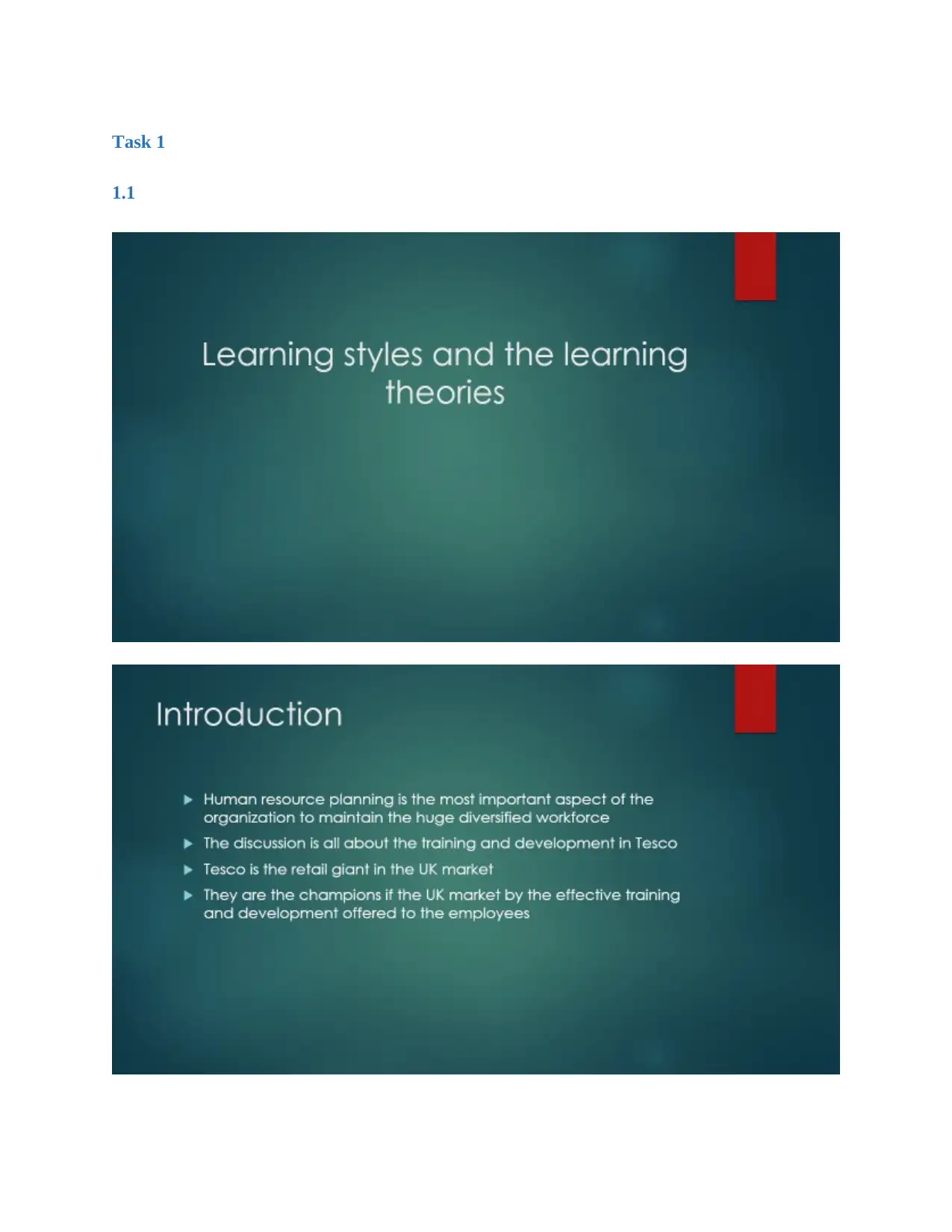
Task 1
1.1
1.1
⊘ This is a preview!⊘
Do you want full access?
Subscribe today to unlock all pages.

Trusted by 1+ million students worldwide
Paraphrase This Document
Need a fresh take? Get an instant paraphrase of this document with our AI Paraphraser
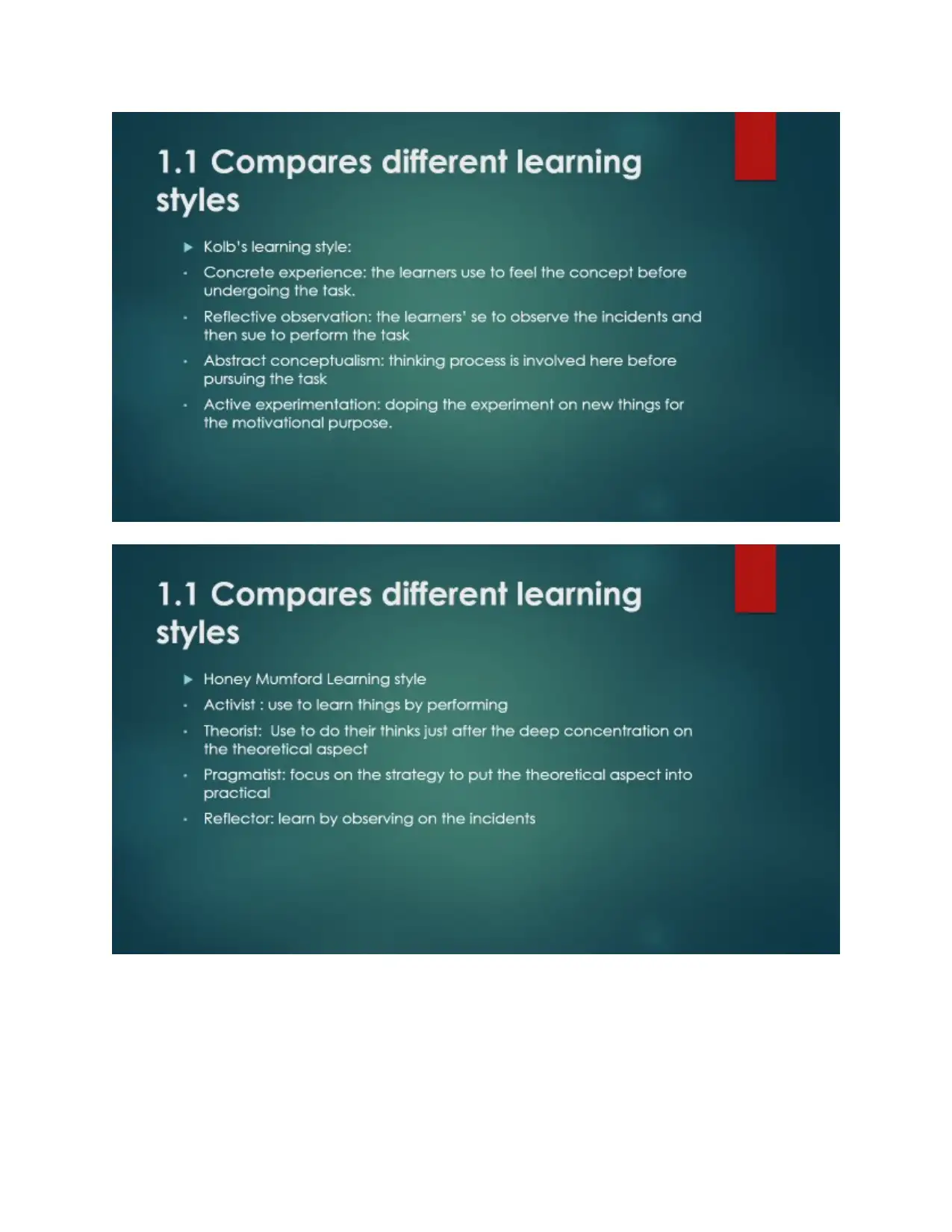
Level of learners use to influence the organisations to use the perfect learning style so
that the employees will be benefitted with this. The individual learning style is adapted based on
the individual performance level and the requirement to match up with market demand. On the
other hand, the organisation level learning style is required to change the management,
administration level change (Clarke, 2013). The different individual level learning styles are
discussed underneath-
Styles of learning Features
Kolb’s learning style The characteristics are :
Factual experience: It is essential for learners
to understand the concept before carrying out
the task.
Personal observation: It is essential for
learners to identify the incidents and then use
the same to carry out the task (Kolb & Kolb,
2012).
Abstract conceptualism: thinking process is
involved here before pursuing the task.
Active experimentation: doping the
experiment on new things for the motivational
purpose.
Honey Mumford Learning style The characteristics of the learners are:
that the employees will be benefitted with this. The individual learning style is adapted based on
the individual performance level and the requirement to match up with market demand. On the
other hand, the organisation level learning style is required to change the management,
administration level change (Clarke, 2013). The different individual level learning styles are
discussed underneath-
Styles of learning Features
Kolb’s learning style The characteristics are :
Factual experience: It is essential for learners
to understand the concept before carrying out
the task.
Personal observation: It is essential for
learners to identify the incidents and then use
the same to carry out the task (Kolb & Kolb,
2012).
Abstract conceptualism: thinking process is
involved here before pursuing the task.
Active experimentation: doping the
experiment on new things for the motivational
purpose.
Honey Mumford Learning style The characteristics of the learners are:

Activist : use to learn things by performing
Theorist: Use to do their thinks just after the
deep concentration on the theoretical aspect
Pragmatist: Here, it is essential for individual
to focus upon the tactic which helps in
converting theoretical aspect into practical.
Reflector: While, such aspect helps in
learning through carrying out observation of
the incidents (Mumford, 2013)
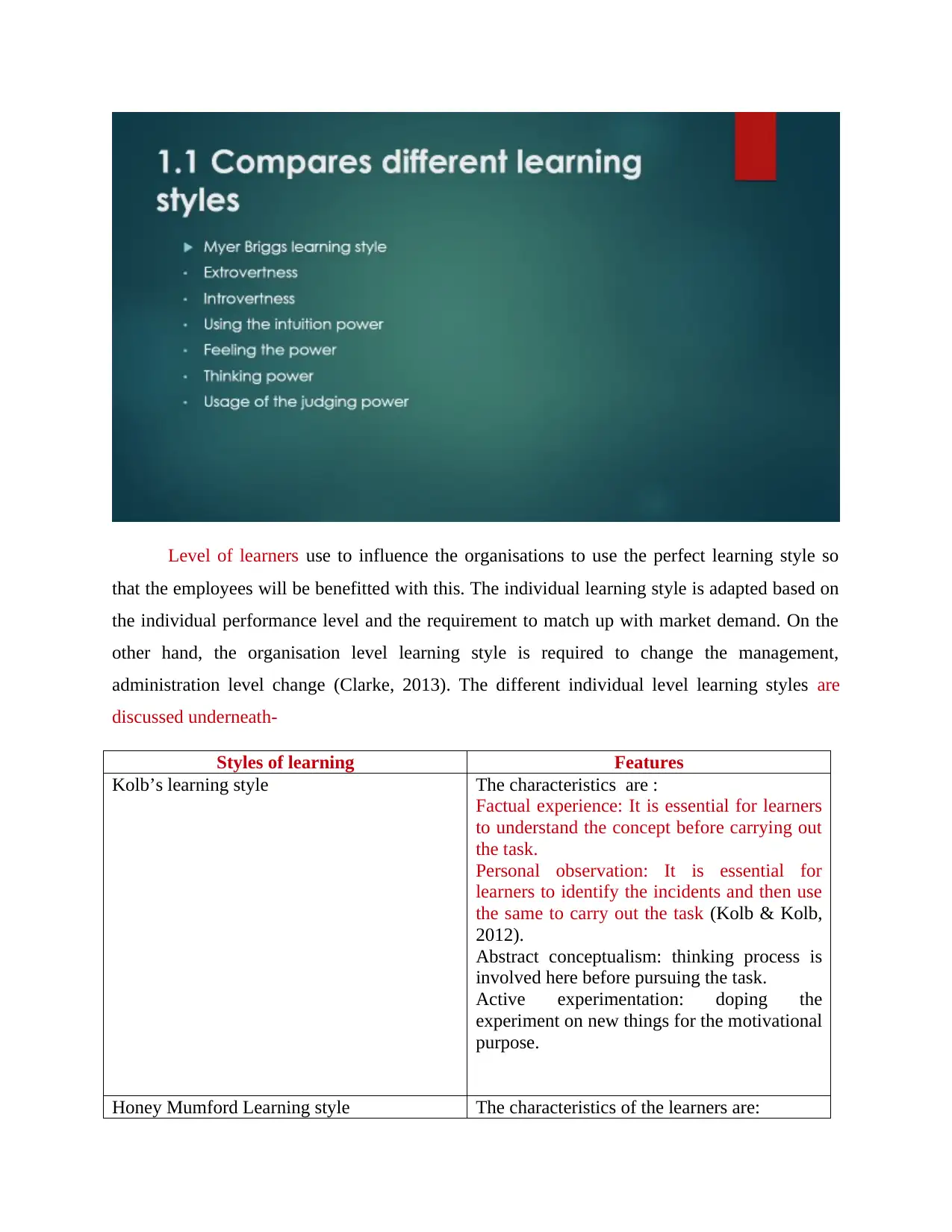
Myer Briggs learning style The characteristics are:
Extrovertness
Introvertness
Using the intuition power
Feeling the power
Thinking power
Usage of the judging power
(Sternberg & Zhang, 2014)
1.2
Theorist: Use to do their thinks just after the
deep concentration on the theoretical aspect
Pragmatist: Here, it is essential for individual
to focus upon the tactic which helps in
converting theoretical aspect into practical.
Reflector: While, such aspect helps in
learning through carrying out observation of
the incidents (Mumford, 2013)
Myer Briggs learning style The characteristics are:
Extrovertness
Introvertness
Using the intuition power
Feeling the power
Thinking power
Usage of the judging power
(Sternberg & Zhang, 2014)
1.2
⊘ This is a preview!⊘
Do you want full access?
Subscribe today to unlock all pages.
Trusted by 1+ million students worldwide
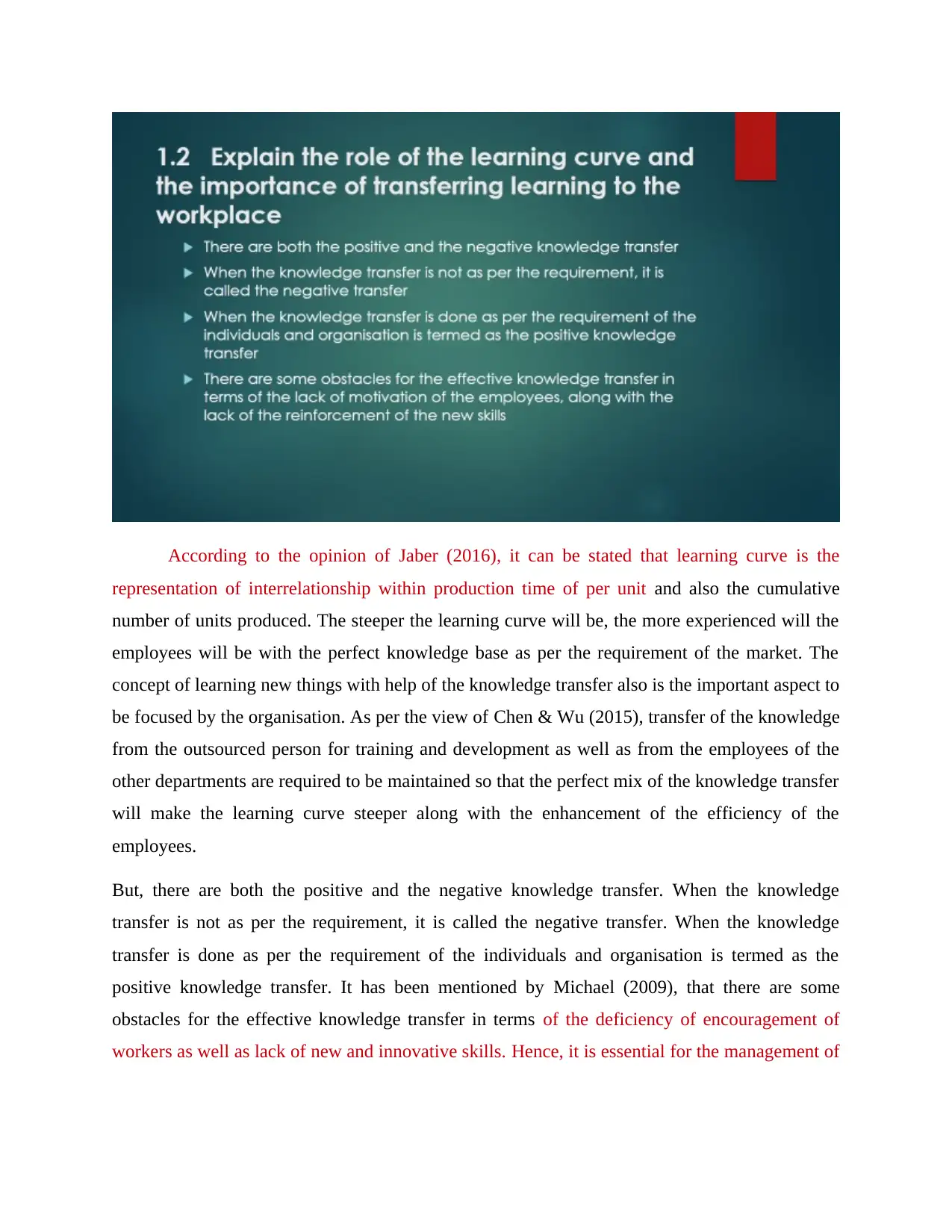
According to the opinion of Jaber (2016), it can be stated that learning curve is the
representation of interrelationship within production time of per unit and also the cumulative
number of units produced. The steeper the learning curve will be, the more experienced will the
employees will be with the perfect knowledge base as per the requirement of the market. The
concept of learning new things with help of the knowledge transfer also is the important aspect to
be focused by the organisation. As per the view of Chen & Wu (2015), transfer of the knowledge
from the outsourced person for training and development as well as from the employees of the
other departments are required to be maintained so that the perfect mix of the knowledge transfer
will make the learning curve steeper along with the enhancement of the efficiency of the
employees.
But, there are both the positive and the negative knowledge transfer. When the knowledge
transfer is not as per the requirement, it is called the negative transfer. When the knowledge
transfer is done as per the requirement of the individuals and organisation is termed as the
positive knowledge transfer. It has been mentioned by Michael (2009), that there are some
obstacles for the effective knowledge transfer in terms of the deficiency of encouragement of
workers as well as lack of new and innovative skills. Hence, it is essential for the management of
representation of interrelationship within production time of per unit and also the cumulative
number of units produced. The steeper the learning curve will be, the more experienced will the
employees will be with the perfect knowledge base as per the requirement of the market. The
concept of learning new things with help of the knowledge transfer also is the important aspect to
be focused by the organisation. As per the view of Chen & Wu (2015), transfer of the knowledge
from the outsourced person for training and development as well as from the employees of the
other departments are required to be maintained so that the perfect mix of the knowledge transfer
will make the learning curve steeper along with the enhancement of the efficiency of the
employees.
But, there are both the positive and the negative knowledge transfer. When the knowledge
transfer is not as per the requirement, it is called the negative transfer. When the knowledge
transfer is done as per the requirement of the individuals and organisation is termed as the
positive knowledge transfer. It has been mentioned by Michael (2009), that there are some
obstacles for the effective knowledge transfer in terms of the deficiency of encouragement of
workers as well as lack of new and innovative skills. Hence, it is essential for the management of
Paraphrase This Document
Need a fresh take? Get an instant paraphrase of this document with our AI Paraphraser
Tesco to provide positive knowledge and transfer the same through assessing the need and thus
employees will become more efficient by reflecting the steeper learning curve.
1.3
employees will become more efficient by reflecting the steeper learning curve.
1.3

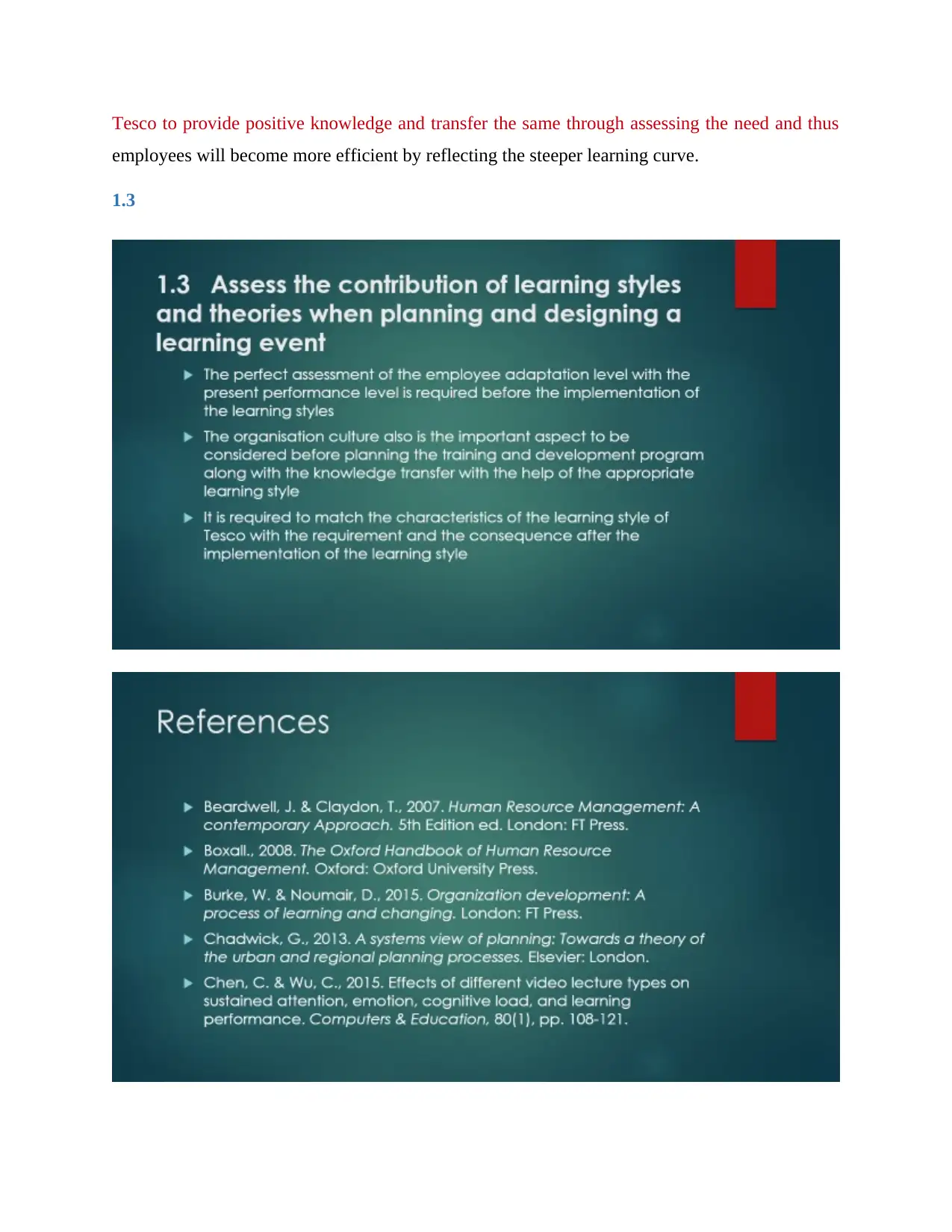
The perfect assessment of the employee adaptation level with the present performance level is
required before the implementation of the learning styles as the individual level as well as
organisational level. At the same time, the organisation culture also is the important aspect to be
considered before planning the training and development program along with the knowledge
transfer with the help of the appropriate learning style (Boxall., 2008). It is required to match the
characteristics of the learning style of Tesco with the requirement and the consequence after the
implementation of the learning style so that the maximum number of the employees will become
skilled and efficient to support the organisation performance at its best level (Beardwell &
Claydon, 2007).
Task 2
2.1
The organisation that has been chosen is Tesco. As per the view of Kolb (2014), training need is
defined as the shortage of the skills of the employees which can be reduced or removed with the
help of the perfect training and development programs. The training need analysis use to identify
the needs of the training and development at the individual level, department level and the
required before the implementation of the learning styles as the individual level as well as
organisational level. At the same time, the organisation culture also is the important aspect to be
considered before planning the training and development program along with the knowledge
transfer with the help of the appropriate learning style (Boxall., 2008). It is required to match the
characteristics of the learning style of Tesco with the requirement and the consequence after the
implementation of the learning style so that the maximum number of the employees will become
skilled and efficient to support the organisation performance at its best level (Beardwell &
Claydon, 2007).
Task 2
2.1
The organisation that has been chosen is Tesco. As per the view of Kolb (2014), training need is
defined as the shortage of the skills of the employees which can be reduced or removed with the
help of the perfect training and development programs. The training need analysis use to identify
the needs of the training and development at the individual level, department level and the
⊘ This is a preview!⊘
Do you want full access?
Subscribe today to unlock all pages.
Trusted by 1+ million students worldwide
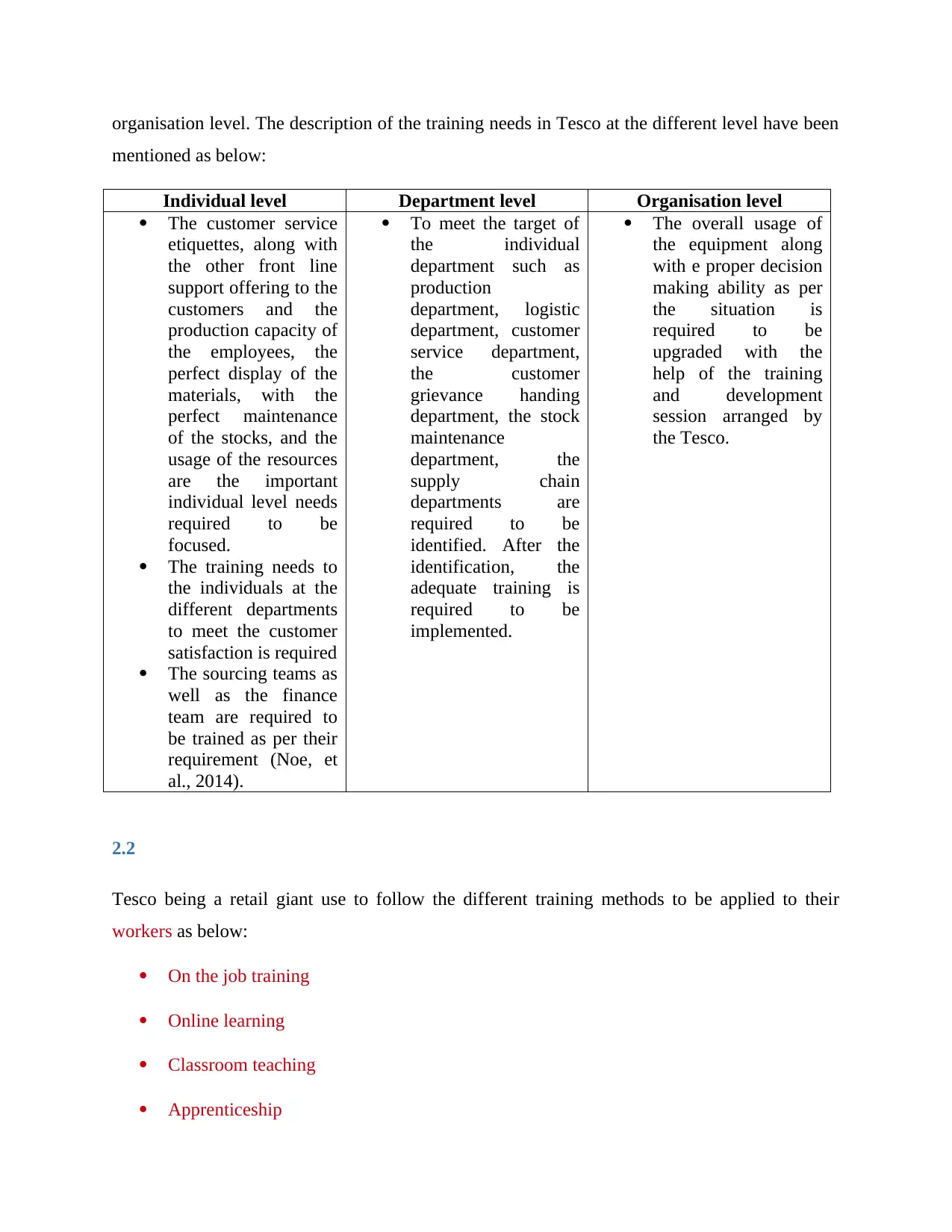
organisation level. The description of the training needs in Tesco at the different level have been
mentioned as below:
Individual level Department level Organisation level
The customer service
etiquettes, along with
the other front line
support offering to the
customers and the
production capacity of
the employees, the
perfect display of the
materials, with the
perfect maintenance
of the stocks, and the
usage of the resources
are the important
individual level needs
required to be
focused.
The training needs to
the individuals at the
different departments
to meet the customer
satisfaction is required
The sourcing teams as
well as the finance
team are required to
be trained as per their
requirement (Noe, et
al., 2014).
To meet the target of
the individual
department such as
production
department, logistic
department, customer
service department,
the customer
grievance handing
department, the stock
maintenance
department, the
supply chain
departments are
required to be
identified. After the
identification, the
adequate training is
required to be
implemented.
The overall usage of
the equipment along
with e proper decision
making ability as per
the situation is
required to be
upgraded with the
help of the training
and development
session arranged by
the Tesco.
2.2
Tesco being a retail giant use to follow the different training methods to be applied to their
workers as below:
On the job training
Online learning
Classroom teaching
Apprenticeship
mentioned as below:
Individual level Department level Organisation level
The customer service
etiquettes, along with
the other front line
support offering to the
customers and the
production capacity of
the employees, the
perfect display of the
materials, with the
perfect maintenance
of the stocks, and the
usage of the resources
are the important
individual level needs
required to be
focused.
The training needs to
the individuals at the
different departments
to meet the customer
satisfaction is required
The sourcing teams as
well as the finance
team are required to
be trained as per their
requirement (Noe, et
al., 2014).
To meet the target of
the individual
department such as
production
department, logistic
department, customer
service department,
the customer
grievance handing
department, the stock
maintenance
department, the
supply chain
departments are
required to be
identified. After the
identification, the
adequate training is
required to be
implemented.
The overall usage of
the equipment along
with e proper decision
making ability as per
the situation is
required to be
upgraded with the
help of the training
and development
session arranged by
the Tesco.
2.2
Tesco being a retail giant use to follow the different training methods to be applied to their
workers as below:
On the job training
Online learning
Classroom teaching
Apprenticeship
Paraphrase This Document
Need a fresh take? Get an instant paraphrase of this document with our AI Paraphraser
Off the job training (Teso, 2016)
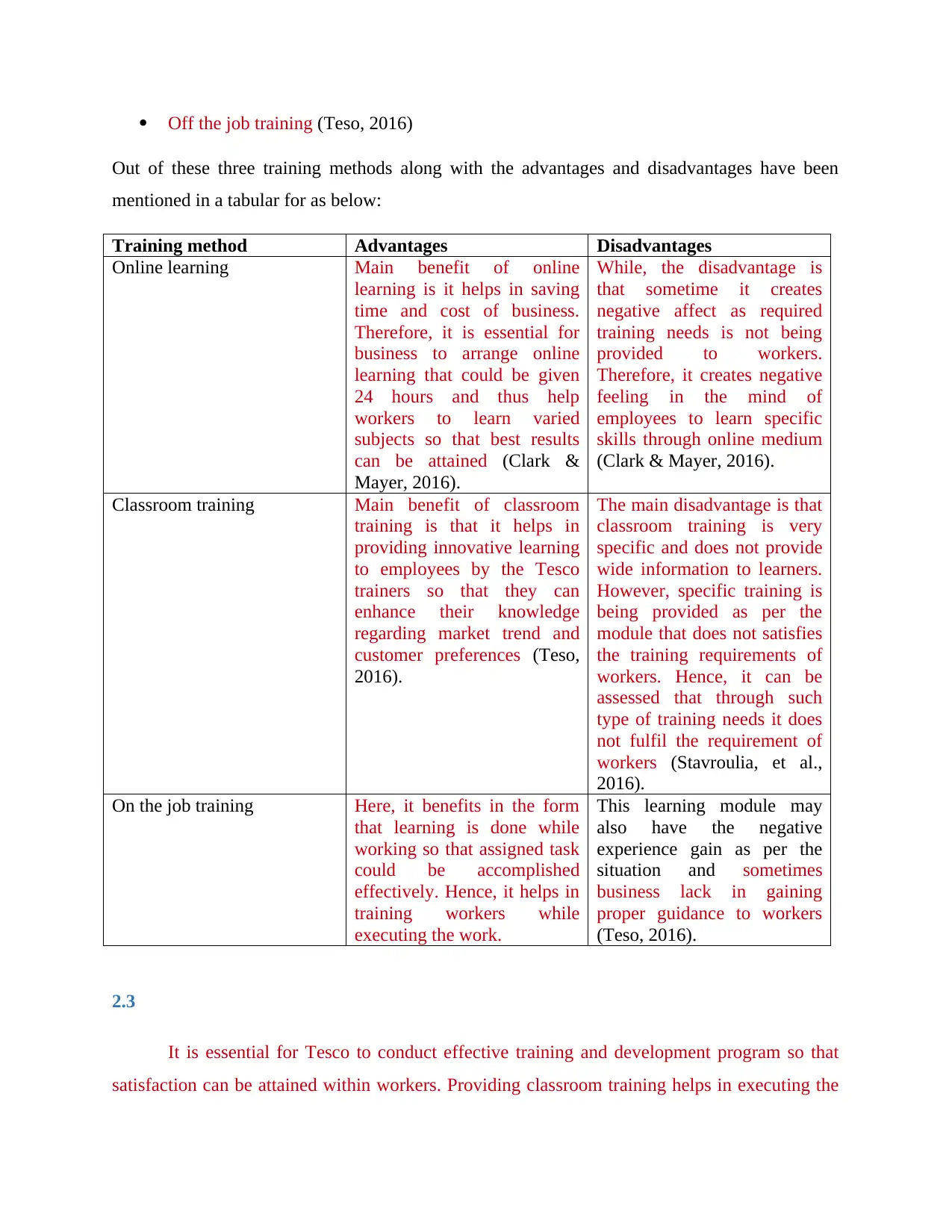
Out of these three training methods along with the advantages and disadvantages have been
mentioned in a tabular for as below:
Training method Advantages Disadvantages
Online learning Main benefit of online
learning is it helps in saving
time and cost of business.
Therefore, it is essential for
business to arrange online
learning that could be given
24 hours and thus help
workers to learn varied
subjects so that best results
can be attained (Clark &
Mayer, 2016).
While, the disadvantage is
that sometime it creates
negative affect as required
training needs is not being
provided to workers.
Therefore, it creates negative
feeling in the mind of
employees to learn specific
skills through online medium
(Clark & Mayer, 2016).
Classroom training Main benefit of classroom
training is that it helps in
providing innovative learning
to employees by the Tesco
trainers so that they can
enhance their knowledge
regarding market trend and
customer preferences (Teso,
2016).
The main disadvantage is that
classroom training is very
specific and does not provide
wide information to learners.
However, specific training is
being provided as per the
module that does not satisfies
the training requirements of
workers. Hence, it can be
assessed that through such
type of training needs it does
not fulfil the requirement of
workers (Stavroulia, et al.,
2016).
On the job training Here, it benefits in the form
that learning is done while
working so that assigned task
could be accomplished
effectively. Hence, it helps in
training workers while
executing the work.
This learning module may
also have the negative
experience gain as per the
situation and sometimes
business lack in gaining
proper guidance to workers
(Teso, 2016).
2.3
It is essential for Tesco to conduct effective training and development program so that
satisfaction can be attained within workers. Providing classroom training helps in executing the
Out of these three training methods along with the advantages and disadvantages have been
mentioned in a tabular for as below:
Training method Advantages Disadvantages
Online learning Main benefit of online
learning is it helps in saving
time and cost of business.
Therefore, it is essential for
business to arrange online
learning that could be given
24 hours and thus help
workers to learn varied
subjects so that best results
can be attained (Clark &
Mayer, 2016).
While, the disadvantage is
that sometime it creates
negative affect as required
training needs is not being
provided to workers.
Therefore, it creates negative
feeling in the mind of
employees to learn specific
skills through online medium
(Clark & Mayer, 2016).
Classroom training Main benefit of classroom
training is that it helps in
providing innovative learning
to employees by the Tesco
trainers so that they can
enhance their knowledge
regarding market trend and
customer preferences (Teso,
2016).
The main disadvantage is that
classroom training is very
specific and does not provide
wide information to learners.
However, specific training is
being provided as per the
module that does not satisfies
the training requirements of
workers. Hence, it can be
assessed that through such
type of training needs it does
not fulfil the requirement of
workers (Stavroulia, et al.,
2016).
On the job training Here, it benefits in the form
that learning is done while
working so that assigned task
could be accomplished
effectively. Hence, it helps in
training workers while
executing the work.
This learning module may
also have the negative
experience gain as per the
situation and sometimes
business lack in gaining
proper guidance to workers
(Teso, 2016).
2.3
It is essential for Tesco to conduct effective training and development program so that
satisfaction can be attained within workers. Providing classroom training helps in executing the

business operations in a successful way. Following is the training and development approach
being prepared in order to carry out proper training plan such as-
Training and
development
approach
Criteria
Identifying the
training need
Here, it is essential for management of Tesso to assess the training needs
of all the employees so that overall performance could be improved.
Assessing the
employees who
requires training
Such step is crucial in order to provide proper lectures and notes to be
provided to employees in order to learn different subject
Identifying the
training need which is
aligned with the
Tesco objectives
Further, it is essential to identify that whether the training lectures and
notes provides to learners is enough to meet the objectives of Tesco or
not.
Finding the suitable
trainers to conduct
training program
(Chadwick, 2013)
Tesco needs to appoint appropriate trainers and communicate with them
so that they can deliver proper training to workers.
Assessing the method
of transferring
knowledge
Here, trainers are required to develop appropriate plan which helps in
transferring the knowledge so that training session could be enhanced
and result into improving the skills of workers.
Monitoring the
training
Employees need to monitor the training process so that it could be
improvised and thus attain successful results (Chadwick, 2013).
Adopting proper
training module
Trainers are required to plan appropriate module for training and thus
fulfil the needs of workers so that best results can be attained.
being prepared in order to carry out proper training plan such as-
Training and
development
approach
Criteria
Identifying the
training need
Here, it is essential for management of Tesso to assess the training needs
of all the employees so that overall performance could be improved.
Assessing the
employees who
requires training
Such step is crucial in order to provide proper lectures and notes to be
provided to employees in order to learn different subject
Identifying the
training need which is
aligned with the
Tesco objectives
Further, it is essential to identify that whether the training lectures and
notes provides to learners is enough to meet the objectives of Tesco or
not.
Finding the suitable
trainers to conduct
training program
(Chadwick, 2013)
Tesco needs to appoint appropriate trainers and communicate with them
so that they can deliver proper training to workers.
Assessing the method
of transferring
knowledge
Here, trainers are required to develop appropriate plan which helps in
transferring the knowledge so that training session could be enhanced
and result into improving the skills of workers.
Monitoring the
training
Employees need to monitor the training process so that it could be
improvised and thus attain successful results (Chadwick, 2013).
Adopting proper
training module
Trainers are required to plan appropriate module for training and thus
fulfil the needs of workers so that best results can be attained.
⊘ This is a preview!⊘
Do you want full access?
Subscribe today to unlock all pages.
Trusted by 1+ million students worldwide

1 out of 22


Related Documents


Your All-in-One AI-Powered Toolkit for Academic Success.
+13062052269
info@desklib.com
Available 24*7 on WhatsApp / Email
![[object Object]](/_next/static/media/star-bottom.7253800d.svg)
Unlock your academic potential
Copyright © 2020–2026 A2Z Services. All Rights Reserved. Developed and managed by ZUCOL.