Human Resource Management: Marketing Manager - Job Design & Analysis
VerifiedAdded on 2023/06/10
|9
|2638
|380
Report
AI Summary
This report provides a comprehensive analysis of Human Resource Management (HRM) principles applied to a Marketing Manager role. It covers key aspects such as job description and specifications, outlining the responsibilities and qualifications required for the position. The report also designs a compensation and benefits package, considering various elements like insurance, vacation policy, and retirement plans. Furthermore, it details a performance appraisal program to evaluate and improve the manager's performance. Finally, the report addresses common issues faced by marketing managers in HRM, such as training, safety, and work-life balance. The considerations undertaken in analyzing and designing various programs are also discussed, providing a holistic view of managing a marketing role within an organization.
RUNNING HEAD: Human Resource Management 0
Human Resource Management
Human Resource Management

Paraphrase This Document
Need a fresh take? Get an instant paraphrase of this document with our AI Paraphraser
Human Resource Management 1
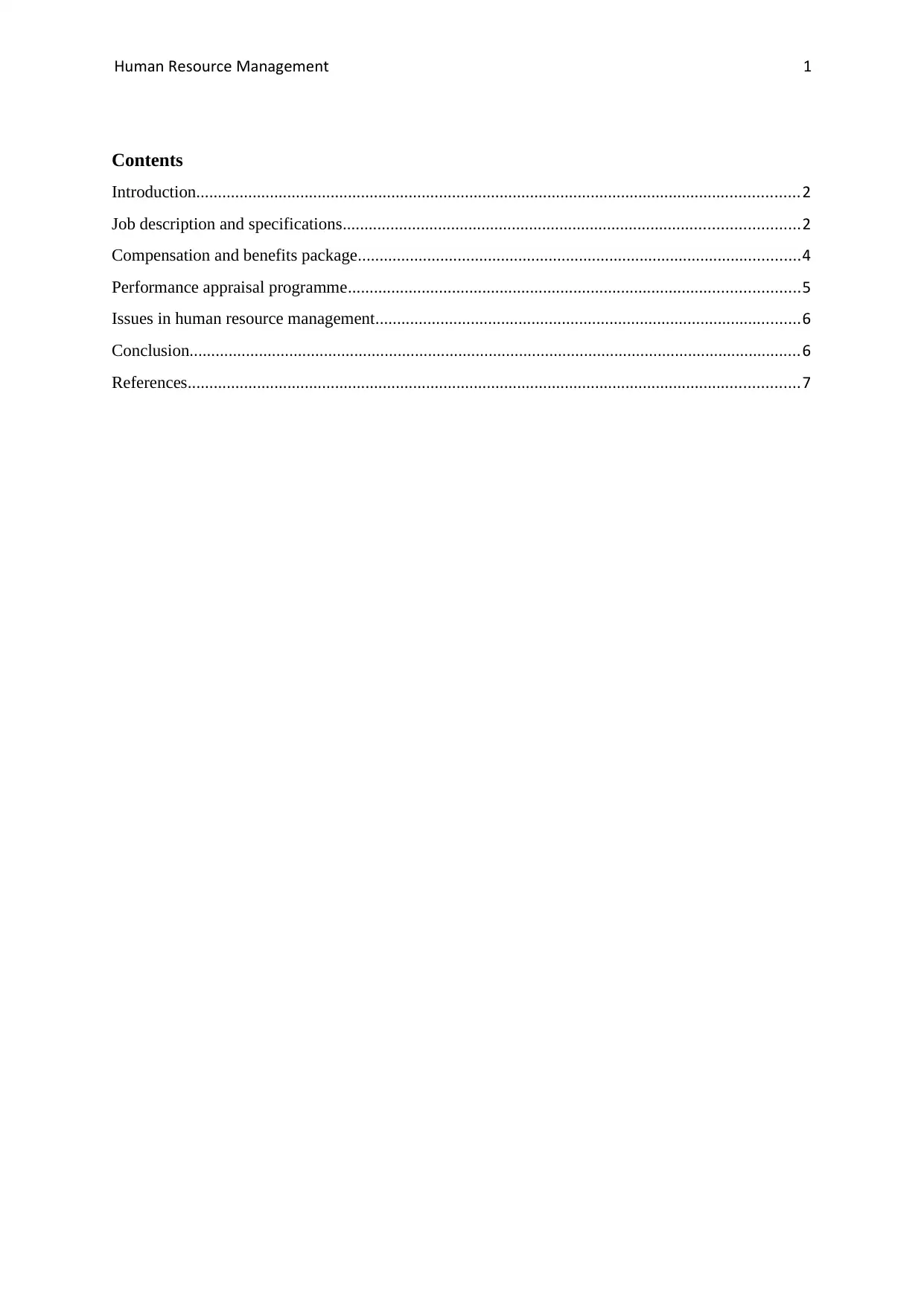
Contents
Introduction...........................................................................................................................................2
Job description and specifications.........................................................................................................2
Compensation and benefits package......................................................................................................4
Performance appraisal programme........................................................................................................5
Issues in human resource management..................................................................................................6
Conclusion.............................................................................................................................................6
References.............................................................................................................................................7
Contents
Introduction...........................................................................................................................................2
Job description and specifications.........................................................................................................2
Compensation and benefits package......................................................................................................4
Performance appraisal programme........................................................................................................5
Issues in human resource management..................................................................................................6
Conclusion.............................................................................................................................................6
References.............................................................................................................................................7
Human Resource Management 2
Introduction
The human resource management is an effective approach for the staff of an organization to
focus on the policies and procedures. The human resource management is responsible to
oversee the benefit designs, recruitment, training, development and performance appraisal of
employees and managers. It ensures that a company is able to achieve success through it’s
people. In this report, a dream job of a marketing manager is created. In order to create this
job, compensation plan and appraisal performance build. The report defines the job
description and specifications of a marketing manager. The compensation and benefits
package related to the job are designed. Further, the performance appraisal programme has
been defined. Finally, the issues faced by the marketing managers in the human resource
management have been defined. Various considerations are undertaken in analyzing and
designing various programmes.
Job description and specifications
Marketing has an important role to play in every industry. It ensures needs of customers
along with maximizing profits of the company. The responsibilities of marketing manager
vary immensely but will always have it as significant objective (Boxall, Guthrie & Paauwe,
2016). The marketing managers use an extensive variety of marketing techniques and
develop new means of communication with the reputable and potential customers.
Job analysis
The marketing managers are accountable for emerging, implementing and executing strategic
marketing plans for the entire organization. The strategic marketing plans are helpful in
attracting potential customers and retaining existing customers. The daily task of managers
includes managing and coordinating marketing activities (Negash, Zewude & Megersa,
2014). The managers carry on market research efforts to discover the feasibility of current
and existing products and services. The analysis of marketing manager’s job can be done by
knowing following responsibilities:
Develop strategies and policies to let the world know about the company.
Deploy successful marketing campaigns and implementation of ideas from planning
to execution.
Experiment with a variety of channels.
Introduction
The human resource management is an effective approach for the staff of an organization to
focus on the policies and procedures. The human resource management is responsible to
oversee the benefit designs, recruitment, training, development and performance appraisal of
employees and managers. It ensures that a company is able to achieve success through it’s
people. In this report, a dream job of a marketing manager is created. In order to create this
job, compensation plan and appraisal performance build. The report defines the job
description and specifications of a marketing manager. The compensation and benefits
package related to the job are designed. Further, the performance appraisal programme has
been defined. Finally, the issues faced by the marketing managers in the human resource
management have been defined. Various considerations are undertaken in analyzing and
designing various programmes.
Job description and specifications
Marketing has an important role to play in every industry. It ensures needs of customers
along with maximizing profits of the company. The responsibilities of marketing manager
vary immensely but will always have it as significant objective (Boxall, Guthrie & Paauwe,
2016). The marketing managers use an extensive variety of marketing techniques and
develop new means of communication with the reputable and potential customers.
Job analysis
The marketing managers are accountable for emerging, implementing and executing strategic
marketing plans for the entire organization. The strategic marketing plans are helpful in
attracting potential customers and retaining existing customers. The daily task of managers
includes managing and coordinating marketing activities (Negash, Zewude & Megersa,
2014). The managers carry on market research efforts to discover the feasibility of current
and existing products and services. The analysis of marketing manager’s job can be done by
knowing following responsibilities:
Develop strategies and policies to let the world know about the company.
Deploy successful marketing campaigns and implementation of ideas from planning
to execution.
Experiment with a variety of channels.
⊘ This is a preview!⊘
Do you want full access?
Subscribe today to unlock all pages.

Trusted by 1+ million students worldwide
Human Resource Management 3
Produce valuable and appealing content for the website which attracts established and
potential customers.
The marketing manager is also responsible to build strategic relationships and
partners in the industry.
The manager takes charge of marketing budget and allocates funds wisely.
He measures and reports progress of marketing campaigns and evaluates against
goals.
Job description
The task and duties of the marketing managers depends on the size of company and structure
of industry. It includes monitoring and analysing market trends and investigates products and
services of competitors. The marketing manager explores methods to develop existing
products and services and increase profitability. He takes measures to identify target markets
and develop strategies to communicate with them (Fox & Cowan, 2015). The managers
mostly work for 37 hours a week, from 9am to 6 pm. The managers are also expected to work
more with urgent deadlines. The managers are anticipated to work for additional hours to
meet targets within deadline. It also requires travelling when working at a MNC. The
marketing manager should have sufficient understanding of marketing concepts and
techniques. He should be able to think creatively and tackle pressure. The marketing manager
should have excellent communication skills and have interest in motivating subordinates.
Job specifications
The marketing manager is accountable for the administration of marketing department. The
requirements of job are determined by the job analysis and derived from the job description.
The experienced marketing managers possess ten years of accountable positions in marketing
if possible in the similar industry. They must have supervised and managed professional staff
of 7. The manager must possess bachelor’s degree in marketing or any associated field. He
can equally possess masters in marketing. The mandatory skills of marketing managers
include strong and effective communication. The managers should be highly developed and
demonstrated teamwork skills. The further specifications include capability to harmonize
efforts of team of various talented employees. It also determines capability to enhance
productivity and improvement procedures, approaches and obligation to continuous learning.
The manager is required to be expertise in internet and social media strategy (Marchington,
2015). He should be effective in signifying effectiveness in holding conversations with
Produce valuable and appealing content for the website which attracts established and
potential customers.
The marketing manager is also responsible to build strategic relationships and
partners in the industry.
The manager takes charge of marketing budget and allocates funds wisely.
He measures and reports progress of marketing campaigns and evaluates against
goals.
Job description
The task and duties of the marketing managers depends on the size of company and structure
of industry. It includes monitoring and analysing market trends and investigates products and
services of competitors. The marketing manager explores methods to develop existing
products and services and increase profitability. He takes measures to identify target markets
and develop strategies to communicate with them (Fox & Cowan, 2015). The managers
mostly work for 37 hours a week, from 9am to 6 pm. The managers are also expected to work
more with urgent deadlines. The managers are anticipated to work for additional hours to
meet targets within deadline. It also requires travelling when working at a MNC. The
marketing manager should have sufficient understanding of marketing concepts and
techniques. He should be able to think creatively and tackle pressure. The marketing manager
should have excellent communication skills and have interest in motivating subordinates.
Job specifications
The marketing manager is accountable for the administration of marketing department. The
requirements of job are determined by the job analysis and derived from the job description.
The experienced marketing managers possess ten years of accountable positions in marketing
if possible in the similar industry. They must have supervised and managed professional staff
of 7. The manager must possess bachelor’s degree in marketing or any associated field. He
can equally possess masters in marketing. The mandatory skills of marketing managers
include strong and effective communication. The managers should be highly developed and
demonstrated teamwork skills. The further specifications include capability to harmonize
efforts of team of various talented employees. It also determines capability to enhance
productivity and improvement procedures, approaches and obligation to continuous learning.
The manager is required to be expertise in internet and social media strategy (Marchington,
2015). He should be effective in signifying effectiveness in holding conversations with
Paraphrase This Document
Need a fresh take? Get an instant paraphrase of this document with our AI Paraphraser
Human Resource Management 4
customers. The manager should have efficiency to lead in an environment of continuous
change. He should have understanding of functioning in a flexible and employee authorizing
work environment. The understanding of working in a global marketplace is a positive
criterion (Stone, Deadrick, Lukaszewski & Johnson, 2015).
Compensation and benefits package
The companies find effective ways to promote benefits of marketing managers. These are
vital for appealing new staff and retain current staff. The marketing manager is the only one
kind of job in the association (Rosen, Kacmar, Harris, Gavin & Hochwarter, 2017). The
compensation and benefits packages may vary widely. The added benefits comprises car
allowances, insurance, pension schemes, share options and more. They are also offered
bonuses which are linked to the performances. The items included in compensation and
benefits package are given below.
Insurance: There are various options for insurance provided to the marketing
managers. The most popular insurance among all is healthcare insurance (Kroneman
& De Jong, 2015). The other insurances which can sort benefit packages more
attractive are short term and long term incapacity, vision and dental insurance.
Vacation policy: The marketing managers are provided 9 paid holidays on an average.
They are also offered one floating holiday each year that can be used by them as a
holiday. The paid time off usually comprises of allowances of time off that undertakes
sick and casual leaves. The companies have embraced a PTO program which honours
employees with a certain number of paid leave days which can be used by the
employees for the specific purpose (Kramar, 2014).
Retirement saving plans: The retirement plan is available for the managers. It is an
easy and operative way for the managers to plan for the retirement. It makes tax
mentioned assistance to an investment fund. The managers also receive tax deductions
by making an investment in the retirement savings plan (Urtasun-Alonso, Larraza-
Kintana, García-Olaverri & Huerta-Arribas, 2014).
Salary is the most popular method of employee compensation. The other benefits focus on
the stability, lifestyle and health and wellness of employees. In terms of incentives, managers
get the short term and long term incentives (Knotz & Lindvall, 2015). These incentives
customers. The manager should have efficiency to lead in an environment of continuous
change. He should have understanding of functioning in a flexible and employee authorizing
work environment. The understanding of working in a global marketplace is a positive
criterion (Stone, Deadrick, Lukaszewski & Johnson, 2015).
Compensation and benefits package
The companies find effective ways to promote benefits of marketing managers. These are
vital for appealing new staff and retain current staff. The marketing manager is the only one
kind of job in the association (Rosen, Kacmar, Harris, Gavin & Hochwarter, 2017). The
compensation and benefits packages may vary widely. The added benefits comprises car
allowances, insurance, pension schemes, share options and more. They are also offered
bonuses which are linked to the performances. The items included in compensation and
benefits package are given below.
Insurance: There are various options for insurance provided to the marketing
managers. The most popular insurance among all is healthcare insurance (Kroneman
& De Jong, 2015). The other insurances which can sort benefit packages more
attractive are short term and long term incapacity, vision and dental insurance.
Vacation policy: The marketing managers are provided 9 paid holidays on an average.
They are also offered one floating holiday each year that can be used by them as a
holiday. The paid time off usually comprises of allowances of time off that undertakes
sick and casual leaves. The companies have embraced a PTO program which honours
employees with a certain number of paid leave days which can be used by the
employees for the specific purpose (Kramar, 2014).
Retirement saving plans: The retirement plan is available for the managers. It is an
easy and operative way for the managers to plan for the retirement. It makes tax
mentioned assistance to an investment fund. The managers also receive tax deductions
by making an investment in the retirement savings plan (Urtasun-Alonso, Larraza-
Kintana, García-Olaverri & Huerta-Arribas, 2014).
Salary is the most popular method of employee compensation. The other benefits focus on
the stability, lifestyle and health and wellness of employees. In terms of incentives, managers
get the short term and long term incentives (Knotz & Lindvall, 2015). These incentives
Human Resource Management 5
include performance bonus, commissions, and stock options. The non-cash compensation
concentrates on the lifestyle and value of marketing managers. It also includes flexible work
hours, work from home and office space improvements. There is some direct and indirect
form of rewards also to encourage managers which results in the desired business outcomes.
Performance appraisal programme
The performance appraisal is the efficient estimation of the performance of marketing
managers. It understands the capabilities of managers for the further progress and
development. The performance appraisal programme undertakes:
The authorities measure the pay of marketing managers and match it with the target
and undertaken measures.
The factors behind the work performance of managers are analyzed.
The higher authorities are in a position to guide managers to achieve better
performance.
The advantages of performance appraisal programme are an investment for the company.
This programme helps higher authorities to chalk out the programme for the resourceful
marketing managers. In this case, unproductive marketing managers can be terminated from
the organization. The performance appraisal benefits in chalking out the compensation
packages. The merit rating can be done with the help of performance appraisal programme
(Denisi & Smith, 2014). It offers worth to a performance. The compensation consists of
bonus, salary packages, additional benefits and allowances. The criteria are decided on the
basis of merit rather than supremacy. The practice of performance appraisal helps authorities
to form training policies and programmes. It is helpful in evaluating strength and weaknesses
of managers so that new job can be planned according to it. It is also helpful in understanding
validity and importance of selection procedure. The future changes can also be implemented
in this process. The communication with the marketing managers can be sought out in the
various ways like; the managers can appreciate and admit skills of assistants. The managers
can comprehend and build trust and confidence in the employees. It is also supportive in
preserving amiable and friendly labour management relationship. It advances the essence of
work and boosts the confidence of managers (Dusterhoff, Cunningham & MacGregor, 2014).
The performance appraisal also works as a motivational tool. The evaluation of performance
include performance bonus, commissions, and stock options. The non-cash compensation
concentrates on the lifestyle and value of marketing managers. It also includes flexible work
hours, work from home and office space improvements. There is some direct and indirect
form of rewards also to encourage managers which results in the desired business outcomes.
Performance appraisal programme
The performance appraisal is the efficient estimation of the performance of marketing
managers. It understands the capabilities of managers for the further progress and
development. The performance appraisal programme undertakes:
The authorities measure the pay of marketing managers and match it with the target
and undertaken measures.
The factors behind the work performance of managers are analyzed.
The higher authorities are in a position to guide managers to achieve better
performance.
The advantages of performance appraisal programme are an investment for the company.
This programme helps higher authorities to chalk out the programme for the resourceful
marketing managers. In this case, unproductive marketing managers can be terminated from
the organization. The performance appraisal benefits in chalking out the compensation
packages. The merit rating can be done with the help of performance appraisal programme
(Denisi & Smith, 2014). It offers worth to a performance. The compensation consists of
bonus, salary packages, additional benefits and allowances. The criteria are decided on the
basis of merit rather than supremacy. The practice of performance appraisal helps authorities
to form training policies and programmes. It is helpful in evaluating strength and weaknesses
of managers so that new job can be planned according to it. It is also helpful in understanding
validity and importance of selection procedure. The future changes can also be implemented
in this process. The communication with the marketing managers can be sought out in the
various ways like; the managers can appreciate and admit skills of assistants. The managers
can comprehend and build trust and confidence in the employees. It is also supportive in
preserving amiable and friendly labour management relationship. It advances the essence of
work and boosts the confidence of managers (Dusterhoff, Cunningham & MacGregor, 2014).
The performance appraisal also works as a motivational tool. The evaluation of performance
⊘ This is a preview!⊘
Do you want full access?
Subscribe today to unlock all pages.
Trusted by 1+ million students worldwide
Human Resource Management 6
measures the efficiency of managers. It also helps in determining whether targets are
achieved or not. It motivates managers to perform their job in a better way.
Issues in human resource management
The issue faced in human resource management is training and safety of the marketing
managers. The training is an important part of the routine operations of the business. Training
is a must for the organizations as every company has different practices to follow. It is also an
investment process. The marketing managers are required to train properly so that they can
conduct marketing activities efficiently. It is the responsibility of human resource
management to make available training for the routine work, financial costs and coordination
with other parties (Ding, Kam, Zhang & Jie, 2015).
Safety is also an important concern of the company. The organizations prefer to adopt
practices which are more likely to reduce risks and promote safety. The issues such as health
and mental are required to be considered for the organization of staff and departments. There
are more issues faced by human resource management such as longer hours of working
(Sheehan, 2014). The work life of managers is required to be balanced so that human
resource management can focus on the major issues of the organization.
Conclusion
In this report, job description and specification of a marketing manager have been discussed.
It tells the duties and responsibilities of the marketing managers as well. A compensation and
benefits package related the job of the marketing manager has been discussed as well. The
considerations are also discussed which are undertaken as a part of designing compensation
and benefits packages. The performance appraisal programmes for the marketing managers
have been explained which are helpful in improving the performance of the marketing
managers. Finally, the issues faced by the managers in the human resource management have
been discussed. Resolving these issues can immensely improve the performance of the
organization as well.
measures the efficiency of managers. It also helps in determining whether targets are
achieved or not. It motivates managers to perform their job in a better way.
Issues in human resource management
The issue faced in human resource management is training and safety of the marketing
managers. The training is an important part of the routine operations of the business. Training
is a must for the organizations as every company has different practices to follow. It is also an
investment process. The marketing managers are required to train properly so that they can
conduct marketing activities efficiently. It is the responsibility of human resource
management to make available training for the routine work, financial costs and coordination
with other parties (Ding, Kam, Zhang & Jie, 2015).
Safety is also an important concern of the company. The organizations prefer to adopt
practices which are more likely to reduce risks and promote safety. The issues such as health
and mental are required to be considered for the organization of staff and departments. There
are more issues faced by human resource management such as longer hours of working
(Sheehan, 2014). The work life of managers is required to be balanced so that human
resource management can focus on the major issues of the organization.
Conclusion
In this report, job description and specification of a marketing manager have been discussed.
It tells the duties and responsibilities of the marketing managers as well. A compensation and
benefits package related the job of the marketing manager has been discussed as well. The
considerations are also discussed which are undertaken as a part of designing compensation
and benefits packages. The performance appraisal programmes for the marketing managers
have been explained which are helpful in improving the performance of the marketing
managers. Finally, the issues faced by the managers in the human resource management have
been discussed. Resolving these issues can immensely improve the performance of the
organization as well.
Paraphrase This Document
Need a fresh take? Get an instant paraphrase of this document with our AI Paraphraser
Human Resource Management 7
References
Boxall, P., Guthrie, J. P., & Paauwe, J. (2016). Editorial introduction: Progressing our
understanding of the mediating variables linking HRM, employee well‐being and
organisational performance. Human Resource Management Journal, 26(2), 103-111.
Denisi, A., & Smith, C. E. (2014). Performance appraisal, performance management, and
firm-level performance: A review, a proposed model, and new directions for future
research. The Academy of Management Annals, 8(1), 127-179.
Ding, M. J., Kam, B. H., Zhang, J. Y., & Jie, F. (2015). Effects of human resource
management practices on logistics and supply chain competencies–evidence from
China logistics service market. International Journal of Production Research, 53(10),
2885-2903.
Dusterhoff, C., Cunningham, J. B., & MacGregor, J. N. (2014). The effects of performance
rating, leader–member exchange, perceived utility, and organizational justice on
performance appraisal satisfaction: Applying a moral judgment perspective. Journal
of business ethics, 119(2), 265-273.
Fox, S., & Cowan, R. L. (2015). Revision of the workplace bullying checklist: the importance
of human resource management's role in defining and addressing workplace
bullying. Human Resource Management Journal, 25(1), 116-130.
Knotz, C., & Lindvall, J. (2015). Coalitions and compensation: The case of unemployment
benefit duration. Comparative Political Studies, 48(5), 586-615.
Kramar, R. (2014). Beyond strategic human resource management: is sustainable human
resource management the next approach?. The International Journal of Human
Resource Management, 25(8), 1069-1089.
Kroneman, M., & De Jong, J. D. (2015). The basic benefit package: Composition and
exceptions to the rules. A case study. Health Policy, 119(3), 245-251.
Marchington, M. (2015). Human resource management (HRM): Too busy looking up to see
where it is going longer term?. Human Resource Management Review, 25(2), 176-
187.
References
Boxall, P., Guthrie, J. P., & Paauwe, J. (2016). Editorial introduction: Progressing our
understanding of the mediating variables linking HRM, employee well‐being and
organisational performance. Human Resource Management Journal, 26(2), 103-111.
Denisi, A., & Smith, C. E. (2014). Performance appraisal, performance management, and
firm-level performance: A review, a proposed model, and new directions for future
research. The Academy of Management Annals, 8(1), 127-179.
Ding, M. J., Kam, B. H., Zhang, J. Y., & Jie, F. (2015). Effects of human resource
management practices on logistics and supply chain competencies–evidence from
China logistics service market. International Journal of Production Research, 53(10),
2885-2903.
Dusterhoff, C., Cunningham, J. B., & MacGregor, J. N. (2014). The effects of performance
rating, leader–member exchange, perceived utility, and organizational justice on
performance appraisal satisfaction: Applying a moral judgment perspective. Journal
of business ethics, 119(2), 265-273.
Fox, S., & Cowan, R. L. (2015). Revision of the workplace bullying checklist: the importance
of human resource management's role in defining and addressing workplace
bullying. Human Resource Management Journal, 25(1), 116-130.
Knotz, C., & Lindvall, J. (2015). Coalitions and compensation: The case of unemployment
benefit duration. Comparative Political Studies, 48(5), 586-615.
Kramar, R. (2014). Beyond strategic human resource management: is sustainable human
resource management the next approach?. The International Journal of Human
Resource Management, 25(8), 1069-1089.
Kroneman, M., & De Jong, J. D. (2015). The basic benefit package: Composition and
exceptions to the rules. A case study. Health Policy, 119(3), 245-251.
Marchington, M. (2015). Human resource management (HRM): Too busy looking up to see
where it is going longer term?. Human Resource Management Review, 25(2), 176-
187.
Human Resource Management 8
Negash, R., Zewude, S., & Megersa, R. (2014). The effect of compensation on employees
motivation: In Jimma University academic staff. Basic Research Journal of Business
Management and Accounts, 3(2), 17-27.
Rosen, C. C., Kacmar, K. M., Harris, K. J., Gavin, M. B., & Hochwarter, W. A. (2017).
Workplace politics and performance appraisal: A two-study, multilevel field
investigation. Journal of Leadership & Organizational Studies, 24(1), 20-38.
Sheehan, M. (2014). Human resource management and performance: Evidence from small
and medium-sized firms. International Small Business Journal, 32(5), 545-570.
Stone, D. L., Deadrick, D. L., Lukaszewski, K. M., & Johnson, R. (2015). The influence of
technology on the future of human resource management. Human Resource
Management Review, 25(2), 216-231.
Urtasun-Alonso, A., Larraza-Kintana, M., García-Olaverri, C., & Huerta-Arribas, E. (2014).
Manufacturing flexibility and advanced human resource management
practices. Production Planning & Control, 25(4), 303-317.
Negash, R., Zewude, S., & Megersa, R. (2014). The effect of compensation on employees
motivation: In Jimma University academic staff. Basic Research Journal of Business
Management and Accounts, 3(2), 17-27.
Rosen, C. C., Kacmar, K. M., Harris, K. J., Gavin, M. B., & Hochwarter, W. A. (2017).
Workplace politics and performance appraisal: A two-study, multilevel field
investigation. Journal of Leadership & Organizational Studies, 24(1), 20-38.
Sheehan, M. (2014). Human resource management and performance: Evidence from small
and medium-sized firms. International Small Business Journal, 32(5), 545-570.
Stone, D. L., Deadrick, D. L., Lukaszewski, K. M., & Johnson, R. (2015). The influence of
technology on the future of human resource management. Human Resource
Management Review, 25(2), 216-231.
Urtasun-Alonso, A., Larraza-Kintana, M., García-Olaverri, C., & Huerta-Arribas, E. (2014).
Manufacturing flexibility and advanced human resource management
practices. Production Planning & Control, 25(4), 303-317.
⊘ This is a preview!⊘
Do you want full access?
Subscribe today to unlock all pages.
Trusted by 1+ million students worldwide

1 out of 9


Related Documents


Your All-in-One AI-Powered Toolkit for Academic Success.
+13062052269
info@desklib.com
Available 24*7 on WhatsApp / Email
![[object Object]](/_next/static/media/star-bottom.7253800d.svg)
Unlock your academic potential
Copyright © 2020–2026 A2Z Services. All Rights Reserved. Developed and managed by ZUCOL.