HRM Evaluation, E-learning, and Performance Improvement Analysis

Verified

Added on  2022/08/12

|4
|736
|33
Homework Assignment
AI Summary
This assignment addresses two key questions in Human Resource Management (HRM). The first question examines the solutions for safeguarding and maintaining the integrity of the HRD evaluation process, drawing on the work of Garavan, Russ-Eft, and Brinkerhoff. The answer emphasizes the importance of evaluating performance respectfully, managing long-term outcomes, incorporating technology, addressing performance issues, highlighting both positive and negative aspects of performance, and maintaining confidentiality. The second question explores the effectiveness of e-learning in employee training and performance improvement, referencing Anderson's work. The answer discusses the challenges of e-learning adoption within a manufacturing firm, highlighting the gap between employees comfortable with e-learning and those who struggle with it, and the need for HRM to adapt training methods to accommodate diverse learning styles and technological proficiencies. The assignment provides a critical analysis of the issues and offers insights into improving HRM practices.

Document Page
HUMAN RESOURCE
MANAGEMENT
tabler-icon-diamond-filled.svg

Paraphrase This Document

Need a fresh take? Get an instant paraphrase of this document with our AI Paraphraser
Document Page
1
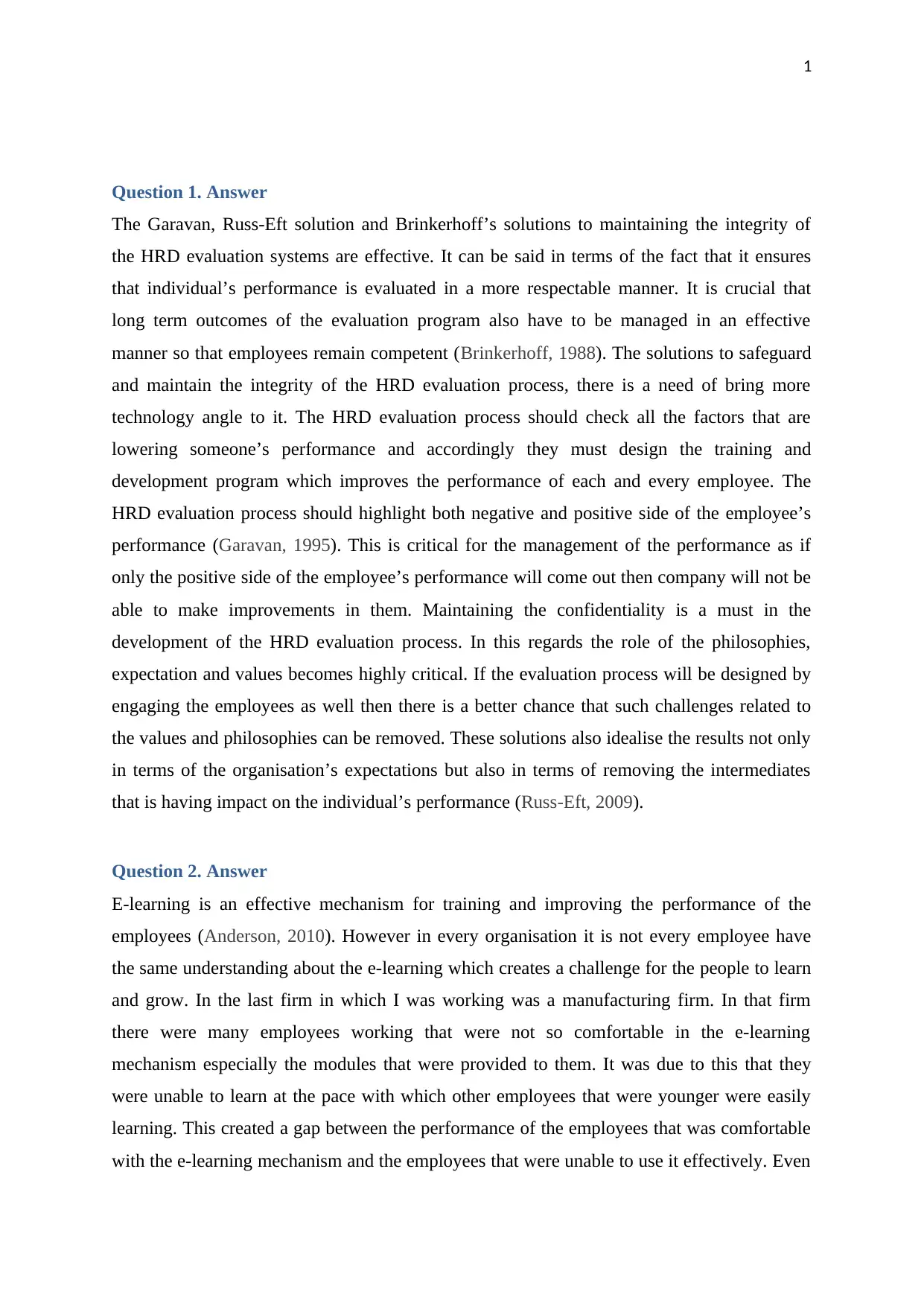
Question 1. Answer
The Garavan, Russ-Eft solution and Brinkerhoff’s solutions to maintaining the integrity of
the HRD evaluation systems are effective. It can be said in terms of the fact that it ensures
that individual’s performance is evaluated in a more respectable manner. It is crucial that
long term outcomes of the evaluation program also have to be managed in an effective
manner so that employees remain competent (Brinkerhoff, 1988). The solutions to safeguard
and maintain the integrity of the HRD evaluation process, there is a need of bring more
technology angle to it. The HRD evaluation process should check all the factors that are
lowering someone’s performance and accordingly they must design the training and
development program which improves the performance of each and every employee. The
HRD evaluation process should highlight both negative and positive side of the employee’s
performance (Garavan, 1995). This is critical for the management of the performance as if
only the positive side of the employee’s performance will come out then company will not be
able to make improvements in them. Maintaining the confidentiality is a must in the
development of the HRD evaluation process. In this regards the role of the philosophies,
expectation and values becomes highly critical. If the evaluation process will be designed by
engaging the employees as well then there is a better chance that such challenges related to
the values and philosophies can be removed. These solutions also idealise the results not only
in terms of the organisation’s expectations but also in terms of removing the intermediates
that is having impact on the individual’s performance (Russ-Eft, 2009).
Question 2. Answer
E-learning is an effective mechanism for training and improving the performance of the
employees (Anderson, 2010). However in every organisation it is not every employee have
the same understanding about the e-learning which creates a challenge for the people to learn
and grow. In the last firm in which I was working was a manufacturing firm. In that firm
there were many employees working that were not so comfortable in the e-learning
mechanism especially the modules that were provided to them. It was due to this that they
were unable to learn at the pace with which other employees that were younger were easily
learning. This created a gap between the performance of the employees that was comfortable
with the e-learning mechanism and the employees that were unable to use it effectively. Even
Document Page
2
when some of the employees were suggesting that they are unable to learn things effectively
the HRM did not changed their training mechanism. This was also because they were not able
to adopt the changes related to the training mechanism. They were used to learn with the age-
old mechanism where they are provided with some or the other type of materials and they
know in which way they will have to move however this promoted theoretical knowledge
while the new e-learning platforms where not easy to handle and some of the employees did
not know how to gather the information from the e-learning platforms (Radović-Marković,
2010).
Document Page
3
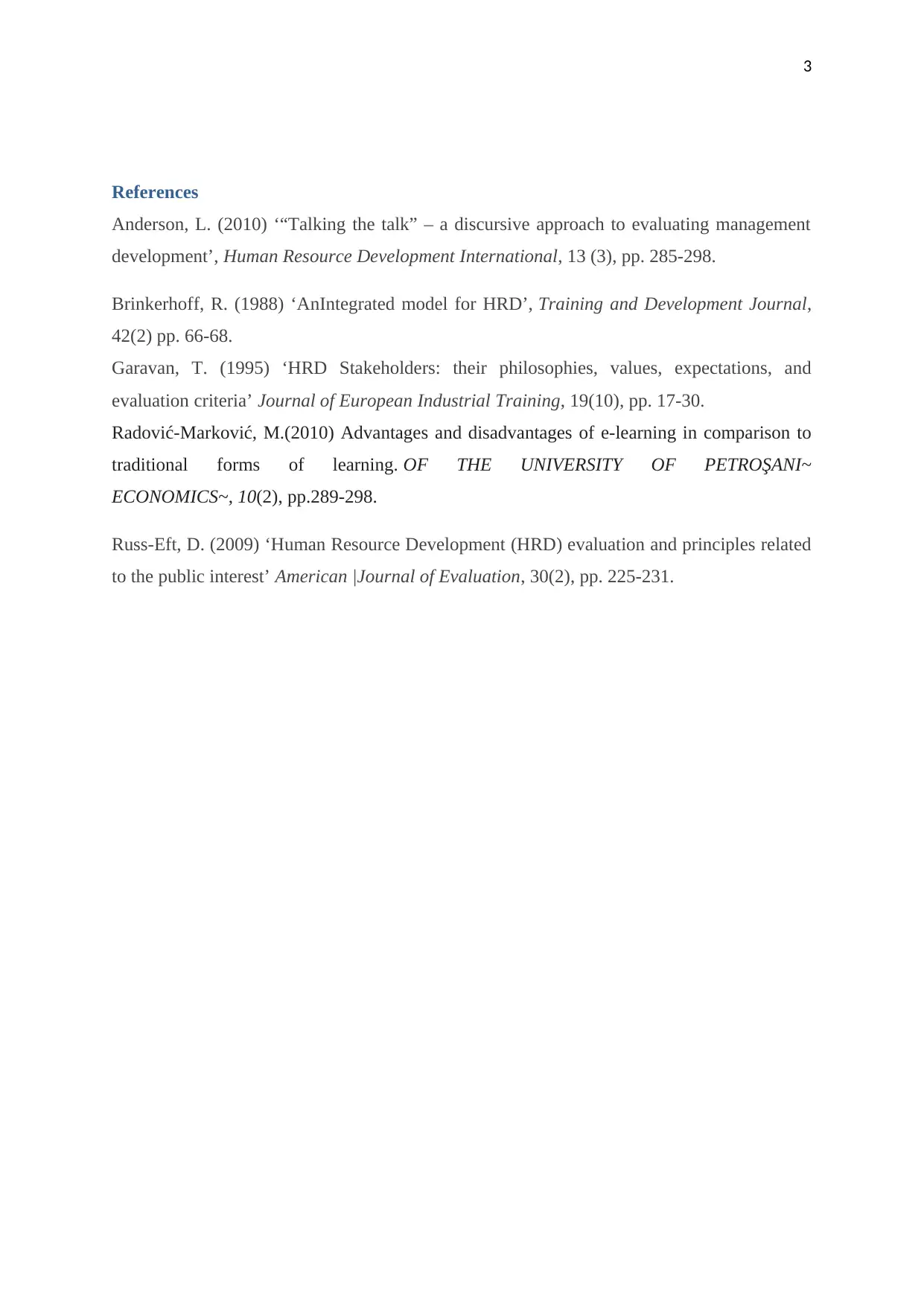
References
Anderson, L. (2010) ‘“Talking the talk” – a discursive approach to evaluating management
development’, Human Resource Development International, 13 (3), pp. 285-298.
Brinkerhoff, R. (1988) ‘AnIntegrated model for HRD’, Training and Development Journal,
42(2) pp. 66-68.
Garavan, T. (1995) ‘HRD Stakeholders: their philosophies, values, expectations, and
evaluation criteria’ Journal of European Industrial Training, 19(10), pp. 17-30.
Radović-Marković, M.(2010) Advantages and disadvantages of e-learning in comparison to
traditional forms of learning. OF THE UNIVERSITY OF PETROŞANI~
ECONOMICS~, 10(2), pp.289-298.
Russ-Eft, D. (2009) ‘Human Resource Development (HRD) evaluation and principles related
to the public interest’ American |Journal of Evaluation, 30(2), pp. 225-231.
chevron_up_icon
1 out of 4
circle_padding
hide_on_mobile
zoom_out_icon
[object Object]