Human Resource Management Report: Workforce Planning and HRM
VerifiedAdded on 2020/06/03
|19
|6214
|26
Report
AI Summary
This report provides a comprehensive analysis of Human Resource Management (HRM) practices, focusing on workforce planning, recruitment, and selection strategies within HSBC. It delves into the purpose and function of HRM, exploring both hard and soft HRM approaches. The report examines the strengths and weaknesses of various recruitment methods, including internal and external sources. It also highlights the benefits of HRM practices for both employers and employees, emphasizing the importance of employee relations and the impact of employment legislation on HRM decision-making. Furthermore, the report discusses the application of HRM practices in a work-related context, offering a holistic view of HRM's role in organizational success. The report covers various aspects like compensation and benefits, worker development, and manpower planning, providing a detailed overview of HRM's significance in a multinational banking and financial services company like HSBC. This report also discusses the importance of employee relations, elements of employee legislation and their application in HRM practices will also be covered.

HUMAN RESOURCE
MANAGEMENT
MANAGEMENT

Paraphrase This Document
Need a fresh take? Get an instant paraphrase of this document with our AI Paraphraser
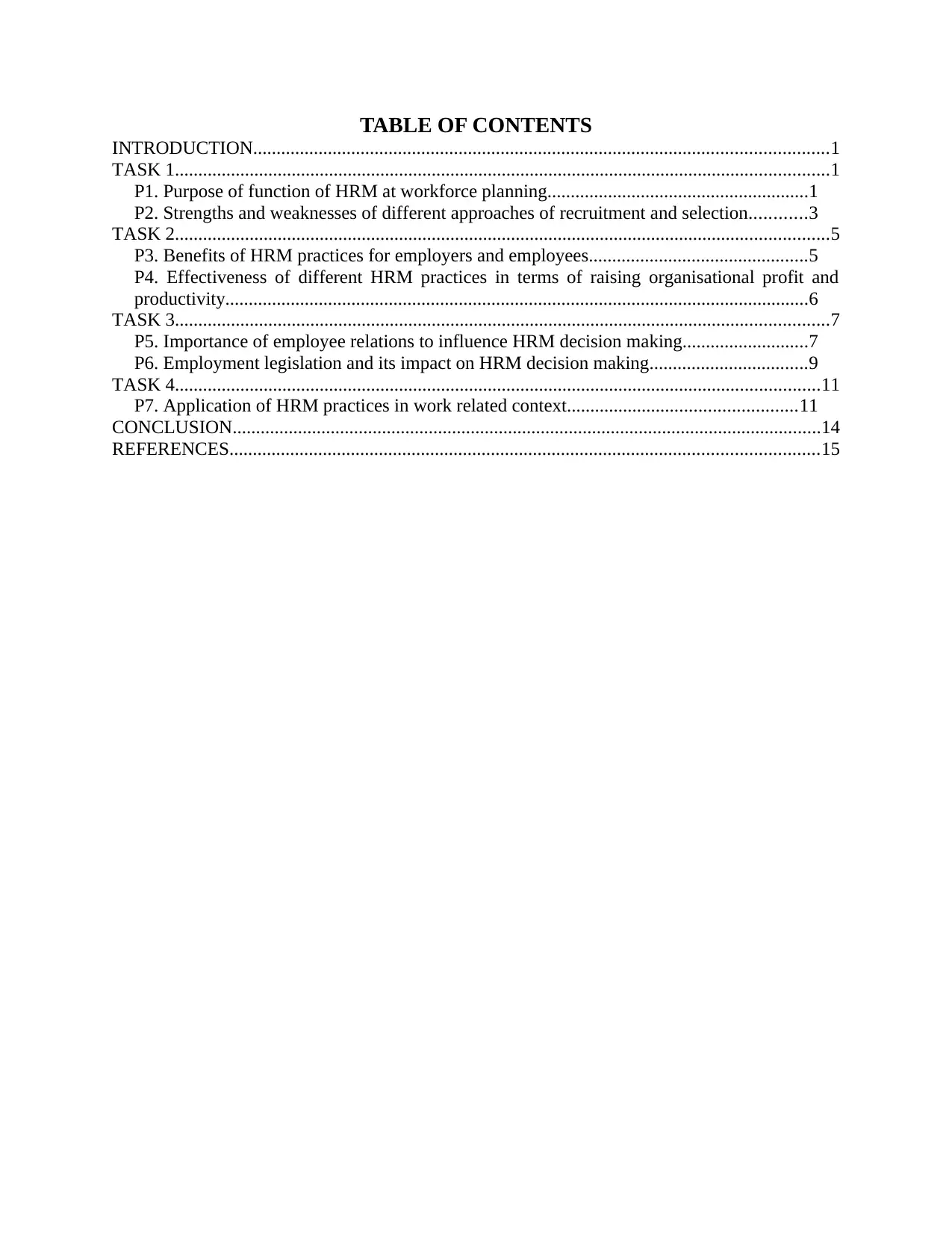
TABLE OF CONTENTS
INTRODUCTION...........................................................................................................................1
TASK 1............................................................................................................................................1
P1. Purpose of function of HRM at workforce planning........................................................1
P2. Strengths and weaknesses of different approaches of recruitment and selection............3
TASK 2............................................................................................................................................5
P3. Benefits of HRM practices for employers and employees...............................................5
P4. Effectiveness of different HRM practices in terms of raising organisational profit and
productivity.............................................................................................................................6
TASK 3............................................................................................................................................7
P5. Importance of employee relations to influence HRM decision making...........................7
P6. Employment legislation and its impact on HRM decision making..................................9
TASK 4..........................................................................................................................................11
P7. Application of HRM practices in work related context.................................................11
CONCLUSION..............................................................................................................................14
REFERENCES..............................................................................................................................15
INTRODUCTION...........................................................................................................................1
TASK 1............................................................................................................................................1
P1. Purpose of function of HRM at workforce planning........................................................1
P2. Strengths and weaknesses of different approaches of recruitment and selection............3
TASK 2............................................................................................................................................5
P3. Benefits of HRM practices for employers and employees...............................................5
P4. Effectiveness of different HRM practices in terms of raising organisational profit and
productivity.............................................................................................................................6
TASK 3............................................................................................................................................7
P5. Importance of employee relations to influence HRM decision making...........................7
P6. Employment legislation and its impact on HRM decision making..................................9
TASK 4..........................................................................................................................................11
P7. Application of HRM practices in work related context.................................................11
CONCLUSION..............................................................................................................................14
REFERENCES..............................................................................................................................15
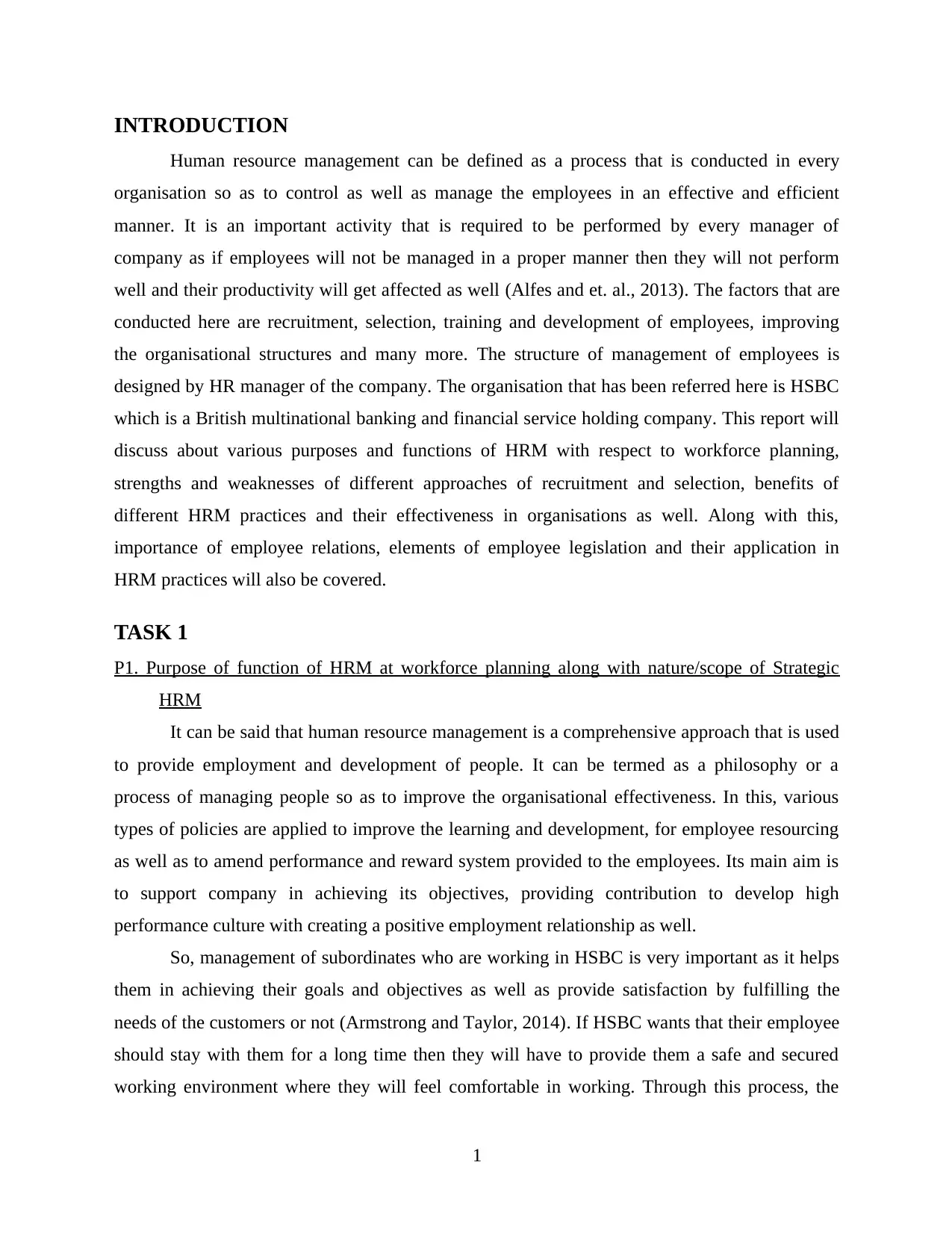
INTRODUCTION
Human resource management can be defined as a process that is conducted in every
organisation so as to control as well as manage the employees in an effective and efficient
manner. It is an important activity that is required to be performed by every manager of
company as if employees will not be managed in a proper manner then they will not perform
well and their productivity will get affected as well (Alfes and et. al., 2013). The factors that are
conducted here are recruitment, selection, training and development of employees, improving
the organisational structures and many more. The structure of management of employees is
designed by HR manager of the company. The organisation that has been referred here is HSBC
which is a British multinational banking and financial service holding company. This report will
discuss about various purposes and functions of HRM with respect to workforce planning,
strengths and weaknesses of different approaches of recruitment and selection, benefits of
different HRM practices and their effectiveness in organisations as well. Along with this,
importance of employee relations, elements of employee legislation and their application in
HRM practices will also be covered.
TASK 1
P1. Purpose of function of HRM at workforce planning along with nature/scope of Strategic
HRM
It can be said that human resource management is a comprehensive approach that is used
to provide employment and development of people. It can be termed as a philosophy or a
process of managing people so as to improve the organisational effectiveness. In this, various
types of policies are applied to improve the learning and development, for employee resourcing
as well as to amend performance and reward system provided to the employees. Its main aim is
to support company in achieving its objectives, providing contribution to develop high
performance culture with creating a positive employment relationship as well.
So, management of subordinates who are working in HSBC is very important as it helps
them in achieving their goals and objectives as well as provide satisfaction by fulfilling the
needs of the customers or not (Armstrong and Taylor, 2014). If HSBC wants that their employee
should stay with them for a long time then they will have to provide them a safe and secured
working environment where they will feel comfortable in working. Through this process, the
1
Human resource management can be defined as a process that is conducted in every
organisation so as to control as well as manage the employees in an effective and efficient
manner. It is an important activity that is required to be performed by every manager of
company as if employees will not be managed in a proper manner then they will not perform
well and their productivity will get affected as well (Alfes and et. al., 2013). The factors that are
conducted here are recruitment, selection, training and development of employees, improving
the organisational structures and many more. The structure of management of employees is
designed by HR manager of the company. The organisation that has been referred here is HSBC
which is a British multinational banking and financial service holding company. This report will
discuss about various purposes and functions of HRM with respect to workforce planning,
strengths and weaknesses of different approaches of recruitment and selection, benefits of
different HRM practices and their effectiveness in organisations as well. Along with this,
importance of employee relations, elements of employee legislation and their application in
HRM practices will also be covered.
TASK 1
P1. Purpose of function of HRM at workforce planning along with nature/scope of Strategic
HRM
It can be said that human resource management is a comprehensive approach that is used
to provide employment and development of people. It can be termed as a philosophy or a
process of managing people so as to improve the organisational effectiveness. In this, various
types of policies are applied to improve the learning and development, for employee resourcing
as well as to amend performance and reward system provided to the employees. Its main aim is
to support company in achieving its objectives, providing contribution to develop high
performance culture with creating a positive employment relationship as well.
So, management of subordinates who are working in HSBC is very important as it helps
them in achieving their goals and objectives as well as provide satisfaction by fulfilling the
needs of the customers or not (Armstrong and Taylor, 2014). If HSBC wants that their employee
should stay with them for a long time then they will have to provide them a safe and secured
working environment where they will feel comfortable in working. Through this process, the
1
⊘ This is a preview!⊘
Do you want full access?
Subscribe today to unlock all pages.

Trusted by 1+ million students worldwide
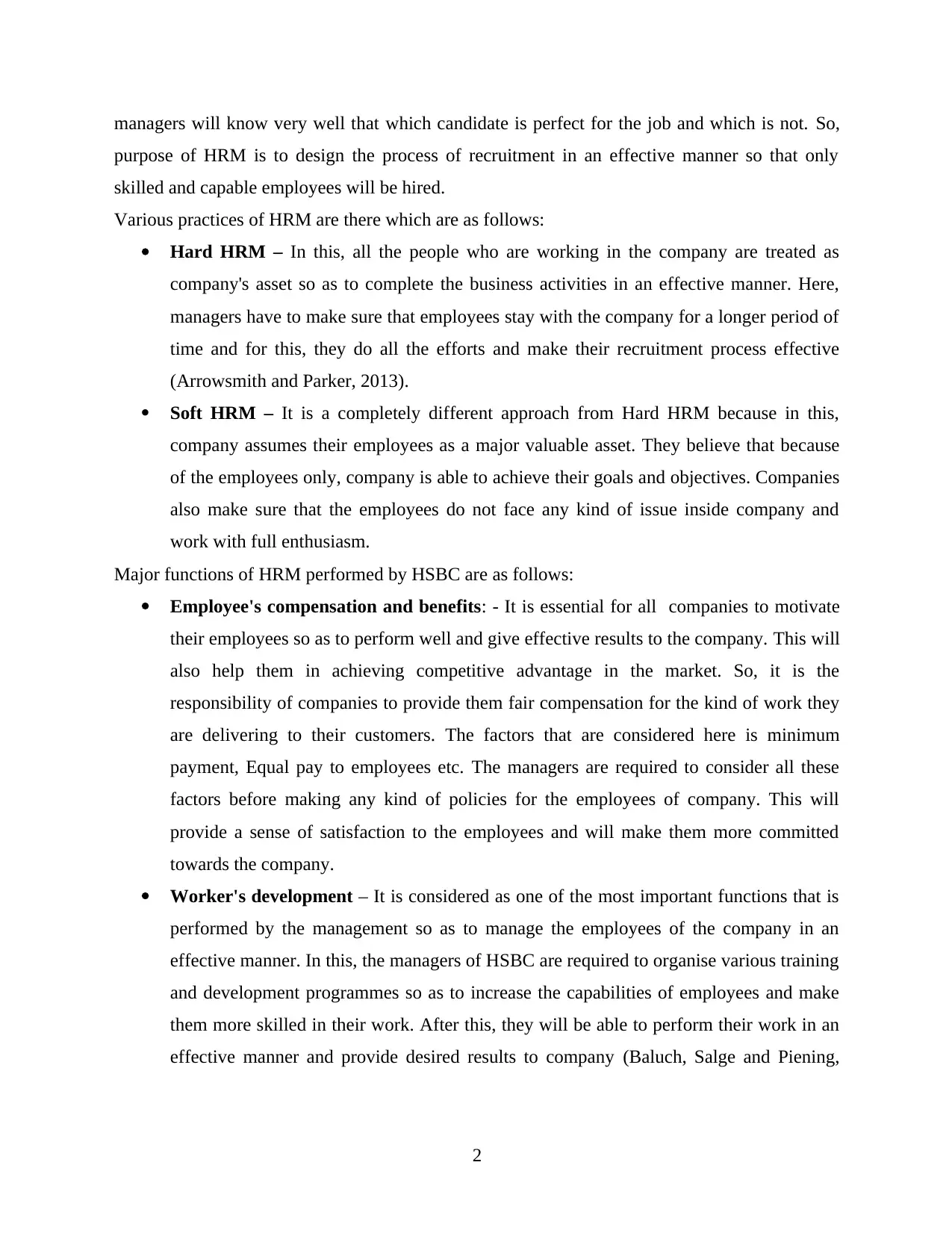
managers will know very well that which candidate is perfect for the job and which is not. So,
purpose of HRM is to design the process of recruitment in an effective manner so that only
skilled and capable employees will be hired.
Various practices of HRM are there which are as follows:
Hard HRM – In this, all the people who are working in the company are treated as
company's asset so as to complete the business activities in an effective manner. Here,
managers have to make sure that employees stay with the company for a longer period of
time and for this, they do all the efforts and make their recruitment process effective
(Arrowsmith and Parker, 2013).
Soft HRM – It is a completely different approach from Hard HRM because in this,
company assumes their employees as a major valuable asset. They believe that because
of the employees only, company is able to achieve their goals and objectives. Companies
also make sure that the employees do not face any kind of issue inside company and
work with full enthusiasm.
Major functions of HRM performed by HSBC are as follows:
Employee's compensation and benefits: - It is essential for all companies to motivate
their employees so as to perform well and give effective results to the company. This will
also help them in achieving competitive advantage in the market. So, it is the
responsibility of companies to provide them fair compensation for the kind of work they
are delivering to their customers. The factors that are considered here is minimum
payment, Equal pay to employees etc. The managers are required to consider all these
factors before making any kind of policies for the employees of company. This will
provide a sense of satisfaction to the employees and will make them more committed
towards the company.
Worker's development – It is considered as one of the most important functions that is
performed by the management so as to manage the employees of the company in an
effective manner. In this, the managers of HSBC are required to organise various training
and development programmes so as to increase the capabilities of employees and make
them more skilled in their work. After this, they will be able to perform their work in an
effective manner and provide desired results to company (Baluch, Salge and Piening,
2
purpose of HRM is to design the process of recruitment in an effective manner so that only
skilled and capable employees will be hired.
Various practices of HRM are there which are as follows:
Hard HRM – In this, all the people who are working in the company are treated as
company's asset so as to complete the business activities in an effective manner. Here,
managers have to make sure that employees stay with the company for a longer period of
time and for this, they do all the efforts and make their recruitment process effective
(Arrowsmith and Parker, 2013).
Soft HRM – It is a completely different approach from Hard HRM because in this,
company assumes their employees as a major valuable asset. They believe that because
of the employees only, company is able to achieve their goals and objectives. Companies
also make sure that the employees do not face any kind of issue inside company and
work with full enthusiasm.
Major functions of HRM performed by HSBC are as follows:
Employee's compensation and benefits: - It is essential for all companies to motivate
their employees so as to perform well and give effective results to the company. This will
also help them in achieving competitive advantage in the market. So, it is the
responsibility of companies to provide them fair compensation for the kind of work they
are delivering to their customers. The factors that are considered here is minimum
payment, Equal pay to employees etc. The managers are required to consider all these
factors before making any kind of policies for the employees of company. This will
provide a sense of satisfaction to the employees and will make them more committed
towards the company.
Worker's development – It is considered as one of the most important functions that is
performed by the management so as to manage the employees of the company in an
effective manner. In this, the managers of HSBC are required to organise various training
and development programmes so as to increase the capabilities of employees and make
them more skilled in their work. After this, they will be able to perform their work in an
effective manner and provide desired results to company (Baluch, Salge and Piening,
2
Paraphrase This Document
Need a fresh take? Get an instant paraphrase of this document with our AI Paraphraser

2013). It will also help in increasing the creativity of employees in performing their
work. All this provides various long term benefits to a firm.
3
work. All this provides various long term benefits to a firm.
3
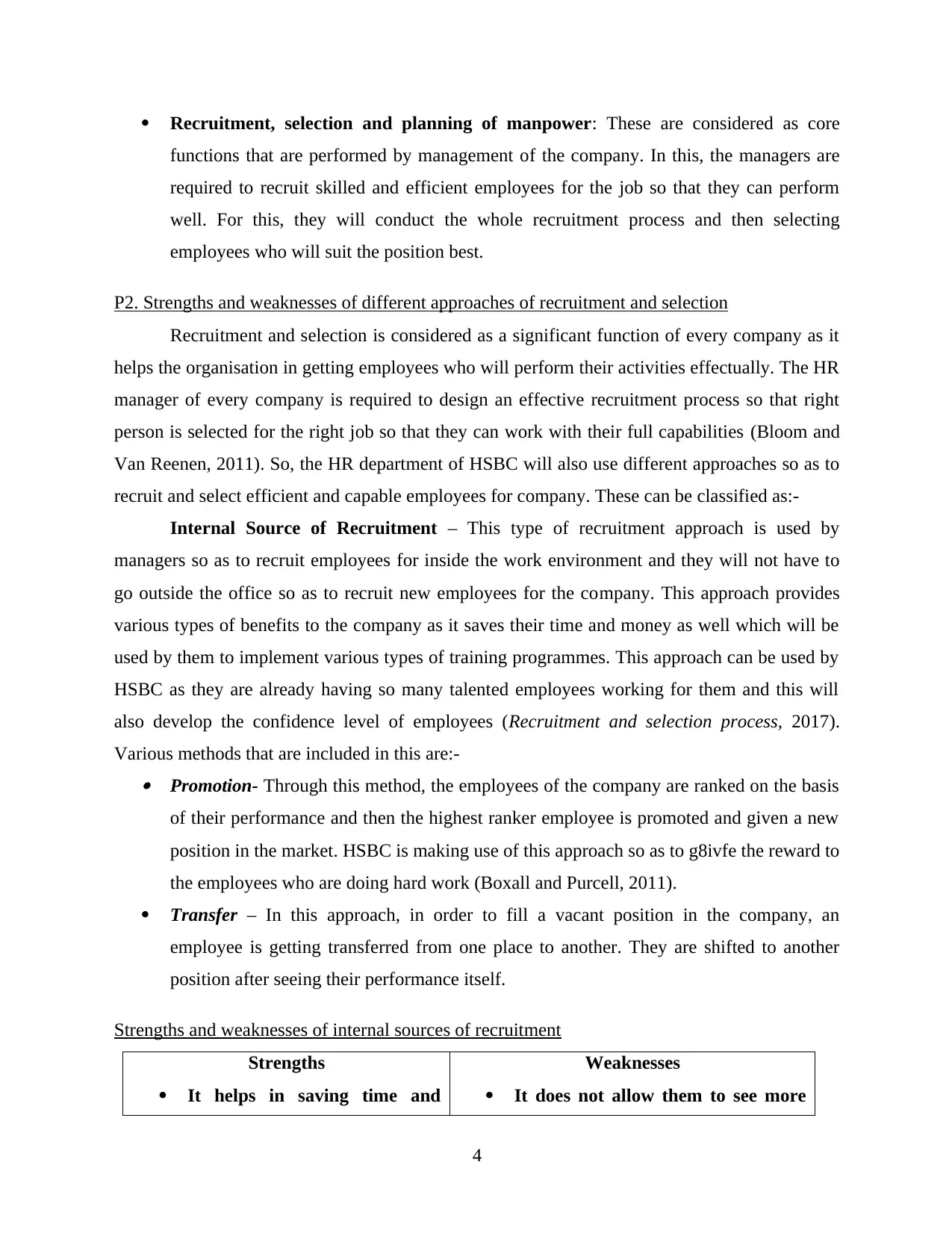
Recruitment, selection and planning of manpower: These are considered as core
functions that are performed by management of the company. In this, the managers are
required to recruit skilled and efficient employees for the job so that they can perform
well. For this, they will conduct the whole recruitment process and then selecting
employees who will suit the position best.
P2. Strengths and weaknesses of different approaches of recruitment and selection
Recruitment and selection is considered as a significant function of every company as it
helps the organisation in getting employees who will perform their activities effectually. The HR
manager of every company is required to design an effective recruitment process so that right
person is selected for the right job so that they can work with their full capabilities (Bloom and
Van Reenen, 2011). So, the HR department of HSBC will also use different approaches so as to
recruit and select efficient and capable employees for company. These can be classified as:-
Internal Source of Recruitment – This type of recruitment approach is used by
managers so as to recruit employees for inside the work environment and they will not have to
go outside the office so as to recruit new employees for the company. This approach provides
various types of benefits to the company as it saves their time and money as well which will be
used by them to implement various types of training programmes. This approach can be used by
HSBC as they are already having so many talented employees working for them and this will
also develop the confidence level of employees (Recruitment and selection process, 2017).
Various methods that are included in this are:- Promotion- Through this method, the employees of the company are ranked on the basis
of their performance and then the highest ranker employee is promoted and given a new
position in the market. HSBC is making use of this approach so as to g8ivfe the reward to
the employees who are doing hard work (Boxall and Purcell, 2011).
Transfer – In this approach, in order to fill a vacant position in the company, an
employee is getting transferred from one place to another. They are shifted to another
position after seeing their performance itself.
Strengths and weaknesses of internal sources of recruitment
Strengths Weaknesses
It helps in saving time and It does not allow them to see more
4
functions that are performed by management of the company. In this, the managers are
required to recruit skilled and efficient employees for the job so that they can perform
well. For this, they will conduct the whole recruitment process and then selecting
employees who will suit the position best.
P2. Strengths and weaknesses of different approaches of recruitment and selection
Recruitment and selection is considered as a significant function of every company as it
helps the organisation in getting employees who will perform their activities effectually. The HR
manager of every company is required to design an effective recruitment process so that right
person is selected for the right job so that they can work with their full capabilities (Bloom and
Van Reenen, 2011). So, the HR department of HSBC will also use different approaches so as to
recruit and select efficient and capable employees for company. These can be classified as:-
Internal Source of Recruitment – This type of recruitment approach is used by
managers so as to recruit employees for inside the work environment and they will not have to
go outside the office so as to recruit new employees for the company. This approach provides
various types of benefits to the company as it saves their time and money as well which will be
used by them to implement various types of training programmes. This approach can be used by
HSBC as they are already having so many talented employees working for them and this will
also develop the confidence level of employees (Recruitment and selection process, 2017).
Various methods that are included in this are:- Promotion- Through this method, the employees of the company are ranked on the basis
of their performance and then the highest ranker employee is promoted and given a new
position in the market. HSBC is making use of this approach so as to g8ivfe the reward to
the employees who are doing hard work (Boxall and Purcell, 2011).
Transfer – In this approach, in order to fill a vacant position in the company, an
employee is getting transferred from one place to another. They are shifted to another
position after seeing their performance itself.
Strengths and weaknesses of internal sources of recruitment
Strengths Weaknesses
It helps in saving time and It does not allow them to see more
4
⊘ This is a preview!⊘
Do you want full access?
Subscribe today to unlock all pages.
Trusted by 1+ million students worldwide
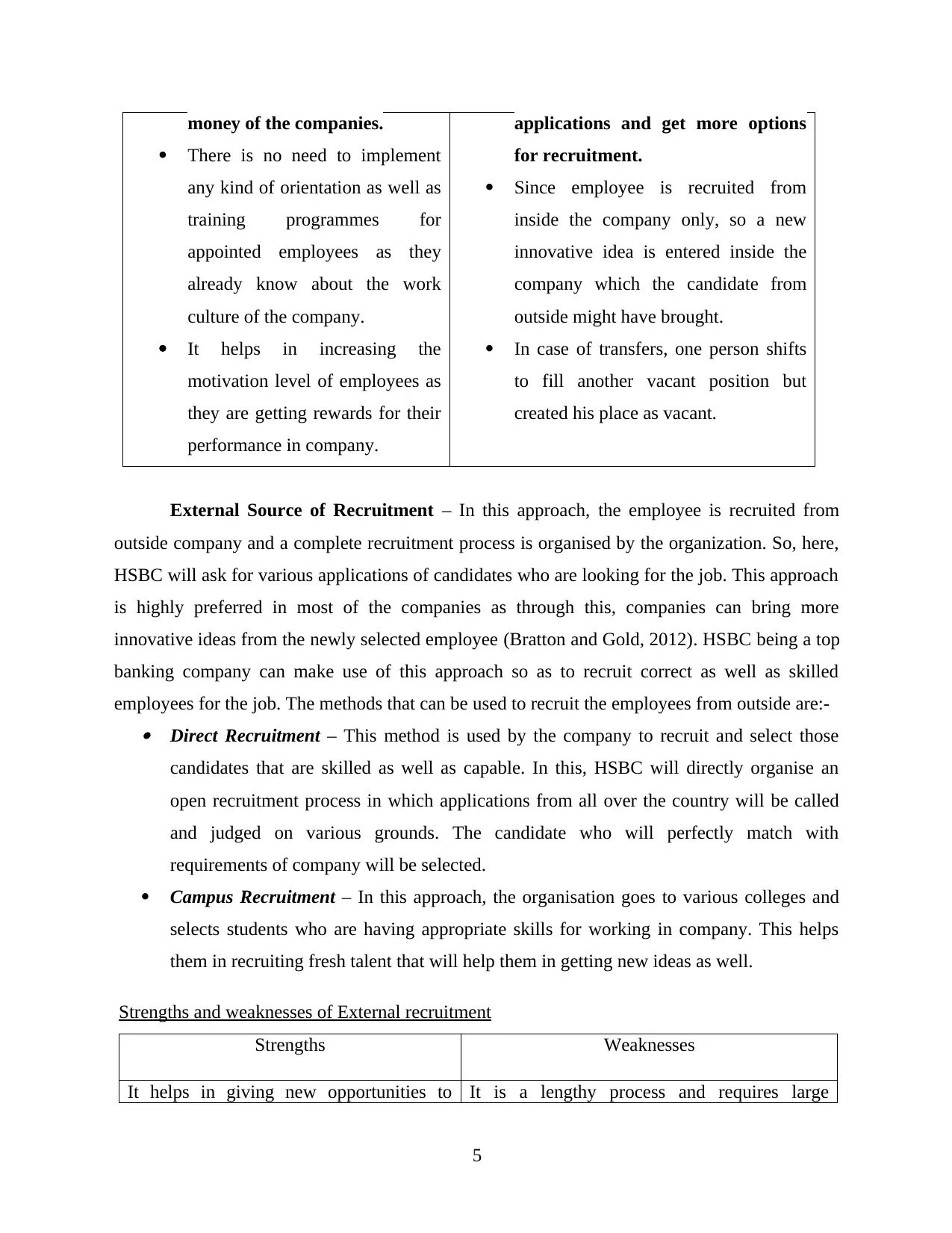
money of the companies.
There is no need to implement
any kind of orientation as well as
training programmes for
appointed employees as they
already know about the work
culture of the company.
It helps in increasing the
motivation level of employees as
they are getting rewards for their
performance in company.
applications and get more options
for recruitment.
Since employee is recruited from
inside the company only, so a new
innovative idea is entered inside the
company which the candidate from
outside might have brought.
In case of transfers, one person shifts
to fill another vacant position but
created his place as vacant.
External Source of Recruitment – In this approach, the employee is recruited from
outside company and a complete recruitment process is organised by the organization. So, here,
HSBC will ask for various applications of candidates who are looking for the job. This approach
is highly preferred in most of the companies as through this, companies can bring more
innovative ideas from the newly selected employee (Bratton and Gold, 2012). HSBC being a top
banking company can make use of this approach so as to recruit correct as well as skilled
employees for the job. The methods that can be used to recruit the employees from outside are:- Direct Recruitment – This method is used by the company to recruit and select those
candidates that are skilled as well as capable. In this, HSBC will directly organise an
open recruitment process in which applications from all over the country will be called
and judged on various grounds. The candidate who will perfectly match with
requirements of company will be selected.
Campus Recruitment – In this approach, the organisation goes to various colleges and
selects students who are having appropriate skills for working in company. This helps
them in recruiting fresh talent that will help them in getting new ideas as well.
Strengths and weaknesses of External recruitment
Strengths Weaknesses
It helps in giving new opportunities to It is a lengthy process and requires large
5
There is no need to implement
any kind of orientation as well as
training programmes for
appointed employees as they
already know about the work
culture of the company.
It helps in increasing the
motivation level of employees as
they are getting rewards for their
performance in company.
applications and get more options
for recruitment.
Since employee is recruited from
inside the company only, so a new
innovative idea is entered inside the
company which the candidate from
outside might have brought.
In case of transfers, one person shifts
to fill another vacant position but
created his place as vacant.
External Source of Recruitment – In this approach, the employee is recruited from
outside company and a complete recruitment process is organised by the organization. So, here,
HSBC will ask for various applications of candidates who are looking for the job. This approach
is highly preferred in most of the companies as through this, companies can bring more
innovative ideas from the newly selected employee (Bratton and Gold, 2012). HSBC being a top
banking company can make use of this approach so as to recruit correct as well as skilled
employees for the job. The methods that can be used to recruit the employees from outside are:- Direct Recruitment – This method is used by the company to recruit and select those
candidates that are skilled as well as capable. In this, HSBC will directly organise an
open recruitment process in which applications from all over the country will be called
and judged on various grounds. The candidate who will perfectly match with
requirements of company will be selected.
Campus Recruitment – In this approach, the organisation goes to various colleges and
selects students who are having appropriate skills for working in company. This helps
them in recruiting fresh talent that will help them in getting new ideas as well.
Strengths and weaknesses of External recruitment
Strengths Weaknesses
It helps in giving new opportunities to It is a lengthy process and requires large
5
Paraphrase This Document
Need a fresh take? Get an instant paraphrase of this document with our AI Paraphraser
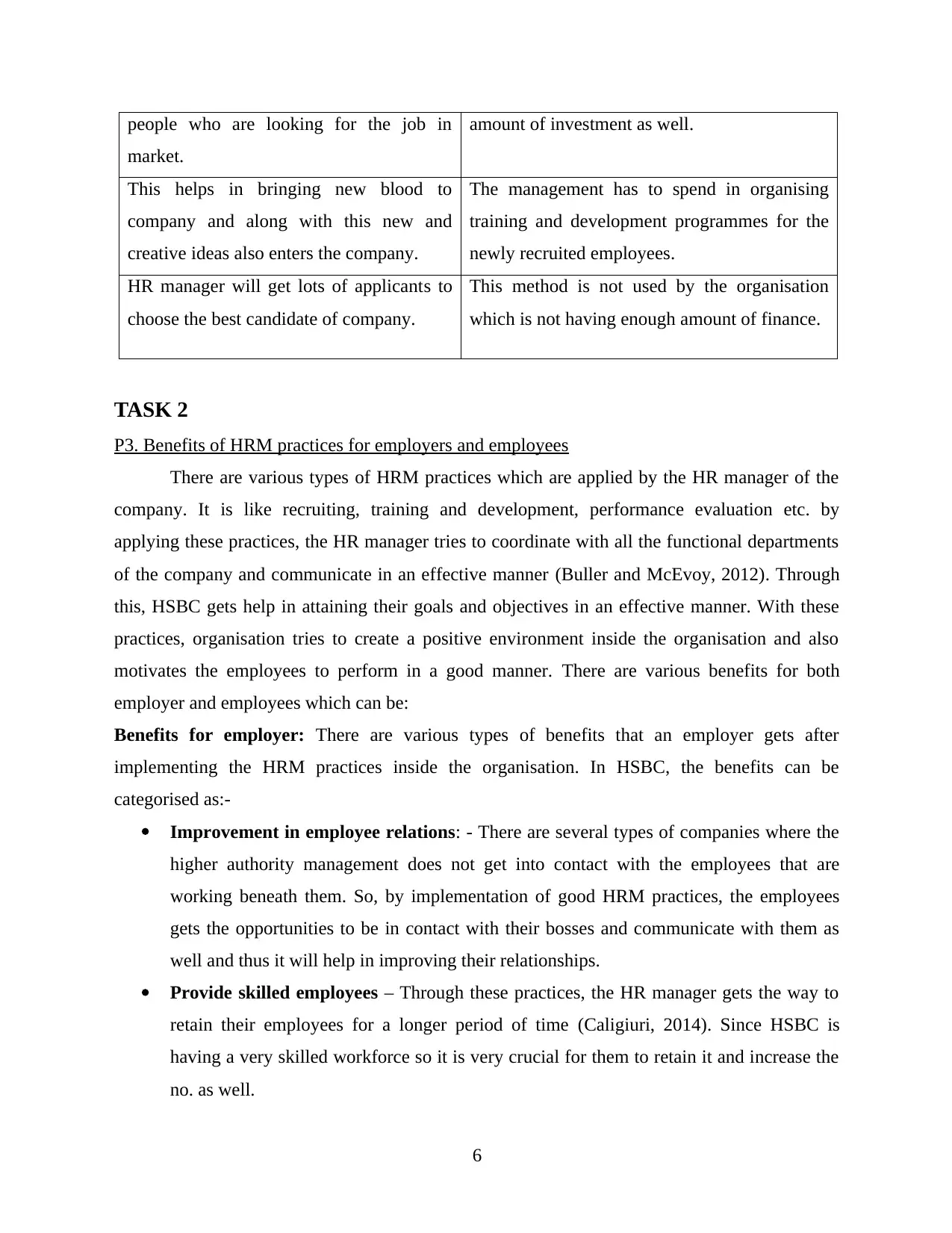
people who are looking for the job in
market.
amount of investment as well.
This helps in bringing new blood to
company and along with this new and
creative ideas also enters the company.
The management has to spend in organising
training and development programmes for the
newly recruited employees.
HR manager will get lots of applicants to
choose the best candidate of company.
This method is not used by the organisation
which is not having enough amount of finance.
TASK 2
P3. Benefits of HRM practices for employers and employees
There are various types of HRM practices which are applied by the HR manager of the
company. It is like recruiting, training and development, performance evaluation etc. by
applying these practices, the HR manager tries to coordinate with all the functional departments
of the company and communicate in an effective manner (Buller and McEvoy, 2012). Through
this, HSBC gets help in attaining their goals and objectives in an effective manner. With these
practices, organisation tries to create a positive environment inside the organisation and also
motivates the employees to perform in a good manner. There are various benefits for both
employer and employees which can be:
Benefits for employer: There are various types of benefits that an employer gets after
implementing the HRM practices inside the organisation. In HSBC, the benefits can be
categorised as:-
Improvement in employee relations: - There are several types of companies where the
higher authority management does not get into contact with the employees that are
working beneath them. So, by implementation of good HRM practices, the employees
gets the opportunities to be in contact with their bosses and communicate with them as
well and thus it will help in improving their relationships.
Provide skilled employees – Through these practices, the HR manager gets the way to
retain their employees for a longer period of time (Caligiuri, 2014). Since HSBC is
having a very skilled workforce so it is very crucial for them to retain it and increase the
no. as well.
6
market.
amount of investment as well.
This helps in bringing new blood to
company and along with this new and
creative ideas also enters the company.
The management has to spend in organising
training and development programmes for the
newly recruited employees.
HR manager will get lots of applicants to
choose the best candidate of company.
This method is not used by the organisation
which is not having enough amount of finance.
TASK 2
P3. Benefits of HRM practices for employers and employees
There are various types of HRM practices which are applied by the HR manager of the
company. It is like recruiting, training and development, performance evaluation etc. by
applying these practices, the HR manager tries to coordinate with all the functional departments
of the company and communicate in an effective manner (Buller and McEvoy, 2012). Through
this, HSBC gets help in attaining their goals and objectives in an effective manner. With these
practices, organisation tries to create a positive environment inside the organisation and also
motivates the employees to perform in a good manner. There are various benefits for both
employer and employees which can be:
Benefits for employer: There are various types of benefits that an employer gets after
implementing the HRM practices inside the organisation. In HSBC, the benefits can be
categorised as:-
Improvement in employee relations: - There are several types of companies where the
higher authority management does not get into contact with the employees that are
working beneath them. So, by implementation of good HRM practices, the employees
gets the opportunities to be in contact with their bosses and communicate with them as
well and thus it will help in improving their relationships.
Provide skilled employees – Through these practices, the HR manager gets the way to
retain their employees for a longer period of time (Caligiuri, 2014). Since HSBC is
having a very skilled workforce so it is very crucial for them to retain it and increase the
no. as well.
6
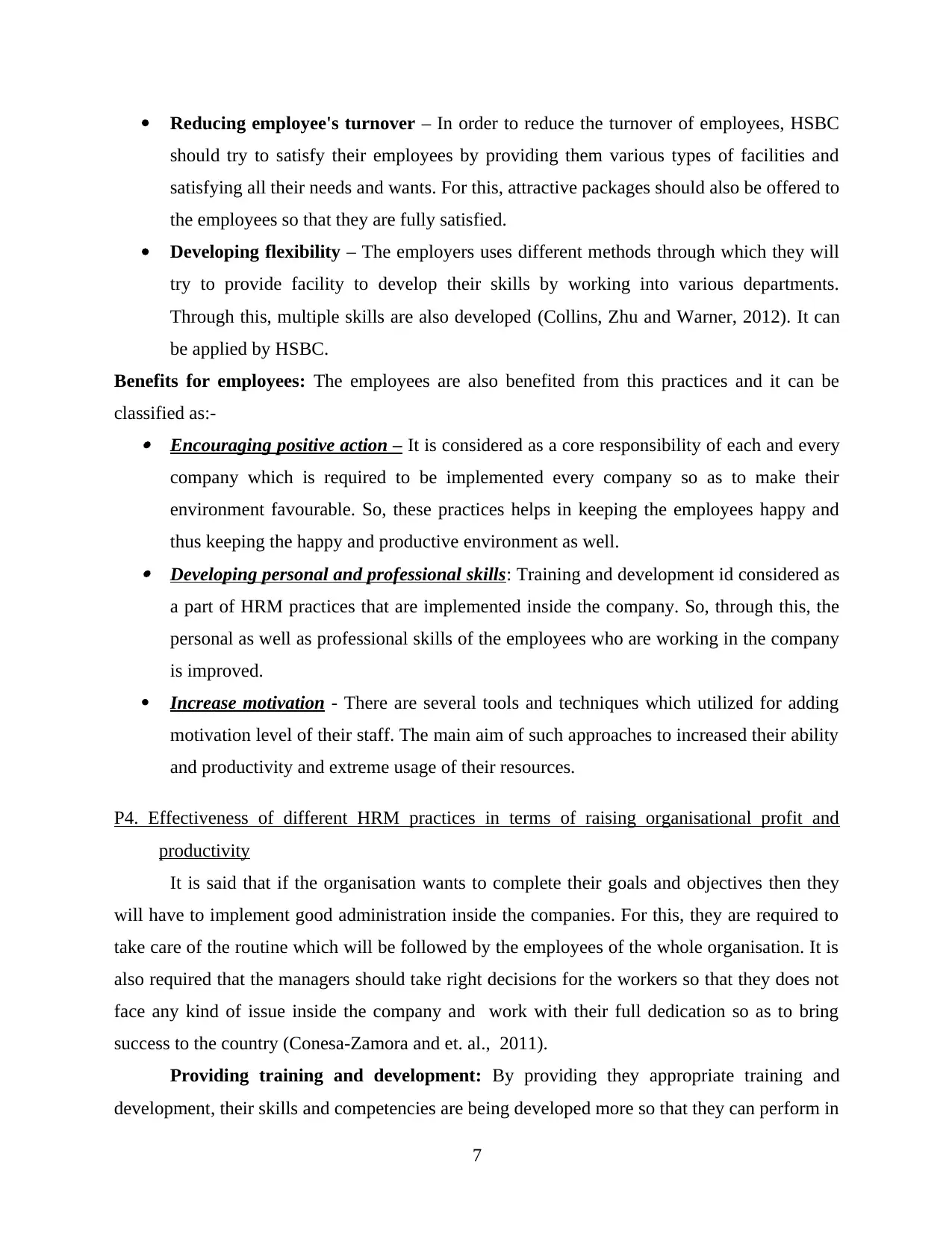
Reducing employee's turnover – In order to reduce the turnover of employees, HSBC
should try to satisfy their employees by providing them various types of facilities and
satisfying all their needs and wants. For this, attractive packages should also be offered to
the employees so that they are fully satisfied.
Developing flexibility – The employers uses different methods through which they will
try to provide facility to develop their skills by working into various departments.
Through this, multiple skills are also developed (Collins, Zhu and Warner, 2012). It can
be applied by HSBC.
Benefits for employees: The employees are also benefited from this practices and it can be
classified as:- Encouraging positive action – It is considered as a core responsibility of each and every
company which is required to be implemented every company so as to make their
environment favourable. So, these practices helps in keeping the employees happy and
thus keeping the happy and productive environment as well. Developing personal and professional skills: Training and development id considered as
a part of HRM practices that are implemented inside the company. So, through this, the
personal as well as professional skills of the employees who are working in the company
is improved.
Increase motivation - There are several tools and techniques which utilized for adding
motivation level of their staff. The main aim of such approaches to increased their ability
and productivity and extreme usage of their resources.
P4. Effectiveness of different HRM practices in terms of raising organisational profit and
productivity
It is said that if the organisation wants to complete their goals and objectives then they
will have to implement good administration inside the companies. For this, they are required to
take care of the routine which will be followed by the employees of the whole organisation. It is
also required that the managers should take right decisions for the workers so that they does not
face any kind of issue inside the company and work with their full dedication so as to bring
success to the country (Conesa-Zamora and et. al., 2011).
Providing training and development: By providing they appropriate training and
development, their skills and competencies are being developed more so that they can perform in
7
should try to satisfy their employees by providing them various types of facilities and
satisfying all their needs and wants. For this, attractive packages should also be offered to
the employees so that they are fully satisfied.
Developing flexibility – The employers uses different methods through which they will
try to provide facility to develop their skills by working into various departments.
Through this, multiple skills are also developed (Collins, Zhu and Warner, 2012). It can
be applied by HSBC.
Benefits for employees: The employees are also benefited from this practices and it can be
classified as:- Encouraging positive action – It is considered as a core responsibility of each and every
company which is required to be implemented every company so as to make their
environment favourable. So, these practices helps in keeping the employees happy and
thus keeping the happy and productive environment as well. Developing personal and professional skills: Training and development id considered as
a part of HRM practices that are implemented inside the company. So, through this, the
personal as well as professional skills of the employees who are working in the company
is improved.
Increase motivation - There are several tools and techniques which utilized for adding
motivation level of their staff. The main aim of such approaches to increased their ability
and productivity and extreme usage of their resources.
P4. Effectiveness of different HRM practices in terms of raising organisational profit and
productivity
It is said that if the organisation wants to complete their goals and objectives then they
will have to implement good administration inside the companies. For this, they are required to
take care of the routine which will be followed by the employees of the whole organisation. It is
also required that the managers should take right decisions for the workers so that they does not
face any kind of issue inside the company and work with their full dedication so as to bring
success to the country (Conesa-Zamora and et. al., 2011).
Providing training and development: By providing they appropriate training and
development, their skills and competencies are being developed more so that they can perform in
7
⊘ This is a preview!⊘
Do you want full access?
Subscribe today to unlock all pages.
Trusted by 1+ million students worldwide
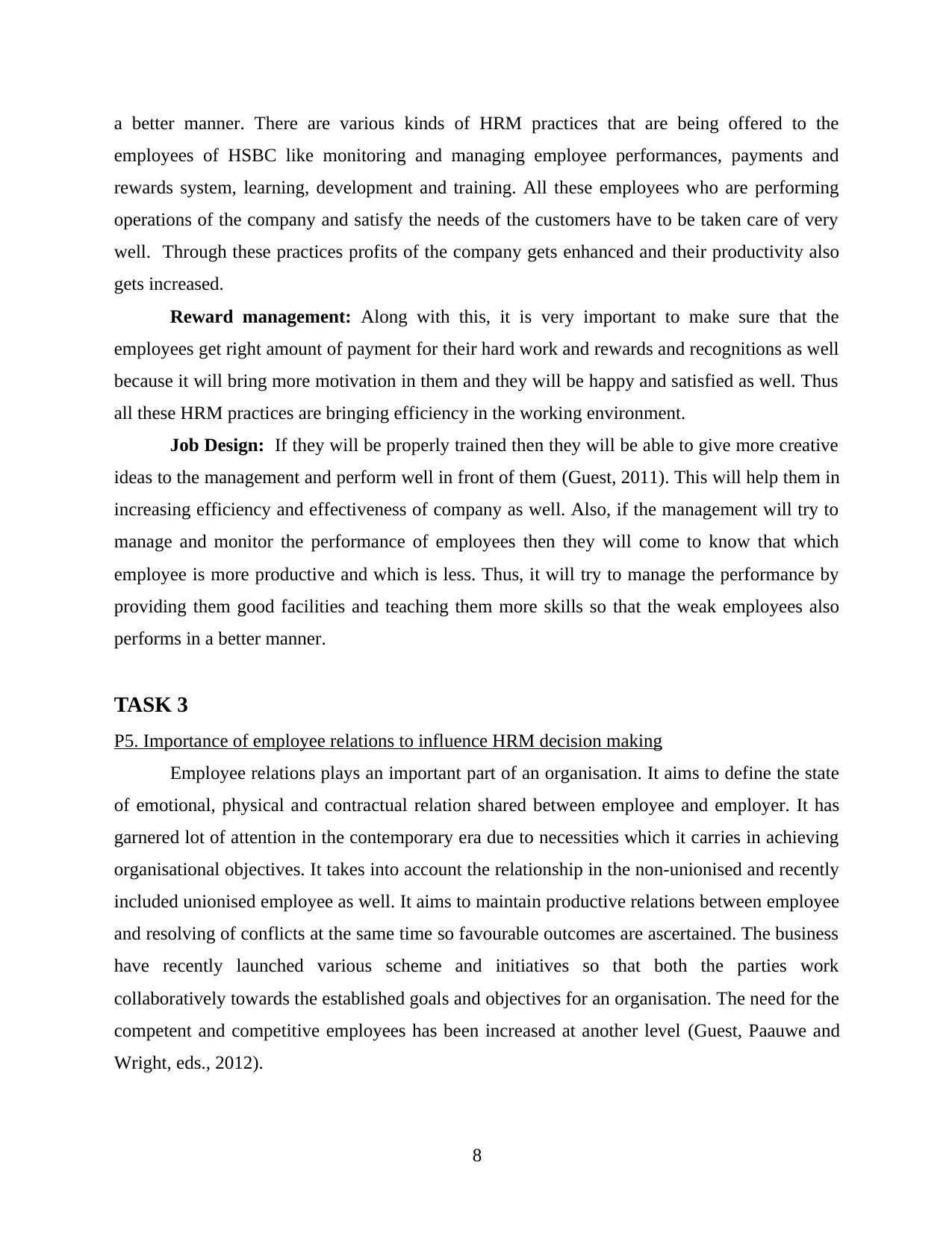
a better manner. There are various kinds of HRM practices that are being offered to the
employees of HSBC like monitoring and managing employee performances, payments and
rewards system, learning, development and training. All these employees who are performing
operations of the company and satisfy the needs of the customers have to be taken care of very
well. Through these practices profits of the company gets enhanced and their productivity also
gets increased.
Reward management: Along with this, it is very important to make sure that the
employees get right amount of payment for their hard work and rewards and recognitions as well
because it will bring more motivation in them and they will be happy and satisfied as well. Thus
all these HRM practices are bringing efficiency in the working environment.
Job Design: If they will be properly trained then they will be able to give more creative
ideas to the management and perform well in front of them (Guest, 2011). This will help them in
increasing efficiency and effectiveness of company as well. Also, if the management will try to
manage and monitor the performance of employees then they will come to know that which
employee is more productive and which is less. Thus, it will try to manage the performance by
providing them good facilities and teaching them more skills so that the weak employees also
performs in a better manner.
TASK 3
P5. Importance of employee relations to influence HRM decision making
Employee relations plays an important part of an organisation. It aims to define the state
of emotional, physical and contractual relation shared between employee and employer. It has
garnered lot of attention in the contemporary era due to necessities which it carries in achieving
organisational objectives. It takes into account the relationship in the non-unionised and recently
included unionised employee as well. It aims to maintain productive relations between employee
and resolving of conflicts at the same time so favourable outcomes are ascertained. The business
have recently launched various scheme and initiatives so that both the parties work
collaboratively towards the established goals and objectives for an organisation. The need for the
competent and competitive employees has been increased at another level (Guest, Paauwe and
Wright, eds., 2012).
8
employees of HSBC like monitoring and managing employee performances, payments and
rewards system, learning, development and training. All these employees who are performing
operations of the company and satisfy the needs of the customers have to be taken care of very
well. Through these practices profits of the company gets enhanced and their productivity also
gets increased.
Reward management: Along with this, it is very important to make sure that the
employees get right amount of payment for their hard work and rewards and recognitions as well
because it will bring more motivation in them and they will be happy and satisfied as well. Thus
all these HRM practices are bringing efficiency in the working environment.
Job Design: If they will be properly trained then they will be able to give more creative
ideas to the management and perform well in front of them (Guest, 2011). This will help them in
increasing efficiency and effectiveness of company as well. Also, if the management will try to
manage and monitor the performance of employees then they will come to know that which
employee is more productive and which is less. Thus, it will try to manage the performance by
providing them good facilities and teaching them more skills so that the weak employees also
performs in a better manner.
TASK 3
P5. Importance of employee relations to influence HRM decision making
Employee relations plays an important part of an organisation. It aims to define the state
of emotional, physical and contractual relation shared between employee and employer. It has
garnered lot of attention in the contemporary era due to necessities which it carries in achieving
organisational objectives. It takes into account the relationship in the non-unionised and recently
included unionised employee as well. It aims to maintain productive relations between employee
and resolving of conflicts at the same time so favourable outcomes are ascertained. The business
have recently launched various scheme and initiatives so that both the parties work
collaboratively towards the established goals and objectives for an organisation. The need for the
competent and competitive employees has been increased at another level (Guest, Paauwe and
Wright, eds., 2012).
8
Paraphrase This Document
Need a fresh take? Get an instant paraphrase of this document with our AI Paraphraser
The justification of the same is dynamics of market has been frequent therefore a
business organisation need to be at their best to sustain their position in the economy. HSBC is
one of the largest banking and financial institution in the world. Therefore the need to have ideal
employee relations is a crucial organ. The approach which has been adopted by the company is
sustainability. It aims to build a business that can be carried out for long and emphasizing on
social and environmental needs of the moment. The employees working from the organisation
comes from different culture and ethics which is comparably difficult for organisations to keep
them focused and productive.
A human resource department before making decision have to identify and consider
interests of all the stakeholders (Gurkov, Zelenova and Saidov, 2012). The individual who are
affected by the decisions and actions of human resource domain are employees, management,
trade unions, employee associations and society. The potential that a decision carries is high and
can disrupt the ideal functioning of a business to a level that is beyond repairable. The state of
relationship shared between employer and employee determine actions plan which has been
formulated by an organisation. The environment which is offered by this banking organisation is
very open. There is incorporation of communication, honesty, transparency and learning from
mistakes.
The treatment which is offered to employee is fair, honest and inclusive. The approach of
participatory and inclusive decision making approach which has been employed by the company
has been receiving a lot of praises from the concerned parties. This approach carries multi-
benefits to the organisation as it can lead to better decision making, better management of
employees and positive outcomes in business. The good relations between employee and
employer can be identified when, human resource professionals give due consideration to the
demands and expectations of employees working with the company. This feature will help a
business in identifying with viewpoint of employees which can be crucial for a business while
formulating decisions (Vaiman, Scullion and Collings, 2012).
In an organisation where ideal employee relations are practised opt for inclusive
approach which ultimately impact the participation of employees in the decision making. The
management encourages employees to speak up and share their issues so that ideal business
decisions are being taken. The reason for the same is that in many organisation decision are
taken by group of senior leaders who does not consider the interest of another. The decision
9
business organisation need to be at their best to sustain their position in the economy. HSBC is
one of the largest banking and financial institution in the world. Therefore the need to have ideal
employee relations is a crucial organ. The approach which has been adopted by the company is
sustainability. It aims to build a business that can be carried out for long and emphasizing on
social and environmental needs of the moment. The employees working from the organisation
comes from different culture and ethics which is comparably difficult for organisations to keep
them focused and productive.
A human resource department before making decision have to identify and consider
interests of all the stakeholders (Gurkov, Zelenova and Saidov, 2012). The individual who are
affected by the decisions and actions of human resource domain are employees, management,
trade unions, employee associations and society. The potential that a decision carries is high and
can disrupt the ideal functioning of a business to a level that is beyond repairable. The state of
relationship shared between employer and employee determine actions plan which has been
formulated by an organisation. The environment which is offered by this banking organisation is
very open. There is incorporation of communication, honesty, transparency and learning from
mistakes.
The treatment which is offered to employee is fair, honest and inclusive. The approach of
participatory and inclusive decision making approach which has been employed by the company
has been receiving a lot of praises from the concerned parties. This approach carries multi-
benefits to the organisation as it can lead to better decision making, better management of
employees and positive outcomes in business. The good relations between employee and
employer can be identified when, human resource professionals give due consideration to the
demands and expectations of employees working with the company. This feature will help a
business in identifying with viewpoint of employees which can be crucial for a business while
formulating decisions (Vaiman, Scullion and Collings, 2012).
In an organisation where ideal employee relations are practised opt for inclusive
approach which ultimately impact the participation of employees in the decision making. The
management encourages employees to speak up and share their issues so that ideal business
decisions are being taken. The reason for the same is that in many organisation decision are
taken by group of senior leaders who does not consider the interest of another. The decision
9
which are taken with input for employees are significant from the economic, social and legal
point of view (Han, Chiang and Chang 2010). The core values of transparency, honesty and
fairness when practised in the organisation can lead to adoption of suitable practices and policies
within organisation. However the criticism which are drawn by this approach is that it is slow
and sometimes lead to indecisiveness within organisation. When carrying out a cost-benefit
analysis it is ascertained that it is a must have approach in the organisation. In this approach
employees feel as integral part of the organisation and productive work environment in
sustained. It aims to establish highest standards of behaviour so that employee and customer feel
proud of this organisation.
Employee engagement is very important to retain workers in any organisation as they re
consider very important asset. It may be possible that HSBC may face problem of labour
turnover where personnel can leave the company for particular reasons. Hence, it is very
indispensable to formulate strategies for employment engagement. Some strategies are
formulated below:
Policy should be made to involve interests and ideas of subordinates with superior's
decision making process.
Proper attention should be made regarding needs and wants of workers. It is very
important to full fill their requirements.
Proper learning and leadership theories should be executed in organisation structure.
It is essential to hear the problems of each individual and proper aid should be made.
Chain of command should be clear that, so that effective communication can be done.
P6. Employment legislation and its impact on HRM decision making
Employment law is term which encompasses all the crucial segment of the job. These are
referred to the laws and policies which are enacted by the government to preserve the interest of
people in this contract of employment (Hauptmann and Steger, 2013). The areas which are
emphasized are to discrimination, unfair treatment and unethical practices within organisation.
The state of regulation between employee and employer are monitored which leads to formation
of ideal relationship in the organisation. It is the duty of an organisation to conform to the
10
point of view (Han, Chiang and Chang 2010). The core values of transparency, honesty and
fairness when practised in the organisation can lead to adoption of suitable practices and policies
within organisation. However the criticism which are drawn by this approach is that it is slow
and sometimes lead to indecisiveness within organisation. When carrying out a cost-benefit
analysis it is ascertained that it is a must have approach in the organisation. In this approach
employees feel as integral part of the organisation and productive work environment in
sustained. It aims to establish highest standards of behaviour so that employee and customer feel
proud of this organisation.
Employee engagement is very important to retain workers in any organisation as they re
consider very important asset. It may be possible that HSBC may face problem of labour
turnover where personnel can leave the company for particular reasons. Hence, it is very
indispensable to formulate strategies for employment engagement. Some strategies are
formulated below:
Policy should be made to involve interests and ideas of subordinates with superior's
decision making process.
Proper attention should be made regarding needs and wants of workers. It is very
important to full fill their requirements.
Proper learning and leadership theories should be executed in organisation structure.
It is essential to hear the problems of each individual and proper aid should be made.
Chain of command should be clear that, so that effective communication can be done.
P6. Employment legislation and its impact on HRM decision making
Employment law is term which encompasses all the crucial segment of the job. These are
referred to the laws and policies which are enacted by the government to preserve the interest of
people in this contract of employment (Hauptmann and Steger, 2013). The areas which are
emphasized are to discrimination, unfair treatment and unethical practices within organisation.
The state of regulation between employee and employer are monitored which leads to formation
of ideal relationship in the organisation. It is the duty of an organisation to conform to the
10
⊘ This is a preview!⊘
Do you want full access?
Subscribe today to unlock all pages.
Trusted by 1+ million students worldwide

1 out of 19


Related Documents


Your All-in-One AI-Powered Toolkit for Academic Success.
+13062052269
info@desklib.com
Available 24*7 on WhatsApp / Email
![[object Object]](/_next/static/media/star-bottom.7253800d.svg)
Unlock your academic potential
Copyright © 2020–2026 A2Z Services. All Rights Reserved. Developed and managed by ZUCOL.