Impact of External Factors on Justice in Australian Local Courts
VerifiedAdded on 2023/01/06
|9
|2486
|46
Report
AI Summary
This report analyzes the challenges to achieving justice in Australian local courts, focusing on how external factors like high case volumes, pressure to plead guilty, and the emphasis on efficiency compromise justice. It explores the reasons behind these issues, including the increasing population and the impact of sentencing discounts. The report also examines how these factors disproportionately affect vulnerable and marginalized groups, such as Aboriginal Australians, due to existing social, economic, and cultural inequalities, stereotypes, and historical injustices. The analysis highlights how these external pressures can lead to compromised legal outcomes and perpetuate systemic disadvantages within the Australian justice system.

Human Right

Paraphrase This Document
Need a fresh take? Get an instant paraphrase of this document with our AI Paraphraser
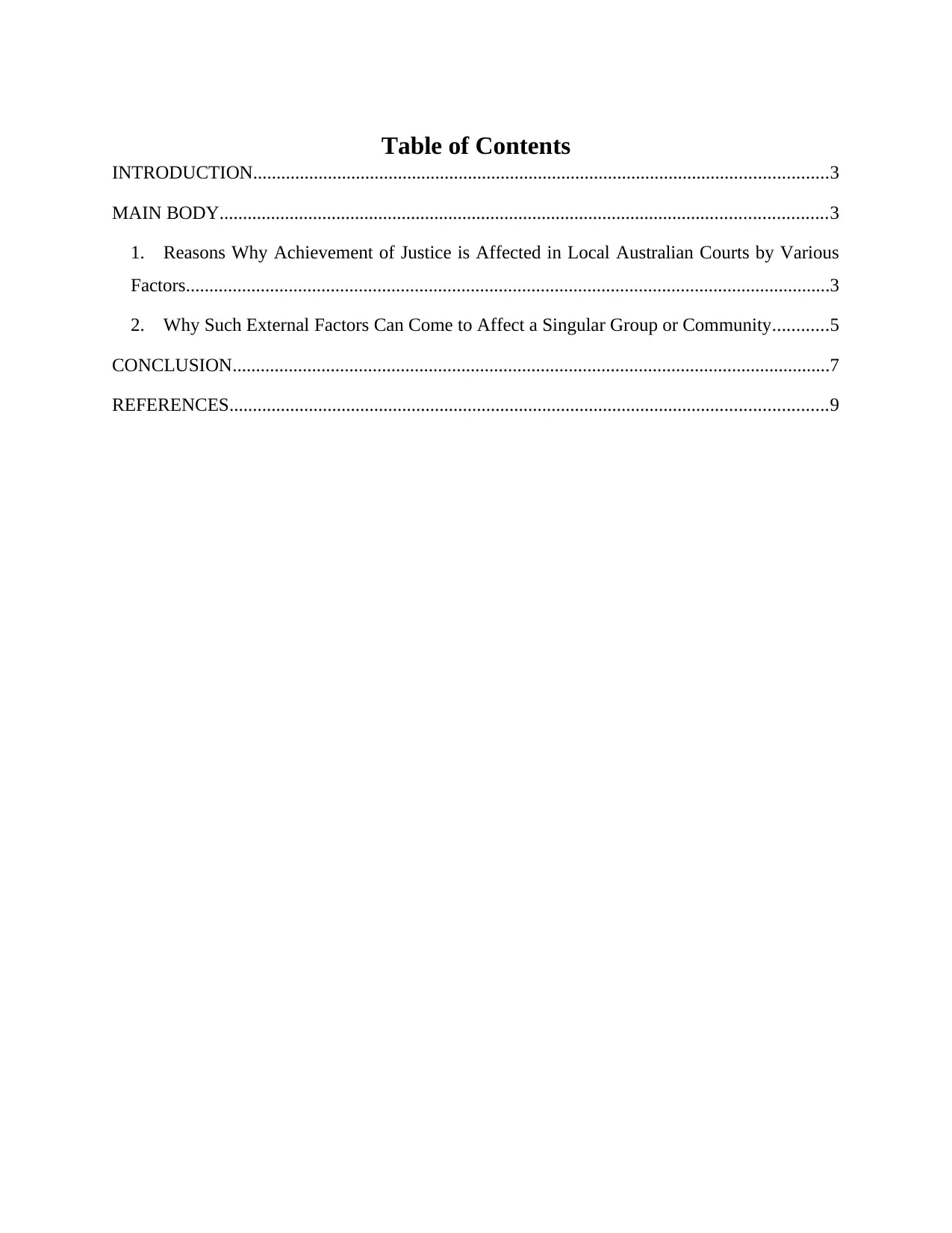
Table of Contents
INTRODUCTION...........................................................................................................................3
MAIN BODY..................................................................................................................................3
1. Reasons Why Achievement of Justice is Affected in Local Australian Courts by Various
Factors..........................................................................................................................................3
2. Why Such External Factors Can Come to Affect a Singular Group or Community............5
CONCLUSION................................................................................................................................7
REFERENCES................................................................................................................................9
INTRODUCTION...........................................................................................................................3
MAIN BODY..................................................................................................................................3
1. Reasons Why Achievement of Justice is Affected in Local Australian Courts by Various
Factors..........................................................................................................................................3
2. Why Such External Factors Can Come to Affect a Singular Group or Community............5
CONCLUSION................................................................................................................................7
REFERENCES................................................................................................................................9
INTRODUCTION
Human rights pertain to the fundamental moral norms or principles that come to describe
certain standards of human behaviour that are cited as natural legal rights of all human beings
and are thus protected and ensured though national and international regulations and laws by
justice courts (Alston, 2017). This report analyses two main topics – “The achievement of justice
in the Local Court is affected by factors including the high volume of cases and the pressure to plead
guilty. The focus on efficiency means that justice is often compromised” and “the effect on one
vulnerable group i.e. one group in the community who already suffer disadvantage. Why do these
factors affect this group in particular?”
MAIN BODY
1. Reasons Why Achievement of Justice is Affected in Local Australian Courts by Various
Factors
It has become increasingly evident to all people involved in the legal processes of a
country that external factors such as high increasing volume of cases, pressure of pleading guilty,
an emphasis on efficiency, sentencing discounts on guilty plea etc., and other external factors
come to significantly impact and affect the achievement of justice in local courts of Australia,
with these factors meaning that to pursuit of justice is often compromised within local Australian
courts. This is quite true as because such factors place increased pressure on local Australian
courts towards increasing the overall efficiency with which they conduct their daily operations,
which means that the local courts in their efforts to achieve increased operational efficiency can
compromise their pursuit of justice, which has numerous significantly negative and adverse
implications for the local courts of Australia and the public perception of how justice is served
within the country (Mack, K. & Roach Anleu, S. (2007)). The main reasons as to why external
factors come to affect and influence the operations of local Australian courts are as follows:
Increased number of Cases: The overall population of Australia stands at approximately 2.5
crore, with the Australian population increasing steadily in the 21st century. This means that due
to the increased number of citizens that now live in Australia, its legal systems and justice courts
Human rights pertain to the fundamental moral norms or principles that come to describe
certain standards of human behaviour that are cited as natural legal rights of all human beings
and are thus protected and ensured though national and international regulations and laws by
justice courts (Alston, 2017). This report analyses two main topics – “The achievement of justice
in the Local Court is affected by factors including the high volume of cases and the pressure to plead
guilty. The focus on efficiency means that justice is often compromised” and “the effect on one
vulnerable group i.e. one group in the community who already suffer disadvantage. Why do these
factors affect this group in particular?”
MAIN BODY
1. Reasons Why Achievement of Justice is Affected in Local Australian Courts by Various
Factors
It has become increasingly evident to all people involved in the legal processes of a
country that external factors such as high increasing volume of cases, pressure of pleading guilty,
an emphasis on efficiency, sentencing discounts on guilty plea etc., and other external factors
come to significantly impact and affect the achievement of justice in local courts of Australia,
with these factors meaning that to pursuit of justice is often compromised within local Australian
courts. This is quite true as because such factors place increased pressure on local Australian
courts towards increasing the overall efficiency with which they conduct their daily operations,
which means that the local courts in their efforts to achieve increased operational efficiency can
compromise their pursuit of justice, which has numerous significantly negative and adverse
implications for the local courts of Australia and the public perception of how justice is served
within the country (Mack, K. & Roach Anleu, S. (2007)). The main reasons as to why external
factors come to affect and influence the operations of local Australian courts are as follows:
Increased number of Cases: The overall population of Australia stands at approximately 2.5
crore, with the Australian population increasing steadily in the 21st century. This means that due
to the increased number of citizens that now live in Australia, its legal systems and justice courts
⊘ This is a preview!⊘
Do you want full access?
Subscribe today to unlock all pages.

Trusted by 1+ million students worldwide
are now responsible for and faced with the legal issues and troubles of an increased number of
Australian citizens, which places intense pressure on the legal system and local Australian courts
to achieve optimum standards of operational efficiency in their daily operations, with the
intention to become able to service and solve as many legal cases of the Australian population as
is humanly possible. This has a negative effect on the operations of the local Australian courts
because increasing efficiency of the legal system of Australia means that the judiciary places
decreased importance and attention to every individual legal case. This is done with regards to
solving all the legal cases with increased efficiency so that the legal courts can move on to the
next legal case, as the total number of legal cases pending is already at startling numbers. Factors
such as decreasing public perception and public reputation of the local Australian courts also
adds to such courts now conducting their daily operations with increased efficiency, even if this
strategy compromises the achievement of justice by local Australian courts (Brown et. al.,).
These are some of the various reasons why the increased number of legal cases pending has a
negative impact on the overall operations of local Australian courts in their objectives of
achieving justice and why local Australian courts are nowadays placing increased emphasis on
operating with increased efficiency, even though this compromises their objectives of achieving
justice.
Pressure to plead guilty: Another major reason as to why external factors affect the operations
of local Australian courts towards their objective of achieving justice pertains to the sentencing
discounts that the legal system of Australia provides to convicts should they plead guilty to the
local Australian courts of their ow volition. Though such initiatives and strategies result directly
out of utilitarian ethics approach and encourage potential convicts to come out with the truth to
the justice courts of Australia, in order to gain decreased sentences or partial punishments, these
can also have major negative implications for the innocent victims. Many a times, the legal
litigations become increasingly complex endeavours, with many powerful parties all trying to
influence the legal courts and their decisions towards their individual benefit. These can force
innocent victims caught up in a losing litigation to plead guilty in hopes of being given decreased
sentences or reduced punishments by the appointed judges, even though they might be innocent
of any crime and may just be pleading guilty to the judges to make the best solution for
themselves as part of the losing side to a complex litigation or legal case (Degener, 2016). This
behaviour of human beings also negatively affects the operations of local Australian courts in
Australian citizens, which places intense pressure on the legal system and local Australian courts
to achieve optimum standards of operational efficiency in their daily operations, with the
intention to become able to service and solve as many legal cases of the Australian population as
is humanly possible. This has a negative effect on the operations of the local Australian courts
because increasing efficiency of the legal system of Australia means that the judiciary places
decreased importance and attention to every individual legal case. This is done with regards to
solving all the legal cases with increased efficiency so that the legal courts can move on to the
next legal case, as the total number of legal cases pending is already at startling numbers. Factors
such as decreasing public perception and public reputation of the local Australian courts also
adds to such courts now conducting their daily operations with increased efficiency, even if this
strategy compromises the achievement of justice by local Australian courts (Brown et. al.,).
These are some of the various reasons why the increased number of legal cases pending has a
negative impact on the overall operations of local Australian courts in their objectives of
achieving justice and why local Australian courts are nowadays placing increased emphasis on
operating with increased efficiency, even though this compromises their objectives of achieving
justice.
Pressure to plead guilty: Another major reason as to why external factors affect the operations
of local Australian courts towards their objective of achieving justice pertains to the sentencing
discounts that the legal system of Australia provides to convicts should they plead guilty to the
local Australian courts of their ow volition. Though such initiatives and strategies result directly
out of utilitarian ethics approach and encourage potential convicts to come out with the truth to
the justice courts of Australia, in order to gain decreased sentences or partial punishments, these
can also have major negative implications for the innocent victims. Many a times, the legal
litigations become increasingly complex endeavours, with many powerful parties all trying to
influence the legal courts and their decisions towards their individual benefit. These can force
innocent victims caught up in a losing litigation to plead guilty in hopes of being given decreased
sentences or reduced punishments by the appointed judges, even though they might be innocent
of any crime and may just be pleading guilty to the judges to make the best solution for
themselves as part of the losing side to a complex litigation or legal case (Degener, 2016). This
behaviour of human beings also negatively affects the operations of local Australian courts in
Paraphrase This Document
Need a fresh take? Get an instant paraphrase of this document with our AI Paraphraser
their objectives of achieving justice and the efficiency driven local Australian courts do not look
closely into the legal litigation, when a convict is readily pleading for being guilty. It is also
possible that the innocent party in a legal litigation may not even possess the financial resources
required to battle out their innocence in a legal litigation against a powerful individual or party or
organisation, eve after all the provisions provided to them by the Australian government. This
leaves them with no realistic choice but to plead as guilty in front of the judges of the local
Australian courts, even though they might actually be innocent, just in hopes of coming out of
the legal case with decreased punishments or sentence (Sandell, 2016). These are the various
reasons as to why the pressure on individuals to plead guilty in front of the judges of the local
Australian courts has a negative effect on the operations of legal courts in their objectives of
achieving justice.
2. Why Such External Factors Can Come to Affect a Singular Group or Community
The existence of such external factors and their ability to negatively affect the operations
of local Australian courts in their objectives of achieving justice has a significantly negative and
adverse impact on the marginal, underprivileged and underrepresented minority groups within
the Australian population. Whether it be individuals belonging to the black ethic minority
community in USA, or people belonging to the aboriginal Australian community in Australia,
individuals belonging to such underprivileged, underrepresented and minority communities are
adversely affected by such external factors influencing the operations of local Australian courts
in a majorly significant manner.
Research has already proven that minority, underprivileged and underrepresented
communities of a country such as the black ethnic minority or the aboriginal Australians are
already facing various social, economical and cultural inequalities in the world which hamper the
development and growth of individuals belonging to such communities of the world. This
directly means that increasing number of people belonging to such communities possess
decreased opportunities within the external environment of the country to make their lives better
either by employment or other operations of the individual (Gilabert, 2019). Such communities
have also been seriously negatively affected by past misdeeds such as increased drug use,
propensity for domestic violence, childhood exposure to violence etc., with all such factors also
significantly contributing towards hindering the overall development of individuals belonging to
closely into the legal litigation, when a convict is readily pleading for being guilty. It is also
possible that the innocent party in a legal litigation may not even possess the financial resources
required to battle out their innocence in a legal litigation against a powerful individual or party or
organisation, eve after all the provisions provided to them by the Australian government. This
leaves them with no realistic choice but to plead as guilty in front of the judges of the local
Australian courts, even though they might actually be innocent, just in hopes of coming out of
the legal case with decreased punishments or sentence (Sandell, 2016). These are the various
reasons as to why the pressure on individuals to plead guilty in front of the judges of the local
Australian courts has a negative effect on the operations of legal courts in their objectives of
achieving justice.
2. Why Such External Factors Can Come to Affect a Singular Group or Community
The existence of such external factors and their ability to negatively affect the operations
of local Australian courts in their objectives of achieving justice has a significantly negative and
adverse impact on the marginal, underprivileged and underrepresented minority groups within
the Australian population. Whether it be individuals belonging to the black ethic minority
community in USA, or people belonging to the aboriginal Australian community in Australia,
individuals belonging to such underprivileged, underrepresented and minority communities are
adversely affected by such external factors influencing the operations of local Australian courts
in a majorly significant manner.
Research has already proven that minority, underprivileged and underrepresented
communities of a country such as the black ethnic minority or the aboriginal Australians are
already facing various social, economical and cultural inequalities in the world which hamper the
development and growth of individuals belonging to such communities of the world. This
directly means that increasing number of people belonging to such communities possess
decreased opportunities within the external environment of the country to make their lives better
either by employment or other operations of the individual (Gilabert, 2019). Such communities
have also been seriously negatively affected by past misdeeds such as increased drug use,
propensity for domestic violence, childhood exposure to violence etc., with all such factors also
significantly contributing towards hindering the overall development of individuals belonging to
such minority communities. Throughout the modern history, such factors have resulted in and in
many ways forced the average individual belonging to such minority communities to earn
opportunities for their grown and development through illegal, immoral or unethical means and
practices.
Due to the decreased opportunities provided to individuals belonging to minority
communities and groups such as the ethnic black minorities or the aboriginal Australians,
increasing number of minority individuals are forced to earn their living through illegal work,
which when caught promotes the stereotype within the general society that all members of the
minority community are criminals who break the law to earn their living and conduct their daily
operations, even though such stereotypes may not share any connection with the ground reality
in the country. This mass perception and stereotype also affects the operations of local Australian
courts as all the legislative judges are also human beings, prone to the same irrationalities and
fallacies that the rest of us within society are also prone to. These stereotypes have an immensely
negative impact on all the innocent members of the minority communities as it is realistically
impossible for all members of a minority community to be behaving in an illegal or immoral
manner (Sikkink, 2019). These stereotypes have in the past influenced the decision making of
judges and judiciary of countries to legally punish an innocent member of such communities as a
criminal based on past experiences of similar cases, even though the evidence at hand might have
been lax or inconsequential, if a convict in question did not belong to such minority group of the
country such as the ethnic black or the aboriginal Australians. In this manner, the cultural
stereotypes have had an immensely negative impact on the operations of local Australian courts
and significantly influenced the decision-making operations of the justice court’s judges towards
coming to the wrong conclusions based on the cultural stereotypes which hinders the objective of
local Australian courts to achieve justice.
Another reason as to why such individuals belonging to the minority groups and
communities are negatively affected by external factors influencing the decision making
operations of local Australian courts is that members of such communities have also been on the
receiving end of past atrocities, wars, discriminations etc., by the normal majority of the country
as is the case in Australia with the aboriginal Australians whose land and resources were stolen
or the black ethnic minority of USA, who were enslaved for major segments of past history
many ways forced the average individual belonging to such minority communities to earn
opportunities for their grown and development through illegal, immoral or unethical means and
practices.
Due to the decreased opportunities provided to individuals belonging to minority
communities and groups such as the ethnic black minorities or the aboriginal Australians,
increasing number of minority individuals are forced to earn their living through illegal work,
which when caught promotes the stereotype within the general society that all members of the
minority community are criminals who break the law to earn their living and conduct their daily
operations, even though such stereotypes may not share any connection with the ground reality
in the country. This mass perception and stereotype also affects the operations of local Australian
courts as all the legislative judges are also human beings, prone to the same irrationalities and
fallacies that the rest of us within society are also prone to. These stereotypes have an immensely
negative impact on all the innocent members of the minority communities as it is realistically
impossible for all members of a minority community to be behaving in an illegal or immoral
manner (Sikkink, 2019). These stereotypes have in the past influenced the decision making of
judges and judiciary of countries to legally punish an innocent member of such communities as a
criminal based on past experiences of similar cases, even though the evidence at hand might have
been lax or inconsequential, if a convict in question did not belong to such minority group of the
country such as the ethnic black or the aboriginal Australians. In this manner, the cultural
stereotypes have had an immensely negative impact on the operations of local Australian courts
and significantly influenced the decision-making operations of the justice court’s judges towards
coming to the wrong conclusions based on the cultural stereotypes which hinders the objective of
local Australian courts to achieve justice.
Another reason as to why such individuals belonging to the minority groups and
communities are negatively affected by external factors influencing the decision making
operations of local Australian courts is that members of such communities have also been on the
receiving end of past atrocities, wars, discriminations etc., by the normal majority of the country
as is the case in Australia with the aboriginal Australians whose land and resources were stolen
or the black ethnic minority of USA, who were enslaved for major segments of past history
⊘ This is a preview!⊘
Do you want full access?
Subscribe today to unlock all pages.
Trusted by 1+ million students worldwide
(Cahill, 2018). Such misdeeds to the ancestors of such minority community, force its current
members to hold grudges and hate towards the majority population of the country. These
eventually result in riots, violence, civil wars etc., which aim to destabilise the ruling powers of
the country so that some power can be gained by the members of such minority groups and
communities. All such riots and public disruption by members of such minority groups, who in
their minds are only fighting for their own justice and rights are eventually met with military or
authorities force, which imprisons them and labels most of the members of such minority
communities as the “enemy of the majority” (Ienca and Andorno, 2017). This is the case even
when the minority community shows their apprehension towards the majority through peaceful
means such as boycotts or rallies. This forces increasing number of members of such minority
communities into the prisons and decreases the overall opportunities available to the other
members of the minority community to make a decent living within the society through moral,
legal and ethical practices and methods. All such operations of minority communities turns the
majority of the country against them, whether through ethical reasoning or state propaganda,
which again limits the overall opportunities available to minority community to make a decent
living through legal and ethical practices.
All such social, cultural, political and economical factors force increasing number of
members belonging to minority groups and communities such as the aboriginal Australians or
the ethnic blacks to engage in illegal, immoral or unethical practices to earn a living. This results
in an unending cycle in which they are eventually caught in such act, with the stereotypes against
the community becoming popular in the country, affecting the help that such underprivileged and
underrepresented minority communities get from the country, which again limits their
opportunities for growth and pushes next generation to commit the same mistakes that their
elders did and in this manner the entire community is affected from such external factors.
CONCLUSION
This report effectively analyses two main topics on human rights. Through evaluation of
the first topic, the report analyses the main reasons why achievement of justice is affected in the
local courts by external factors such as high volume of cases, pressure to plead guilty etc.
Through the analyses of the second topic, the report discusses why a singular vulnerable group of
members to hold grudges and hate towards the majority population of the country. These
eventually result in riots, violence, civil wars etc., which aim to destabilise the ruling powers of
the country so that some power can be gained by the members of such minority groups and
communities. All such riots and public disruption by members of such minority groups, who in
their minds are only fighting for their own justice and rights are eventually met with military or
authorities force, which imprisons them and labels most of the members of such minority
communities as the “enemy of the majority” (Ienca and Andorno, 2017). This is the case even
when the minority community shows their apprehension towards the majority through peaceful
means such as boycotts or rallies. This forces increasing number of members of such minority
communities into the prisons and decreases the overall opportunities available to the other
members of the minority community to make a decent living within the society through moral,
legal and ethical practices and methods. All such operations of minority communities turns the
majority of the country against them, whether through ethical reasoning or state propaganda,
which again limits the overall opportunities available to minority community to make a decent
living through legal and ethical practices.
All such social, cultural, political and economical factors force increasing number of
members belonging to minority groups and communities such as the aboriginal Australians or
the ethnic blacks to engage in illegal, immoral or unethical practices to earn a living. This results
in an unending cycle in which they are eventually caught in such act, with the stereotypes against
the community becoming popular in the country, affecting the help that such underprivileged and
underrepresented minority communities get from the country, which again limits their
opportunities for growth and pushes next generation to commit the same mistakes that their
elders did and in this manner the entire community is affected from such external factors.
CONCLUSION
This report effectively analyses two main topics on human rights. Through evaluation of
the first topic, the report analyses the main reasons why achievement of justice is affected in the
local courts by external factors such as high volume of cases, pressure to plead guilty etc.
Through the analyses of the second topic, the report discusses why a singular vulnerable group of
Paraphrase This Document
Need a fresh take? Get an instant paraphrase of this document with our AI Paraphraser

community who already suffer from other disadvantages also come to be affected by the factors
discussed in the first topic.
discussed in the first topic.
REFERENCES
Books and Journals
Alston, P., 2017. The populist challenge to human rights. Journal of Human Rights Practice.
9(1). pp.1-15.
Brown et al, Criminal Laws: Materials and Commentary on Criminal Law and Process in New
South Wales, (5th edition, Federation Press, 2011), pp. 142-166
Cahill, S., 2018. Dementia and human rights. Policy Press.
Degener, T., 2016. Disability in a human rights context. Laws. 5(3). p.35.
Gilabert, P., 2019. Human dignity and human rights. Oxford University Press, USA.
Ienca, M. and Andorno, R., 2017. Towards new human rights in the age of neuroscience and
neurotechnology. Life Sciences, Society and Policy. 13(1). pp.1-27.
Mack, K. & Roach Anleu, S. (2007) ‘“Getting through the list”: Judge craft and legitimacy in the
lower courts’ Social and Legal Studies, vol.16, pp. 341-61
Sandell, R., 2016. Museums, moralities and human rights. Taylor & Francis.
Sikkink, K., 2019. Evidence for hope: Making human rights work in the 21st century (Vol. 28).
Princeton University Press.
Books and Journals
Alston, P., 2017. The populist challenge to human rights. Journal of Human Rights Practice.
9(1). pp.1-15.
Brown et al, Criminal Laws: Materials and Commentary on Criminal Law and Process in New
South Wales, (5th edition, Federation Press, 2011), pp. 142-166
Cahill, S., 2018. Dementia and human rights. Policy Press.
Degener, T., 2016. Disability in a human rights context. Laws. 5(3). p.35.
Gilabert, P., 2019. Human dignity and human rights. Oxford University Press, USA.
Ienca, M. and Andorno, R., 2017. Towards new human rights in the age of neuroscience and
neurotechnology. Life Sciences, Society and Policy. 13(1). pp.1-27.
Mack, K. & Roach Anleu, S. (2007) ‘“Getting through the list”: Judge craft and legitimacy in the
lower courts’ Social and Legal Studies, vol.16, pp. 341-61
Sandell, R., 2016. Museums, moralities and human rights. Taylor & Francis.
Sikkink, K., 2019. Evidence for hope: Making human rights work in the 21st century (Vol. 28).
Princeton University Press.
⊘ This is a preview!⊘
Do you want full access?
Subscribe today to unlock all pages.
Trusted by 1+ million students worldwide

1 out of 9


Related Documents


Your All-in-One AI-Powered Toolkit for Academic Success.
+13062052269
info@desklib.com
Available 24*7 on WhatsApp / Email
![[object Object]](/_next/static/media/star-bottom.7253800d.svg)
Unlock your academic potential
Copyright © 2020–2026 A2Z Services. All Rights Reserved. Developed and managed by ZUCOL.