Evaluating Health Factors Affecting Running Performance Post-40
VerifiedAdded on 2023/06/17
|6
|1908
|138
Essay
AI Summary
This essay provides a comprehensive analysis of the factors affecting a female runner's performance as she ages, focusing on the impact of endometrial tissue changes, hormone levels (specifically estrogen), and dietary supplements. It discusses how endometrial tissue thickening post-menopause can lead to pain and bone weakness, and how decreased estrogen levels affect energy and bone health. The essay also examines urinalysis results, highlighting the implications of high ketone levels due to ketone supplements, and the importance of protein intake for bone health. Furthermore, it addresses the use of nonsteroidal anti-inflammatory drugs (NSAIDs) for pain management, considering their bioavailability and half-life. The conclusion emphasizes the significance of understanding these physiological changes for maintaining optimal health and performance in aging female athletes. Desklib offers a wealth of resources for students seeking similar content.

Essay scenario

Paraphrase This Document
Need a fresh take? Get an instant paraphrase of this document with our AI Paraphraser
INTRODUCTION
Runner are the person who especially in a specified way, in case of the women runner
age and biological system changes impact their capability of running (Zadeh, & Mills (2018)).
Regular running slows the effects of ageing, after the age 40 runners decline running.
Endometrial tissue is the part of female body effect the performance of running by impacting the
hormones secretion and increased body pain after the age 40. in this essay brief evaluation of the
Jessica health and impact of age on her running capabilities is done.
Topic 1
Endometrial tissue contain glandular structure, this is the tissue inside the uterus that
body peels off and sheds during the menstrual periods
(Gifford, & Reynolds, (2021)). All the mammalian uteri contain glands in the endometrium that
synthesize or transport and secrete substances essential for survival and development of
conceptus, embryo, fetus and associated extra-embryonic membranes. Endometrium contain
extensive uterine gland that synthesize and secrete substances into the uterine lumen, including
the complex array of enzymes, growth factors, cytokines, lymphokines, hormones, transport
protein and other substances, collectively term's histotroph. Endometrium is inner lining of the
uterus, each month endometrium thickness and renews itself preparing for the pregnancy and if
pregnancy doesn't occur then endometrium sheds in a process known as menstruation. In the case
of Jessica she reached the menopause 5 months ago, women's with the menopausal are more
likely to have endometrial hyperplasia. After the menopause Endometrial glandular structure
get more thicker and causes the huge pain and bones get more weak (Noë, & Shih, (2018)) .
Oestrogen is one of the most essential female sex hormones, although it produce by both
man and females but this play bigger role in the women's bodies, oestrogen is produce through
hormonal system and moves through the bloodstream. Oestrogen level is0 to 30 pg/mL for
postmenopausal women. Role in context to the Jessica is keeping bone stronger , change in the
level of the oestrogen levels affect overall the physical development and bone health. Role of
the oestrogen in context to the Jessica who is the runner and now her age is 40, oestrogen has
been identified with the number of beneficial metabolic effects and in context to the energy level
which is required by the runner, this hormone help to increase the energy by increased storage of
the glycogen in muscles, free fatty acid availability, ability to burn the fat and oxidative capacity
Runner are the person who especially in a specified way, in case of the women runner
age and biological system changes impact their capability of running (Zadeh, & Mills (2018)).
Regular running slows the effects of ageing, after the age 40 runners decline running.
Endometrial tissue is the part of female body effect the performance of running by impacting the
hormones secretion and increased body pain after the age 40. in this essay brief evaluation of the
Jessica health and impact of age on her running capabilities is done.
Topic 1
Endometrial tissue contain glandular structure, this is the tissue inside the uterus that
body peels off and sheds during the menstrual periods
(Gifford, & Reynolds, (2021)). All the mammalian uteri contain glands in the endometrium that
synthesize or transport and secrete substances essential for survival and development of
conceptus, embryo, fetus and associated extra-embryonic membranes. Endometrium contain
extensive uterine gland that synthesize and secrete substances into the uterine lumen, including
the complex array of enzymes, growth factors, cytokines, lymphokines, hormones, transport
protein and other substances, collectively term's histotroph. Endometrium is inner lining of the
uterus, each month endometrium thickness and renews itself preparing for the pregnancy and if
pregnancy doesn't occur then endometrium sheds in a process known as menstruation. In the case
of Jessica she reached the menopause 5 months ago, women's with the menopausal are more
likely to have endometrial hyperplasia. After the menopause Endometrial glandular structure
get more thicker and causes the huge pain and bones get more weak (Noë, & Shih, (2018)) .
Oestrogen is one of the most essential female sex hormones, although it produce by both
man and females but this play bigger role in the women's bodies, oestrogen is produce through
hormonal system and moves through the bloodstream. Oestrogen level is0 to 30 pg/mL for
postmenopausal women. Role in context to the Jessica is keeping bone stronger , change in the
level of the oestrogen levels affect overall the physical development and bone health. Role of
the oestrogen in context to the Jessica who is the runner and now her age is 40, oestrogen has
been identified with the number of beneficial metabolic effects and in context to the energy level
which is required by the runner, this hormone help to increase the energy by increased storage of
the glycogen in muscles, free fatty acid availability, ability to burn the fat and oxidative capacity
in exercise. Oestrogen level in the Jessica level should be 0 to 30 pg/mL because she has
reached the stage of postmenopausal due to which now she is facing the energy issues.
Homoeostatic regulation in the female reproductive system maintain by the reproductive
system by regulating vagina PH (Milić, (2018)). Hormonal interaction between the
Hypothalamus, anterior pituitary gland and ovaries regulates the female productive system. The
hypothalamus secretes a small peptide, gonadotropin releasing hormone luteinizing hormone.
Management and adjustment of physiological systems within the body is called homoeostatic
regulation.
Topic 2
Urinalysis is a simple test that looks at a small sample of your urine, this helps to find and
evaluate problem that need treatment, such as infections or kidney problems. In the case of
Jessica urinalysis it has been identified that urine colour is dark yellow, urobilinogen is 0.2,
ketone positive and protein ++, nitrite is absent, glucose is also absent, pH is 5.5. specific gravity
is 1.015 and leucocytes are absent. On the basis of the basic knowledge it has been evaluated that
ketone values are abnormal high ketone levels could result in serious illness or death, this can
also be associated with the diabetic ketoacidosis (DKA). This higher amount of the ketose in the
urine is associated with Ketone supplements of the Jessica. Ketone supplements cause
electrolyte imbalance and due to the continuous supplement it effective the body system of
energy production(Thuma,2019)).
Topic 3
Jessica supplement her diet with a daily protein shake after exercise, that is important for
the Jessica to maintain the intake of protein diet for the bone health, because athletes need to
consume sufficient protein to support the increased rate of bone turnover caused by athletic
training. Protein ingestion increases the production of a number of the hormones and growth
factors, such as IGF-1, which are also involves in the formation of bone. Protein makes up rough
50% of the volume of bone and about one third of its mass, the bone protein matrix undergoes
continuous turnover and remodelling, there for the adequate supply of the amino acid and
mineral substrate is needed to support the formation and maintenance of bone across the life span
(Hines, (2019)).
reached the stage of postmenopausal due to which now she is facing the energy issues.
Homoeostatic regulation in the female reproductive system maintain by the reproductive
system by regulating vagina PH (Milić, (2018)). Hormonal interaction between the
Hypothalamus, anterior pituitary gland and ovaries regulates the female productive system. The
hypothalamus secretes a small peptide, gonadotropin releasing hormone luteinizing hormone.
Management and adjustment of physiological systems within the body is called homoeostatic
regulation.
Topic 2
Urinalysis is a simple test that looks at a small sample of your urine, this helps to find and
evaluate problem that need treatment, such as infections or kidney problems. In the case of
Jessica urinalysis it has been identified that urine colour is dark yellow, urobilinogen is 0.2,
ketone positive and protein ++, nitrite is absent, glucose is also absent, pH is 5.5. specific gravity
is 1.015 and leucocytes are absent. On the basis of the basic knowledge it has been evaluated that
ketone values are abnormal high ketone levels could result in serious illness or death, this can
also be associated with the diabetic ketoacidosis (DKA). This higher amount of the ketose in the
urine is associated with Ketone supplements of the Jessica. Ketone supplements cause
electrolyte imbalance and due to the continuous supplement it effective the body system of
energy production(Thuma,2019)).
Topic 3
Jessica supplement her diet with a daily protein shake after exercise, that is important for
the Jessica to maintain the intake of protein diet for the bone health, because athletes need to
consume sufficient protein to support the increased rate of bone turnover caused by athletic
training. Protein ingestion increases the production of a number of the hormones and growth
factors, such as IGF-1, which are also involves in the formation of bone. Protein makes up rough
50% of the volume of bone and about one third of its mass, the bone protein matrix undergoes
continuous turnover and remodelling, there for the adequate supply of the amino acid and
mineral substrate is needed to support the formation and maintenance of bone across the life span
(Hines, (2019)).
⊘ This is a preview!⊘
Do you want full access?
Subscribe today to unlock all pages.

Trusted by 1+ million students worldwide
Protein absorption in the case of Jessica and any other individual done by the mechanism
known as active transport mechanisms, primarily in the duodenum and jejunum, absorb most
proteins as their breakdown products, amino acids and almost 95 to 98% protein is digested and
absorbed in the small intestine (Veronese, & Chebel, (2019)). Chemical process of protein
absorption is hydrolysis, protein is made of the repeating units, called as amino acids, which held
together by peptide bonds. During the digestion protein get breakdown into the amino aides
through hydrolysis. The amino acid are then absorbed in blood and carried by blood cells to out
tissues and organs. Proline digestion requires the chemical actions of the gastric juice and the
mechanical actions of the stomach, such as the chemical ligation of the protein requires acid
hydrochloric and pepsin enzyme which is known as the gastric juices . In other hand the
chemical digestion is involving the muscular contractions which is known as peristalsis. In
adults protein is absorbed as the peptides or amino acids and this process occurs in the duodenum
or proximal jejunum of the small intestine (Nagori, & Panchal, (2019)). Then the peptide and
amino acids pass through the interstitial brush border by affiliating diffusion or active transport.
Active transport sodium and ATP to actively transport the molecule through the cell membrane.
Once passed through the membrane the amino acid or peptide are released into the intestinal
blood stream and are transport to the liver by the hepatic portal vein, this is known as the
enterohepatic circulation .
Glucose raising hormones which help the Jessica to maintain the blood glucose level is
adrenaline and glucagon. It increase plasma glucose levels by stimulating liver gluconeogenesis.
Topic 4
Nonsteroidal anti inflammatory drugs continue to be used, most commonly it available as
oral tablets, according to the package insert, the dosage for the most common over the counter
are as follows, 200 mg tablets, 1 to 2 tablets every 4 to 6 hours while symptoms persist. NSAID
are the good at treating pain caused by slow tissue damage, this also work well fighting back
pain, headaches, this works like corticsteriods, without many side effects.
NSAIDs generally have high bioavailability after oral administration, as a result their
chemical properties they are well absorbed from the gastrointestinal tract and hepatic clearance is
low. Bioavailability is 89 % (Laird, (2019)).
known as active transport mechanisms, primarily in the duodenum and jejunum, absorb most
proteins as their breakdown products, amino acids and almost 95 to 98% protein is digested and
absorbed in the small intestine (Veronese, & Chebel, (2019)). Chemical process of protein
absorption is hydrolysis, protein is made of the repeating units, called as amino acids, which held
together by peptide bonds. During the digestion protein get breakdown into the amino aides
through hydrolysis. The amino acid are then absorbed in blood and carried by blood cells to out
tissues and organs. Proline digestion requires the chemical actions of the gastric juice and the
mechanical actions of the stomach, such as the chemical ligation of the protein requires acid
hydrochloric and pepsin enzyme which is known as the gastric juices . In other hand the
chemical digestion is involving the muscular contractions which is known as peristalsis. In
adults protein is absorbed as the peptides or amino acids and this process occurs in the duodenum
or proximal jejunum of the small intestine (Nagori, & Panchal, (2019)). Then the peptide and
amino acids pass through the interstitial brush border by affiliating diffusion or active transport.
Active transport sodium and ATP to actively transport the molecule through the cell membrane.
Once passed through the membrane the amino acid or peptide are released into the intestinal
blood stream and are transport to the liver by the hepatic portal vein, this is known as the
enterohepatic circulation .
Glucose raising hormones which help the Jessica to maintain the blood glucose level is
adrenaline and glucagon. It increase plasma glucose levels by stimulating liver gluconeogenesis.
Topic 4
Nonsteroidal anti inflammatory drugs continue to be used, most commonly it available as
oral tablets, according to the package insert, the dosage for the most common over the counter
are as follows, 200 mg tablets, 1 to 2 tablets every 4 to 6 hours while symptoms persist. NSAID
are the good at treating pain caused by slow tissue damage, this also work well fighting back
pain, headaches, this works like corticsteriods, without many side effects.
NSAIDs generally have high bioavailability after oral administration, as a result their
chemical properties they are well absorbed from the gastrointestinal tract and hepatic clearance is
low. Bioavailability is 89 % (Laird, (2019)).
Paraphrase This Document
Need a fresh take? Get an instant paraphrase of this document with our AI Paraphraser
Ibuprofen is rapidly absorbed, reaching peak serum levels one to two hours after
administration and has a half life of 1.8 to two hours. Steady state is refers as the maintenance of
the constant internal concentrations of molecules and ions in the cells and organs of living
system. Half-life is a quantitative parameter and can be used to predict the duration for which the
drug will be available in the body after administration. It also helps to to estimate early or late
the drugs could be eliminated from the body. It also helps to determine the dosing interval of a
drugs. Benefits of the Steady achievement is understanding steady state is also important for
choosing the right dose and dosing interval to achieve a desired steady-state concentration
(Słabuszewska-Jóźwiak, & Jakiel, (2021)).
CONCLUSION
From the above study it has been concluded that Endometrial tissue contain glandular
structure, its thickness after the age of 40 increase the body pain and bone weakness. Protein
absorption is one of the mos6t essential process which done by the active transportation.
Nonsteroidal anti inflammatory drugs have high bioavailability. Benefits of the Steady
achievement is understanding steady state is also important for choosing the right dose.
administration and has a half life of 1.8 to two hours. Steady state is refers as the maintenance of
the constant internal concentrations of molecules and ions in the cells and organs of living
system. Half-life is a quantitative parameter and can be used to predict the duration for which the
drug will be available in the body after administration. It also helps to to estimate early or late
the drugs could be eliminated from the body. It also helps to determine the dosing interval of a
drugs. Benefits of the Steady achievement is understanding steady state is also important for
choosing the right dose and dosing interval to achieve a desired steady-state concentration
(Słabuszewska-Jóźwiak, & Jakiel, (2021)).
CONCLUSION
From the above study it has been concluded that Endometrial tissue contain glandular
structure, its thickness after the age of 40 increase the body pain and bone weakness. Protein
absorption is one of the mos6t essential process which done by the active transportation.
Nonsteroidal anti inflammatory drugs have high bioavailability. Benefits of the Steady
achievement is understanding steady state is also important for choosing the right dose.
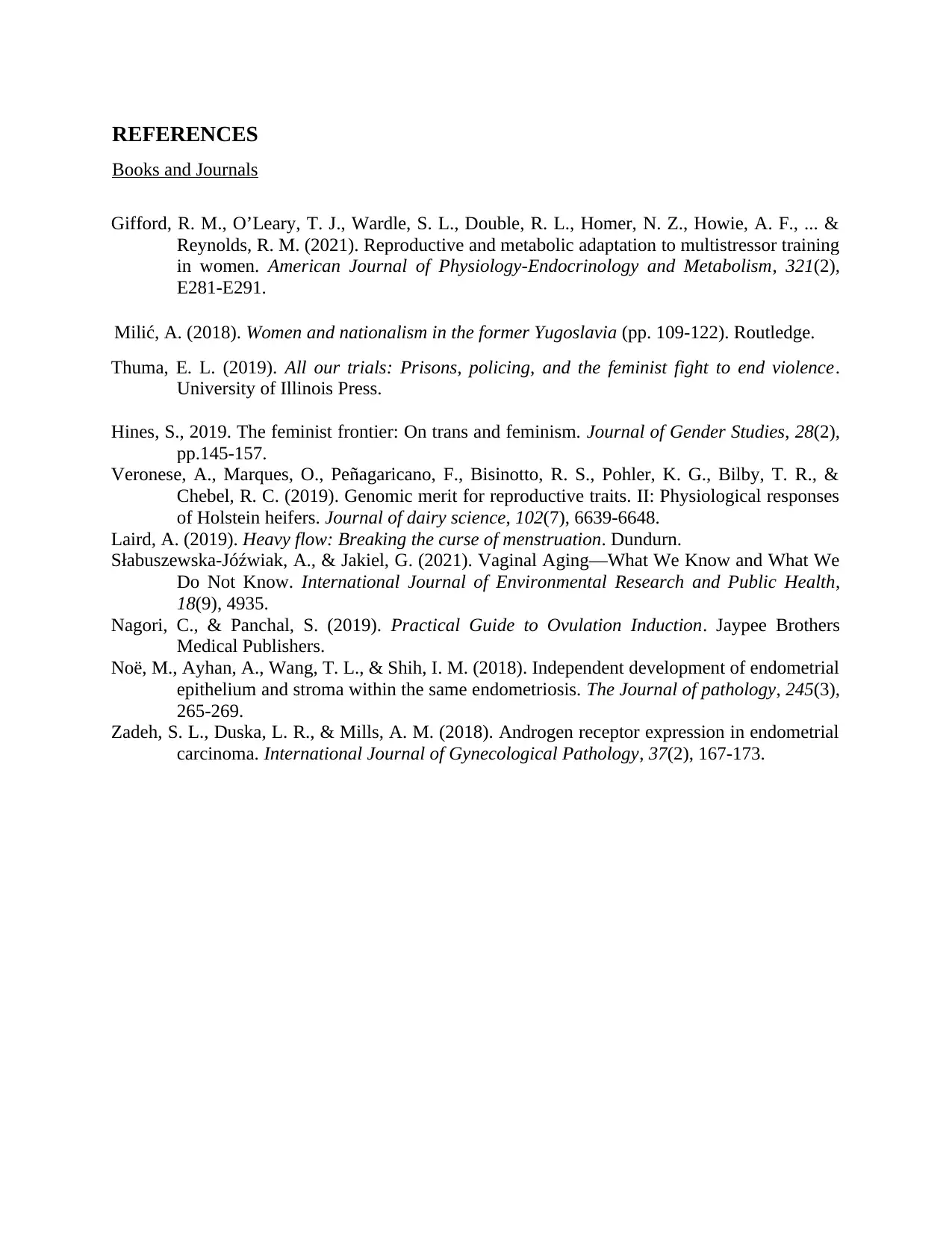
REFERENCES
Books and Journals
Gifford, R. M., O’Leary, T. J., Wardle, S. L., Double, R. L., Homer, N. Z., Howie, A. F., ... &
Reynolds, R. M. (2021). Reproductive and metabolic adaptation to multistressor training
in women. American Journal of Physiology-Endocrinology and Metabolism, 321(2),
E281-E291.
Milić, A. (2018). Women and nationalism in the former Yugoslavia (pp. 109-122). Routledge.
Thuma, E. L. (2019). All our trials: Prisons, policing, and the feminist fight to end violence.
University of Illinois Press.
Hines, S., 2019. The feminist frontier: On trans and feminism. Journal of Gender Studies, 28(2),
pp.145-157.
Veronese, A., Marques, O., Peñagaricano, F., Bisinotto, R. S., Pohler, K. G., Bilby, T. R., &
Chebel, R. C. (2019). Genomic merit for reproductive traits. II: Physiological responses
of Holstein heifers. Journal of dairy science, 102(7), 6639-6648.
Laird, A. (2019). Heavy flow: Breaking the curse of menstruation. Dundurn.
Słabuszewska-Jóźwiak, A., & Jakiel, G. (2021). Vaginal Aging—What We Know and What We
Do Not Know. International Journal of Environmental Research and Public Health,
18(9), 4935.
Nagori, C., & Panchal, S. (2019). Practical Guide to Ovulation Induction. Jaypee Brothers
Medical Publishers.
Noë, M., Ayhan, A., Wang, T. L., & Shih, I. M. (2018). Independent development of endometrial
epithelium and stroma within the same endometriosis. The Journal of pathology, 245(3),
265-269.
Zadeh, S. L., Duska, L. R., & Mills, A. M. (2018). Androgen receptor expression in endometrial
carcinoma. International Journal of Gynecological Pathology, 37(2), 167-173.
Books and Journals
Gifford, R. M., O’Leary, T. J., Wardle, S. L., Double, R. L., Homer, N. Z., Howie, A. F., ... &
Reynolds, R. M. (2021). Reproductive and metabolic adaptation to multistressor training
in women. American Journal of Physiology-Endocrinology and Metabolism, 321(2),
E281-E291.
Milić, A. (2018). Women and nationalism in the former Yugoslavia (pp. 109-122). Routledge.
Thuma, E. L. (2019). All our trials: Prisons, policing, and the feminist fight to end violence.
University of Illinois Press.
Hines, S., 2019. The feminist frontier: On trans and feminism. Journal of Gender Studies, 28(2),
pp.145-157.
Veronese, A., Marques, O., Peñagaricano, F., Bisinotto, R. S., Pohler, K. G., Bilby, T. R., &
Chebel, R. C. (2019). Genomic merit for reproductive traits. II: Physiological responses
of Holstein heifers. Journal of dairy science, 102(7), 6639-6648.
Laird, A. (2019). Heavy flow: Breaking the curse of menstruation. Dundurn.
Słabuszewska-Jóźwiak, A., & Jakiel, G. (2021). Vaginal Aging—What We Know and What We
Do Not Know. International Journal of Environmental Research and Public Health,
18(9), 4935.
Nagori, C., & Panchal, S. (2019). Practical Guide to Ovulation Induction. Jaypee Brothers
Medical Publishers.
Noë, M., Ayhan, A., Wang, T. L., & Shih, I. M. (2018). Independent development of endometrial
epithelium and stroma within the same endometriosis. The Journal of pathology, 245(3),
265-269.
Zadeh, S. L., Duska, L. R., & Mills, A. M. (2018). Androgen receptor expression in endometrial
carcinoma. International Journal of Gynecological Pathology, 37(2), 167-173.
⊘ This is a preview!⊘
Do you want full access?
Subscribe today to unlock all pages.
Trusted by 1+ million students worldwide

1 out of 6


Your All-in-One AI-Powered Toolkit for Academic Success.
+13062052269
info@desklib.com
Available 24*7 on WhatsApp / Email
![[object Object]](/_next/static/media/star-bottom.7253800d.svg)
Unlock your academic potential
Copyright © 2020–2026 A2Z Services. All Rights Reserved. Developed and managed by ZUCOL.