Consumer Purchase Decision: Branding Impact Analysis at Lulu UAE
VerifiedAdded on 2020/04/07
|18
|3712
|64
Project
AI Summary
This research project investigates the impact of branding on consumer purchase decisions, focusing on the Lulu UAE retail chain. The study begins with a research proposal outlining the background, rationale, aims, and objectives, including an examination of how reduced branding, non-branded information, and copycat branding influence consumer choices. A literature review explores brand characteristics, significance, and impact on consumer behavior. The methodology employs an interpretivism research philosophy, utilizing both primary (customer interviews) and secondary research. The project aims to determine the strategies used by Lulu for branding. The study also includes a detailed timetable and a comprehensive list of references. The research anticipates that reduced branding, copycat branding and other factors like reference groups, age and cultural values will influence consumer decisions. The project concludes with a critical review of key references and an analysis of the research data.

IMPACT OF BRANDING ON CONSUMER
PURCHASE DECISION: LULU UAE
PURCHASE DECISION: LULU UAE

Paraphrase This Document
Need a fresh take? Get an instant paraphrase of this document with our AI Paraphraser
TABLE OF CONTENTS
Task 1: Research proposal...............................................................................3
1. Introduction..............................................................................................3
Title...........................................................................................................3
Background...............................................................................................3
Rationale for the study..............................................................................4
Research Aims...........................................................................................4
2. Literature review......................................................................................5
Characteristics of brand............................................................................5
Significance of brand.................................................................................5
Impact of brand on consumer behavior.....................................................6
3. Research Design and Methodology..........................................................7
Time table and References..............................................................................7
References.......................................................................................................9
Task 2: Research project...............................................................................10
Critical review of key references for planned area of research..................10
Research investigation...............................................................................10
Collection, interpretation and analysis of research data............................10
Conclusion..................................................................................................10
Recommendations......................................................................................10
Task 1: Research proposal...............................................................................3
1. Introduction..............................................................................................3
Title...........................................................................................................3
Background...............................................................................................3
Rationale for the study..............................................................................4
Research Aims...........................................................................................4
2. Literature review......................................................................................5
Characteristics of brand............................................................................5
Significance of brand.................................................................................5
Impact of brand on consumer behavior.....................................................6
3. Research Design and Methodology..........................................................7
Time table and References..............................................................................7
References.......................................................................................................9
Task 2: Research project...............................................................................10
Critical review of key references for planned area of research..................10
Research investigation...............................................................................10
Collection, interpretation and analysis of research data............................10
Conclusion..................................................................................................10
Recommendations......................................................................................10
TASK 1: RESEARCH PROPOSAL
1. Introduction
Title
Impact of branding on consumer purchase decision: Lulu UAE
Background
The modern times exhibit significant transformations in the marketing
strategies used by companies to become more competitive and ensure their
survival in turbulent markets. Customers today are living in a world where
product and service purchases are constant and enormous. The success and
survival of organizations are reliant on the amount of information which is
collected meticulously by companies regarding buying habits of their existing
and potential customers. For long term sustenance, firms are interested in
building powerful brands which result in enduring customer relations (Iqbal,
2014).
In the cluttered environment of today, customers have become
overwhelmed with variety. An average supermarket has nearly 45,000
products. An average buyer purchases nearly 50 products in 50 minutes.
Customers, therefore, need to weigh around 900 products every minute
(Sharma, 2015).
For obtaining a complete understanding of customer choice, it is
important to comprehend the underpinning psychological factors which
stimulate those decisions, i.e. the unconscious and conscious elements which
impact decision making. Varied branding practices can impact customer
choice in myriad ways (Kotler and Keller, 2009). Firstly, branding can impact
whether customers notice an item or not, i.e. the level of attention paid to
that product. Secondly, branding can also impact whether and how fast
customers distinguish a product.
Rationale for the study
Comprehending this crucial role of branding in consumer purchase
decision making is the main issue to be researched in the current study. This
1. Introduction
Title
Impact of branding on consumer purchase decision: Lulu UAE
Background
The modern times exhibit significant transformations in the marketing
strategies used by companies to become more competitive and ensure their
survival in turbulent markets. Customers today are living in a world where
product and service purchases are constant and enormous. The success and
survival of organizations are reliant on the amount of information which is
collected meticulously by companies regarding buying habits of their existing
and potential customers. For long term sustenance, firms are interested in
building powerful brands which result in enduring customer relations (Iqbal,
2014).
In the cluttered environment of today, customers have become
overwhelmed with variety. An average supermarket has nearly 45,000
products. An average buyer purchases nearly 50 products in 50 minutes.
Customers, therefore, need to weigh around 900 products every minute
(Sharma, 2015).
For obtaining a complete understanding of customer choice, it is
important to comprehend the underpinning psychological factors which
stimulate those decisions, i.e. the unconscious and conscious elements which
impact decision making. Varied branding practices can impact customer
choice in myriad ways (Kotler and Keller, 2009). Firstly, branding can impact
whether customers notice an item or not, i.e. the level of attention paid to
that product. Secondly, branding can also impact whether and how fast
customers distinguish a product.
Rationale for the study
Comprehending this crucial role of branding in consumer purchase
decision making is the main issue to be researched in the current study. This
⊘ This is a preview!⊘
Do you want full access?
Subscribe today to unlock all pages.

Trusted by 1+ million students worldwide
study is perfectly timed for two reasons. Firstly, current evolutions in
behavioural and brain sciences have grown our comprehension of how the
mind collects and stores information and how decisions are made. While in
the earlier days, scholars had to depend on questioning customers’ opinions,
it is now possible to delve deeper to identify the decision-making process,
which the customers are not even conscious of. Secondly, a better
comprehension of the impacts of branding on customer purchase decision is
especially relevant in light of present legal considerations and public policy.
With restrictions on some type of branding and stringent regulations in some
categories, companies are keen to know how such modifications will affect
their choice and eventually sales. Besides legislation, companies also
encounter another threat, i.e. copycat branding. It is still not comprehended
how and whether copycat branding influences customer choice.
Research Aims
The present research intends to explore the role of branding using
meticulous qualitative and quantitative techniques, underlined by a
comprehension of customer decision making. The study will be carried out in
relation to the branding of packaged products in the UAE retail industry, Lulu
to be specific. The main aim of the present study is to identify the impact of
branding on decision making. This impact will be examined in three areas
which also form the objectives of this research.
1. To identify the effect of reduced branding on customer decision
making and choice – When the level of branding on the packaging is
decreased, what influence does it have on decision making?
2. To determine the effect of higher non-branded information on
customer decision making and choice – What is the impact of non-
branded information, like nutritional information, have on purchase
decision?
behavioural and brain sciences have grown our comprehension of how the
mind collects and stores information and how decisions are made. While in
the earlier days, scholars had to depend on questioning customers’ opinions,
it is now possible to delve deeper to identify the decision-making process,
which the customers are not even conscious of. Secondly, a better
comprehension of the impacts of branding on customer purchase decision is
especially relevant in light of present legal considerations and public policy.
With restrictions on some type of branding and stringent regulations in some
categories, companies are keen to know how such modifications will affect
their choice and eventually sales. Besides legislation, companies also
encounter another threat, i.e. copycat branding. It is still not comprehended
how and whether copycat branding influences customer choice.
Research Aims
The present research intends to explore the role of branding using
meticulous qualitative and quantitative techniques, underlined by a
comprehension of customer decision making. The study will be carried out in
relation to the branding of packaged products in the UAE retail industry, Lulu
to be specific. The main aim of the present study is to identify the impact of
branding on decision making. This impact will be examined in three areas
which also form the objectives of this research.
1. To identify the effect of reduced branding on customer decision
making and choice – When the level of branding on the packaging is
decreased, what influence does it have on decision making?
2. To determine the effect of higher non-branded information on
customer decision making and choice – What is the impact of non-
branded information, like nutritional information, have on purchase
decision?
Paraphrase This Document
Need a fresh take? Get an instant paraphrase of this document with our AI Paraphraser
3. To examine the effect of copycat branding on customer decision
making and choice – When a company is almost similar to some
renowned brand, does it impact consumer decision?
4. To determine the strategies used by Lulu for branding
Hypotheses of the study are:
H1 – Reduced branding negatively impacts customer decision making
H2 – Higher non-branded information positively affects customer decision
making
H3 – Copycat branding negatively impacts customer decision making
H4 – Reference groups, age, emotional exploitation and cultural values and
attitudes have a positive impact on purchase decisions.
2. Literature review
Characteristics of brand
In accordance with the study of Malik (2013) every brand has its own
characteristics for which customers are ready to pay the supreme amount to
buy them. In this aspect Solomon (2014) had cited certain characteristics
brought up with a brand as it is a product or a blueprint which has its own
colour, size, shape and logo, and is expensively and proactively secured by
an organization via legal ways. All well-known brands all around the world
are protected and secured by law and regulations. It is the trademark which
an organization doesn’t operate with. In support of this fact Pappas (2016)
had said that a brand contains some category for a targeted audience such
as upper and lower category of products in that order. In the same way,
there is the brand of Axe deodorant and perfumes particularly for youngsters
and the items of angry birds brand for kids. A brand can also be used for
security against financial obligations, and further can be a deal as an asset.
making and choice – When a company is almost similar to some
renowned brand, does it impact consumer decision?
4. To determine the strategies used by Lulu for branding
Hypotheses of the study are:
H1 – Reduced branding negatively impacts customer decision making
H2 – Higher non-branded information positively affects customer decision
making
H3 – Copycat branding negatively impacts customer decision making
H4 – Reference groups, age, emotional exploitation and cultural values and
attitudes have a positive impact on purchase decisions.
2. Literature review
Characteristics of brand
In accordance with the study of Malik (2013) every brand has its own
characteristics for which customers are ready to pay the supreme amount to
buy them. In this aspect Solomon (2014) had cited certain characteristics
brought up with a brand as it is a product or a blueprint which has its own
colour, size, shape and logo, and is expensively and proactively secured by
an organization via legal ways. All well-known brands all around the world
are protected and secured by law and regulations. It is the trademark which
an organization doesn’t operate with. In support of this fact Pappas (2016)
had said that a brand contains some category for a targeted audience such
as upper and lower category of products in that order. In the same way,
there is the brand of Axe deodorant and perfumes particularly for youngsters
and the items of angry birds brand for kids. A brand can also be used for
security against financial obligations, and further can be a deal as an asset.
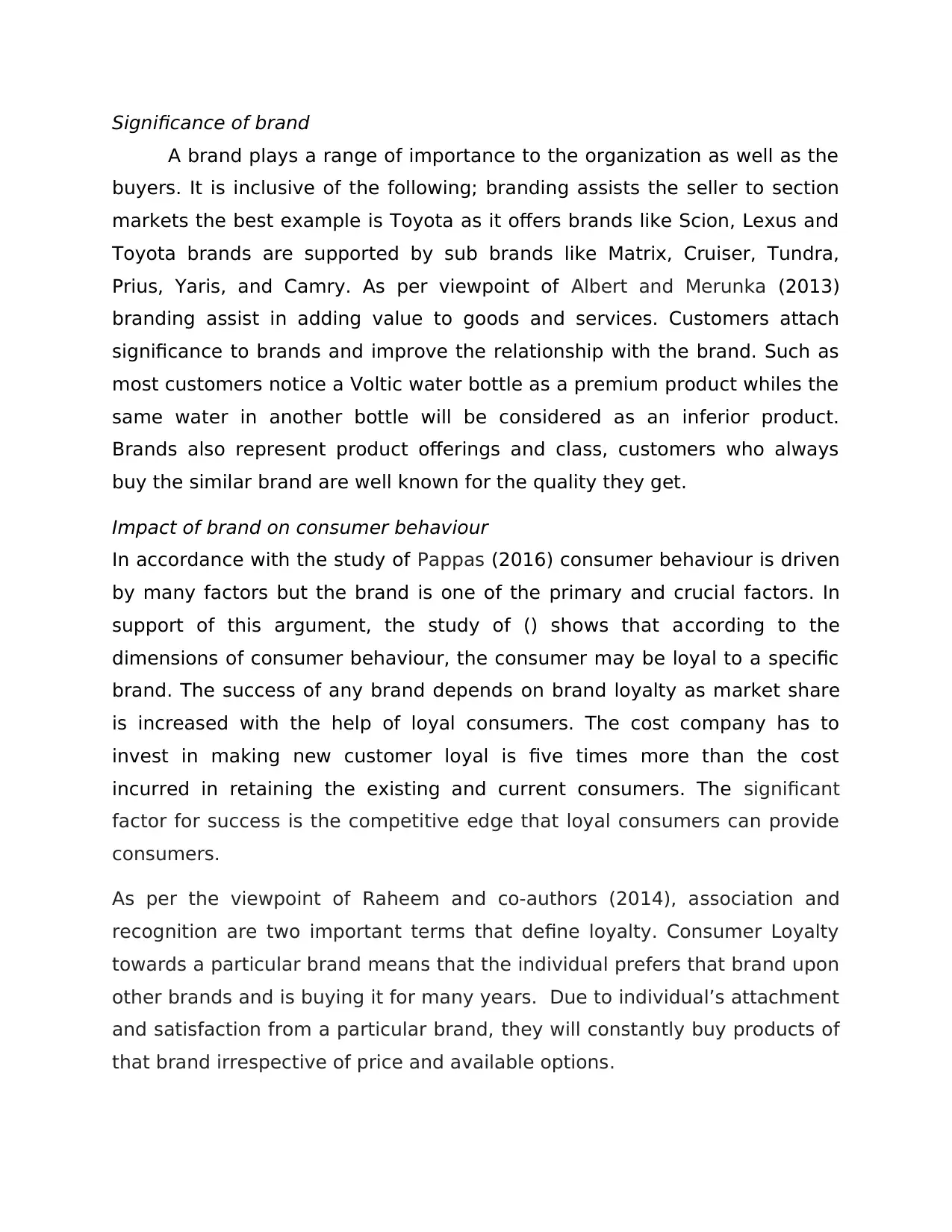
Significance of brand
A brand plays a range of importance to the organization as well as the
buyers. It is inclusive of the following; branding assists the seller to section
markets the best example is Toyota as it offers brands like Scion, Lexus and
Toyota brands are supported by sub brands like Matrix, Cruiser, Tundra,
Prius, Yaris, and Camry. As per viewpoint of Albert and Merunka (2013)
branding assist in adding value to goods and services. Customers attach
significance to brands and improve the relationship with the brand. Such as
most customers notice a Voltic water bottle as a premium product whiles the
same water in another bottle will be considered as an inferior product.
Brands also represent product offerings and class, customers who always
buy the similar brand are well known for the quality they get.
Impact of brand on consumer behaviour
In accordance with the study of Pappas (2016) consumer behaviour is driven
by many factors but the brand is one of the primary and crucial factors. In
support of this argument, the study of () shows that according to the
dimensions of consumer behaviour, the consumer may be loyal to a specific
brand. The success of any brand depends on brand loyalty as market share
is increased with the help of loyal consumers. The cost company has to
invest in making new customer loyal is five times more than the cost
incurred in retaining the existing and current consumers. The significant
factor for success is the competitive edge that loyal consumers can provide
consumers.
As per the viewpoint of Raheem and co-authors (2014), association and
recognition are two important terms that define loyalty. Consumer Loyalty
towards a particular brand means that the individual prefers that brand upon
other brands and is buying it for many years. Due to individual’s attachment
and satisfaction from a particular brand, they will constantly buy products of
that brand irrespective of price and available options.
A brand plays a range of importance to the organization as well as the
buyers. It is inclusive of the following; branding assists the seller to section
markets the best example is Toyota as it offers brands like Scion, Lexus and
Toyota brands are supported by sub brands like Matrix, Cruiser, Tundra,
Prius, Yaris, and Camry. As per viewpoint of Albert and Merunka (2013)
branding assist in adding value to goods and services. Customers attach
significance to brands and improve the relationship with the brand. Such as
most customers notice a Voltic water bottle as a premium product whiles the
same water in another bottle will be considered as an inferior product.
Brands also represent product offerings and class, customers who always
buy the similar brand are well known for the quality they get.
Impact of brand on consumer behaviour
In accordance with the study of Pappas (2016) consumer behaviour is driven
by many factors but the brand is one of the primary and crucial factors. In
support of this argument, the study of () shows that according to the
dimensions of consumer behaviour, the consumer may be loyal to a specific
brand. The success of any brand depends on brand loyalty as market share
is increased with the help of loyal consumers. The cost company has to
invest in making new customer loyal is five times more than the cost
incurred in retaining the existing and current consumers. The significant
factor for success is the competitive edge that loyal consumers can provide
consumers.
As per the viewpoint of Raheem and co-authors (2014), association and
recognition are two important terms that define loyalty. Consumer Loyalty
towards a particular brand means that the individual prefers that brand upon
other brands and is buying it for many years. Due to individual’s attachment
and satisfaction from a particular brand, they will constantly buy products of
that brand irrespective of price and available options.
⊘ This is a preview!⊘
Do you want full access?
Subscribe today to unlock all pages.
Trusted by 1+ million students worldwide
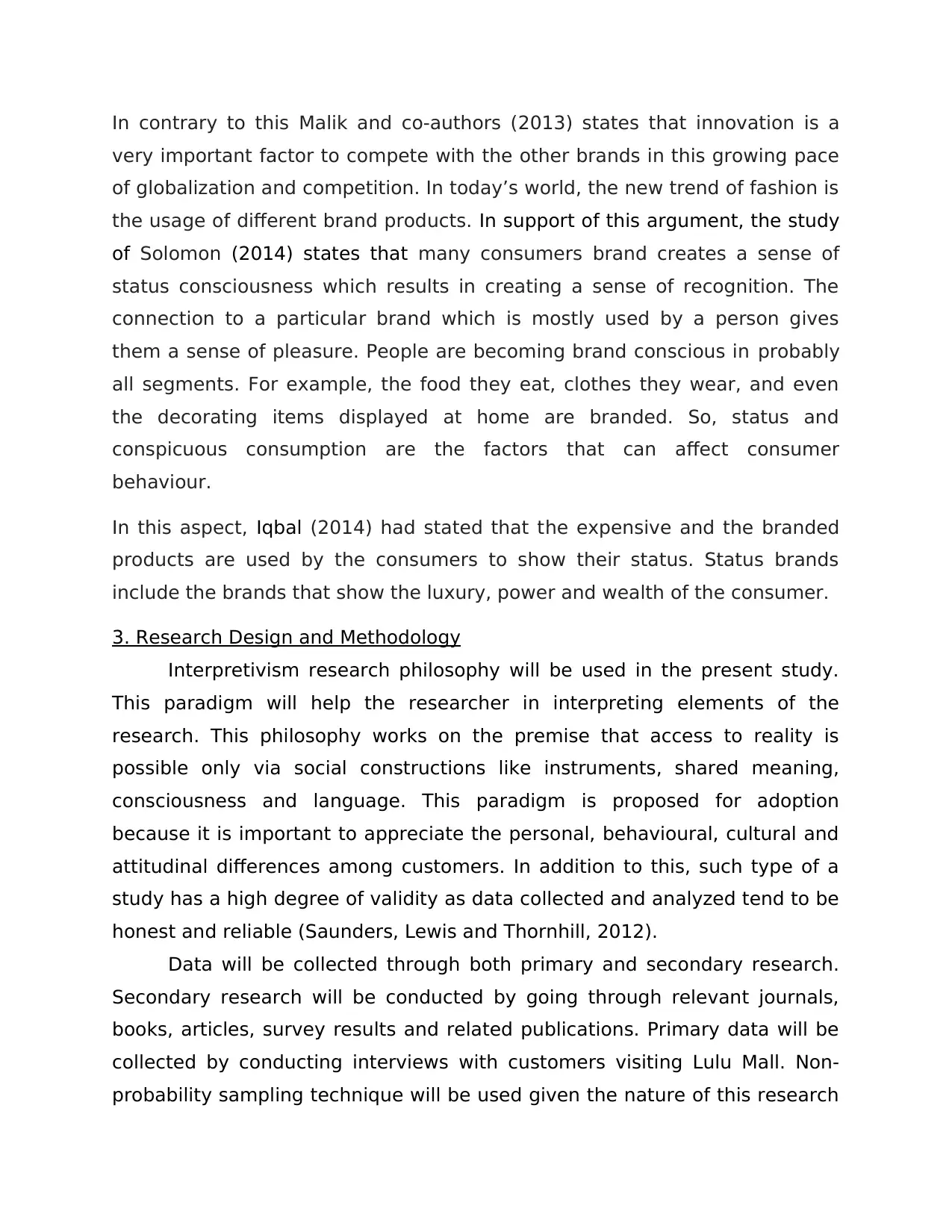
In contrary to this Malik and co-authors (2013) states that innovation is a
very important factor to compete with the other brands in this growing pace
of globalization and competition. In today’s world, the new trend of fashion is
the usage of different brand products. In support of this argument, the study
of Solomon (2014) states that many consumers brand creates a sense of
status consciousness which results in creating a sense of recognition. The
connection to a particular brand which is mostly used by a person gives
them a sense of pleasure. People are becoming brand conscious in probably
all segments. For example, the food they eat, clothes they wear, and even
the decorating items displayed at home are branded. So, status and
conspicuous consumption are the factors that can affect consumer
behaviour.
In this aspect, Iqbal (2014) had stated that the expensive and the branded
products are used by the consumers to show their status. Status brands
include the brands that show the luxury, power and wealth of the consumer.
3. Research Design and Methodology
Interpretivism research philosophy will be used in the present study.
This paradigm will help the researcher in interpreting elements of the
research. This philosophy works on the premise that access to reality is
possible only via social constructions like instruments, shared meaning,
consciousness and language. This paradigm is proposed for adoption
because it is important to appreciate the personal, behavioural, cultural and
attitudinal differences among customers. In addition to this, such type of a
study has a high degree of validity as data collected and analyzed tend to be
honest and reliable (Saunders, Lewis and Thornhill, 2012).
Data will be collected through both primary and secondary research.
Secondary research will be conducted by going through relevant journals,
books, articles, survey results and related publications. Primary data will be
collected by conducting interviews with customers visiting Lulu Mall. Non-
probability sampling technique will be used given the nature of this research
very important factor to compete with the other brands in this growing pace
of globalization and competition. In today’s world, the new trend of fashion is
the usage of different brand products. In support of this argument, the study
of Solomon (2014) states that many consumers brand creates a sense of
status consciousness which results in creating a sense of recognition. The
connection to a particular brand which is mostly used by a person gives
them a sense of pleasure. People are becoming brand conscious in probably
all segments. For example, the food they eat, clothes they wear, and even
the decorating items displayed at home are branded. So, status and
conspicuous consumption are the factors that can affect consumer
behaviour.
In this aspect, Iqbal (2014) had stated that the expensive and the branded
products are used by the consumers to show their status. Status brands
include the brands that show the luxury, power and wealth of the consumer.
3. Research Design and Methodology
Interpretivism research philosophy will be used in the present study.
This paradigm will help the researcher in interpreting elements of the
research. This philosophy works on the premise that access to reality is
possible only via social constructions like instruments, shared meaning,
consciousness and language. This paradigm is proposed for adoption
because it is important to appreciate the personal, behavioural, cultural and
attitudinal differences among customers. In addition to this, such type of a
study has a high degree of validity as data collected and analyzed tend to be
honest and reliable (Saunders, Lewis and Thornhill, 2012).
Data will be collected through both primary and secondary research.
Secondary research will be conducted by going through relevant journals,
books, articles, survey results and related publications. Primary data will be
collected by conducting interviews with customers visiting Lulu Mall. Non-
probability sampling technique will be used given the nature of this research
Paraphrase This Document
Need a fresh take? Get an instant paraphrase of this document with our AI Paraphraser
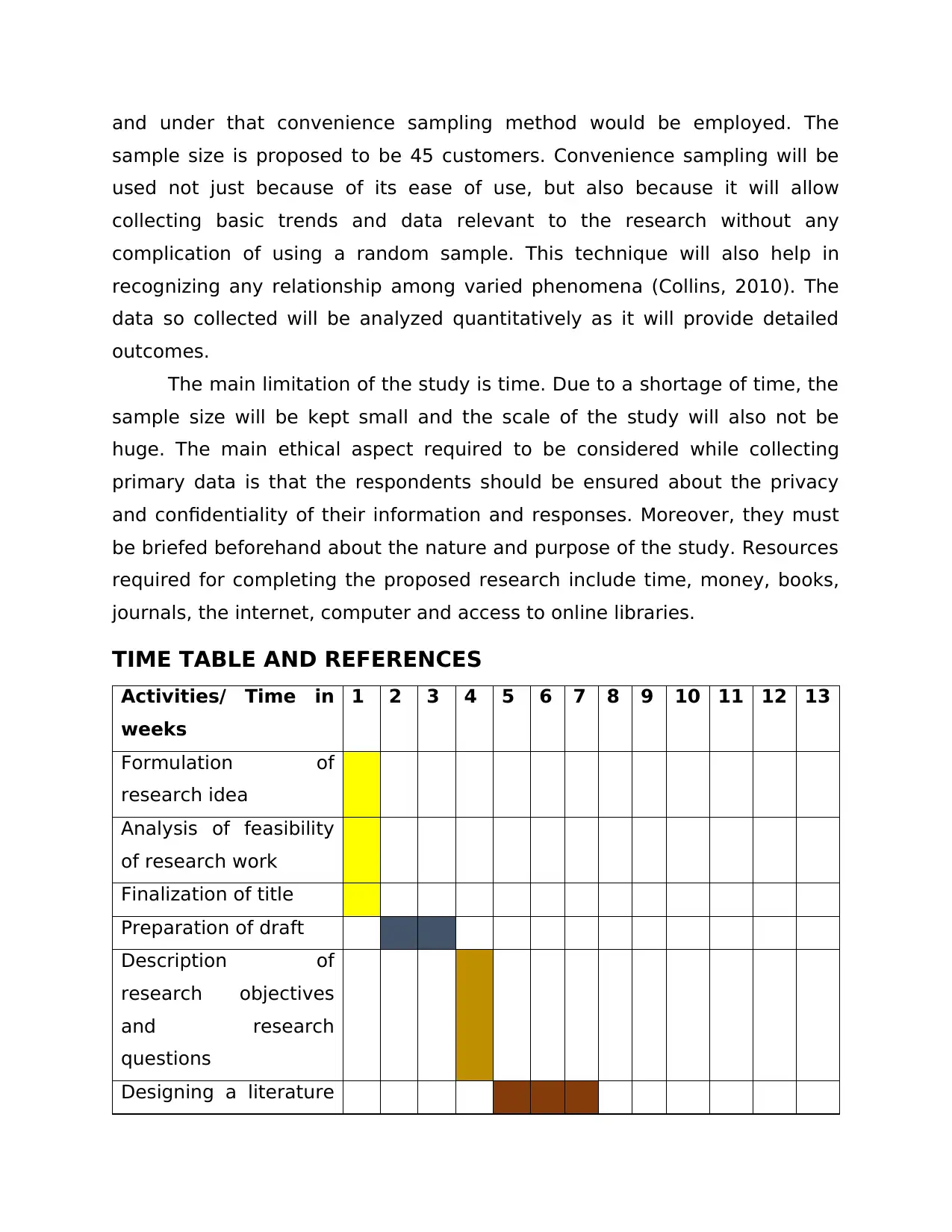
and under that convenience sampling method would be employed. The
sample size is proposed to be 45 customers. Convenience sampling will be
used not just because of its ease of use, but also because it will allow
collecting basic trends and data relevant to the research without any
complication of using a random sample. This technique will also help in
recognizing any relationship among varied phenomena (Collins, 2010). The
data so collected will be analyzed quantitatively as it will provide detailed
outcomes.
The main limitation of the study is time. Due to a shortage of time, the
sample size will be kept small and the scale of the study will also not be
huge. The main ethical aspect required to be considered while collecting
primary data is that the respondents should be ensured about the privacy
and confidentiality of their information and responses. Moreover, they must
be briefed beforehand about the nature and purpose of the study. Resources
required for completing the proposed research include time, money, books,
journals, the internet, computer and access to online libraries.
TIME TABLE AND REFERENCES
Activities/ Time in
weeks
1 2 3 4 5 6 7 8 9 10 11 12 13
Formulation of
research idea
Analysis of feasibility
of research work
Finalization of title
Preparation of draft
Description of
research objectives
and research
questions
Designing a literature
sample size is proposed to be 45 customers. Convenience sampling will be
used not just because of its ease of use, but also because it will allow
collecting basic trends and data relevant to the research without any
complication of using a random sample. This technique will also help in
recognizing any relationship among varied phenomena (Collins, 2010). The
data so collected will be analyzed quantitatively as it will provide detailed
outcomes.
The main limitation of the study is time. Due to a shortage of time, the
sample size will be kept small and the scale of the study will also not be
huge. The main ethical aspect required to be considered while collecting
primary data is that the respondents should be ensured about the privacy
and confidentiality of their information and responses. Moreover, they must
be briefed beforehand about the nature and purpose of the study. Resources
required for completing the proposed research include time, money, books,
journals, the internet, computer and access to online libraries.
TIME TABLE AND REFERENCES
Activities/ Time in
weeks
1 2 3 4 5 6 7 8 9 10 11 12 13
Formulation of
research idea
Analysis of feasibility
of research work
Finalization of title
Preparation of draft
Description of
research objectives
and research
questions
Designing a literature
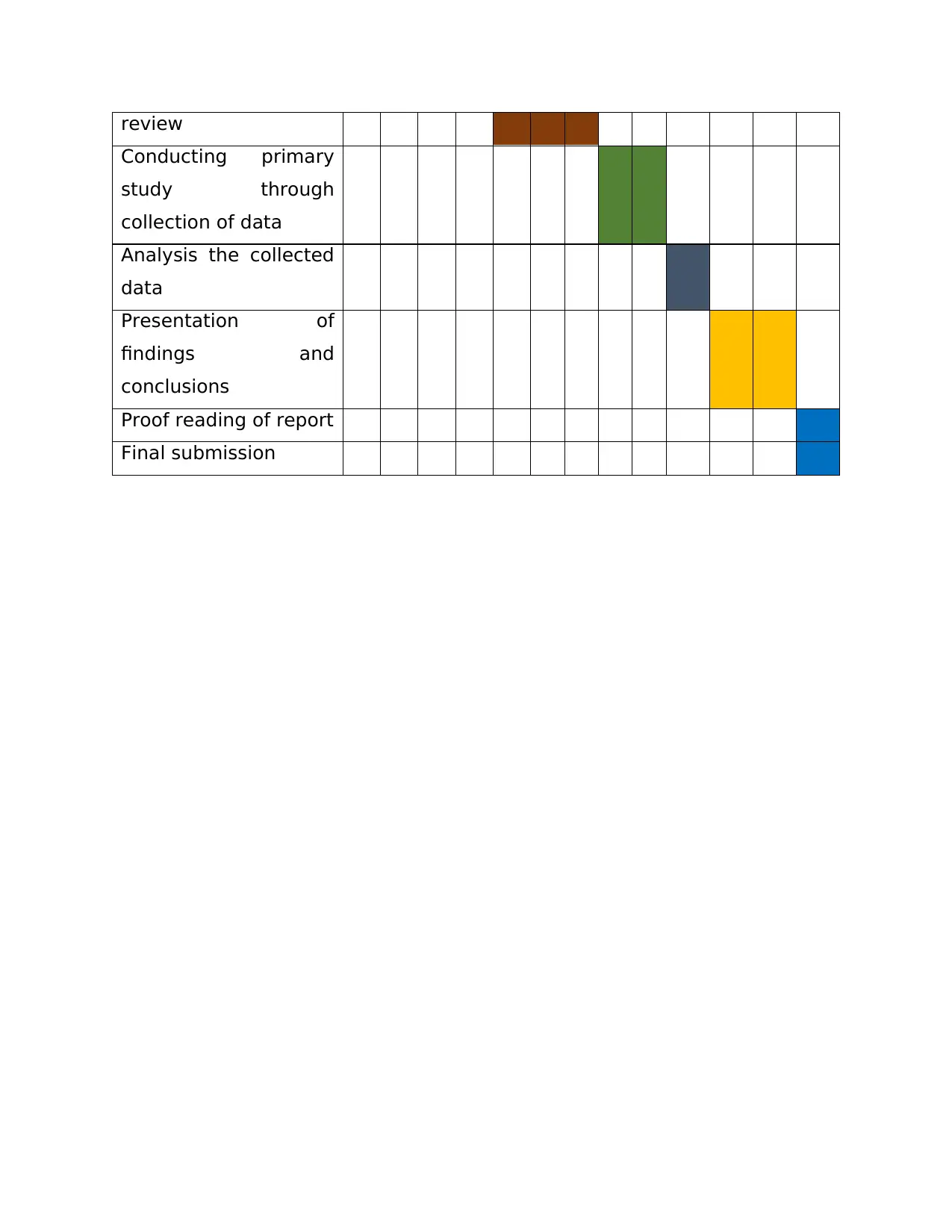
review
Conducting primary
study through
collection of data
Analysis the collected
data
Presentation of
findings and
conclusions
Proof reading of report
Final submission
Conducting primary
study through
collection of data
Analysis the collected
data
Presentation of
findings and
conclusions
Proof reading of report
Final submission
⊘ This is a preview!⊘
Do you want full access?
Subscribe today to unlock all pages.
Trusted by 1+ million students worldwide
REFERENCES
Albert, N. and Merunka, D., 2013. The role of brand love in consumer-brand
relationships. Journal of Consumer Marketing, 30(3), pp.258-266.
Collins, H., 2010. Creative Research: The Theory and Practice of Research for
the Creative Industries. AVA Publications.
Iqbal, M., 2014. The Impact of Branding on Consumer Buying Behavior.
International Journal of Technology and Research.
Kotler, P. and Keller, K., 2009. Marketing management. 13th Ed. New Jersey:
Pearson Prentice Hall.
Malik, M.E., Ghafoor, M.M., Iqbal, H.K., Ali, Q., Hunbal, H., Noman, M. and
Ahmad, B., 2013. Impact of brand image and advertisement on consumer
buying behavior. World Applied Sciences Journal, 23(1), pp.117-122.
Pappas, N., 2016. Marketing strategies, perceived risks, and consumer trust
in online buying behaviour. Journal of Retailing and Consumer Services, 29,
pp.92-103.
Raheem, A.R., Vishnu, P. and Ahmed, A.M., 2014. Impact of product
packaging on consumer’s buying behavior. European Journal of Scientific
Research, 122(2), pp.125-134.
Saunders, M., Lewis, P. and Thornhill, A., 2012. Research Methods for
Business Students. 6th edition. Pearson Education Limited.
Sharma, E., 2015. How Does Branding Impact Consumer Purchase Decisions?
[Online]. Available through: <http://www.brandanew.co/how-does-branding-
impact-consumer-purchase-decisions/>. [Accessed on 15th September 2017].
Solomon, M.R., 2014. Consumer behavior: Buying, having, and being (Vol.
10). Upper Saddle River, NJ: Prentice Hall.
Albert, N. and Merunka, D., 2013. The role of brand love in consumer-brand
relationships. Journal of Consumer Marketing, 30(3), pp.258-266.
Collins, H., 2010. Creative Research: The Theory and Practice of Research for
the Creative Industries. AVA Publications.
Iqbal, M., 2014. The Impact of Branding on Consumer Buying Behavior.
International Journal of Technology and Research.
Kotler, P. and Keller, K., 2009. Marketing management. 13th Ed. New Jersey:
Pearson Prentice Hall.
Malik, M.E., Ghafoor, M.M., Iqbal, H.K., Ali, Q., Hunbal, H., Noman, M. and
Ahmad, B., 2013. Impact of brand image and advertisement on consumer
buying behavior. World Applied Sciences Journal, 23(1), pp.117-122.
Pappas, N., 2016. Marketing strategies, perceived risks, and consumer trust
in online buying behaviour. Journal of Retailing and Consumer Services, 29,
pp.92-103.
Raheem, A.R., Vishnu, P. and Ahmed, A.M., 2014. Impact of product
packaging on consumer’s buying behavior. European Journal of Scientific
Research, 122(2), pp.125-134.
Saunders, M., Lewis, P. and Thornhill, A., 2012. Research Methods for
Business Students. 6th edition. Pearson Education Limited.
Sharma, E., 2015. How Does Branding Impact Consumer Purchase Decisions?
[Online]. Available through: <http://www.brandanew.co/how-does-branding-
impact-consumer-purchase-decisions/>. [Accessed on 15th September 2017].
Solomon, M.R., 2014. Consumer behavior: Buying, having, and being (Vol.
10). Upper Saddle River, NJ: Prentice Hall.
Paraphrase This Document
Need a fresh take? Get an instant paraphrase of this document with our AI Paraphraser
TASK 2: RESEARCH PROJECT
Critical review of key references for planned area of research 100
[Iqbal, M., 2014. The Impact of Branding on Consumer Buying Behavior.
International Journal of Technology and Research.
According to Iqbal, (2014), branding has great effect on the purchasing
decisions of customers and it influences them to go for products even if they
are out of their range. Various theories of consumer behavior are presented
in this book with proper examples that provide great learning.
[Sharma, E., 2015. How Does Branding Impact Consumer Purchase
Decisions? [Online]. Available through: <http://www.brandanew.co/how-
does-branding-impact-consumer-purchase-decisions/>. [Accessed on 15th
September 2017]
According to Sharma, (2015), Branding is created with the help of
advertising, celebrity endorsement and solving query of people. If a company
has brand value in the market, then it will be able to have great sale even if
the quality of products is low as compared to other non-branded companies.
Research investigation
Research investigation was done in order to understand Impact of
branding on consumer purchase decision. For this 45 respondents of the Lulu
Hypermarket were taken and different sets of questions were asked from
them. Further, proper literature reviews are framed and results are
presented in the form of thematic analysis. Proper research methodologies
are also defined to preset the report appropriately.
Collection, interpretation and analysis of research data
It is one of the most important parts of the project as it allows the
researcher to provide the data that is collected with its analysis. Present
research analysis was conducted with the help of 45 customers of Lulu UAE
and their responses are presented in the form of thematic analysis.
Critical review of key references for planned area of research 100
[Iqbal, M., 2014. The Impact of Branding on Consumer Buying Behavior.
International Journal of Technology and Research.
According to Iqbal, (2014), branding has great effect on the purchasing
decisions of customers and it influences them to go for products even if they
are out of their range. Various theories of consumer behavior are presented
in this book with proper examples that provide great learning.
[Sharma, E., 2015. How Does Branding Impact Consumer Purchase
Decisions? [Online]. Available through: <http://www.brandanew.co/how-
does-branding-impact-consumer-purchase-decisions/>. [Accessed on 15th
September 2017]
According to Sharma, (2015), Branding is created with the help of
advertising, celebrity endorsement and solving query of people. If a company
has brand value in the market, then it will be able to have great sale even if
the quality of products is low as compared to other non-branded companies.
Research investigation
Research investigation was done in order to understand Impact of
branding on consumer purchase decision. For this 45 respondents of the Lulu
Hypermarket were taken and different sets of questions were asked from
them. Further, proper literature reviews are framed and results are
presented in the form of thematic analysis. Proper research methodologies
are also defined to preset the report appropriately.
Collection, interpretation and analysis of research data
It is one of the most important parts of the project as it allows the
researcher to provide the data that is collected with its analysis. Present
research analysis was conducted with the help of 45 customers of Lulu UAE
and their responses are presented in the form of thematic analysis.
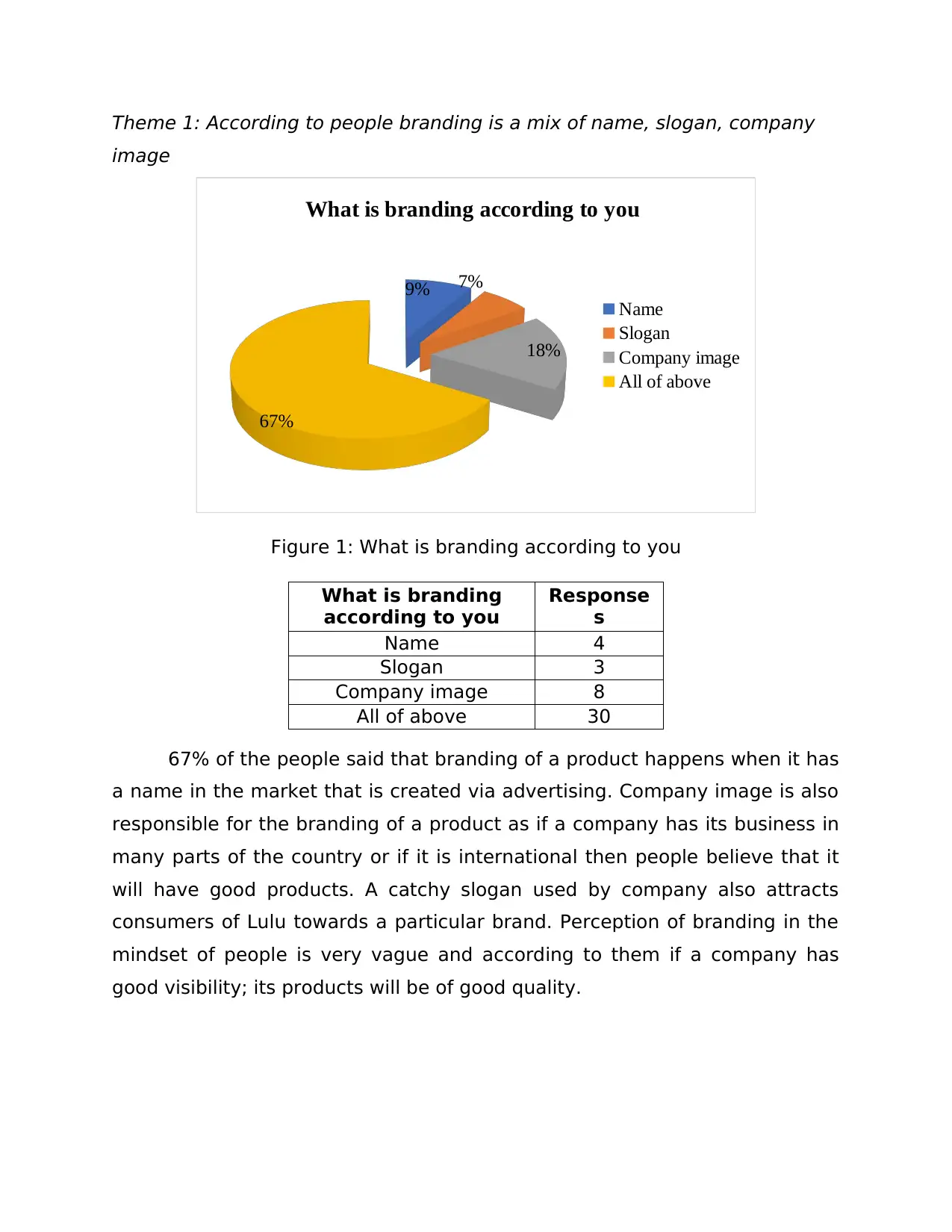
Theme 1: According to people branding is a mix of name, slogan, company
image
9% 7%
18%
67%
What is branding according to you
Name
Slogan
Company image
All of above
Figure 1: What is branding according to you
What is branding
according to you
Response
s
Name 4
Slogan 3
Company image 8
All of above 30
67% of the people said that branding of a product happens when it has
a name in the market that is created via advertising. Company image is also
responsible for the branding of a product as if a company has its business in
many parts of the country or if it is international then people believe that it
will have good products. A catchy slogan used by company also attracts
consumers of Lulu towards a particular brand. Perception of branding in the
mindset of people is very vague and according to them if a company has
good visibility; its products will be of good quality.
image
9% 7%
18%
67%
What is branding according to you
Name
Slogan
Company image
All of above
Figure 1: What is branding according to you
What is branding
according to you
Response
s
Name 4
Slogan 3
Company image 8
All of above 30
67% of the people said that branding of a product happens when it has
a name in the market that is created via advertising. Company image is also
responsible for the branding of a product as if a company has its business in
many parts of the country or if it is international then people believe that it
will have good products. A catchy slogan used by company also attracts
consumers of Lulu towards a particular brand. Perception of branding in the
mindset of people is very vague and according to them if a company has
good visibility; its products will be of good quality.
⊘ This is a preview!⊘
Do you want full access?
Subscribe today to unlock all pages.
Trusted by 1+ million students worldwide

1 out of 18


Related Documents


Your All-in-One AI-Powered Toolkit for Academic Success.
+13062052269
info@desklib.com
Available 24*7 on WhatsApp / Email
![[object Object]](/_next/static/media/star-bottom.7253800d.svg)
Unlock your academic potential
Copyright © 2020–2026 A2Z Services. All Rights Reserved. Developed and managed by ZUCOL.