Assessing E-Marketing's Impact on Consumer Satisfaction: Thomas Cook
VerifiedAdded on 2020/07/22
|32
|8456
|75
Report
AI Summary
This report investigates the impact of e-marketing on consumer satisfaction, focusing on the UK tour operator Thomas Cook. The study begins with a research proposal outlining the background, rationale, and research questions, followed by an examination of relevant literature on the use of e-marketing in the UK tour industry and its role in tour organizations. The methodology includes an inductive approach, incorporating both qualitative and quantitative methods, such as surveys. The report addresses ethical considerations, limitations, and the chosen case study organization. The findings are presented through data organization, analysis, conclusions, and recommendations, culminating in a presentation of the research outcomes and highlights. The report covers various aspects of e-marketing, including its importance in attracting customers, enhancing brand image, and improving customer relationship management. The research aims to assess how e-marketing influences consumer satisfaction levels and provides recommendations for tour operators like Thomas Cook to optimize their e-marketing strategies for improved customer satisfaction. The research also explores the use of the internet as a marketing tool, the role of e-marketing in the tourism industry, and the importance of online presence for tour organizations.
IMPACT OF E-MARKETING ON THE
SATISFACTION LEVEL OF CONSUMERS
SATISFACTION LEVEL OF CONSUMERS

Paraphrase This Document
Need a fresh take? Get an instant paraphrase of this document with our AI Paraphraser
TABLE OF CONTENTS
TASK 1............................................................................................................................................1
a. Brief research proposal............................................................................................................1
b. Identifying relevant literature on the basis of objectives.........................................................3
c. Discussing relevant methodology............................................................................................7
TASK 2..........................................................................................................................................10
a. Gantt chart..............................................................................................................................10
b. Record and collate relevant data............................................................................................11
TASK 3..........................................................................................................................................16
a. Organizing and structuring raw data in a tabular format.......................................................16
b. Drawing conclusion and giving recommendations................................................................19
TASK 4..........................................................................................................................................21
a. Presenting outcomes of the entire research............................................................................21
b. Making presentation on research highlights..........................................................................23
REFERENCES..............................................................................................................................24
APPENDIX....................................................................................................................................27
TASK 1............................................................................................................................................1
a. Brief research proposal............................................................................................................1
b. Identifying relevant literature on the basis of objectives.........................................................3
c. Discussing relevant methodology............................................................................................7
TASK 2..........................................................................................................................................10
a. Gantt chart..............................................................................................................................10
b. Record and collate relevant data............................................................................................11
TASK 3..........................................................................................................................................16
a. Organizing and structuring raw data in a tabular format.......................................................16
b. Drawing conclusion and giving recommendations................................................................19
TASK 4..........................................................................................................................................21
a. Presenting outcomes of the entire research............................................................................21
b. Making presentation on research highlights..........................................................................23
REFERENCES..............................................................................................................................24
APPENDIX....................................................................................................................................27
TASK 1
1.1. Brief research proposal
Background of the study
Successful marketing is of utmost importance to all types of firms that directly
contributes in the attainment of organizational goals. This in turn necessitates the organisations
to cope up with rigorous changes that are continually taking place in the market to satisfy today’s
contemporary needs of consumers (Chan, Hsu and Baum, 2015). In the recent times, internet
marketing is the most effectual tools that is undertaken by the firms for attracting large number
of customers towards the products or services offered. This effective tool is called as internet that
is nowadays referred to be an important consideration of individuals of almost all age, existing in
this current era. The present research work is also based on a corresponding outlook of the
organisations for serving their consumers in a well- considerate manner.
E-marketing is thus represented to be one of the most essential considerations of the
enterprises working in any sector. However, the present investigation is based on a well-known
tour organisation of UK i.e. Thomas Cook and the way they tend to make an efficient use of E-
marketing. This is mainly due to its recent technicalities where it is one of the most considerate
way of attracting large number of consumers towards the proposed goods and services. Internet
marketing implies for the process brand of enhancing brand image and its products &services
through the means of mail as well as social networking sites. It thereby indicates a broader scope
of marketing goods with an effective use of email, CRM termed for customer relationship
management and any such promotional activities that are required to be done with the help of
wireless media.
Rationale and Research Question
This section is responsible to demonstrate the importance of a chosen subject matter in
terms of signifying any issues or concerns prevailing over it. It is basically to prove a sustainable
outlook behind selecting the topic for conducting research on it. In this, impact of E- marketing
on the satisfaction level of customers is investigated by the researcher over here. This is stated to
be an important agenda for the undertaken organisation named Thomas Cook. It is one of the
leading organization under travel & tourism sector which offer lucrative tour packages to the
customers. (Elkhani, Soltani and Jamshidi, 2014). Herein, the customer’s demands keep on
changing at a higher pace and hence, necessitates such entities to operate in an effectual way by
1
1.1. Brief research proposal
Background of the study
Successful marketing is of utmost importance to all types of firms that directly
contributes in the attainment of organizational goals. This in turn necessitates the organisations
to cope up with rigorous changes that are continually taking place in the market to satisfy today’s
contemporary needs of consumers (Chan, Hsu and Baum, 2015). In the recent times, internet
marketing is the most effectual tools that is undertaken by the firms for attracting large number
of customers towards the products or services offered. This effective tool is called as internet that
is nowadays referred to be an important consideration of individuals of almost all age, existing in
this current era. The present research work is also based on a corresponding outlook of the
organisations for serving their consumers in a well- considerate manner.
E-marketing is thus represented to be one of the most essential considerations of the
enterprises working in any sector. However, the present investigation is based on a well-known
tour organisation of UK i.e. Thomas Cook and the way they tend to make an efficient use of E-
marketing. This is mainly due to its recent technicalities where it is one of the most considerate
way of attracting large number of consumers towards the proposed goods and services. Internet
marketing implies for the process brand of enhancing brand image and its products &services
through the means of mail as well as social networking sites. It thereby indicates a broader scope
of marketing goods with an effective use of email, CRM termed for customer relationship
management and any such promotional activities that are required to be done with the help of
wireless media.
Rationale and Research Question
This section is responsible to demonstrate the importance of a chosen subject matter in
terms of signifying any issues or concerns prevailing over it. It is basically to prove a sustainable
outlook behind selecting the topic for conducting research on it. In this, impact of E- marketing
on the satisfaction level of customers is investigated by the researcher over here. This is stated to
be an important agenda for the undertaken organisation named Thomas Cook. It is one of the
leading organization under travel & tourism sector which offer lucrative tour packages to the
customers. (Elkhani, Soltani and Jamshidi, 2014). Herein, the customer’s demands keep on
changing at a higher pace and hence, necessitates such entities to operate in an effectual way by
1
⊘ This is a preview!⊘
Do you want full access?
Subscribe today to unlock all pages.

Trusted by 1+ million students worldwide
considering the competent framework. The present research topic has thus referred to assess the
impact of E- marketing refers to the marketing procedures that places direct impact on the
buying decisions of the consumers to a great extent and raises their satisfaction level.. As a result
to which the marketing function refers to one of the most thoughtful measures that is required to
be undertaken by the organisations like Thomas Cook in the best possible way.
Aim and Objectives
A prior aim of this investigation is "To assess the impact of E- marketing on the
satisfaction level of customers in tour organisations- A study on Thomas Cook". Following the
same, below are the objectives defined on the basis of above intended aim:
To evaluate the use of E- marketing in tour industry of UK
To analyse the role of E-marketing in tour organisations like Thomas Cook
To assess the importance of E- marketing in raising satisfaction level of the consumers
To recommend ways in which Thomas Cook can make an effective use of E- marketing
for enhancing the satisfaction level of its customers to a great extent
Study Approach, Ethical Issues and Limitations
For presenting the suitable or fair view of study, several tools and techniques have been
undertaken by the researcher through taking into account the nature of investigation. Considering
the same, researcher, under present investigation refers to undertake an inductive approach as per
the qualitative nature of subject matter. This will mainly lead to the composition of a qualitative
study where quantitative will together be used for the purpose of carrying out a survey,
interrogating customers of Thomas Cook (Caber, Albayrak and Loiacono, 2013). However,
researcher can hereby face some ethical dilemmas in order to maintain confidentiality of data
acquired from the customers revealing any of their personal information. Along with this, they
are hereby required to undertake an ethical approach in terms of addressing the respondents in a
respectful manner and for this purpose, the researcher must avoid any sort of discernment.
Also, another prior outlook of the researcher to carry out an ethical study is to avoid taking
any forceful consent of participants where they must willingly contribute in survey. Besides this,
limitations are also a concerning part of research where the investigator may face several issues
in terms of getting sufficient amount of time and budget to carry out an effective study (Bowie
and et. al., 2016). Also, getting adequate number of respondents who are willing to participate in
the survey is a vital concern while considering to conduct a primary research. Herein, an easy
2
impact of E- marketing refers to the marketing procedures that places direct impact on the
buying decisions of the consumers to a great extent and raises their satisfaction level.. As a result
to which the marketing function refers to one of the most thoughtful measures that is required to
be undertaken by the organisations like Thomas Cook in the best possible way.
Aim and Objectives
A prior aim of this investigation is "To assess the impact of E- marketing on the
satisfaction level of customers in tour organisations- A study on Thomas Cook". Following the
same, below are the objectives defined on the basis of above intended aim:
To evaluate the use of E- marketing in tour industry of UK
To analyse the role of E-marketing in tour organisations like Thomas Cook
To assess the importance of E- marketing in raising satisfaction level of the consumers
To recommend ways in which Thomas Cook can make an effective use of E- marketing
for enhancing the satisfaction level of its customers to a great extent
Study Approach, Ethical Issues and Limitations
For presenting the suitable or fair view of study, several tools and techniques have been
undertaken by the researcher through taking into account the nature of investigation. Considering
the same, researcher, under present investigation refers to undertake an inductive approach as per
the qualitative nature of subject matter. This will mainly lead to the composition of a qualitative
study where quantitative will together be used for the purpose of carrying out a survey,
interrogating customers of Thomas Cook (Caber, Albayrak and Loiacono, 2013). However,
researcher can hereby face some ethical dilemmas in order to maintain confidentiality of data
acquired from the customers revealing any of their personal information. Along with this, they
are hereby required to undertake an ethical approach in terms of addressing the respondents in a
respectful manner and for this purpose, the researcher must avoid any sort of discernment.
Also, another prior outlook of the researcher to carry out an ethical study is to avoid taking
any forceful consent of participants where they must willingly contribute in survey. Besides this,
limitations are also a concerning part of research where the investigator may face several issues
in terms of getting sufficient amount of time and budget to carry out an effective study (Bowie
and et. al., 2016). Also, getting adequate number of respondents who are willing to participate in
the survey is a vital concern while considering to conduct a primary research. Herein, an easy
2
Paraphrase This Document
Need a fresh take? Get an instant paraphrase of this document with our AI Paraphraser
access is a concerning matter for the researcher that is also stated to be a limitation. However, the
investigator in present study has used a planned approach to avoid any such limited aspect of
research. For this, a definite budget has been decided to finish the study within a stipulated
period of time.
Case Study Organisation or Destination
Current research work is based on a selected tour organisation named Thomas Cook where
it is a renowned hospitality and tourism based enterprise operating since last 10 years and
provide travel related services at the global level. Its products involve holiday packages, hotel
related services along with passengers, cruise lines and charter airline services (About Thomas
Cook, 2015). It is mainly because of its 6 distinct subsidiary firms where Thomas Cook Group is
presently operating with around 21, 940 number of employees and an operating income of £308
million. However, Thomas Cook Group PLC is a result of merger between 3 distinct
organizations namely Thomas Cook AG, MyTravel Group plc and Thomas Cook & Son.
1.2. Identifying relevant literature on the basis of objectives
Theme 1.2.1: Use of E- marketing in tour industry of UK
A rising popularity of internet has largely assisted the organisations of almost all industrial
sectors with a special consideration of tourism and hospitality based associations (Hays, Page
and Buhalis, 2013). By doing assessment, it has found that referring the increasing prevalence of
internet hospitality and tour related enterprises lay emphasis on considering the same as
marketing tool.. Internet has been specified as a global network where it is composed of certain
interlinked computers that are operating on a standard protocol. This standard protocol in turn
permits them to transfer the information from one network to another. It is thereby used as a
system for exchanging information with a greater role of its connectivity that enables the users to
access the network. Cohen and et.al., (2014) have stated that such likely use of internet for
conducting activities of marketing is a result of its general use as a data exchange scheme in
today’s digital era. Internet directly enables the users in a mechanical storage of
information, indexing, retrieving, restructuring and redistribution of the same. It is done
automatically with the help of a software with no intervention by the humans. Internet also tends
to connect the companies with customers and individuals with no such regard to time, hardware
or software platforms and space, etc.
3
investigator in present study has used a planned approach to avoid any such limited aspect of
research. For this, a definite budget has been decided to finish the study within a stipulated
period of time.
Case Study Organisation or Destination
Current research work is based on a selected tour organisation named Thomas Cook where
it is a renowned hospitality and tourism based enterprise operating since last 10 years and
provide travel related services at the global level. Its products involve holiday packages, hotel
related services along with passengers, cruise lines and charter airline services (About Thomas
Cook, 2015). It is mainly because of its 6 distinct subsidiary firms where Thomas Cook Group is
presently operating with around 21, 940 number of employees and an operating income of £308
million. However, Thomas Cook Group PLC is a result of merger between 3 distinct
organizations namely Thomas Cook AG, MyTravel Group plc and Thomas Cook & Son.
1.2. Identifying relevant literature on the basis of objectives
Theme 1.2.1: Use of E- marketing in tour industry of UK
A rising popularity of internet has largely assisted the organisations of almost all industrial
sectors with a special consideration of tourism and hospitality based associations (Hays, Page
and Buhalis, 2013). By doing assessment, it has found that referring the increasing prevalence of
internet hospitality and tour related enterprises lay emphasis on considering the same as
marketing tool.. Internet has been specified as a global network where it is composed of certain
interlinked computers that are operating on a standard protocol. This standard protocol in turn
permits them to transfer the information from one network to another. It is thereby used as a
system for exchanging information with a greater role of its connectivity that enables the users to
access the network. Cohen and et.al., (2014) have stated that such likely use of internet for
conducting activities of marketing is a result of its general use as a data exchange scheme in
today’s digital era. Internet directly enables the users in a mechanical storage of
information, indexing, retrieving, restructuring and redistribution of the same. It is done
automatically with the help of a software with no intervention by the humans. Internet also tends
to connect the companies with customers and individuals with no such regard to time, hardware
or software platforms and space, etc.
3
Jung, Ineson and Green (2013) investigated and presented favourable use of internet
marketing in the tour based organisations of UK where it is not only used as a tool to connect or
interact with users. Along with this, internet marketing tool also provides high level of assistance
in connecting businesses directly with the customers. This is turn is known as facilitating a
smooth transition of business by adopting the tactic of internet marketing and proceeding
processes of both B2B and B2C marketing. Despite of considering the fact where internet was
initially originated in the year 60’s, it is a current buzzword. Avraham (2015) have hereby
argued with a distinct consideration of internet marketing where it can be used by the businesses
in two distinct manners. These areas have represented as recent creations and indicated the usage
of internet services for communication and processing data. However, both these classifications
are interlinked to each other where the communication services involving use of email and email
based net news and discussion lists are known to permit a direct exchange of data among users.
Further, the information services include Telnet, anonymous FTP i.e. File Transfer Protocol,
Gopher which permits customers to access the information which has been accessible to all as
well (Chathoth and et.al., 2014). Since the year 1993, internet has shown a huge transformation
that has totally due to its latest constituent called World Wide Web also abbreviated as WWW or
Web.
Internet as a vital tool of marketing is of huge benefit to all virtual areas of marketing as
elucidated by Tyrväinen and et.al., (2014). This directly states about the other pivotal areas of
marketing involving process of conducting a market research via segmentation, targeting and
positioning. Also, internet is known to enable the tour related organisations to make an effective
usage of models namely marketing mix to further organise their strategies and control when and
if required. It is therefore known to eradicate all manual processing done by the organisation in
terms of marketing where they can easily propagate their brand in a much easier way.
Theme 1.2.2: Role of E-marketing in tour organisations
Internet marketing is also termed as E- marketing where it is known to have distinct roles
and characteristics with a special context of tour based organisations in UK in accordance with
the bestowed views of Kropinova, Zaitseva and Moroz (2015). This is specially for being an
information intensive sector where internet is referred to be the most efficient mean for
exchanging information at global level. It is where the tourism industry is stated to be a very data
concentrated sector where the collected set of information represents the strength of the
4
marketing in the tour based organisations of UK where it is not only used as a tool to connect or
interact with users. Along with this, internet marketing tool also provides high level of assistance
in connecting businesses directly with the customers. This is turn is known as facilitating a
smooth transition of business by adopting the tactic of internet marketing and proceeding
processes of both B2B and B2C marketing. Despite of considering the fact where internet was
initially originated in the year 60’s, it is a current buzzword. Avraham (2015) have hereby
argued with a distinct consideration of internet marketing where it can be used by the businesses
in two distinct manners. These areas have represented as recent creations and indicated the usage
of internet services for communication and processing data. However, both these classifications
are interlinked to each other where the communication services involving use of email and email
based net news and discussion lists are known to permit a direct exchange of data among users.
Further, the information services include Telnet, anonymous FTP i.e. File Transfer Protocol,
Gopher which permits customers to access the information which has been accessible to all as
well (Chathoth and et.al., 2014). Since the year 1993, internet has shown a huge transformation
that has totally due to its latest constituent called World Wide Web also abbreviated as WWW or
Web.
Internet as a vital tool of marketing is of huge benefit to all virtual areas of marketing as
elucidated by Tyrväinen and et.al., (2014). This directly states about the other pivotal areas of
marketing involving process of conducting a market research via segmentation, targeting and
positioning. Also, internet is known to enable the tour related organisations to make an effective
usage of models namely marketing mix to further organise their strategies and control when and
if required. It is therefore known to eradicate all manual processing done by the organisation in
terms of marketing where they can easily propagate their brand in a much easier way.
Theme 1.2.2: Role of E-marketing in tour organisations
Internet marketing is also termed as E- marketing where it is known to have distinct roles
and characteristics with a special context of tour based organisations in UK in accordance with
the bestowed views of Kropinova, Zaitseva and Moroz (2015). This is specially for being an
information intensive sector where internet is referred to be the most efficient mean for
exchanging information at global level. It is where the tourism industry is stated to be a very data
concentrated sector where the collected set of information represents the strength of the
4
⊘ This is a preview!⊘
Do you want full access?
Subscribe today to unlock all pages.
Trusted by 1+ million students worldwide
establishment where they are also known to hold distinct producers within the industry. This
involves the tour operators, attractions, cruise lines, airlines, travel agencies, other suppliers and
car rentals, etc. It in turn results in a prime requirement of generating, collecting, processing,
applying and communicating such extensive data on regular basis as a way of handling their
daily operations.
Another vital role of internet marketing in the field of tourism is evaluation of its offered
products and services as described by Backer and King (2015). This is basically for being into
service industry where the tourism based enterprises are known to deal with intangible products
that in turn refers to their services. As a result, these services can neither be experienced nor be
seen by the tourists. Also, on considering this fact, until the tourists arrive at destination, it is
almost impossible for them to experience the services and assess its quality in terms of their
expectations (Filieri, Alguezaui and McLeay, 2015). Besides this, there exists very less number
of travellers who nowadays prefer to rely upon limited access of brochures and other such
conventional tools to evaluate the information about their respective travel destination.
This in turn necessitates the tour based organisations to enable their targeted set of
customers to make an effective use of detailed information provided on the official websites of
the firm. Herein, the printed form of brochure has nowadays replaced by electronic or web based
modes where it has also resolved one such complex issue that is often faced by the travellers in
choosing from thousands of locations. Now, the tourists can undertake assistance of test drive as
a way of selecting from the browser generated options as per their distinct set of demands as
stated by Zaidan (2017).
Whereas, Sirakaya-Turk, Ekinci and Martin (2015) with a distinct set of consideration has
hereby mentioned yet another major role of internet in the tour based organisations as it
facilitates automation and helps in providing information to the customers about tour packages.
This specifies about the need of ticketing with an ease of booking it online these days. The
electronic forms of ticketing are referred to have a leading role in today’s contemporary world
where no one relies on its physical distribution. It is in context to both; tour operators and
travellers where this undertaking assists both the parties in an equal manner. For an in-depth
evidence, such rising trend of e-ticketing is apparent to benefit the organisations in terms of
saving their money and offers time benefits to the customers (Carlisle and et.al., 2013). Both
valuable assets are easily secured with assistance of e-ticketing.
5
involves the tour operators, attractions, cruise lines, airlines, travel agencies, other suppliers and
car rentals, etc. It in turn results in a prime requirement of generating, collecting, processing,
applying and communicating such extensive data on regular basis as a way of handling their
daily operations.
Another vital role of internet marketing in the field of tourism is evaluation of its offered
products and services as described by Backer and King (2015). This is basically for being into
service industry where the tourism based enterprises are known to deal with intangible products
that in turn refers to their services. As a result, these services can neither be experienced nor be
seen by the tourists. Also, on considering this fact, until the tourists arrive at destination, it is
almost impossible for them to experience the services and assess its quality in terms of their
expectations (Filieri, Alguezaui and McLeay, 2015). Besides this, there exists very less number
of travellers who nowadays prefer to rely upon limited access of brochures and other such
conventional tools to evaluate the information about their respective travel destination.
This in turn necessitates the tour based organisations to enable their targeted set of
customers to make an effective use of detailed information provided on the official websites of
the firm. Herein, the printed form of brochure has nowadays replaced by electronic or web based
modes where it has also resolved one such complex issue that is often faced by the travellers in
choosing from thousands of locations. Now, the tourists can undertake assistance of test drive as
a way of selecting from the browser generated options as per their distinct set of demands as
stated by Zaidan (2017).
Whereas, Sirakaya-Turk, Ekinci and Martin (2015) with a distinct set of consideration has
hereby mentioned yet another major role of internet in the tour based organisations as it
facilitates automation and helps in providing information to the customers about tour packages.
This specifies about the need of ticketing with an ease of booking it online these days. The
electronic forms of ticketing are referred to have a leading role in today’s contemporary world
where no one relies on its physical distribution. It is in context to both; tour operators and
travellers where this undertaking assists both the parties in an equal manner. For an in-depth
evidence, such rising trend of e-ticketing is apparent to benefit the organisations in terms of
saving their money and offers time benefits to the customers (Carlisle and et.al., 2013). Both
valuable assets are easily secured with assistance of e-ticketing.
5
Paraphrase This Document
Need a fresh take? Get an instant paraphrase of this document with our AI Paraphraser
Theme 1.2.3: Importance of E- marketing in raising the satisfaction level of consumers
According to Christie and et.al., (2014) the main reason behind the success of tourism
companies is that they are adopting E-marketing strategies. They carefully analyse and observe
how people interact with surrounding environment while they travel. These things help them to
recognize the need of a customer. Increasing fight in the global tourism market promote tourism
operators to invest more in promotion, resources, knowledge and quality in order to achieve
satisfactory development (Marcoz, Melewar and Dennis, 2016). Therefore, it is very important to
be in touch with the latest technological trends and have knowledge required to effectively
respond to challenges of global contest. Internet technology provides high-quality and efficient
operations in all sectors including the tourism industry. The following material study the main
features of the Net, in comparing with conventional media and with relevance to marketing, as
an impressive and economic communications' means.
As per the opinion of Ashworth and Tunbridge (2017) before going on a trip, every
customer investigates the spot of visiting or destination on internet that helps him to save money
and time. He can also book his whole trip through internet including hotels, food, vehicles. Etc.
The main impact of this is that in comparison with the traditional media, in order to gain relevant
information of a destination, a tourist needs to go to a travel agency to get a brochure and guide
book, and may also contact the destination's national tourist office to get some content study.
Furthermore, the printed literature the tourists get is often outdated. On the other side, proper
Internet service provider tourist an unlimited amount of information through video telephony,
chat interaction and tourists can also "test drive" a prospective holiday by viewing real-time
scenes through, cameras, placed in hotels, clubs, restaurants, scenic spots and other sites in the
destination before the trip (Holliday and et.al., 2015). With online registration, customers are
able to maintain their reputation as well. They get discounts on selected things and pre-bookings
option also secures their place to avoid the major issue of booked hotels and other places. There
is also an advantage for them that they can cancel their trip if they have any kind of issue
regarding to the trip before the companies' policy and will get be refunded.
In contrary to this, Akamavi and et.al., (2015) states that the Web is a much more flexible
marketing medium than the traditional mass media that the customer has many options to choose
their trip within their budget plans. Internet not only provides more information but also offers it
from a much wider range of sources which help customers to search their trips anywhere and
6
According to Christie and et.al., (2014) the main reason behind the success of tourism
companies is that they are adopting E-marketing strategies. They carefully analyse and observe
how people interact with surrounding environment while they travel. These things help them to
recognize the need of a customer. Increasing fight in the global tourism market promote tourism
operators to invest more in promotion, resources, knowledge and quality in order to achieve
satisfactory development (Marcoz, Melewar and Dennis, 2016). Therefore, it is very important to
be in touch with the latest technological trends and have knowledge required to effectively
respond to challenges of global contest. Internet technology provides high-quality and efficient
operations in all sectors including the tourism industry. The following material study the main
features of the Net, in comparing with conventional media and with relevance to marketing, as
an impressive and economic communications' means.
As per the opinion of Ashworth and Tunbridge (2017) before going on a trip, every
customer investigates the spot of visiting or destination on internet that helps him to save money
and time. He can also book his whole trip through internet including hotels, food, vehicles. Etc.
The main impact of this is that in comparison with the traditional media, in order to gain relevant
information of a destination, a tourist needs to go to a travel agency to get a brochure and guide
book, and may also contact the destination's national tourist office to get some content study.
Furthermore, the printed literature the tourists get is often outdated. On the other side, proper
Internet service provider tourist an unlimited amount of information through video telephony,
chat interaction and tourists can also "test drive" a prospective holiday by viewing real-time
scenes through, cameras, placed in hotels, clubs, restaurants, scenic spots and other sites in the
destination before the trip (Holliday and et.al., 2015). With online registration, customers are
able to maintain their reputation as well. They get discounts on selected things and pre-bookings
option also secures their place to avoid the major issue of booked hotels and other places. There
is also an advantage for them that they can cancel their trip if they have any kind of issue
regarding to the trip before the companies' policy and will get be refunded.
In contrary to this, Akamavi and et.al., (2015) states that the Web is a much more flexible
marketing medium than the traditional mass media that the customer has many options to choose
their trip within their budget plans. Internet not only provides more information but also offers it
from a much wider range of sources which help customers to search their trips anywhere and
6
anytime. Internet also delivers the information in a greater variety of formats, from text to
photos, graphs, audio and video clips, which clear the vision of any customer. This in turn
provides high level of assistance to the customers in selecting suitable destination and tour
package.
Liu (2000) articulates that in the whole process, from the booking, throughout the journey
to the return journey, the only things being transported are travel tickets and the tourist himself.
This unique thing offers tourism a great advantage in Internet marketing. With the increasing
quality and popularity of electronic-ticketing or ticket less travel, especially for airlines, online
tourism distribution over the internet may one day have no physical goods not even a ticket to
deliver. Ticket less travel saves the cost of ticketing for airline which usually includes stationery,
printing and postage as well as speeds up the check-in process at airports by enabling passengers
to self-check-in at check-in machines with just a credit card (Mathis and et.al., 2016). The master
destination database can be combining through hyperlinks with their own tourism companies as
well as with suite of applications which enable tourists to pick and mix their own holiday
packages.
1.3. Discussing relevant methodology
In order to conduct research of specific problem statement at workplace, there are a wide
range of tools and techniques taken into consideration by the investigator. The present chapter
consists of those methods which are necessary to include in the research for deriving an
appropriate kind of conclusion. Further, if the researcher does not consider such effectual tools
then it is not possible to gain effective outcomes. This chapter reflects research methods which
are used to accomplish the current research properly. It includes research philosophy, design,
approach, data collection, sampling as well as analysis method of collected information.
Moreover, undertaken research tools for present research are explained as below:
Research Philosophy
A method of research which deals with various sources, nature as well as development of
knowledge is referred as research philosophy. For determining one of the best method to collect
primary information, this tool is used by most of the scholars. It comprises with major two
philosophies which are positivism and interpretivism (Research Philosophy, 2017). For
conducting proper research on this stated topic, interpretivism research philosophy is taken into
7
photos, graphs, audio and video clips, which clear the vision of any customer. This in turn
provides high level of assistance to the customers in selecting suitable destination and tour
package.
Liu (2000) articulates that in the whole process, from the booking, throughout the journey
to the return journey, the only things being transported are travel tickets and the tourist himself.
This unique thing offers tourism a great advantage in Internet marketing. With the increasing
quality and popularity of electronic-ticketing or ticket less travel, especially for airlines, online
tourism distribution over the internet may one day have no physical goods not even a ticket to
deliver. Ticket less travel saves the cost of ticketing for airline which usually includes stationery,
printing and postage as well as speeds up the check-in process at airports by enabling passengers
to self-check-in at check-in machines with just a credit card (Mathis and et.al., 2016). The master
destination database can be combining through hyperlinks with their own tourism companies as
well as with suite of applications which enable tourists to pick and mix their own holiday
packages.
1.3. Discussing relevant methodology
In order to conduct research of specific problem statement at workplace, there are a wide
range of tools and techniques taken into consideration by the investigator. The present chapter
consists of those methods which are necessary to include in the research for deriving an
appropriate kind of conclusion. Further, if the researcher does not consider such effectual tools
then it is not possible to gain effective outcomes. This chapter reflects research methods which
are used to accomplish the current research properly. It includes research philosophy, design,
approach, data collection, sampling as well as analysis method of collected information.
Moreover, undertaken research tools for present research are explained as below:
Research Philosophy
A method of research which deals with various sources, nature as well as development of
knowledge is referred as research philosophy. For determining one of the best method to collect
primary information, this tool is used by most of the scholars. It comprises with major two
philosophies which are positivism and interpretivism (Research Philosophy, 2017). For
conducting proper research on this stated topic, interpretivism research philosophy is taken into
7
⊘ This is a preview!⊘
Do you want full access?
Subscribe today to unlock all pages.
Trusted by 1+ million students worldwide
consideration. The reason behind this is that it is associated with philosophical position and
based on beliefs of the people. Apart from this, it is used in diverse approaches also for analysing
appropriate study. Further, positivism method consists with some scientific tools which consume
more time. Therefore, selected research philosophy seems to be highly suitable to analyse the
impact of E-marketing on customer's satisfaction level.
Research Approach
The present stated tool gives a clear and proper outline of the overall study that how
research starts and ends. Further, researcher and his team members are easily able to know that
which are actual requirements and in which manner throughout the analysis. Herein, basic two
techniques are involved, that is, deductive and inductive. When the research is of quantitative
and qualitative nature then deductive and inductive approaches are applied respectively
(Research Approach, 2017). The present project about E-marketing, that comes under the
category of qualitative investigation. Hence, considering such aspect inductive method has been
selected by the researcher.. As per the selected research approach, study starts with general and
introductory part. After that theories collected and required information gathered from targeted
population. At the end, proper conclusion and outcomes are reflected which come under specific
part. However, deductive approach is quite typical and unable to apply on qualitative study due
to which it is ignored.
Research Design
It can be explained as a basic plan for research which is undertaken by investigator to
analyse research questions or issues. It shows that what actually is to be done for collecting
information and identifying possible outcomes of the problem statement. In this, descriptive,
exploratory as well as experimental methods are involved. When qualitative study is conducted
for completing the research then usually, descriptive research design is used (Khan, 2014).
Therefore, in the present project of E-marketing, descriptive method is used by the researcher in
which a particular situation has to be further described. Apart from this, the analyst has clear and
proper knowledge about the concept of E-marketing. However, he does not know its implications
on the firm. Due to describing influences of E-marketing on satisfaction level of consumers
within Thomas Cook this technique has been undertaken.
Data Collection
8
based on beliefs of the people. Apart from this, it is used in diverse approaches also for analysing
appropriate study. Further, positivism method consists with some scientific tools which consume
more time. Therefore, selected research philosophy seems to be highly suitable to analyse the
impact of E-marketing on customer's satisfaction level.
Research Approach
The present stated tool gives a clear and proper outline of the overall study that how
research starts and ends. Further, researcher and his team members are easily able to know that
which are actual requirements and in which manner throughout the analysis. Herein, basic two
techniques are involved, that is, deductive and inductive. When the research is of quantitative
and qualitative nature then deductive and inductive approaches are applied respectively
(Research Approach, 2017). The present project about E-marketing, that comes under the
category of qualitative investigation. Hence, considering such aspect inductive method has been
selected by the researcher.. As per the selected research approach, study starts with general and
introductory part. After that theories collected and required information gathered from targeted
population. At the end, proper conclusion and outcomes are reflected which come under specific
part. However, deductive approach is quite typical and unable to apply on qualitative study due
to which it is ignored.
Research Design
It can be explained as a basic plan for research which is undertaken by investigator to
analyse research questions or issues. It shows that what actually is to be done for collecting
information and identifying possible outcomes of the problem statement. In this, descriptive,
exploratory as well as experimental methods are involved. When qualitative study is conducted
for completing the research then usually, descriptive research design is used (Khan, 2014).
Therefore, in the present project of E-marketing, descriptive method is used by the researcher in
which a particular situation has to be further described. Apart from this, the analyst has clear and
proper knowledge about the concept of E-marketing. However, he does not know its implications
on the firm. Due to describing influences of E-marketing on satisfaction level of consumers
within Thomas Cook this technique has been undertaken.
Data Collection
8
Paraphrase This Document
Need a fresh take? Get an instant paraphrase of this document with our AI Paraphraser
Once all the methods for conducting research are identified and selected then analyst
goes for collecting information. There are two types of data collected which are like primary and
secondary (Smith, 2015). In the current project, primary information is gathered with the help of
survey method. In accordance with this, research questionnaire is prepared initially and then
distributed among targeted population i.e. customers of Thomas Cook. Once the questionnaire is
distributed then responses taken by them which considered as data for present research. The
reason for selecting primary data is that it supports to collect reliable as well as valid information
(Taylor, Bogdan and DeVault, 2015). Apart from this, when considering to the validity and
reliability of the data then it is higher in primary rather than secondary. Along with this, another
type of information collected as well as utilised by other scholars due to which reliability and
validity get declined. Henceforth, primary information is collected with the help of online survey
method.
Data Sampling
Number of targeted population is always huge where it is not possible to distribute the
research questionnaire among all of them. To eliminate this major issue in data collection, few
people are selected between customers of Thomas Cook. For this, data sampling method is
undertaken which is of two types like probabilistic and non-probabilistic. In the current research
project, simple random sampling tool is to be used by the scholar which is the part of
probabilistic sampling. On the basis of this, sample has been selected by the researcher from the
whole targeted population. Furthermore, here any kind of particular terminology or parameter
not has to use to the researcher. In addition to this, it is very simple and easy process where
issues for occurring errors are fewer as compared to other sampling methods (Billig and
Waterman, 2014). Considering to simple random sampling, sample size of 70 customers is taken
from the Thomas Cook. Questionnaire prepared are distributed among these 70 people and
responses received from these are considered as data for research.
Data Analysis
Apart from the above stated all research methods, another is data analysis technique
which helps to analyse information collected from targeted population. When information is
gathered and arranged in proper structure or format then analysis tool is applied on the same.
There are basically two kinds of analysis techniques available which are thematic and statistical.
When study relies under quantitative investigation then statistical analysis is implemented on
9
goes for collecting information. There are two types of data collected which are like primary and
secondary (Smith, 2015). In the current project, primary information is gathered with the help of
survey method. In accordance with this, research questionnaire is prepared initially and then
distributed among targeted population i.e. customers of Thomas Cook. Once the questionnaire is
distributed then responses taken by them which considered as data for present research. The
reason for selecting primary data is that it supports to collect reliable as well as valid information
(Taylor, Bogdan and DeVault, 2015). Apart from this, when considering to the validity and
reliability of the data then it is higher in primary rather than secondary. Along with this, another
type of information collected as well as utilised by other scholars due to which reliability and
validity get declined. Henceforth, primary information is collected with the help of online survey
method.
Data Sampling
Number of targeted population is always huge where it is not possible to distribute the
research questionnaire among all of them. To eliminate this major issue in data collection, few
people are selected between customers of Thomas Cook. For this, data sampling method is
undertaken which is of two types like probabilistic and non-probabilistic. In the current research
project, simple random sampling tool is to be used by the scholar which is the part of
probabilistic sampling. On the basis of this, sample has been selected by the researcher from the
whole targeted population. Furthermore, here any kind of particular terminology or parameter
not has to use to the researcher. In addition to this, it is very simple and easy process where
issues for occurring errors are fewer as compared to other sampling methods (Billig and
Waterman, 2014). Considering to simple random sampling, sample size of 70 customers is taken
from the Thomas Cook. Questionnaire prepared are distributed among these 70 people and
responses received from these are considered as data for research.
Data Analysis
Apart from the above stated all research methods, another is data analysis technique
which helps to analyse information collected from targeted population. When information is
gathered and arranged in proper structure or format then analysis tool is applied on the same.
There are basically two kinds of analysis techniques available which are thematic and statistical.
When study relies under quantitative investigation then statistical analysis is implemented on
9
data set (Roberts, 2013). Moreover, due to having qualitative kind of present research thematic
data analysis seems suitable. In accordance to this, with the help of research questionnaire
themes are framed and analysed them. Apart from this, for analysing secondary data, reviews of
list of literatures are taken into account. Under the statistical method, different SPSS tools are
applied on data set which consume more time and decline efficiency of researcher.
Research Limitations
At the time of conducting research, some issues and problems are faced by the analyst
which are discussed in the present section. Basic obstacle is regarding time frame where to
collect primary information, long duration is required. But, by considering various kinds of time
management strategies and skills, researcher easily managed the work and completed study on
time. Another limitation of the research is that sometimes, customers do not provide required
information in a fair manner (Gast and Ledford, 2014). Due to this reason, appropriate
conclusion and results of the stated problem statement are not derived.
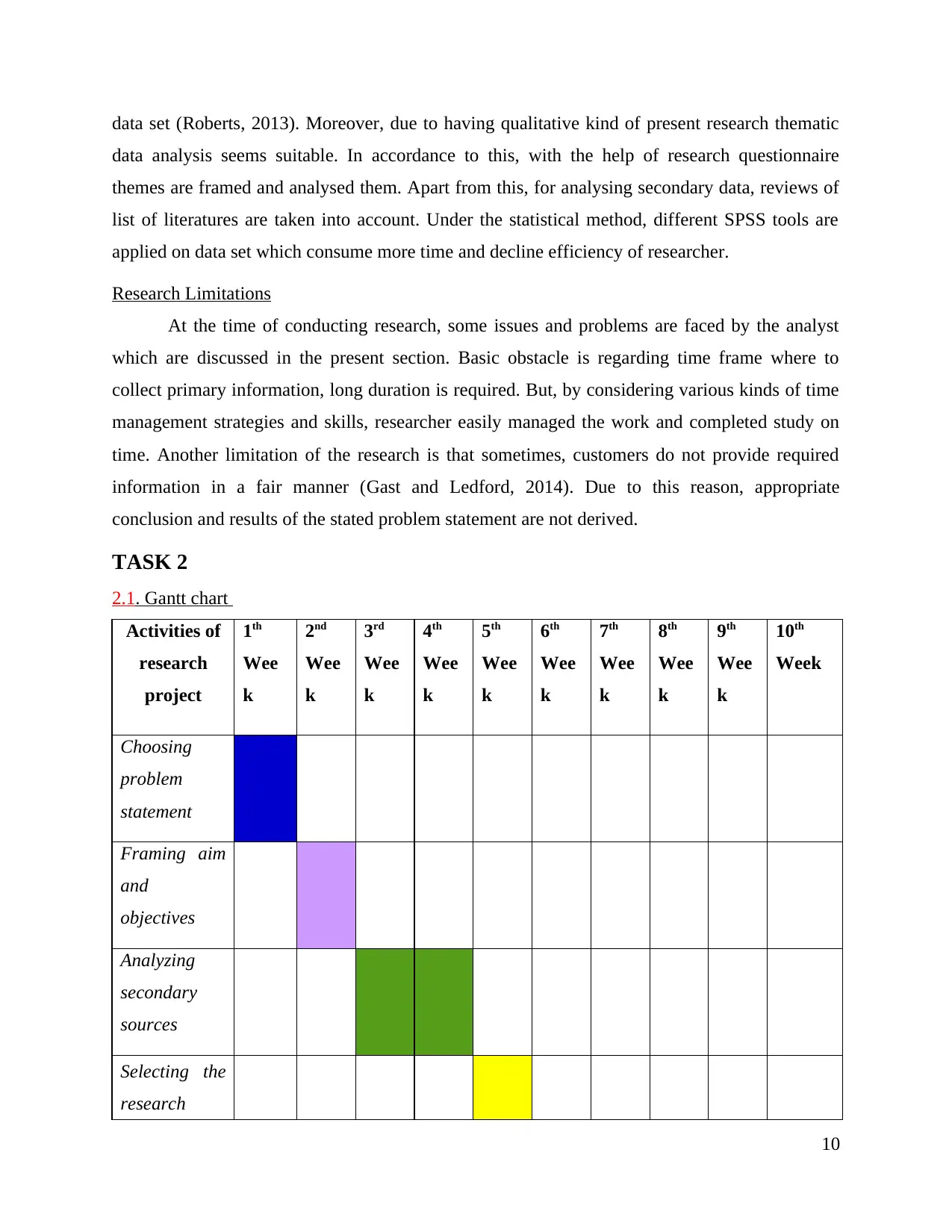
TASK 2
2.1. Gantt chart
Activities of
research
project
1th
Wee
k
2nd
Wee
k
3rd
Wee
k
4th
Wee
k
5th
Wee
k
6th
Wee
k
7th
Wee
k
8th
Wee
k
9th
Wee
k
10th
Week
Choosing
problem
statement
Framing aim
and
objectives
Analyzing
secondary
sources
Selecting the
research
10
data analysis seems suitable. In accordance to this, with the help of research questionnaire
themes are framed and analysed them. Apart from this, for analysing secondary data, reviews of
list of literatures are taken into account. Under the statistical method, different SPSS tools are
applied on data set which consume more time and decline efficiency of researcher.
Research Limitations
At the time of conducting research, some issues and problems are faced by the analyst
which are discussed in the present section. Basic obstacle is regarding time frame where to
collect primary information, long duration is required. But, by considering various kinds of time
management strategies and skills, researcher easily managed the work and completed study on
time. Another limitation of the research is that sometimes, customers do not provide required
information in a fair manner (Gast and Ledford, 2014). Due to this reason, appropriate
conclusion and results of the stated problem statement are not derived.
TASK 2
2.1. Gantt chart
Activities of
research
project
1th
Wee
k
2nd
Wee
k
3rd
Wee
k
4th
Wee
k
5th
Wee
k
6th
Wee
k
7th
Wee
k
8th
Wee
k
9th
Wee
k
10th
Week
Choosing
problem
statement
Framing aim
and
objectives
Analyzing
secondary
sources
Selecting the
research
10
⊘ This is a preview!⊘
Do you want full access?
Subscribe today to unlock all pages.
Trusted by 1+ million students worldwide

1 out of 32


Related Documents


Your All-in-One AI-Powered Toolkit for Academic Success.
+13062052269
info@desklib.com
Available 24*7 on WhatsApp / Email
![[object Object]](/_next/static/media/star-bottom.7253800d.svg)
Unlock your academic potential
Copyright © 2020–2026 A2Z Services. All Rights Reserved. Developed and managed by ZUCOL.