Analysing Talent Management Strategies Impact on Organisation Success
VerifiedAdded on 2022/12/29
|25
|4950
|46
Report
AI Summary
This report investigates the impact of effective talent management strategies on organisational success, focusing on a case study of Sophos. It begins with an introduction outlining the research aim, objectives, and questions, followed by a rationale for the study. A literature review explores the meaning of talent management and various strategies employed by companies like Sophos, such as training and development, rewards, and recognition. The report then presents data analysis and findings from primary research, detailing the research methodology employed, including the research philosophy, approach, strategy, data collection methods, and sampling techniques. The questionnaire used for data collection is also included. The report concludes with research outcomes, recommendations for Sophos, a conclusion summarising the findings, and a reflection on the research process.
Impact of Effective
talent management
strategies for
successful
organisations
talent management
strategies for
successful
organisations

Paraphrase This Document
Need a fresh take? Get an instant paraphrase of this document with our AI Paraphraser
Executive summary
In the below report it is mentioned about the topic called talent management strategies. It
consist of introduction which includes research aim, objectives and questions. Then it consist of
research rationale. Then there is a discussion which is conducted through primary and secondary
research. Then there is data interpretation and findings. Then at last it consist of research
methodology and reflection and research outcomes. Then there is a recommendations and
conclusion are given.
In the below report it is mentioned about the topic called talent management strategies. It
consist of introduction which includes research aim, objectives and questions. Then it consist of
research rationale. Then there is a discussion which is conducted through primary and secondary
research. Then there is data interpretation and findings. Then at last it consist of research
methodology and reflection and research outcomes. Then there is a recommendations and
conclusion are given.
Table of Contents
Executive summary .........................................................................................................................2
Introduction .....................................................................................................................................4
Research rationale............................................................................................................................4
Literature review .............................................................................................................................5
Research Methodology....................................................................................................................6
Data analysis and interpretations.....................................................................................................9
Research outcomes ........................................................................................................................18
Recommendation...........................................................................................................................19
CONCLUSION..............................................................................................................................19
Reflection.......................................................................................................................................20
REFERENCES..............................................................................................................................21
Executive summary .........................................................................................................................2
Introduction .....................................................................................................................................4
Research rationale............................................................................................................................4
Literature review .............................................................................................................................5
Research Methodology....................................................................................................................6
Data analysis and interpretations.....................................................................................................9
Research outcomes ........................................................................................................................18
Recommendation...........................................................................................................................19
CONCLUSION..............................................................................................................................19
Reflection.......................................................................................................................................20
REFERENCES..............................................................................................................................21
⊘ This is a preview!⊘
Do you want full access?
Subscribe today to unlock all pages.

Trusted by 1+ million students worldwide
Introduction
This project aims to examine the impact of Effective talent management strategies a
successful organisation. Talent management is the full scope of human resource process which
helps in developing, attracting, on-boarding, motivating and retaining employees for long run in
the organisation. There are certain talent management strategies that are being used by the
company in order to retain employees for long run (Pandita, and Ray, 2018). These are training
and development, rewards and recognisation, growth opportunities etc. in this below research,
the company which is considering is Sophos group plc. It is a British security software and
hardware company. It was founded in the year 1985 by Jan Hruska and Peter Lammer. Company
provides products like security software and services like computer security. This research
includes research aim, objectives and questions. Then there is a research rationale which is being
given of the investigator. Then it consist literature review which is conducted to collect
secondary researcher. Then there is a data interpretation and findings of the primary data which
is collected by the people. Then there is a research methodology and at last it covers conclusion,
reflection and recommendation to the company.
Research aim: “To examine the impact of Effective talent management strategies for successful
organisations”. A case study of Sophos.
Research objectives
To assess the meaning and concept of talent management
To evaluate different types of talent management strategies of Sophos to retain
employees in the organisation.
To determine relation are being suggested between talent management strategies and
success of Sophos.
Research questions
What do you understand by the meaning of talent management?
What are the various forms of talent management strategies are being used in Sophos to
retain employee in the organisation?
What is the relation can you suggest between talent management strategies and success of
Sophos?
This project aims to examine the impact of Effective talent management strategies a
successful organisation. Talent management is the full scope of human resource process which
helps in developing, attracting, on-boarding, motivating and retaining employees for long run in
the organisation. There are certain talent management strategies that are being used by the
company in order to retain employees for long run (Pandita, and Ray, 2018). These are training
and development, rewards and recognisation, growth opportunities etc. in this below research,
the company which is considering is Sophos group plc. It is a British security software and
hardware company. It was founded in the year 1985 by Jan Hruska and Peter Lammer. Company
provides products like security software and services like computer security. This research
includes research aim, objectives and questions. Then there is a research rationale which is being
given of the investigator. Then it consist literature review which is conducted to collect
secondary researcher. Then there is a data interpretation and findings of the primary data which
is collected by the people. Then there is a research methodology and at last it covers conclusion,
reflection and recommendation to the company.
Research aim: “To examine the impact of Effective talent management strategies for successful
organisations”. A case study of Sophos.
Research objectives
To assess the meaning and concept of talent management
To evaluate different types of talent management strategies of Sophos to retain
employees in the organisation.
To determine relation are being suggested between talent management strategies and
success of Sophos.
Research questions
What do you understand by the meaning of talent management?
What are the various forms of talent management strategies are being used in Sophos to
retain employee in the organisation?
What is the relation can you suggest between talent management strategies and success of
Sophos?
Paraphrase This Document
Need a fresh take? Get an instant paraphrase of this document with our AI Paraphraser
Research rationale
The rationale behind choosing this topic is that this topic is most essential for every
organisation. As talent management strategies helps the employees in retaining for long run
(Tafti, Mahmoudsalehi, and Amiri, 2017). By conducting this research, researcher will be able to
enhance their personal and professional skills. And this will helps them in there near future in
finding their satisfying job role. This topic is more important for the investigator because by this
they will get knowledge about talent management. In this research, researcher is using primary
and secondary method to collect data and information. Primary research is collected with
questionnaire survey and secondary research information is collected with literature review.
These methods will help the researcher in getting accurate information. This rationale of
choosing this topic is more important because this helps investigator in understanding about the
concept of talent management strategies which will help in near future when researcher is
applying for any job application. Then this will help the investigator in gaining more information
about the topic and management related purposes.
Literature review
Meaning of talent management
According to the views of Susan (2021), Talent management is the process of attracting,
developing, motivating and rewarding the employees so that they can retain in the company for
long run. It plays an important part in every organisation because talent management strategies
are the strategies which are being used by company can helps them in increasing their
productivity also helps themselves to reduce their employee turnover (Why Talent Management
Is an Important Business, 2021). This process of developing and motivating their skills will helps
them in increasing the work performance. The major purpose of talent management is to make a
productive team which can results in gaining employees performance. By using effective talent
management strategies company can attain its long term and short-term gaols effectively. Also,
in this, HR manger is most responsible in performing their job roles at the time of recruiting
employees for the company so that they can helps the company in targeting more about the
company and results in increasing their profitability. The major importance of talent
management is that it provides productivity to the employees and business both (Narayanan,
Rajithakumar, and Menon, 2019). In context of Sophos company, there managers are also
The rationale behind choosing this topic is that this topic is most essential for every
organisation. As talent management strategies helps the employees in retaining for long run
(Tafti, Mahmoudsalehi, and Amiri, 2017). By conducting this research, researcher will be able to
enhance their personal and professional skills. And this will helps them in there near future in
finding their satisfying job role. This topic is more important for the investigator because by this
they will get knowledge about talent management. In this research, researcher is using primary
and secondary method to collect data and information. Primary research is collected with
questionnaire survey and secondary research information is collected with literature review.
These methods will help the researcher in getting accurate information. This rationale of
choosing this topic is more important because this helps investigator in understanding about the
concept of talent management strategies which will help in near future when researcher is
applying for any job application. Then this will help the investigator in gaining more information
about the topic and management related purposes.
Literature review
Meaning of talent management
According to the views of Susan (2021), Talent management is the process of attracting,
developing, motivating and rewarding the employees so that they can retain in the company for
long run. It plays an important part in every organisation because talent management strategies
are the strategies which are being used by company can helps them in increasing their
productivity also helps themselves to reduce their employee turnover (Why Talent Management
Is an Important Business, 2021). This process of developing and motivating their skills will helps
them in increasing the work performance. The major purpose of talent management is to make a
productive team which can results in gaining employees performance. By using effective talent
management strategies company can attain its long term and short-term gaols effectively. Also,
in this, HR manger is most responsible in performing their job roles at the time of recruiting
employees for the company so that they can helps the company in targeting more about the
company and results in increasing their profitability. The major importance of talent
management is that it provides productivity to the employees and business both (Narayanan,
Rajithakumar, and Menon, 2019). In context of Sophos company, there managers are also
providing proper proper training and development sessions to the employees so that they could
gain proper knowledge about the task which they have to be performed.
Several talent management strategies used by Sophos
According to the views of Ansari (2021), It is important for the company to use talent
managements strategies that are being used in the Sophos company. As it is important for a
business to use these talent managements strategies because it provides assistance to retaining
employees fro long run in the organisation and results in gaining competitive advantage in the
market (Simple Talent Management Strategies, 2021). The strategies which are being used in the
company are training and development sessions. As human resource mangers is providing a
proper training methods to the employees so that they will get proper knowledge about the task
which they have to be performed and also by this they will get motivated. Company is making
consideration of the rewards and recognisation which should be given to the employees on
regular basis. By this employees will get motivated and results in increasing their productivity
(Ford, 2017). Managers of the company take regular feedbacks of employees and provide them
there specified job roles and responsibilities so that there can't be any confusion between
employees.
Determine relation between talent management strategies and success of Sophos
From the views of Hughes (2018), both of terms talent management strategies and
success of the company re interrelated with each other. These are dependent on each other
because this will helps the company in increasing its productivity and also of employees
productivity. This is important to analyse the strategic approaches and methods which are being
used by the company in order to increase the motivation of the employees and also their growth.
If there is a proper growth and opportunity of the employee then they will not leave the company
and this will results in increasing the productivity of the employees. If company will will provide
proper rewards and recognisation to employees, performance management programmes and job
descriptions etc. this will helps them in motivating employees and retain them for long run. If
employees are having better productivity and have sufficient skills (Hughes, 2018). Then this
may results in in achieving overall organisational goals and objectives.
gain proper knowledge about the task which they have to be performed.
Several talent management strategies used by Sophos
According to the views of Ansari (2021), It is important for the company to use talent
managements strategies that are being used in the Sophos company. As it is important for a
business to use these talent managements strategies because it provides assistance to retaining
employees fro long run in the organisation and results in gaining competitive advantage in the
market (Simple Talent Management Strategies, 2021). The strategies which are being used in the
company are training and development sessions. As human resource mangers is providing a
proper training methods to the employees so that they will get proper knowledge about the task
which they have to be performed and also by this they will get motivated. Company is making
consideration of the rewards and recognisation which should be given to the employees on
regular basis. By this employees will get motivated and results in increasing their productivity
(Ford, 2017). Managers of the company take regular feedbacks of employees and provide them
there specified job roles and responsibilities so that there can't be any confusion between
employees.
Determine relation between talent management strategies and success of Sophos
From the views of Hughes (2018), both of terms talent management strategies and
success of the company re interrelated with each other. These are dependent on each other
because this will helps the company in increasing its productivity and also of employees
productivity. This is important to analyse the strategic approaches and methods which are being
used by the company in order to increase the motivation of the employees and also their growth.
If there is a proper growth and opportunity of the employee then they will not leave the company
and this will results in increasing the productivity of the employees. If company will will provide
proper rewards and recognisation to employees, performance management programmes and job
descriptions etc. this will helps them in motivating employees and retain them for long run. If
employees are having better productivity and have sufficient skills (Hughes, 2018). Then this
may results in in achieving overall organisational goals and objectives.
⊘ This is a preview!⊘
Do you want full access?
Subscribe today to unlock all pages.
Trusted by 1+ million students worldwide
Research Methodology
It is defined as the specific procedures and techniques utilised by the researcher to
conduct their research and obtain desired research outcome. Research onion framework is an
important tool which includes levels of research methodology. Several levels of the research
onion framework are provided below:
Research Philosophy: The pint of view from which the research is conducted is
provided in this level of the research onion framework. Positivism and Interpretivism are two
types of research philosophy (Bisdas and et. al., 2019). Positivism assumes that reality is not
influenced by the observer and therefore dependent from it while interpretivisim is centred
around the argument that each observer has different understanding of the truth. The present
study utilises positivism research philosophy as it does not use large amount of resources and can
be completed in less time.
Research approach: The plan utilised for completion of this research are part of this
level of the framework. Deductive and Inductive are two divisions of research approach.
Deductive approach is focused at testing present theories while inductive approach is centred
around creation of new theory. The present study utilises deductive approach. This research
approach is justified as it helps in generalisation of research findings to certain extent and helps
understand relation between various topics and variables.
Research strategy: The aim of giving relevant and relabel information from the research
is part of this level of this level of the framework (Gruszczyński, 2018). Usage of suitable
strategy plays an important role in effective completion of the research and helps the researcher
gain accurate results. The present report utilises questionnaire as it allows the investigator to gain
subject specific results.
Data collection: This part of the research framework is focused around obtaining and
measuring data for the topic of the research. Qualitative and quantitative data collection are two
main types of data collection methods. Quantitative data collection is used for this research. The
justification for usage of this quantitative data collection is that it provides objective results.
Time horizon: This level of the research framework is important as it helps in timely
completion of the research. Longitudinal and cross sectional are two approaches to time horizon.
This approach utilises cross-sectional approach to time horizon. Primary reason behind this is
that the investigator is able to swiftly complete the research.
It is defined as the specific procedures and techniques utilised by the researcher to
conduct their research and obtain desired research outcome. Research onion framework is an
important tool which includes levels of research methodology. Several levels of the research
onion framework are provided below:
Research Philosophy: The pint of view from which the research is conducted is
provided in this level of the research onion framework. Positivism and Interpretivism are two
types of research philosophy (Bisdas and et. al., 2019). Positivism assumes that reality is not
influenced by the observer and therefore dependent from it while interpretivisim is centred
around the argument that each observer has different understanding of the truth. The present
study utilises positivism research philosophy as it does not use large amount of resources and can
be completed in less time.
Research approach: The plan utilised for completion of this research are part of this
level of the framework. Deductive and Inductive are two divisions of research approach.
Deductive approach is focused at testing present theories while inductive approach is centred
around creation of new theory. The present study utilises deductive approach. This research
approach is justified as it helps in generalisation of research findings to certain extent and helps
understand relation between various topics and variables.
Research strategy: The aim of giving relevant and relabel information from the research
is part of this level of this level of the framework (Gruszczyński, 2018). Usage of suitable
strategy plays an important role in effective completion of the research and helps the researcher
gain accurate results. The present report utilises questionnaire as it allows the investigator to gain
subject specific results.
Data collection: This part of the research framework is focused around obtaining and
measuring data for the topic of the research. Qualitative and quantitative data collection are two
main types of data collection methods. Quantitative data collection is used for this research. The
justification for usage of this quantitative data collection is that it provides objective results.
Time horizon: This level of the research framework is important as it helps in timely
completion of the research. Longitudinal and cross sectional are two approaches to time horizon.
This approach utilises cross-sectional approach to time horizon. Primary reason behind this is
that the investigator is able to swiftly complete the research.
Paraphrase This Document
Need a fresh take? Get an instant paraphrase of this document with our AI Paraphraser
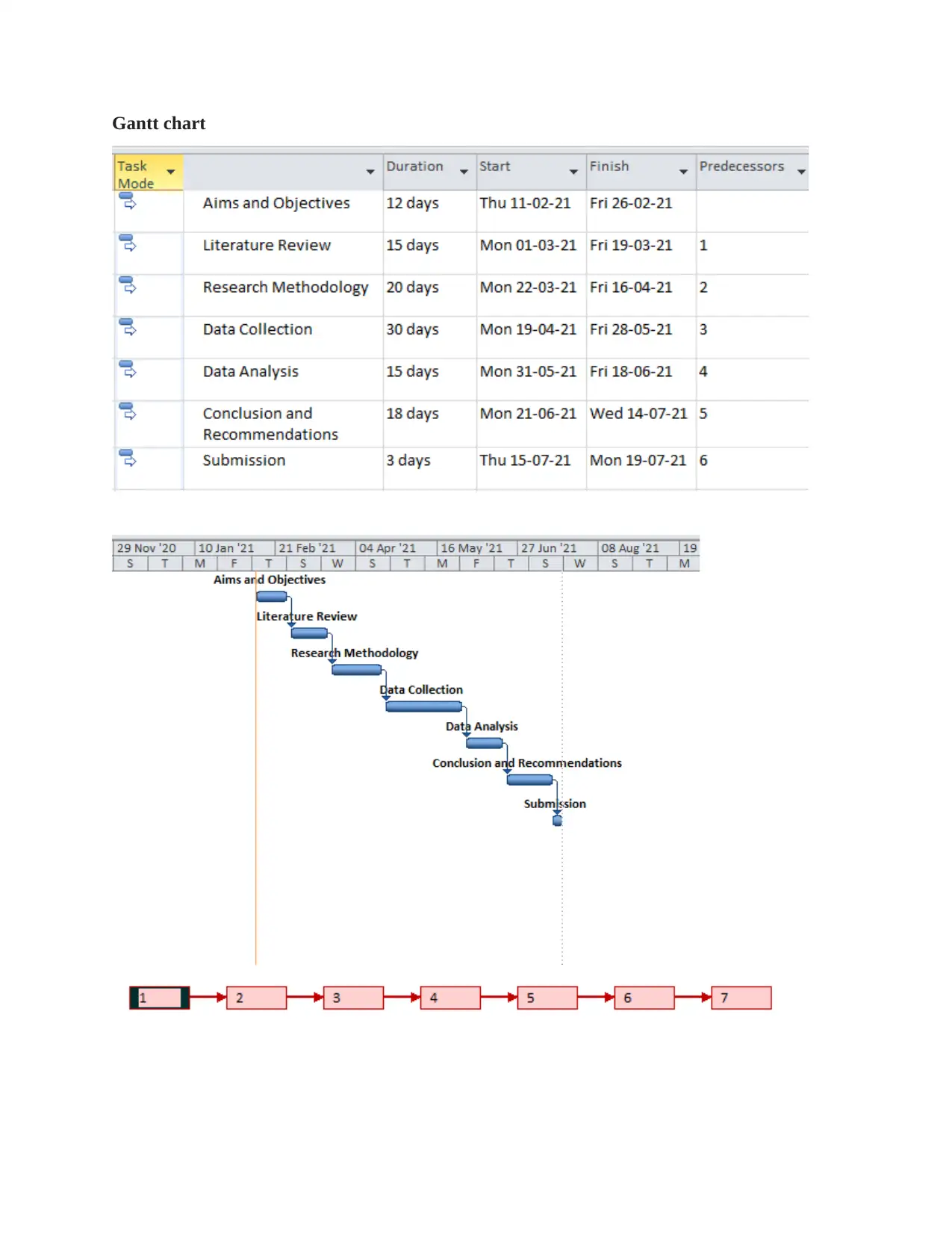
Gantt chart
Data sources: Primary and secondary data sources are two sources present in this level of
the framework. This research utilises both primary and secondary data sources in order to gain
the most reliable results.
Data analysis: This is defined as the process of evaluation, condensations and illustration
of data in an effective manner. Frequency and thematic data analysis are two types of approaches
to data analysis. This report utilises frequency data analysis (Smith and et. al., 2017). The
justification of adoption of frequency data analysis is that it helps the investigator obtain
unbiased outcome which is not affected by personal prejudices.
Research sampling: This plays an important role in the research as it is vital to select
appropriate size for sampling certain part of a huge population. Probabilistic and non-
probabilistic are two kinds of research sampling methods. This research utilises probabilistic
method as it randomized selection of researchers is completed by the company. 50 employees of
the company are selected under this method (Gilroy and et. al., 2018).
Questionnaire:
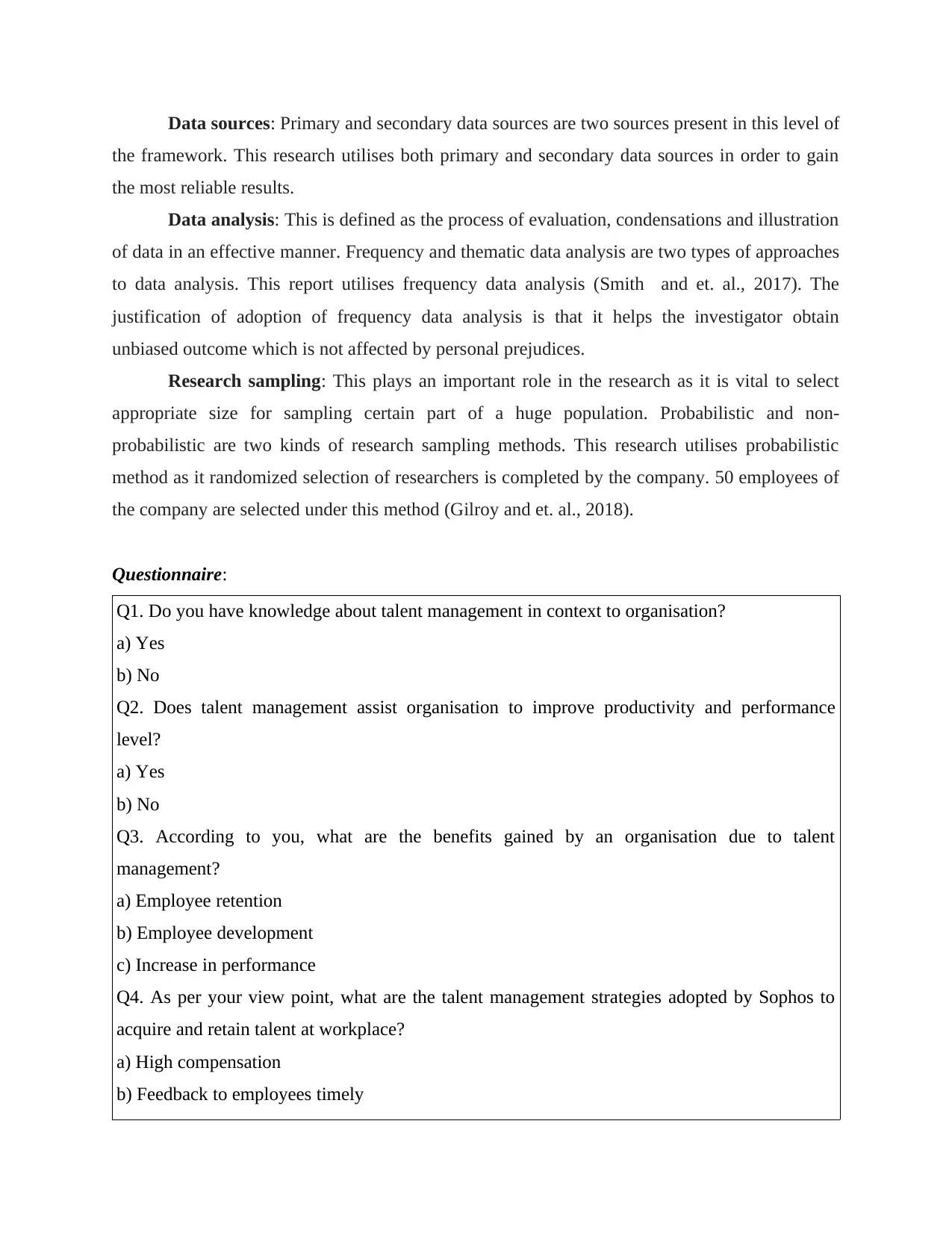
Q1. Do you have knowledge about talent management in context to organisation?
a) Yes
b) No
Q2. Does talent management assist organisation to improve productivity and performance
level?
a) Yes
b) No
Q3. According to you, what are the benefits gained by an organisation due to talent
management?
a) Employee retention
b) Employee development
c) Increase in performance
Q4. As per your view point, what are the talent management strategies adopted by Sophos to
acquire and retain talent at workplace?
a) High compensation
b) Feedback to employees timely
the framework. This research utilises both primary and secondary data sources in order to gain
the most reliable results.
Data analysis: This is defined as the process of evaluation, condensations and illustration
of data in an effective manner. Frequency and thematic data analysis are two types of approaches
to data analysis. This report utilises frequency data analysis (Smith and et. al., 2017). The
justification of adoption of frequency data analysis is that it helps the investigator obtain
unbiased outcome which is not affected by personal prejudices.
Research sampling: This plays an important role in the research as it is vital to select
appropriate size for sampling certain part of a huge population. Probabilistic and non-
probabilistic are two kinds of research sampling methods. This research utilises probabilistic
method as it randomized selection of researchers is completed by the company. 50 employees of
the company are selected under this method (Gilroy and et. al., 2018).
Questionnaire:
Q1. Do you have knowledge about talent management in context to organisation?
a) Yes
b) No
Q2. Does talent management assist organisation to improve productivity and performance
level?
a) Yes
b) No
Q3. According to you, what are the benefits gained by an organisation due to talent
management?
a) Employee retention
b) Employee development
c) Increase in performance
Q4. As per your view point, what are the talent management strategies adopted by Sophos to
acquire and retain talent at workplace?
a) High compensation
b) Feedback to employees timely
⊘ This is a preview!⊘
Do you want full access?
Subscribe today to unlock all pages.
Trusted by 1+ million students worldwide
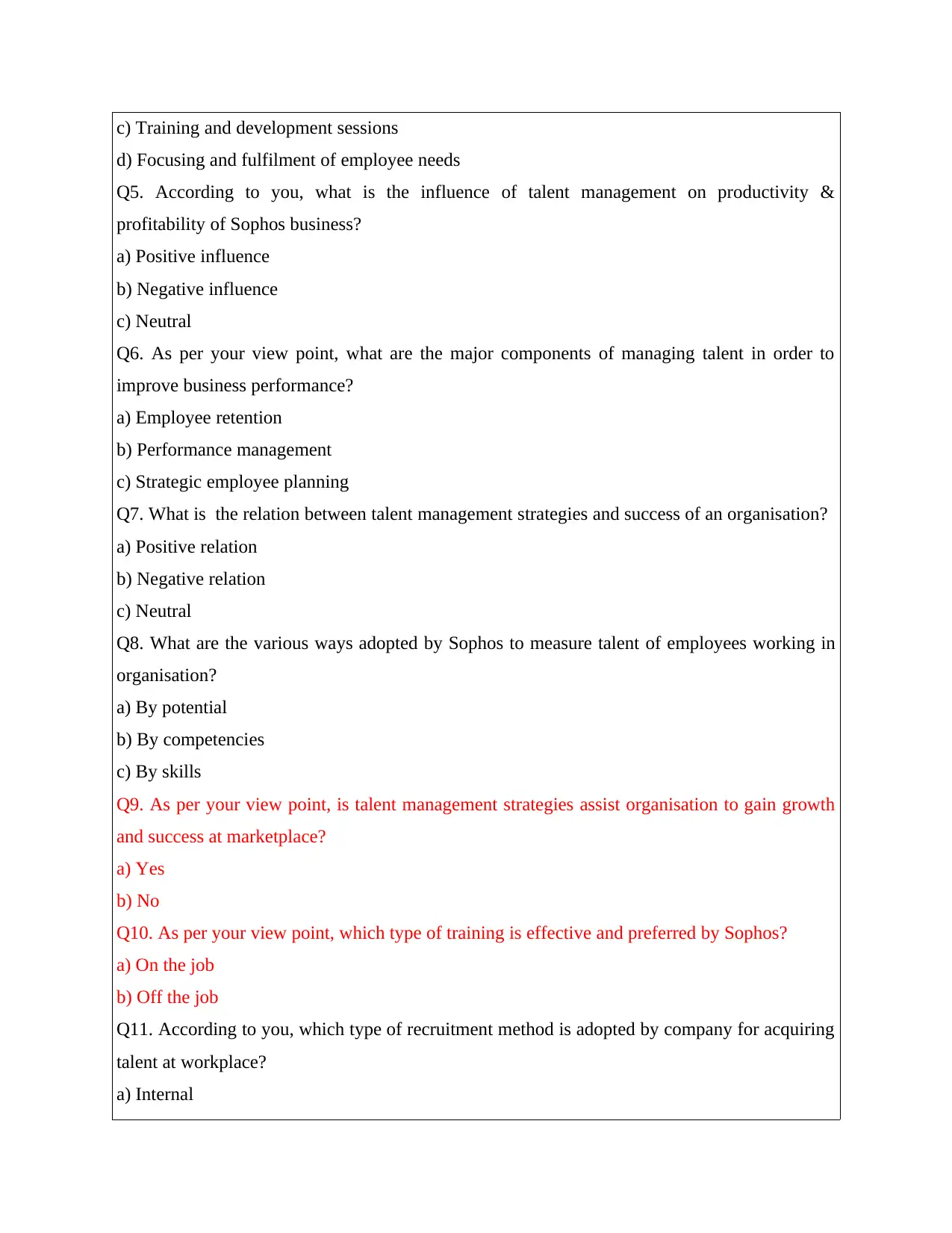
c) Training and development sessions
d) Focusing and fulfilment of employee needs
Q5. According to you, what is the influence of talent management on productivity &
profitability of Sophos business?
a) Positive influence
b) Negative influence
c) Neutral
Q6. As per your view point, what are the major components of managing talent in order to
improve business performance?
a) Employee retention
b) Performance management
c) Strategic employee planning
Q7. What is the relation between talent management strategies and success of an organisation?
a) Positive relation
b) Negative relation
c) Neutral
Q8. What are the various ways adopted by Sophos to measure talent of employees working in
organisation?
a) By potential
b) By competencies
c) By skills
Q9. As per your view point, is talent management strategies assist organisation to gain growth
and success at marketplace?
a) Yes
b) No
Q10. As per your view point, which type of training is effective and preferred by Sophos?
a) On the job
b) Off the job
Q11. According to you, which type of recruitment method is adopted by company for acquiring
talent at workplace?
a) Internal
d) Focusing and fulfilment of employee needs
Q5. According to you, what is the influence of talent management on productivity &
profitability of Sophos business?
a) Positive influence
b) Negative influence
c) Neutral
Q6. As per your view point, what are the major components of managing talent in order to
improve business performance?
a) Employee retention
b) Performance management
c) Strategic employee planning
Q7. What is the relation between talent management strategies and success of an organisation?
a) Positive relation
b) Negative relation
c) Neutral
Q8. What are the various ways adopted by Sophos to measure talent of employees working in
organisation?
a) By potential
b) By competencies
c) By skills
Q9. As per your view point, is talent management strategies assist organisation to gain growth
and success at marketplace?
a) Yes
b) No
Q10. As per your view point, which type of training is effective and preferred by Sophos?
a) On the job
b) Off the job
Q11. According to you, which type of recruitment method is adopted by company for acquiring
talent at workplace?
a) Internal
Paraphrase This Document
Need a fresh take? Get an instant paraphrase of this document with our AI Paraphraser
b)External
Q20. Suggest some ways to higher authorities of Sophos to improving talent management
strategies.
Data analysis and interpretations
Theme 1: Concept of talent management
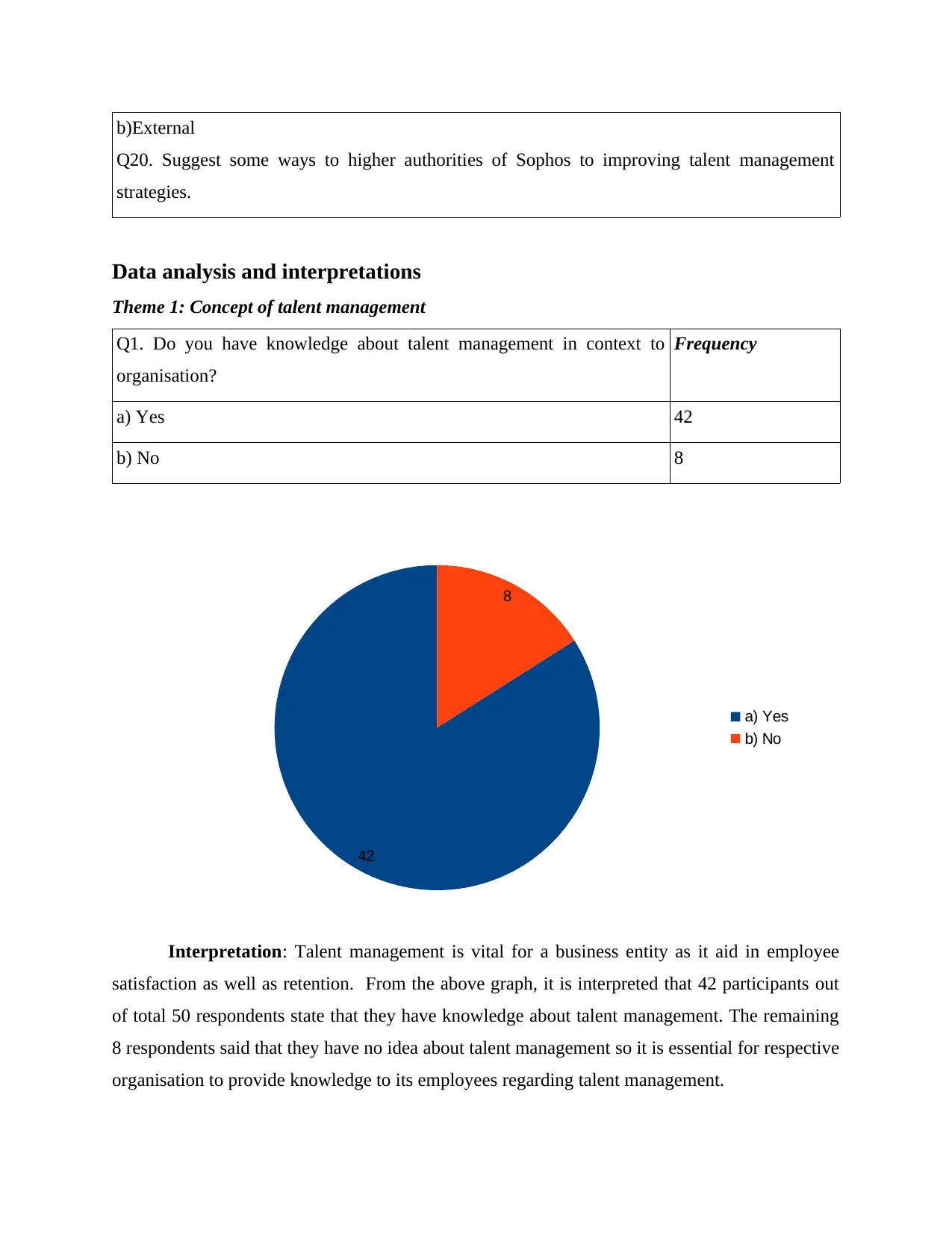
Q1. Do you have knowledge about talent management in context to
organisation?
Frequency
a) Yes 42
b) No 8
Interpretation: Talent management is vital for a business entity as it aid in employee
satisfaction as well as retention. From the above graph, it is interpreted that 42 participants out
of total 50 respondents state that they have knowledge about talent management. The remaining
8 respondents said that they have no idea about talent management so it is essential for respective
organisation to provide knowledge to its employees regarding talent management.
42
8
a) Yes
b) No
Q20. Suggest some ways to higher authorities of Sophos to improving talent management
strategies.
Data analysis and interpretations
Theme 1: Concept of talent management
Q1. Do you have knowledge about talent management in context to
organisation?
Frequency
a) Yes 42
b) No 8
Interpretation: Talent management is vital for a business entity as it aid in employee
satisfaction as well as retention. From the above graph, it is interpreted that 42 participants out
of total 50 respondents state that they have knowledge about talent management. The remaining
8 respondents said that they have no idea about talent management so it is essential for respective
organisation to provide knowledge to its employees regarding talent management.
42
8
a) Yes
b) No
Theme 2: Impact of talent management on performance and productivity level
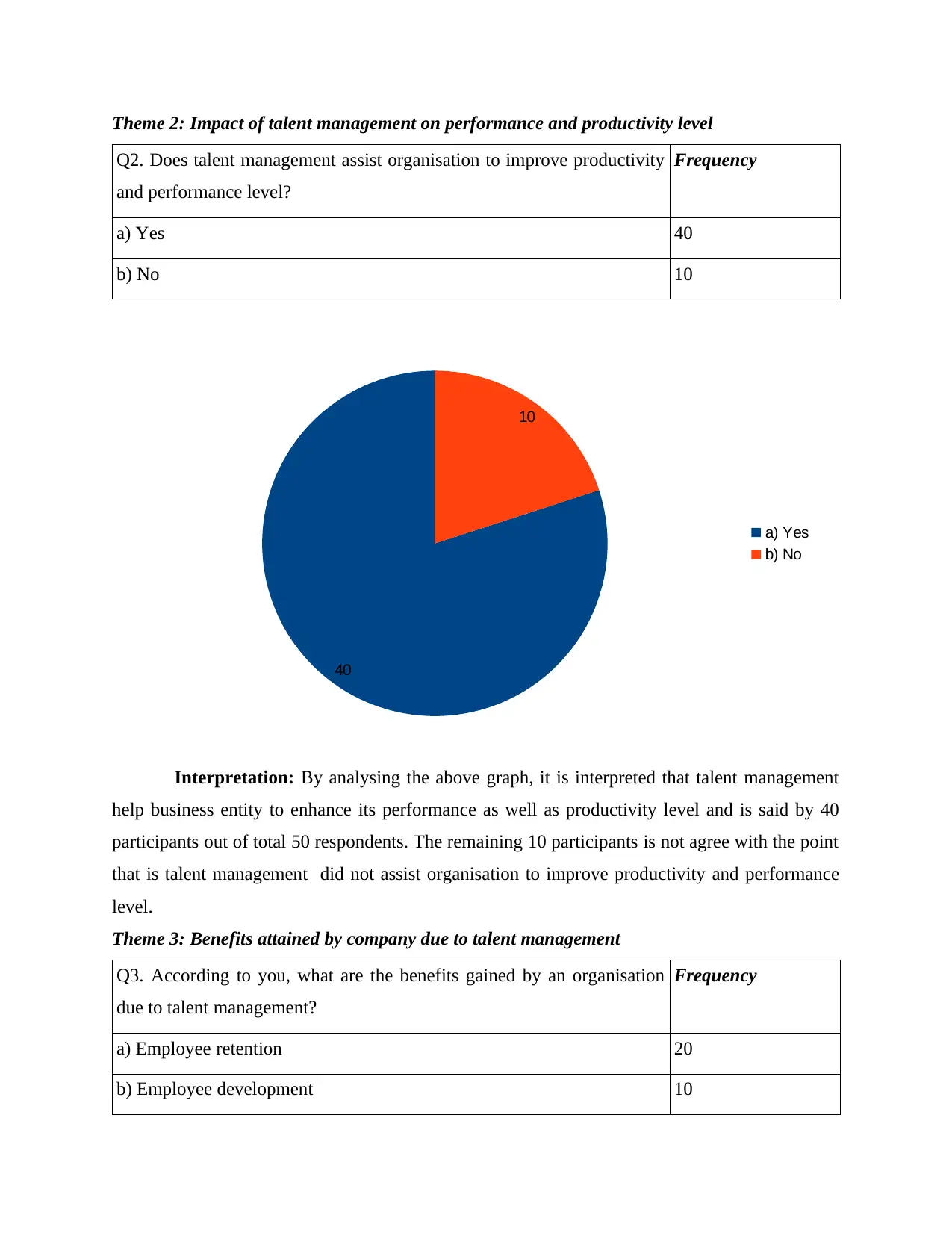
Q2. Does talent management assist organisation to improve productivity
and performance level?
Frequency
a) Yes 40
b) No 10
Interpretation: By analysing the above graph, it is interpreted that talent management
help business entity to enhance its performance as well as productivity level and is said by 40
participants out of total 50 respondents. The remaining 10 participants is not agree with the point
that is talent management did not assist organisation to improve productivity and performance
level.
Theme 3: Benefits attained by company due to talent management
Q3. According to you, what are the benefits gained by an organisation
due to talent management?
Frequency
a) Employee retention 20
b) Employee development 10
40
10
a) Yes
b) No
Q2. Does talent management assist organisation to improve productivity
and performance level?
Frequency
a) Yes 40
b) No 10
Interpretation: By analysing the above graph, it is interpreted that talent management
help business entity to enhance its performance as well as productivity level and is said by 40
participants out of total 50 respondents. The remaining 10 participants is not agree with the point
that is talent management did not assist organisation to improve productivity and performance
level.
Theme 3: Benefits attained by company due to talent management
Q3. According to you, what are the benefits gained by an organisation
due to talent management?
Frequency
a) Employee retention 20
b) Employee development 10
40
10
a) Yes
b) No
⊘ This is a preview!⊘
Do you want full access?
Subscribe today to unlock all pages.
Trusted by 1+ million students worldwide

1 out of 25


Related Documents


Your All-in-One AI-Powered Toolkit for Academic Success.
+13062052269
info@desklib.com
Available 24*7 on WhatsApp / Email
![[object Object]](/_next/static/media/star-bottom.7253800d.svg)
Unlock your academic potential
Copyright © 2020–2026 A2Z Services. All Rights Reserved. Developed and managed by ZUCOL.