The Impact of Ethical Issues on Corporate Culture: Asda UK Study
VerifiedAdded on 2020/01/15
|12
|3721
|122
Report
AI Summary
This report investigates the impact of ethical issues on the corporate culture of Asda UK. It begins by defining corporate culture and its significance, followed by an examination of various ethical challenges faced by businesses, such as workplace discrimination and employee working conditions. The research then explores how these ethical issues influence the development of an organization's culture, using Asda as a specific example. The report also outlines the research design, which employs a descriptive approach, and discusses the data analysis procedure. The core of the analysis revolves around the ethical dimensions of Asda's operations, including its interactions with employees, customers, and suppliers, to assess the impact of these issues on the company's overall corporate culture. Finally, the report recommends strategies for Asda to overcome ethical challenges and enhance its corporate culture, contributing to its long-term sustainability and success in a competitive market.

Corporate culture and
ethics issues
1
ethics issues
1

Paraphrase This Document
Need a fresh take? Get an instant paraphrase of this document with our AI Paraphraser
TABLE OF CONTENTS
Aim .................................................................................................................................................3
Objectives .......................................................................................................................................3
Introduction .....................................................................................................................................3
Research questions ..........................................................................................................................4
Literature review .............................................................................................................................5
Research design and Methodology .................................................................................................7
Time Scale ......................................................................................................................................9
Data analysis procedure ................................................................................................................10
Practical issues ..............................................................................................................................10
References......................................................................................................................................12
2
Aim .................................................................................................................................................3
Objectives .......................................................................................................................................3
Introduction .....................................................................................................................................3
Research questions ..........................................................................................................................4
Literature review .............................................................................................................................5
Research design and Methodology .................................................................................................7
Time Scale ......................................................................................................................................9
Data analysis procedure ................................................................................................................10
Practical issues ..............................................................................................................................10
References......................................................................................................................................12
2
AIM
“To assess the impact of ethical issues in development of organization's corporate culture”- A
study on Asda UK.
OBJECTIVES
To assess the meaning and significance of corporate culture in businesses
To determine different type of ethical issues which are faced by Asda UK
Impact of ethical issues in development of organization's corporate culture
To Recommend ways through which Asda can overcome their ethical issues and enhance
corporate culture
INTRODUCTION
In the present era, corporate culture has become very important aspects of business
enterprises. In simpler terms it can be defined as values and belief of an organization regarding
how its management and workers are going to interact with each other. In addition to this, it also
plays a crucial role in carrying out transactions which are outside business organizations. It can
be stated that effective culture creates sense of satisfaction among workers and contributes a lot
in success of businesses. On the other side of this, effective culture also supports businesses in
lowering down the rate of employee turnover which is another challenges faced by firms.
Corporate culture is also important to enhance reputation, productivity and quality of firms. In
the current scenario, ethics has become one of the important part of organizations. In order to
carry out smooth operations in long run, firms are required to take care of all ethical aspects in
the best possible manner. The present research will determine what kind of impact does ethical
issues have on overall corporate culture of organization. In last few years, there has been many
arguments done by various researchers to determine the relationship between corporate culture of
organization and ethics. Some researchers view corporate culture as one of the major and most
important aspect institutionalization of ethics in businesses. On the other side of this, some
3
“To assess the impact of ethical issues in development of organization's corporate culture”- A
study on Asda UK.
OBJECTIVES
To assess the meaning and significance of corporate culture in businesses
To determine different type of ethical issues which are faced by Asda UK
Impact of ethical issues in development of organization's corporate culture
To Recommend ways through which Asda can overcome their ethical issues and enhance
corporate culture
INTRODUCTION
In the present era, corporate culture has become very important aspects of business
enterprises. In simpler terms it can be defined as values and belief of an organization regarding
how its management and workers are going to interact with each other. In addition to this, it also
plays a crucial role in carrying out transactions which are outside business organizations. It can
be stated that effective culture creates sense of satisfaction among workers and contributes a lot
in success of businesses. On the other side of this, effective culture also supports businesses in
lowering down the rate of employee turnover which is another challenges faced by firms.
Corporate culture is also important to enhance reputation, productivity and quality of firms. In
the current scenario, ethics has become one of the important part of organizations. In order to
carry out smooth operations in long run, firms are required to take care of all ethical aspects in
the best possible manner. The present research will determine what kind of impact does ethical
issues have on overall corporate culture of organization. In last few years, there has been many
arguments done by various researchers to determine the relationship between corporate culture of
organization and ethics. Some researchers view corporate culture as one of the major and most
important aspect institutionalization of ethics in businesses. On the other side of this, some
3
⊘ This is a preview!⊘
Do you want full access?
Subscribe today to unlock all pages.

Trusted by 1+ million students worldwide
authors perceives culture as backbone in ethics. It can be also argued that, culture has direct
impact on the process of improving business ethics.
For this purpose, Asda which is one of the most popular brands in grocery industry of UK
will be taken into consideration. This study will support in getting aware of the fact that whether
ethical issues have any kind of role in Asda corporate culture. At the time of carrying out their
operations businesses are required to deal with ethical issues such as working conditions of
employees, relations with customers and suppliers, behaviour of their employees etc. Further,
organizations cannot sustain in long run by neglecting ethical issues. In the present scenario,
firms are required to take care of both culture and ethics at the time of operating in business
environment. Culture supports in enhancing the relationship and coordination among workers
which results in accomplishment of organizations objectives.
On the other side of this, ethics encourage businesses to operate in such a manner that no
negative impact is created on employees, customers and society. In order to sustain in long run
and achieve its vision, firms are required to develop strong culture which includes ethics.
Nowadays the competition among firms in almost every sector has become so intense that it is
not easy for them to attract customers and earn higher profits. It can be also explained that such
kind of situations enhances the temptations of firms to engage in various kinds of unethical
practises. Most of the time, businesses are also required to pay heavy fines and penalties because
of such kind of practises. Another reason which encourage business to involve in unethical
practises is that they neglect other key considerations and place profits ahead of the same. Ethical
businesses are the one which adhere their commitments and promises in any kind of situation. In
addition to this, ethical organizations establish strong code of conduct which every employee
need to strictly follow. The aim of this research will be to assess positive or negative impact of
ethical issues on organizations corporate culture.
It can be stated that the present study is going to focus on four main areas. The first area
will include meaning and significance of corporate culture in businesses. The second area which
the present study will explore is different type of ethical issues which are faced by organizations
at the time of carrying out their operations. The third area explain impact of ethical issues in
development of organization's corporate culture. At last this research will recommend the ways
through which businesses such as Asda can overcome their ethical issues and enhance corporate
4
impact on the process of improving business ethics.
For this purpose, Asda which is one of the most popular brands in grocery industry of UK
will be taken into consideration. This study will support in getting aware of the fact that whether
ethical issues have any kind of role in Asda corporate culture. At the time of carrying out their
operations businesses are required to deal with ethical issues such as working conditions of
employees, relations with customers and suppliers, behaviour of their employees etc. Further,
organizations cannot sustain in long run by neglecting ethical issues. In the present scenario,
firms are required to take care of both culture and ethics at the time of operating in business
environment. Culture supports in enhancing the relationship and coordination among workers
which results in accomplishment of organizations objectives.
On the other side of this, ethics encourage businesses to operate in such a manner that no
negative impact is created on employees, customers and society. In order to sustain in long run
and achieve its vision, firms are required to develop strong culture which includes ethics.
Nowadays the competition among firms in almost every sector has become so intense that it is
not easy for them to attract customers and earn higher profits. It can be also explained that such
kind of situations enhances the temptations of firms to engage in various kinds of unethical
practises. Most of the time, businesses are also required to pay heavy fines and penalties because
of such kind of practises. Another reason which encourage business to involve in unethical
practises is that they neglect other key considerations and place profits ahead of the same. Ethical
businesses are the one which adhere their commitments and promises in any kind of situation. In
addition to this, ethical organizations establish strong code of conduct which every employee
need to strictly follow. The aim of this research will be to assess positive or negative impact of
ethical issues on organizations corporate culture.
It can be stated that the present study is going to focus on four main areas. The first area
will include meaning and significance of corporate culture in businesses. The second area which
the present study will explore is different type of ethical issues which are faced by organizations
at the time of carrying out their operations. The third area explain impact of ethical issues in
development of organization's corporate culture. At last this research will recommend the ways
through which businesses such as Asda can overcome their ethical issues and enhance corporate
4
Paraphrase This Document
Need a fresh take? Get an instant paraphrase of this document with our AI Paraphraser
culture. One of the main reason behind carrying out this study to determine how corporate
culture of organization is affected by ethical issues.
RESEARCH QUESTIONS
Determine the meaning and significance of corporate culture in businesses?
What are the different type of ethical issues which are faced by Asda UK?
Explain the impact of ethical issues in development of organization's corporate culture
What are the ways through which Asda can overcome their ethical issues and enhance
corporate culture
LITERATURE REVIEW
Meaning and significance of corporate culture in businesses
Corporate culture can be defined as attitude, beliefs and values of a business enterprise
which act as guidelines to carry out its practises and operations. As per the view of Schein,
(2010), corporate culture of every organizations articulate around its vision and mission
statements (Schein, 2010). Some key elements of corporate culture includes vision, values,
practises etc. However, Farndale, Scullion and Sparrow, (2010) argued that companies cannot
sustain for long run in market without having sound and effective culture. In addition to this
healthy culture always motivates workers to give their best towards the success of an
organization (Farndale, Scullion and Sparrow, 2010). Corporate culture depicts the way people
within a business enterprise interact with each others. According to, in an organizations
employees come from different type of social, educational and cultural background. Culture
supports organizations to unite workers which come from different background. Furthermore, it
cannot achieve its goals and objectives in situations where employees do not have strong
relationship and coordination among themselves. Linnenluecke and Griffiths, (2010) has
explained that culture plays a very important role in overall growth and success of a business
organization. It provides workers with core principles and guidelines regrading how they are
required to behave and carry out their task in organization (Linnenluecke and Griffiths, 2010).
Majority of the times workers are well aware of their respective roles, duties and
responsibilities. According to, Schein, (2009) corporate culture provides directions to workers
regrading how they are required to carry out their roles and responsibilities. In the present
5
culture of organization is affected by ethical issues.
RESEARCH QUESTIONS
Determine the meaning and significance of corporate culture in businesses?
What are the different type of ethical issues which are faced by Asda UK?
Explain the impact of ethical issues in development of organization's corporate culture
What are the ways through which Asda can overcome their ethical issues and enhance
corporate culture
LITERATURE REVIEW
Meaning and significance of corporate culture in businesses
Corporate culture can be defined as attitude, beliefs and values of a business enterprise
which act as guidelines to carry out its practises and operations. As per the view of Schein,
(2010), corporate culture of every organizations articulate around its vision and mission
statements (Schein, 2010). Some key elements of corporate culture includes vision, values,
practises etc. However, Farndale, Scullion and Sparrow, (2010) argued that companies cannot
sustain for long run in market without having sound and effective culture. In addition to this
healthy culture always motivates workers to give their best towards the success of an
organization (Farndale, Scullion and Sparrow, 2010). Corporate culture depicts the way people
within a business enterprise interact with each others. According to, in an organizations
employees come from different type of social, educational and cultural background. Culture
supports organizations to unite workers which come from different background. Furthermore, it
cannot achieve its goals and objectives in situations where employees do not have strong
relationship and coordination among themselves. Linnenluecke and Griffiths, (2010) has
explained that culture plays a very important role in overall growth and success of a business
organization. It provides workers with core principles and guidelines regrading how they are
required to behave and carry out their task in organization (Linnenluecke and Griffiths, 2010).
Majority of the times workers are well aware of their respective roles, duties and
responsibilities. According to, Schein, (2009) corporate culture provides directions to workers
regrading how they are required to carry out their roles and responsibilities. In the present
5
scenario, employees are termed as one of the biggest and most important asset of companies. It
can be also stated that businesses cannot achieve higher growth and profitability if their
employees are not motivated (Schein, 2009). Strong corporate culture is the one which brings all
employees in organization to common platform. As per the view of Van den Steen, (2010) one of
the most important characteristic of effective culture is that it promotes equality at workplace.
This means that each and every member of organization is provided with fair and equal
opportunity regrading growth and development. Strong Corporate culture results in creating
sense of satisfaction among workers and encourages them to give their best. However, it can be
argued that it is not easy for businesses to develop strong and sound culture. Furthermore, they
are required to take care of different kinds of factors which directly or indirectly affects culture
of businesses. One of the major factor among those can be considered as employees of
organization. In addition to this, it is the workers which contributes a significant part in the
development of corporate culture of a business.
For example organization in which majority of employee are young are able to encourage
healthy competition within itself. Further, such businesses are also able to achieve their goals
objectives and mission in better way. On the other side of this, nature of companies is another
key factor which affects corporate culture. In addition to this, culture of business such as banking
and broking directly gets negatively affected during situations such as market crash. In order to
operate in appropriate manner these businesses are required to terminate employees because of
instability in market.
Different type of ethical issues faced by businesses
In the 21st century ethics has emerged as one of the most crucial aspect which needs to be
taken into consideration by businesses at the time of carrying out their operations. As per the
view of Weiss, (2014) ethics is simply termed as basis sense which helps in getting aware of the
difference between societal right and wrong. Furthermore, ethics in business encourages to make
only those decisions which do not have any kind of wrong or negative impact on society (Weiss,
2014)). One of the major and most important issues which is now faced by businesses is related
to workplace discrimination. Nowadays, many employees all across the world are facing issues
related to various kinds of discriminations which exist in workplace. The example of this is can
be preference provided to male workers over female employees, some workers provided with
6
can be also stated that businesses cannot achieve higher growth and profitability if their
employees are not motivated (Schein, 2009). Strong corporate culture is the one which brings all
employees in organization to common platform. As per the view of Van den Steen, (2010) one of
the most important characteristic of effective culture is that it promotes equality at workplace.
This means that each and every member of organization is provided with fair and equal
opportunity regrading growth and development. Strong Corporate culture results in creating
sense of satisfaction among workers and encourages them to give their best. However, it can be
argued that it is not easy for businesses to develop strong and sound culture. Furthermore, they
are required to take care of different kinds of factors which directly or indirectly affects culture
of businesses. One of the major factor among those can be considered as employees of
organization. In addition to this, it is the workers which contributes a significant part in the
development of corporate culture of a business.
For example organization in which majority of employee are young are able to encourage
healthy competition within itself. Further, such businesses are also able to achieve their goals
objectives and mission in better way. On the other side of this, nature of companies is another
key factor which affects corporate culture. In addition to this, culture of business such as banking
and broking directly gets negatively affected during situations such as market crash. In order to
operate in appropriate manner these businesses are required to terminate employees because of
instability in market.
Different type of ethical issues faced by businesses
In the 21st century ethics has emerged as one of the most crucial aspect which needs to be
taken into consideration by businesses at the time of carrying out their operations. As per the
view of Weiss, (2014) ethics is simply termed as basis sense which helps in getting aware of the
difference between societal right and wrong. Furthermore, ethics in business encourages to make
only those decisions which do not have any kind of wrong or negative impact on society (Weiss,
2014)). One of the major and most important issues which is now faced by businesses is related
to workplace discrimination. Nowadays, many employees all across the world are facing issues
related to various kinds of discriminations which exist in workplace. The example of this is can
be preference provided to male workers over female employees, some workers provided with
6
⊘ This is a preview!⊘
Do you want full access?
Subscribe today to unlock all pages.
Trusted by 1+ million students worldwide
better opportunities related to growth and development over others etc. Discrimination has
emerged as one of the biggest issues for organizations in the present scenario (Brooks and Dunn,
2011). It can be stated that in order to grow and sustain in long run, businesses are required to
become well aware of consequence of workplace discrimination.
On the other side of this, has explained that workplace discrimination creates
dissatisfaction among employee and also lower down their entire productivity. Ethics in business
explains that organization should provide all employees with equal and fair chances related to
their growth and development. In addition to this, promotion and rewards should be provided on
the basis of employee skills, productivity, capabilities and knowledge. As per the view of De
George, (2011) working conditions provided to workers is another issue related to ethics which
is faced by businesses. In the modern era, ethical businesses are the on which provide safe and
healthy working environment to their employees (De George, 2011). In addition to this, it can be
also argued that businesses can also face legal consequence if they fail to provide health work
environment to workers. Ethical issues are also faced by firms at the time of carrying out their
decision making process. Fassin, Van Rossem and Buelens, (2011) has asserted that ethic
encourage organization to take decision which are protects rights of all its employees and
customers. Businesses cannot survive in marketplace for long run if they made decisions which
exploits rights of employee and customers (Fassin, Van Rossem and Buelens, 2011). Thus, it can
be argued that firms needs to make sure that at during the time of decision making, opinions and
suggestions of workers are taken into consideration. Nowadays majority of businesses in the
world has taken a step forward to develop ethical culture.
RESEARCH DESIGN AND METHODOLOGY
Research methodologies is an important chapter of research which depicts techniques and
tools used by scholar to carry out the research. Furthermore, it can be stated that every researcher
needs to ensure that right and most appropriate tools are used in study. The techniques and tools
which will be employed in the present study are mentioned below as:
Research design- Research design can be termed as a detailed outline which depicts how
researcher will carry out his/her entire research. In simpler terms it can be defined as framework
upon which a scholar carry out the study (Chilisa, 2011). There are various kinds of research
design such as exploratory, descriptive, causal, case study, experimental, ethnographic, practice-
7
emerged as one of the biggest issues for organizations in the present scenario (Brooks and Dunn,
2011). It can be stated that in order to grow and sustain in long run, businesses are required to
become well aware of consequence of workplace discrimination.
On the other side of this, has explained that workplace discrimination creates
dissatisfaction among employee and also lower down their entire productivity. Ethics in business
explains that organization should provide all employees with equal and fair chances related to
their growth and development. In addition to this, promotion and rewards should be provided on
the basis of employee skills, productivity, capabilities and knowledge. As per the view of De
George, (2011) working conditions provided to workers is another issue related to ethics which
is faced by businesses. In the modern era, ethical businesses are the on which provide safe and
healthy working environment to their employees (De George, 2011). In addition to this, it can be
also argued that businesses can also face legal consequence if they fail to provide health work
environment to workers. Ethical issues are also faced by firms at the time of carrying out their
decision making process. Fassin, Van Rossem and Buelens, (2011) has asserted that ethic
encourage organization to take decision which are protects rights of all its employees and
customers. Businesses cannot survive in marketplace for long run if they made decisions which
exploits rights of employee and customers (Fassin, Van Rossem and Buelens, 2011). Thus, it can
be argued that firms needs to make sure that at during the time of decision making, opinions and
suggestions of workers are taken into consideration. Nowadays majority of businesses in the
world has taken a step forward to develop ethical culture.
RESEARCH DESIGN AND METHODOLOGY
Research methodologies is an important chapter of research which depicts techniques and
tools used by scholar to carry out the research. Furthermore, it can be stated that every researcher
needs to ensure that right and most appropriate tools are used in study. The techniques and tools
which will be employed in the present study are mentioned below as:
Research design- Research design can be termed as a detailed outline which depicts how
researcher will carry out his/her entire research. In simpler terms it can be defined as framework
upon which a scholar carry out the study (Chilisa, 2011). There are various kinds of research
design such as exploratory, descriptive, causal, case study, experimental, ethnographic, practice-
7
Paraphrase This Document
Need a fresh take? Get an instant paraphrase of this document with our AI Paraphraser
based, naturalistic etc. Furthermore, it can be stated that each design has its own set of
characteristic, advantage and limitations.
In the present study, descriptive research design will be selected by the research. One of
the main reason behind selecting the above stated design is that it will help in describing impact
of ethical issues in development of organization's corporate culture. Along with this, it will also
support in accomplishment of aim and objectives of research in the best possible manner. It can
be also argued that descriptive research design supports in looking forwards to collect every form
of data which is possible. Therefore, the selected design will be more appropriate for the present
study as it will enhance overall effectiveness of the same.
Data collection- It can be defined as the process in which research use variety of sources to
gather information regarding topic under investigation. Primary and secondary are the two major
sources through which data can be collected by researcher. Primary sources provide information
which is collected for the first time (Coleman and Ringrose, 2013). In addition to this, the data is
considered as more reliable as it is gathered by researcher himself/herself. On the other side of
this, secondary sources render information which has been already collected by someone else. .
In the current study, both primary and secondary sources of data collection will be used
by research. Furthermore, various sources such as books, journals and online sources are going
to be taken into consideration. In addition to this, primary data will be gathered with the help of
well structured questionnaire. The rationale behind using both the sources is that it will support
in getting the best possible and reliable information regarding the impact of ethical issues in
development of organization's corporate culture. In order to collect primary data, the researcher
will be using purposive sampling which is a part of non-probabilistic sampling method.
Furthermore, the information will be collected by 10 employees of Asda. Therefore, sample will
employees of Asda and sample size is going to be 10. It can be stated that the selected sample
and its size will be help the researcher in finding accurate and reliable information regarding the
impact of ethical issues in development of organization's corporate culture.
Research approach- The term research approach depicts the fact that how research is going to
gather informations from various sources and evaluates the same. Deductive and inductive are
the two common types of research approaches which are used by scholar to carry out the study. It
can be stated that inductive approach is used when the findings of research are move from
8
characteristic, advantage and limitations.
In the present study, descriptive research design will be selected by the research. One of
the main reason behind selecting the above stated design is that it will help in describing impact
of ethical issues in development of organization's corporate culture. Along with this, it will also
support in accomplishment of aim and objectives of research in the best possible manner. It can
be also argued that descriptive research design supports in looking forwards to collect every form
of data which is possible. Therefore, the selected design will be more appropriate for the present
study as it will enhance overall effectiveness of the same.
Data collection- It can be defined as the process in which research use variety of sources to
gather information regarding topic under investigation. Primary and secondary are the two major
sources through which data can be collected by researcher. Primary sources provide information
which is collected for the first time (Coleman and Ringrose, 2013). In addition to this, the data is
considered as more reliable as it is gathered by researcher himself/herself. On the other side of
this, secondary sources render information which has been already collected by someone else. .
In the current study, both primary and secondary sources of data collection will be used
by research. Furthermore, various sources such as books, journals and online sources are going
to be taken into consideration. In addition to this, primary data will be gathered with the help of
well structured questionnaire. The rationale behind using both the sources is that it will support
in getting the best possible and reliable information regarding the impact of ethical issues in
development of organization's corporate culture. In order to collect primary data, the researcher
will be using purposive sampling which is a part of non-probabilistic sampling method.
Furthermore, the information will be collected by 10 employees of Asda. Therefore, sample will
employees of Asda and sample size is going to be 10. It can be stated that the selected sample
and its size will be help the researcher in finding accurate and reliable information regarding the
impact of ethical issues in development of organization's corporate culture.
Research approach- The term research approach depicts the fact that how research is going to
gather informations from various sources and evaluates the same. Deductive and inductive are
the two common types of research approaches which are used by scholar to carry out the study. It
can be stated that inductive approach is used when the findings of research are move from
8
specific form to general. In deductive approach, findings are directed from general to specific
form. Majority of the time. Selection of research relies on the nature, aim and objectives of
researcher behind carrying out the study.
In the present research, inductive approach will be used by researches. This means that
findings will be more in generalized form. The reason behind choosing inductive approach is that
it will help the scholar to identify what kind of impact does ethical issues has on development of
organization's corporate culture.
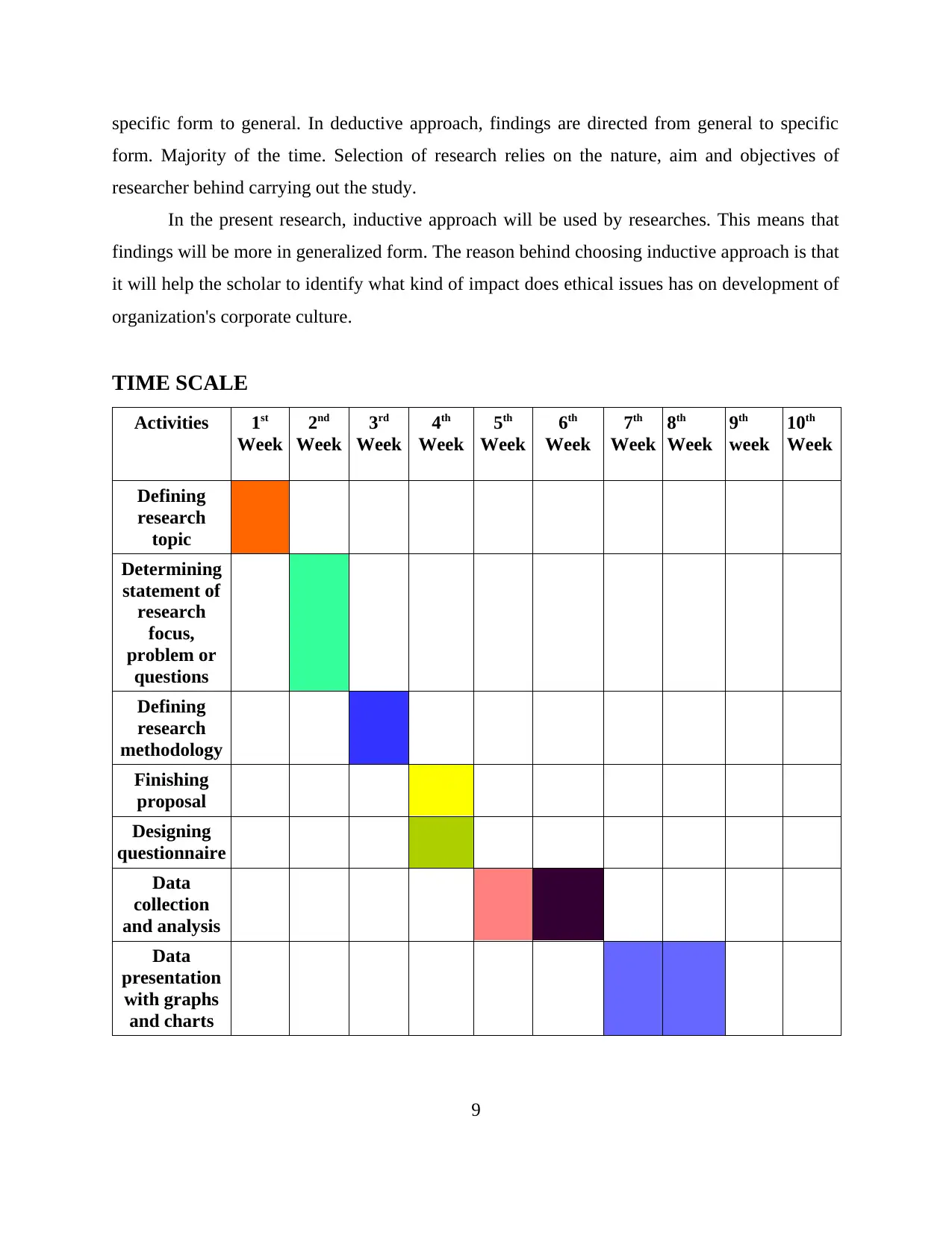
TIME SCALE
Activities 1st
Week
2nd
Week
3rd
Week
4th
Week
5th
Week
6th
Week
7th
Week
8th
Week
9th
week
10th
Week
Defining
research
topic
Determining
statement of
research
focus,
problem or
questions
Defining
research
methodology
Finishing
proposal
Designing
questionnaire
Data
collection
and analysis
Data
presentation
with graphs
and charts
9
form. Majority of the time. Selection of research relies on the nature, aim and objectives of
researcher behind carrying out the study.
In the present research, inductive approach will be used by researches. This means that
findings will be more in generalized form. The reason behind choosing inductive approach is that
it will help the scholar to identify what kind of impact does ethical issues has on development of
organization's corporate culture.
TIME SCALE
Activities 1st
Week
2nd
Week
3rd
Week
4th
Week
5th
Week
6th
Week
7th
Week
8th
Week
9th
week
10th
Week
Defining
research
topic
Determining
statement of
research
focus,
problem or
questions
Defining
research
methodology
Finishing
proposal
Designing
questionnaire
Data
collection
and analysis
Data
presentation
with graphs
and charts
9
⊘ This is a preview!⊘
Do you want full access?
Subscribe today to unlock all pages.
Trusted by 1+ million students worldwide
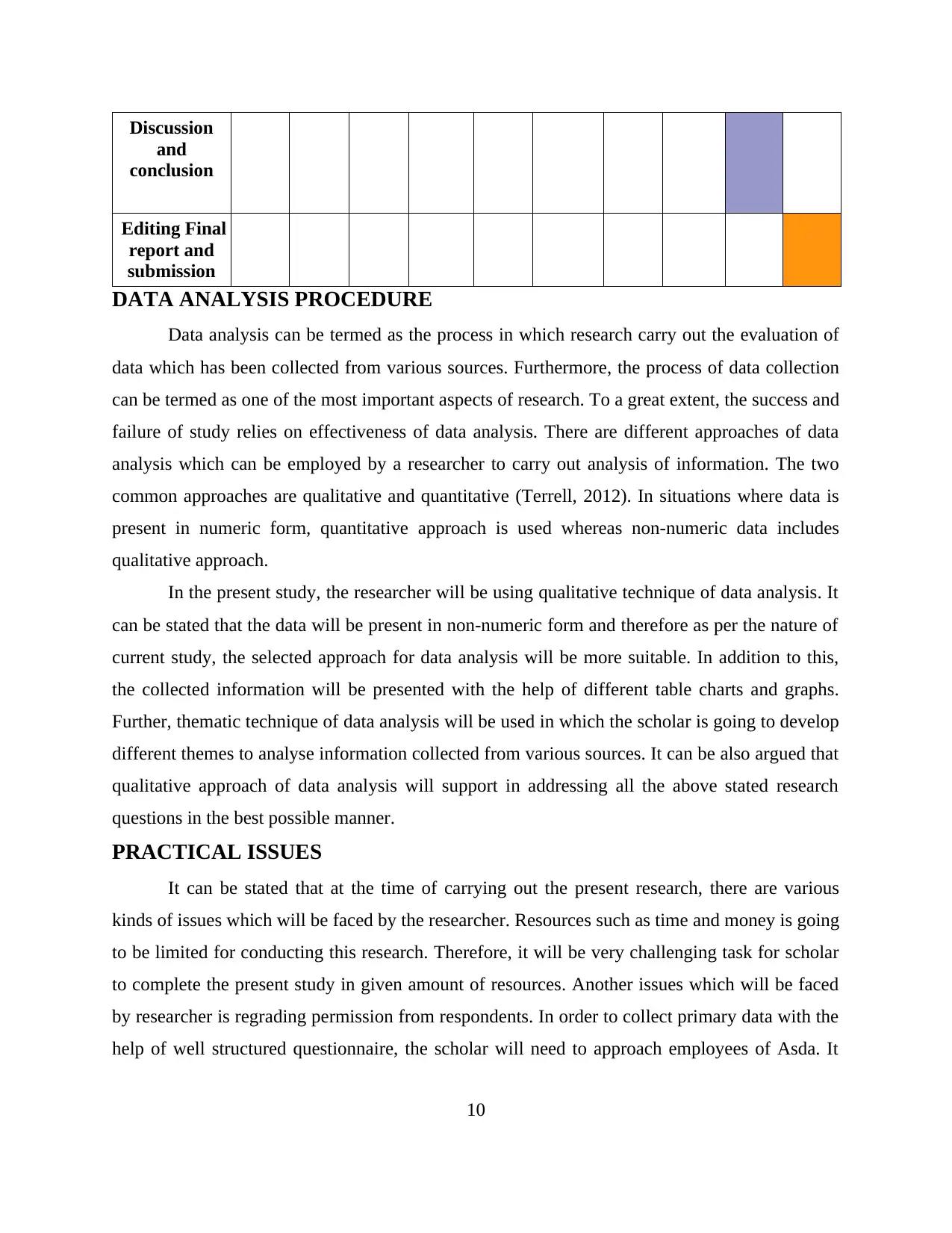
Discussion
and
conclusion
Editing Final
report and
submission
DATA ANALYSIS PROCEDURE
Data analysis can be termed as the process in which research carry out the evaluation of
data which has been collected from various sources. Furthermore, the process of data collection
can be termed as one of the most important aspects of research. To a great extent, the success and
failure of study relies on effectiveness of data analysis. There are different approaches of data
analysis which can be employed by a researcher to carry out analysis of information. The two
common approaches are qualitative and quantitative (Terrell, 2012). In situations where data is
present in numeric form, quantitative approach is used whereas non-numeric data includes
qualitative approach.
In the present study, the researcher will be using qualitative technique of data analysis. It
can be stated that the data will be present in non-numeric form and therefore as per the nature of
current study, the selected approach for data analysis will be more suitable. In addition to this,
the collected information will be presented with the help of different table charts and graphs.
Further, thematic technique of data analysis will be used in which the scholar is going to develop
different themes to analyse information collected from various sources. It can be also argued that
qualitative approach of data analysis will support in addressing all the above stated research
questions in the best possible manner.
PRACTICAL ISSUES
It can be stated that at the time of carrying out the present research, there are various
kinds of issues which will be faced by the researcher. Resources such as time and money is going
to be limited for conducting this research. Therefore, it will be very challenging task for scholar
to complete the present study in given amount of resources. Another issues which will be faced
by researcher is regrading permission from respondents. In order to collect primary data with the
help of well structured questionnaire, the scholar will need to approach employees of Asda. It
10
and
conclusion
Editing Final
report and
submission
DATA ANALYSIS PROCEDURE
Data analysis can be termed as the process in which research carry out the evaluation of
data which has been collected from various sources. Furthermore, the process of data collection
can be termed as one of the most important aspects of research. To a great extent, the success and
failure of study relies on effectiveness of data analysis. There are different approaches of data
analysis which can be employed by a researcher to carry out analysis of information. The two
common approaches are qualitative and quantitative (Terrell, 2012). In situations where data is
present in numeric form, quantitative approach is used whereas non-numeric data includes
qualitative approach.
In the present study, the researcher will be using qualitative technique of data analysis. It
can be stated that the data will be present in non-numeric form and therefore as per the nature of
current study, the selected approach for data analysis will be more suitable. In addition to this,
the collected information will be presented with the help of different table charts and graphs.
Further, thematic technique of data analysis will be used in which the scholar is going to develop
different themes to analyse information collected from various sources. It can be also argued that
qualitative approach of data analysis will support in addressing all the above stated research
questions in the best possible manner.
PRACTICAL ISSUES
It can be stated that at the time of carrying out the present research, there are various
kinds of issues which will be faced by the researcher. Resources such as time and money is going
to be limited for conducting this research. Therefore, it will be very challenging task for scholar
to complete the present study in given amount of resources. Another issues which will be faced
by researcher is regrading permission from respondents. In order to collect primary data with the
help of well structured questionnaire, the scholar will need to approach employees of Asda. It
10
Paraphrase This Document
Need a fresh take? Get an instant paraphrase of this document with our AI Paraphraser
might be possible that the respondents disagree to provide information for carrying out this
study. In order to deal with this issue, the researcher will make respondents aware about the aim
and objectives of present study. In addition to this, scholar will also make them aware of the fact
that their responses and information will be kept completely confidential. This means that the
data will not be provided to any other party in any condition. Other than this, the researcher will
also face practical issues related to finance and funding. It can be stated that if adequate amount
of funds are not available then the entire study will be affected by the same. In order to overcome
this issue, the researcher will be seeking from funds through different research councils of UK.
Along with this, scholar is also going to approach British council, major research foundation and
charities to gather required amount of funds for carrying out the present study.
11
study. In order to deal with this issue, the researcher will make respondents aware about the aim
and objectives of present study. In addition to this, scholar will also make them aware of the fact
that their responses and information will be kept completely confidential. This means that the
data will not be provided to any other party in any condition. Other than this, the researcher will
also face practical issues related to finance and funding. It can be stated that if adequate amount
of funds are not available then the entire study will be affected by the same. In order to overcome
this issue, the researcher will be seeking from funds through different research councils of UK.
Along with this, scholar is also going to approach British council, major research foundation and
charities to gather required amount of funds for carrying out the present study.
11
REFERENCES
Books and journals
Brooks, L.J. and Dunn, P., 2011. Business & professional ethics. Cengage Learning.
Chilisa, B., 2011. Indigenous research methodologies. Sage Publications.
Coleman, R. and Ringrose, J. eds., 2013. Deleuze and research methodologies. Edinburgh
University Press.
De George, R.T., 2011. Business ethics. Pearson Education India.
Farndale, E., Scullion, H. and Sparrow, P., 2010. The role of the corporate HR function in global
talent management. Journal of World Business. 45(2). pp.161-168.
Fassin, Y., Van Rossem, A. and Buelens, M., 2011. Small-business owner-managers’
perceptions of business ethics and CSR-related concepts. Journal of Business ethics.
98(3). pp.425-453.
Linnenluecke, M.K. and Griffiths, A., 2010. Corporate sustainability and organizational
culture. Journal of world business. 45(4). pp.357-366.
Schein, E.H., 2009.The corporate culture survival guide. John Wiley & Sons.
Schein, E.H., 2010. Organizational culture and leadership. John Wiley & Sons.
Terrell, S.R., 2012. Mixed-methods research methodologies. The Qualitative Report. 17(1).
pp.254-280.
Van den Steen, E., 2010. On the origin of shared beliefs (and corporate culture). The RAND
Journal of Economics. 41(4). pp.617-648.
Weiss, J.W., 2014. Business ethics: A stakeholder and issues management approach. Berrett-
Koehler Publishers.
12
Books and journals
Brooks, L.J. and Dunn, P., 2011. Business & professional ethics. Cengage Learning.
Chilisa, B., 2011. Indigenous research methodologies. Sage Publications.
Coleman, R. and Ringrose, J. eds., 2013. Deleuze and research methodologies. Edinburgh
University Press.
De George, R.T., 2011. Business ethics. Pearson Education India.
Farndale, E., Scullion, H. and Sparrow, P., 2010. The role of the corporate HR function in global
talent management. Journal of World Business. 45(2). pp.161-168.
Fassin, Y., Van Rossem, A. and Buelens, M., 2011. Small-business owner-managers’
perceptions of business ethics and CSR-related concepts. Journal of Business ethics.
98(3). pp.425-453.
Linnenluecke, M.K. and Griffiths, A., 2010. Corporate sustainability and organizational
culture. Journal of world business. 45(4). pp.357-366.
Schein, E.H., 2009.The corporate culture survival guide. John Wiley & Sons.
Schein, E.H., 2010. Organizational culture and leadership. John Wiley & Sons.
Terrell, S.R., 2012. Mixed-methods research methodologies. The Qualitative Report. 17(1).
pp.254-280.
Van den Steen, E., 2010. On the origin of shared beliefs (and corporate culture). The RAND
Journal of Economics. 41(4). pp.617-648.
Weiss, J.W., 2014. Business ethics: A stakeholder and issues management approach. Berrett-
Koehler Publishers.
12
⊘ This is a preview!⊘
Do you want full access?
Subscribe today to unlock all pages.
Trusted by 1+ million students worldwide

1 out of 12


Related Documents


Your All-in-One AI-Powered Toolkit for Academic Success.
+13062052269
info@desklib.com
Available 24*7 on WhatsApp / Email
![[object Object]](/_next/static/media/star-bottom.7253800d.svg)
Unlock your academic potential
Copyright © 2020–2026 A2Z Services. All Rights Reserved. Developed and managed by ZUCOL.