DET Level 5 Inclusive Practice: Factors & Regulatory Frameworks
VerifiedAdded on  2023/06/13
|4
|1725
|120
Report
AI Summary
This report provides a comprehensive overview of inclusive learning, examining the impact of personal, social, and cultural factors on learning outcomes. It discusses how cognitive, physical, and sensory abilities affect learning, and delves into the policy and regulatory frameworks that govern inclusive practice, such as the Equality Act. The report further explains how these frameworks influence organizational policies, emphasizing the importance of creating supportive and equitable learning environments. It references various studies and legal guidelines to support its analysis of inclusive practices and their implementation in educational settings. Desklib provides a platform for students to explore similar solved assignments and past papers.
Social factor: this is another factor that help the scholar to squire the knowledge
in adequate manner. The individual person learns from the society and from the
people. The scholar observes the plans of action used by the society the learner
willing to defy in the day to day life. In context to that the society built the
belief and the value for acknowledge the student. The ignorance of education
system and the training by some people of society put pressure on the student
for not learning the beneficial skills and knowledge. On this other hand the
society deliver the environment that stimulate the students' knowledge by
observing the activity of the public. For instance, delivering a reward to the
person for performing better in the exam motivate the student to acquire the
knowledge in order to gain the rewards
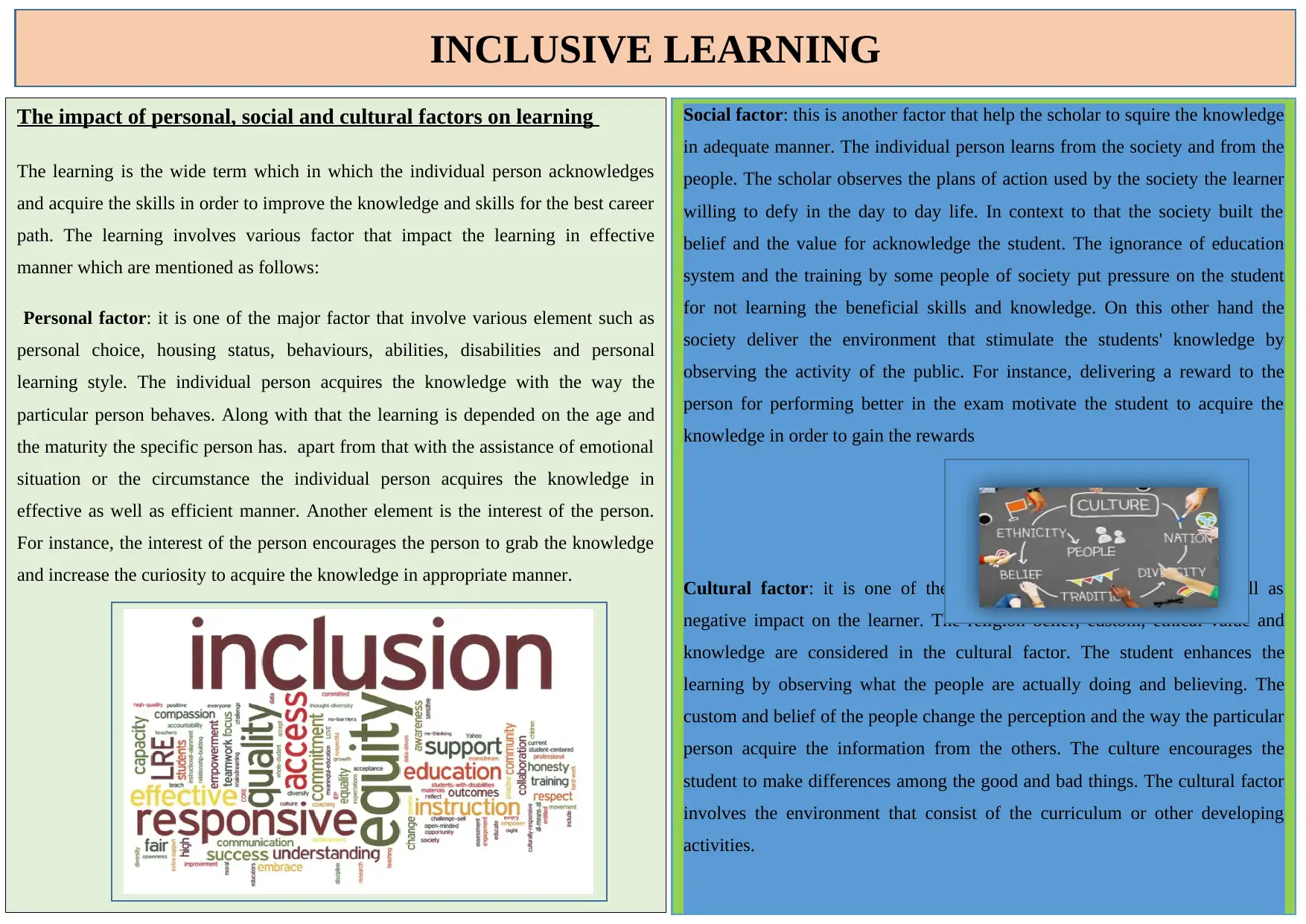
Cultural factor: it is one of the major factor that put positive as well as
negative impact on the learner. The religion belief, custom, ethical value and
knowledge are considered in the cultural factor. The student enhances the
learning by observing what the people are actually doing and believing. The
custom and belief of the people change the perception and the way the particular
person acquire the information from the others. The culture encourages the
student to make differences among the good and bad things. The cultural factor
involves the environment that consist of the curriculum or other developing
activities.
INCLUSIVE LEARNING
The impact of personal, social and cultural factors on learning
The learning is the wide term which in which the individual person acknowledges
and acquire the skills in order to improve the knowledge and skills for the best career
path. The learning involves various factor that impact the learning in effective
manner which are mentioned as follows:
Personal factor: it is one of the major factor that involve various element such as
personal choice, housing status, behaviours, abilities, disabilities and personal
learning style. The individual person acquires the knowledge with the way the
particular person behaves. Along with that the learning is depended on the age and
the maturity the specific person has. apart from that with the assistance of emotional
situation or the circumstance the individual person acquires the knowledge in
effective as well as efficient manner. Another element is the interest of the person.
For instance, the interest of the person encourages the person to grab the knowledge
and increase the curiosity to acquire the knowledge in appropriate manner.
in adequate manner. The individual person learns from the society and from the
people. The scholar observes the plans of action used by the society the learner
willing to defy in the day to day life. In context to that the society built the
belief and the value for acknowledge the student. The ignorance of education
system and the training by some people of society put pressure on the student
for not learning the beneficial skills and knowledge. On this other hand the
society deliver the environment that stimulate the students' knowledge by
observing the activity of the public. For instance, delivering a reward to the
person for performing better in the exam motivate the student to acquire the
knowledge in order to gain the rewards
Cultural factor: it is one of the major factor that put positive as well as
negative impact on the learner. The religion belief, custom, ethical value and
knowledge are considered in the cultural factor. The student enhances the
learning by observing what the people are actually doing and believing. The
custom and belief of the people change the perception and the way the particular
person acquire the information from the others. The culture encourages the
student to make differences among the good and bad things. The cultural factor
involves the environment that consist of the curriculum or other developing
activities.
INCLUSIVE LEARNING
The impact of personal, social and cultural factors on learning
The learning is the wide term which in which the individual person acknowledges
and acquire the skills in order to improve the knowledge and skills for the best career
path. The learning involves various factor that impact the learning in effective
manner which are mentioned as follows:
Personal factor: it is one of the major factor that involve various element such as
personal choice, housing status, behaviours, abilities, disabilities and personal
learning style. The individual person acquires the knowledge with the way the
particular person behaves. Along with that the learning is depended on the age and
the maturity the specific person has. apart from that with the assistance of emotional
situation or the circumstance the individual person acquires the knowledge in
effective as well as efficient manner. Another element is the interest of the person.
For instance, the interest of the person encourages the person to grab the knowledge
and increase the curiosity to acquire the knowledge in appropriate manner.
Paraphrase This Document
Need a fresh take? Get an instant paraphrase of this document with our AI Paraphraser

Impact of different cognitive, physical and sensory abilities on
learning
cognitive ability: The cognitive ability is the major ability that affect the learning
ability of the individual person. It involves other element such as concentration,
perception, memory, logical thinking etc. in the cognitive ability the teacher teaches
the student with the real life situation. Through the concentration in the training and
development programme the individual person learns the skills and implement in the
forthcoming challenges. The concentration of the student motivates the learner to
understand the learning activity in effective as well as efficient manner. It allows the
scholar to avoid the unnecessary issues and difficulty while solving the questions or
gaining the knowledge. The memory of the person allows the student to develop the
habit of continuously enhancing the skills and knowledge rather than stuck at one
point. With the memory of the person the individual can hold various information in
the mind at the same time. Along with that the individual person improve the
reading as well as learning skills with the assistance of cognitive learning.
Sensory: due to the sensory the student is not able to concentrate on the learning
skills and it will be hard to keep themselves engaged in the educational activities. In
the learning activity the individual person is not able to sense the information in
speciose manner as compare to fit and fine student. Due to sensory processing
difficulty the individual person is not able to cope the skills and knowledge in the
right manner. Along with that the student is not able to improve the abilities or
Physical: the physical abilities or disability occur due the certain injury or the
diseases. The learner develops the learning in order to improve the injury or
disease. The ability to make the progress the individual person boosts the
confidence. Along with due to the physical ability or disability the learning will
be complex of difficult for the individual person. Due to hearing impairment the
individual person is not able to concentrate on skills and knowledge or the
information the teacher is providing to the student. The student is not able to
handle the difficulty along they are not independent. On the other hand, the
person is not able to concentrate on the learning skills as the injury highlight the
emotions of the person. The institute or teacher keep the student engaged in the
education in order to make them more active in day to day life. With the physical
activeness the individual person is able to identified or determine the learning
outcomes in appropriate manner. The individual person shares the views and
opinion with the other human personality in order to make the thinking abilities.
learning
cognitive ability: The cognitive ability is the major ability that affect the learning
ability of the individual person. It involves other element such as concentration,
perception, memory, logical thinking etc. in the cognitive ability the teacher teaches
the student with the real life situation. Through the concentration in the training and
development programme the individual person learns the skills and implement in the
forthcoming challenges. The concentration of the student motivates the learner to
understand the learning activity in effective as well as efficient manner. It allows the
scholar to avoid the unnecessary issues and difficulty while solving the questions or
gaining the knowledge. The memory of the person allows the student to develop the
habit of continuously enhancing the skills and knowledge rather than stuck at one
point. With the memory of the person the individual can hold various information in
the mind at the same time. Along with that the individual person improve the
reading as well as learning skills with the assistance of cognitive learning.
Sensory: due to the sensory the student is not able to concentrate on the learning
skills and it will be hard to keep themselves engaged in the educational activities. In
the learning activity the individual person is not able to sense the information in
speciose manner as compare to fit and fine student. Due to sensory processing
difficulty the individual person is not able to cope the skills and knowledge in the
right manner. Along with that the student is not able to improve the abilities or
Physical: the physical abilities or disability occur due the certain injury or the
diseases. The learner develops the learning in order to improve the injury or
disease. The ability to make the progress the individual person boosts the
confidence. Along with due to the physical ability or disability the learning will
be complex of difficult for the individual person. Due to hearing impairment the
individual person is not able to concentrate on skills and knowledge or the
information the teacher is providing to the student. The student is not able to
handle the difficulty along they are not independent. On the other hand, the
person is not able to concentrate on the learning skills as the injury highlight the
emotions of the person. The institute or teacher keep the student engaged in the
education in order to make them more active in day to day life. With the physical
activeness the individual person is able to identified or determine the learning
outcomes in appropriate manner. The individual person shares the views and
opinion with the other human personality in order to make the thinking abilities.

The policy and regulatory frameworks relating to inclusive practice.
The inclusive practice involves the uniqueness of every individual as per the abilities
and knowledge. The policy and regulatory framework related to inclusive practices
such as equality act, deaf awareness, visual awareness etc. in the equality act the
authority of the UK prohibited the discrimination among the people on the basis of
individual disabilities
This act also involves the child protection guidelines for the consideration and for
the welfare of the students or the learners. In this act the people or the learner is
treated in the same manner any kind of discrimination supposed to be avoided. In
order to deliver he information the educational institutes are responsible for making
the suitable adjustment for the scholar without any direct or indirect discrimination.
In context to that the mentor is responsible to deliver the suitable learning challenges
as per the abilities of the scholars for the better understanding and overcoming form
the barriers in the career path. For the deaf awareness the scholar can acquire the
knowledge through the communicational skill
It will give assistance in improving the communication with the people along
with that it will improve the hearing barriers. The teacher delivers the
information through the sign language interpretation which will be easier for the
deaf disabilities. The deaf awareness includes the hearing impairment and
hearing loss in the people. According to the law or the act 2010 the scholar has
equal right to attend the lecture in appropriate masseurs.
Along with that the educational institute do not have right to refuge to admit the
deaf student in the organization. The teacher or the instructor encourage the
scholar which are having the disability of visually impaired. The instructor
provides the glasses, magnifiers, big printed books to the scholar in order to
allow them to enhance the skills and knowledge in the adequate manner. Along
with that the scholar obtain extra time in order to complete the task in effective as
well as efficient manner. The humans or the scholars are having the equals right
to get education as per individual requirement. The deaf and visual awareness is
one of the best framework that provide training to the scholars for acquiring the
information by taking all measure steps for the people having deaf or visually
impairment. The other people or the educators cooperated with the people in
effective as well as efficient manner.
The inclusive practice involves the uniqueness of every individual as per the abilities
and knowledge. The policy and regulatory framework related to inclusive practices
such as equality act, deaf awareness, visual awareness etc. in the equality act the
authority of the UK prohibited the discrimination among the people on the basis of
individual disabilities
This act also involves the child protection guidelines for the consideration and for
the welfare of the students or the learners. In this act the people or the learner is
treated in the same manner any kind of discrimination supposed to be avoided. In
order to deliver he information the educational institutes are responsible for making
the suitable adjustment for the scholar without any direct or indirect discrimination.
In context to that the mentor is responsible to deliver the suitable learning challenges
as per the abilities of the scholars for the better understanding and overcoming form
the barriers in the career path. For the deaf awareness the scholar can acquire the
knowledge through the communicational skill
It will give assistance in improving the communication with the people along
with that it will improve the hearing barriers. The teacher delivers the
information through the sign language interpretation which will be easier for the
deaf disabilities. The deaf awareness includes the hearing impairment and
hearing loss in the people. According to the law or the act 2010 the scholar has
equal right to attend the lecture in appropriate masseurs.
Along with that the educational institute do not have right to refuge to admit the
deaf student in the organization. The teacher or the instructor encourage the
scholar which are having the disability of visually impaired. The instructor
provides the glasses, magnifiers, big printed books to the scholar in order to
allow them to enhance the skills and knowledge in the adequate manner. Along
with that the scholar obtain extra time in order to complete the task in effective as
well as efficient manner. The humans or the scholars are having the equals right
to get education as per individual requirement. The deaf and visual awareness is
one of the best framework that provide training to the scholars for acquiring the
information by taking all measure steps for the people having deaf or visually
impairment. The other people or the educators cooperated with the people in
effective as well as efficient manner.
⊘ This is a preview!⊘
Do you want full access?
Subscribe today to unlock all pages.

Trusted by 1+ million students worldwide

Explain how policy and regulatory frameworks influence
organizational policies relating to inclusive practice.
The policy and regulatory framework play essential role in the development of
organizational policies. The policy and the procedure work as the guidance toward
establishing institutional policies which give assistance in promoting and deliver the
quality assurance. In the inclusive practice the staff members deliver the assistance in
filling the complaints against the institution. The employees of the organization are
allowed to file the case against any kind of discrimination among the people at
workplace. In order to bring the effective learning, the manager of the organization
provide training to the workers according to the skills and knowledge. inclusion
policies develop the environment that deliver the support to the employees toward
the effective learning. In the CRB procedure the organization determine the details of
the individual person. with the screening process the organisation identified the
background of the candidate that involve the relevant information or criminal record
information and unsuitability of nature of the person.
REFERENCES
Akers, R.L., 2017. Social learning and social structure: A general theory of
crime and deviance. Routledge.
Florian, L. and Pantic, N., 2017. Inclusive Learning and Educational Equity.
Kotseruba, I. and Tsotsos, J.K., 2020. 40 years of cognitive architectures: core
cognitive abilities and practical applications. Artificial Intelligence
Review, 53(1), pp.17-94.
Lawrie and et.al 2017. Moving towards inclusive learning and teaching: A
synthesis of recent literature. Teaching & learning inquiry, 5(1), pp.9-
21.
Leifler, E., 2020. Teachers' capacity to create inclusive learning
environments. International Journal for Lesson & Learning Studies.
Loreman, T., 2017. Pedagogy for inclusive education. In Oxford research
encyclopedia of education.Newman, I. and Conway, J., 2017. Busting
the barriers to inclusive learning environments. The Journal of
Inclusive Practice in Further and Higher Education, p.30.
Schunk, D.H. and DiBenedetto, M.K., 2020. Motivation and social cognitive
theory. Contemporary Educational Psychology, 60, p.101832.
organizational policies relating to inclusive practice.
The policy and regulatory framework play essential role in the development of
organizational policies. The policy and the procedure work as the guidance toward
establishing institutional policies which give assistance in promoting and deliver the
quality assurance. In the inclusive practice the staff members deliver the assistance in
filling the complaints against the institution. The employees of the organization are
allowed to file the case against any kind of discrimination among the people at
workplace. In order to bring the effective learning, the manager of the organization
provide training to the workers according to the skills and knowledge. inclusion
policies develop the environment that deliver the support to the employees toward
the effective learning. In the CRB procedure the organization determine the details of
the individual person. with the screening process the organisation identified the
background of the candidate that involve the relevant information or criminal record
information and unsuitability of nature of the person.
REFERENCES
Akers, R.L., 2017. Social learning and social structure: A general theory of
crime and deviance. Routledge.
Florian, L. and Pantic, N., 2017. Inclusive Learning and Educational Equity.
Kotseruba, I. and Tsotsos, J.K., 2020. 40 years of cognitive architectures: core
cognitive abilities and practical applications. Artificial Intelligence
Review, 53(1), pp.17-94.
Lawrie and et.al 2017. Moving towards inclusive learning and teaching: A
synthesis of recent literature. Teaching & learning inquiry, 5(1), pp.9-
21.
Leifler, E., 2020. Teachers' capacity to create inclusive learning
environments. International Journal for Lesson & Learning Studies.
Loreman, T., 2017. Pedagogy for inclusive education. In Oxford research
encyclopedia of education.Newman, I. and Conway, J., 2017. Busting
the barriers to inclusive learning environments. The Journal of
Inclusive Practice in Further and Higher Education, p.30.
Schunk, D.H. and DiBenedetto, M.K., 2020. Motivation and social cognitive
theory. Contemporary Educational Psychology, 60, p.101832.
1 out of 4
Related Documents
Your All-in-One AI-Powered Toolkit for Academic Success.
 +13062052269
info@desklib.com
Available 24*7 on WhatsApp / Email
Unlock your academic potential
Copyright © 2020–2026 A2Z Services. All Rights Reserved. Developed and managed by ZUCOL.