Pharmacology & Therapeutics: Epilepsy and Chloride Homeostasis Review

Verified

Added on  2022/09/18

|7
|1242
|26
Report
AI Summary
This report, authored by Theresa Auer et al., provides a comprehensive review of impaired chloride homeostasis in epilepsy, exploring its molecular basis, impact on treatment, and current therapeutic approaches. The review begins with an overview of epilepsy as a common neurological disease characterized by recurrent seizures resulting from imbalances in brain neurotransmission, particularly the GABAergic system. The authors highlight the importance of chloride ions (Cl-) and their gradients in neuronal function and the role of plasmalemmal cation-chloride cotransporters (CCCs) like NKCC1 and KCC2. The report discusses how alterations in chloride homeostasis, often involving changes in the balance of these transporters, contribute to the pathophysiology of epilepsy, potentially affecting the efficacy of GABA-mimetic drugs. The review also covers the potential of drugs like bumetanide, which targets NKCC1, to restore chloride balance and improve treatment outcomes. The authors discuss the regulation of CCCs by various kinases and the age-dependent changes in chloride gradients. They also discuss the impact of genetic mutations and the hyperexcitability of neurons in epilepsy. In conclusion, the review emphasizes the critical role of chloride homeostasis in epilepsy and the potential for therapeutic interventions targeting CCCs to improve treatment outcomes.
Document Page
Running head: SUMMARY
Summary
Name of the student
Name of the university
Author note
tabler-icon-diamond-filled.svg

Paraphrase This Document

Need a fresh take? Get an instant paraphrase of this document with our AI Paraphraser
Document Page
1SUMMARY
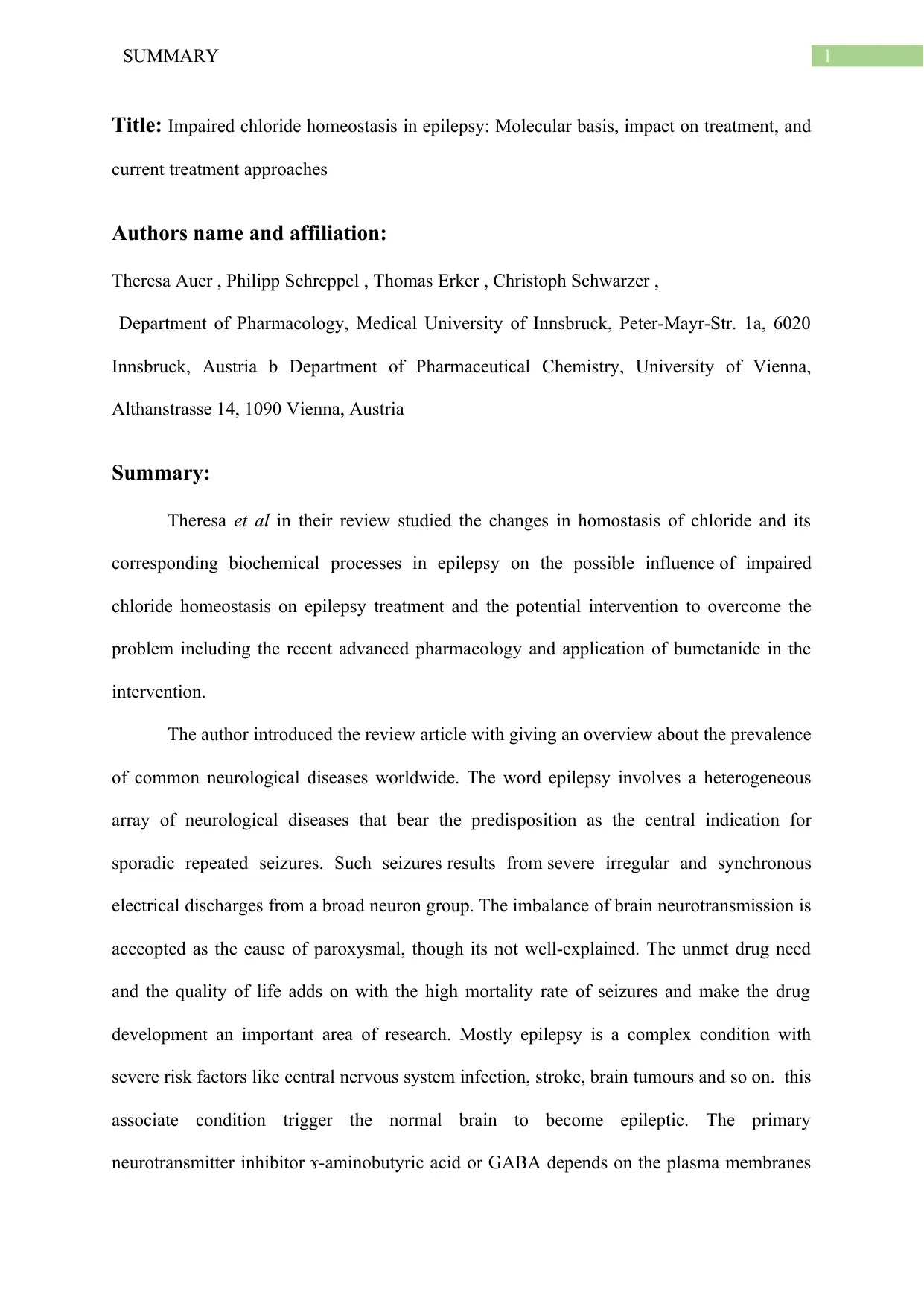
Title: Impaired chloride homeostasis in epilepsy: Molecular basis, impact on treatment, and
current treatment approaches
Authors name and affiliation:
Theresa Auer , Philipp Schreppel , Thomas Erker , Christoph Schwarzer ,
Department of Pharmacology, Medical University of Innsbruck, Peter-Mayr-Str. 1a, 6020
Innsbruck, Austria b Department of Pharmaceutical Chemistry, University of Vienna,
Althanstrasse 14, 1090 Vienna, Austria
Summary:
Theresa et al in their review studied the changes in homostasis of chloride and its
corresponding biochemical processes in epilepsy on the possible influence of impaired
chloride homeostasis on epilepsy treatment and the potential intervention to overcome the
problem including the recent advanced pharmacology and application of bumetanide in the
intervention.
The author introduced the review article with giving an overview about the prevalence
of common neurological diseases worldwide. The word epilepsy involves a heterogeneous
array of neurological diseases that bear the predisposition as the central indication for
sporadic repeated seizures. Such seizures results from severe irregular and synchronous
electrical discharges from a broad neuron group. The imbalance of brain neurotransmission is
acceopted as the cause of paroxysmal, though its not well-explained. The unmet drug need
and the quality of life adds on with the high mortality rate of seizures and make the drug
development an important area of research. Mostly epilepsy is a complex condition with
severe risk factors like central nervous system infection, stroke, brain tumours and so on. this
associate condition trigger the normal brain to become epileptic. The primary
neurotransmitter inhibitor ɤ-aminobutyric acid or GABA depends on the plasma membranes
Document Page
2SUMMARY
Cl- ions gradient.This fact made the plasmalemmal cation-chloride cotransporters
(CCCs) potential antiepileptogenic and antiepileptic drug. Concerning this fact the
development of diuretic drug bumetanide and its derivatives are also vital. The author also
highlighted the drug side effect related study limits.
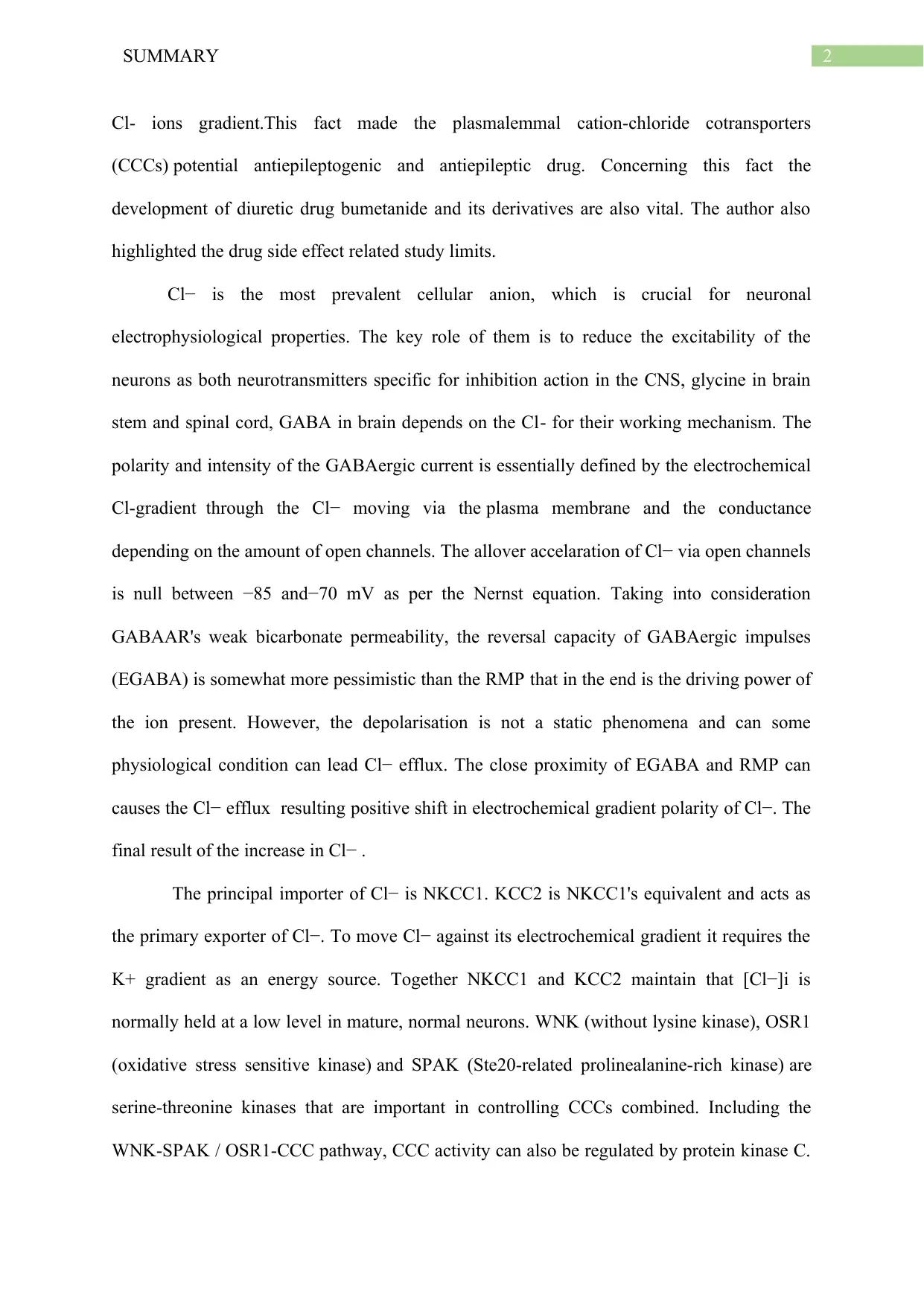
Cl− is the most prevalent cellular anion, which is crucial for neuronal
electrophysiological properties. The key role of them is to reduce the excitability of the
neurons as both neurotransmitters specific for inhibition action in the CNS, glycine in brain
stem and spinal cord, GABA in brain depends on the Cl- for their working mechanism. The
polarity and intensity of the GABAergic current is essentially defined by the electrochemical
Cl-gradient through the Cl− moving via the plasma membrane and the conductance
depending on the amount of open channels. The allover accelaration of Cl− via open channels
is null between −85 and−70 mV as per the Nernst equation. Taking into consideration
GABAAR's weak bicarbonate permeability, the reversal capacity of GABAergic impulses
(EGABA) is somewhat more pessimistic than the RMP that in the end is the driving power of
the ion present. However, the depolarisation is not a static phenomena and can some
physiological condition can lead Cl− efflux. The close proximity of EGABA and RMP can
causes the Cl− efflux resulting positive shift in electrochemical gradient polarity of Cl−. The
final result of the increase in Cl− .
The principal importer of Cl− is NKCC1. KCC2 is NKCC1's equivalent and acts as
the primary exporter of Cl−. To move Cl− against its electrochemical gradient it requires the
K+ gradient as an energy source. Together NKCC1 and KCC2 maintain that [Cl−]i is
normally held at a low level in mature, normal neurons. WNK (without lysine kinase), OSR1
(oxidative stress sensitive kinase) and SPAK (Ste20-related prolinealanine-rich kinase) are
serine-threonine kinases that are important in controlling CCCs combined. Including the
WNK-SPAK / OSR1-CCC pathway, CCC activity can also be regulated by protein kinase C.
Document Page
3SUMMARY
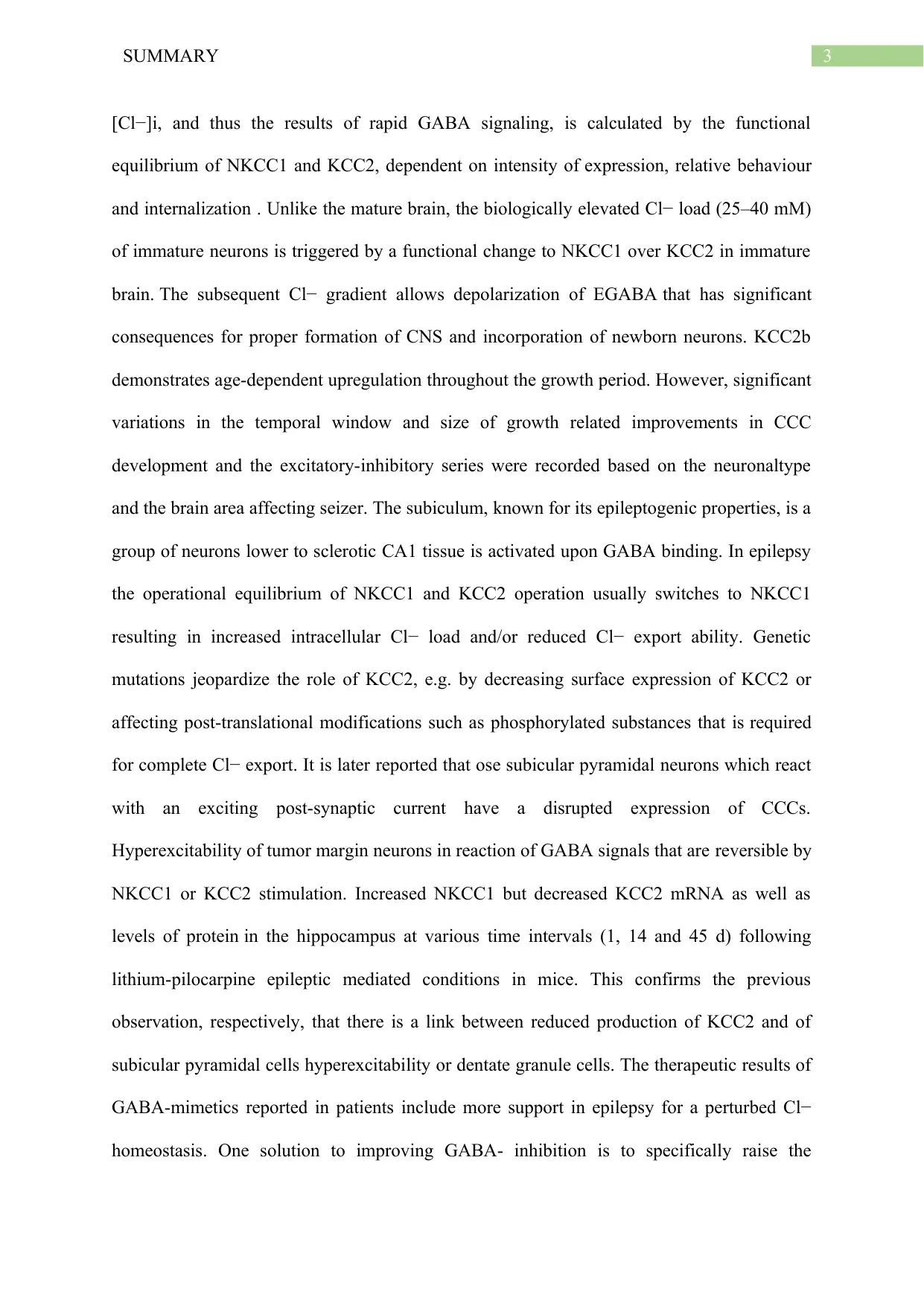
[Cl−]i, and thus the results of rapid GABA signaling, is calculated by the functional
equilibrium of NKCC1 and KCC2, dependent on intensity of expression, relative behaviour
and internalization . Unlike the mature brain, the biologically elevated Cl− load (25–40 mM)
of immature neurons is triggered by a functional change to NKCC1 over KCC2 in immature
brain. The subsequent Cl− gradient allows depolarization of EGABA that has significant
consequences for proper formation of CNS and incorporation of newborn neurons. KCC2b
demonstrates age-dependent upregulation throughout the growth period. However, significant
variations in the temporal window and size of growth related improvements in CCC
development and the excitatory-inhibitory series were recorded based on the neuronaltype
and the brain area affecting seizer. The subiculum, known for its epileptogenic properties, is a
group of neurons lower to sclerotic CA1 tissue is activated upon GABA binding. In epilepsy
the operational equilibrium of NKCC1 and KCC2 operation usually switches to NKCC1
resulting in increased intracellular Cl− load and/or reduced Cl− export ability. Genetic
mutations jeopardize the role of KCC2, e.g. by decreasing surface expression of KCC2 or
affecting post-translational modifications such as phosphorylated substances that is required
for complete Cl− export. It is later reported that ose subicular pyramidal neurons which react
with an exciting post-synaptic current have a disrupted expression of CCCs.
Hyperexcitability of tumor margin neurons in reaction of GABA signals that are reversible by
NKCC1 or KCC2 stimulation. Increased NKCC1 but decreased KCC2 mRNA as well as
levels of protein in the hippocampus at various time intervals (1, 14 and 45 d) following
lithium-pilocarpine epileptic mediated conditions in mice. This confirms the previous
observation, respectively, that there is a link between reduced production of KCC2 and of
subicular pyramidal cells hyperexcitability or dentate granule cells. The therapeutic results of
GABA-mimetics reported in patients include more support in epilepsy for a perturbed Cl−
homeostasis. One solution to improving GABA- inhibition is to specifically raise the
tabler-icon-diamond-filled.svg

Paraphrase This Document

Need a fresh take? Get an instant paraphrase of this document with our AI Paraphraser
Document Page
4SUMMARY
number of receptor- neurotransmitters available. The second option is for the GABAAR to
potentiate the neurotransmitter reaction. As a therapeutic alternative it is also recommended
not only for relaxation but also pharmacological suppression of KCC2 function. Still, the
existence of specifically formulated compounds for KCC2 restricts this technique. Alkanoic
acid that was known as a selective KCC2 inhibitor blocked NKCC1 which compromised the
understanding of the anticonvulsant effect. Bumetanide is a derivative of benzoic acid with a
diuretic activity that can be traced mainly to kidney reabsorption inhibition of
Cl− . Treatment with bumetanide reduced the amount of NKCC1 in peripheral blood, found
as more than normal in TLE patients compared with stable pre-study controls. This impact
has been suggested as a possible mechanism of action on NKCC1 protein expression.
Bumetanide is deemed an NKCC1 and NKCC2 inhibitor and will decrease the amount of
intracellular Cl− via this.
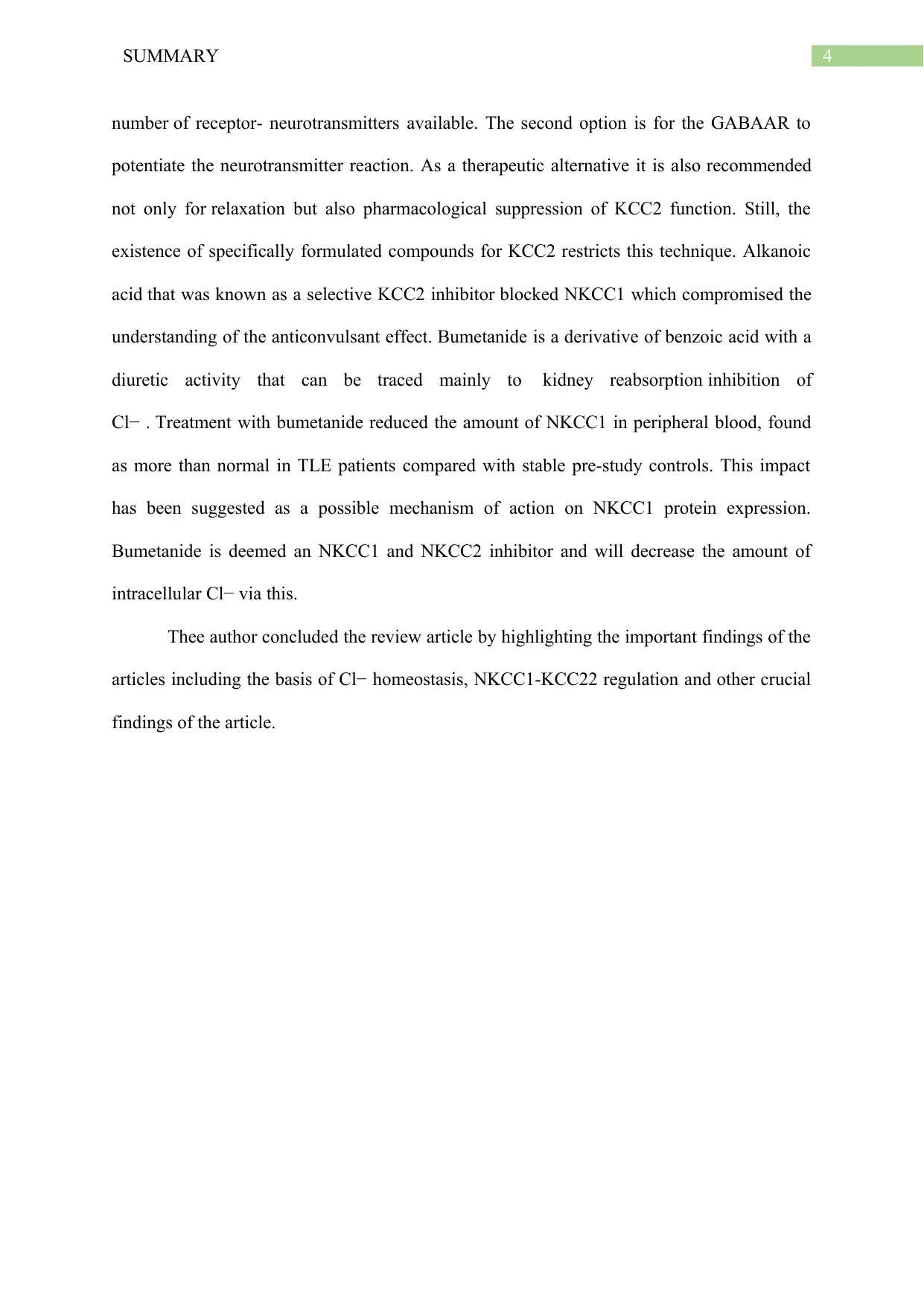
Thee author concluded the review article by highlighting the important findings of the
articles including the basis of Cl− homeostasis, NKCC1-KCC22 regulation and other crucial
findings of the article.
Document Page
5SUMMARY
Reference:
Auer, T., Schreppel, P., Erker, T. and Schwarzer, C., 2020. Impaired chloride homeostasis in
epilepsy: molecular basis, impact on treatment, and current treatment
approaches. Pharmacology & Therapeutics, 205, p.107422.
Document Page
6SUMMARY
chevron_up_icon
1 out of 7
circle_padding
hide_on_mobile
zoom_out_icon
[object Object]