Ethical Communication as an Essential Part of Business Analysis
VerifiedAdded on 2023/06/11
|10
|2308
|424
Essay
AI Summary
This essay examines the crucial role of ethical communication in modern business, asserting its necessity for organizational success and ethical responsibility. It delves into ethical communication issues by analyzing three case studies: Hills Pet Nutrition's response to pet food contamination, Odwalla Juice Company's E. coli outbreak and subsequent crisis management, and Unilever's unethical practices related to corporate social responsibility and sustainability. The analysis reveals that ineffective communication and a lack of transparency exacerbated the challenges faced by these companies, leading to damaged reputations and financial repercussions. The essay concludes that prioritizing ethical communication is essential for mitigating business risks, building trust with stakeholders, and fostering a positive corporate image.
Running head: BUSINESS
Business
Name of the University:
Name of the Student:
Author Note:
Business
Name of the University:
Name of the Student:
Author Note:

Paraphrase This Document
Need a fresh take? Get an instant paraphrase of this document with our AI Paraphraser
1BUSINESS
Abstract
Organizations have the major responsibility of acting ethically outside of their legal
and capitalistic obligations. Ethical issues of business communication can be
referred to the procedure through which the individuals exchange their information
between other groups of people. Effective business communicators try to convey
their intentions, objectives and thoughts to their receivers, all throughout the process
in the most accurate and clear manner. The purpose of the report is to highlight the
importance of ethical communication in modern day businesses. The report throws
light on three companies namely, Hills Pet Nutrition, Inc., Odwalla Juice Company
and Unilever Company in order to discuss in detail, the unethical practices
conducted within the organization.
Abstract
Organizations have the major responsibility of acting ethically outside of their legal
and capitalistic obligations. Ethical issues of business communication can be
referred to the procedure through which the individuals exchange their information
between other groups of people. Effective business communicators try to convey
their intentions, objectives and thoughts to their receivers, all throughout the process
in the most accurate and clear manner. The purpose of the report is to highlight the
importance of ethical communication in modern day businesses. The report throws
light on three companies namely, Hills Pet Nutrition, Inc., Odwalla Juice Company
and Unilever Company in order to discuss in detail, the unethical practices
conducted within the organization.
2BUSINESS
Table of Contents
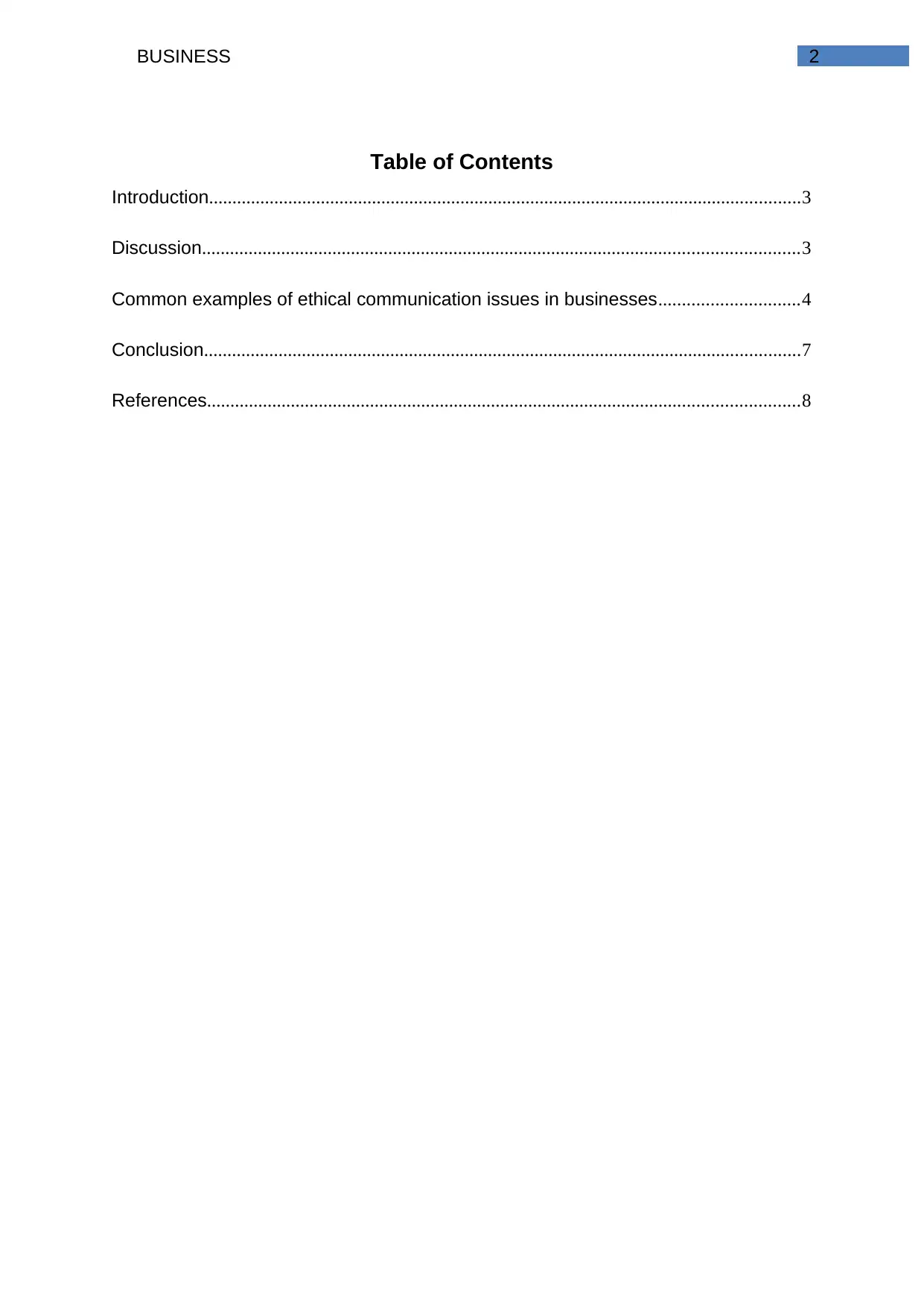
Introduction...............................................................................................................................3
Discussion................................................................................................................................3
Common examples of ethical communication issues in businesses..............................4
Conclusion................................................................................................................................7
References...............................................................................................................................8
Table of Contents
Introduction...............................................................................................................................3
Discussion................................................................................................................................3
Common examples of ethical communication issues in businesses..............................4
Conclusion................................................................................................................................7
References...............................................................................................................................8
⊘ This is a preview!⊘
Do you want full access?
Subscribe today to unlock all pages.

Trusted by 1+ million students worldwide
3BUSINESS
Introduction
Ethical issues of business communication can be referred to the procedure
through which the individuals exchange their information between other groups of
people. Effective business communicators try to convey their intentions, objectives
and thoughts to their receivers, all throughout the process in the most accurate and
clear manner. Communication is only successful when the receivers understand the
same message conveyed by the senders. In modern day’s business environments,
efficient communication skills are immensely important due to highly technological
and informational era. Communication hugely involves choice, has consequences
and reflects ethics as well as values (Ferrell and Fraedrich 2015). The purpose of the
report is to analyze the importance of ethical communication in business. Any
organization, which aims to be ethically and socially responsible, should make the
priority of ethical communication within the company and in its public interactions.
Discussion
The core purpose of a business is to generate the maximum amount of
revenue possible. Behaving ethically and most importantly, communicating with each
other in an accurate and truthful manner serves this purpose. Individuals and
stakeholders prefer doing business with the companies that are ethical in nature, so
that they can trust them. Therefore on the long run, the business ethics benefits the
companies and keeps their credibility intact. This particularly means that the goal of
ethical business communications is to build credibility and trust within the company
(Pearson 2017). For instance; the practice of the ethical business communication
within the businesses is maintained by the International Association of Business
Communicators. This also helps in increasing the team feeling among the
employees as well as boosts up the team spirit and morale. In order to accomplish
these goals and objectives, the corporate communication need to strive for attaining
certain ethical goals of the organization. The company gets highly benefitted if it is
honest, as it is the basis of truth. Several business consultants recommend that the
organizations need to be unbiased in order to gain trust of its publics, keeping its
credibility intact. Ethical business communication requires clear understanding of the
issues, without any attempt to confuse the public or other companies, with whom the
Introduction
Ethical issues of business communication can be referred to the procedure
through which the individuals exchange their information between other groups of
people. Effective business communicators try to convey their intentions, objectives
and thoughts to their receivers, all throughout the process in the most accurate and
clear manner. Communication is only successful when the receivers understand the
same message conveyed by the senders. In modern day’s business environments,
efficient communication skills are immensely important due to highly technological
and informational era. Communication hugely involves choice, has consequences
and reflects ethics as well as values (Ferrell and Fraedrich 2015). The purpose of the
report is to analyze the importance of ethical communication in business. Any
organization, which aims to be ethically and socially responsible, should make the
priority of ethical communication within the company and in its public interactions.
Discussion
The core purpose of a business is to generate the maximum amount of
revenue possible. Behaving ethically and most importantly, communicating with each
other in an accurate and truthful manner serves this purpose. Individuals and
stakeholders prefer doing business with the companies that are ethical in nature, so
that they can trust them. Therefore on the long run, the business ethics benefits the
companies and keeps their credibility intact. This particularly means that the goal of
ethical business communications is to build credibility and trust within the company
(Pearson 2017). For instance; the practice of the ethical business communication
within the businesses is maintained by the International Association of Business
Communicators. This also helps in increasing the team feeling among the
employees as well as boosts up the team spirit and morale. In order to accomplish
these goals and objectives, the corporate communication need to strive for attaining
certain ethical goals of the organization. The company gets highly benefitted if it is
honest, as it is the basis of truth. Several business consultants recommend that the
organizations need to be unbiased in order to gain trust of its publics, keeping its
credibility intact. Ethical business communication requires clear understanding of the
issues, without any attempt to confuse the public or other companies, with whom the
Paraphrase This Document
Need a fresh take? Get an instant paraphrase of this document with our AI Paraphraser
4BUSINESS
business is being done. In addition to this, timeliness is also a major part of
communication. The company should acknowledge the problems and keep relevant
individuals informed on time, with direct and clear communication methods (Ulmer,
Sellnow and Seeger 2017).
Common examples of ethical communication issues in businesses
Ineffective communication leads to several problems which can impact
business relations, productivity, team morale and job satisfaction. For example;
The Case of Hills Pet Nutrition, Inc.
In the year 2007, several pet food brands were being recalled because of the
contamination in the food. Due to this, thousands of cats and dogs developed renal
failure and most of them died. They customers were highly upset with this behavior
of the company and asked the pet food brands to undertake financial responsibility
for the entire costs, which were incurred during vital veterinary care for the sick pets.
Few companies were ethical enough to respond to this situation in an ethical
manner, whereas some failed to meet the customers’ demands with financial
settlements. One such company was Hills Pet Nutrition, Inc. who failed to meet the
demands of the customers seeking reimbursement for their sick pets (Zicker and
Wedekind, Hill's Pet Nutrition Inc 2014). Taking this instance into consideration, it is
important to mention that the companies need to keep three ethical terms in their
minds, coined by Krep. These three ethical terms are clearly relevant to the
principles of ethical communication. It is evident from the instance that Hills, Inc.
engaged itself into ethical communication. They could have easily re-gained their
credibility by;
1. Telling the customers the truth,
2. Do no harm,
3. Treat the customers in a justified manner.
Therefore, it can be stated that the differences in the perceptions and failure to
bridge the communication gap leads to miscommunication at both organizational and
interpersonal levels (Schultz, Patti and Kitchen 2013).
Odwalla Juice Company Crisis
business is being done. In addition to this, timeliness is also a major part of
communication. The company should acknowledge the problems and keep relevant
individuals informed on time, with direct and clear communication methods (Ulmer,
Sellnow and Seeger 2017).
Common examples of ethical communication issues in businesses
Ineffective communication leads to several problems which can impact
business relations, productivity, team morale and job satisfaction. For example;
The Case of Hills Pet Nutrition, Inc.
In the year 2007, several pet food brands were being recalled because of the
contamination in the food. Due to this, thousands of cats and dogs developed renal
failure and most of them died. They customers were highly upset with this behavior
of the company and asked the pet food brands to undertake financial responsibility
for the entire costs, which were incurred during vital veterinary care for the sick pets.
Few companies were ethical enough to respond to this situation in an ethical
manner, whereas some failed to meet the customers’ demands with financial
settlements. One such company was Hills Pet Nutrition, Inc. who failed to meet the
demands of the customers seeking reimbursement for their sick pets (Zicker and
Wedekind, Hill's Pet Nutrition Inc 2014). Taking this instance into consideration, it is
important to mention that the companies need to keep three ethical terms in their
minds, coined by Krep. These three ethical terms are clearly relevant to the
principles of ethical communication. It is evident from the instance that Hills, Inc.
engaged itself into ethical communication. They could have easily re-gained their
credibility by;
1. Telling the customers the truth,
2. Do no harm,
3. Treat the customers in a justified manner.
Therefore, it can be stated that the differences in the perceptions and failure to
bridge the communication gap leads to miscommunication at both organizational and
interpersonal levels (Schultz, Patti and Kitchen 2013).
Odwalla Juice Company Crisis
5BUSINESS
In the year 1996, an E.coli outbreak struck various West Coast states that
includes California, Washington and also reached into the western side of Canada
as well. The health officials in the Washington state suspected the operations of the
Odwalla Juice Company and decided to carry on an investigation. The company’s
corporate crisis turned when a sixteen month old child died after drinking Odwalla
apple juice. In a similar instance, several customers were being hospitalized in a
time period of just one month, due to E.coli illness. The health government officials
decided to carry out a similar investigation at the heights of E.coli outbreak. It was
then confirmed that the products of the company were contaminated with the E.coli
bacteria. The company faced ethical business issues as the managers concealed
the entire news from the media. Initially they were not ready to let their customers
know the truth; however, after the enraged customers started demanding for
compensation. The manager of the company decided to implement a media strategy
in this context (Cheng, Padgett and Parekh 2013). The media strategies included
daily press statements, internal conferences where the managers informed their
publics regarding the situation. In addition to this, the company decided to set up an
official website for disseminating information to its target customers. The company
promised publicly that they will pay for all the medical expenses and will reevaluate
their manufacturing procedures. However, in the year 2001, the Coca-Cola Company
took over the company’s ownership and till now, Odwalla remains their subsidiary
(Bland 2016).
In this context, it can be stated that there was a disconnection or
communication between the company’s corporate social responsibility model and
their actions as well as course of conduct. The company was manufacturing
defective products and initially, they concealed the information from their publics.
The incidents occurred due to the negligence of the case either pre or post
contamination. The company should have taken some measures before the
outbreak, so that the issue could get resolved. Failing to comply with the industrial
standards on time, the contamination led to the breach of duty. Ineffective
communication within the organization led to the creation of such problems, which
impacted the company to such an extent that it decided to close down. The problems
impacted business relationships as well, the production lessened and it affected
team morale. According to Wiio, if the communication fails in an organization, it can
In the year 1996, an E.coli outbreak struck various West Coast states that
includes California, Washington and also reached into the western side of Canada
as well. The health officials in the Washington state suspected the operations of the
Odwalla Juice Company and decided to carry on an investigation. The company’s
corporate crisis turned when a sixteen month old child died after drinking Odwalla
apple juice. In a similar instance, several customers were being hospitalized in a
time period of just one month, due to E.coli illness. The health government officials
decided to carry out a similar investigation at the heights of E.coli outbreak. It was
then confirmed that the products of the company were contaminated with the E.coli
bacteria. The company faced ethical business issues as the managers concealed
the entire news from the media. Initially they were not ready to let their customers
know the truth; however, after the enraged customers started demanding for
compensation. The manager of the company decided to implement a media strategy
in this context (Cheng, Padgett and Parekh 2013). The media strategies included
daily press statements, internal conferences where the managers informed their
publics regarding the situation. In addition to this, the company decided to set up an
official website for disseminating information to its target customers. The company
promised publicly that they will pay for all the medical expenses and will reevaluate
their manufacturing procedures. However, in the year 2001, the Coca-Cola Company
took over the company’s ownership and till now, Odwalla remains their subsidiary
(Bland 2016).
In this context, it can be stated that there was a disconnection or
communication between the company’s corporate social responsibility model and
their actions as well as course of conduct. The company was manufacturing
defective products and initially, they concealed the information from their publics.
The incidents occurred due to the negligence of the case either pre or post
contamination. The company should have taken some measures before the
outbreak, so that the issue could get resolved. Failing to comply with the industrial
standards on time, the contamination led to the breach of duty. Ineffective
communication within the organization led to the creation of such problems, which
impacted the company to such an extent that it decided to close down. The problems
impacted business relationships as well, the production lessened and it affected
team morale. According to Wiio, if the communication fails in an organization, it can
⊘ This is a preview!⊘
Do you want full access?
Subscribe today to unlock all pages.
Trusted by 1+ million students worldwide
6BUSINESS
lead to a negative business environment. Moreover, if a message is not being
conveyed in an appropriate manner, miscommunication or misunderstandings arise
(Sellnow and Seeger 2013). The more the communication, the more the organization
is successful. One of the greatest challenges, Odwalla Juice Company faced is their
ethical practices. The company was unethical in terms of giving information to its
internal as well as external publics. It concealed information from the media and the
public relations officer of the company was not effective enough to manage the
whole situation. Therefore, it can be stated that the company could have taken
necessary steps at the initial stage, in order to keep the situation under control (Kim,
Marina Choi and Atkinson 2017).
Unilever Unethical Behavior
The Unilever Company was being named as the most unethical company of
the world, in the year 2009. The company faced several issues related to their
corporate social responsibility, sustainability as well as anti-corruption practices. The
company has been named as the worst offender in the new ethical ranking of United
Kingdom’s top hundred companies. The company failed to protect the health as well
as safety of the working employees (Moumita and Zaman 2013). Moreover, most of
the conflicts between the employees occurred due to communication gaps, which
existed within the organization. The company is mainly engaged with the production
as well as manufacturing of food, home and personal care products all across the
world (Janssen, Sen and Bhattacharya 2015). However, the company was
associated with indirect slavery, using of plastic particles in the skin care products,
encouraging deforestation at several countries and to give way to palm plantations. It
is alleged that Unilever acquire palm oil for their products from those plantations. In
addition to this, they promote racism by presenting fair skin as a measure of success
and personality. The plastic particles in the skin care products harm aquatic life as
well. The company decided to face the issues by directly conveying the message to
the media. They tried to keep their ethical communications intact; however, most of
the issues occurred due to the unethical business communications (Kreckova 2015).
Therefore, it can be stated that the company is promoting unfair measures by
adopting these unethical practices.
lead to a negative business environment. Moreover, if a message is not being
conveyed in an appropriate manner, miscommunication or misunderstandings arise
(Sellnow and Seeger 2013). The more the communication, the more the organization
is successful. One of the greatest challenges, Odwalla Juice Company faced is their
ethical practices. The company was unethical in terms of giving information to its
internal as well as external publics. It concealed information from the media and the
public relations officer of the company was not effective enough to manage the
whole situation. Therefore, it can be stated that the company could have taken
necessary steps at the initial stage, in order to keep the situation under control (Kim,
Marina Choi and Atkinson 2017).
Unilever Unethical Behavior
The Unilever Company was being named as the most unethical company of
the world, in the year 2009. The company faced several issues related to their
corporate social responsibility, sustainability as well as anti-corruption practices. The
company has been named as the worst offender in the new ethical ranking of United
Kingdom’s top hundred companies. The company failed to protect the health as well
as safety of the working employees (Moumita and Zaman 2013). Moreover, most of
the conflicts between the employees occurred due to communication gaps, which
existed within the organization. The company is mainly engaged with the production
as well as manufacturing of food, home and personal care products all across the
world (Janssen, Sen and Bhattacharya 2015). However, the company was
associated with indirect slavery, using of plastic particles in the skin care products,
encouraging deforestation at several countries and to give way to palm plantations. It
is alleged that Unilever acquire palm oil for their products from those plantations. In
addition to this, they promote racism by presenting fair skin as a measure of success
and personality. The plastic particles in the skin care products harm aquatic life as
well. The company decided to face the issues by directly conveying the message to
the media. They tried to keep their ethical communications intact; however, most of
the issues occurred due to the unethical business communications (Kreckova 2015).
Therefore, it can be stated that the company is promoting unfair measures by
adopting these unethical practices.
Paraphrase This Document
Need a fresh take? Get an instant paraphrase of this document with our AI Paraphraser
7BUSINESS
Conclusion
To conclude, organizations have the major responsibility of acting ethically
outside of their legal and capitalistic obligations. The purpose of the report is to
highlight the importance of ethical communication in modern day businesses. The
report throws light on three companies namely, Hills Pet Nutrition, Inc., Odwalla
Juice Company and Unilever Company in order to discuss in detail, the unethical
practices conducted within the organization. Almost in all the cases, it is seen that
communication plays a major role in mitigating the business risks in an effective
manner. The companies lacked effective and efficient communication, which led to
the creation of such issues. Therefore, it can be stated that ethical communication is
an essential part of any business.
Conclusion
To conclude, organizations have the major responsibility of acting ethically
outside of their legal and capitalistic obligations. The purpose of the report is to
highlight the importance of ethical communication in modern day businesses. The
report throws light on three companies namely, Hills Pet Nutrition, Inc., Odwalla
Juice Company and Unilever Company in order to discuss in detail, the unethical
practices conducted within the organization. Almost in all the cases, it is seen that
communication plays a major role in mitigating the business risks in an effective
manner. The companies lacked effective and efficient communication, which led to
the creation of such issues. Therefore, it can be stated that ethical communication is
an essential part of any business.
8BUSINESS
References
Bland, M., 2016. Communicating out of a crisis. Springer.
Cheng, S.S., Padgett, D.R.G. and Parekh, V., 2013. Crisis Response across
Borders: A Comparative Study of Two Companies' Image Repair
Discourse. International Journal of Business and Social Science, 4(5).
Ferrell, O.C. and Fraedrich, J., 2015. Business ethics: Ethical decision making &
cases. Nelson Education.
Janssen, C., Sen, S. and Bhattacharya, C.B., 2015. Corporate crises in the age of
corporate social responsibility. Business Horizons, 58(2), pp.183-192.
Kim, S., Marina Choi, S. and Atkinson, L., 2017. Congruence effects of corporate
associations and crisis issue on crisis communication strategies. Social Behavior
and Personality: an international journal, 45(7), pp.1085-1098.
Kreckova, Z., 2015. Corporate response to concept of shared value. European
Scientific Journal, ESJ, 11(22).
Moumita, N. and Zaman, L., 2013. An Analysis of Global Training and Experience
Sharing in Multinational Companies. American Journal of Business and
Management, 2(1), pp.75-83.
Pearson, R., 2017. Business ethics as communication ethics: Public relations
practice and the idea of dialogue. In Public relations theory (pp. 111-131).
Routledge.
Schultz, D., Patti, C.H. and Kitchen, P.J. eds., 2013. The evolution of integrated
marketing communications: The customer-driven marketplace. Routledge.
Sellnow, T.L. and Seeger, M.W., 2013. Theorizing crisis communication (Vol. 4).
John Wiley & Sons.
Ulmer, R.R., Sellnow, T.L. and Seeger, M.W., 2017. Effective crisis communication:
Moving from crisis to opportunity. Sage Publications.
References
Bland, M., 2016. Communicating out of a crisis. Springer.
Cheng, S.S., Padgett, D.R.G. and Parekh, V., 2013. Crisis Response across
Borders: A Comparative Study of Two Companies' Image Repair
Discourse. International Journal of Business and Social Science, 4(5).
Ferrell, O.C. and Fraedrich, J., 2015. Business ethics: Ethical decision making &
cases. Nelson Education.
Janssen, C., Sen, S. and Bhattacharya, C.B., 2015. Corporate crises in the age of
corporate social responsibility. Business Horizons, 58(2), pp.183-192.
Kim, S., Marina Choi, S. and Atkinson, L., 2017. Congruence effects of corporate
associations and crisis issue on crisis communication strategies. Social Behavior
and Personality: an international journal, 45(7), pp.1085-1098.
Kreckova, Z., 2015. Corporate response to concept of shared value. European
Scientific Journal, ESJ, 11(22).
Moumita, N. and Zaman, L., 2013. An Analysis of Global Training and Experience
Sharing in Multinational Companies. American Journal of Business and
Management, 2(1), pp.75-83.
Pearson, R., 2017. Business ethics as communication ethics: Public relations
practice and the idea of dialogue. In Public relations theory (pp. 111-131).
Routledge.
Schultz, D., Patti, C.H. and Kitchen, P.J. eds., 2013. The evolution of integrated
marketing communications: The customer-driven marketplace. Routledge.
Sellnow, T.L. and Seeger, M.W., 2013. Theorizing crisis communication (Vol. 4).
John Wiley & Sons.
Ulmer, R.R., Sellnow, T.L. and Seeger, M.W., 2017. Effective crisis communication:
Moving from crisis to opportunity. Sage Publications.
⊘ This is a preview!⊘
Do you want full access?
Subscribe today to unlock all pages.
Trusted by 1+ million students worldwide
9BUSINESS
Zicker, S.C. and Wedekind, K.J., Hill's Pet Nutrition Inc, 2014. Method for prolonging
the life of animals. U.S. Patent 8,722,112.
Zicker, S.C. and Wedekind, K.J., Hill's Pet Nutrition Inc, 2014. Method for prolonging
the life of animals. U.S. Patent 8,722,112.

1 out of 10


Related Documents


Your All-in-One AI-Powered Toolkit for Academic Success.
+13062052269
info@desklib.com
Available 24*7 on WhatsApp / Email
![[object Object]](/_next/static/media/star-bottom.7253800d.svg)
Unlock your academic potential
Copyright © 2020–2026 A2Z Services. All Rights Reserved. Developed and managed by ZUCOL.