Tesco's Decision-Making Strategies in the Global Business Environment
VerifiedAdded on 2023/06/18
|12
|3639
|338
Report
AI Summary
This report provides an analysis of decision-making processes within Tesco, a leading supermarket retailer in the UK, operating in the global business environment. It highlights the importance of effective decision-making at both operational and strategic levels for maximizing productivity and profitability. The report delves into Tesco's strategies, including their mission, core values, and approach to strategic planning and implementation. It also explores the company's leadership style, employee engagement initiatives, and performance management strategies. Furthermore, the report discusses the rational problem-solving approach and the consequences of not following it, along with barriers to effective problem-solving such as confirmation bias and functional fixedness. The analysis incorporates both quantitative and qualitative information to provide a comprehensive understanding of Tesco's decision-making practices and their impact on the organization's success. Desklib offers a variety of resources including similar reports and solved assignments for students.

GLOBAL BUSINESS
ENVIRONMENT
ENVIRONMENT

Paraphrase This Document
Need a fresh take? Get an instant paraphrase of this document with our AI Paraphraser

Contents
INTRODUCTION...........................................................................................................................................3
MAIN BODY..................................................................................................................................................3
CONCLUSION...............................................................................................................................................9
REFERENCES..............................................................................................................................................10
INTRODUCTION...........................................................................................................................................3
MAIN BODY..................................................................................................................................................3
CONCLUSION...............................................................................................................................................9
REFERENCES..............................................................................................................................................10
INTRODUCTION
This report helps in understanding the importance of decision-making in the organization at both
operational and strategic levels. This report helps in understanding the need for effective
decision-making and how it does help organizations in maximizing their productivity and
profitability. This report also focuses on problems that are addressed with the help of decision-
making and how it can help organizations in resolving their issues. This report is based on the
organization TESCO which is the leading supermarket retailer in the UK and provides grocery
products to its consumers. Strategy formulation offers future courses by establishing policies and
strategies aimed at achieving goals, and afterward assigning funds to bring those visions into
practice. In the end, strategy implementation is used by businesses to acquire an advantage over
their competitors.
MAIN BODY
Tesco employs 240,000 employees & manages 923 shops, providing customers accessibility to a
market of 260 million citizens throughout nine countries. The organization has grown beyond the
conventional Uk grocery foundation towards new nations, goods, and activities during the last
five years, along with a large non-food company, financial planning, and internet shopping. As
the organization gets closer to the long-term objective of being a truly worldwide store, the rising
volume and internationalization of the sales and buying processes contribute significantly to
productivity and effectiveness. This corporation's mission is to assist a large number of
individuals. This firm sells a wide range of products, including groceries, smartphones, clothing,
and services. Tesco's fundamental philosophy and goal are that "Every little helps." This will be
the organization's corporate concept and goal for many years to come. Tesco isn't coming up
with any new advertising slogans or captions. Tesco, on the other hand, implies that the firm is
for all of us.
This steering wheel is used by Tesco to track the company's success. That steering wheel is used
throughout the Tesco Corporation to determine specifications. This should show the business
This report helps in understanding the importance of decision-making in the organization at both
operational and strategic levels. This report helps in understanding the need for effective
decision-making and how it does help organizations in maximizing their productivity and
profitability. This report also focuses on problems that are addressed with the help of decision-
making and how it can help organizations in resolving their issues. This report is based on the
organization TESCO which is the leading supermarket retailer in the UK and provides grocery
products to its consumers. Strategy formulation offers future courses by establishing policies and
strategies aimed at achieving goals, and afterward assigning funds to bring those visions into
practice. In the end, strategy implementation is used by businesses to acquire an advantage over
their competitors.
MAIN BODY
Tesco employs 240,000 employees & manages 923 shops, providing customers accessibility to a
market of 260 million citizens throughout nine countries. The organization has grown beyond the
conventional Uk grocery foundation towards new nations, goods, and activities during the last
five years, along with a large non-food company, financial planning, and internet shopping. As
the organization gets closer to the long-term objective of being a truly worldwide store, the rising
volume and internationalization of the sales and buying processes contribute significantly to
productivity and effectiveness. This corporation's mission is to assist a large number of
individuals. This firm sells a wide range of products, including groceries, smartphones, clothing,
and services. Tesco's fundamental philosophy and goal are that "Every little helps." This will be
the organization's corporate concept and goal for many years to come. Tesco isn't coming up
with any new advertising slogans or captions. Tesco, on the other hand, implies that the firm is
for all of us.
This steering wheel is used by Tesco to track the company's success. That steering wheel is used
throughout the Tesco Corporation to determine specifications. This should show the business
⊘ This is a preview!⊘
Do you want full access?
Subscribe today to unlock all pages.

Trusted by 1+ million students worldwide
visibility first from the top to the bottom of the organization. This allows employees to
effortlessly concentrate on the consumer.
Each company wants its employees who are committed. Tesco, on the other hand, encourages its
customers to be incredibly dedicated throughout their lives. Tesco is putting in a lot of effort to
keep this devotion. The term "corporate culture" refers to the process of establishing new and
invigorating ones, as well as inspiring accountability, adhering to conventions, and doing
positive things in a company that is distinct from others. This is the fact that everyone in the
company is working to keep the firm steady via the marketplace. This company's core value is to
be genuine, strong, and straightforward. Companies provide fresh innovation activities, efficient
quality, and innovative thinking to the marketplace, all of which should be turned off to other
goods. Principles make an employee feel that they're all the same and that they're gentle,
pleasant, and honest. Strategic planning is the process in which management develops conceptual
approaches to making appropriate choices for a specific task or activity, as well as strategies for
achieving those goals and ambitions in the growth of the industry. Strategy formulation involves
a series of steps and activities taken to develop and implement the knowledge that will help the
company to accomplish its goals by providing a competitive advantage fit here between
individuals and the environment.
Tactical planning is associated with providing relevant information, whereas leadership is
concerned with putting those choices into action through efficient communication with workers.
Leading evaluates employee productivity for effectiveness, supervises and assigns
responsibilities to individuals, and motivates and rewards excellent results via acknowledgment
and leading by example because then individuals create decent work. The organization's mission,
beliefs, and regulations are formed via strategic management. Tesco shows its appreciation for
its workers by offering benefits packages and the chance to build a long and successful career
alongside invaluable experience, which keeps people engaged and enthusiastic about working for
the company. Experts conduct a performance assessment by detecting issues and providing
assistance in guiding people toward their objectives. Tesco considers its workers to be extremely
valuable members of the company, as they all work with each other to promote the company's
growth. Companies are also committed to caring for their workers in the same manner that they
effortlessly concentrate on the consumer.
Each company wants its employees who are committed. Tesco, on the other hand, encourages its
customers to be incredibly dedicated throughout their lives. Tesco is putting in a lot of effort to
keep this devotion. The term "corporate culture" refers to the process of establishing new and
invigorating ones, as well as inspiring accountability, adhering to conventions, and doing
positive things in a company that is distinct from others. This is the fact that everyone in the
company is working to keep the firm steady via the marketplace. This company's core value is to
be genuine, strong, and straightforward. Companies provide fresh innovation activities, efficient
quality, and innovative thinking to the marketplace, all of which should be turned off to other
goods. Principles make an employee feel that they're all the same and that they're gentle,
pleasant, and honest. Strategic planning is the process in which management develops conceptual
approaches to making appropriate choices for a specific task or activity, as well as strategies for
achieving those goals and ambitions in the growth of the industry. Strategy formulation involves
a series of steps and activities taken to develop and implement the knowledge that will help the
company to accomplish its goals by providing a competitive advantage fit here between
individuals and the environment.
Tactical planning is associated with providing relevant information, whereas leadership is
concerned with putting those choices into action through efficient communication with workers.
Leading evaluates employee productivity for effectiveness, supervises and assigns
responsibilities to individuals, and motivates and rewards excellent results via acknowledgment
and leading by example because then individuals create decent work. The organization's mission,
beliefs, and regulations are formed via strategic management. Tesco shows its appreciation for
its workers by offering benefits packages and the chance to build a long and successful career
alongside invaluable experience, which keeps people engaged and enthusiastic about working for
the company. Experts conduct a performance assessment by detecting issues and providing
assistance in guiding people toward their objectives. Tesco considers its workers to be extremely
valuable members of the company, as they all work with each other to promote the company's
growth. Companies are also committed to caring for their workers in the same manner that they
Paraphrase This Document
Need a fresh take? Get an instant paraphrase of this document with our AI Paraphraser
are required to care for their consumers. Tesco has developed the Tesco Academy to assist in the
development of its workers into great employees.
Tesco's primarily formed a democrat form of leadership, also referred to as participatory
leadership, inside which employees' views are acknowledged while making decisions. Tesco's
leadership inspires its staff, and as a result, the company needs to deliver excellent service to its
consumers. It's worth noting that perhaps the leadership emphasizes the significance of
designating managers in each area to oversee the organization's processes. Employees in the
company are assigned management positions by managers so that everyone understands their
duties and can put strategic choices into action through good communication and gatherings.
Every shop's management does weekly and daily inspections to discover and fix concerns, as
well as complete operational routines that include the ability to deliver excellent retail standards,
greater availability, and outstanding customer service. Tesco's managerial style is democratic,
thus its operations are centralized, and data is communicated from senior leadership to lower
staff, everybody is free to talk and begin and offer good suggestions for the organization's
growth. Tesco's management empowers their staff, and they are seen as a valuable asset to the
company. Tesco engages staff by providing incentives and perks such as paid vacation, a worker
gift voucher during one year of employment, and an award-winning benefit system. To enhance
the performance management at Tesco, the company's management employs a client business
strategy, in which employees listen to their consumers' concerns to provide better services. Tesco
is customer-focused, and they strive to meet their needs by pleasing them and delivering
whatever customers require.
Consequences of not following William rational problem solving approach is that it makes
impact on overall productivity and profitability of organization. This approach is based on
understanding and identifying the problem and implementing suitable solution for problem. If
such model is not followed then there would be no solution for the problem which exists in
organization. It affect organization goals and objectives in long-term scenario. It also affect
employees morale as problems in organization functioning can affect their motivation. Process of
rational approach focuses on verifying the problem and prioritizing problems and taking
appropriate solution for problems. Ignoring problems in organization can lead to downfall of
organization and it can affect its goodwill in market. This approach is important for problem
development of its workers into great employees.
Tesco's primarily formed a democrat form of leadership, also referred to as participatory
leadership, inside which employees' views are acknowledged while making decisions. Tesco's
leadership inspires its staff, and as a result, the company needs to deliver excellent service to its
consumers. It's worth noting that perhaps the leadership emphasizes the significance of
designating managers in each area to oversee the organization's processes. Employees in the
company are assigned management positions by managers so that everyone understands their
duties and can put strategic choices into action through good communication and gatherings.
Every shop's management does weekly and daily inspections to discover and fix concerns, as
well as complete operational routines that include the ability to deliver excellent retail standards,
greater availability, and outstanding customer service. Tesco's managerial style is democratic,
thus its operations are centralized, and data is communicated from senior leadership to lower
staff, everybody is free to talk and begin and offer good suggestions for the organization's
growth. Tesco's management empowers their staff, and they are seen as a valuable asset to the
company. Tesco engages staff by providing incentives and perks such as paid vacation, a worker
gift voucher during one year of employment, and an award-winning benefit system. To enhance
the performance management at Tesco, the company's management employs a client business
strategy, in which employees listen to their consumers' concerns to provide better services. Tesco
is customer-focused, and they strive to meet their needs by pleasing them and delivering
whatever customers require.
Consequences of not following William rational problem solving approach is that it makes
impact on overall productivity and profitability of organization. This approach is based on
understanding and identifying the problem and implementing suitable solution for problem. If
such model is not followed then there would be no solution for the problem which exists in
organization. It affect organization goals and objectives in long-term scenario. It also affect
employees morale as problems in organization functioning can affect their motivation. Process of
rational approach focuses on verifying the problem and prioritizing problems and taking
appropriate solution for problems. Ignoring problems in organization can lead to downfall of
organization and it can affect its goodwill in market. This approach is important for problem

solving but if it is not followed then it affect efficiency of organization and which can lead to
huge losses for organization. Top management of every organization have to focus on identifying
issues in organization and should take appropriate steps to overcome such issues.
Problem solving is important for organization as it helps in overcoming the issues which is
affecting productivity and profitability of organization. It also helps in boosting revenues of
organization. There are various barriers which are faced by organization during problem solving
which are mentioned below:
Confirmation Bias – This can be based on missing out on steps for problem solving. This
situation arises when there is perceived notion about the problem. For example, individual have
find solution of the problem and won't do any research about the problem.
Mental set – It is explained as the situation where individual uses the approach which is
successful in past without even understanding about nature of problem and assessing information
about problem.
Functional Fixedness – It is explained as the lack of creativity because individual has a narrow
mindset which is stopping individual from making effective decision.
Even while everybody chooses to act, not everybody does this in the same manner. In truth, not
everybody makes decisions using a "method." There are many other decision-making styles to
consider, but we'll concentrate on the rational decision-making approach. We'll also learn about a
typical decision-making method used by several organizations and people. Although virtually
everybody agrees as decision-making ought to be reasonable, there have been a few key counter-
arguments that frequently counterbalance out the "rational" parts of the system.
Although this may seem like very little, failing to adequately identify a problem could sabotage
the full procedure. Finding the fundamental issue that needs to be tackled might require some
real consideration. For example, if you've started a new job, one could determine that you'll need
to have a new automobile to get to and for the job. One main issue, though, is that you require a
reliable mode of transportation into and out of the job.
The policymaker must decide what is important in deciding this stage. Each stage will include
the decisions maker's objectives, beliefs, and interests, as well as those of any other parties. Let's
huge losses for organization. Top management of every organization have to focus on identifying
issues in organization and should take appropriate steps to overcome such issues.
Problem solving is important for organization as it helps in overcoming the issues which is
affecting productivity and profitability of organization. It also helps in boosting revenues of
organization. There are various barriers which are faced by organization during problem solving
which are mentioned below:
Confirmation Bias – This can be based on missing out on steps for problem solving. This
situation arises when there is perceived notion about the problem. For example, individual have
find solution of the problem and won't do any research about the problem.
Mental set – It is explained as the situation where individual uses the approach which is
successful in past without even understanding about nature of problem and assessing information
about problem.
Functional Fixedness – It is explained as the lack of creativity because individual has a narrow
mindset which is stopping individual from making effective decision.
Even while everybody chooses to act, not everybody does this in the same manner. In truth, not
everybody makes decisions using a "method." There are many other decision-making styles to
consider, but we'll concentrate on the rational decision-making approach. We'll also learn about a
typical decision-making method used by several organizations and people. Although virtually
everybody agrees as decision-making ought to be reasonable, there have been a few key counter-
arguments that frequently counterbalance out the "rational" parts of the system.
Although this may seem like very little, failing to adequately identify a problem could sabotage
the full procedure. Finding the fundamental issue that needs to be tackled might require some
real consideration. For example, if you've started a new job, one could determine that you'll need
to have a new automobile to get to and for the job. One main issue, though, is that you require a
reliable mode of transportation into and out of the job.
The policymaker must decide what is important in deciding this stage. Each stage will include
the decisions maker's objectives, beliefs, and interests, as well as those of any other parties. Let's
⊘ This is a preview!⊘
Do you want full access?
Subscribe today to unlock all pages.
Trusted by 1+ million students worldwide
proceed with our scenario by supposing you're engaged. Affordability, security, usefulness, and
dependability are some of the factors that may be recognized.
Also because factors you've listed are unlikely to be extremely important, you'll need to balance
them to determine the right order of importance in your selection. For example, one might well
have prioritized money, safety, and dependability as the most essential factors to examine, along
with a few other less significant factors.
After you've recognized the problem and acquired relevant data, it's time to generate a list of
possible solutions. Several of the choices will be apparent and popular, although it is frequently
beneficial to be inventive and come up with unexpected ideas as well. These sorts of automobiles
that suggested, as well as public transit, carpooling, and a ride-hailing company, are all
possibilities.
After compiling a reasonably comprehensive list of potential options, each one may be assessed.
What option is the most appealing, or even why? Are some of these choices viable, or are most
of them impractical or unfeasible? Now is the moment to assess both the benefits and the
drawbacks.
One should pick a strategy following carefully weighing the options. To prevent any ambiguity
or misunderstanding, one must explain the decision explicitly. Another of the initial alternatives
provided, an adaption of one of the other choices, or a mix of diverse features from several
recommendations might have been the answer. It is conceivable that throughout the assessment
process, a new option could emerge.
Rational decision-making is characterized mostly by sticking to a meticulous procedure, as well
as by implementing it in a rational, informative way. The procedure might take a long time and
be pricey. On most ordinary choices, it isn't worth it. It's better for huge judgments with a lot of
variables that affect a lot of people.
This procedure probably involves quantitative numbers during the assessment step. This will be
used in the following stage to generate a score for each option. Certain qualities are difficult to
quantify, and subjective judgment-based variables should be avoided. The analysis of the data
will bias toward whichever is easier to measure when they're not properly balanced. Although
dependability are some of the factors that may be recognized.
Also because factors you've listed are unlikely to be extremely important, you'll need to balance
them to determine the right order of importance in your selection. For example, one might well
have prioritized money, safety, and dependability as the most essential factors to examine, along
with a few other less significant factors.
After you've recognized the problem and acquired relevant data, it's time to generate a list of
possible solutions. Several of the choices will be apparent and popular, although it is frequently
beneficial to be inventive and come up with unexpected ideas as well. These sorts of automobiles
that suggested, as well as public transit, carpooling, and a ride-hailing company, are all
possibilities.
After compiling a reasonably comprehensive list of potential options, each one may be assessed.
What option is the most appealing, or even why? Are some of these choices viable, or are most
of them impractical or unfeasible? Now is the moment to assess both the benefits and the
drawbacks.
One should pick a strategy following carefully weighing the options. To prevent any ambiguity
or misunderstanding, one must explain the decision explicitly. Another of the initial alternatives
provided, an adaption of one of the other choices, or a mix of diverse features from several
recommendations might have been the answer. It is conceivable that throughout the assessment
process, a new option could emerge.
Rational decision-making is characterized mostly by sticking to a meticulous procedure, as well
as by implementing it in a rational, informative way. The procedure might take a long time and
be pricey. On most ordinary choices, it isn't worth it. It's better for huge judgments with a lot of
variables that affect a lot of people.
This procedure probably involves quantitative numbers during the assessment step. This will be
used in the following stage to generate a score for each option. Certain qualities are difficult to
quantify, and subjective judgment-based variables should be avoided. The analysis of the data
will bias toward whichever is easier to measure when they're not properly balanced. Although
Paraphrase This Document
Need a fresh take? Get an instant paraphrase of this document with our AI Paraphraser

this logical decision-making method has more to encourage it, there are already advantages to
examine complementing or even opposing views. When executed correctly, the rational
approach may completely disregard recognized and evident qualities including such emotions
and sentiments, expertise, or perhaps even professional ethics. Because of this risk, as well as
other shortcomings of the logical process, the following principles were developed to give a
more comprehensive and accurate approach to planning.
In case of quantitative and qualitative information every meeting has its own agenda and need of
information can help in understanding about facts by understanding about the previous
information. Meetings which have been held should understand importance of past information
as it can assist top management in building and implementing strategy for organization. Such
types of information can assist top management in understanding about nature of problem and
understanding about various approaches which can be used to resolve the problem. Such types of
information help in making vital improvements in functioning of organization and it can help
organization in achieving its goals and objectives.
During first meeting qualitative information has been utilized to understand the problem and
different approaches which can be used to resolve the problem. This type of information is
considered as first hand where observation of individuals are recorded to understand about nature
of problem and determining solution of problem.
During second meeting quantitative information is used for evaluation of problem and for its
solution. Quantitative information is in the form of numbers and it can help organization in
understanding about its problems regarding profits.
Recommendations
During gathering of information participants are involved as information is qualitative in nature
and participants response in evaluated for understanding the problem. Meetings which are called
is for implementing appropriate solutions for problems which are identified. Problems in
organization which are identified should be resolved by using rational problem solving approach
as it helps in understanding about nature of problem and focuses on prioritizing the problems
according to its nature and in final step appropriate solutions are implemented to resolve the
examine complementing or even opposing views. When executed correctly, the rational
approach may completely disregard recognized and evident qualities including such emotions
and sentiments, expertise, or perhaps even professional ethics. Because of this risk, as well as
other shortcomings of the logical process, the following principles were developed to give a
more comprehensive and accurate approach to planning.
In case of quantitative and qualitative information every meeting has its own agenda and need of
information can help in understanding about facts by understanding about the previous
information. Meetings which have been held should understand importance of past information
as it can assist top management in building and implementing strategy for organization. Such
types of information can assist top management in understanding about nature of problem and
understanding about various approaches which can be used to resolve the problem. Such types of
information help in making vital improvements in functioning of organization and it can help
organization in achieving its goals and objectives.
During first meeting qualitative information has been utilized to understand the problem and
different approaches which can be used to resolve the problem. This type of information is
considered as first hand where observation of individuals are recorded to understand about nature
of problem and determining solution of problem.
During second meeting quantitative information is used for evaluation of problem and for its
solution. Quantitative information is in the form of numbers and it can help organization in
understanding about its problems regarding profits.
Recommendations
During gathering of information participants are involved as information is qualitative in nature
and participants response in evaluated for understanding the problem. Meetings which are called
is for implementing appropriate solutions for problems which are identified. Problems in
organization which are identified should be resolved by using rational problem solving approach
as it helps in understanding about nature of problem and focuses on prioritizing the problems
according to its nature and in final step appropriate solutions are implemented to resolve the
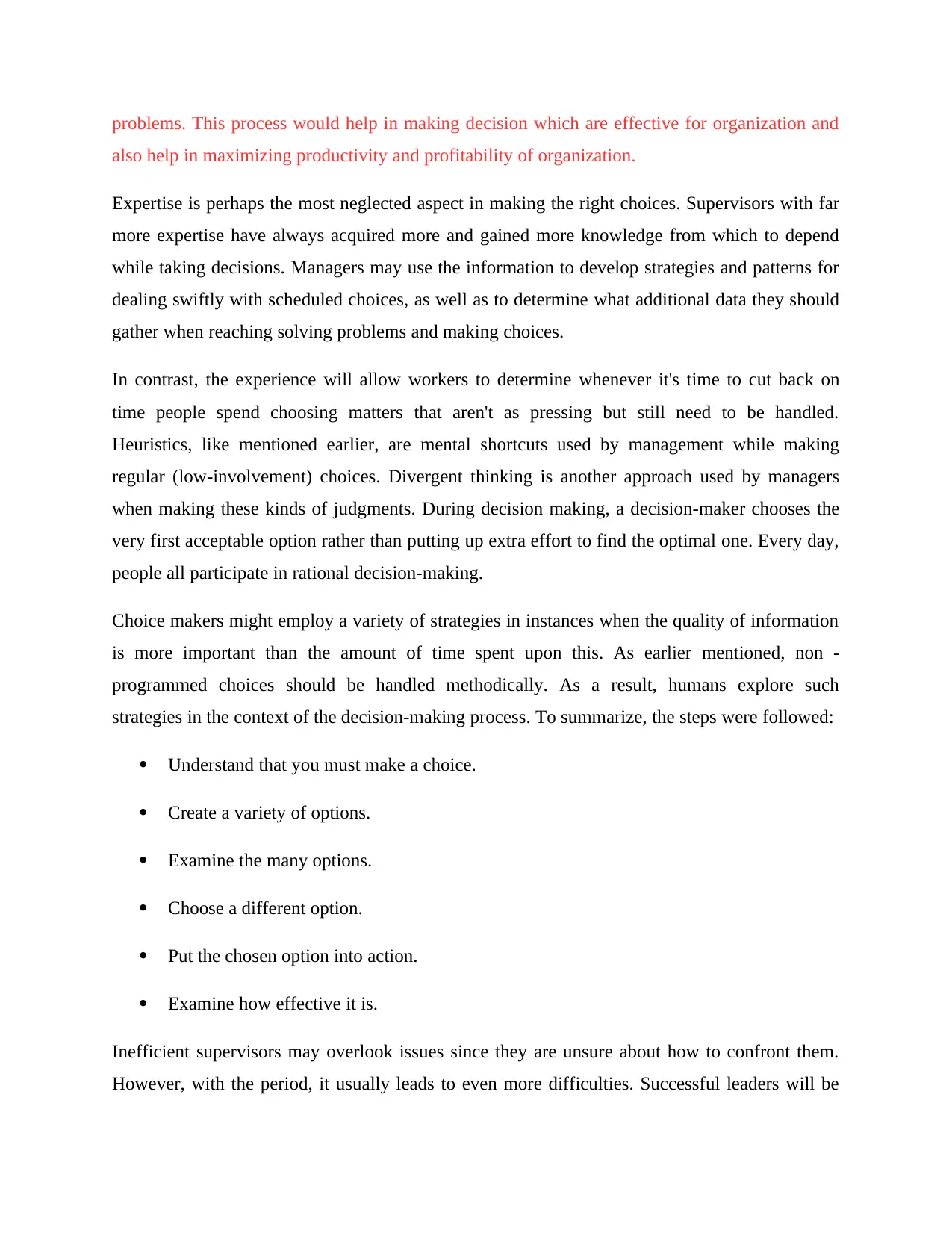
problems. This process would help in making decision which are effective for organization and
also help in maximizing productivity and profitability of organization.
Expertise is perhaps the most neglected aspect in making the right choices. Supervisors with far
more expertise have always acquired more and gained more knowledge from which to depend
while taking decisions. Managers may use the information to develop strategies and patterns for
dealing swiftly with scheduled choices, as well as to determine what additional data they should
gather when reaching solving problems and making choices.
In contrast, the experience will allow workers to determine whenever it's time to cut back on
time people spend choosing matters that aren't as pressing but still need to be handled.
Heuristics, like mentioned earlier, are mental shortcuts used by management while making
regular (low-involvement) choices. Divergent thinking is another approach used by managers
when making these kinds of judgments. During decision making, a decision-maker chooses the
very first acceptable option rather than putting up extra effort to find the optimal one. Every day,
people all participate in rational decision-making.
Choice makers might employ a variety of strategies in instances when the quality of information
is more important than the amount of time spent upon this. As earlier mentioned, non -
programmed choices should be handled methodically. As a result, humans explore such
strategies in the context of the decision-making process. To summarize, the steps were followed:
Understand that you must make a choice.
Create a variety of options.
Examine the many options.
Choose a different option.
Put the chosen option into action.
Examine how effective it is.
Inefficient supervisors may overlook issues since they are unsure about how to confront them.
However, with the period, it usually leads to even more difficulties. Successful leaders will be
also help in maximizing productivity and profitability of organization.
Expertise is perhaps the most neglected aspect in making the right choices. Supervisors with far
more expertise have always acquired more and gained more knowledge from which to depend
while taking decisions. Managers may use the information to develop strategies and patterns for
dealing swiftly with scheduled choices, as well as to determine what additional data they should
gather when reaching solving problems and making choices.
In contrast, the experience will allow workers to determine whenever it's time to cut back on
time people spend choosing matters that aren't as pressing but still need to be handled.
Heuristics, like mentioned earlier, are mental shortcuts used by management while making
regular (low-involvement) choices. Divergent thinking is another approach used by managers
when making these kinds of judgments. During decision making, a decision-maker chooses the
very first acceptable option rather than putting up extra effort to find the optimal one. Every day,
people all participate in rational decision-making.
Choice makers might employ a variety of strategies in instances when the quality of information
is more important than the amount of time spent upon this. As earlier mentioned, non -
programmed choices should be handled methodically. As a result, humans explore such
strategies in the context of the decision-making process. To summarize, the steps were followed:
Understand that you must make a choice.
Create a variety of options.
Examine the many options.
Choose a different option.
Put the chosen option into action.
Examine how effective it is.
Inefficient supervisors may overlook issues since they are unsure about how to confront them.
However, with the period, it usually leads to even more difficulties. Successful leaders will be
⊘ This is a preview!⊘
Do you want full access?
Subscribe today to unlock all pages.
Trusted by 1+ million students worldwide

aware of challenges and opportunities and would not hesitate to make choices that maximize the
development and efficiency of their group, division, or company. Whenever it comes to creating
options, management may frequently enhance the quality of overall decision-making by
including someone else in the procedure. Because they've had various personal experiences,
various individuals tend to see situations from various perspectives. It could assist anyone come
up with ideas that wouldn't have been thought of otherwise. Speaking with such a supervisor
about important choices may be useful, particularly for new leaders that are still studying and
building their knowledge; somebody with some expertise would frequently be able to formulate
additional possibilities.
Whenever it comes to making decisions, innovation is very useful for coming up with new ideas.
Innovation is the capacity to come up with new or unique ideas. It necessitates any use of
creativity as well as the capacity to think critically from established methods of communication
and perceiving the world. Whereas some men continue to be born with the ability to be
innovative, it is a talent that can be learned. To be innovative, one must allow your employees to
roam and combine existing information from previous encounters in innovative ways.
Proof decision-making is indeed a decision-making strategy that says that management must
acquire the materials provided to make good judgments. External evidence, including a review of
other parties, contextual variables important to the business, prospective advantages, and
disadvantages, as well as other useful facts, is likely to be bought alongside the decision maker's
knowledge. Executives are urged to depend on facts and knowledge instead of personal instinct
when making evidence-based decisions. That's very useful for rookie supervisors or veteran
supervisors who are just getting started.
CONCLUSION
This part of the report concludes with the importance of effective decision-making in an
organization and how such decision-making assists the organization in achieving its goals and
objectives as well as maximizing its productivity and profitability. This part of the report also
concludes about decision-making at different levels such as operational and strategic levels and
understanding the impact of effective decision making on such levels. It also concludes about
development and efficiency of their group, division, or company. Whenever it comes to creating
options, management may frequently enhance the quality of overall decision-making by
including someone else in the procedure. Because they've had various personal experiences,
various individuals tend to see situations from various perspectives. It could assist anyone come
up with ideas that wouldn't have been thought of otherwise. Speaking with such a supervisor
about important choices may be useful, particularly for new leaders that are still studying and
building their knowledge; somebody with some expertise would frequently be able to formulate
additional possibilities.
Whenever it comes to making decisions, innovation is very useful for coming up with new ideas.
Innovation is the capacity to come up with new or unique ideas. It necessitates any use of
creativity as well as the capacity to think critically from established methods of communication
and perceiving the world. Whereas some men continue to be born with the ability to be
innovative, it is a talent that can be learned. To be innovative, one must allow your employees to
roam and combine existing information from previous encounters in innovative ways.
Proof decision-making is indeed a decision-making strategy that says that management must
acquire the materials provided to make good judgments. External evidence, including a review of
other parties, contextual variables important to the business, prospective advantages, and
disadvantages, as well as other useful facts, is likely to be bought alongside the decision maker's
knowledge. Executives are urged to depend on facts and knowledge instead of personal instinct
when making evidence-based decisions. That's very useful for rookie supervisors or veteran
supervisors who are just getting started.
CONCLUSION
This part of the report concludes with the importance of effective decision-making in an
organization and how such decision-making assists the organization in achieving its goals and
objectives as well as maximizing its productivity and profitability. This part of the report also
concludes about decision-making at different levels such as operational and strategic levels and
understanding the impact of effective decision making on such levels. It also concludes about
Paraphrase This Document
Need a fresh take? Get an instant paraphrase of this document with our AI Paraphraser

how an organization can achieve its goals by effective implementation of strategies and
decisions.
REFERENCES
BOOKS AND JOURNALS
decisions.
REFERENCES
BOOKS AND JOURNALS
Arsić, S., and et. al., 2019. Family business owner as a central figure in customer relationship
management. Sustainability, 11(1), p.77.
Chin, T. L., Yean, T. F. and Yahya, K. K., 2017. Ability, Motivation, Opportunity Enhancing
Human Resource Management and Corporate Environmental Citizenship: What's the
Connection?. Global Business & Management Research, 9.
Dhir, S., and et. al., 2021. Critical success factors determining performance of cross‐border
acquisition: Evidence from the African telecom market. Thunderbird International Business
Review, 63(1), pp.43-61.
Ghani, F.A., and et. al., 2018. An empirical investigation of the relationship between
transformational, transactional female leadership styles and employee engagement. Global
Business and Management Research, 10(3), p.724.
Houlton, B. Z., Morford, S. L. and Dahlgren, R. A., 2018. Convergent evidence for widespread
rock nitrogen sources in Earth’s surface environment. Science, 360(6384), pp.58-62.
Lubbe, I., 2017. Challenges for curriculum design: Considerations for a four-year business and
accounting degree in South Africa. South African Journal of Accounting Research, 31(1), pp.60-
82.
Melnyk, L. H., Derykolenko, O. M., Kubatko, O. V. and Matsenko, O. M., 2019. Business
models of reproduction cycles for digital economy (Doctoral dissertation, CEUR-WS).
Nagar, K. and Singh, V. P., 2019. Modelling the effects of materialism, ethics and variety-
seeking behaviour on counterfeit consumption of young consumers. Global Business Review,
p.0972150918818015.
Neal, M., 2017. Learning from poverty: Why business schools should address poverty, and how
they can go about it. Academy of Management Learning & Education, 16(1), pp.54-69.
Reis, R., and et. al., 2019. Business intelligence for nutrition therapy. In Healthcare Policy and
Reform: Concepts, Methodologies, Tools, and Applications (pp. 459-474). IGI Global.
Viswanadham, N., 2018. Performance analysis and design of competitive business
models. International Journal of Production Research, 56(1-2), pp.983-999.
Yiu, L. and Saner, R., 2017. Business Diplomacy in Implementing the Global 2030 Development
Agenda: Core Competencies Needed at the Corporate and Managerial Level. In International
Business Diplomacy. Emerald Publishing Limited.
management. Sustainability, 11(1), p.77.
Chin, T. L., Yean, T. F. and Yahya, K. K., 2017. Ability, Motivation, Opportunity Enhancing
Human Resource Management and Corporate Environmental Citizenship: What's the
Connection?. Global Business & Management Research, 9.
Dhir, S., and et. al., 2021. Critical success factors determining performance of cross‐border
acquisition: Evidence from the African telecom market. Thunderbird International Business
Review, 63(1), pp.43-61.
Ghani, F.A., and et. al., 2018. An empirical investigation of the relationship between
transformational, transactional female leadership styles and employee engagement. Global
Business and Management Research, 10(3), p.724.
Houlton, B. Z., Morford, S. L. and Dahlgren, R. A., 2018. Convergent evidence for widespread
rock nitrogen sources in Earth’s surface environment. Science, 360(6384), pp.58-62.
Lubbe, I., 2017. Challenges for curriculum design: Considerations for a four-year business and
accounting degree in South Africa. South African Journal of Accounting Research, 31(1), pp.60-
82.
Melnyk, L. H., Derykolenko, O. M., Kubatko, O. V. and Matsenko, O. M., 2019. Business
models of reproduction cycles for digital economy (Doctoral dissertation, CEUR-WS).
Nagar, K. and Singh, V. P., 2019. Modelling the effects of materialism, ethics and variety-
seeking behaviour on counterfeit consumption of young consumers. Global Business Review,
p.0972150918818015.
Neal, M., 2017. Learning from poverty: Why business schools should address poverty, and how
they can go about it. Academy of Management Learning & Education, 16(1), pp.54-69.
Reis, R., and et. al., 2019. Business intelligence for nutrition therapy. In Healthcare Policy and
Reform: Concepts, Methodologies, Tools, and Applications (pp. 459-474). IGI Global.
Viswanadham, N., 2018. Performance analysis and design of competitive business
models. International Journal of Production Research, 56(1-2), pp.983-999.
Yiu, L. and Saner, R., 2017. Business Diplomacy in Implementing the Global 2030 Development
Agenda: Core Competencies Needed at the Corporate and Managerial Level. In International
Business Diplomacy. Emerald Publishing Limited.
⊘ This is a preview!⊘
Do you want full access?
Subscribe today to unlock all pages.
Trusted by 1+ million students worldwide

1 out of 12


Related Documents


Your All-in-One AI-Powered Toolkit for Academic Success.
+13062052269
info@desklib.com
Available 24*7 on WhatsApp / Email
![[object Object]](/_next/static/media/star-bottom.7253800d.svg)
Unlock your academic potential
Copyright © 2020–2026 A2Z Services. All Rights Reserved. Developed and managed by ZUCOL.