The Critical Role of Ethics: Why Accountants Must Be Ethical in BUS100
VerifiedAdded on 2024/04/25
|9
|2206
|500
Essay
AI Summary
This essay explores the critical importance of ethical standards for accountants and their impact on organizational success. It emphasizes that while accounting education is essential, a deep understanding and adoption of ethical principles are vital for the smooth functioning of an organization. The accountant's role extends beyond maintaining books of accounts to depicting a true and fair financial position to stakeholders, necessitating integrity, competence, and confidentiality. The essay references various studies highlighting how ethical leadership, transparency, and adherence to accounting standards contribute to building trust among stakeholders, fostering a healthy work environment, and ensuring the long-term sustainability of the organization. Ultimately, the essay concludes that an accountant's commitment to ethical conduct is paramount for achieving organizational objectives and maintaining public confidence in financial reporting. Desklib provides access to similar essays and resources for students.
Do Accountant needs to be ethical
1
1
Paraphrase This Document
Need a fresh take? Get an instant paraphrase of this document with our AI Paraphraser

Contents
Introduction.................................................................................................................................................3
Conclusion...................................................................................................................................................8
References:..................................................................................................................................................9
2
Introduction.................................................................................................................................................3
Conclusion...................................................................................................................................................8
References:..................................................................................................................................................9
2

Introduction
Ethical standards need ton adopted by the accountant in the organisation so that he can manage
the efficiency of people in the organisation. This is made to know the importance of ethical
standard for their accountant. Ethical standards include the values and principles that have been
adopted by the accountant so that he can make the employees to work with enthusiasm in the
organisation. The success of the organisation depends on the ethical standards that have been
adopted by the accountant. The education of accounting standards is not enough, the
understanding of the accounting and ethical standards needs to be taken up by the accountant for
the smooth running of the organisation. The main role of an accountant is to maintain the books
of account and depict the financial position of the business to the stakeholders. The integration,
competence, confidentiality, objectivity etc., are the main elements that need to be adopted by an
accountant.
3
Ethical standards need ton adopted by the accountant in the organisation so that he can manage
the efficiency of people in the organisation. This is made to know the importance of ethical
standard for their accountant. Ethical standards include the values and principles that have been
adopted by the accountant so that he can make the employees to work with enthusiasm in the
organisation. The success of the organisation depends on the ethical standards that have been
adopted by the accountant. The education of accounting standards is not enough, the
understanding of the accounting and ethical standards needs to be taken up by the accountant for
the smooth running of the organisation. The main role of an accountant is to maintain the books
of account and depict the financial position of the business to the stakeholders. The integration,
competence, confidentiality, objectivity etc., are the main elements that need to be adopted by an
accountant.
3
⊘ This is a preview!⊘
Do you want full access?
Subscribe today to unlock all pages.

Trusted by 1+ million students worldwide

Ho, S. S., Li, A. Y., Tam, K., & Zhang, F. (2015). CEO gender, ethical leadership, and
accounting conservatism. Journal of Business Ethics, vol. 127(2), 351-370.
The accountant needs to be ethical so that they can make the fair judgements or decisions in the
organisation. This mainly made to make that accountant to have fair decision making in the
organisation. Ethics play a significant role in the success of the organisation. These need to be
adopted in the organisation as an accountant are a person who keeps the all the records of the
organisation. He is a person who has all the accounting and financial information in the
organisation. He needs to be sincere and has to depict the true and fair financial position of the
organisation. The success of the organisation depends on the ethics of the organisation that has
been adopted by the accountant. Ethics are the value that ah been adopted by the accountant so
that he can make the true and fair picture of the organisation. The books of accounts have been
prepared by the accountant on which the all the stakeholders such as customers, employees,
government and general public rely upon. The accounting standards are made by the organisation
so that it can make the proper adoption of values and ethics in the organisation (Ho, et. al.,
2015).
Mattingly, C. (2016). Accounting for oneself and other ethical acts: Big picture ethics with
a small picture focus. HAU: Journal of Ethnographic Theory, vol. 6(1), 433-447.
The adoption of ethics is not made to be taught or learned by the accountant. It is a practice that
needs to be adopted in the organisation so that it can manage the values and culture of the
organisation. The ethics are adopted by the accountant so that he can make the people and
stakeholders have trust in him. The accounting ethics are to be adopted by the accountant so that
it can make the peaceful environment in the organisation. The duties that are fulfilled by the
accountant needs to be the adoption of ethics so that it can make the pope to work with
enthusiasm in the organisation. The ethics are made in accordance with the requirements of the
organisation and employees so that it can be acceptable by the people in the organisation. An
accountant is a person which has more power in the organisation as the financial information is
kept in the hand of an accountant and the entire organisation depends on the decision made by
him and the picture of the organisation that is depicted by him to the general public. To provide a
safe and secure environment to the people in the organisation to the people it is the duty of the
4
accounting conservatism. Journal of Business Ethics, vol. 127(2), 351-370.
The accountant needs to be ethical so that they can make the fair judgements or decisions in the
organisation. This mainly made to make that accountant to have fair decision making in the
organisation. Ethics play a significant role in the success of the organisation. These need to be
adopted in the organisation as an accountant are a person who keeps the all the records of the
organisation. He is a person who has all the accounting and financial information in the
organisation. He needs to be sincere and has to depict the true and fair financial position of the
organisation. The success of the organisation depends on the ethics of the organisation that has
been adopted by the accountant. Ethics are the value that ah been adopted by the accountant so
that he can make the true and fair picture of the organisation. The books of accounts have been
prepared by the accountant on which the all the stakeholders such as customers, employees,
government and general public rely upon. The accounting standards are made by the organisation
so that it can make the proper adoption of values and ethics in the organisation (Ho, et. al.,
2015).
Mattingly, C. (2016). Accounting for oneself and other ethical acts: Big picture ethics with
a small picture focus. HAU: Journal of Ethnographic Theory, vol. 6(1), 433-447.
The adoption of ethics is not made to be taught or learned by the accountant. It is a practice that
needs to be adopted in the organisation so that it can manage the values and culture of the
organisation. The ethics are adopted by the accountant so that he can make the people and
stakeholders have trust in him. The accounting ethics are to be adopted by the accountant so that
it can make the peaceful environment in the organisation. The duties that are fulfilled by the
accountant needs to be the adoption of ethics so that it can make the pope to work with
enthusiasm in the organisation. The ethics are made in accordance with the requirements of the
organisation and employees so that it can be acceptable by the people in the organisation. An
accountant is a person which has more power in the organisation as the financial information is
kept in the hand of an accountant and the entire organisation depends on the decision made by
him and the picture of the organisation that is depicted by him to the general public. To provide a
safe and secure environment to the people in the organisation to the people it is the duty of the
4
Paraphrase This Document
Need a fresh take? Get an instant paraphrase of this document with our AI Paraphraser

accountant so that employees and stakeholders can have on the working of the organisation and
make their investments in the organisation (Mattingly, 2016).
Himick, D., Brivot, M., & Henri, J. F. (2016). An ethical perspective on accounting
standard setting: Professional and lay-experts’ contribution to GASB’s Pension
Project. Critical Perspectives on Accounting, vol. 36, 22-38.
The article presents the importance of ethics in the organisation that needs to be adopted by the
accountant as he is a person who holds the crucial information of the organisation. This is the
responsibility of the accountant to keep the information or data in safe and secure position. The
leakage of information should not take place in the organisation as this is the responsibility of the
accountant to keep the information in the custody. The manipulation of data also possible by the
accountant as the biases can take place in the in the mind of an accountant. This happens due to
the pressure that is exerted on the accountant regarding the goodwill of the organisation as the
financial position of the organisation shows the performance of the organisation and its
employees in the organisation. The adoption of ethics makes the accountant feel the employees
work with determination so that they can make the justice to the work and lead to achieve the
goals of the organisation. The healthy environment created by the accountant make the
employees motivated for working hard in the organisation for the achievement of the goals of the
organisation. The performance of the employees is enhanced with the adoption of ethics in the
organisation by the accountant. This makes it work with integrity and creative ideas take place in
the mind of the people (Himik, et. al., 2016).
Cameron, R. A., & O'Leary, C. (2015). Improving ethical attitudes or simply teaching
ethical codes? The reality of accounting ethics education. Accounting Education, vol. 24(4),
275-290.
The ethical standards help in making the working of the organisation and employees to work for
the interest of the organisation. The accountant needs to work with honesty and integrity so that
it can make the true and fair depiction of accounting information of the organisation. The
financial statements are prepared by the accountant so they need to make the accounts on that
show the correct picture of the organisation. The ethical standards need to be an accountant as
these are mandatory for the accountant to adopt the ethical and accounting standards. The ethics
5
make their investments in the organisation (Mattingly, 2016).
Himick, D., Brivot, M., & Henri, J. F. (2016). An ethical perspective on accounting
standard setting: Professional and lay-experts’ contribution to GASB’s Pension
Project. Critical Perspectives on Accounting, vol. 36, 22-38.
The article presents the importance of ethics in the organisation that needs to be adopted by the
accountant as he is a person who holds the crucial information of the organisation. This is the
responsibility of the accountant to keep the information or data in safe and secure position. The
leakage of information should not take place in the organisation as this is the responsibility of the
accountant to keep the information in the custody. The manipulation of data also possible by the
accountant as the biases can take place in the in the mind of an accountant. This happens due to
the pressure that is exerted on the accountant regarding the goodwill of the organisation as the
financial position of the organisation shows the performance of the organisation and its
employees in the organisation. The adoption of ethics makes the accountant feel the employees
work with determination so that they can make the justice to the work and lead to achieve the
goals of the organisation. The healthy environment created by the accountant make the
employees motivated for working hard in the organisation for the achievement of the goals of the
organisation. The performance of the employees is enhanced with the adoption of ethics in the
organisation by the accountant. This makes it work with integrity and creative ideas take place in
the mind of the people (Himik, et. al., 2016).
Cameron, R. A., & O'Leary, C. (2015). Improving ethical attitudes or simply teaching
ethical codes? The reality of accounting ethics education. Accounting Education, vol. 24(4),
275-290.
The ethical standards help in making the working of the organisation and employees to work for
the interest of the organisation. The accountant needs to work with honesty and integrity so that
it can make the true and fair depiction of accounting information of the organisation. The
financial statements are prepared by the accountant so they need to make the accounts on that
show the correct picture of the organisation. The ethical standards need to be an accountant as
these are mandatory for the accountant to adopt the ethical and accounting standards. The ethics
5

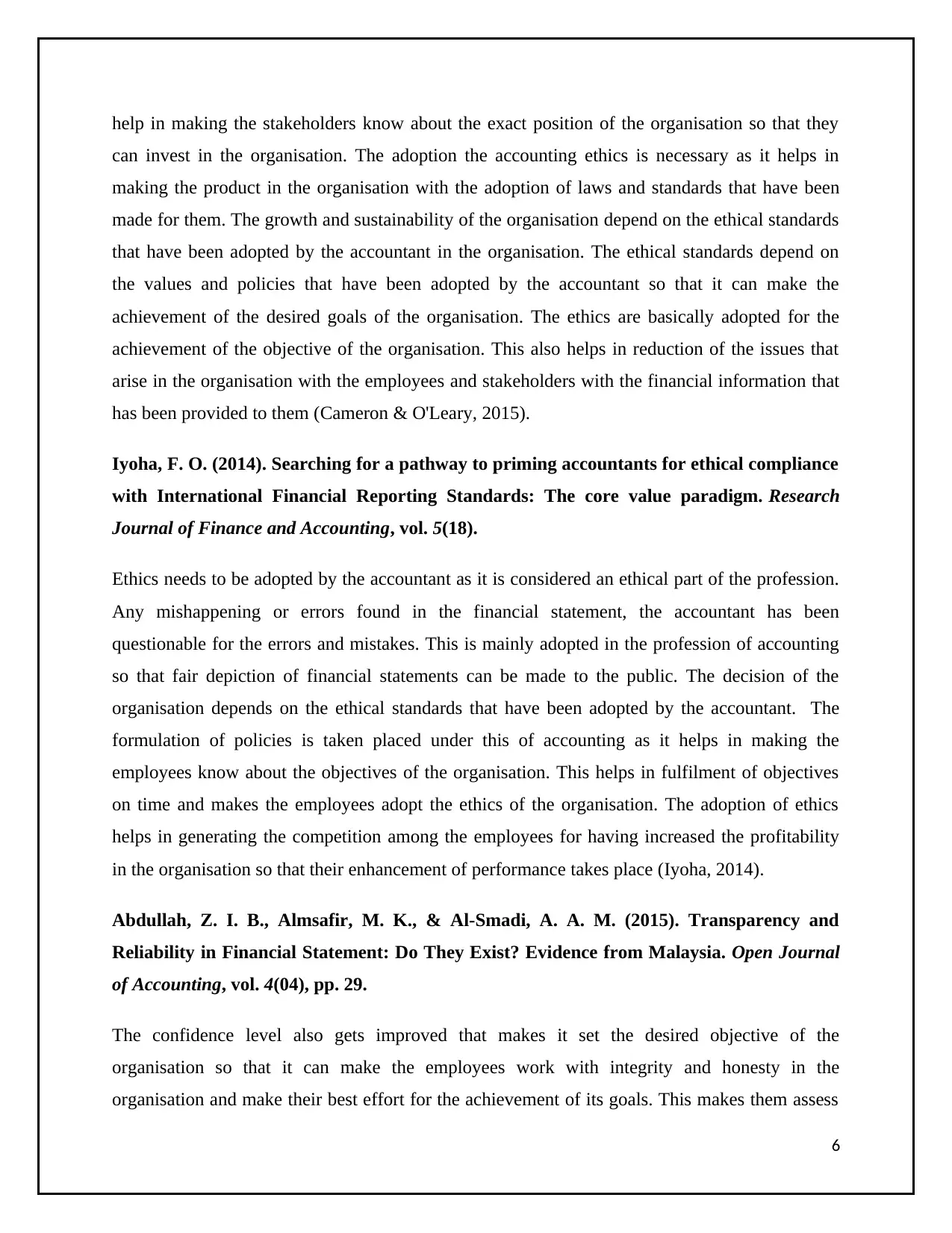
help in making the stakeholders know about the exact position of the organisation so that they
can invest in the organisation. The adoption the accounting ethics is necessary as it helps in
making the product in the organisation with the adoption of laws and standards that have been
made for them. The growth and sustainability of the organisation depend on the ethical standards
that have been adopted by the accountant in the organisation. The ethical standards depend on
the values and policies that have been adopted by the accountant so that it can make the
achievement of the desired goals of the organisation. The ethics are basically adopted for the
achievement of the objective of the organisation. This also helps in reduction of the issues that
arise in the organisation with the employees and stakeholders with the financial information that
has been provided to them (Cameron & O'Leary, 2015).
Iyoha, F. O. (2014). Searching for a pathway to priming accountants for ethical compliance
with International Financial Reporting Standards: The core value paradigm. Research
Journal of Finance and Accounting, vol. 5(18).
Ethics needs to be adopted by the accountant as it is considered an ethical part of the profession.
Any mishappening or errors found in the financial statement, the accountant has been
questionable for the errors and mistakes. This is mainly adopted in the profession of accounting
so that fair depiction of financial statements can be made to the public. The decision of the
organisation depends on the ethical standards that have been adopted by the accountant. The
formulation of policies is taken placed under this of accounting as it helps in making the
employees know about the objectives of the organisation. This helps in fulfilment of objectives
on time and makes the employees adopt the ethics of the organisation. The adoption of ethics
helps in generating the competition among the employees for having increased the profitability
in the organisation so that their enhancement of performance takes place (Iyoha, 2014).
Abdullah, Z. I. B., Almsafir, M. K., & Al-Smadi, A. A. M. (2015). Transparency and
Reliability in Financial Statement: Do They Exist? Evidence from Malaysia. Open Journal
of Accounting, vol. 4(04), pp. 29.
The confidence level also gets improved that makes it set the desired objective of the
organisation so that it can make the employees work with integrity and honesty in the
organisation and make their best effort for the achievement of its goals. This makes them assess
6
can invest in the organisation. The adoption the accounting ethics is necessary as it helps in
making the product in the organisation with the adoption of laws and standards that have been
made for them. The growth and sustainability of the organisation depend on the ethical standards
that have been adopted by the accountant in the organisation. The ethical standards depend on
the values and policies that have been adopted by the accountant so that it can make the
achievement of the desired goals of the organisation. The ethics are basically adopted for the
achievement of the objective of the organisation. This also helps in reduction of the issues that
arise in the organisation with the employees and stakeholders with the financial information that
has been provided to them (Cameron & O'Leary, 2015).
Iyoha, F. O. (2014). Searching for a pathway to priming accountants for ethical compliance
with International Financial Reporting Standards: The core value paradigm. Research
Journal of Finance and Accounting, vol. 5(18).
Ethics needs to be adopted by the accountant as it is considered an ethical part of the profession.
Any mishappening or errors found in the financial statement, the accountant has been
questionable for the errors and mistakes. This is mainly adopted in the profession of accounting
so that fair depiction of financial statements can be made to the public. The decision of the
organisation depends on the ethical standards that have been adopted by the accountant. The
formulation of policies is taken placed under this of accounting as it helps in making the
employees know about the objectives of the organisation. This helps in fulfilment of objectives
on time and makes the employees adopt the ethics of the organisation. The adoption of ethics
helps in generating the competition among the employees for having increased the profitability
in the organisation so that their enhancement of performance takes place (Iyoha, 2014).
Abdullah, Z. I. B., Almsafir, M. K., & Al-Smadi, A. A. M. (2015). Transparency and
Reliability in Financial Statement: Do They Exist? Evidence from Malaysia. Open Journal
of Accounting, vol. 4(04), pp. 29.
The confidence level also gets improved that makes it set the desired objective of the
organisation so that it can make the employees work with integrity and honesty in the
organisation and make their best effort for the achievement of its goals. This makes them assess
6
⊘ This is a preview!⊘
Do you want full access?
Subscribe today to unlock all pages.

Trusted by 1+ million students worldwide

the skills of employees in the organisation so that they can make the measurable steps to improve
their skills so that enhancement in the performance would take place. It is the major duty of an
accountant to analyse that the proper training has been provided to the employees in the
organisation. The skills of the accountant also get improved with making the employees work as
per the needs of the organisation. Ethics helps in making the organisation to adopt all the laws
for achieving the objective of the organisation (Abdullah, et. al., 2015).
7
their skills so that enhancement in the performance would take place. It is the major duty of an
accountant to analyse that the proper training has been provided to the employees in the
organisation. The skills of the accountant also get improved with making the employees work as
per the needs of the organisation. Ethics helps in making the organisation to adopt all the laws
for achieving the objective of the organisation (Abdullah, et. al., 2015).
7
Paraphrase This Document
Need a fresh take? Get an instant paraphrase of this document with our AI Paraphraser

Conclusion
The above essay elucidates about the importance of ethics that need to be adopted in the
organisation. The accountant needs to be ethical so that they can make the other employees to
achieve the desired goals of the organisation. This is mainly adopted in the organisation so that
they can make the true and fair picture of eth organisation. The success of the organisation
depends on the ethical standards that have been adopted by the accountant. The accountant
maintains the ethical standards o that they can make the organisation to work with competence
and diligence in the organisation. The above essay explains the needs of being ethical in the
organisation so that it can achieve the desired goals of the organisation. The employees are made
aware of the ethics and its role in the organisation. To fulfil the role of the profession in the
organisation, an accountant needs to adopt the ethical and accounting standards in the
organisation. This has been the major duty of the accountant for the achievement of the objective
of the organisation with the adoption of ethical standards.
8
The above essay elucidates about the importance of ethics that need to be adopted in the
organisation. The accountant needs to be ethical so that they can make the other employees to
achieve the desired goals of the organisation. This is mainly adopted in the organisation so that
they can make the true and fair picture of eth organisation. The success of the organisation
depends on the ethical standards that have been adopted by the accountant. The accountant
maintains the ethical standards o that they can make the organisation to work with competence
and diligence in the organisation. The above essay explains the needs of being ethical in the
organisation so that it can achieve the desired goals of the organisation. The employees are made
aware of the ethics and its role in the organisation. To fulfil the role of the profession in the
organisation, an accountant needs to adopt the ethical and accounting standards in the
organisation. This has been the major duty of the accountant for the achievement of the objective
of the organisation with the adoption of ethical standards.
8

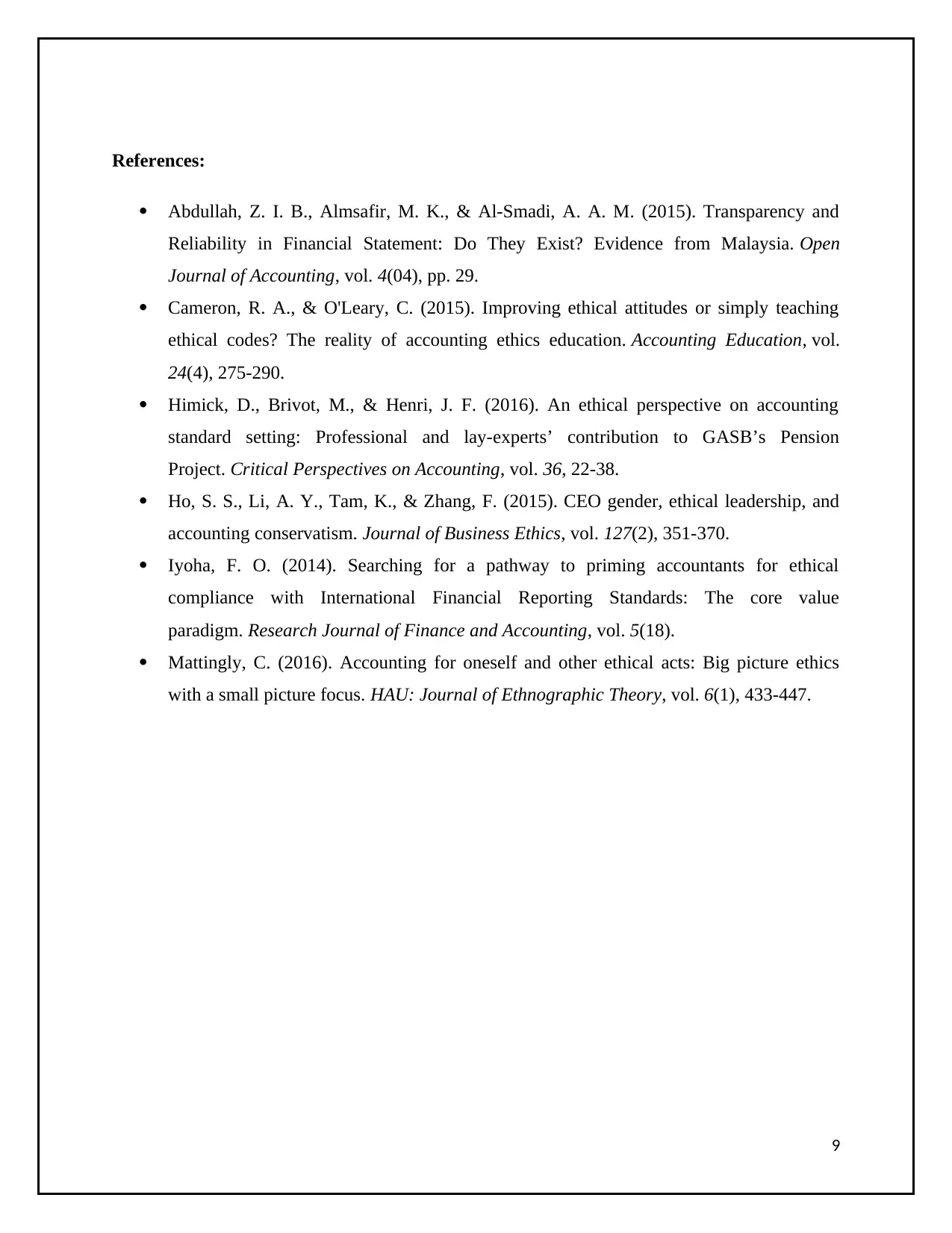
References:
Abdullah, Z. I. B., Almsafir, M. K., & Al-Smadi, A. A. M. (2015). Transparency and
Reliability in Financial Statement: Do They Exist? Evidence from Malaysia. Open
Journal of Accounting, vol. 4(04), pp. 29.
Cameron, R. A., & O'Leary, C. (2015). Improving ethical attitudes or simply teaching
ethical codes? The reality of accounting ethics education. Accounting Education, vol.
24(4), 275-290.
Himick, D., Brivot, M., & Henri, J. F. (2016). An ethical perspective on accounting
standard setting: Professional and lay-experts’ contribution to GASB’s Pension
Project. Critical Perspectives on Accounting, vol. 36, 22-38.
Ho, S. S., Li, A. Y., Tam, K., & Zhang, F. (2015). CEO gender, ethical leadership, and
accounting conservatism. Journal of Business Ethics, vol. 127(2), 351-370.
Iyoha, F. O. (2014). Searching for a pathway to priming accountants for ethical
compliance with International Financial Reporting Standards: The core value
paradigm. Research Journal of Finance and Accounting, vol. 5(18).
Mattingly, C. (2016). Accounting for oneself and other ethical acts: Big picture ethics
with a small picture focus. HAU: Journal of Ethnographic Theory, vol. 6(1), 433-447.
9
Abdullah, Z. I. B., Almsafir, M. K., & Al-Smadi, A. A. M. (2015). Transparency and
Reliability in Financial Statement: Do They Exist? Evidence from Malaysia. Open
Journal of Accounting, vol. 4(04), pp. 29.
Cameron, R. A., & O'Leary, C. (2015). Improving ethical attitudes or simply teaching
ethical codes? The reality of accounting ethics education. Accounting Education, vol.
24(4), 275-290.
Himick, D., Brivot, M., & Henri, J. F. (2016). An ethical perspective on accounting
standard setting: Professional and lay-experts’ contribution to GASB’s Pension
Project. Critical Perspectives on Accounting, vol. 36, 22-38.
Ho, S. S., Li, A. Y., Tam, K., & Zhang, F. (2015). CEO gender, ethical leadership, and
accounting conservatism. Journal of Business Ethics, vol. 127(2), 351-370.
Iyoha, F. O. (2014). Searching for a pathway to priming accountants for ethical
compliance with International Financial Reporting Standards: The core value
paradigm. Research Journal of Finance and Accounting, vol. 5(18).
Mattingly, C. (2016). Accounting for oneself and other ethical acts: Big picture ethics
with a small picture focus. HAU: Journal of Ethnographic Theory, vol. 6(1), 433-447.
9
⊘ This is a preview!⊘
Do you want full access?
Subscribe today to unlock all pages.

Trusted by 1+ million students worldwide
1 out of 9
Related Documents
Your All-in-One AI-Powered Toolkit for Academic Success.
+13062052269
info@desklib.com
Available 24*7 on WhatsApp / Email
Unlock your academic potential
Copyright © 2020–2026 A2Z Services. All Rights Reserved. Developed and managed by ZUCOL.