Educational Leadership: Strategies for Student and School Improvement
VerifiedAdded on 2022/09/02
|7
|1799
|19
Essay
AI Summary
This essay delves into the multifaceted role of educational leadership in enhancing student learning and overall school improvement. It begins by defining educational leadership and emphasizing the leader's responsibility in guiding students toward success, highlighting the importance of ethical care, discipline, and knowledge. The discussion explores how leadership influences school culture, socioeconomic factors, and the integration of multicultural education. The essay proposes several strategies, including practical-based learning, cooperative learning, and technological integration, to foster a positive and inclusive educational environment. It underscores the significance of ethical care and the leader's role in promoting equity and addressing socioeconomic disparities. The conclusion emphasizes the importance of encouragement, motivation, and practical application in achieving educational goals. It also recommends implementing practical work and active learning to develop students' skills and prepare them for real-world challenges. The essay stresses the need for educational leaders to maintain discipline, impart knowledge, and promote critical thinking among students.
Running head: EDUCATIONAL LEADERSHIP
EDUCATIONAL LEADERSHIP
Name of the Student:
Name of the University:
Author Note:
EDUCATIONAL LEADERSHIP
Name of the Student:
Name of the University:
Author Note:
Paraphrase This Document
Need a fresh take? Get an instant paraphrase of this document with our AI Paraphraser

1EDUCATIONAL LEADERSHIP
Introduction
The essay is going to be structured on the impact of improving learning and achievement,
along with leadership. An analysis will be provided from the perspective of an educational
leader, and a list of recommendations will be advised in order to improve the establishment of
all the students. The analysis is going to be proposed on specific aspects such as the culture
and socioeconomic status, ethical care, commitment to multicultural education, and
suggestions for the betterment of the school along with the local community. Several methods
are going to be introduced, and it may help in order to attain improvements among the
students and the school itself. An educational leader is a tough job and responsibility to
follow accordingly and to maintain the students as per their knowledge and to provide them
with equal opportunities to showcase their talents. There are various ways to improve the
quality of the education system and providing assurance through an educational program and
encouraging the students (Parkay, Anctil & Hass, 2014). The primary objective is to highlight
different strategies and methods for the betterment of the respective school so that the readers
can stimulate their ideas appropriately. The concepts such as engaging the students in
practical-based learning, traditional studies, cooperative learning, team management,
technological aspects, and so on will be a benefit to understand the factors efficiently and
adequately.
Introduction
The essay is going to be structured on the impact of improving learning and achievement,
along with leadership. An analysis will be provided from the perspective of an educational
leader, and a list of recommendations will be advised in order to improve the establishment of
all the students. The analysis is going to be proposed on specific aspects such as the culture
and socioeconomic status, ethical care, commitment to multicultural education, and
suggestions for the betterment of the school along with the local community. Several methods
are going to be introduced, and it may help in order to attain improvements among the
students and the school itself. An educational leader is a tough job and responsibility to
follow accordingly and to maintain the students as per their knowledge and to provide them
with equal opportunities to showcase their talents. There are various ways to improve the
quality of the education system and providing assurance through an educational program and
encouraging the students (Parkay, Anctil & Hass, 2014). The primary objective is to highlight
different strategies and methods for the betterment of the respective school so that the readers
can stimulate their ideas appropriately. The concepts such as engaging the students in
practical-based learning, traditional studies, cooperative learning, team management,
technological aspects, and so on will be a benefit to understand the factors efficiently and
adequately.

2EDUCATIONAL LEADERSHIP
Discussion
Educational leadership is defined as the process of listing as well as guiding the students
according to their talents and skills. It is the teacher’s responsibility to guide the students
towards attaining success and removing failure from their lives. As an educational leader, one
should possess dignity and personality and should maintain discipline as well as proper
knowledge of their desired subjects. Leadership aims at focusing that the leader should lead
their pupils on the right track (Robertson, 2016). It is one of the main factors in management
and in order to sustain an organisation or a school, one should have a belief along with a clear
vision that will work to attain the desired goals. It is referred to that individual who will
provide coordination, cooperation, equality among the students or co-workers, healthy
communication, and motivating them (Bush, Bell & Middlewood, 2019).
As per my belief is concerned, an educational leader is a tough work to collaborate
with all the students and to make them study together so that they can gain better
understanding and knowledge. In every school, it is a leader’s responsibility to showcase the
vision and improve the qualities among the students by providing them with a healthy
environment, well-functional management facilities, and proper directions that should
concerning the students (Robertson, 2016). Several programs have been applied, such as
active learning, practical work, and cooperative learning.
Ethical care and educational leadership are interconnected, and it is focused on
several responsibilities and duties that are significant while caring for the students. So
becoming an educational leader, leadership and ethics are the core of the education system
(Ehrich et al., 2015). The term leadership is focused on several relationships, and it
strengthens a leader from the inner side so that he or she can show immense care along with
honouring their work. After utilising, the ethics of care, it is bound to benefit the pupils from
avoiding the conflicts among the students and encouraging them to improve their skills and
Discussion
Educational leadership is defined as the process of listing as well as guiding the students
according to their talents and skills. It is the teacher’s responsibility to guide the students
towards attaining success and removing failure from their lives. As an educational leader, one
should possess dignity and personality and should maintain discipline as well as proper
knowledge of their desired subjects. Leadership aims at focusing that the leader should lead
their pupils on the right track (Robertson, 2016). It is one of the main factors in management
and in order to sustain an organisation or a school, one should have a belief along with a clear
vision that will work to attain the desired goals. It is referred to that individual who will
provide coordination, cooperation, equality among the students or co-workers, healthy
communication, and motivating them (Bush, Bell & Middlewood, 2019).
As per my belief is concerned, an educational leader is a tough work to collaborate
with all the students and to make them study together so that they can gain better
understanding and knowledge. In every school, it is a leader’s responsibility to showcase the
vision and improve the qualities among the students by providing them with a healthy
environment, well-functional management facilities, and proper directions that should
concerning the students (Robertson, 2016). Several programs have been applied, such as
active learning, practical work, and cooperative learning.
Ethical care and educational leadership are interconnected, and it is focused on
several responsibilities and duties that are significant while caring for the students. So
becoming an educational leader, leadership and ethics are the core of the education system
(Ehrich et al., 2015). The term leadership is focused on several relationships, and it
strengthens a leader from the inner side so that he or she can show immense care along with
honouring their work. After utilising, the ethics of care, it is bound to benefit the pupils from
avoiding the conflicts among the students and encouraging them to improve their skills and
⊘ This is a preview!⊘
Do you want full access?
Subscribe today to unlock all pages.

Trusted by 1+ million students worldwide

3EDUCATIONAL LEADERSHIP
follow the failure to receive success in their life. It is a severe challenge for a leader to lead
the students for their betterment without hurting their feelings or emotions. In this way, it aids
to remember that every individual is equally essential and treating them well in one’s prime
responsibility. They should provide support, care, love, affections, and strictness when it is
required. Thus, it signifies as part of one’s shared experience in their individual lives. There
is no better cure than caring for one student, and every leader should cooperate with the
students while managing their homework, classwork, presentation and practical work (Louis,
Murphy & Smylie, 2016). They should handle the students tactfully without hampering their
studies, and a leader must maintain the ethics of care not for the sake of their position but to
support them in every manner.
Education can be signified in terms of different cultures, as every individual is
distributed among various cultural background (Turan & Bektas, 2013). A leader can
incorporate different lessons that may reflect on the cultural diversity of the students
(Theoharis & Scanlan, 2015). Therefore, it has shown an effort to remove the barriers among
the students because of their distinctive cultures. Educators should practice different
programs based on their cultures so that every individual may come across another
individual’s background and mix with them appropriately. The students should follow the
principle of educational equity, and it should be regardless of their separate cultures.
Teachers can modify the lessons irrespective of their gender, sex, race, culture, nationality,
religion, and social status (Nichols, 2014).
The status acts as a barrier among the students when it is based on their own
socioeconomic status and it ensures their financial security (Theoharis & Scanlan, 2015). It is
connected through their behavioural terms along with social science which includes practice,
researches, advocacy and education. The factors like low socio-economic status will
definitely affect in the achievements of education system. Students suffering from poverty
follow the failure to receive success in their life. It is a severe challenge for a leader to lead
the students for their betterment without hurting their feelings or emotions. In this way, it aids
to remember that every individual is equally essential and treating them well in one’s prime
responsibility. They should provide support, care, love, affections, and strictness when it is
required. Thus, it signifies as part of one’s shared experience in their individual lives. There
is no better cure than caring for one student, and every leader should cooperate with the
students while managing their homework, classwork, presentation and practical work (Louis,
Murphy & Smylie, 2016). They should handle the students tactfully without hampering their
studies, and a leader must maintain the ethics of care not for the sake of their position but to
support them in every manner.
Education can be signified in terms of different cultures, as every individual is
distributed among various cultural background (Turan & Bektas, 2013). A leader can
incorporate different lessons that may reflect on the cultural diversity of the students
(Theoharis & Scanlan, 2015). Therefore, it has shown an effort to remove the barriers among
the students because of their distinctive cultures. Educators should practice different
programs based on their cultures so that every individual may come across another
individual’s background and mix with them appropriately. The students should follow the
principle of educational equity, and it should be regardless of their separate cultures.
Teachers can modify the lessons irrespective of their gender, sex, race, culture, nationality,
religion, and social status (Nichols, 2014).
The status acts as a barrier among the students when it is based on their own
socioeconomic status and it ensures their financial security (Theoharis & Scanlan, 2015). It is
connected through their behavioural terms along with social science which includes practice,
researches, advocacy and education. The factors like low socio-economic status will
definitely affect in the achievements of education system. Students suffering from poverty
Paraphrase This Document
Need a fresh take? Get an instant paraphrase of this document with our AI Paraphraser

4EDUCATIONAL LEADERSHIP
and illness will fall a direct effect on the society. In this way, society will benefit from this
emerging factors such as the gaps in between many students and that cannot be fill up unless
education is not involved in the community. Education serves as the medium of bridging the
gap between the socioeconomic statuses. Thus, individuals should indulge themselves and
should provide enough efforts to upgrade the falling situation of the society. Therefore,
education can create a separate personality regardless of socioeconomic status, cultural
backgrounds, and religious factors.
Thus, being an educational leader, schools should be more diverse in nature so that
they can encourage students and motivate them in order to rise from the narrow perspective
of the society. Educational programs such as practical work and active learning should be
implemented among the students and it should be practiced positively and adequately.
and illness will fall a direct effect on the society. In this way, society will benefit from this
emerging factors such as the gaps in between many students and that cannot be fill up unless
education is not involved in the community. Education serves as the medium of bridging the
gap between the socioeconomic statuses. Thus, individuals should indulge themselves and
should provide enough efforts to upgrade the falling situation of the society. Therefore,
education can create a separate personality regardless of socioeconomic status, cultural
backgrounds, and religious factors.
Thus, being an educational leader, schools should be more diverse in nature so that
they can encourage students and motivate them in order to rise from the narrow perspective
of the society. Educational programs such as practical work and active learning should be
implemented among the students and it should be practiced positively and adequately.

5EDUCATIONAL LEADERSHIP
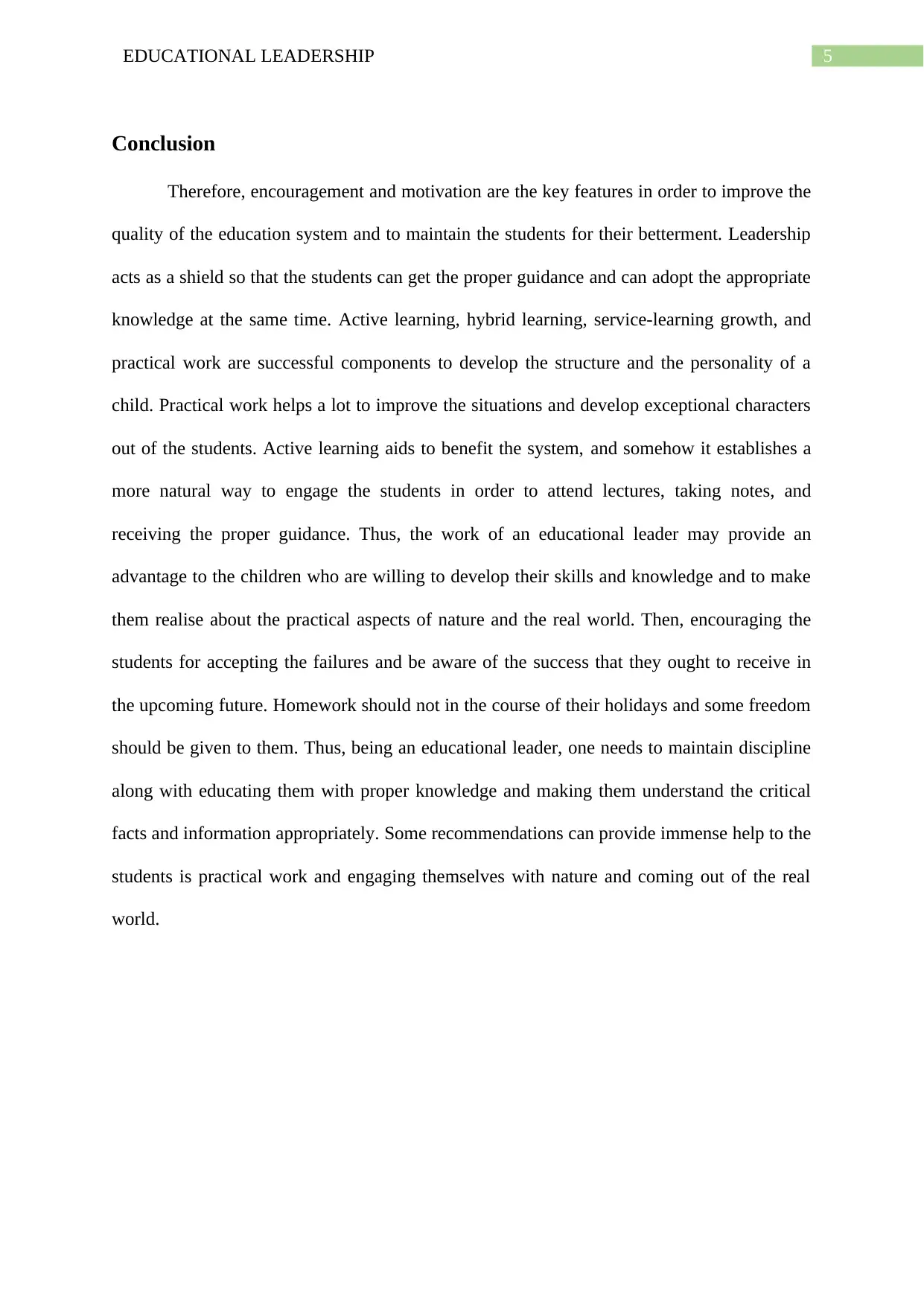
Conclusion
Therefore, encouragement and motivation are the key features in order to improve the
quality of the education system and to maintain the students for their betterment. Leadership
acts as a shield so that the students can get the proper guidance and can adopt the appropriate
knowledge at the same time. Active learning, hybrid learning, service-learning growth, and
practical work are successful components to develop the structure and the personality of a
child. Practical work helps a lot to improve the situations and develop exceptional characters
out of the students. Active learning aids to benefit the system, and somehow it establishes a
more natural way to engage the students in order to attend lectures, taking notes, and
receiving the proper guidance. Thus, the work of an educational leader may provide an
advantage to the children who are willing to develop their skills and knowledge and to make
them realise about the practical aspects of nature and the real world. Then, encouraging the
students for accepting the failures and be aware of the success that they ought to receive in
the upcoming future. Homework should not in the course of their holidays and some freedom
should be given to them. Thus, being an educational leader, one needs to maintain discipline
along with educating them with proper knowledge and making them understand the critical
facts and information appropriately. Some recommendations can provide immense help to the
students is practical work and engaging themselves with nature and coming out of the real
world.
Conclusion
Therefore, encouragement and motivation are the key features in order to improve the
quality of the education system and to maintain the students for their betterment. Leadership
acts as a shield so that the students can get the proper guidance and can adopt the appropriate
knowledge at the same time. Active learning, hybrid learning, service-learning growth, and
practical work are successful components to develop the structure and the personality of a
child. Practical work helps a lot to improve the situations and develop exceptional characters
out of the students. Active learning aids to benefit the system, and somehow it establishes a
more natural way to engage the students in order to attend lectures, taking notes, and
receiving the proper guidance. Thus, the work of an educational leader may provide an
advantage to the children who are willing to develop their skills and knowledge and to make
them realise about the practical aspects of nature and the real world. Then, encouraging the
students for accepting the failures and be aware of the success that they ought to receive in
the upcoming future. Homework should not in the course of their holidays and some freedom
should be given to them. Thus, being an educational leader, one needs to maintain discipline
along with educating them with proper knowledge and making them understand the critical
facts and information appropriately. Some recommendations can provide immense help to the
students is practical work and engaging themselves with nature and coming out of the real
world.
⊘ This is a preview!⊘
Do you want full access?
Subscribe today to unlock all pages.

Trusted by 1+ million students worldwide

6EDUCATIONAL LEADERSHIP
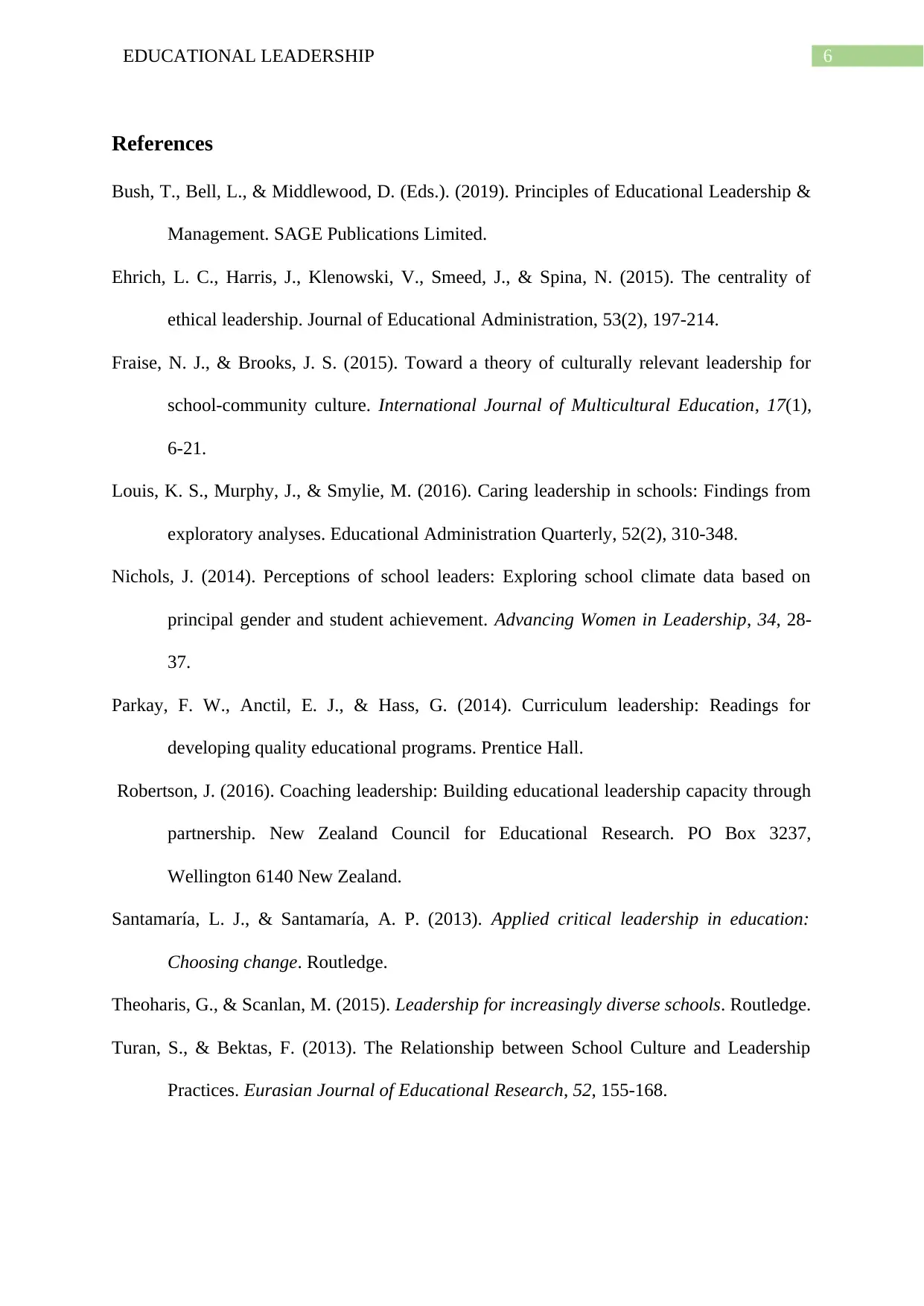
References
Bush, T., Bell, L., & Middlewood, D. (Eds.). (2019). Principles of Educational Leadership &
Management. SAGE Publications Limited.
Ehrich, L. C., Harris, J., Klenowski, V., Smeed, J., & Spina, N. (2015). The centrality of
ethical leadership. Journal of Educational Administration, 53(2), 197-214.
Fraise, N. J., & Brooks, J. S. (2015). Toward a theory of culturally relevant leadership for
school-community culture. International Journal of Multicultural Education, 17(1),
6-21.
Louis, K. S., Murphy, J., & Smylie, M. (2016). Caring leadership in schools: Findings from
exploratory analyses. Educational Administration Quarterly, 52(2), 310-348.
Nichols, J. (2014). Perceptions of school leaders: Exploring school climate data based on
principal gender and student achievement. Advancing Women in Leadership, 34, 28-
37.
Parkay, F. W., Anctil, E. J., & Hass, G. (2014). Curriculum leadership: Readings for
developing quality educational programs. Prentice Hall.
Robertson, J. (2016). Coaching leadership: Building educational leadership capacity through
partnership. New Zealand Council for Educational Research. PO Box 3237,
Wellington 6140 New Zealand.
Santamaría, L. J., & Santamaría, A. P. (2013). Applied critical leadership in education:
Choosing change. Routledge.
Theoharis, G., & Scanlan, M. (2015). Leadership for increasingly diverse schools. Routledge.
Turan, S., & Bektas, F. (2013). The Relationship between School Culture and Leadership
Practices. Eurasian Journal of Educational Research, 52, 155-168.
References
Bush, T., Bell, L., & Middlewood, D. (Eds.). (2019). Principles of Educational Leadership &
Management. SAGE Publications Limited.
Ehrich, L. C., Harris, J., Klenowski, V., Smeed, J., & Spina, N. (2015). The centrality of
ethical leadership. Journal of Educational Administration, 53(2), 197-214.
Fraise, N. J., & Brooks, J. S. (2015). Toward a theory of culturally relevant leadership for
school-community culture. International Journal of Multicultural Education, 17(1),
6-21.
Louis, K. S., Murphy, J., & Smylie, M. (2016). Caring leadership in schools: Findings from
exploratory analyses. Educational Administration Quarterly, 52(2), 310-348.
Nichols, J. (2014). Perceptions of school leaders: Exploring school climate data based on
principal gender and student achievement. Advancing Women in Leadership, 34, 28-
37.
Parkay, F. W., Anctil, E. J., & Hass, G. (2014). Curriculum leadership: Readings for
developing quality educational programs. Prentice Hall.
Robertson, J. (2016). Coaching leadership: Building educational leadership capacity through
partnership. New Zealand Council for Educational Research. PO Box 3237,
Wellington 6140 New Zealand.
Santamaría, L. J., & Santamaría, A. P. (2013). Applied critical leadership in education:
Choosing change. Routledge.
Theoharis, G., & Scanlan, M. (2015). Leadership for increasingly diverse schools. Routledge.
Turan, S., & Bektas, F. (2013). The Relationship between School Culture and Leadership
Practices. Eurasian Journal of Educational Research, 52, 155-168.
1 out of 7
Related Documents
Your All-in-One AI-Powered Toolkit for Academic Success.
+13062052269
info@desklib.com
Available 24*7 on WhatsApp / Email
Unlock your academic potential
Copyright © 2020–2026 A2Z Services. All Rights Reserved. Developed and managed by ZUCOL.


![NBA Program: Administrative Decision Report - [University Name]](/_next/image/?url=https%3A%2F%2Fdesklib.com%2Fmedia%2Fimages%2Few%2F6d079663a35e48aea489ee77290172a8.jpg&w=256&q=75)