Analysis of Income Statement and Cash Flow Statements in Accounting
VerifiedAdded on 2023/06/08
|10
|2208
|480
Report
AI Summary
This report provides a comprehensive analysis of two crucial financial statements: the income statement and the cash flow statement. It begins by defining the income statement, also known as the profit and loss statement, and explores its uses both internally for management decision-making and externally for stakeholders like investors and creditors. The report then details the limitations of the income statement, such as the reliance on accounting assumptions and potential for manipulation through inventory valuation methods. It also provides techniques to overcome these limitations, emphasizing adherence to financial reporting regulations and the consistent application of accounting methods. Following this, the report defines the cash flow statement and its importance in assessing an organization's cash position, planning for future cash needs, and evaluating liquidity. It also discusses the limitations of the cash flow statement, such as the difficulty in equating it with the profit and loss statement, and suggests techniques to overcome these, including expense auditing, incentivizing faster payments from customers, and optimizing inventory management. The report concludes with a discussion of how these financial statements are used for financial analysis and decision making.
Running head: ACCOUNTING
Accounting
Name of the Student
Name of the University
Author’s Note
Course ID
Accounting
Name of the Student
Name of the University
Author’s Note
Course ID
Paraphrase This Document
Need a fresh take? Get an instant paraphrase of this document with our AI Paraphraser

1ACCOUNTING
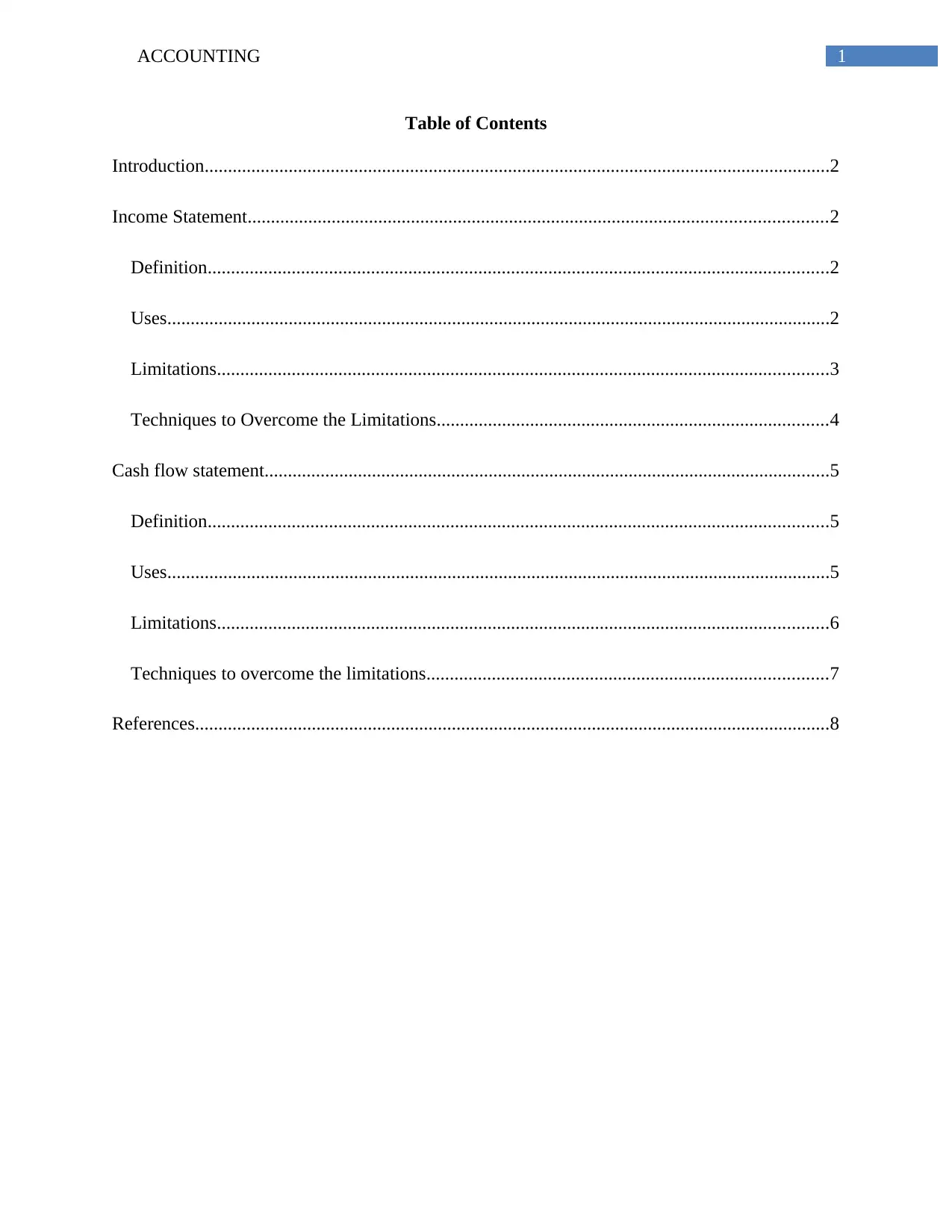
Table of Contents
Introduction......................................................................................................................................2
Income Statement............................................................................................................................2
Definition.....................................................................................................................................2
Uses..............................................................................................................................................2
Limitations...................................................................................................................................3
Techniques to Overcome the Limitations....................................................................................4
Cash flow statement.........................................................................................................................5
Definition.....................................................................................................................................5
Uses..............................................................................................................................................5
Limitations...................................................................................................................................6
Techniques to overcome the limitations......................................................................................7
References........................................................................................................................................8
Table of Contents
Introduction......................................................................................................................................2
Income Statement............................................................................................................................2
Definition.....................................................................................................................................2
Uses..............................................................................................................................................2
Limitations...................................................................................................................................3
Techniques to Overcome the Limitations....................................................................................4
Cash flow statement.........................................................................................................................5
Definition.....................................................................................................................................5
Uses..............................................................................................................................................5
Limitations...................................................................................................................................6
Techniques to overcome the limitations......................................................................................7
References........................................................................................................................................8

2ACCOUNTING
Introduction
Financial Statements are considered as major components of the financial accounting of
the companies as they are regarded as the formal record of the financial activities as well as
financial positions of the companies. There are different components of financial statements; and
two of them are Income Statement and Cash Flow Statement. These two components of
financial statements play a crucial part in reflecting the true financial standing of the business
entities (Carraher and Auken 2013). This report aims at the analysis and evaluation of various
dimensions of income statement and cash flow statement.
Income Statement
Definition
The Income Statement is considered as one of the prime financial statements of the
companies that the investors use for the assessment of financial performance and financial
position. The income statement is also called as a profit and loss statement and the companies are
responsible for preparing it for showing revenue, expenses and net profit or loss for a financial
period. The existing and potential investors consider income statement as a major tool for the
assessment of the financial standings of the business entities (Auken and Carraher 2013).
Uses
In the business organisations, both the internal as well as external use of income
statement can be seen. The uses are discussed below:
Internal Use: In the internal affairs of the business organisations, the company managers use
income statement for the assessment of any change in the financial aspects of the businesses. For
Introduction
Financial Statements are considered as major components of the financial accounting of
the companies as they are regarded as the formal record of the financial activities as well as
financial positions of the companies. There are different components of financial statements; and
two of them are Income Statement and Cash Flow Statement. These two components of
financial statements play a crucial part in reflecting the true financial standing of the business
entities (Carraher and Auken 2013). This report aims at the analysis and evaluation of various
dimensions of income statement and cash flow statement.
Income Statement
Definition
The Income Statement is considered as one of the prime financial statements of the
companies that the investors use for the assessment of financial performance and financial
position. The income statement is also called as a profit and loss statement and the companies are
responsible for preparing it for showing revenue, expenses and net profit or loss for a financial
period. The existing and potential investors consider income statement as a major tool for the
assessment of the financial standings of the business entities (Auken and Carraher 2013).
Uses
In the business organisations, both the internal as well as external use of income
statement can be seen. The uses are discussed below:
Internal Use: In the internal affairs of the business organisations, the company managers use
income statement for the assessment of any change in the financial aspects of the businesses. For
⊘ This is a preview!⊘
Do you want full access?
Subscribe today to unlock all pages.

Trusted by 1+ million students worldwide

3ACCOUNTING
instance, in case there is a drop in the gross margin of the business, the finance managers of the
companies may consider the negotiation with the suppliers, or they can use marketing strategies
for interests of the buyers. At the same time, in case the operating expenses of the business are
high, the financial managers can develop strategies to reduce the expenses. Thus, it can be seen
that the financial managers of the companies can assess these changes with the help of income
statement (Minnis and Sutherland 2017).
External Use: At the same time, income statement is of great use for the external users like
various external stakeholders. It is the responsibility of the companies to publish quarterly
income statement so that the shareholders can review and analyze them. At the same time, the
private investors and creditors also consider the analysis of the income statements of the
companies at the time to conduct the due diligence. At the time to make the investment
decisions, the investors and creditors consider the assessment of near-term and historic income
and all this information can be obtained from the income statement of the companies (Hoyle,
Schaefer and Doupnik 2015).
Limitations
Although, both the internal as well as external uses of income statement are there, certain
limitations of income statement can also be observed and they are discussed below:
It needs to be mentioned that the accountants of the companies use different types of
assumptions at the time of the preparation of income statement. For this reason, the net
income of the net loss obtained from the income statement cannot be considered as
absolutely accurate. The example of depreciation can be presented here as the used
assumption (Lee and Parker 2014).
instance, in case there is a drop in the gross margin of the business, the finance managers of the
companies may consider the negotiation with the suppliers, or they can use marketing strategies
for interests of the buyers. At the same time, in case the operating expenses of the business are
high, the financial managers can develop strategies to reduce the expenses. Thus, it can be seen
that the financial managers of the companies can assess these changes with the help of income
statement (Minnis and Sutherland 2017).
External Use: At the same time, income statement is of great use for the external users like
various external stakeholders. It is the responsibility of the companies to publish quarterly
income statement so that the shareholders can review and analyze them. At the same time, the
private investors and creditors also consider the analysis of the income statements of the
companies at the time to conduct the due diligence. At the time to make the investment
decisions, the investors and creditors consider the assessment of near-term and historic income
and all this information can be obtained from the income statement of the companies (Hoyle,
Schaefer and Doupnik 2015).
Limitations
Although, both the internal as well as external uses of income statement are there, certain
limitations of income statement can also be observed and they are discussed below:
It needs to be mentioned that the accountants of the companies use different types of
assumptions at the time of the preparation of income statement. For this reason, the net
income of the net loss obtained from the income statement cannot be considered as
absolutely accurate. The example of depreciation can be presented here as the used
assumption (Lee and Parker 2014).
Paraphrase This Document
Need a fresh take? Get an instant paraphrase of this document with our AI Paraphraser

4ACCOUNTING
At the time of the preparation of income statement, the finance managers and the
accountants use different types of assumptions and judgments and there is not any
restriction on the finance managers for the use of accounting judgments. This particular
aspect provides the managers with the scope to generate desired level of profit with the
help of manipulation (Hoyle, Schaefer and Doupnik 2015).
At the time of the preparation of income statement, the accountants have the option to
use different types of inventory valuation method for the valuation of inventory such as
LIFO, FIFO, Average Costing method and others. This aspect enhances the chance of
manipulation with the financial position of the companies (Nobes 2014).
The income statement includes the revenue the sales activities along with the revenues
from accounts receivable that have not been received yet. It leads to the misinterpretation
of the revenue of the companies (Auken and Carraher 2013).
Techniques to Overcome the Limitations
There are some specific ways for overcoming these limitations. First, the financial
managers of the companies are needed to comply with all the regulations and rules of financial
reporting for the true and fair preparation and presentation of income statement. Second, the
accountants are needed to use the assumptions those are specified by the financial reporting
authority. Third, the finance managers of the companies are needed to ensure the use of one
specific method for the valuation of inventory that will be followed through the financial year as
this process is helpful for the reduction of the possibility of manipulation activities in income
statement (Minnis and Sutherland 2017).
At the time of the preparation of income statement, the finance managers and the
accountants use different types of assumptions and judgments and there is not any
restriction on the finance managers for the use of accounting judgments. This particular
aspect provides the managers with the scope to generate desired level of profit with the
help of manipulation (Hoyle, Schaefer and Doupnik 2015).
At the time of the preparation of income statement, the accountants have the option to
use different types of inventory valuation method for the valuation of inventory such as
LIFO, FIFO, Average Costing method and others. This aspect enhances the chance of
manipulation with the financial position of the companies (Nobes 2014).
The income statement includes the revenue the sales activities along with the revenues
from accounts receivable that have not been received yet. It leads to the misinterpretation
of the revenue of the companies (Auken and Carraher 2013).
Techniques to Overcome the Limitations
There are some specific ways for overcoming these limitations. First, the financial
managers of the companies are needed to comply with all the regulations and rules of financial
reporting for the true and fair preparation and presentation of income statement. Second, the
accountants are needed to use the assumptions those are specified by the financial reporting
authority. Third, the finance managers of the companies are needed to ensure the use of one
specific method for the valuation of inventory that will be followed through the financial year as
this process is helpful for the reduction of the possibility of manipulation activities in income
statement (Minnis and Sutherland 2017).

5ACCOUNTING
Cash flow statement
Definition
In the words of Collins, Hribar and Tian (2014), cash flow statement is a financial
statement providing aggregate data about all the cash inflows an organisation gathers from its
existing operations and external sources of investment. Similarly, it takes into consideration the
cash outflows incurred for running the business activities along with investments during a
specified timeframe. The cash flow statement is segregated mainly into three business activities
including operating, financing and investing cash flows.
The operating cash flow starts with net profit, after which the non-cash items are
reconciled to cash items by taking into account operational activities. The investing cash flows
constitute of cash incurred on property, plant and equipment and the analysts tend to search for
changes in capital expenditure. Finally, the financing cash flows provide a reflection of cash
utilised in business financing, which are often used by the analysts to ascertain the payment
made by the organisation in terms of share repurchase or dividend payments.
Uses
Cash flow statement is extremely significant to the financial management, since it has a
variety of uses, which are elucidated briefly as follows:
As this statement is prepared on cash accounting, it is significant in analysing the cash
position of an organisation (Gordon et al. 2017).
By formulating this statement, an organisation could gain an overview of the expected
amount of cash generation and cash payments. Hence, the organisation could make
effective planning to make arrangements for meeting the future cash requirements.
Cash flow statement
Definition
In the words of Collins, Hribar and Tian (2014), cash flow statement is a financial
statement providing aggregate data about all the cash inflows an organisation gathers from its
existing operations and external sources of investment. Similarly, it takes into consideration the
cash outflows incurred for running the business activities along with investments during a
specified timeframe. The cash flow statement is segregated mainly into three business activities
including operating, financing and investing cash flows.
The operating cash flow starts with net profit, after which the non-cash items are
reconciled to cash items by taking into account operational activities. The investing cash flows
constitute of cash incurred on property, plant and equipment and the analysts tend to search for
changes in capital expenditure. Finally, the financing cash flows provide a reflection of cash
utilised in business financing, which are often used by the analysts to ascertain the payment
made by the organisation in terms of share repurchase or dividend payments.
Uses
Cash flow statement is extremely significant to the financial management, since it has a
variety of uses, which are elucidated briefly as follows:
As this statement is prepared on cash accounting, it is significant in analysing the cash
position of an organisation (Gordon et al. 2017).
By formulating this statement, an organisation could gain an overview of the expected
amount of cash generation and cash payments. Hence, the organisation could make
effective planning to make arrangements for meeting the future cash requirements.
⊘ This is a preview!⊘
Do you want full access?
Subscribe today to unlock all pages.

Trusted by 1+ million students worldwide

6ACCOUNTING
Comparison could be conducted between the past and estimated cash flow statements for
detecting any deficiency in performance, as it would help any business organisation to
undertake remedial actions, if necessary.
Both inter-firm and intra-firm cash flow statements disclose whether the liquidity
position of an organisation is improving or declining over a specified period and in
contrast to other organisations over a specified timeframe (Hoskin, Fizzell and Cherry
2014).
With the help of cash flow statement, it is possible to make prior plans for loan
repayments, fixed asset replacements, investment appraisal decisions and other identical
long-term cash planning.
It is more useful in contrast to fund flow analysis for short-term financial evaluation, as in
short period, cash is more necessary than working capital in order to predict the ability of
an organisation for fulfilling its immediate obligations.
Limitations
Despite the fact that cash flow statement provides immense assistance in conducting
financial analysis, it suffers from certain limitations, which are demonstrated briefly as follows:
With the help of cash flow statement, it is possible to reveal the inflows and outflows
related to cash. This statement discloses the cash balance, which might not represent the
actual liquidity position of the business. This is because certain controversies are evident
over a number of items such as stamps, cheques, postal orders and others to be included
in cash.
Comparison could be conducted between the past and estimated cash flow statements for
detecting any deficiency in performance, as it would help any business organisation to
undertake remedial actions, if necessary.
Both inter-firm and intra-firm cash flow statements disclose whether the liquidity
position of an organisation is improving or declining over a specified period and in
contrast to other organisations over a specified timeframe (Hoskin, Fizzell and Cherry
2014).
With the help of cash flow statement, it is possible to make prior plans for loan
repayments, fixed asset replacements, investment appraisal decisions and other identical
long-term cash planning.
It is more useful in contrast to fund flow analysis for short-term financial evaluation, as in
short period, cash is more necessary than working capital in order to predict the ability of
an organisation for fulfilling its immediate obligations.
Limitations
Despite the fact that cash flow statement provides immense assistance in conducting
financial analysis, it suffers from certain limitations, which are demonstrated briefly as follows:
With the help of cash flow statement, it is possible to reveal the inflows and outflows
related to cash. This statement discloses the cash balance, which might not represent the
actual liquidity position of the business. This is because certain controversies are evident
over a number of items such as stamps, cheques, postal orders and others to be included
in cash.
Paraphrase This Document
Need a fresh take? Get an instant paraphrase of this document with our AI Paraphraser

7ACCOUNTING
It is not possible to equate the cash flow statement with the profit and loss statement. The
profit and loss statement takes into consideration cash items as well as non-cash items.
Therefore, cash fund does not imply net profit of the business.
As working capital is a broader fund concept, the funds flow statement reflects a more
detailed overview in comparison to the cash flow statement (Miao, Teoh and Zhu 2016).
Techniques to overcome the limitations
There are certain techniques to overcome the limitations of the cash flow statement,
which are discussed briefly as follows:
Initially, the business organisations need to audit their expenses and make appropriate
cuts, where possible. However, there need not be too much cuts, as such cuts could have
detrimental impact on the organisation.
The customers could be provided with incentives for making faster payments. For
example, an organisation could offer 3% discount in lieu for clearing payments within 10
days in order to motivate the clients to make faster payments. However, negotiations
need to be made directly with the customers (Öztürk 2015).
The inventory could be tuned for stocking items for the minimum possible time before
they are sold or utilised in the production process. In addition, purchase order financing is
another option for those organisations involved reselling products for funding large sales
exceeding the cash flow abilities.
The organisations could review the commercial credit of the clients before granting the
extension of payment terms. The payment terms should be exceeded for those clients
having effective credit records. Even though it might result in some loss of sales initially,
the credit risk would be minimised as well (Sun, Xu and Zhao 2018).
It is not possible to equate the cash flow statement with the profit and loss statement. The
profit and loss statement takes into consideration cash items as well as non-cash items.
Therefore, cash fund does not imply net profit of the business.
As working capital is a broader fund concept, the funds flow statement reflects a more
detailed overview in comparison to the cash flow statement (Miao, Teoh and Zhu 2016).
Techniques to overcome the limitations
There are certain techniques to overcome the limitations of the cash flow statement,
which are discussed briefly as follows:
Initially, the business organisations need to audit their expenses and make appropriate
cuts, where possible. However, there need not be too much cuts, as such cuts could have
detrimental impact on the organisation.
The customers could be provided with incentives for making faster payments. For
example, an organisation could offer 3% discount in lieu for clearing payments within 10
days in order to motivate the clients to make faster payments. However, negotiations
need to be made directly with the customers (Öztürk 2015).
The inventory could be tuned for stocking items for the minimum possible time before
they are sold or utilised in the production process. In addition, purchase order financing is
another option for those organisations involved reselling products for funding large sales
exceeding the cash flow abilities.
The organisations could review the commercial credit of the clients before granting the
extension of payment terms. The payment terms should be exceeded for those clients
having effective credit records. Even though it might result in some loss of sales initially,
the credit risk would be minimised as well (Sun, Xu and Zhao 2018).

8ACCOUNTING
References
Carraher, S. and Van Auken, H., 2013. The use of financial statements for decision making by
small firms. Journal of Small Business & Entrepreneurship, 26(3), pp.323-336.
Collins, D.W., Hribar, P. and Tian, X.S., 2014. Cash flow asymmetry: Causes and implications
for conditional conservatism research. Journal of Accounting and Economics, 58(2-3), pp.173-
200.
Gordon, E.A., Henry, E., Jorgensen, B.N. and Linthicum, C.L., 2017. Flexibility in cash-flow
classification under IFRS: determinants and consequences. Review of Accounting Studies, 22(2),
pp.839-872.
Hoskin, R.E., Fizzell, M.R. and Cherry, D.C., 2014. Financial Accounting: a user perspective.
Wiley Global Education.
Hoyle, J.B., Schaefer, T. and Doupnik, T., 2015. Advanced accounting. McGraw Hill.
Lee, T.A. and Parker, R.H., 2014. Company financial statements: an essay in business history
1830–1950. In Evolution of Corporate Financial Reporting (RLE Accounting)(pp. 27-51).
Routledge.
Miao, B., Teoh, S.H. and Zhu, Z., 2016. Limited attention, statement of cash flow disclosure, and
the valuation of accruals. Review of Accounting Studies, 21(2), pp.473-515.
Minnis, M. and Sutherland, A., 2017. Financial statements as monitoring mechanisms: Evidence
from small commercial loans. Journal of Accounting Research, 55(1), pp.197-233.
Nobes, C., 2014. International classification of financial reporting. Routledge.
References
Carraher, S. and Van Auken, H., 2013. The use of financial statements for decision making by
small firms. Journal of Small Business & Entrepreneurship, 26(3), pp.323-336.
Collins, D.W., Hribar, P. and Tian, X.S., 2014. Cash flow asymmetry: Causes and implications
for conditional conservatism research. Journal of Accounting and Economics, 58(2-3), pp.173-
200.
Gordon, E.A., Henry, E., Jorgensen, B.N. and Linthicum, C.L., 2017. Flexibility in cash-flow
classification under IFRS: determinants and consequences. Review of Accounting Studies, 22(2),
pp.839-872.
Hoskin, R.E., Fizzell, M.R. and Cherry, D.C., 2014. Financial Accounting: a user perspective.
Wiley Global Education.
Hoyle, J.B., Schaefer, T. and Doupnik, T., 2015. Advanced accounting. McGraw Hill.
Lee, T.A. and Parker, R.H., 2014. Company financial statements: an essay in business history
1830–1950. In Evolution of Corporate Financial Reporting (RLE Accounting)(pp. 27-51).
Routledge.
Miao, B., Teoh, S.H. and Zhu, Z., 2016. Limited attention, statement of cash flow disclosure, and
the valuation of accruals. Review of Accounting Studies, 21(2), pp.473-515.
Minnis, M. and Sutherland, A., 2017. Financial statements as monitoring mechanisms: Evidence
from small commercial loans. Journal of Accounting Research, 55(1), pp.197-233.
Nobes, C., 2014. International classification of financial reporting. Routledge.
⊘ This is a preview!⊘
Do you want full access?
Subscribe today to unlock all pages.

Trusted by 1+ million students worldwide

9ACCOUNTING
Öztürk, C., 2015. Some issues related to cash flow statement in accounting education: The case
of Turkey. Accounting and Management Information Systems, 14(2), p.398.
Sun, X.C., Xu, Y. and Zhao, L., 2018. Does Industry Affect the Cash Flow Statement
Presentation Format?. Accounting and Finance Research, 7(3), p.1.
Van Auken, H. and Carraher, S., 2013. Influences on frequency of preparation of financial
statements among SMEs. Journal of Innovation Management, 1(1), p.143.
Öztürk, C., 2015. Some issues related to cash flow statement in accounting education: The case
of Turkey. Accounting and Management Information Systems, 14(2), p.398.
Sun, X.C., Xu, Y. and Zhao, L., 2018. Does Industry Affect the Cash Flow Statement
Presentation Format?. Accounting and Finance Research, 7(3), p.1.
Van Auken, H. and Carraher, S., 2013. Influences on frequency of preparation of financial
statements among SMEs. Journal of Innovation Management, 1(1), p.143.
1 out of 10
Related Documents
Your All-in-One AI-Powered Toolkit for Academic Success.
+13062052269
info@desklib.com
Available 24*7 on WhatsApp / Email
Unlock your academic potential
Copyright © 2020–2025 A2Z Services. All Rights Reserved. Developed and managed by ZUCOL.