Calculus Homework: Solving Various Types of Integrals Problems

Verified

Added on  2023/05/28

|10
|603
|66
Homework Assignment
AI Summary
This assignment provides solutions to a variety of integral calculus problems. It covers finding indefinite integrals using substitution and integration by parts, evaluating definite integrals, approximating definite integrals using the midpoint rule, trapezoid rule, and Simpson’s rule, and evaluating improper integrals for convergence. Additionally, it includes application problems such as finding the present value of a continuous income stream and predicting total property tax revenue based on distance from a city center. Desklib provides access to similar solved assignments and past papers to assist students further.
Document Page
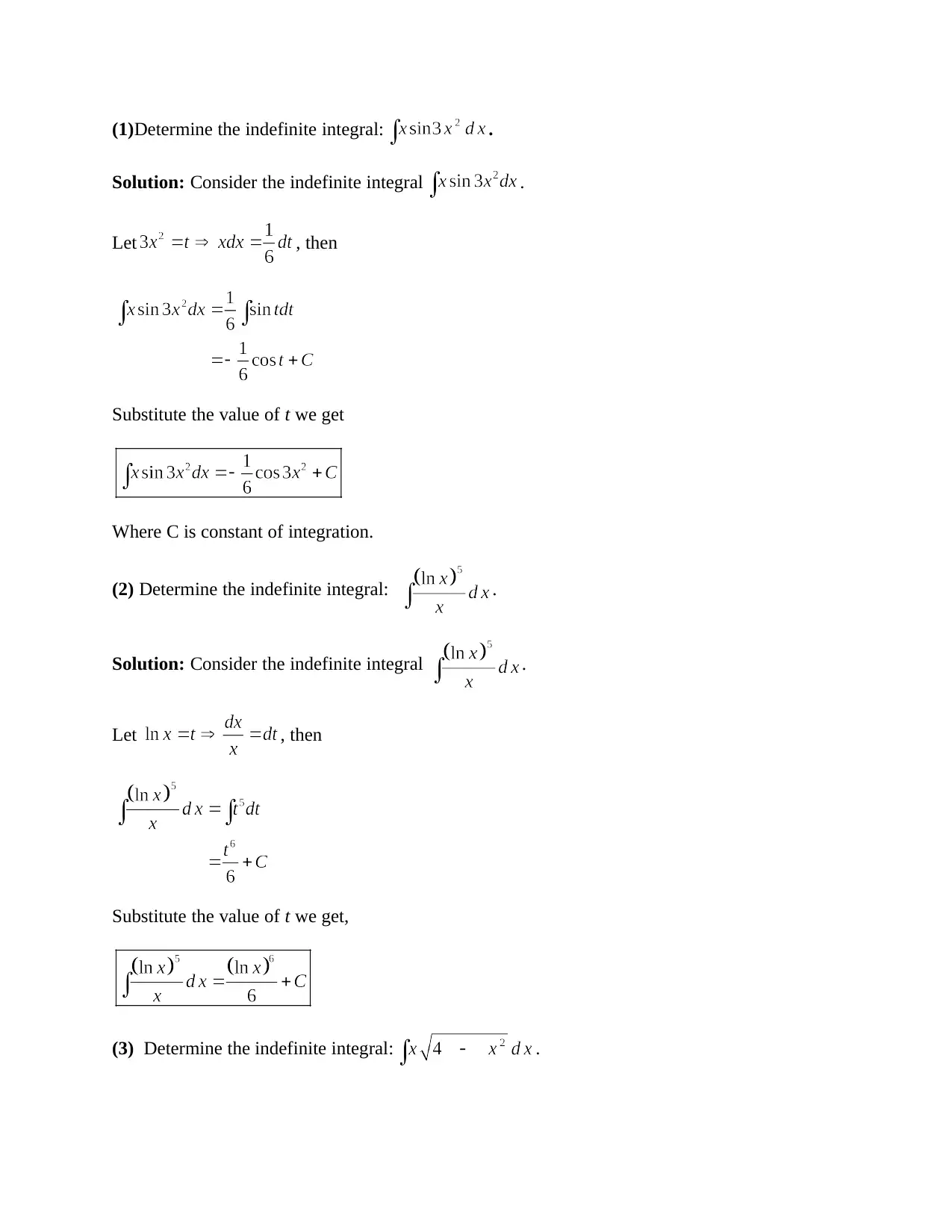
(1)Determine the indefinite integral: .
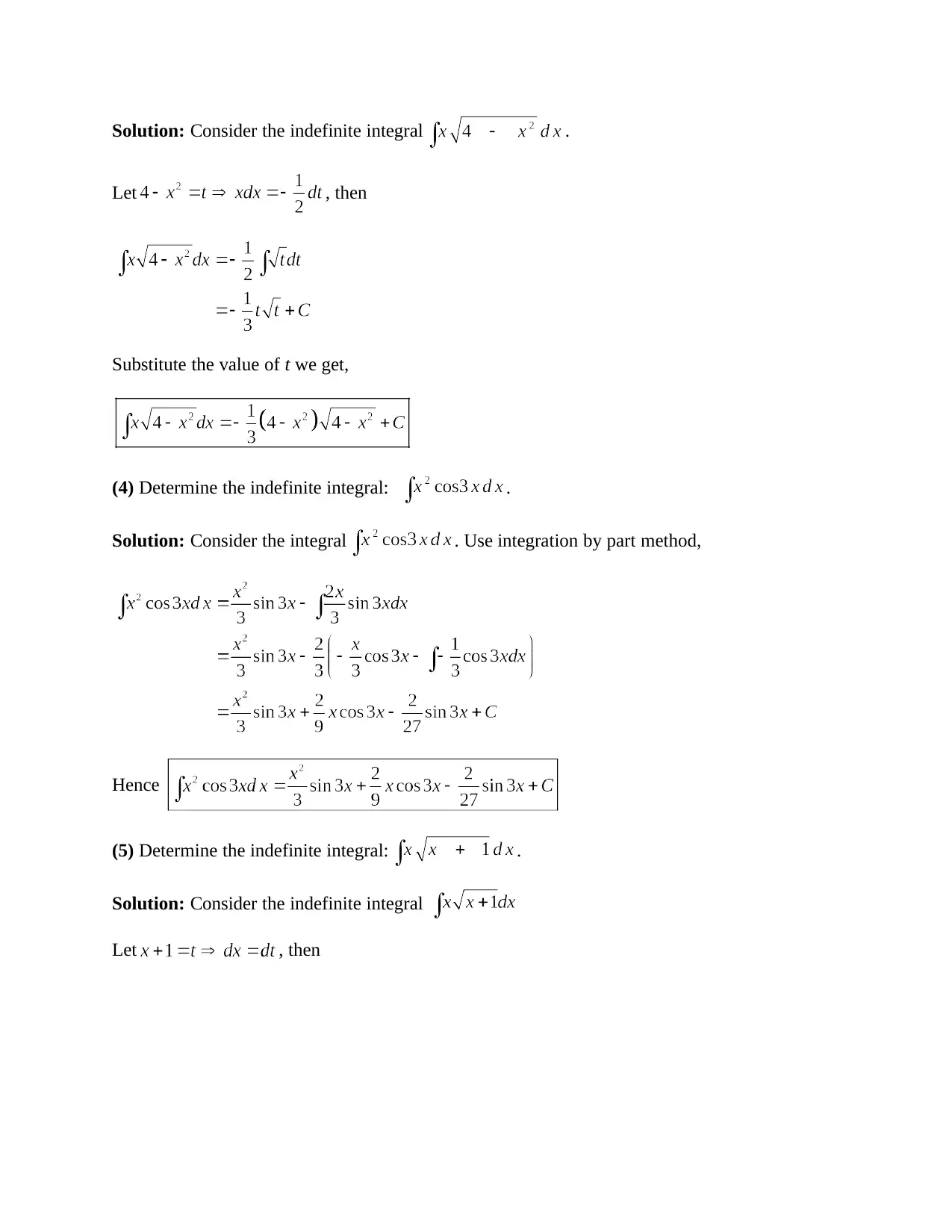
Solution: Consider the indefinite integral .
Let , then
Substitute the value of t we get
Where C is constant of integration.
(2) Determine the indefinite integral: .
Solution: Consider the indefinite integral .
Let , then
Substitute the value of t we get,
(3) Determine the indefinite integral: .
tabler-icon-diamond-filled.svg

Paraphrase This Document

Need a fresh take? Get an instant paraphrase of this document with our AI Paraphraser
Document Page
Solution: Consider the indefinite integral .
Let , then
Substitute the value of t we get,
(4) Determine the indefinite integral: .
Solution: Consider the integral . Use integration by part method,
Hence
(5) Determine the indefinite integral: .
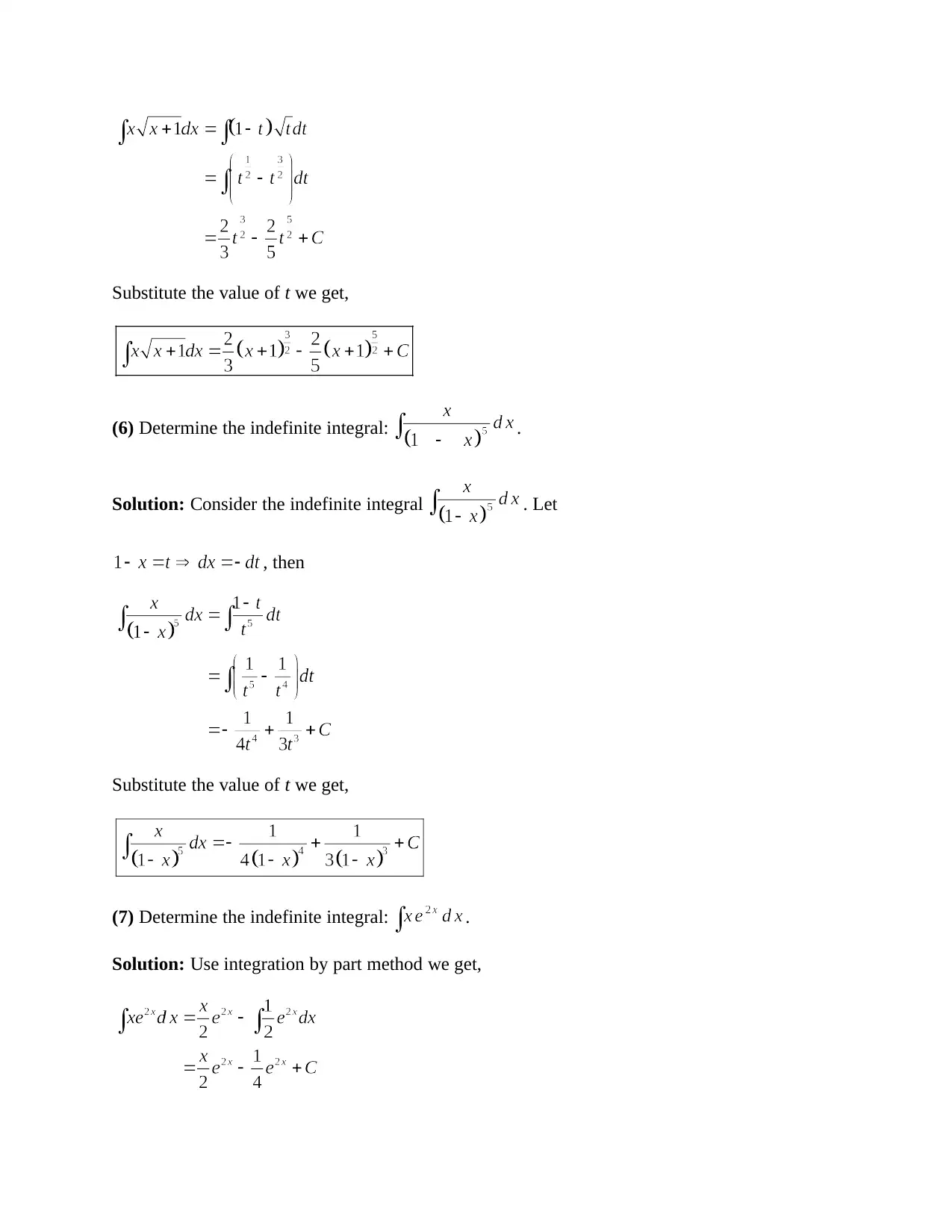
Solution: Consider the indefinite integral
Let , then
Document Page
Substitute the value of t we get,
(6) Determine the indefinite integral: .
Solution: Consider the indefinite integral . Let
, then
Substitute the value of t we get,
(7) Determine the indefinite integral: .
Solution: Use integration by part method we get,
Document Page
Hence
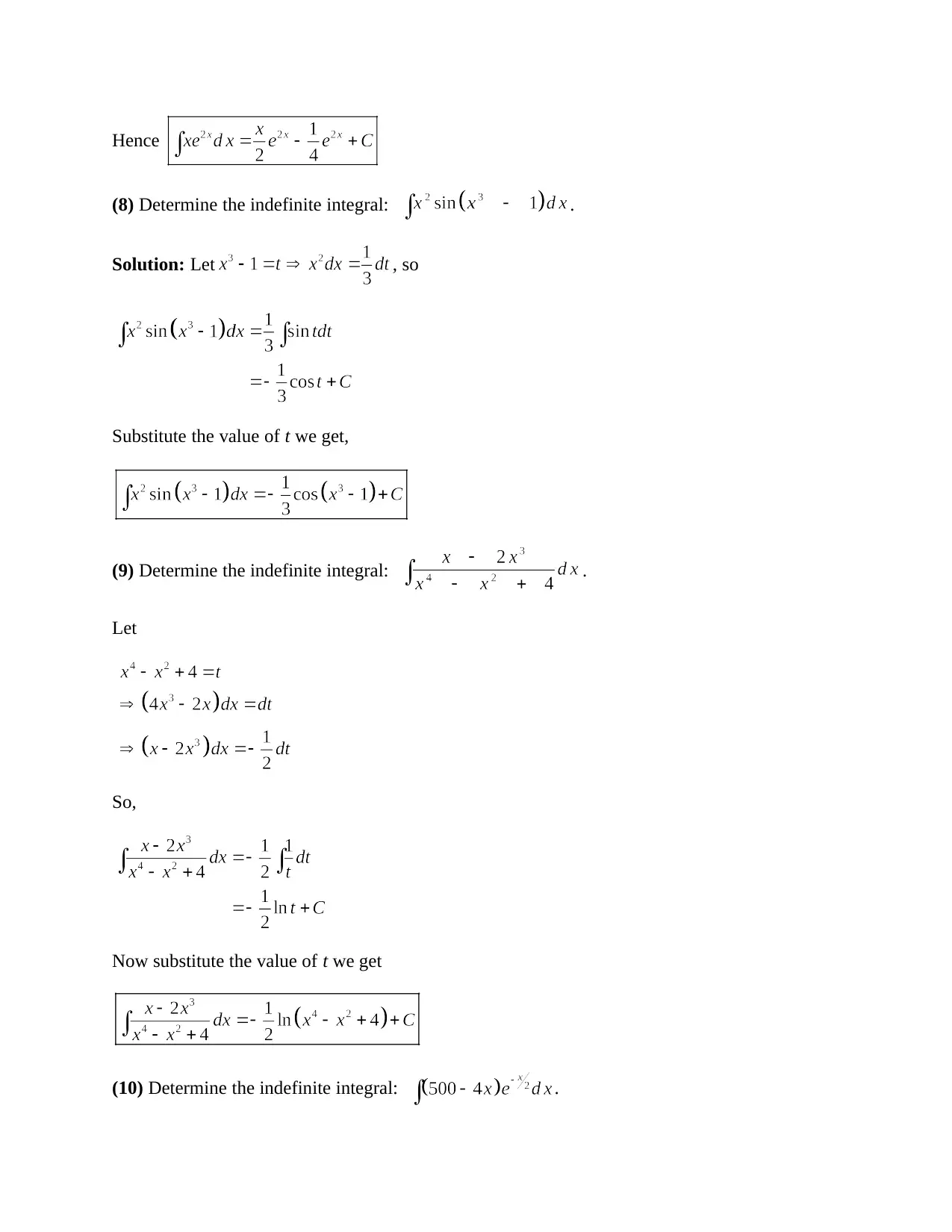
(8) Determine the indefinite integral: .
Solution: Let , so
Substitute the value of t we get,
(9) Determine the indefinite integral: .
Let
So,
Now substitute the value of t we get
(10) Determine the indefinite integral: .
tabler-icon-diamond-filled.svg

Paraphrase This Document

Need a fresh take? Get an instant paraphrase of this document with our AI Paraphraser
Document Page
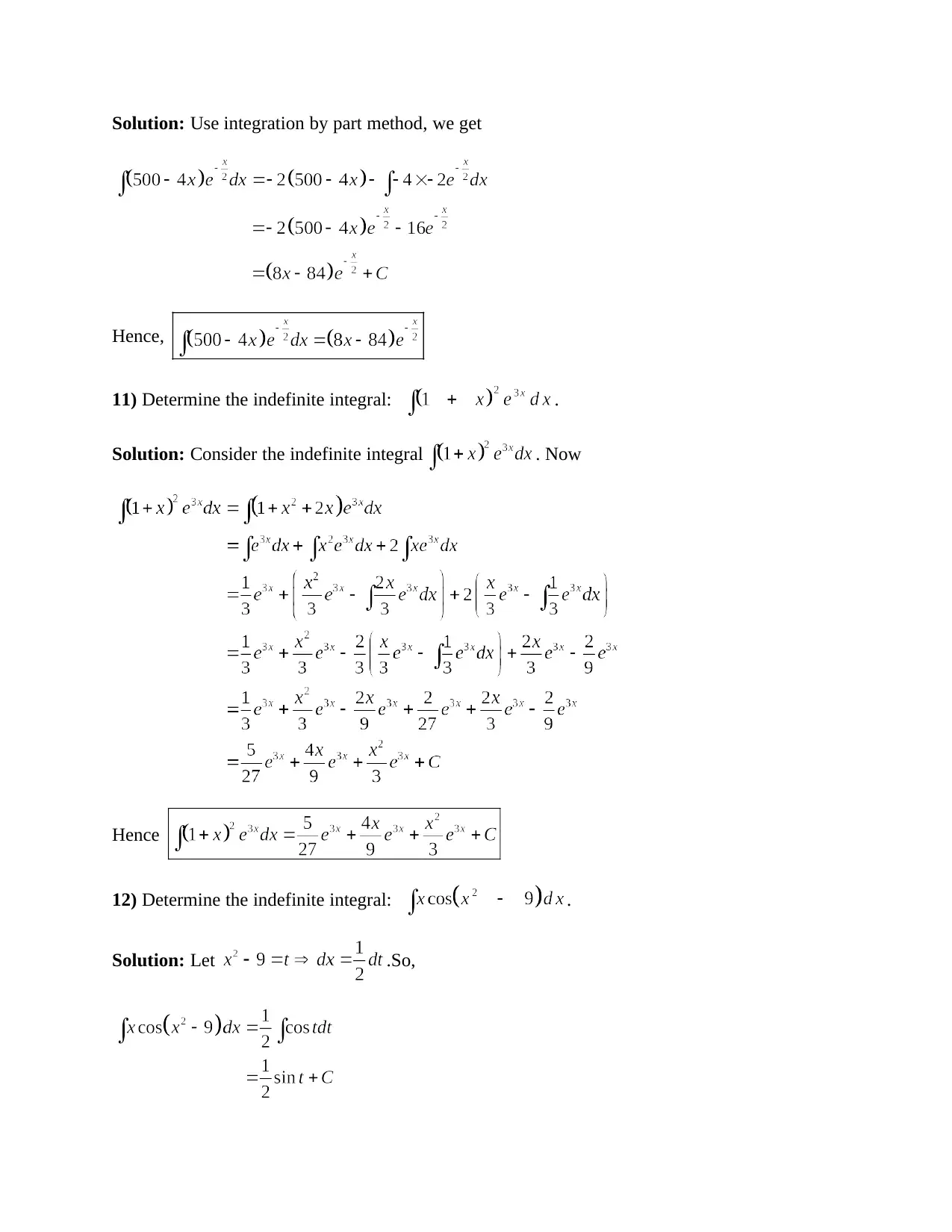
Solution: Use integration by part method, we get
Hence,
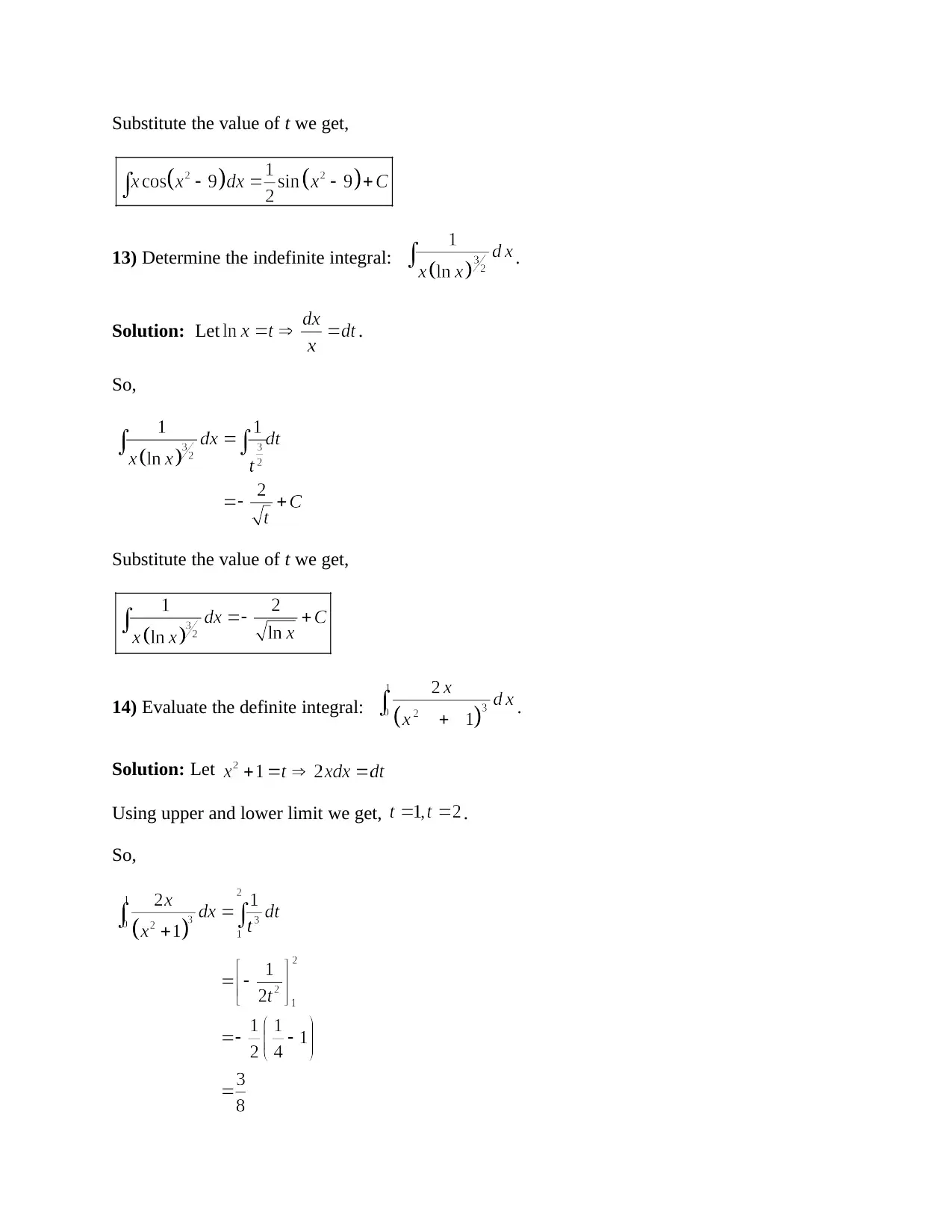
11) Determine the indefinite integral: .
Solution: Consider the indefinite integral . Now
Hence
12) Determine the indefinite integral: .
Solution: Let .So,
Document Page
Substitute the value of t we get,
13) Determine the indefinite integral: .
Solution: Let .
So,
Substitute the value of t we get,
14) Evaluate the definite integral: .
Solution: Let
Using upper and lower limit we get, .
So,
Document Page
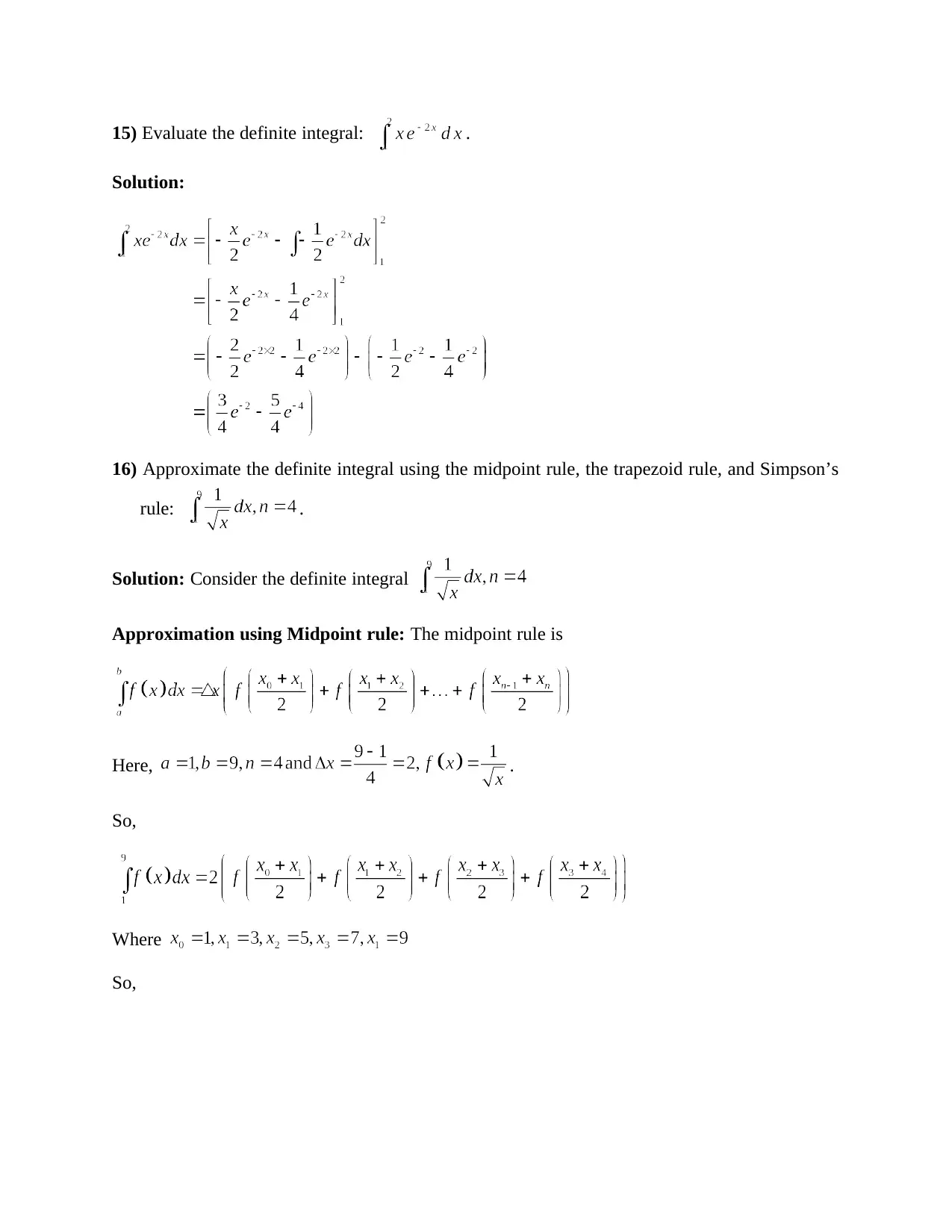
15) Evaluate the definite integral: .
Solution:
16) Approximate the definite integral using the midpoint rule, the trapezoid rule, and Simpson’s
rule: .
Solution: Consider the definite integral
Approximation using Midpoint rule: The midpoint rule is
Here, .
So,
Where
So,
tabler-icon-diamond-filled.svg

Paraphrase This Document

Need a fresh take? Get an instant paraphrase of this document with our AI Paraphraser
Document Page
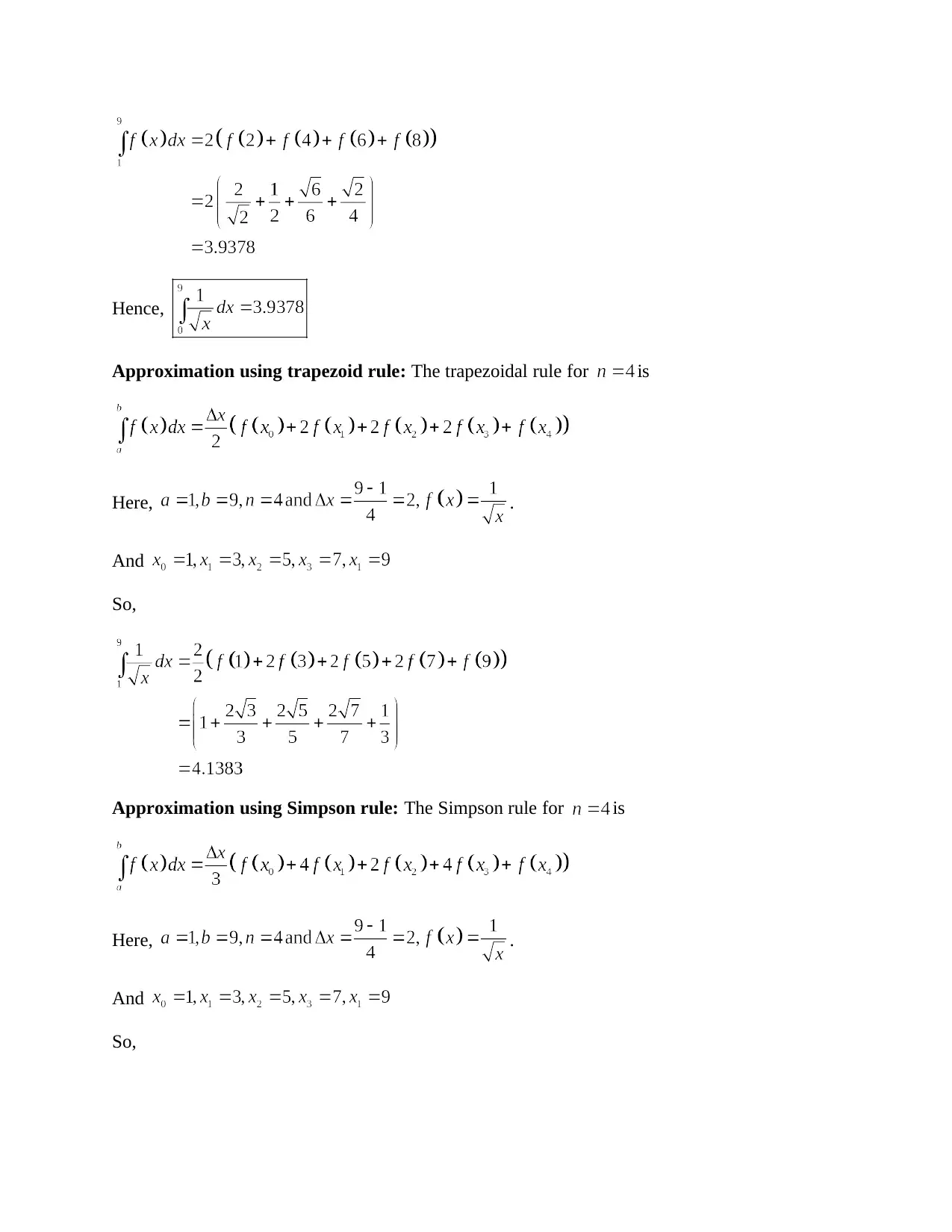
Hence,
Approximation using trapezoid rule: The trapezoidal rule for is
Here, .
And
So,
Approximation using Simpson rule: The Simpson rule for is
Here, .
And
So,
Document Page
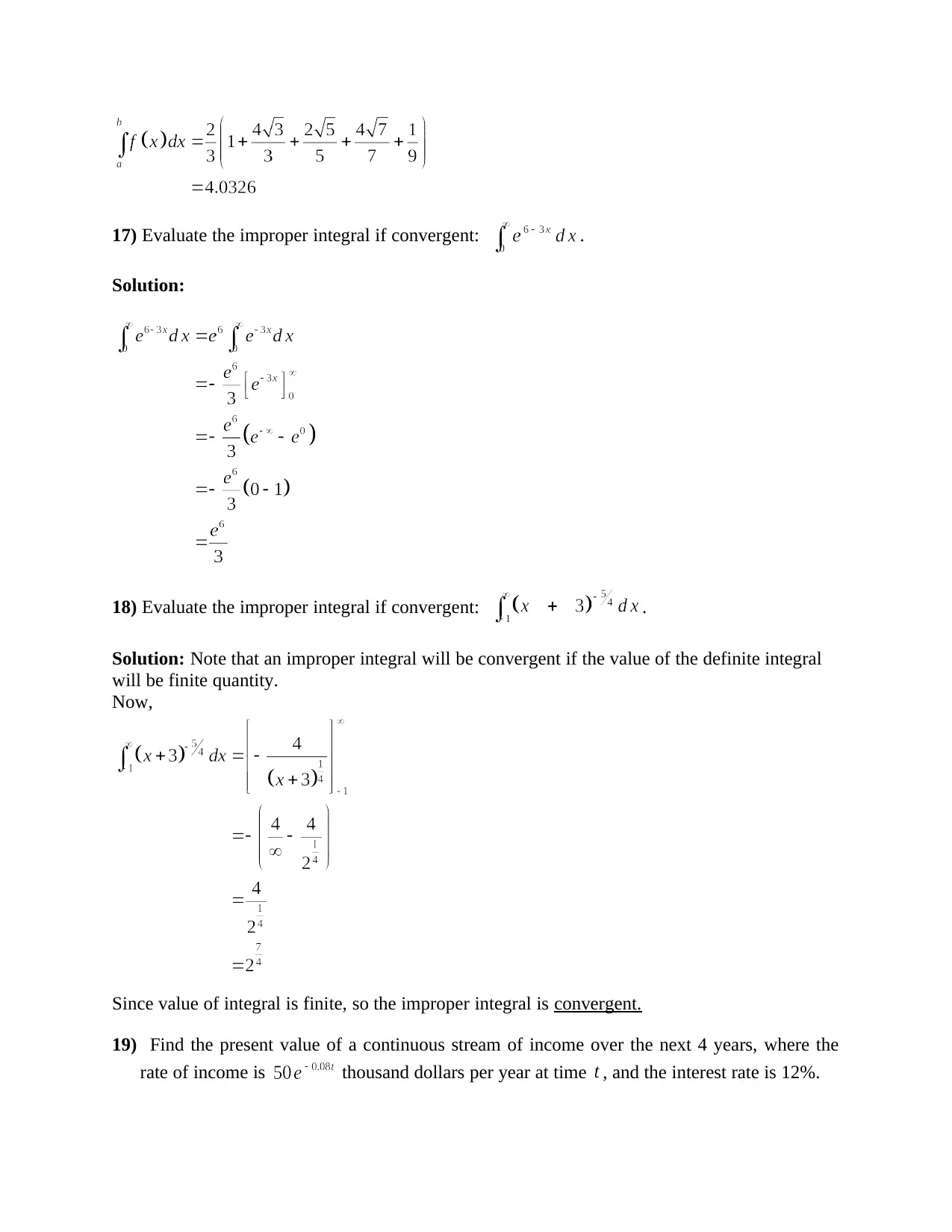
17) Evaluate the improper integral if convergent: .
Solution:
18) Evaluate the improper integral if convergent: .
Solution: Note that an improper integral will be convergent if the value of the definite integral
will be finite quantity.
Now,
Since value of integral is finite, so the improper integral is convergent.
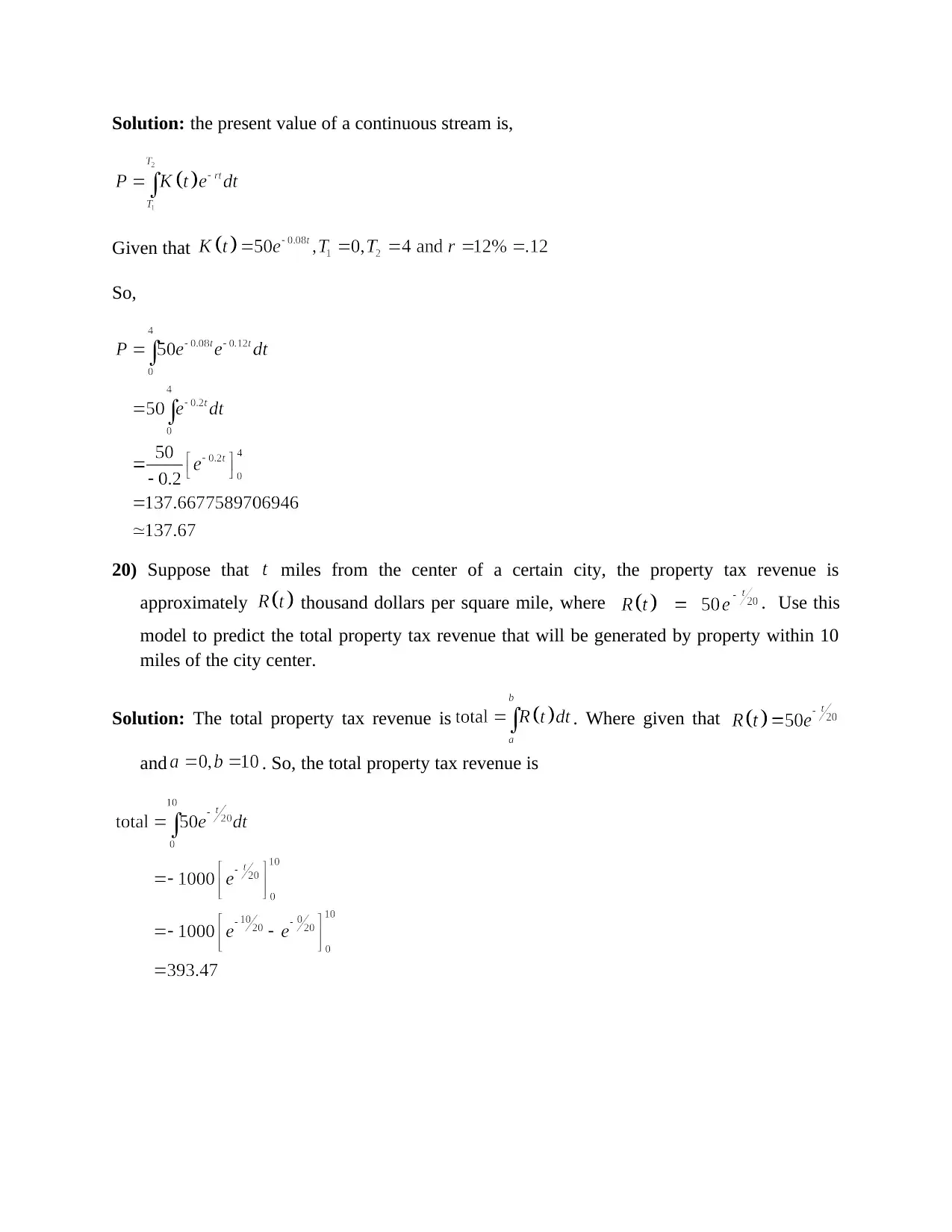
19) Find the present value of a continuous stream of income over the next 4 years, where the
rate of income is thousand dollars per year at time , and the interest rate is 12%.
Document Page
Solution: the present value of a continuous stream is,
Given that
So,
20) Suppose that miles from the center of a certain city, the property tax revenue is
approximately thousand dollars per square mile, where . Use this
model to predict the total property tax revenue that will be generated by property within 10
miles of the city center.
Solution: The total property tax revenue is . Where given that
and . So, the total property tax revenue is
chevron_up_icon
1 out of 10
circle_padding
hide_on_mobile
zoom_out_icon
[object Object]