Law for Social Work: Indigenous Knowledge & Intellectual Property
VerifiedAdded on 2023/06/05
|20
|5755
|145
Essay
AI Summary
This essay delves into the complex intersection of indigenous traditional knowledge and intellectual property law, highlighting the challenges and opportunities in protecting indigenous rights. It examines the political and definitional problems associated with indigenous knowledge, showcasing examples of both the use and misuse of this knowledge, including case studies like AVEDA, Batik design in Indonesia, Bikram Yoga, the Genographic Project, the San/Hoodia Plant, I La Galigo, and Maori v Lego. The essay further explores current proposals, ranging from treaties to private legislation, aimed at safeguarding indigenous knowledge, while addressing the dangers, problems, and opportunities these proposals present. It emphasizes the need for accessible and comprehensive solutions that respect indigenous modes of understanding and classifying traditional knowledge.
Law for Social Work 1
INDIGENOUS TRADITIONAL KNOWLEDGE & INTELLECTUAL PROPERTY
[Author(s) name(s):]
Law for Social Work
[Institution:]
[Tutor(s) name(s):]
[City and State:]
[Date:]
INDIGENOUS TRADITIONAL KNOWLEDGE & INTELLECTUAL PROPERTY
[Author(s) name(s):]
Law for Social Work
[Institution:]
[Tutor(s) name(s):]
[City and State:]
[Date:]

Paraphrase This Document
Need a fresh take? Get an instant paraphrase of this document with our AI Paraphraser
Law for Social Work 2
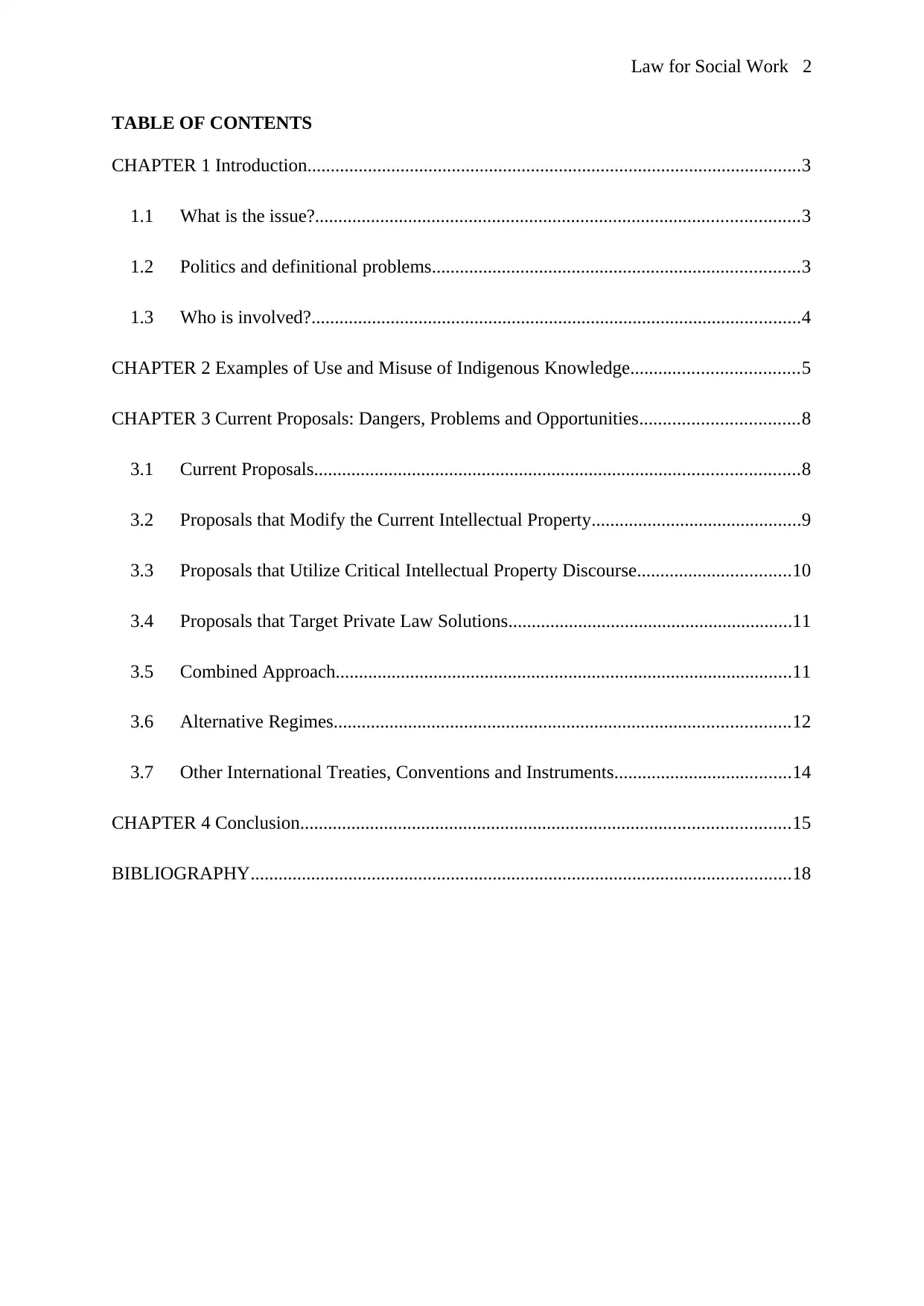
TABLE OF CONTENTS
CHAPTER 1 Introduction..........................................................................................................3
1.1 What is the issue?........................................................................................................3
1.2 Politics and definitional problems...............................................................................3
1.3 Who is involved?.........................................................................................................4
CHAPTER 2 Examples of Use and Misuse of Indigenous Knowledge....................................5
CHAPTER 3 Current Proposals: Dangers, Problems and Opportunities..................................8
3.1 Current Proposals........................................................................................................8
3.2 Proposals that Modify the Current Intellectual Property.............................................9
3.3 Proposals that Utilize Critical Intellectual Property Discourse.................................10
3.4 Proposals that Target Private Law Solutions.............................................................11
3.5 Combined Approach..................................................................................................11
3.6 Alternative Regimes..................................................................................................12
3.7 Other International Treaties, Conventions and Instruments......................................14
CHAPTER 4 Conclusion.........................................................................................................15
BIBLIOGRAPHY....................................................................................................................18
TABLE OF CONTENTS
CHAPTER 1 Introduction..........................................................................................................3
1.1 What is the issue?........................................................................................................3
1.2 Politics and definitional problems...............................................................................3
1.3 Who is involved?.........................................................................................................4
CHAPTER 2 Examples of Use and Misuse of Indigenous Knowledge....................................5
CHAPTER 3 Current Proposals: Dangers, Problems and Opportunities..................................8
3.1 Current Proposals........................................................................................................8
3.2 Proposals that Modify the Current Intellectual Property.............................................9
3.3 Proposals that Utilize Critical Intellectual Property Discourse.................................10
3.4 Proposals that Target Private Law Solutions.............................................................11
3.5 Combined Approach..................................................................................................11
3.6 Alternative Regimes..................................................................................................12
3.7 Other International Treaties, Conventions and Instruments......................................14
CHAPTER 4 Conclusion.........................................................................................................15
BIBLIOGRAPHY....................................................................................................................18
Law for Social Work 3
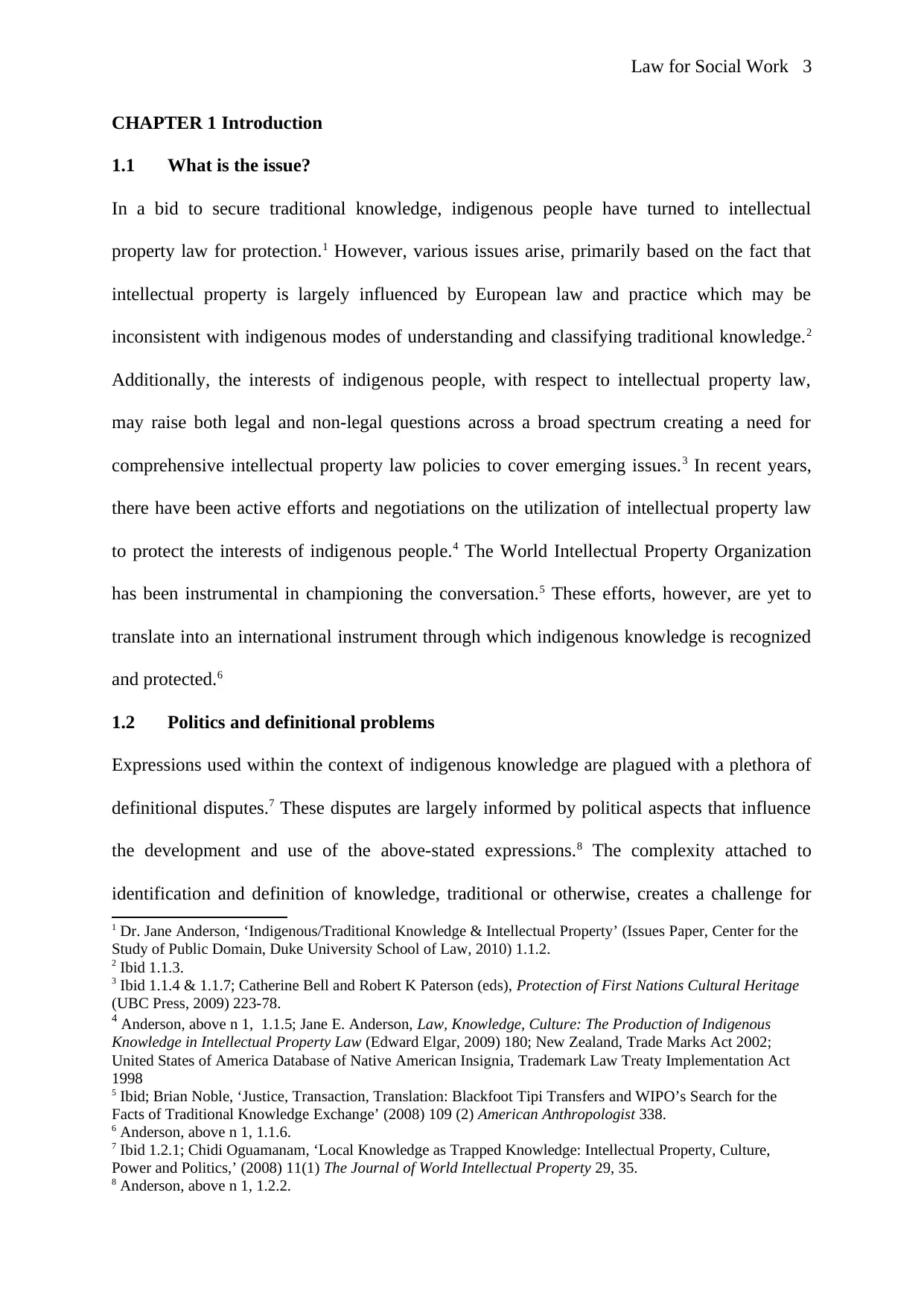
CHAPTER 1 Introduction
1.1 What is the issue?
In a bid to secure traditional knowledge, indigenous people have turned to intellectual
property law for protection.1 However, various issues arise, primarily based on the fact that
intellectual property is largely influenced by European law and practice which may be
inconsistent with indigenous modes of understanding and classifying traditional knowledge.2
Additionally, the interests of indigenous people, with respect to intellectual property law,
may raise both legal and non-legal questions across a broad spectrum creating a need for
comprehensive intellectual property law policies to cover emerging issues.3 In recent years,
there have been active efforts and negotiations on the utilization of intellectual property law
to protect the interests of indigenous people.4 The World Intellectual Property Organization
has been instrumental in championing the conversation.5 These efforts, however, are yet to
translate into an international instrument through which indigenous knowledge is recognized
and protected.6
1.2 Politics and definitional problems
Expressions used within the context of indigenous knowledge are plagued with a plethora of
definitional disputes.7 These disputes are largely informed by political aspects that influence
the development and use of the above-stated expressions.8 The complexity attached to
identification and definition of knowledge, traditional or otherwise, creates a challenge for
1 Dr. Jane Anderson, ‘Indigenous/Traditional Knowledge & Intellectual Property’ (Issues Paper, Center for the
Study of Public Domain, Duke University School of Law, 2010) 1.1.2.
2 Ibid 1.1.3.
3 Ibid 1.1.4 & 1.1.7; Catherine Bell and Robert K Paterson (eds), Protection of First Nations Cultural Heritage
(UBC Press, 2009) 223-78.
4 Anderson, above n 1, 1.1.5; Jane E. Anderson, Law, Knowledge, Culture: The Production of Indigenous
Knowledge in Intellectual Property Law (Edward Elgar, 2009) 180; New Zealand, Trade Marks Act 2002;
United States of America Database of Native American Insignia, Trademark Law Treaty Implementation Act
1998
5 Ibid; Brian Noble, ‘Justice, Transaction, Translation: Blackfoot Tipi Transfers and WIPO’s Search for the
Facts of Traditional Knowledge Exchange’ (2008) 109 (2) American Anthropologist 338.
6 Anderson, above n 1, 1.1.6.
7 Ibid 1.2.1; Chidi Oguamanam, ‘Local Knowledge as Trapped Knowledge: Intellectual Property, Culture,
Power and Politics,’ (2008) 11(1) The Journal of World Intellectual Property 29, 35.
8 Anderson, above n 1, 1.2.2.
CHAPTER 1 Introduction
1.1 What is the issue?
In a bid to secure traditional knowledge, indigenous people have turned to intellectual
property law for protection.1 However, various issues arise, primarily based on the fact that
intellectual property is largely influenced by European law and practice which may be
inconsistent with indigenous modes of understanding and classifying traditional knowledge.2
Additionally, the interests of indigenous people, with respect to intellectual property law,
may raise both legal and non-legal questions across a broad spectrum creating a need for
comprehensive intellectual property law policies to cover emerging issues.3 In recent years,
there have been active efforts and negotiations on the utilization of intellectual property law
to protect the interests of indigenous people.4 The World Intellectual Property Organization
has been instrumental in championing the conversation.5 These efforts, however, are yet to
translate into an international instrument through which indigenous knowledge is recognized
and protected.6
1.2 Politics and definitional problems
Expressions used within the context of indigenous knowledge are plagued with a plethora of
definitional disputes.7 These disputes are largely informed by political aspects that influence
the development and use of the above-stated expressions.8 The complexity attached to
identification and definition of knowledge, traditional or otherwise, creates a challenge for
1 Dr. Jane Anderson, ‘Indigenous/Traditional Knowledge & Intellectual Property’ (Issues Paper, Center for the
Study of Public Domain, Duke University School of Law, 2010) 1.1.2.
2 Ibid 1.1.3.
3 Ibid 1.1.4 & 1.1.7; Catherine Bell and Robert K Paterson (eds), Protection of First Nations Cultural Heritage
(UBC Press, 2009) 223-78.
4 Anderson, above n 1, 1.1.5; Jane E. Anderson, Law, Knowledge, Culture: The Production of Indigenous
Knowledge in Intellectual Property Law (Edward Elgar, 2009) 180; New Zealand, Trade Marks Act 2002;
United States of America Database of Native American Insignia, Trademark Law Treaty Implementation Act
1998
5 Ibid; Brian Noble, ‘Justice, Transaction, Translation: Blackfoot Tipi Transfers and WIPO’s Search for the
Facts of Traditional Knowledge Exchange’ (2008) 109 (2) American Anthropologist 338.
6 Anderson, above n 1, 1.1.6.
7 Ibid 1.2.1; Chidi Oguamanam, ‘Local Knowledge as Trapped Knowledge: Intellectual Property, Culture,
Power and Politics,’ (2008) 11(1) The Journal of World Intellectual Property 29, 35.
8 Anderson, above n 1, 1.2.2.
⊘ This is a preview!⊘
Do you want full access?
Subscribe today to unlock all pages.

Trusted by 1+ million students worldwide
Law for Social Work 4
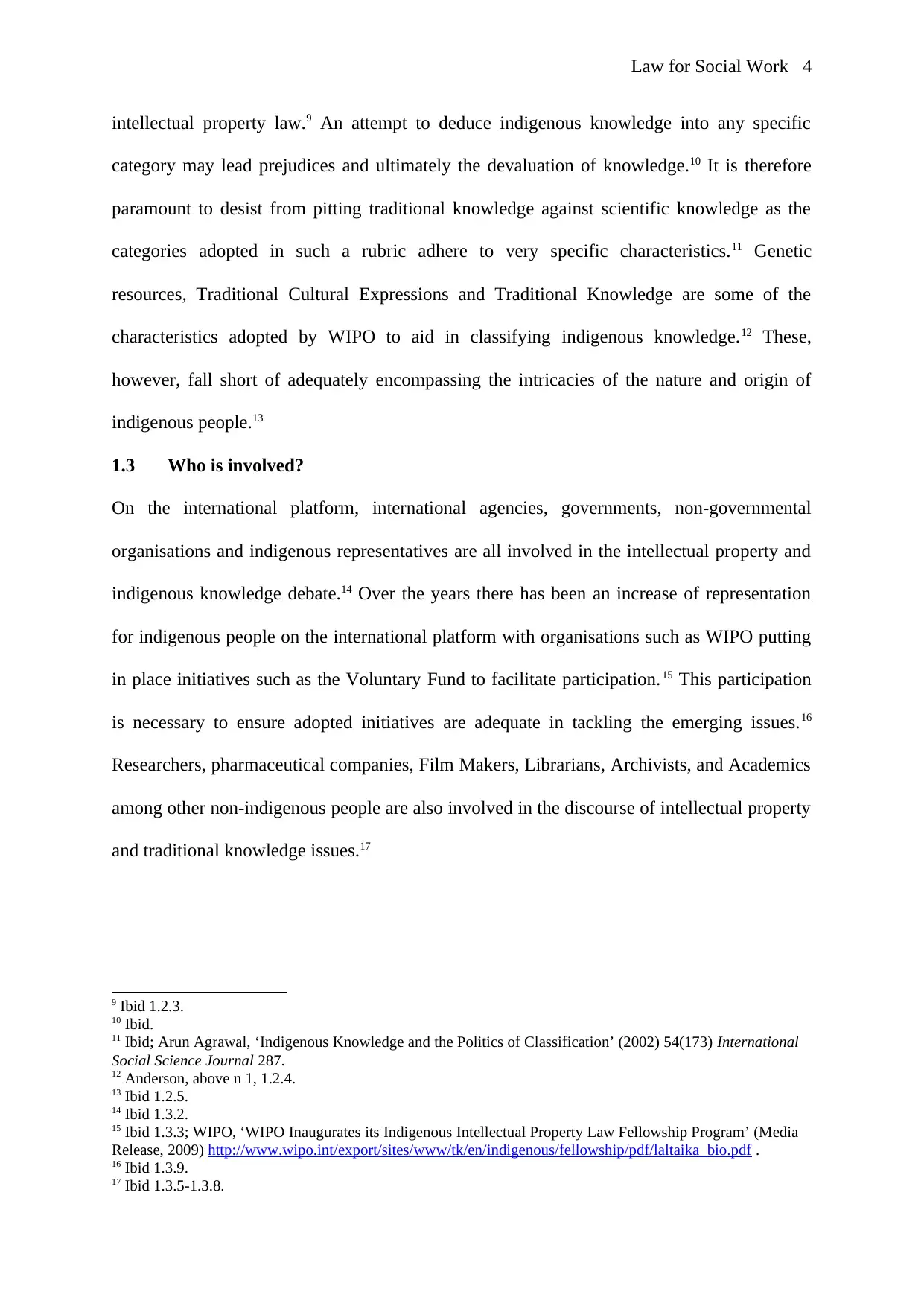
intellectual property law.9 An attempt to deduce indigenous knowledge into any specific
category may lead prejudices and ultimately the devaluation of knowledge.10 It is therefore
paramount to desist from pitting traditional knowledge against scientific knowledge as the
categories adopted in such a rubric adhere to very specific characteristics.11 Genetic
resources, Traditional Cultural Expressions and Traditional Knowledge are some of the
characteristics adopted by WIPO to aid in classifying indigenous knowledge.12 These,
however, fall short of adequately encompassing the intricacies of the nature and origin of
indigenous people.13
1.3 Who is involved?
On the international platform, international agencies, governments, non-governmental
organisations and indigenous representatives are all involved in the intellectual property and
indigenous knowledge debate.14 Over the years there has been an increase of representation
for indigenous people on the international platform with organisations such as WIPO putting
in place initiatives such as the Voluntary Fund to facilitate participation.15 This participation
is necessary to ensure adopted initiatives are adequate in tackling the emerging issues.16
Researchers, pharmaceutical companies, Film Makers, Librarians, Archivists, and Academics
among other non-indigenous people are also involved in the discourse of intellectual property
and traditional knowledge issues.17
9 Ibid 1.2.3.
10 Ibid.
11 Ibid; Arun Agrawal, ‘Indigenous Knowledge and the Politics of Classification’ (2002) 54(173) International
Social Science Journal 287.
12 Anderson, above n 1, 1.2.4.
13 Ibid 1.2.5.
14 Ibid 1.3.2.
15 Ibid 1.3.3; WIPO, ‘WIPO Inaugurates its Indigenous Intellectual Property Law Fellowship Program’ (Media
Release, 2009) http://www.wipo.int/export/sites/www/tk/en/indigenous/fellowship/pdf/laltaika_bio.pdf .
16 Ibid 1.3.9.
17 Ibid 1.3.5-1.3.8.
intellectual property law.9 An attempt to deduce indigenous knowledge into any specific
category may lead prejudices and ultimately the devaluation of knowledge.10 It is therefore
paramount to desist from pitting traditional knowledge against scientific knowledge as the
categories adopted in such a rubric adhere to very specific characteristics.11 Genetic
resources, Traditional Cultural Expressions and Traditional Knowledge are some of the
characteristics adopted by WIPO to aid in classifying indigenous knowledge.12 These,
however, fall short of adequately encompassing the intricacies of the nature and origin of
indigenous people.13
1.3 Who is involved?
On the international platform, international agencies, governments, non-governmental
organisations and indigenous representatives are all involved in the intellectual property and
indigenous knowledge debate.14 Over the years there has been an increase of representation
for indigenous people on the international platform with organisations such as WIPO putting
in place initiatives such as the Voluntary Fund to facilitate participation.15 This participation
is necessary to ensure adopted initiatives are adequate in tackling the emerging issues.16
Researchers, pharmaceutical companies, Film Makers, Librarians, Archivists, and Academics
among other non-indigenous people are also involved in the discourse of intellectual property
and traditional knowledge issues.17
9 Ibid 1.2.3.
10 Ibid.
11 Ibid; Arun Agrawal, ‘Indigenous Knowledge and the Politics of Classification’ (2002) 54(173) International
Social Science Journal 287.
12 Anderson, above n 1, 1.2.4.
13 Ibid 1.2.5.
14 Ibid 1.3.2.
15 Ibid 1.3.3; WIPO, ‘WIPO Inaugurates its Indigenous Intellectual Property Law Fellowship Program’ (Media
Release, 2009) http://www.wipo.int/export/sites/www/tk/en/indigenous/fellowship/pdf/laltaika_bio.pdf .
16 Ibid 1.3.9.
17 Ibid 1.3.5-1.3.8.
Paraphrase This Document
Need a fresh take? Get an instant paraphrase of this document with our AI Paraphraser
Law for Social Work 5
CHAPTER 2 Examples of Use and Misuse of Indigenous Knowledge
In the AVEDA case of 2006, the cosmetics company launched a skincare line dubbed
‘Indigenous’ and went on to trademark the word ‘Indigenous’ to secure their marketing
strategy.18 AVEDA received massive backlash worldwide as people believed that a word as
politically and internationally significant as ‘Indigenous’ to marginalised communities should
not be limited to use by a cosmetic organisation for financial gain.19 The outrage eventually
led AVEDA to terminate the line as well as the trademark.20 Since then, AVEDA has
committed to promoting the interests and protecting the knowledge of indigenous
communities.21 This is evident in their establishment of benefit-sharing agreements with
indigenous communities such as the Katkabubba in Australia.22 AVEDA has also promoted
the participation of indigenous people in global discussions on intellectual property rights by
funding their engagement in negotiation forums.23
The Batik design case study in Indonesia illustrates how governments can react to ensure
proper use of indigenous knowledge. Solo, Java is historically recognised as the batik artistic
community in Indonesia.24 In an effort to protect the rights of batik artists in Solo, the
government has made considerable efforts to protect the art and curb rising reproduction in
other communities and countries.25 The local government established a patent registration
programme in Solo.26 This, however, has led to new challenges as smaller producers fail to
18 Anderson, above n 1, 2.1.1.
19 Ibid.
20 Ibid 2.1.2; Aveda, ‘Aveda Announces Discontinuation of Indigenous Product Collection’ (Press Release, 4
November 2003) http://aveda.aveda.com/about/press/indigenous.asp
21 Ibid 2.1.3.
22 Ibid 2.1.3; Dora Marinova and Margaret Raven, ‘Indigenous Knowledge and Intellectual Property: A
Sustainability Agenda’ (2006) 20(4) Journal of Economic Surveys 587; Songman Circle of Wisdom Indigenous
Plant Certification Protocol http://www.atns.net.au/agreement.asp?EntityID=2882
23 Ibid 2.1.4; Tribal Link Foundation http://www.tribal-link.org/
24 Anderson, above n 1, 2.2.1.
25 Ibid 2.2.2; Peter A. Jaszi, ‘ Traditional Culture: A Step Forward for Protection in Indonesia’ (WCL Research
Paper No. 2010-16, Ford Foundation, American University, 2010)
26 Ibid 2.2.3; Charles Knobloch and Dewi Savitri Reni, ‘Using Batikmark as a First Step to Extend Protection of
Indonesian Javanese-batik Patterned Textile in Foreign Countries’ Arnold & Knobloch LLP, 5 February 2009
http://www.usptclaw.com/pdfs/Batikmark_Article.pdf
CHAPTER 2 Examples of Use and Misuse of Indigenous Knowledge
In the AVEDA case of 2006, the cosmetics company launched a skincare line dubbed
‘Indigenous’ and went on to trademark the word ‘Indigenous’ to secure their marketing
strategy.18 AVEDA received massive backlash worldwide as people believed that a word as
politically and internationally significant as ‘Indigenous’ to marginalised communities should
not be limited to use by a cosmetic organisation for financial gain.19 The outrage eventually
led AVEDA to terminate the line as well as the trademark.20 Since then, AVEDA has
committed to promoting the interests and protecting the knowledge of indigenous
communities.21 This is evident in their establishment of benefit-sharing agreements with
indigenous communities such as the Katkabubba in Australia.22 AVEDA has also promoted
the participation of indigenous people in global discussions on intellectual property rights by
funding their engagement in negotiation forums.23
The Batik design case study in Indonesia illustrates how governments can react to ensure
proper use of indigenous knowledge. Solo, Java is historically recognised as the batik artistic
community in Indonesia.24 In an effort to protect the rights of batik artists in Solo, the
government has made considerable efforts to protect the art and curb rising reproduction in
other communities and countries.25 The local government established a patent registration
programme in Solo.26 This, however, has led to new challenges as smaller producers fail to
18 Anderson, above n 1, 2.1.1.
19 Ibid.
20 Ibid 2.1.2; Aveda, ‘Aveda Announces Discontinuation of Indigenous Product Collection’ (Press Release, 4
November 2003) http://aveda.aveda.com/about/press/indigenous.asp
21 Ibid 2.1.3.
22 Ibid 2.1.3; Dora Marinova and Margaret Raven, ‘Indigenous Knowledge and Intellectual Property: A
Sustainability Agenda’ (2006) 20(4) Journal of Economic Surveys 587; Songman Circle of Wisdom Indigenous
Plant Certification Protocol http://www.atns.net.au/agreement.asp?EntityID=2882
23 Ibid 2.1.4; Tribal Link Foundation http://www.tribal-link.org/
24 Anderson, above n 1, 2.2.1.
25 Ibid 2.2.2; Peter A. Jaszi, ‘ Traditional Culture: A Step Forward for Protection in Indonesia’ (WCL Research
Paper No. 2010-16, Ford Foundation, American University, 2010)
26 Ibid 2.2.3; Charles Knobloch and Dewi Savitri Reni, ‘Using Batikmark as a First Step to Extend Protection of
Indonesian Javanese-batik Patterned Textile in Foreign Countries’ Arnold & Knobloch LLP, 5 February 2009
http://www.usptclaw.com/pdfs/Batikmark_Article.pdf
Law for Social Work 6
meet the fees required to register patents or seek permission to use a registered design.27 They
are therefore cut off by the very measures created to protect them.28
In Open Source Yoga Unity v Bikram Choudhury No. C 03-3182 PJH. (N.D. Cal. Apr. 1,
2005), the copyright of yoga asana sequences derived from Indian indigenous knowledge by
Bikram Choudhury, illustrates a misuse of traditional knowledge.29 Choudhury began
copyrighting postures and breathing exercises in 1979 and has since challenged various
trainers and practitioners for using them without permission.30 In 2005, Open Source Yoga
Unity sought to challenge the validity of Bikram’s trademarks and copyrights in court; the
issues remain unsolved to date.31 In response, government representatives in India have
committed to legally challenge Bikram Yoga’s copyrights on grounds that they amount to
misuse of indigenous knowledge.32 Efforts have also been made to register asanas to protect
similar misuse in the future.33
The Genographic Project, launched in 2005, presents another illustration of possible misuse
of indigenous knowledge.34 In this case study, IBM, the Wiatt Family Foundation and
National Geographic launched the Genographic projects aimed at researching and resolving
issues on the genesis of human diversity based on genetics.35 The project relies on the
collection and analysis of over 100,000 DNA samples from indigenous people.36 The
challenge arose from the lack of uniformity in the collection, control and protection of bio-
banks and genetic databases.37 A Resolution passed by the National Congress of American
Indians sought to halt the process until sufficient guidelines where put in place to ensure the
27 Jaszi above n 25; 2.2.5
28 Ibid.
29 Anderson, above n 1, 2.3.1-2.3.2.
30 Ibid 2.3.3.
31 Ibid 2.3.4; Open Source Yoga Unity v Bikram Choudhury No. C 03-3182 PJH. (N.D. Cal. Apr. 1, 2005).
32 Ibid 2.3.5.
33 Ibid.
34 Ibid 2.4.1
35 Ibid.
36 Ibid.
37 Ibid 2.4.2
meet the fees required to register patents or seek permission to use a registered design.27 They
are therefore cut off by the very measures created to protect them.28
In Open Source Yoga Unity v Bikram Choudhury No. C 03-3182 PJH. (N.D. Cal. Apr. 1,
2005), the copyright of yoga asana sequences derived from Indian indigenous knowledge by
Bikram Choudhury, illustrates a misuse of traditional knowledge.29 Choudhury began
copyrighting postures and breathing exercises in 1979 and has since challenged various
trainers and practitioners for using them without permission.30 In 2005, Open Source Yoga
Unity sought to challenge the validity of Bikram’s trademarks and copyrights in court; the
issues remain unsolved to date.31 In response, government representatives in India have
committed to legally challenge Bikram Yoga’s copyrights on grounds that they amount to
misuse of indigenous knowledge.32 Efforts have also been made to register asanas to protect
similar misuse in the future.33
The Genographic Project, launched in 2005, presents another illustration of possible misuse
of indigenous knowledge.34 In this case study, IBM, the Wiatt Family Foundation and
National Geographic launched the Genographic projects aimed at researching and resolving
issues on the genesis of human diversity based on genetics.35 The project relies on the
collection and analysis of over 100,000 DNA samples from indigenous people.36 The
challenge arose from the lack of uniformity in the collection, control and protection of bio-
banks and genetic databases.37 A Resolution passed by the National Congress of American
Indians sought to halt the process until sufficient guidelines where put in place to ensure the
27 Jaszi above n 25; 2.2.5
28 Ibid.
29 Anderson, above n 1, 2.3.1-2.3.2.
30 Ibid 2.3.3.
31 Ibid 2.3.4; Open Source Yoga Unity v Bikram Choudhury No. C 03-3182 PJH. (N.D. Cal. Apr. 1, 2005).
32 Ibid 2.3.5.
33 Ibid.
34 Ibid 2.4.1
35 Ibid.
36 Ibid.
37 Ibid 2.4.2
⊘ This is a preview!⊘
Do you want full access?
Subscribe today to unlock all pages.
Trusted by 1+ million students worldwide
Law for Social Work 7
interest of indigenous people were protected in the course of the study.38 The resolution and
current debate are influenced by the changing nature of ownership and the increasing value of
genetic material.39
In the San/Hoodia Plant case, anthropological evidence dating back to the 1930s recognises
the use of the Hoodia plant as an appetite suppressant among the San of Botswana.40 When
the South African Council for Scientific and Industrial Research (CSIR) began efforts to
internationally patent the Hoodia plant and its uses in 2001, the San were not involved or
recognised.41 The CSIR faced backlash from various advocates and in 2003 a benefit-sharing
deal was struck where the San would receive royalties from sales.42 However, in 2008,
Unilever, which had been licensed to use the patents, withdrew its development project thus
halting any benefit to the San from expected sales.43 This case illuminates that indigenous
people are often set aside for the benefit of industry parties with a dominant stake in
negotiations.44
In the I La Galigo, case, the Bugis people of South Sulawesi, Indonesia have suffered a
disadvantage with the continued production and showing of the Sureq Galigo creation story
around the globe without credit or economic compensation to the Bugis people.45 As a
musical theatre production, I La Galigo, has been shown in various countries around the
world attracting vast recognition and an intensified cultural pride among the Buginese.46 It
has also led to the development of intellectual property law with respect to the rights of
performers and copyright protections.47 The Bugis in South Sulawesi, however, have never
38 Anderson, above n 1, 2.4.3
39 Ibid 2.4.5.
40 Ibid 2.5.1.
41 Ibid 2.5.2.
42 Ibid 2.5.3.
43 Ibid 2.5.4
44 Ibid; Kabir Bavikatte, Harry Jonas and Johanna von Braun, ‘Shifting Sands of ABS Best Practice: Hoodia
from the Community Perspective’ Unutki, (2009) http://www.unutki.org/default.php?doc_id=137
45 Anderson, above n 1, 2.6.1-2.6.3.
46 Ibid 2.6.2; Matthew Isaac Cohen, ‘Performance Reviews: I La Galigo’ (2005) 22(1) Asian Theatre Journal
138
47 Anderson, above n 1, 2.6.3.
interest of indigenous people were protected in the course of the study.38 The resolution and
current debate are influenced by the changing nature of ownership and the increasing value of
genetic material.39
In the San/Hoodia Plant case, anthropological evidence dating back to the 1930s recognises
the use of the Hoodia plant as an appetite suppressant among the San of Botswana.40 When
the South African Council for Scientific and Industrial Research (CSIR) began efforts to
internationally patent the Hoodia plant and its uses in 2001, the San were not involved or
recognised.41 The CSIR faced backlash from various advocates and in 2003 a benefit-sharing
deal was struck where the San would receive royalties from sales.42 However, in 2008,
Unilever, which had been licensed to use the patents, withdrew its development project thus
halting any benefit to the San from expected sales.43 This case illuminates that indigenous
people are often set aside for the benefit of industry parties with a dominant stake in
negotiations.44
In the I La Galigo, case, the Bugis people of South Sulawesi, Indonesia have suffered a
disadvantage with the continued production and showing of the Sureq Galigo creation story
around the globe without credit or economic compensation to the Bugis people.45 As a
musical theatre production, I La Galigo, has been shown in various countries around the
world attracting vast recognition and an intensified cultural pride among the Buginese.46 It
has also led to the development of intellectual property law with respect to the rights of
performers and copyright protections.47 The Bugis in South Sulawesi, however, have never
38 Anderson, above n 1, 2.4.3
39 Ibid 2.4.5.
40 Ibid 2.5.1.
41 Ibid 2.5.2.
42 Ibid 2.5.3.
43 Ibid 2.5.4
44 Ibid; Kabir Bavikatte, Harry Jonas and Johanna von Braun, ‘Shifting Sands of ABS Best Practice: Hoodia
from the Community Perspective’ Unutki, (2009) http://www.unutki.org/default.php?doc_id=137
45 Anderson, above n 1, 2.6.1-2.6.3.
46 Ibid 2.6.2; Matthew Isaac Cohen, ‘Performance Reviews: I La Galigo’ (2005) 22(1) Asian Theatre Journal
138
47 Anderson, above n 1, 2.6.3.
Paraphrase This Document
Need a fresh take? Get an instant paraphrase of this document with our AI Paraphraser
Law for Social Work 8
seen a performance of the I La Galigo, and despite the reliance on Bugis style practices and
tradition, intellectual property rights and subsequent economic benefits do not lie with the
Buginese.48
In the Maori v Lego case, the toy company, Lego received backlash in 2001 after launching
a range of action figures whose storyline adopted various Maori names.49 A New Zealand
based lawyer wrote to the company arguing that the use of the words trivialised Maori culture
as some held spiritual importance.50 The succeeding negative backlash led Lego to organise
talks with Maori groups in New Zealand where it acknowledged its error in the use of Maori
words and committed to abstaining from using them in the future.51 Although efforts were
made by both parties in the development to a code of conduct to guide future production with
respect to indigenous knowledge, these efforts bore no fruit.52
CHAPTER 3 Current Proposals: Dangers, Problems and Opportunities
3.1 Current Proposals
Protecting indigenous knowledge is challenging particularly where non-indigenous parties
are involved.53 A blanket solution would be ineffective as various bodies of law are
involved.54 Current proposals discussed below range from treaties to private legislation which
incorporates the diversity of opinions on possible issues and remedies.55 All solutions should
be adequately accessible to ensure success.56
48 Ibid 2.6.4; Peter A. Jaszi, ‘Traditional Culture: A Step Forward for Protection in Indonesia’ (WCL Research
Paper No. 2010-16, Ford Foundation, American University, 2010).
49 Ibid 2.7.1.
50 Ibid 2.7.2.
51 Ibid 2.7.3.
52 Ibid 2.7.4; Kim Griggs, ‘Maori Take On Hi-tech Lego Toys’ BBC News, 26 October 2001
http://news.bbc.co.uk/2/hi/asia-pacific/1619406.stm
53 Ibid 3.1.1.
54 Ibid.
55 Anderson, above n 1, 3.1.2.
56 Ibid 3.1.4.
seen a performance of the I La Galigo, and despite the reliance on Bugis style practices and
tradition, intellectual property rights and subsequent economic benefits do not lie with the
Buginese.48
In the Maori v Lego case, the toy company, Lego received backlash in 2001 after launching
a range of action figures whose storyline adopted various Maori names.49 A New Zealand
based lawyer wrote to the company arguing that the use of the words trivialised Maori culture
as some held spiritual importance.50 The succeeding negative backlash led Lego to organise
talks with Maori groups in New Zealand where it acknowledged its error in the use of Maori
words and committed to abstaining from using them in the future.51 Although efforts were
made by both parties in the development to a code of conduct to guide future production with
respect to indigenous knowledge, these efforts bore no fruit.52
CHAPTER 3 Current Proposals: Dangers, Problems and Opportunities
3.1 Current Proposals
Protecting indigenous knowledge is challenging particularly where non-indigenous parties
are involved.53 A blanket solution would be ineffective as various bodies of law are
involved.54 Current proposals discussed below range from treaties to private legislation which
incorporates the diversity of opinions on possible issues and remedies.55 All solutions should
be adequately accessible to ensure success.56
48 Ibid 2.6.4; Peter A. Jaszi, ‘Traditional Culture: A Step Forward for Protection in Indonesia’ (WCL Research
Paper No. 2010-16, Ford Foundation, American University, 2010).
49 Ibid 2.7.1.
50 Ibid 2.7.2.
51 Ibid 2.7.3.
52 Ibid 2.7.4; Kim Griggs, ‘Maori Take On Hi-tech Lego Toys’ BBC News, 26 October 2001
http://news.bbc.co.uk/2/hi/asia-pacific/1619406.stm
53 Ibid 3.1.1.
54 Ibid.
55 Anderson, above n 1, 3.1.2.
56 Ibid 3.1.4.
Law for Social Work 9
3.2 Proposals that Modify the Current Intellectual Property
Trademarks and labelling have been beneficial in the protection of indigenous products on
the market; where product value has a direct tie to a particular community, certification and
origination marks have served to protect their interests.57 In New Zealand, trademarking
allowed the Maori to benefit from the sale of their artefacts by differentiating authentic
products from counterfeits.58 However, there is a risk of increased marginalisation among
communities as the qualities used to identify a label may be restrictive.59 Also, lack of proper
education on the use of labels can also be detrimental to the community.60 Moral rights are
inalienable rights embodying the right of attribution; they protect and identify the relationship
between the product and its originator.61 The challenge in using them, however, lies in the
fact that, they are dependent on the existence of a copyright.62 Additionally, their use is
limited to individual rights as opposed to community interests.63 However, as most
indigenous communities have raised concerns over acknowledgement for their products,
moral rights may be a suitable remedy to this issue.64 Confidential Information laws have
been significant in the protection of sacred indigenous community information as evidenced
in Canada and Australia.65 In the 1980s and 1990s, the works of Charles Mountford led to the
revelation of significant sacred information of the Pitjantjatjara people.66 The representative
council successfully challenged the viewing, sale and distribution of Mountford’s works on
grounds of confidential information.67 Despite lack of clear guidelines for identifying breach
57 Ibid 3.2.1.1; Daphne Bramham, ‘Cowichan Knitters Win Olympic Showcase to the World’ Vancouver Sun,
29 October 2009 http://www.vancouversun.com/life/Cowichan+knitters+Olympic+showcase+world/2157672/
story.html
58 Ibid 3.2.1.5.
59 Ibid 3.2.1.6.
60 Ibid 3.2.1.7
61 Ibid 3.2.2.1.
62 Ibid 3.2.2.3
63 Ibid.
64 Ibid 3.2.2.4.
65 Anderson, above n 1, 3.2.3.1-3.2.3.2.
66 Anderson, above n 1, 3.2.3.2.
67 Ibid.
3.2 Proposals that Modify the Current Intellectual Property
Trademarks and labelling have been beneficial in the protection of indigenous products on
the market; where product value has a direct tie to a particular community, certification and
origination marks have served to protect their interests.57 In New Zealand, trademarking
allowed the Maori to benefit from the sale of their artefacts by differentiating authentic
products from counterfeits.58 However, there is a risk of increased marginalisation among
communities as the qualities used to identify a label may be restrictive.59 Also, lack of proper
education on the use of labels can also be detrimental to the community.60 Moral rights are
inalienable rights embodying the right of attribution; they protect and identify the relationship
between the product and its originator.61 The challenge in using them, however, lies in the
fact that, they are dependent on the existence of a copyright.62 Additionally, their use is
limited to individual rights as opposed to community interests.63 However, as most
indigenous communities have raised concerns over acknowledgement for their products,
moral rights may be a suitable remedy to this issue.64 Confidential Information laws have
been significant in the protection of sacred indigenous community information as evidenced
in Canada and Australia.65 In the 1980s and 1990s, the works of Charles Mountford led to the
revelation of significant sacred information of the Pitjantjatjara people.66 The representative
council successfully challenged the viewing, sale and distribution of Mountford’s works on
grounds of confidential information.67 Despite lack of clear guidelines for identifying breach
57 Ibid 3.2.1.1; Daphne Bramham, ‘Cowichan Knitters Win Olympic Showcase to the World’ Vancouver Sun,
29 October 2009 http://www.vancouversun.com/life/Cowichan+knitters+Olympic+showcase+world/2157672/
story.html
58 Ibid 3.2.1.5.
59 Ibid 3.2.1.6.
60 Ibid 3.2.1.7
61 Ibid 3.2.2.1.
62 Ibid 3.2.2.3
63 Ibid.
64 Ibid 3.2.2.4.
65 Anderson, above n 1, 3.2.3.1-3.2.3.2.
66 Anderson, above n 1, 3.2.3.2.
67 Ibid.
⊘ This is a preview!⊘
Do you want full access?
Subscribe today to unlock all pages.
Trusted by 1+ million students worldwide
Law for Social Work 10
of confidence, this appears to be a promising tool in protecting indigenous interests.68
Performer’s rights, recognised internationally since 1961 through the Rome Convention,
provide another avenue for protecting indigenous interests particularly in the context of
folklore expressions.69 The WIPO Performances and Phonographs Treaty of 1996 specifically
ensure folklore expressions are protected as literary and artistic works.70 Their success is
dependent on the extent to which they are adopted into national legislation.71 Limitations
and exceptions on existing laws are a proposal that promotes access.72 Under copyright laws
indigenous people have had to seek copyright permissions where they are not legally
recognised as the owners of their indigenous information.73 This arises in cases where
researchers or colonial governments registered copyrights on this knowledge.74 Limitations
and exceptions would allow indigenous people to be viewed differently as a user group and
exempted from copyright restrictions.75 The process of allowing limitations could, however,
constitute a sought of discrimination against indigenous communities due to classification.76
3.3 Proposals that Utilize Critical Intellectual Property Discourse
Contradictions in the politics and historical accounts of traditional knowledge and public
domain discussions have led to the exclusion of indigenous knowledge from this discourse.77
Indigenous persons are concerned with issues of control and access of indigenous knowledge
lost through colonisation and early research practices.78 The public domain discourse aids in
identifying these contradictions in order to develop suitable relevant solutions.79 Creative
Commons create an alternative context-specific avenue for the protection of indigenous
68 Ibid 3.2.3.5.
69 Ibid 3.2.4.1; International Convention for the Protection of Performers, Producers of Phonograms, and
Broadcasting Organisations 1961 art. 7.
70 Ibid 3.2.4.2
71 Ibid 3.2.4.3
72 Ibid 3.2.5.1.
73 Ibid.
74 Ibid 3.2.5.2.
75 Ibid 3.2.5.3.
76 Ibid.
77 Ibid 3.3.1.2
78 Anderson, above n 1, 3.3.1.3.
79 Ibid
of confidence, this appears to be a promising tool in protecting indigenous interests.68
Performer’s rights, recognised internationally since 1961 through the Rome Convention,
provide another avenue for protecting indigenous interests particularly in the context of
folklore expressions.69 The WIPO Performances and Phonographs Treaty of 1996 specifically
ensure folklore expressions are protected as literary and artistic works.70 Their success is
dependent on the extent to which they are adopted into national legislation.71 Limitations
and exceptions on existing laws are a proposal that promotes access.72 Under copyright laws
indigenous people have had to seek copyright permissions where they are not legally
recognised as the owners of their indigenous information.73 This arises in cases where
researchers or colonial governments registered copyrights on this knowledge.74 Limitations
and exceptions would allow indigenous people to be viewed differently as a user group and
exempted from copyright restrictions.75 The process of allowing limitations could, however,
constitute a sought of discrimination against indigenous communities due to classification.76
3.3 Proposals that Utilize Critical Intellectual Property Discourse
Contradictions in the politics and historical accounts of traditional knowledge and public
domain discussions have led to the exclusion of indigenous knowledge from this discourse.77
Indigenous persons are concerned with issues of control and access of indigenous knowledge
lost through colonisation and early research practices.78 The public domain discourse aids in
identifying these contradictions in order to develop suitable relevant solutions.79 Creative
Commons create an alternative context-specific avenue for the protection of indigenous
68 Ibid 3.2.3.5.
69 Ibid 3.2.4.1; International Convention for the Protection of Performers, Producers of Phonograms, and
Broadcasting Organisations 1961 art. 7.
70 Ibid 3.2.4.2
71 Ibid 3.2.4.3
72 Ibid 3.2.5.1.
73 Ibid.
74 Ibid 3.2.5.2.
75 Ibid 3.2.5.3.
76 Ibid.
77 Ibid 3.3.1.2
78 Anderson, above n 1, 3.3.1.3.
79 Ibid
Paraphrase This Document
Need a fresh take? Get an instant paraphrase of this document with our AI Paraphraser
Law for Social Work 11
property rights.80 Creative Commons licensing offers a cure to the homogeneity issue of
copyright protection. It recognises and appreciates the different experiences and interests of
indigenous people locally.81
3.4 Proposals that Target Private Law Solutions
Protocols have been instrumental in tackling issues of access, ownership and control of
traditional knowledge.82 As codes of conduct, they provide a flexibility under which
communities can develop relevant context-specific measures to protect their indigenous
knowledge.83 Through knowledge registries and databases indigenous knowledge is
protected by challenging the defence of ‘lack of prior knowledge.84 Oral transmission of
traditional knowledge has facilitated non-indigenous use without acknowledgement
particularly in the pharmaceutical industry.85 However, knowledge registries and databases
also make previously inaccessible traditional knowledge easily accessible to non-indigenous
groups.86 Licenses and licensing also allow indigenous communities to develop protective
measures that specifically address their individual needs.87
3.5 Combined Approach
Through toolkits, a comprehensive framework can be developed which contains various
options for protecting traditional knowledge.88 This ensures the previously stated overlapping
issues are addressed and that indigenous people are protected when participating in activities
where their knowledge and practices are used.89 With a toolkit, communities have guidelines
to develop context-specific protection measures.90
80 Ibid 3.3.2.1.
81 Ibid 3.3.2.2-3.3.2.5.
82 Ibid 3.4.1.1.
83 Ibid 3.4.1.3.
84 Ibid 3.4.2.2.
85 Ibid 3.4.2.1.
86 Ibid 3.4.2.5.
87 Ibid 3.4.3.
88 Anderson, above n 1, 3.5.1.
89 Ibid.
90 Ibid 3.5.2-.3.5.3.
property rights.80 Creative Commons licensing offers a cure to the homogeneity issue of
copyright protection. It recognises and appreciates the different experiences and interests of
indigenous people locally.81
3.4 Proposals that Target Private Law Solutions
Protocols have been instrumental in tackling issues of access, ownership and control of
traditional knowledge.82 As codes of conduct, they provide a flexibility under which
communities can develop relevant context-specific measures to protect their indigenous
knowledge.83 Through knowledge registries and databases indigenous knowledge is
protected by challenging the defence of ‘lack of prior knowledge.84 Oral transmission of
traditional knowledge has facilitated non-indigenous use without acknowledgement
particularly in the pharmaceutical industry.85 However, knowledge registries and databases
also make previously inaccessible traditional knowledge easily accessible to non-indigenous
groups.86 Licenses and licensing also allow indigenous communities to develop protective
measures that specifically address their individual needs.87
3.5 Combined Approach
Through toolkits, a comprehensive framework can be developed which contains various
options for protecting traditional knowledge.88 This ensures the previously stated overlapping
issues are addressed and that indigenous people are protected when participating in activities
where their knowledge and practices are used.89 With a toolkit, communities have guidelines
to develop context-specific protection measures.90
80 Ibid 3.3.2.1.
81 Ibid 3.3.2.2-3.3.2.5.
82 Ibid 3.4.1.1.
83 Ibid 3.4.1.3.
84 Ibid 3.4.2.2.
85 Ibid 3.4.2.1.
86 Ibid 3.4.2.5.
87 Ibid 3.4.3.
88 Anderson, above n 1, 3.5.1.
89 Ibid.
90 Ibid 3.5.2-.3.5.3.
Law for Social Work 12
3.6 Alternative Regimes
In order to adequately respect and protect the use of traditional knowledge, indigenous people
have argued that customary laws, which have historically served to regulate the use and
distribution of this knowledge, have to be treated as authoritative.91 The advantage of
customary laws over international aspects of intellectual property laws is that customary laws
are context-specific.92 It is suggested that the previously stated protocols would serve as an
adequate avenue through which to marry customary laws and international legal frameworks
of property protection.93 In the long run, it is expected that the enhanced legitimacy and
authority of customary laws would translate to the eased identification and synthesis of
significant categories of knowledge management across communities.94 The current goal,
however, is recognising that customary laws exist and initiating supportive strategies.95
Additionally, due to the notable challenges attached to developing protective measures within
the current legislative framework, adopting sui generis legislation has been proposed to cure
this problem.96 This approach allows for the development of special laws where established
systems fall short.97 The current issues arise from the expectations of indigenous people to fit
their concerns within a framework that fails to recognise or appreciate their unique needs.98
Sui generis legislation in the context of indigenous property rights is underway as countries
like Panama and Peru adopt sui generis legislation.99 Essentially, this type of legislation
provides a bridge through which the interests of indigenous communities and the aspects of
91 Ibid 3.6.1.1; Wallace Coffey and Rebecca Tsosie, ‘Rethinking the Tribal Sovereignty Doctrine: Cultural
Sovereignty and the Collective Future of Indian Nations’ (2001) 12 Stanford Law & Policy Review 191.
92 Ibid 3.6.1.2.
93 Ibid 3.6.1.3.
94 Ibid 3.6.1.4.
95 Ibid.
96 Ibid 3.6.2.1.
97 Ibid.
98 Ibid 3.6.2.2.
99 Ibid 3.6.2.3.
3.6 Alternative Regimes
In order to adequately respect and protect the use of traditional knowledge, indigenous people
have argued that customary laws, which have historically served to regulate the use and
distribution of this knowledge, have to be treated as authoritative.91 The advantage of
customary laws over international aspects of intellectual property laws is that customary laws
are context-specific.92 It is suggested that the previously stated protocols would serve as an
adequate avenue through which to marry customary laws and international legal frameworks
of property protection.93 In the long run, it is expected that the enhanced legitimacy and
authority of customary laws would translate to the eased identification and synthesis of
significant categories of knowledge management across communities.94 The current goal,
however, is recognising that customary laws exist and initiating supportive strategies.95
Additionally, due to the notable challenges attached to developing protective measures within
the current legislative framework, adopting sui generis legislation has been proposed to cure
this problem.96 This approach allows for the development of special laws where established
systems fall short.97 The current issues arise from the expectations of indigenous people to fit
their concerns within a framework that fails to recognise or appreciate their unique needs.98
Sui generis legislation in the context of indigenous property rights is underway as countries
like Panama and Peru adopt sui generis legislation.99 Essentially, this type of legislation
provides a bridge through which the interests of indigenous communities and the aspects of
91 Ibid 3.6.1.1; Wallace Coffey and Rebecca Tsosie, ‘Rethinking the Tribal Sovereignty Doctrine: Cultural
Sovereignty and the Collective Future of Indian Nations’ (2001) 12 Stanford Law & Policy Review 191.
92 Ibid 3.6.1.2.
93 Ibid 3.6.1.3.
94 Ibid 3.6.1.4.
95 Ibid.
96 Ibid 3.6.2.1.
97 Ibid.
98 Ibid 3.6.2.2.
99 Ibid 3.6.2.3.
⊘ This is a preview!⊘
Do you want full access?
Subscribe today to unlock all pages.
Trusted by 1+ million students worldwide

1 out of 20


Your All-in-One AI-Powered Toolkit for Academic Success.
+13062052269
info@desklib.com
Available 24*7 on WhatsApp / Email
![[object Object]](/_next/static/media/star-bottom.7253800d.svg)
Unlock your academic potential
Copyright © 2020–2025 A2Z Services. All Rights Reserved. Developed and managed by ZUCOL.