Comparative Analysis: Individual and Group Decision Making Processes

Verified

Added on  2022/05/11

|8
|1923
|24
Essay
AI Summary
This essay delves into the multifaceted world of decision-making, contrasting individual and group approaches. It begins by highlighting the significance of decision-making in shaping our responses to the environment and the evolution of thought processes, setting the stage for an in-depth analysis of individual versus group dynamics. The paper explores the advantages and disadvantages of both individual and group decision-making, examining individual decision-making's strengths in terms of comprehensive judgments and reduced complications, while also acknowledging its limitations in perspective. It then transitions into group decision-making, acknowledging its potential for synergy and broader perspectives while also addressing challenges such as bias and time consumption. The essay reviews existing literature, including peer-reviewed journals, to support its arguments, ultimately concluding that both approaches are valuable depending on the specific context and organizational goals. The rational and creative decision-making models are also discussed. Additionally, the role of leadership in facilitating effective group decision-making is emphasized.
Document Page
Running head: DECISION MAKING
DECISION MAKING
Name of the Student
Name of the University
Author Note
tabler-icon-diamond-filled.svg

Paraphrase This Document

Need a fresh take? Get an instant paraphrase of this document with our AI Paraphraser
Document Page
2DECISION MAKING
Introduction:
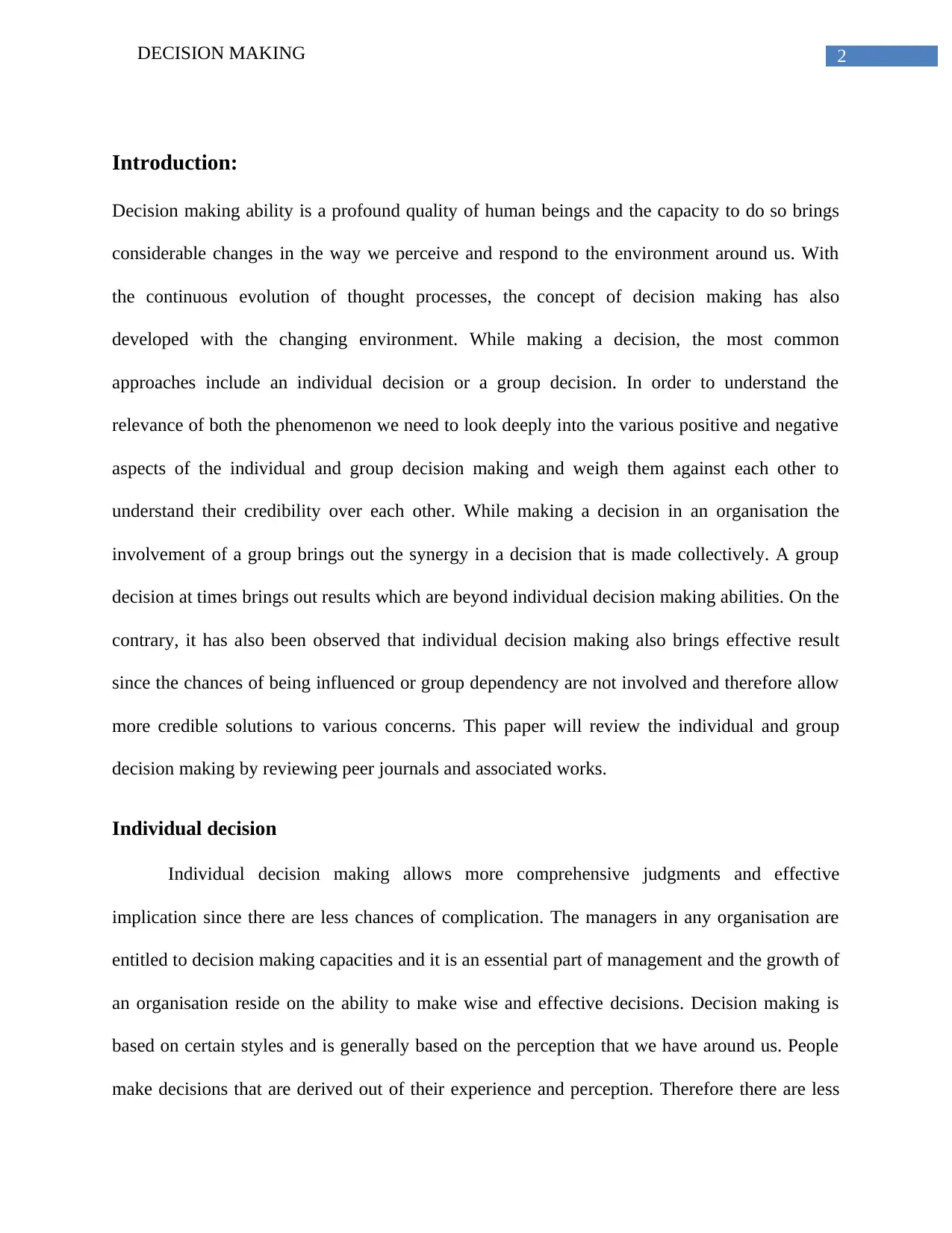
Decision making ability is a profound quality of human beings and the capacity to do so brings
considerable changes in the way we perceive and respond to the environment around us. With
the continuous evolution of thought processes, the concept of decision making has also
developed with the changing environment. While making a decision, the most common
approaches include an individual decision or a group decision. In order to understand the
relevance of both the phenomenon we need to look deeply into the various positive and negative
aspects of the individual and group decision making and weigh them against each other to
understand their credibility over each other. While making a decision in an organisation the
involvement of a group brings out the synergy in a decision that is made collectively. A group
decision at times brings out results which are beyond individual decision making abilities. On the
contrary, it has also been observed that individual decision making also brings effective result
since the chances of being influenced or group dependency are not involved and therefore allow
more credible solutions to various concerns. This paper will review the individual and group
decision making by reviewing peer journals and associated works.
Individual decision
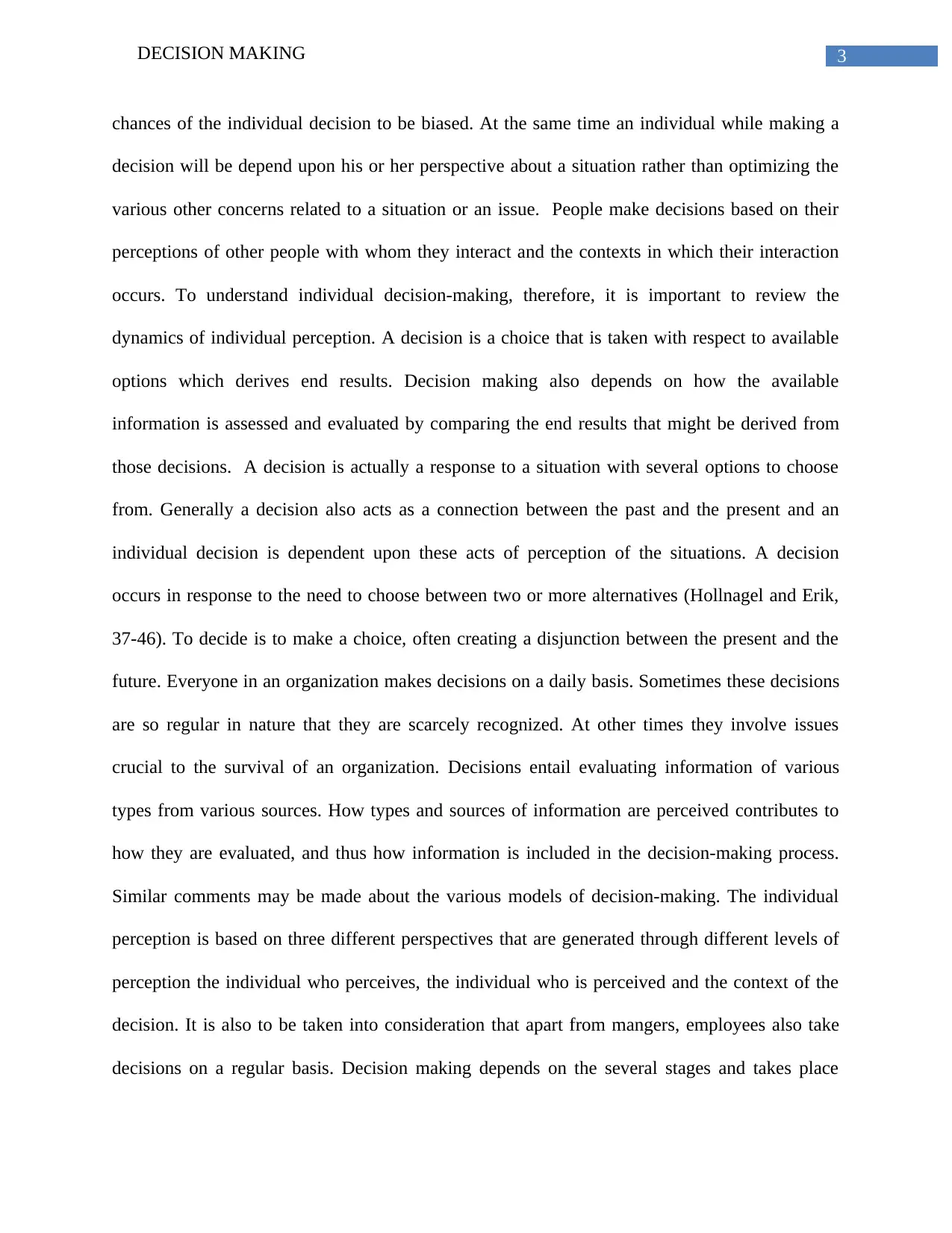
Individual decision making allows more comprehensive judgments and effective
implication since there are less chances of complication. The managers in any organisation are
entitled to decision making capacities and it is an essential part of management and the growth of
an organisation reside on the ability to make wise and effective decisions. Decision making is
based on certain styles and is generally based on the perception that we have around us. People
make decisions that are derived out of their experience and perception. Therefore there are less
Document Page
3DECISION MAKING
chances of the individual decision to be biased. At the same time an individual while making a
decision will be depend upon his or her perspective about a situation rather than optimizing the
various other concerns related to a situation or an issue. People make decisions based on their
perceptions of other people with whom they interact and the contexts in which their interaction
occurs. To understand individual decision-making, therefore, it is important to review the
dynamics of individual perception. A decision is a choice that is taken with respect to available
options which derives end results. Decision making also depends on how the available
information is assessed and evaluated by comparing the end results that might be derived from
those decisions. A decision is actually a response to a situation with several options to choose
from. Generally a decision also acts as a connection between the past and the present and an
individual decision is dependent upon these acts of perception of the situations. A decision
occurs in response to the need to choose between two or more alternatives (Hollnagel and Erik,
37-46). To decide is to make a choice, often creating a disjunction between the present and the
future. Everyone in an organization makes decisions on a daily basis. Sometimes these decisions
are so regular in nature that they are scarcely recognized. At other times they involve issues
crucial to the survival of an organization. Decisions entail evaluating information of various
types from various sources. How types and sources of information are perceived contributes to
how they are evaluated, and thus how information is included in the decision-making process.
Similar comments may be made about the various models of decision-making. The individual
perception is based on three different perspectives that are generated through different levels of
perception the individual who perceives, the individual who is perceived and the context of the
decision. It is also to be taken into consideration that apart from mangers, employees also take
decisions on a regular basis. Decision making depends on the several stages and takes place
Document Page
4DECISION MAKING
depending on the situation that is made across several stages of development and decision
making is characterized by the following types of decisions making models.
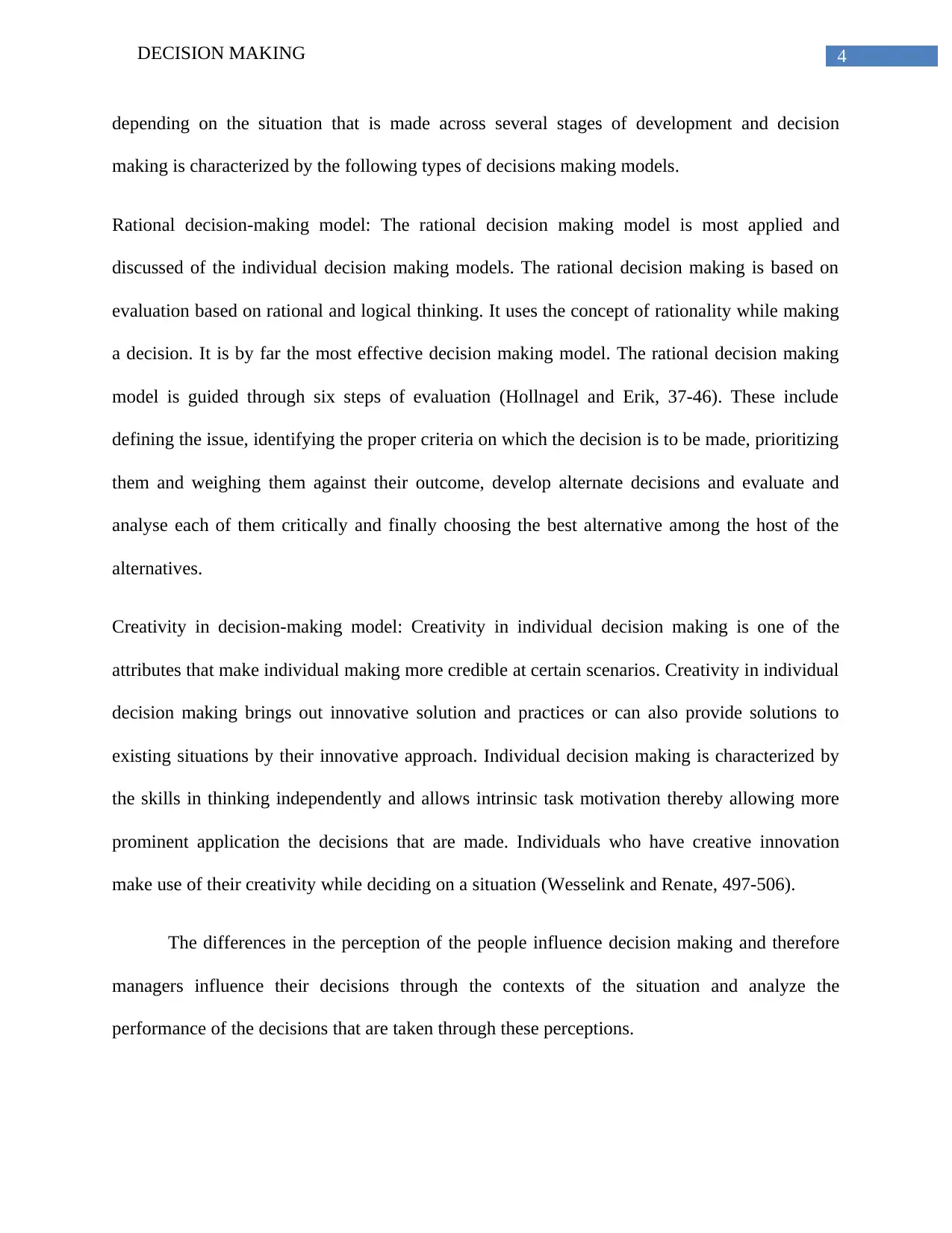
Rational decision-making model: The rational decision making model is most applied and
discussed of the individual decision making models. The rational decision making is based on
evaluation based on rational and logical thinking. It uses the concept of rationality while making
a decision. It is by far the most effective decision making model. The rational decision making
model is guided through six steps of evaluation (Hollnagel and Erik, 37-46). These include
defining the issue, identifying the proper criteria on which the decision is to be made, prioritizing
them and weighing them against their outcome, develop alternate decisions and evaluate and
analyse each of them critically and finally choosing the best alternative among the host of the
alternatives.
Creativity in decision-making model: Creativity in individual decision making is one of the
attributes that make individual making more credible at certain scenarios. Creativity in individual
decision making brings out innovative solution and practices or can also provide solutions to
existing situations by their innovative approach. Individual decision making is characterized by
the skills in thinking independently and allows intrinsic task motivation thereby allowing more
prominent application the decisions that are made. Individuals who have creative innovation
make use of their creativity while deciding on a situation (Wesselink and Renate, 497-506).
The differences in the perception of the people influence decision making and therefore
managers influence their decisions through the contexts of the situation and analyze the
performance of the decisions that are taken through these perceptions.
tabler-icon-diamond-filled.svg

Paraphrase This Document

Need a fresh take? Get an instant paraphrase of this document with our AI Paraphraser
Document Page
5DECISION MAKING
Group Decision
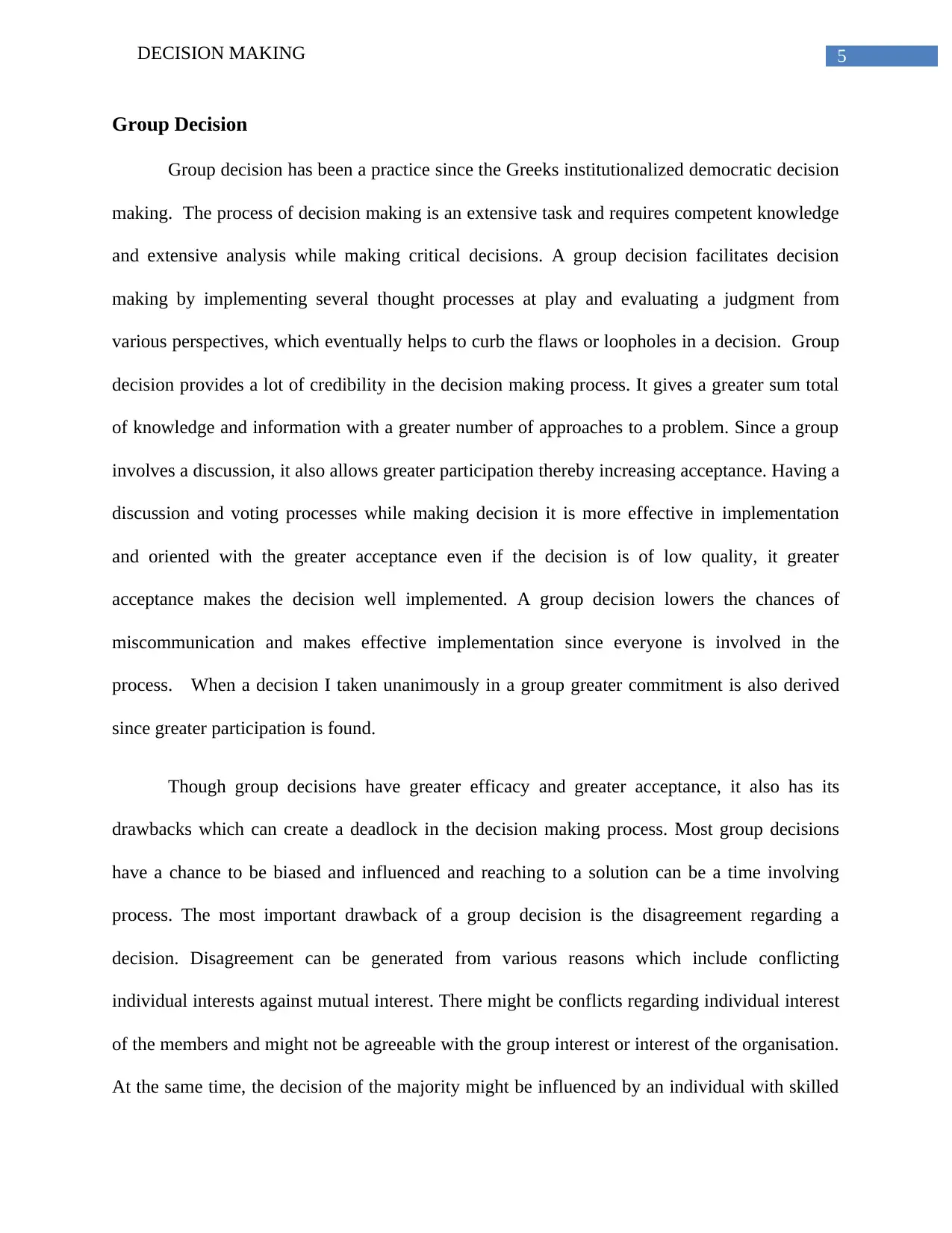
Group decision has been a practice since the Greeks institutionalized democratic decision
making. The process of decision making is an extensive task and requires competent knowledge
and extensive analysis while making critical decisions. A group decision facilitates decision
making by implementing several thought processes at play and evaluating a judgment from
various perspectives, which eventually helps to curb the flaws or loopholes in a decision. Group
decision provides a lot of credibility in the decision making process. It gives a greater sum total
of knowledge and information with a greater number of approaches to a problem. Since a group
involves a discussion, it also allows greater participation thereby increasing acceptance. Having a
discussion and voting processes while making decision it is more effective in implementation
and oriented with the greater acceptance even if the decision is of low quality, it greater
acceptance makes the decision well implemented. A group decision lowers the chances of
miscommunication and makes effective implementation since everyone is involved in the
process. When a decision I taken unanimously in a group greater commitment is also derived
since greater participation is found.
Though group decisions have greater efficacy and greater acceptance, it also has its
drawbacks which can create a deadlock in the decision making process. Most group decisions
have a chance to be biased and influenced and reaching to a solution can be a time involving
process. The most important drawback of a group decision is the disagreement regarding a
decision. Disagreement can be generated from various reasons which include conflicting
individual interests against mutual interest. There might be conflicts regarding individual interest
of the members and might not be agreeable with the group interest or interest of the organisation.
At the same time, the decision of the majority might be influenced by an individual with skilled
Document Page
6DECISION MAKING
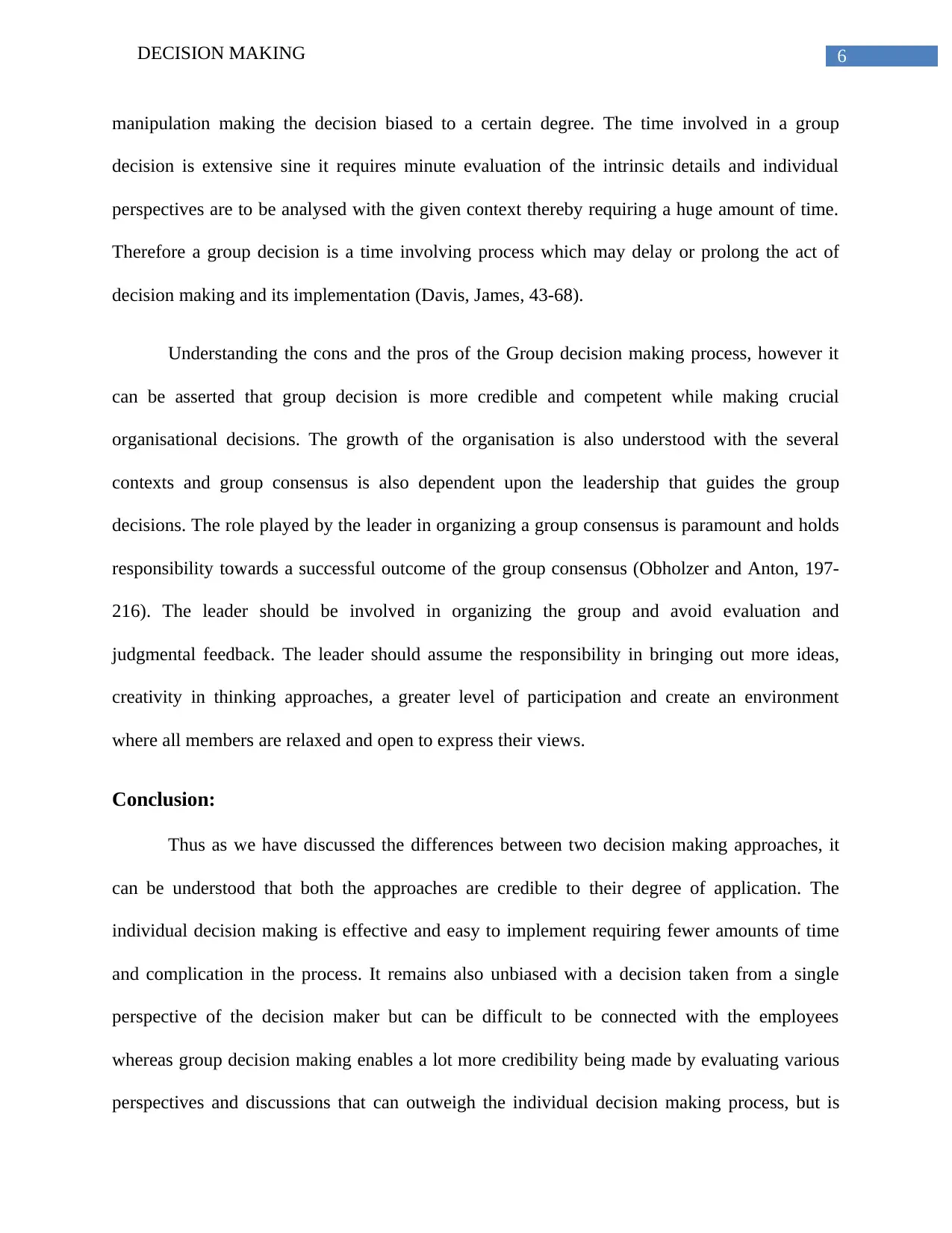
manipulation making the decision biased to a certain degree. The time involved in a group
decision is extensive sine it requires minute evaluation of the intrinsic details and individual
perspectives are to be analysed with the given context thereby requiring a huge amount of time.
Therefore a group decision is a time involving process which may delay or prolong the act of
decision making and its implementation (Davis, James, 43-68).
Understanding the cons and the pros of the Group decision making process, however it
can be asserted that group decision is more credible and competent while making crucial
organisational decisions. The growth of the organisation is also understood with the several
contexts and group consensus is also dependent upon the leadership that guides the group
decisions. The role played by the leader in organizing a group consensus is paramount and holds
responsibility towards a successful outcome of the group consensus (Obholzer and Anton, 197-
216). The leader should be involved in organizing the group and avoid evaluation and
judgmental feedback. The leader should assume the responsibility in bringing out more ideas,
creativity in thinking approaches, a greater level of participation and create an environment
where all members are relaxed and open to express their views.
Conclusion:
Thus as we have discussed the differences between two decision making approaches, it
can be understood that both the approaches are credible to their degree of application. The
individual decision making is effective and easy to implement requiring fewer amounts of time
and complication in the process. It remains also unbiased with a decision taken from a single
perspective of the decision maker but can be difficult to be connected with the employees
whereas group decision making enables a lot more credibility being made by evaluating various
perspectives and discussions that can outweigh the individual decision making process, but is
Document Page
7DECISION MAKING
again accompanied with its complication arising from disagreement and time consuming process
in arriving at a conclusion.
tabler-icon-diamond-filled.svg

Paraphrase This Document

Need a fresh take? Get an instant paraphrase of this document with our AI Paraphraser
Document Page
8DECISION MAKING
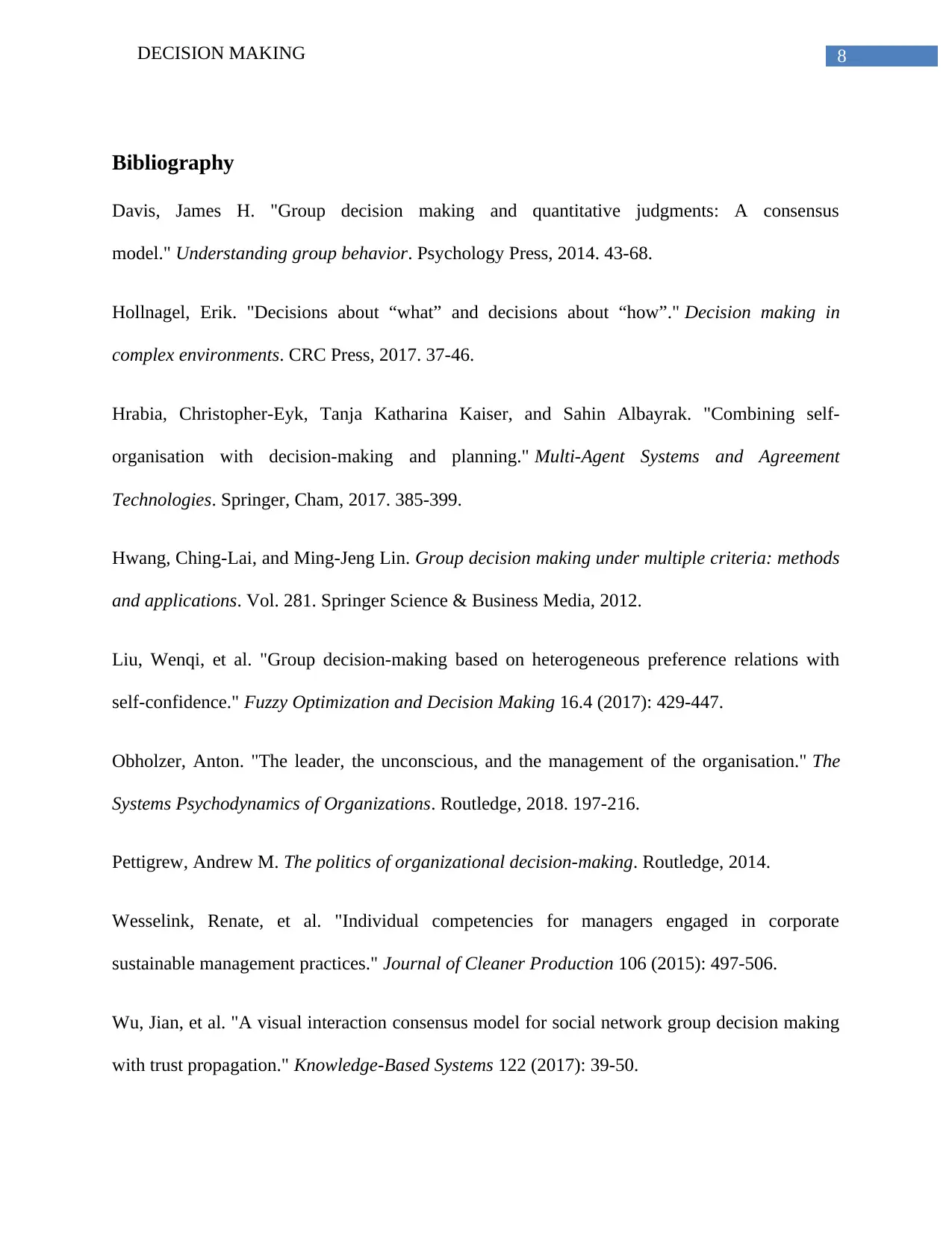
Bibliography
Davis, James H. "Group decision making and quantitative judgments: A consensus
model." Understanding group behavior. Psychology Press, 2014. 43-68.
Hollnagel, Erik. "Decisions about “what” and decisions about “how”." Decision making in
complex environments. CRC Press, 2017. 37-46.
Hrabia, Christopher-Eyk, Tanja Katharina Kaiser, and Sahin Albayrak. "Combining self-
organisation with decision-making and planning." Multi-Agent Systems and Agreement
Technologies. Springer, Cham, 2017. 385-399.
Hwang, Ching-Lai, and Ming-Jeng Lin. Group decision making under multiple criteria: methods
and applications. Vol. 281. Springer Science & Business Media, 2012.
Liu, Wenqi, et al. "Group decision-making based on heterogeneous preference relations with
self-confidence." Fuzzy Optimization and Decision Making 16.4 (2017): 429-447.
Obholzer, Anton. "The leader, the unconscious, and the management of the organisation." The
Systems Psychodynamics of Organizations. Routledge, 2018. 197-216.
Pettigrew, Andrew M. The politics of organizational decision-making. Routledge, 2014.
Wesselink, Renate, et al. "Individual competencies for managers engaged in corporate
sustainable management practices." Journal of Cleaner Production 106 (2015): 497-506.
Wu, Jian, et al. "A visual interaction consensus model for social network group decision making
with trust propagation." Knowledge-Based Systems 122 (2017): 39-50.
chevron_up_icon
1 out of 8
circle_padding
hide_on_mobile
zoom_out_icon
[object Object]