Griffith University 6007ENG: Socio-economic Assessment of EVs
VerifiedAdded on 2022/09/28
|50
|17014
|18
Report
AI Summary
This report, submitted to Griffith University's Industrial Affiliates Program, assesses the socio-economic and environmental implications of electric vehicle (EV) operation. It examines the transport sector's energy intensity, reliance on petroleum, and associated environmental impacts. The project develops models to evaluate the effects of a large-scale electrified transportation sector, including vehicle and infrastructure safety, standardization, electric vehicle supplies, and impacts of sustainable development. The study reviews existing literature on mobility, transport-environment links, and EV technologies, incorporating four modeling attempts: an integrated sustainability assessment model, a life impact model, a stochastic cost simulation model, and an electricity mix sustainability model. The methodology includes sampling, survey design, and risk assessment related to EV charging and safety. The report highlights the potential of EVs to reduce fossil fuel consumption and GHG emissions, addressing challenges such as infrastructure limitations and customer adoption. The research also explores vehicle-to-grid technology and vehicle-to-home integration for enhanced sustainability and cost reduction.
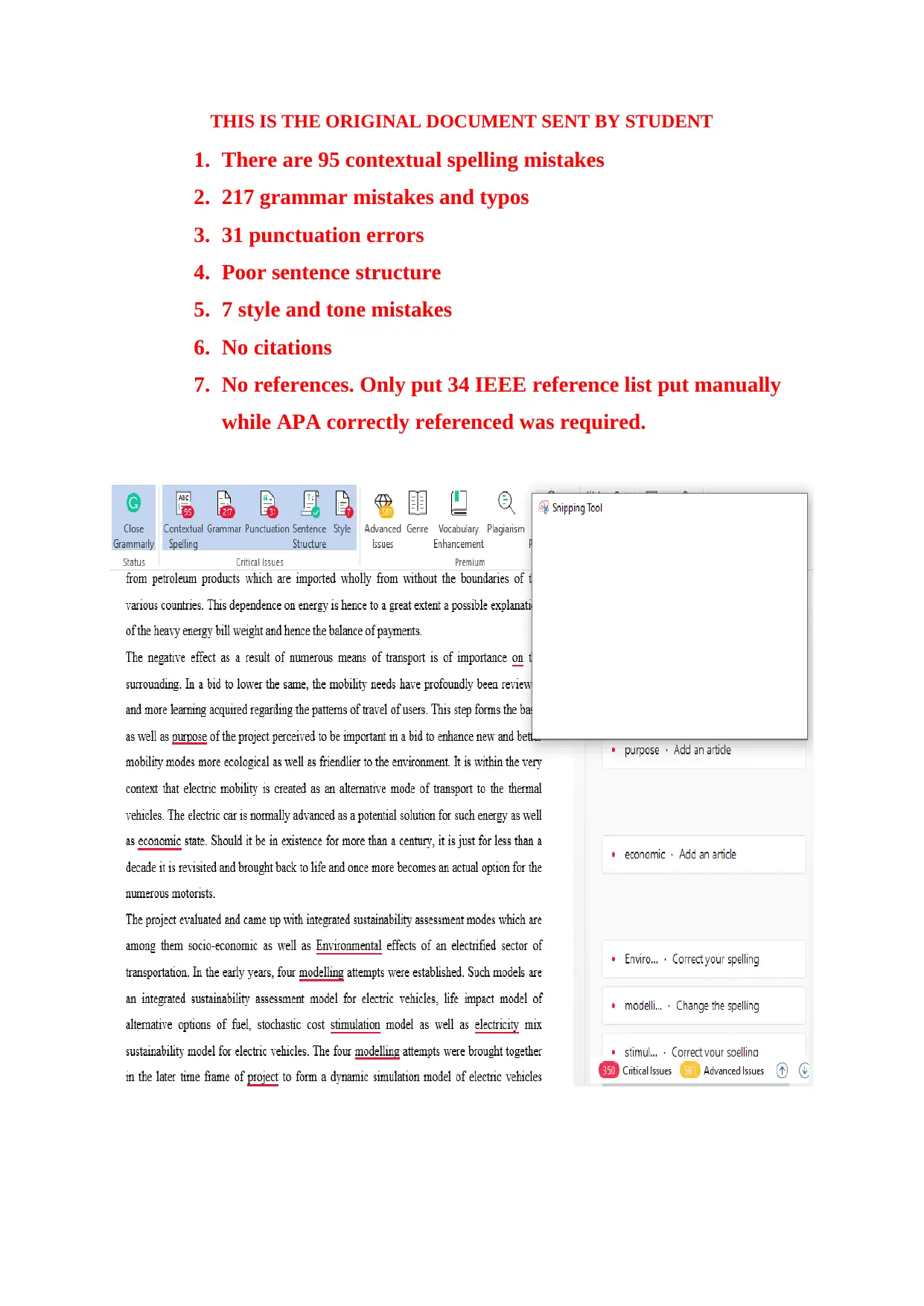
THIS IS THE ORIGINAL DOCUMENT SENT BY STUDENT
1. There are 95 contextual spelling mistakes
2. 217 grammar mistakes and typos
3. 31 punctuation errors
4. Poor sentence structure
5. 7 style and tone mistakes
6. No citations
7. No references. Only put 34 IEEE reference list put manually
while APA correctly referenced was required.
1. There are 95 contextual spelling mistakes
2. 217 grammar mistakes and typos
3. 31 punctuation errors
4. Poor sentence structure
5. 7 style and tone mistakes
6. No citations
7. No references. Only put 34 IEEE reference list put manually
while APA correctly referenced was required.

Paraphrase This Document
Need a fresh take? Get an instant paraphrase of this document with our AI Paraphraser
Griffith School of Engineering
Griffith University
6007ENG – Industry Affiliates Program
Socio-economic Assessment of Electric
Vehicles Operation
M……, s……..
Date, Trimester 2, 2019
Company Name Here
Industry Supervisor Name Here
Academic Supervisor Name Here
A report submitted in partial fulfilment of the degree of Your Degree Program Here, eg
Bachelor of Engineering (Honours)
The copyright on this report is held by the author and/or the IAP Industry Partner. Permission has been granted to Griffith University to keep
a reference copy of this report.
Griffith University
6007ENG – Industry Affiliates Program
Socio-economic Assessment of Electric
Vehicles Operation
M……, s……..
Date, Trimester 2, 2019
Company Name Here
Industry Supervisor Name Here
Academic Supervisor Name Here
A report submitted in partial fulfilment of the degree of Your Degree Program Here, eg
Bachelor of Engineering (Honours)
The copyright on this report is held by the author and/or the IAP Industry Partner. Permission has been granted to Griffith University to keep
a reference copy of this report.
6007ENG – Industry Affiliates Program, Trimester 2, 2019
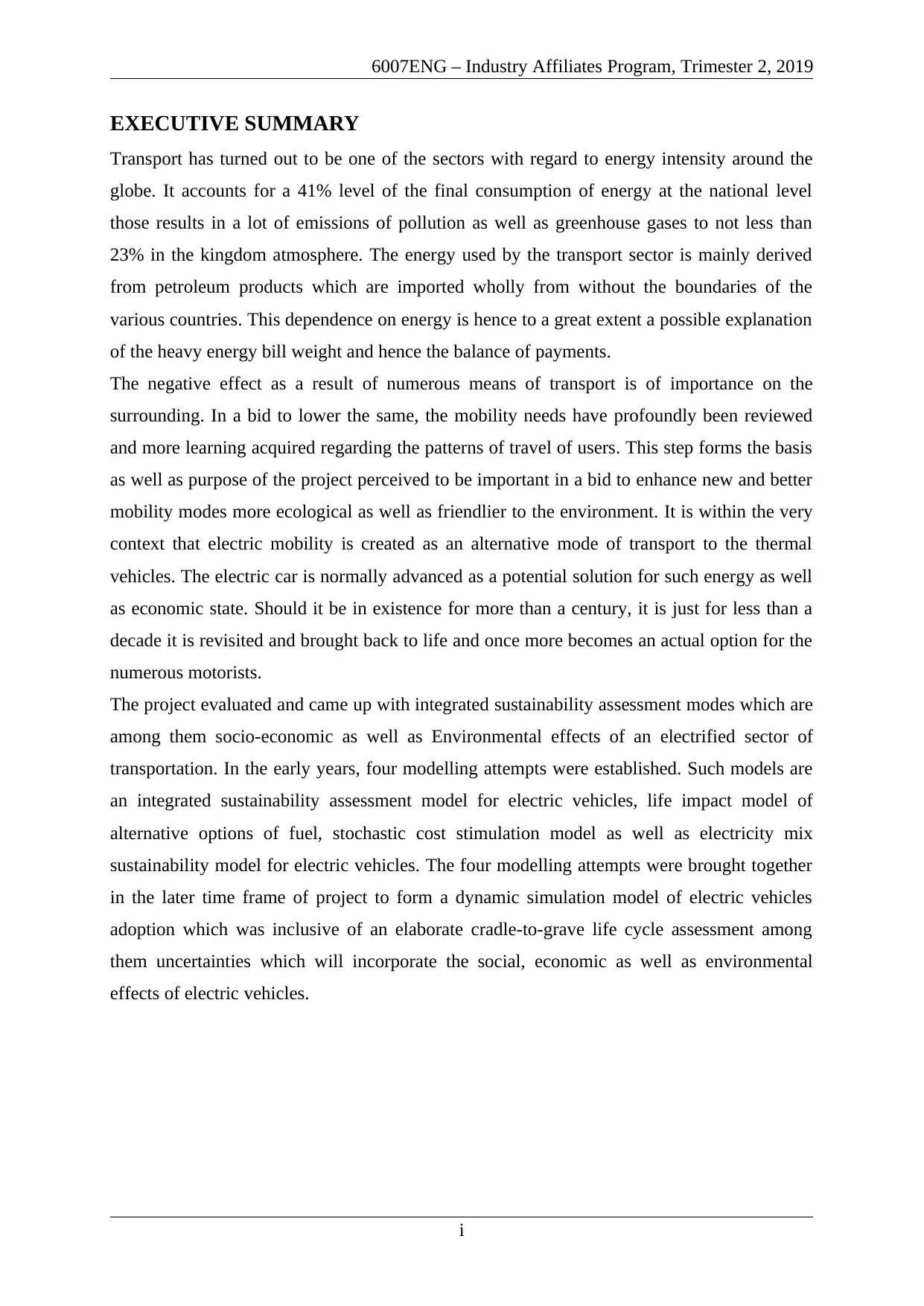
EXECUTIVE SUMMARY
Transport has turned out to be one of the sectors with regard to energy intensity around the
globe. It accounts for a 41% level of the final consumption of energy at the national level
those results in a lot of emissions of pollution as well as greenhouse gases to not less than
23% in the kingdom atmosphere. The energy used by the transport sector is mainly derived
from petroleum products which are imported wholly from without the boundaries of the
various countries. This dependence on energy is hence to a great extent a possible explanation
of the heavy energy bill weight and hence the balance of payments.
The negative effect as a result of numerous means of transport is of importance on the
surrounding. In a bid to lower the same, the mobility needs have profoundly been reviewed
and more learning acquired regarding the patterns of travel of users. This step forms the basis
as well as purpose of the project perceived to be important in a bid to enhance new and better
mobility modes more ecological as well as friendlier to the environment. It is within the very
context that electric mobility is created as an alternative mode of transport to the thermal
vehicles. The electric car is normally advanced as a potential solution for such energy as well
as economic state. Should it be in existence for more than a century, it is just for less than a
decade it is revisited and brought back to life and once more becomes an actual option for the
numerous motorists.
The project evaluated and came up with integrated sustainability assessment modes which are
among them socio-economic as well as Environmental effects of an electrified sector of
transportation. In the early years, four modelling attempts were established. Such models are
an integrated sustainability assessment model for electric vehicles, life impact model of
alternative options of fuel, stochastic cost stimulation model as well as electricity mix
sustainability model for electric vehicles. The four modelling attempts were brought together
in the later time frame of project to form a dynamic simulation model of electric vehicles
adoption which was inclusive of an elaborate cradle-to-grave life cycle assessment among
them uncertainties which will incorporate the social, economic as well as environmental
effects of electric vehicles.
i
EXECUTIVE SUMMARY
Transport has turned out to be one of the sectors with regard to energy intensity around the
globe. It accounts for a 41% level of the final consumption of energy at the national level
those results in a lot of emissions of pollution as well as greenhouse gases to not less than
23% in the kingdom atmosphere. The energy used by the transport sector is mainly derived
from petroleum products which are imported wholly from without the boundaries of the
various countries. This dependence on energy is hence to a great extent a possible explanation
of the heavy energy bill weight and hence the balance of payments.
The negative effect as a result of numerous means of transport is of importance on the
surrounding. In a bid to lower the same, the mobility needs have profoundly been reviewed
and more learning acquired regarding the patterns of travel of users. This step forms the basis
as well as purpose of the project perceived to be important in a bid to enhance new and better
mobility modes more ecological as well as friendlier to the environment. It is within the very
context that electric mobility is created as an alternative mode of transport to the thermal
vehicles. The electric car is normally advanced as a potential solution for such energy as well
as economic state. Should it be in existence for more than a century, it is just for less than a
decade it is revisited and brought back to life and once more becomes an actual option for the
numerous motorists.
The project evaluated and came up with integrated sustainability assessment modes which are
among them socio-economic as well as Environmental effects of an electrified sector of
transportation. In the early years, four modelling attempts were established. Such models are
an integrated sustainability assessment model for electric vehicles, life impact model of
alternative options of fuel, stochastic cost stimulation model as well as electricity mix
sustainability model for electric vehicles. The four modelling attempts were brought together
in the later time frame of project to form a dynamic simulation model of electric vehicles
adoption which was inclusive of an elaborate cradle-to-grave life cycle assessment among
them uncertainties which will incorporate the social, economic as well as environmental
effects of electric vehicles.
i
⊘ This is a preview!⊘
Do you want full access?
Subscribe today to unlock all pages.

Trusted by 1+ million students worldwide
6007ENG – Industry Affiliates Program, Trimester 2, 2019
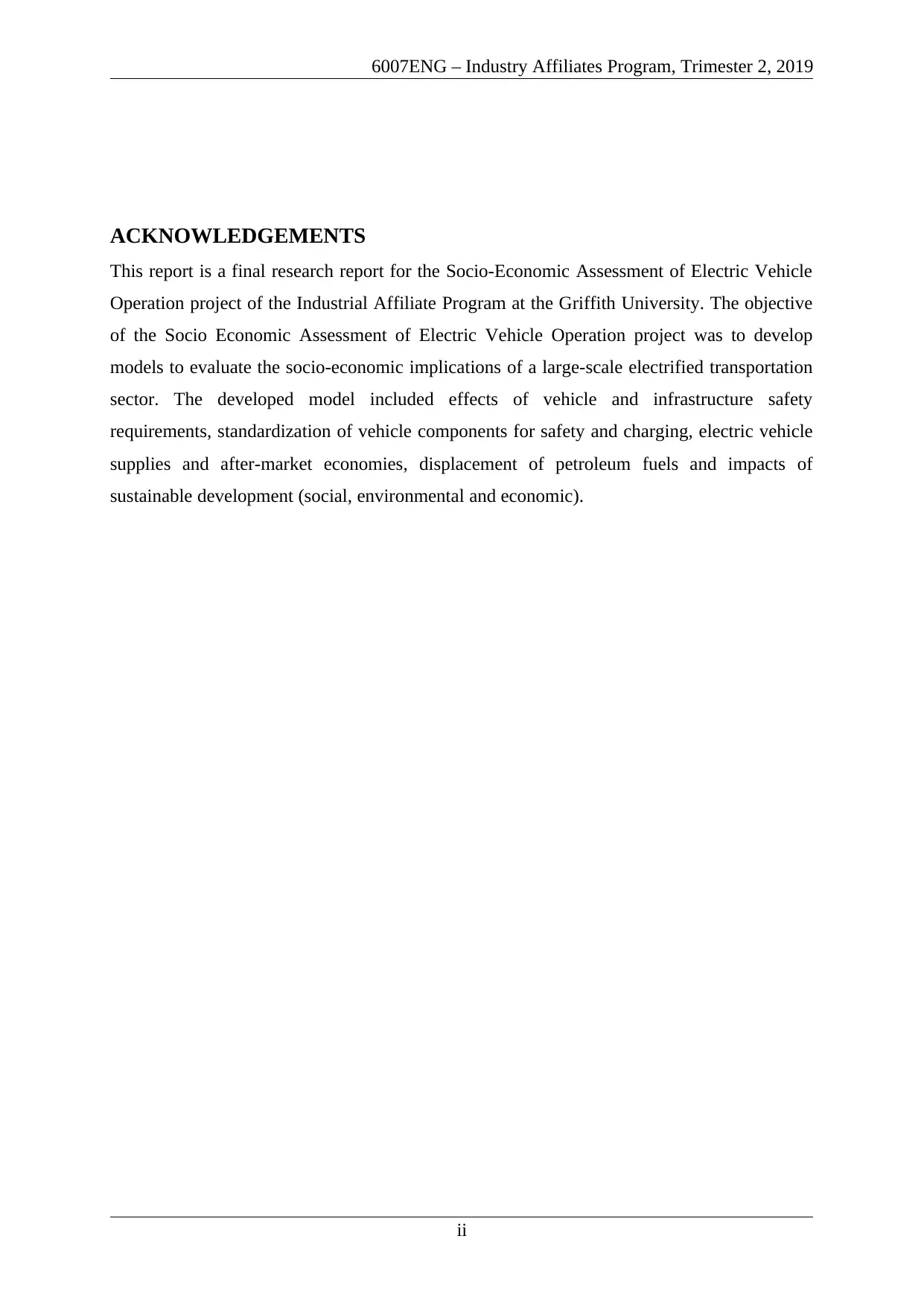
ACKNOWLEDGEMENTS
This report is a final research report for the Socio-Economic Assessment of Electric Vehicle
Operation project of the Industrial Affiliate Program at the Griffith University. The objective
of the Socio Economic Assessment of Electric Vehicle Operation project was to develop
models to evaluate the socio-economic implications of a large-scale electrified transportation
sector. The developed model included effects of vehicle and infrastructure safety
requirements, standardization of vehicle components for safety and charging, electric vehicle
supplies and after-market economies, displacement of petroleum fuels and impacts of
sustainable development (social, environmental and economic).
ii
ACKNOWLEDGEMENTS
This report is a final research report for the Socio-Economic Assessment of Electric Vehicle
Operation project of the Industrial Affiliate Program at the Griffith University. The objective
of the Socio Economic Assessment of Electric Vehicle Operation project was to develop
models to evaluate the socio-economic implications of a large-scale electrified transportation
sector. The developed model included effects of vehicle and infrastructure safety
requirements, standardization of vehicle components for safety and charging, electric vehicle
supplies and after-market economies, displacement of petroleum fuels and impacts of
sustainable development (social, environmental and economic).
ii
Paraphrase This Document
Need a fresh take? Get an instant paraphrase of this document with our AI Paraphraser
6007ENG – Industry Affiliates Program, Trimester 2, 2019
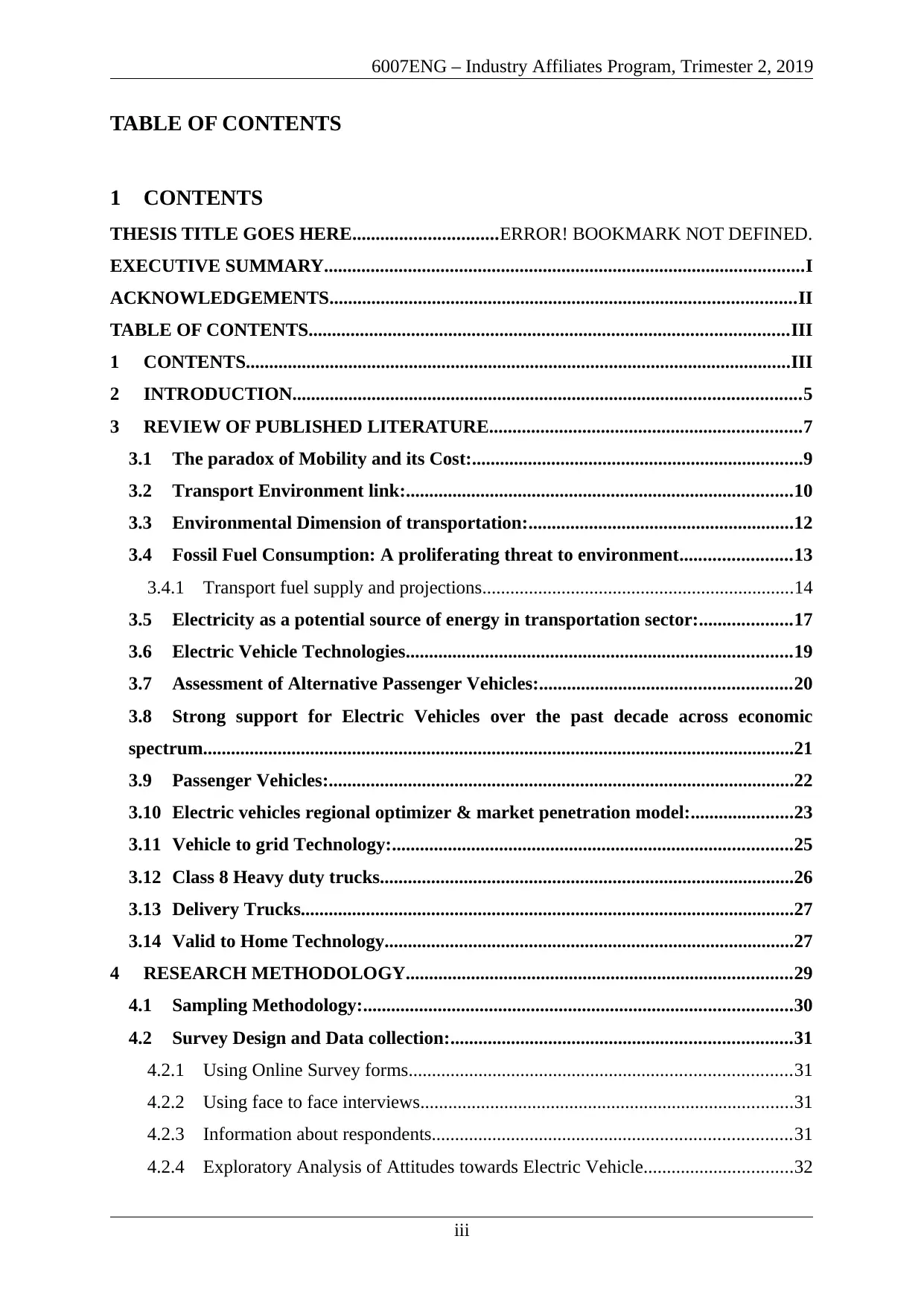
TABLE OF CONTENTS
1 CONTENTS
THESIS TITLE GOES HERE...............................ERROR! BOOKMARK NOT DEFINED.
EXECUTIVE SUMMARY.......................................................................................................I
ACKNOWLEDGEMENTS....................................................................................................II
TABLE OF CONTENTS.......................................................................................................III
1 CONTENTS.....................................................................................................................III
2 INTRODUCTION.............................................................................................................5
3 REVIEW OF PUBLISHED LITERATURE...................................................................7
3.1 The paradox of Mobility and its Cost:.......................................................................9
3.2 Transport Environment link:...................................................................................10
3.3 Environmental Dimension of transportation:.........................................................12
3.4 Fossil Fuel Consumption: A proliferating threat to environment........................13
3.4.1 Transport fuel supply and projections...................................................................14
3.5 Electricity as a potential source of energy in transportation sector:....................17
3.6 Electric Vehicle Technologies...................................................................................19
3.7 Assessment of Alternative Passenger Vehicles:......................................................20
3.8 Strong support for Electric Vehicles over the past decade across economic
spectrum...............................................................................................................................21
3.9 Passenger Vehicles:....................................................................................................22
3.10 Electric vehicles regional optimizer & market penetration model:......................23
3.11 Vehicle to grid Technology:......................................................................................25
3.12 Class 8 Heavy duty trucks.........................................................................................26
3.13 Delivery Trucks..........................................................................................................27
3.14 Valid to Home Technology........................................................................................27
4 RESEARCH METHODOLOGY...................................................................................29
4.1 Sampling Methodology:............................................................................................30
4.2 Survey Design and Data collection:.........................................................................31
4.2.1 Using Online Survey forms..................................................................................31
4.2.2 Using face to face interviews................................................................................31
4.2.3 Information about respondents.............................................................................31
4.2.4 Exploratory Analysis of Attitudes towards Electric Vehicle................................32
iii
TABLE OF CONTENTS
1 CONTENTS
THESIS TITLE GOES HERE...............................ERROR! BOOKMARK NOT DEFINED.
EXECUTIVE SUMMARY.......................................................................................................I
ACKNOWLEDGEMENTS....................................................................................................II
TABLE OF CONTENTS.......................................................................................................III
1 CONTENTS.....................................................................................................................III
2 INTRODUCTION.............................................................................................................5
3 REVIEW OF PUBLISHED LITERATURE...................................................................7
3.1 The paradox of Mobility and its Cost:.......................................................................9
3.2 Transport Environment link:...................................................................................10
3.3 Environmental Dimension of transportation:.........................................................12
3.4 Fossil Fuel Consumption: A proliferating threat to environment........................13
3.4.1 Transport fuel supply and projections...................................................................14
3.5 Electricity as a potential source of energy in transportation sector:....................17
3.6 Electric Vehicle Technologies...................................................................................19
3.7 Assessment of Alternative Passenger Vehicles:......................................................20
3.8 Strong support for Electric Vehicles over the past decade across economic
spectrum...............................................................................................................................21
3.9 Passenger Vehicles:....................................................................................................22
3.10 Electric vehicles regional optimizer & market penetration model:......................23
3.11 Vehicle to grid Technology:......................................................................................25
3.12 Class 8 Heavy duty trucks.........................................................................................26
3.13 Delivery Trucks..........................................................................................................27
3.14 Valid to Home Technology........................................................................................27
4 RESEARCH METHODOLOGY...................................................................................29
4.1 Sampling Methodology:............................................................................................30
4.2 Survey Design and Data collection:.........................................................................31
4.2.1 Using Online Survey forms..................................................................................31
4.2.2 Using face to face interviews................................................................................31
4.2.3 Information about respondents.............................................................................31
4.2.4 Exploratory Analysis of Attitudes towards Electric Vehicle................................32
iii
6007ENG – Industry Affiliates Program, Trimester 2, 2019
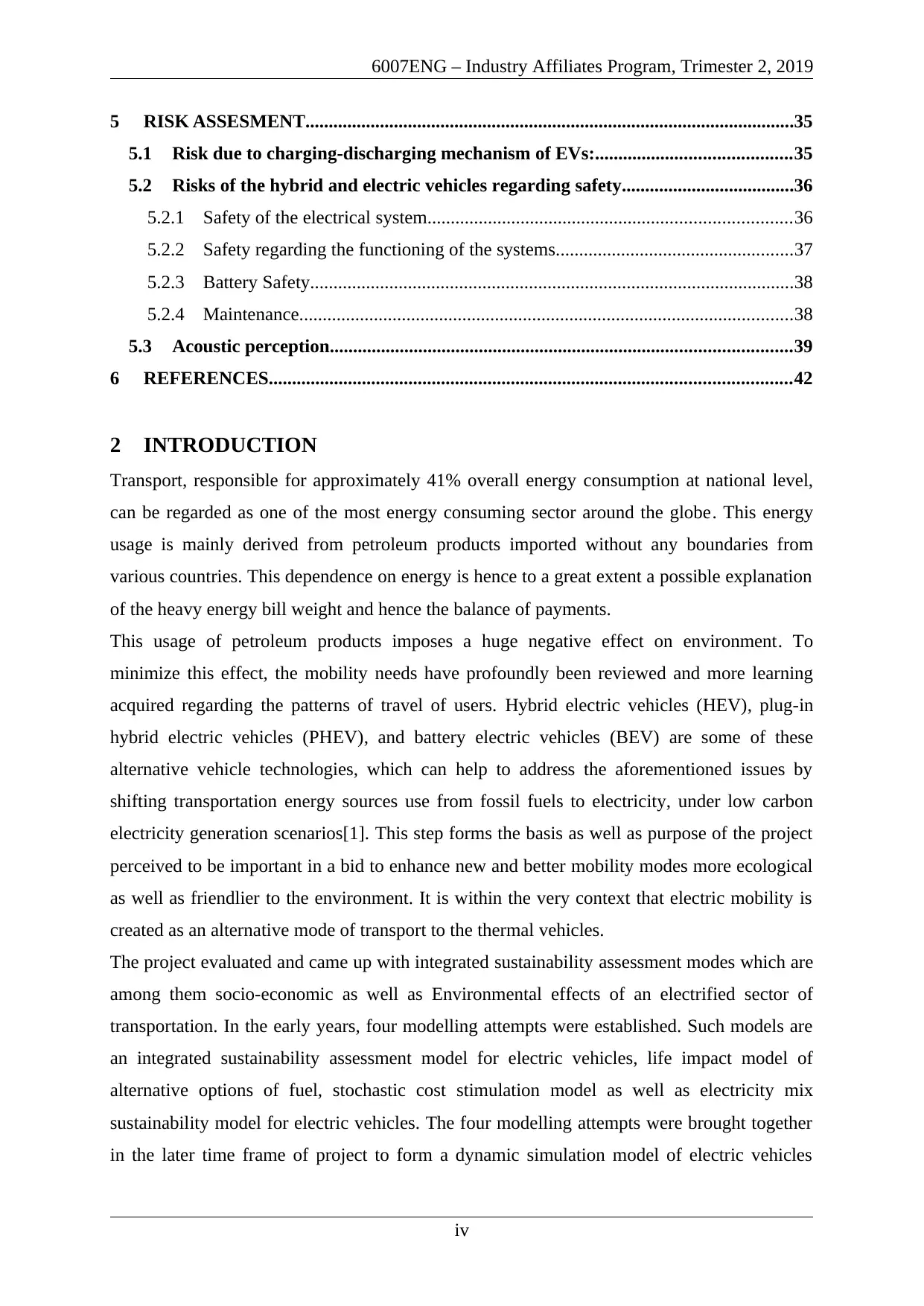
5 RISK ASSESMENT.........................................................................................................35
5.1 Risk due to charging-discharging mechanism of EVs:..........................................35
5.2 Risks of the hybrid and electric vehicles regarding safety.....................................36
5.2.1 Safety of the electrical system..............................................................................36
5.2.2 Safety regarding the functioning of the systems...................................................37
5.2.3 Battery Safety........................................................................................................38
5.2.4 Maintenance..........................................................................................................38
5.3 Acoustic perception...................................................................................................39
6 REFERENCES................................................................................................................42
2 INTRODUCTION
Transport, responsible for approximately 41% overall energy consumption at national level,
can be regarded as one of the most energy consuming sector around the globe. This energy
usage is mainly derived from petroleum products imported without any boundaries from
various countries. This dependence on energy is hence to a great extent a possible explanation
of the heavy energy bill weight and hence the balance of payments.
This usage of petroleum products imposes a huge negative effect on environment. To
minimize this effect, the mobility needs have profoundly been reviewed and more learning
acquired regarding the patterns of travel of users. Hybrid electric vehicles (HEV), plug-in
hybrid electric vehicles (PHEV), and battery electric vehicles (BEV) are some of these
alternative vehicle technologies, which can help to address the aforementioned issues by
shifting transportation energy sources use from fossil fuels to electricity, under low carbon
electricity generation scenarios[1]. This step forms the basis as well as purpose of the project
perceived to be important in a bid to enhance new and better mobility modes more ecological
as well as friendlier to the environment. It is within the very context that electric mobility is
created as an alternative mode of transport to the thermal vehicles.
The project evaluated and came up with integrated sustainability assessment modes which are
among them socio-economic as well as Environmental effects of an electrified sector of
transportation. In the early years, four modelling attempts were established. Such models are
an integrated sustainability assessment model for electric vehicles, life impact model of
alternative options of fuel, stochastic cost stimulation model as well as electricity mix
sustainability model for electric vehicles. The four modelling attempts were brought together
in the later time frame of project to form a dynamic simulation model of electric vehicles
iv
5 RISK ASSESMENT.........................................................................................................35
5.1 Risk due to charging-discharging mechanism of EVs:..........................................35
5.2 Risks of the hybrid and electric vehicles regarding safety.....................................36
5.2.1 Safety of the electrical system..............................................................................36
5.2.2 Safety regarding the functioning of the systems...................................................37
5.2.3 Battery Safety........................................................................................................38
5.2.4 Maintenance..........................................................................................................38
5.3 Acoustic perception...................................................................................................39
6 REFERENCES................................................................................................................42
2 INTRODUCTION
Transport, responsible for approximately 41% overall energy consumption at national level,
can be regarded as one of the most energy consuming sector around the globe. This energy
usage is mainly derived from petroleum products imported without any boundaries from
various countries. This dependence on energy is hence to a great extent a possible explanation
of the heavy energy bill weight and hence the balance of payments.
This usage of petroleum products imposes a huge negative effect on environment. To
minimize this effect, the mobility needs have profoundly been reviewed and more learning
acquired regarding the patterns of travel of users. Hybrid electric vehicles (HEV), plug-in
hybrid electric vehicles (PHEV), and battery electric vehicles (BEV) are some of these
alternative vehicle technologies, which can help to address the aforementioned issues by
shifting transportation energy sources use from fossil fuels to electricity, under low carbon
electricity generation scenarios[1]. This step forms the basis as well as purpose of the project
perceived to be important in a bid to enhance new and better mobility modes more ecological
as well as friendlier to the environment. It is within the very context that electric mobility is
created as an alternative mode of transport to the thermal vehicles.
The project evaluated and came up with integrated sustainability assessment modes which are
among them socio-economic as well as Environmental effects of an electrified sector of
transportation. In the early years, four modelling attempts were established. Such models are
an integrated sustainability assessment model for electric vehicles, life impact model of
alternative options of fuel, stochastic cost stimulation model as well as electricity mix
sustainability model for electric vehicles. The four modelling attempts were brought together
in the later time frame of project to form a dynamic simulation model of electric vehicles
iv
⊘ This is a preview!⊘
Do you want full access?
Subscribe today to unlock all pages.
Trusted by 1+ million students worldwide
6007ENG – Industry Affiliates Program, Trimester 2, 2019
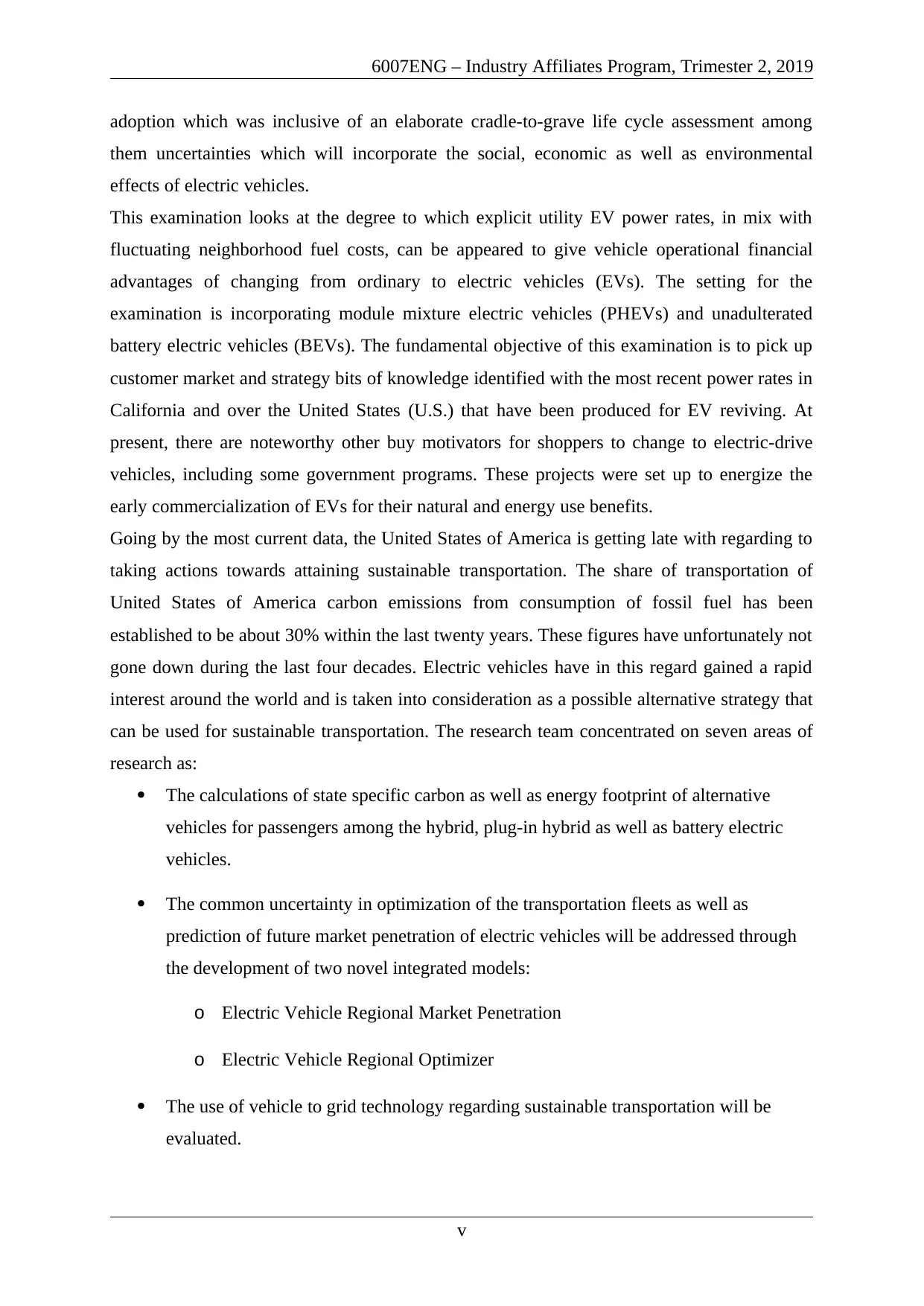
adoption which was inclusive of an elaborate cradle-to-grave life cycle assessment among
them uncertainties which will incorporate the social, economic as well as environmental
effects of electric vehicles.
This examination looks at the degree to which explicit utility EV power rates, in mix with
fluctuating neighborhood fuel costs, can be appeared to give vehicle operational financial
advantages of changing from ordinary to electric vehicles (EVs). The setting for the
examination is incorporating module mixture electric vehicles (PHEVs) and unadulterated
battery electric vehicles (BEVs). The fundamental objective of this examination is to pick up
customer market and strategy bits of knowledge identified with the most recent power rates in
California and over the United States (U.S.) that have been produced for EV reviving. At
present, there are noteworthy other buy motivators for shoppers to change to electric-drive
vehicles, including some government programs. These projects were set up to energize the
early commercialization of EVs for their natural and energy use benefits.
Going by the most current data, the United States of America is getting late with regarding to
taking actions towards attaining sustainable transportation. The share of transportation of
United States of America carbon emissions from consumption of fossil fuel has been
established to be about 30% within the last twenty years. These figures have unfortunately not
gone down during the last four decades. Electric vehicles have in this regard gained a rapid
interest around the world and is taken into consideration as a possible alternative strategy that
can be used for sustainable transportation. The research team concentrated on seven areas of
research as:
The calculations of state specific carbon as well as energy footprint of alternative
vehicles for passengers among the hybrid, plug-in hybrid as well as battery electric
vehicles.
The common uncertainty in optimization of the transportation fleets as well as
prediction of future market penetration of electric vehicles will be addressed through
the development of two novel integrated models:
o Electric Vehicle Regional Market Penetration
o Electric Vehicle Regional Optimizer
The use of vehicle to grid technology regarding sustainable transportation will be
evaluated.
v
adoption which was inclusive of an elaborate cradle-to-grave life cycle assessment among
them uncertainties which will incorporate the social, economic as well as environmental
effects of electric vehicles.
This examination looks at the degree to which explicit utility EV power rates, in mix with
fluctuating neighborhood fuel costs, can be appeared to give vehicle operational financial
advantages of changing from ordinary to electric vehicles (EVs). The setting for the
examination is incorporating module mixture electric vehicles (PHEVs) and unadulterated
battery electric vehicles (BEVs). The fundamental objective of this examination is to pick up
customer market and strategy bits of knowledge identified with the most recent power rates in
California and over the United States (U.S.) that have been produced for EV reviving. At
present, there are noteworthy other buy motivators for shoppers to change to electric-drive
vehicles, including some government programs. These projects were set up to energize the
early commercialization of EVs for their natural and energy use benefits.
Going by the most current data, the United States of America is getting late with regarding to
taking actions towards attaining sustainable transportation. The share of transportation of
United States of America carbon emissions from consumption of fossil fuel has been
established to be about 30% within the last twenty years. These figures have unfortunately not
gone down during the last four decades. Electric vehicles have in this regard gained a rapid
interest around the world and is taken into consideration as a possible alternative strategy that
can be used for sustainable transportation. The research team concentrated on seven areas of
research as:
The calculations of state specific carbon as well as energy footprint of alternative
vehicles for passengers among the hybrid, plug-in hybrid as well as battery electric
vehicles.
The common uncertainty in optimization of the transportation fleets as well as
prediction of future market penetration of electric vehicles will be addressed through
the development of two novel integrated models:
o Electric Vehicle Regional Market Penetration
o Electric Vehicle Regional Optimizer
The use of vehicle to grid technology regarding sustainable transportation will be
evaluated.
v
Paraphrase This Document
Need a fresh take? Get an instant paraphrase of this document with our AI Paraphraser
6007ENG – Industry Affiliates Program, Trimester 2, 2019
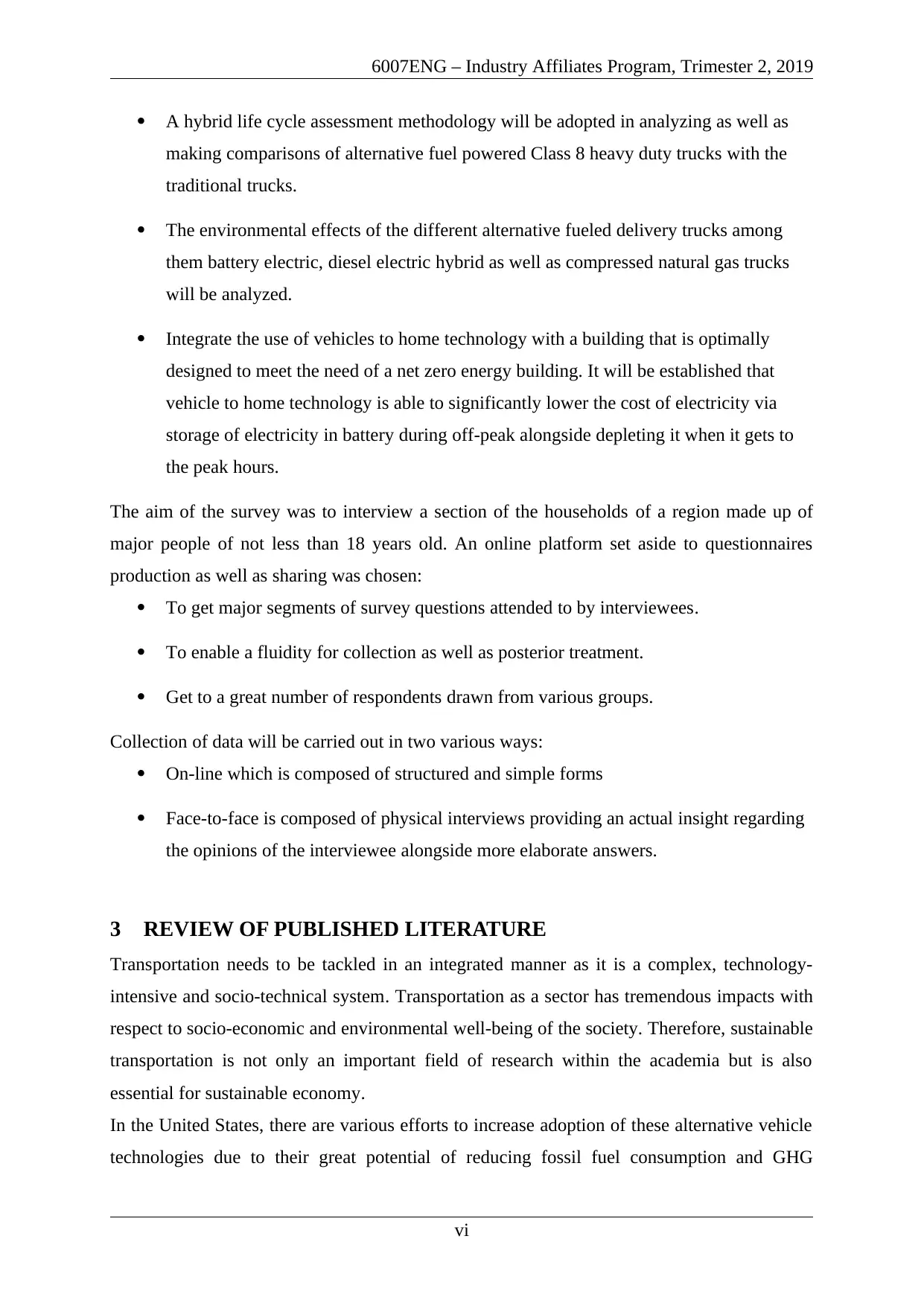
A hybrid life cycle assessment methodology will be adopted in analyzing as well as
making comparisons of alternative fuel powered Class 8 heavy duty trucks with the
traditional trucks.
The environmental effects of the different alternative fueled delivery trucks among
them battery electric, diesel electric hybrid as well as compressed natural gas trucks
will be analyzed.
Integrate the use of vehicles to home technology with a building that is optimally
designed to meet the need of a net zero energy building. It will be established that
vehicle to home technology is able to significantly lower the cost of electricity via
storage of electricity in battery during off-peak alongside depleting it when it gets to
the peak hours.
The aim of the survey was to interview a section of the households of a region made up of
major people of not less than 18 years old. An online platform set aside to questionnaires
production as well as sharing was chosen:
To get major segments of survey questions attended to by interviewees.
To enable a fluidity for collection as well as posterior treatment.
Get to a great number of respondents drawn from various groups.
Collection of data will be carried out in two various ways:
On-line which is composed of structured and simple forms
Face-to-face is composed of physical interviews providing an actual insight regarding
the opinions of the interviewee alongside more elaborate answers.
3 REVIEW OF PUBLISHED LITERATURE
Transportation needs to be tackled in an integrated manner as it is a complex, technology-
intensive and socio-technical system. Transportation as a sector has tremendous impacts with
respect to socio-economic and environmental well-being of the society. Therefore, sustainable
transportation is not only an important field of research within the academia but is also
essential for sustainable economy.
In the United States, there are various efforts to increase adoption of these alternative vehicle
technologies due to their great potential of reducing fossil fuel consumption and GHG
vi
A hybrid life cycle assessment methodology will be adopted in analyzing as well as
making comparisons of alternative fuel powered Class 8 heavy duty trucks with the
traditional trucks.
The environmental effects of the different alternative fueled delivery trucks among
them battery electric, diesel electric hybrid as well as compressed natural gas trucks
will be analyzed.
Integrate the use of vehicles to home technology with a building that is optimally
designed to meet the need of a net zero energy building. It will be established that
vehicle to home technology is able to significantly lower the cost of electricity via
storage of electricity in battery during off-peak alongside depleting it when it gets to
the peak hours.
The aim of the survey was to interview a section of the households of a region made up of
major people of not less than 18 years old. An online platform set aside to questionnaires
production as well as sharing was chosen:
To get major segments of survey questions attended to by interviewees.
To enable a fluidity for collection as well as posterior treatment.
Get to a great number of respondents drawn from various groups.
Collection of data will be carried out in two various ways:
On-line which is composed of structured and simple forms
Face-to-face is composed of physical interviews providing an actual insight regarding
the opinions of the interviewee alongside more elaborate answers.
3 REVIEW OF PUBLISHED LITERATURE
Transportation needs to be tackled in an integrated manner as it is a complex, technology-
intensive and socio-technical system. Transportation as a sector has tremendous impacts with
respect to socio-economic and environmental well-being of the society. Therefore, sustainable
transportation is not only an important field of research within the academia but is also
essential for sustainable economy.
In the United States, there are various efforts to increase adoption of these alternative vehicle
technologies due to their great potential of reducing fossil fuel consumption and GHG
vi
6007ENG – Industry Affiliates Program, Trimester 2, 2019
emissions. The U.S. road system has the largest network size in the world, as well as one of
the largest network usage densities at three million Vehicle Miles Traveled (VMT) per year.
These factors make the U.S. transportation sector an important source of GHG emissions and
energy consumption with 28% of the nation’s total emissions [2]. Additionally, the
transportation sector consumes immense amounts of petroleum and it is responsible for 67%
of the total U.S. petroleum consumption. This high petroleum demand is more than the U.S.
petroleum production (141% of total petroleum production in the U.S.), which compromises
national energy security and result in high dependency on fossil fuels [3]. Although the
alternative vehicle technologies have great potential to minimize the negative economic,
social, and environmental impacts of the fast-growing transportation sector, there are certain
challenges against widespread adoption of these technologies. These barriers include lack of
infrastructure, customer’s unwillingness to purchase these vehicles, high initial costs of
BEVs, and insufficient all-electric range [4]. In this regard, national agencies, state level
authorities, and international organizations support the adoption of alternative vehicle
technologies to increase their market penetration [5][6][7][8]. For instance, The Obama
administration and the Department of Energy (DOE) aim to reach one million electric
vehicles (including HEVs, PHEVs, and BEVs) by 2015 and are trying to accelerate sales by
state and federal level incentives [9]. In addition, a program by the DOE, EV-Everywhere
Challenge, aims to promote development and research activities to reduce battery costs,
increase the all-electric range of electric vehicles, and make these vehicles affordable for
American families [10]. While all of these efforts are necessary and useful, it is more
important to understand the macro-level social, economic, and environmental (termed as the
triple bottom line) impacts of alternative vehicle technologies to be able to develop more
effective policies and guide the offering of incentives to the right domains.
Analysis of alternative vehicle systems needs a holistic triple bottom line sustainability
accounting which requires a broad set of environmental, economic and environmental
indicators [11]. Although many studies have used life-cycle based approaches to quantify the
environmental consequences of alternative transportation systems, only a handful of studies
have been found in the literature which analyze the socio-economic aspects of these
transportation systems. The majority of the studies which conducted an environmental life-
cycle assessment of conventional and electric vehicles mainly focused on the limited
environmental impact categories such as greenhouse gas emissions, energy consumption, and
some mid-point indicators[12][13][14]. In general, the difficulties related to precisely
assessing the broader social and economic impacts of transportation stem from lack of
vii
emissions. The U.S. road system has the largest network size in the world, as well as one of
the largest network usage densities at three million Vehicle Miles Traveled (VMT) per year.
These factors make the U.S. transportation sector an important source of GHG emissions and
energy consumption with 28% of the nation’s total emissions [2]. Additionally, the
transportation sector consumes immense amounts of petroleum and it is responsible for 67%
of the total U.S. petroleum consumption. This high petroleum demand is more than the U.S.
petroleum production (141% of total petroleum production in the U.S.), which compromises
national energy security and result in high dependency on fossil fuels [3]. Although the
alternative vehicle technologies have great potential to minimize the negative economic,
social, and environmental impacts of the fast-growing transportation sector, there are certain
challenges against widespread adoption of these technologies. These barriers include lack of
infrastructure, customer’s unwillingness to purchase these vehicles, high initial costs of
BEVs, and insufficient all-electric range [4]. In this regard, national agencies, state level
authorities, and international organizations support the adoption of alternative vehicle
technologies to increase their market penetration [5][6][7][8]. For instance, The Obama
administration and the Department of Energy (DOE) aim to reach one million electric
vehicles (including HEVs, PHEVs, and BEVs) by 2015 and are trying to accelerate sales by
state and federal level incentives [9]. In addition, a program by the DOE, EV-Everywhere
Challenge, aims to promote development and research activities to reduce battery costs,
increase the all-electric range of electric vehicles, and make these vehicles affordable for
American families [10]. While all of these efforts are necessary and useful, it is more
important to understand the macro-level social, economic, and environmental (termed as the
triple bottom line) impacts of alternative vehicle technologies to be able to develop more
effective policies and guide the offering of incentives to the right domains.
Analysis of alternative vehicle systems needs a holistic triple bottom line sustainability
accounting which requires a broad set of environmental, economic and environmental
indicators [11]. Although many studies have used life-cycle based approaches to quantify the
environmental consequences of alternative transportation systems, only a handful of studies
have been found in the literature which analyze the socio-economic aspects of these
transportation systems. The majority of the studies which conducted an environmental life-
cycle assessment of conventional and electric vehicles mainly focused on the limited
environmental impact categories such as greenhouse gas emissions, energy consumption, and
some mid-point indicators[12][13][14]. In general, the difficulties related to precisely
assessing the broader social and economic impacts of transportation stem from lack of
vii
⊘ This is a preview!⊘
Do you want full access?
Subscribe today to unlock all pages.
Trusted by 1+ million students worldwide
6007ENG – Industry Affiliates Program, Trimester 2, 2019
appropriate methods, tools and data availability. However, the socio-economic effects of
transportation should be considered since they are highly critical for the quality of people’s
lives [15]. According to a comprehensive guidebook published by the Transportation
Research Board on the socio-economic effects of transportation projects, travel time, safety,
vehicle operating cost, noise, and congestion are listed among the prominent socio-economic
metrics [16]. In another study related to issues in sustainable transportation, the importance of
environmental, economic, and social indicators for sustainability assessment of transportation
systems was discussed. According to Litman and Burwell [17], income, employment,
accessibility, safety, equity, and affordability are listed as the major socio-economic metrics
of sustainable transportation. Offer et al. [18] also conducted a comparative study and focused
on the economic impacts of battery and electric vehicles using a life-cycle cost analysis based
on capital cost, running cost, and end-of-life cost. Stone et al. [19] used the Global Trade
Analysis Project (GTAP) database in order to analyze the socio-economic impacts of
transportation projects considering a wide range of socio-economic indicators such as
contribution to gross domestic product (GDP), household income, poverty, and import. The
World Bank’s report on social analysis of transportation projects also revealed important
insights regarding the significance of socio-economic aspects of transportation. In this report,
employment, road safety, health impacts, and accessibility are considered key drivers of
socio-economic sustainability in transportation [20]. In a report published by the European
Commission for the future of sustainable transportation in European States, number of
fatalities and injuries, contribution to GDP, employment, external cost of transportation
activities such as congestion, emission and safety, taxation, average passenger travel time, and
affordability are listed among the key indicators to assess the socio-economic sustainability
aspects of transportation activities [21].
3.1 The paradox of Mobility and its Cost:
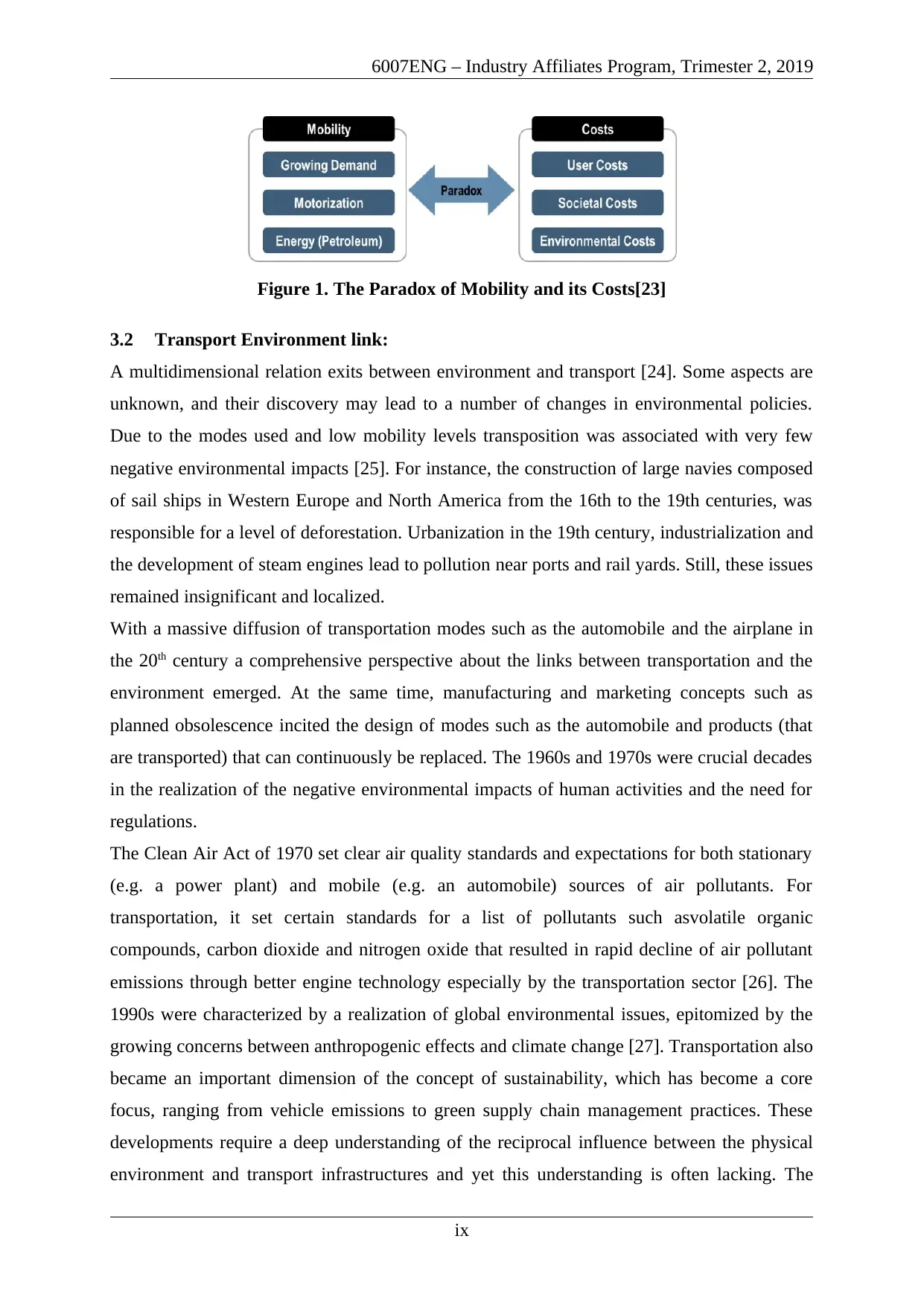
A paradoxical relationship exists between the mobility and its cost. This relationship is
dependent on the benefits derived by the users and the costs (in part assumed by the society
and the environment). Increasing demands for mobility is directly linked with motorization
but mobility consumes large amount of energy resources, mainly petroleum. Mobility comes
at a cost (e.g. fuel, maintenance, licensing, insurance, etc.) which is partially assumed by the
user and environmental impacts are a cost mostly assumed by the society. The benefits of
mobility are internal to the users while the costs are in part externalized [22].
viii
appropriate methods, tools and data availability. However, the socio-economic effects of
transportation should be considered since they are highly critical for the quality of people’s
lives [15]. According to a comprehensive guidebook published by the Transportation
Research Board on the socio-economic effects of transportation projects, travel time, safety,
vehicle operating cost, noise, and congestion are listed among the prominent socio-economic
metrics [16]. In another study related to issues in sustainable transportation, the importance of
environmental, economic, and social indicators for sustainability assessment of transportation
systems was discussed. According to Litman and Burwell [17], income, employment,
accessibility, safety, equity, and affordability are listed as the major socio-economic metrics
of sustainable transportation. Offer et al. [18] also conducted a comparative study and focused
on the economic impacts of battery and electric vehicles using a life-cycle cost analysis based
on capital cost, running cost, and end-of-life cost. Stone et al. [19] used the Global Trade
Analysis Project (GTAP) database in order to analyze the socio-economic impacts of
transportation projects considering a wide range of socio-economic indicators such as
contribution to gross domestic product (GDP), household income, poverty, and import. The
World Bank’s report on social analysis of transportation projects also revealed important
insights regarding the significance of socio-economic aspects of transportation. In this report,
employment, road safety, health impacts, and accessibility are considered key drivers of
socio-economic sustainability in transportation [20]. In a report published by the European
Commission for the future of sustainable transportation in European States, number of
fatalities and injuries, contribution to GDP, employment, external cost of transportation
activities such as congestion, emission and safety, taxation, average passenger travel time, and
affordability are listed among the key indicators to assess the socio-economic sustainability
aspects of transportation activities [21].
3.1 The paradox of Mobility and its Cost:
A paradoxical relationship exists between the mobility and its cost. This relationship is
dependent on the benefits derived by the users and the costs (in part assumed by the society
and the environment). Increasing demands for mobility is directly linked with motorization
but mobility consumes large amount of energy resources, mainly petroleum. Mobility comes
at a cost (e.g. fuel, maintenance, licensing, insurance, etc.) which is partially assumed by the
user and environmental impacts are a cost mostly assumed by the society. The benefits of
mobility are internal to the users while the costs are in part externalized [22].
viii
Paraphrase This Document
Need a fresh take? Get an instant paraphrase of this document with our AI Paraphraser
6007ENG – Industry Affiliates Program, Trimester 2, 2019
Figure 1. The Paradox of Mobility and its Costs[23]
3.2 Transport Environment link:
A multidimensional relation exits between environment and transport [24]. Some aspects are
unknown, and their discovery may lead to a number of changes in environmental policies.
Due to the modes used and low mobility levels transposition was associated with very few
negative environmental impacts [25]. For instance, the construction of large navies composed
of sail ships in Western Europe and North America from the 16th to the 19th centuries, was
responsible for a level of deforestation. Urbanization in the 19th century, industrialization and
the development of steam engines lead to pollution near ports and rail yards. Still, these issues
remained insignificant and localized.
With a massive diffusion of transportation modes such as the automobile and the airplane in
the 20th century a comprehensive perspective about the links between transportation and the
environment emerged. At the same time, manufacturing and marketing concepts such as
planned obsolescence incited the design of modes such as the automobile and products (that
are transported) that can continuously be replaced. The 1960s and 1970s were crucial decades
in the realization of the negative environmental impacts of human activities and the need for
regulations.
The Clean Air Act of 1970 set clear air quality standards and expectations for both stationary
(e.g. a power plant) and mobile (e.g. an automobile) sources of air pollutants. For
transportation, it set certain standards for a list of pollutants such asvolatile organic
compounds, carbon dioxide and nitrogen oxide that resulted in rapid decline of air pollutant
emissions through better engine technology especially by the transportation sector [26]. The
1990s were characterized by a realization of global environmental issues, epitomized by the
growing concerns between anthropogenic effects and climate change [27]. Transportation also
became an important dimension of the concept of sustainability, which has become a core
focus, ranging from vehicle emissions to green supply chain management practices. These
developments require a deep understanding of the reciprocal influence between the physical
environment and transport infrastructures and yet this understanding is often lacking. The
ix
Figure 1. The Paradox of Mobility and its Costs[23]
3.2 Transport Environment link:
A multidimensional relation exits between environment and transport [24]. Some aspects are
unknown, and their discovery may lead to a number of changes in environmental policies.
Due to the modes used and low mobility levels transposition was associated with very few
negative environmental impacts [25]. For instance, the construction of large navies composed
of sail ships in Western Europe and North America from the 16th to the 19th centuries, was
responsible for a level of deforestation. Urbanization in the 19th century, industrialization and
the development of steam engines lead to pollution near ports and rail yards. Still, these issues
remained insignificant and localized.
With a massive diffusion of transportation modes such as the automobile and the airplane in
the 20th century a comprehensive perspective about the links between transportation and the
environment emerged. At the same time, manufacturing and marketing concepts such as
planned obsolescence incited the design of modes such as the automobile and products (that
are transported) that can continuously be replaced. The 1960s and 1970s were crucial decades
in the realization of the negative environmental impacts of human activities and the need for
regulations.
The Clean Air Act of 1970 set clear air quality standards and expectations for both stationary
(e.g. a power plant) and mobile (e.g. an automobile) sources of air pollutants. For
transportation, it set certain standards for a list of pollutants such asvolatile organic
compounds, carbon dioxide and nitrogen oxide that resulted in rapid decline of air pollutant
emissions through better engine technology especially by the transportation sector [26]. The
1990s were characterized by a realization of global environmental issues, epitomized by the
growing concerns between anthropogenic effects and climate change [27]. Transportation also
became an important dimension of the concept of sustainability, which has become a core
focus, ranging from vehicle emissions to green supply chain management practices. These
developments require a deep understanding of the reciprocal influence between the physical
environment and transport infrastructures and yet this understanding is often lacking. The
ix
6007ENG – Industry Affiliates Program, Trimester 2, 2019
main factors considered in the physical environment are geographical location, topography,
geological structure, climate, hydrology, soil, natural vegetation and animal life.
Transportation environmental dimensions are related to the causes, the activities, the outputs
and the results of transport systems [28]. It is a difficult task to establish linkages between
environmental dimensions e.g. to what extent carbon dioxide emissions are linked to land use
patterns? Furthermore, transportation is rooted in environmental cycles, especially over the
carbon cycle where carbon flows from one element of the biosphere, like the atmosphere, to
another like the ecosphere, where it can be accumulated (permanently or temporarily) or
passed on. The relationships between transport and the environment are also complicated by
two observations:
Level of contribution. Transport activities contribute directly, indirectly and cumulatively to
environmental problems. In some cases, they may be a dominant factor, while in others their
role is marginal and difficult to determine.
Scale of impact. Transport activities contribute at different geographical scales to
environmental problems, ranging from local (noise and CO emissions) to global (climate
change).
Therefore, establishing environmental rules and regulations should take into account the level
of contribution and the geographical scale otherwise the policies will just result in the moving
of problems to another region and have unintended consequences.
The major factors in the sector of transportation that impact the environment include the
modes used for transportation, transport network and traffic levels. Modes relate to the nature
of emission while the modes and traffic levels influence the spatial distribution of emission
and intensity of these emission respectively. In addition to these environmental impacts,
industrial processes and economics (such as the extraction and production of fuels, vehicles
and construction materials) should also be considered. All of these have a life cycle timing
their production, utilization and disposal. Thus, without the consideration of the relationship
between environment and product life, the evaluation of the link between transport and the
environment is likely to convey a limited overview of the situation and may even lead to
incorrect appraisal, mitigation and policies.
x
main factors considered in the physical environment are geographical location, topography,
geological structure, climate, hydrology, soil, natural vegetation and animal life.
Transportation environmental dimensions are related to the causes, the activities, the outputs
and the results of transport systems [28]. It is a difficult task to establish linkages between
environmental dimensions e.g. to what extent carbon dioxide emissions are linked to land use
patterns? Furthermore, transportation is rooted in environmental cycles, especially over the
carbon cycle where carbon flows from one element of the biosphere, like the atmosphere, to
another like the ecosphere, where it can be accumulated (permanently or temporarily) or
passed on. The relationships between transport and the environment are also complicated by
two observations:
Level of contribution. Transport activities contribute directly, indirectly and cumulatively to
environmental problems. In some cases, they may be a dominant factor, while in others their
role is marginal and difficult to determine.
Scale of impact. Transport activities contribute at different geographical scales to
environmental problems, ranging from local (noise and CO emissions) to global (climate
change).
Therefore, establishing environmental rules and regulations should take into account the level
of contribution and the geographical scale otherwise the policies will just result in the moving
of problems to another region and have unintended consequences.
The major factors in the sector of transportation that impact the environment include the
modes used for transportation, transport network and traffic levels. Modes relate to the nature
of emission while the modes and traffic levels influence the spatial distribution of emission
and intensity of these emission respectively. In addition to these environmental impacts,
industrial processes and economics (such as the extraction and production of fuels, vehicles
and construction materials) should also be considered. All of these have a life cycle timing
their production, utilization and disposal. Thus, without the consideration of the relationship
between environment and product life, the evaluation of the link between transport and the
environment is likely to convey a limited overview of the situation and may even lead to
incorrect appraisal, mitigation and policies.
x
⊘ This is a preview!⊘
Do you want full access?
Subscribe today to unlock all pages.
Trusted by 1+ million students worldwide

1 out of 50


Your All-in-One AI-Powered Toolkit for Academic Success.
+13062052269
info@desklib.com
Available 24*7 on WhatsApp / Email
![[object Object]](/_next/static/media/star-bottom.7253800d.svg)
Unlock your academic potential
Copyright © 2020–2026 A2Z Services. All Rights Reserved. Developed and managed by ZUCOL.