Inflation Targeting: Comparative Economic Analysis of Japan and US

Verified

Added on  2022/10/06

|6
|1002
|80
Essay
AI Summary
This essay critically examines the concept of inflation targeting, questioning its perceived success by analyzing the experiences of Japan and the United States. The analysis begins by presenting historical inflation data for Japan, demonstrating its ability to control inflation without explicit inflation targeting, attributing this to the conservative consumption behavior of its population and deflation in the 1980s. The study then contrasts this with the United States, which also managed inflation effectively without adopting inflation targeting, despite a less inflation-averse populace. The essay delves into the policies implemented by both countries, such as Japan's zero interest rate policy and quantitative easing, arguing that inflation targeting might not be universally superior. It concludes that the low inflation in both countries stems from economic conditions and that inflation targeting might not be over glorified, suggesting that the effectiveness of inflation targeting is context-dependent and influenced by underlying economic factors.
Document Page
Running head: INFLATION TARGETING
Inflation Targeting
Name of the Student
Name of the University
Student ID
tabler-icon-diamond-filled.svg

Paraphrase This Document

Need a fresh take? Get an instant paraphrase of this document with our AI Paraphraser
Document Page
1INFLATION TARGETING
Table of Contents
Answer c.....................................................................................................................................2
References..................................................................................................................................5
Document Page
2INFLATION TARGETING
Answer c
The statement in the question states that inflation targeting is over glorified and by
observing the failure of the countries that used inflation targeting, and success of the
countries that did not, it seems the statement is justified. The countries in this context that
have not adopted the inflation targeting policy are Japan and the United States and both are
categorised under developed or advanced economies. Furthermore, it is observed that these
two countries have more efficiently controlled the inflation rate than the countries with
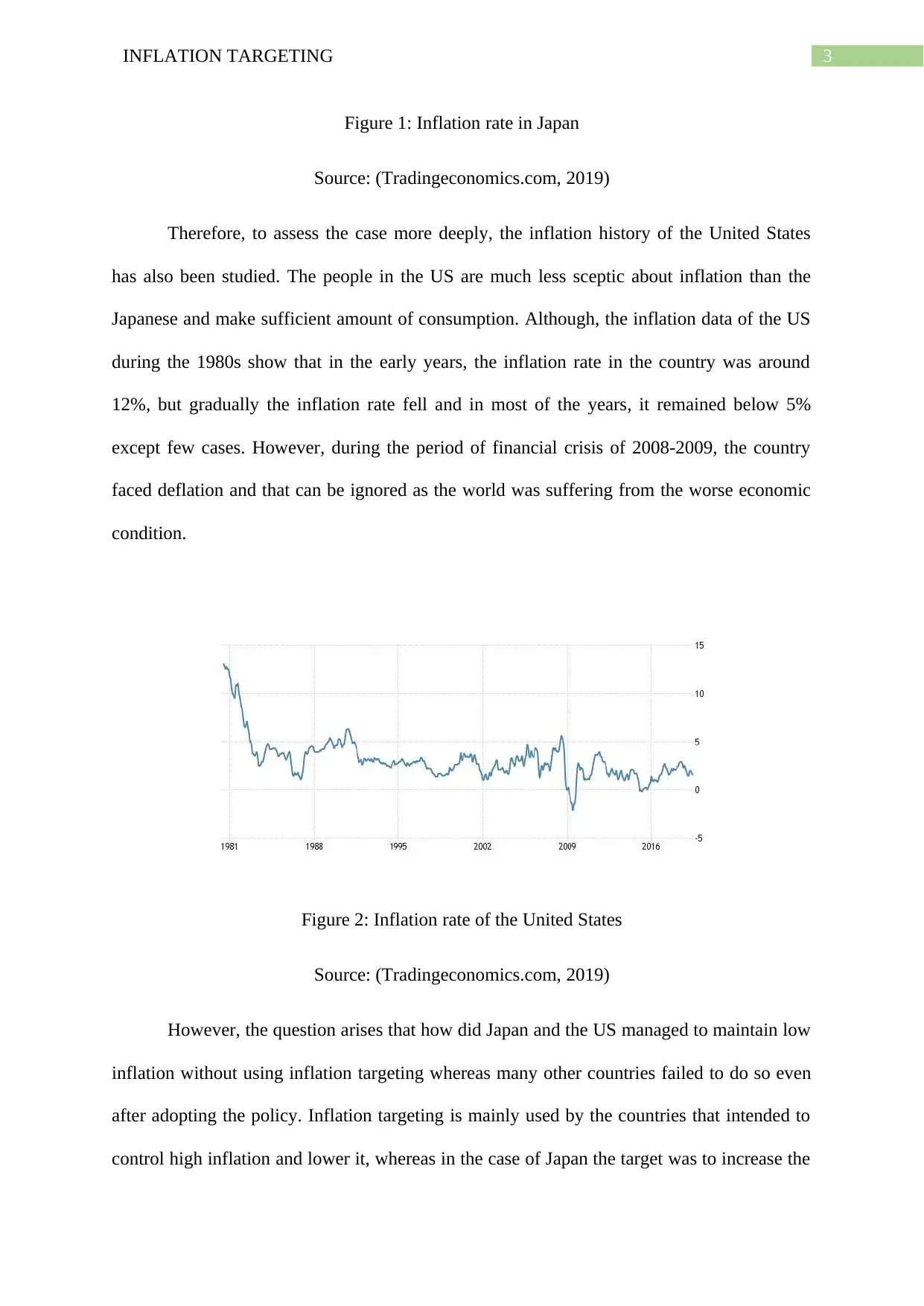
inflation targeting policy and helped their respective economies grow faster. In figure 1, the
historical inflation data of Japan is given and if the decade of introduction of inflation
targeting is considered that is the 1980s, it can be observed that in early 1980s the inflation
rate in Japan was close to 10%. However, it gradually fell and by the end of the decade, the
average inflation rate of the country was below 4%. The reason for such a low average
despite the high inflation in the early years was due to the deflation that occurred in the
middle of the decade. Thus, Japan was able to control its inflation rate and stabilize its price
level without using the inflation targeting policy and it is a laudable task to accomplish
(Bernanke et al., 2018). It is known that the Japanese people are considerably sceptic toward
increase in inflation and thus they keep their consumption low to avoid any rise in inflation
rate. Thus, many can argue that this conservative behaviour of the Japanese people might
have contributed to the low inflation rate.
Document Page
3INFLATION TARGETING
Figure 1: Inflation rate in Japan
Source: (Tradingeconomics.com, 2019)
Therefore, to assess the case more deeply, the inflation history of the United States
has also been studied. The people in the US are much less sceptic about inflation than the
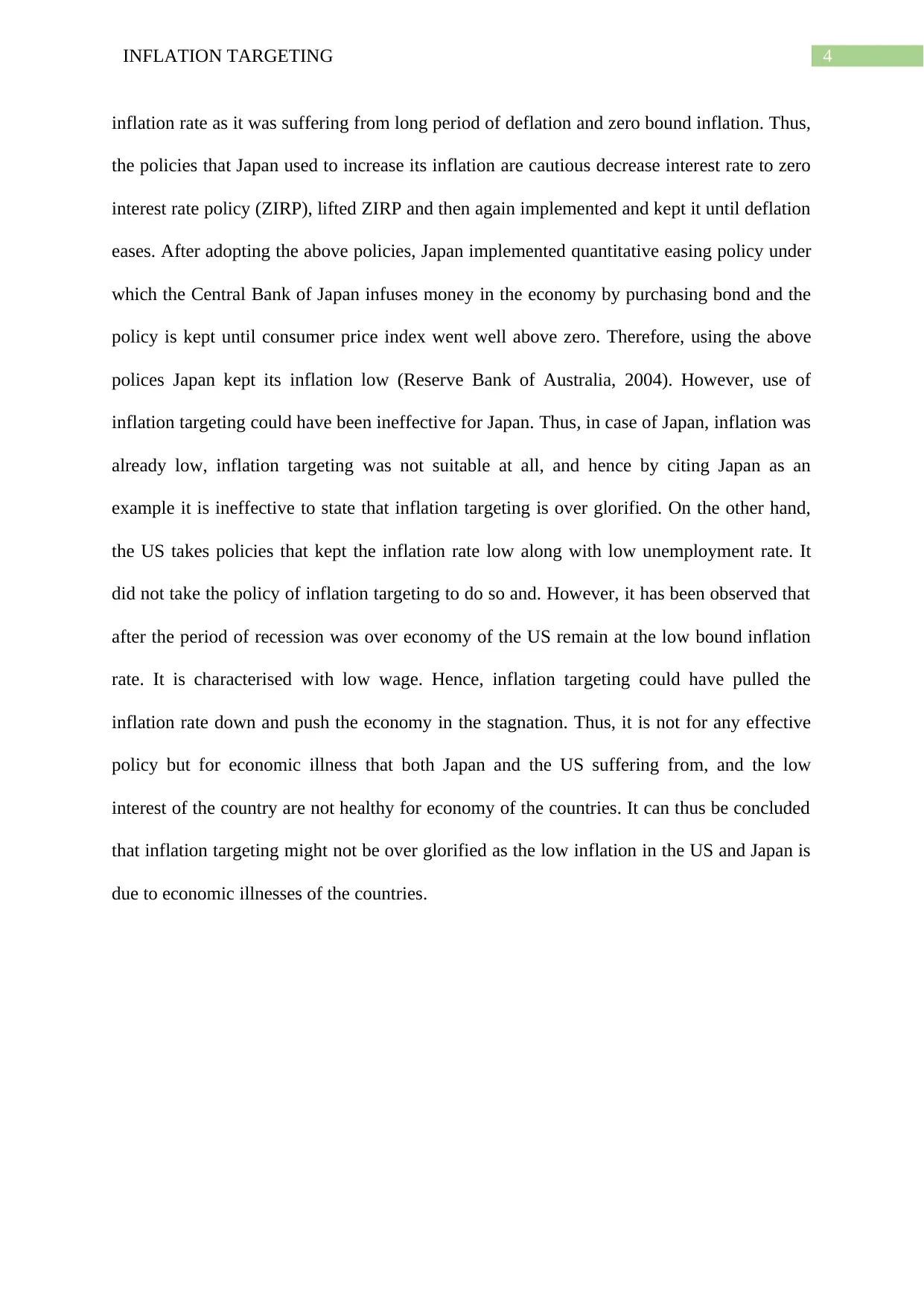
Japanese and make sufficient amount of consumption. Although, the inflation data of the US
during the 1980s show that in the early years, the inflation rate in the country was around
12%, but gradually the inflation rate fell and in most of the years, it remained below 5%
except few cases. However, during the period of financial crisis of 2008-2009, the country
faced deflation and that can be ignored as the world was suffering from the worse economic
condition.
Figure 2: Inflation rate of the United States
Source: (Tradingeconomics.com, 2019)
However, the question arises that how did Japan and the US managed to maintain low
inflation without using inflation targeting whereas many other countries failed to do so even
after adopting the policy. Inflation targeting is mainly used by the countries that intended to
control high inflation and lower it, whereas in the case of Japan the target was to increase the
tabler-icon-diamond-filled.svg

Paraphrase This Document

Need a fresh take? Get an instant paraphrase of this document with our AI Paraphraser
Document Page
4INFLATION TARGETING
inflation rate as it was suffering from long period of deflation and zero bound inflation. Thus,
the policies that Japan used to increase its inflation are cautious decrease interest rate to zero
interest rate policy (ZIRP), lifted ZIRP and then again implemented and kept it until deflation
eases. After adopting the above policies, Japan implemented quantitative easing policy under
which the Central Bank of Japan infuses money in the economy by purchasing bond and the
policy is kept until consumer price index went well above zero. Therefore, using the above
polices Japan kept its inflation low (Reserve Bank of Australia, 2004). However, use of
inflation targeting could have been ineffective for Japan. Thus, in case of Japan, inflation was
already low, inflation targeting was not suitable at all, and hence by citing Japan as an
example it is ineffective to state that inflation targeting is over glorified. On the other hand,
the US takes policies that kept the inflation rate low along with low unemployment rate. It
did not take the policy of inflation targeting to do so and. However, it has been observed that
after the period of recession was over economy of the US remain at the low bound inflation
rate. It is characterised with low wage. Hence, inflation targeting could have pulled the
inflation rate down and push the economy in the stagnation. Thus, it is not for any effective
policy but for economic illness that both Japan and the US suffering from, and the low
interest of the country are not healthy for economy of the countries. It can thus be concluded
that inflation targeting might not be over glorified as the low inflation in the US and Japan is
due to economic illnesses of the countries.
Document Page
5INFLATION TARGETING
References
Bernanke, B. S., Laubach, T., Mishkin, F. S., & Posen, A. S. (2018). Inflation targeting:
lessons from the international experience. Princeton University Press.
Reserve Bank of Australia. (2004). Inflation Targeting and Japan: Why has the Bank of Japan
not Adopted Inflation Targeting? | Conference – 2004. Retrieved 13 August 2019,
from https://www.rba.gov.au/publications/confs/2004/ito.html
Tradingeconomics.com. (2019). Japan Inflation Rate | 2019 | Data | Chart | Calendar |
Forecast | News. Retrieved 26 July 2019, from
https://tradingeconomics.com/japan/inflation-cpi
Tradingeconomics.com. (2019). United States Inflation Rate | 2019 | Data | Chart | Calendar |
Forecast. Retrieved 26 July 2019, from
https://tradingeconomics.com/united-states/inflation-cpi
chevron_up_icon
1 out of 6
circle_padding
hide_on_mobile
zoom_out_icon
[object Object]