MG413 Presentation: Data Insights for Business Decisions 2022
VerifiedAdded on 2023/06/12
|15
|1326
|218
Presentation
AI Summary
This presentation explores the role of data and information in business decisions, particularly within the retail sector, using Sainsbury as an example. It covers the types of data collected (primary, secondary, big data), compares traditional market research with big data approaches, and discusses how data is captured, stored, and used to improve the value chain. The presentation also highlights the impact of technological developments on data collection and analysis, emphasizing the importance of data-driven capabilities for staying competitive. It concludes with ways to improve data capture, emphasizing customer involvement, and encourages organizations to focus on data generation throughout their operations. Desklib provides access to similar presentations and solved assignments for students.

COVER PAGE
NAMES OF GROUP MEMBERS
1.
2.
3.
4.
5.
NAMES OF GROUP MEMBERS
1.
2.
3.
4.
5.
Paraphrase This Document
Need a fresh take? Get an instant paraphrase of this document with our AI Paraphraser

Introduction
Data-driven decision-making is crucial for a company's success since it enables for
real-time insights and forecasts to improve performance. They may also use this
strategy to evaluate the viability of alternative concepts and methodologies, allowing
them to make informed business decisions for long-term growth (Testa, Iovino, and
Iraldo, 2020). The Sainsbury Firm, a worldwide retail corporation, is the subject of this
lecture. Data may be viewed as a systematic record of a certain quantity.
Data-driven decision-making is crucial for a company's success since it enables for
real-time insights and forecasts to improve performance. They may also use this
strategy to evaluate the viability of alternative concepts and methodologies, allowing
them to make informed business decisions for long-term growth (Testa, Iovino, and
Iraldo, 2020). The Sainsbury Firm, a worldwide retail corporation, is the subject of this
lecture. Data may be viewed as a systematic record of a certain quantity.

Importance of data collection for
organisations
The collection of data is a crucial part for any business as it helps in analysing different aspect in
the business and help the business do better in the competitive market (Siddique, and et.al.,2019).
Following are some specific importance of data collection for businesses:
It is hard to make judgments that will help their organisation expand without properly
examining the obtained data.
Since the global market has grown more accessible to everyone, it is constantly evolving. As a
result, without a thorough data analysis or the use of a data processing solution, businesses will
be unable to enhance productivity and growth.
organisations
The collection of data is a crucial part for any business as it helps in analysing different aspect in
the business and help the business do better in the competitive market (Siddique, and et.al.,2019).
Following are some specific importance of data collection for businesses:
It is hard to make judgments that will help their organisation expand without properly
examining the obtained data.
Since the global market has grown more accessible to everyone, it is constantly evolving. As a
result, without a thorough data analysis or the use of a data processing solution, businesses will
be unable to enhance productivity and growth.
⊘ This is a preview!⊘
Do you want full access?
Subscribe today to unlock all pages.

Trusted by 1+ million students worldwide

Importance of primary, secondary data (cont.)
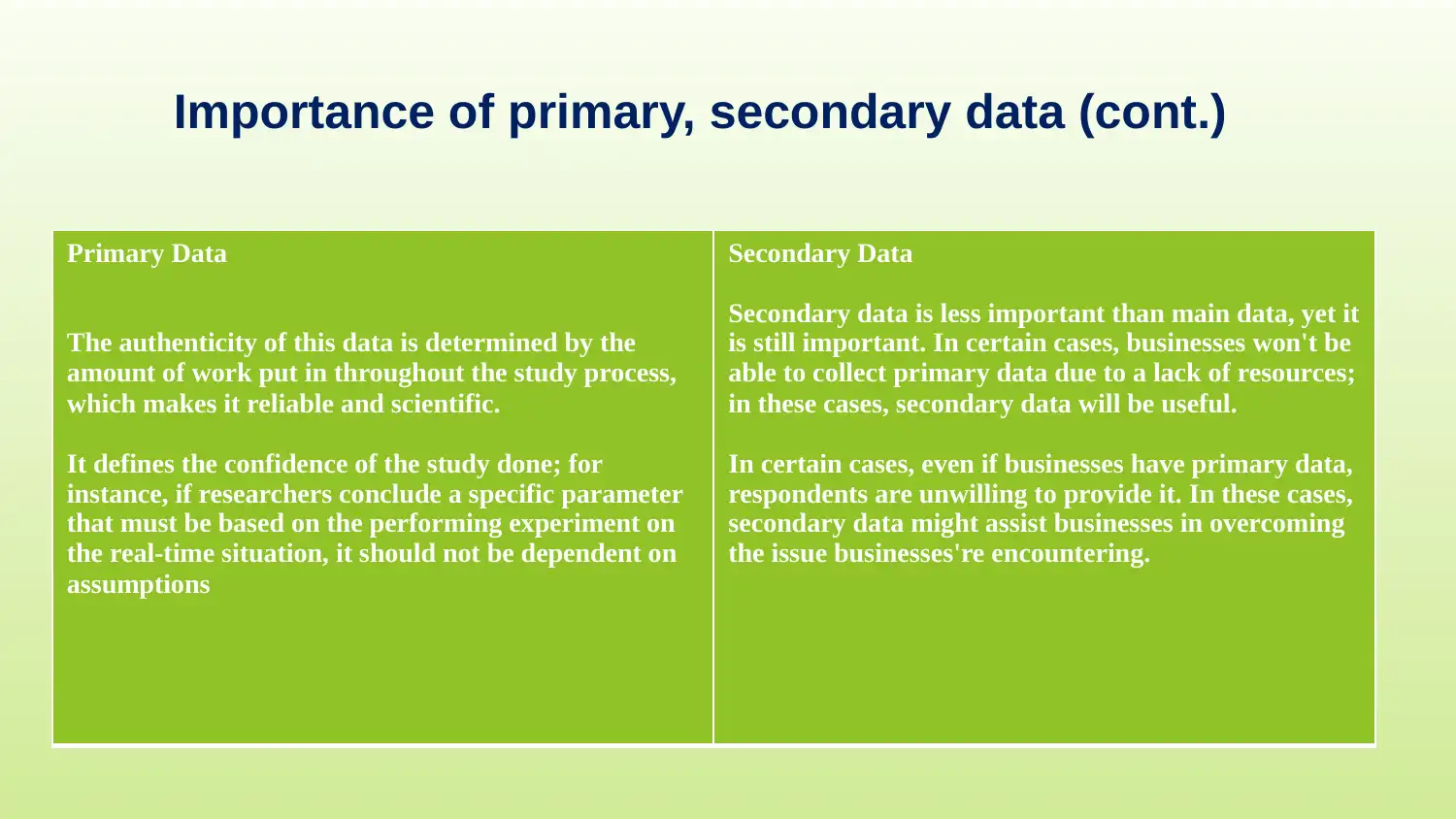
Primary Data
The authenticity of this data is determined by the
amount of work put in throughout the study process,
which makes it reliable and scientific.
It defines the confidence of the study done; for
instance, if researchers conclude a specific parameter
that must be based on the performing experiment on
the real-time situation, it should not be dependent on
assumptions
Secondary Data
Secondary data is less important than main data, yet it
is still important. In certain cases, businesses won't be
able to collect primary data due to a lack of resources;
in these cases, secondary data will be useful.
In certain cases, even if businesses have primary data,
respondents are unwilling to provide it. In these cases,
secondary data might assist businesses in overcoming
the issue businesses're encountering.
Primary Data
The authenticity of this data is determined by the
amount of work put in throughout the study process,
which makes it reliable and scientific.
It defines the confidence of the study done; for
instance, if researchers conclude a specific parameter
that must be based on the performing experiment on
the real-time situation, it should not be dependent on
assumptions
Secondary Data
Secondary data is less important than main data, yet it
is still important. In certain cases, businesses won't be
able to collect primary data due to a lack of resources;
in these cases, secondary data will be useful.
In certain cases, even if businesses have primary data,
respondents are unwilling to provide it. In these cases,
secondary data might assist businesses in overcoming
the issue businesses're encountering.
Paraphrase This Document
Need a fresh take? Get an instant paraphrase of this document with our AI Paraphraser

Types of Data
The following are some of the data type:
Primary information: This form of data is frequently developed by the researcher and is
particularly designed to recognize and solve the study problem at hand, such as interviews,
questionnaires, and experiments.
Secondary data are data that has been gathered and disseminated earlier by large government
agency or any other source (Bahlo, and et.al, 2019). It's made up of several different data
files.
The following are some of the data type:
Primary information: This form of data is frequently developed by the researcher and is
particularly designed to recognize and solve the study problem at hand, such as interviews,
questionnaires, and experiments.
Secondary data are data that has been gathered and disseminated earlier by large government
agency or any other source (Bahlo, and et.al, 2019). It's made up of several different data
files.

Types of Collected Data and Use
Primary data: Experiments, surveys, and observations are used to gather primary
or raw data from a first-hand source.
Secondary data: it is information gathered by someone other than the researcher.
Secondary data is easily accessible and does not necessitate the use of any
specific gathering methods.
Primary data: Experiments, surveys, and observations are used to gather primary
or raw data from a first-hand source.
Secondary data: it is information gathered by someone other than the researcher.
Secondary data is easily accessible and does not necessitate the use of any
specific gathering methods.
⊘ This is a preview!⊘
Do you want full access?
Subscribe today to unlock all pages.

Trusted by 1+ million students worldwide

Description of orthodox market research VS Big Data
The practise of establishing the feasibility of a new product or service via
direct interviews with potential consumers is known as orthodox market
research (Trifirò, Sultana, and Bate, 2018). Traditional market research is
conducting direct interviews with potential customers to assess the viability of
a new product or service.
The practise of establishing the feasibility of a new product or service via
direct interviews with potential consumers is known as orthodox market
research (Trifirò, Sultana, and Bate, 2018). Traditional market research is
conducting direct interviews with potential customers to assess the viability of
a new product or service.
Paraphrase This Document
Need a fresh take? Get an instant paraphrase of this document with our AI Paraphraser

How is information captured and stored?
To gather and maintain data, two essential components are used:
software and hardware. These can be stated verbally or numerically.
It comes in two varieties: qualitative and quantitative (Piryonesi,
and El-Diraby, 2020). The distinction between data bases and
management information systems is as follows.
To gather and maintain data, two essential components are used:
software and hardware. These can be stated verbally or numerically.
It comes in two varieties: qualitative and quantitative (Piryonesi,
and El-Diraby, 2020). The distinction between data bases and
management information systems is as follows.

Description of the impact of technological developments
Every organization's technological innovation and development makes it
simpler to make sensitive and essential judgments (Elena-Bucea, and
et.al.,2021). When the scenario is unstructured, a decision support system may
be quite helpful, and a flexible IT system can help with the decision-making
process. Technology improvements help organizations obtain data more
quickly, allowing them to make more prompt and effective decisions.
Every organization's technological innovation and development makes it
simpler to make sensitive and essential judgments (Elena-Bucea, and
et.al.,2021). When the scenario is unstructured, a decision support system may
be quite helpful, and a flexible IT system can help with the decision-making
process. Technology improvements help organizations obtain data more
quickly, allowing them to make more prompt and effective decisions.
⊘ This is a preview!⊘
Do you want full access?
Subscribe today to unlock all pages.

Trusted by 1+ million students worldwide

How are data and information used?
Retail sector, for example, is becoming increasingly data-rich as a result of technological advancements. As a
result of digitization, there are more chances for data collecting. Sainsbury, for example, employs a customer
relationship management system to track client contacts via email or phone in order to build its data base on
items such as food, fashion, electronics, and financial services while responding frequent enquiries.
The chosen organisation employs data to better its value chain, with the objective of using data-driven
capabilities in practically every aspect of the business (Sebastianelli, and Tamimi, 2018). Big data has been
regarded as one of the most effective methods for gathering information about future retailing trends that
consider client expectations for both physical and online companies and services.
Retail sector, for example, is becoming increasingly data-rich as a result of technological advancements. As a
result of digitization, there are more chances for data collecting. Sainsbury, for example, employs a customer
relationship management system to track client contacts via email or phone in order to build its data base on
items such as food, fashion, electronics, and financial services while responding frequent enquiries.
The chosen organisation employs data to better its value chain, with the objective of using data-driven
capabilities in practically every aspect of the business (Sebastianelli, and Tamimi, 2018). Big data has been
regarded as one of the most effective methods for gathering information about future retailing trends that
consider client expectations for both physical and online companies and services.
Paraphrase This Document
Need a fresh take? Get an instant paraphrase of this document with our AI Paraphraser

What are some of the ways of
improving data capture?
As a result, in order to optimise data capture and usage, a company must focus on customers
who have completed their purchases while following the entire organisational chain.
Organizations must also evaluate how their actions may result in the generation of data that is
vital to their operations (Carbonara, and Pellegrino, 2020). If a specific firm is chosen, it
should be informed of the data sources that will be used. In the retail industry, there are
numerous techniques of investigating any information or data. For this reason, the business
must emphasise the value of client involvement.
improving data capture?
As a result, in order to optimise data capture and usage, a company must focus on customers
who have completed their purchases while following the entire organisational chain.
Organizations must also evaluate how their actions may result in the generation of data that is
vital to their operations (Carbonara, and Pellegrino, 2020). If a specific firm is chosen, it
should be informed of the data sources that will be used. In the retail industry, there are
numerous techniques of investigating any information or data. For this reason, the business
must emphasise the value of client involvement.

Conclusion
It can be deduced from the preceding PPT that every business
utilises data and information to stay up with market advancements.
Every business uses a number of data collection techniques,
including primary, secondary, and large-scale data collection, among
others. Because technology has greatly transformed the purpose of
data, traditional research marketing is vastly different from data.
It can be deduced from the preceding PPT that every business
utilises data and information to stay up with market advancements.
Every business uses a number of data collection techniques,
including primary, secondary, and large-scale data collection, among
others. Because technology has greatly transformed the purpose of
data, traditional research marketing is vastly different from data.
⊘ This is a preview!⊘
Do you want full access?
Subscribe today to unlock all pages.

Trusted by 1+ million students worldwide
1 out of 15
Related Documents
Your All-in-One AI-Powered Toolkit for Academic Success.
+13062052269
info@desklib.com
Available 24*7 on WhatsApp / Email
Unlock your academic potential
Copyright © 2020–2026 A2Z Services. All Rights Reserved. Developed and managed by ZUCOL.