Comprehensive Report on Information System and Big Data Analysis
VerifiedAdded on 2023/06/18
|11
|3323
|82
Report
AI Summary
This report provides a detailed analysis of information systems and big data, exploring various theories and methods for designing IT solutions such as Canvas and MS Office. It discusses different types of information systems, including DSS, ESS, TPS, MIS, and KSM, highlighting their roles and examples. The report also examines the impact of globalization on IT, focusing on how technology advancements drive global value chains and reduce barriers to trade. Furthermore, it presents the advantages and disadvantages of digital infrastructure, using cloud computing as an example, and addresses the risks associated with information system outsourcing, such as potential management weaknesses and employee morale issues. Desklib offers a platform to access this and many other solved assignments for students.
INFORMATION SYSTEM
AND BIG DATA ANALYSIS
AND BIG DATA ANALYSIS

Paraphrase This Document
Need a fresh take? Get an instant paraphrase of this document with our AI Paraphraser
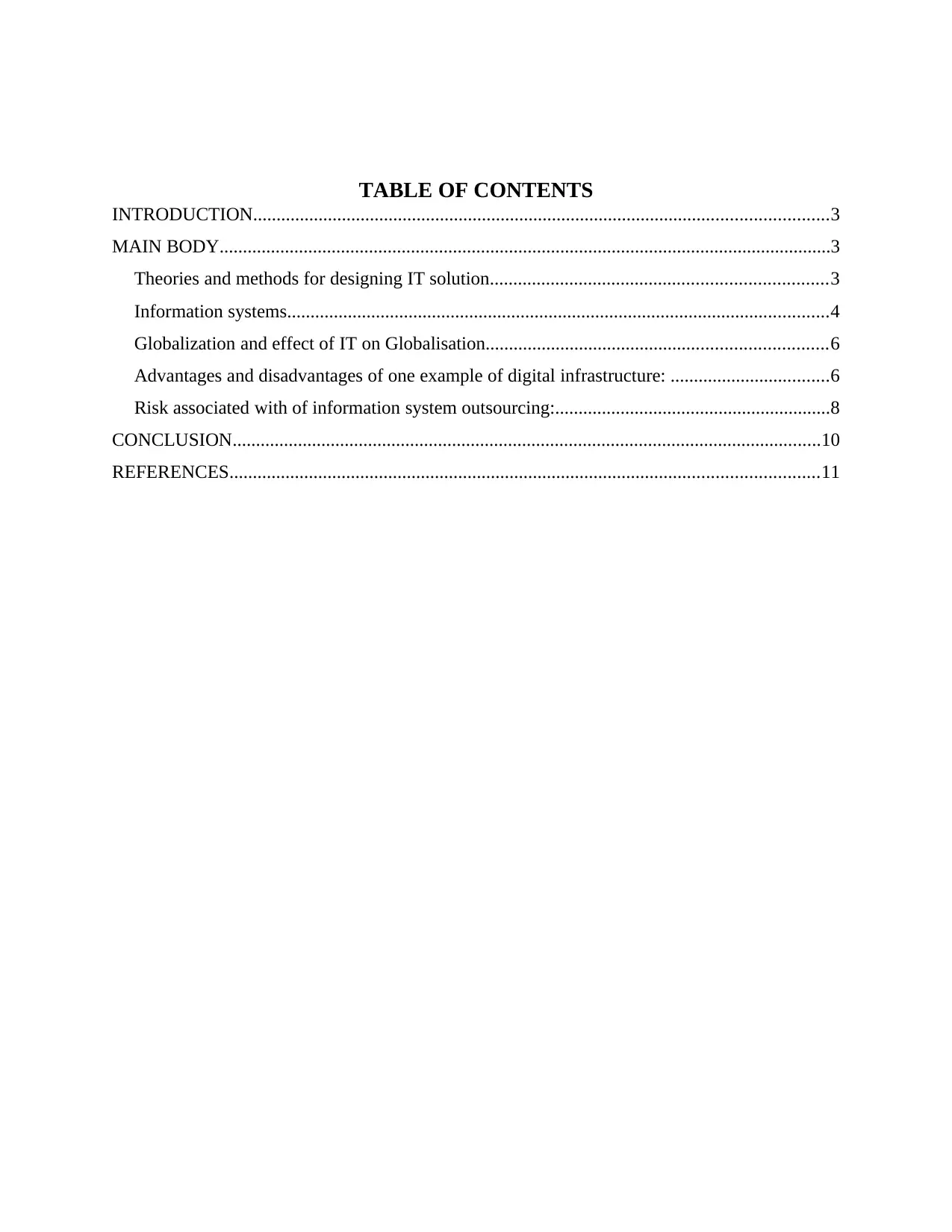
TABLE OF CONTENTS
INTRODUCTION...........................................................................................................................3
MAIN BODY...................................................................................................................................3
Theories and methods for designing IT solution........................................................................3
Information systems....................................................................................................................4
Globalization and effect of IT on Globalisation.........................................................................6
Advantages and disadvantages of one example of digital infrastructure: ..................................6
Risk associated with of information system outsourcing:...........................................................8
CONCLUSION..............................................................................................................................10
REFERENCES..............................................................................................................................11
INTRODUCTION...........................................................................................................................3
MAIN BODY...................................................................................................................................3
Theories and methods for designing IT solution........................................................................3
Information systems....................................................................................................................4
Globalization and effect of IT on Globalisation.........................................................................6
Advantages and disadvantages of one example of digital infrastructure: ..................................6
Risk associated with of information system outsourcing:...........................................................8
CONCLUSION..............................................................................................................................10
REFERENCES..............................................................................................................................11
INTRODUCTION
Information system an integrated hardware and software, it is a system that is used to
process the data for giving information to the system. Information system helps the organization
to carry out their organizational operation and to manage their interaction with their customers
and supplier agents. Big data analysis is the growing field of technology it is used to process big
and large data into simpler form (Bessen, 2017). Organization uses big data technology to
process their unstructured large data into a useful information to carried out several
organizational operation. Organization used this technology to carried out their operation
effectively. This report consist of methods and techniques of IT solution, effect of globalization
of IT on organization, information systems with examples also include advantage and
disadvantages of digital infrastructure and risk associated to information system.
MAIN BODY
Theories and methods for designing IT solution
Information technology solution are used to provide solution for many problems. These
are bundle of services and solution are used by the organization to perform their organizational
operation. Designing and developing the IT solution requires deep knowledge about its algorithm
which can be done by person who has relevant skills related to this area. Development methods
and techniques of Two IT solution are-
Canvas:
Canvas an IT solution used in HTML markup language. It is used for image Bitmap and
for several functions in HTML code. Canvas in HTML used to draw 2D graphics. Canvas is a
web based learning technology which is used by different technologies to use its functions.
Canvas technology consists of customizable functions and tools to solve analytical problems.
Canvas technology includes various tools as lines, text, graphic frames and other drawing
elements which is used for designing process (Gaardboe and Svarre, 2017). It adds extra
detailing in designing process. In a drawing canvas hold the whole picture if any part of the
picture is not shown on the canvas that it can be easily seen by the viewer and with the use of
canvas tools user can easily design their images and projects. Developing a canvas includes
Information system an integrated hardware and software, it is a system that is used to
process the data for giving information to the system. Information system helps the organization
to carry out their organizational operation and to manage their interaction with their customers
and supplier agents. Big data analysis is the growing field of technology it is used to process big
and large data into simpler form (Bessen, 2017). Organization uses big data technology to
process their unstructured large data into a useful information to carried out several
organizational operation. Organization used this technology to carried out their operation
effectively. This report consist of methods and techniques of IT solution, effect of globalization
of IT on organization, information systems with examples also include advantage and
disadvantages of digital infrastructure and risk associated to information system.
MAIN BODY
Theories and methods for designing IT solution
Information technology solution are used to provide solution for many problems. These
are bundle of services and solution are used by the organization to perform their organizational
operation. Designing and developing the IT solution requires deep knowledge about its algorithm
which can be done by person who has relevant skills related to this area. Development methods
and techniques of Two IT solution are-
Canvas:
Canvas an IT solution used in HTML markup language. It is used for image Bitmap and
for several functions in HTML code. Canvas in HTML used to draw 2D graphics. Canvas is a
web based learning technology which is used by different technologies to use its functions.
Canvas technology consists of customizable functions and tools to solve analytical problems.
Canvas technology includes various tools as lines, text, graphic frames and other drawing
elements which is used for designing process (Gaardboe and Svarre, 2017). It adds extra
detailing in designing process. In a drawing canvas hold the whole picture if any part of the
picture is not shown on the canvas that it can be easily seen by the viewer and with the use of
canvas tools user can easily design their images and projects. Developing a canvas includes
⊘ This is a preview!⊘
Do you want full access?
Subscribe today to unlock all pages.

Trusted by 1+ million students worldwide
algorithms and technologies, to design a canvas one should know proper knowledge about its
algorithms. Canvas for the business can be made as designing purpose of their project then target
customers are decided, collect information to make relationship between consumers further
decided key suppliers, key resources and key activities and finally budget is decided therefore
these are the process of developing a canvas for business.
MS Office:
MS office full name is Microsoft office a simply office it is a software that is produced
by Microsoft to perform many tasks. It carried out business office task and gives productivity to
them. It consists of different tools which are designed to carry out specific task each tool has its
different advantage which helps the user to perform several tasks. It is made for the purpose of
business to give productivity in business functions. Microsoft office allows the user to edit or
develop their text in its format by applying its services tool. For designing a Microsoft office first
decide positioning in which select the text wrap option then positions the text with text boxes
then use table if its needed use text direction to rotate the text, edit the margins and space, use
thumbnails for long document. With the help of MS office tools user can easily creates the
shortcuts so it will be easy for them to use. MS office in business used for text editing purpose its
tools helped them to develop better business solution (Li and et.al 2020).
Information systems
Information system a software that is used for the purpose of collecting and processing
the data. There are some information systems which are follows as-
DSS information system:
DSS stands for decision support system is a computerized information system used by
businesses to support their judgements, actions and their resolution. It supports the decision-
making process of business by processing large amount of information. DSS system is a
combination of both fully computerize or human powered. It helps the organizational manager to
solve any structured and unstructured query to support their decision-making process.
Example of DSS system- GPS route planning is the main example of decision support system it
allows the user to find fastest and best route between two analysing points.
ESS information system:
algorithms. Canvas for the business can be made as designing purpose of their project then target
customers are decided, collect information to make relationship between consumers further
decided key suppliers, key resources and key activities and finally budget is decided therefore
these are the process of developing a canvas for business.
MS Office:
MS office full name is Microsoft office a simply office it is a software that is produced
by Microsoft to perform many tasks. It carried out business office task and gives productivity to
them. It consists of different tools which are designed to carry out specific task each tool has its
different advantage which helps the user to perform several tasks. It is made for the purpose of
business to give productivity in business functions. Microsoft office allows the user to edit or
develop their text in its format by applying its services tool. For designing a Microsoft office first
decide positioning in which select the text wrap option then positions the text with text boxes
then use table if its needed use text direction to rotate the text, edit the margins and space, use
thumbnails for long document. With the help of MS office tools user can easily creates the
shortcuts so it will be easy for them to use. MS office in business used for text editing purpose its
tools helped them to develop better business solution (Li and et.al 2020).
Information systems
Information system a software that is used for the purpose of collecting and processing
the data. There are some information systems which are follows as-
DSS information system:
DSS stands for decision support system is a computerized information system used by
businesses to support their judgements, actions and their resolution. It supports the decision-
making process of business by processing large amount of information. DSS system is a
combination of both fully computerize or human powered. It helps the organizational manager to
solve any structured and unstructured query to support their decision-making process.
Example of DSS system- GPS route planning is the main example of decision support system it
allows the user to find fastest and best route between two analysing points.
ESS information system:
Paraphrase This Document
Need a fresh take? Get an instant paraphrase of this document with our AI Paraphraser
ESS stands for executive support system it is a management system which helps the
executive of the organization to take good decisions for their organization. It gives complete
inner and outer information to the executive about the organization goals. Motion detector and
magnetic detector are the main component of ESS (Dezi and et.al 2018). It allows executive to
quickly transform organizational data into access form so that it can be use in decision-making
process.
Examples of ESS system-word processor, desktop database emails are the examples of executive
support system.
TPS information system:
TPS system stands for transaction processing system used by organizations to access,
collect, stores and modifies their transactional data. Transaction process system sometimes
contrast with the batch processing system where all the transactional request executed at the
same time. Many organizations use this system to process their transactional process thus it helps
the organization to support their organizational operation.
Example of TPS system-order processing, employee records, sales and order entry, payroll etc.
MIS information system:
MIS system stands for management information system, this system tells about the
relationship between people, organization and technology. It is use for decision-making process
of organization as it allows the MIS professional to analyse the benefit from their business
investment (Ritzer and Dean, 2019). Working of MIS information system involves collection of
data and then processing it for producing a good report for making business decisions. It is also
termed as a backbone of organizational operation as it produce desire result for organization.
Example of MIS system- Microsoft dynamics, stock control system etc.
KSM information system:
KSM system stands for knowledge management system it is used as to collect, process
and analyse the business information it is also termed as multidisciplinary approach which is
used by the organization to increase their productivity. This system allows employees and
customers to build, share and find useful information quickly. It gathers and analyse the data for
organization to increase the efficiency of organizational operation.
Example of KSM system- ever note, slack, amazon, instacart etc.
executive of the organization to take good decisions for their organization. It gives complete
inner and outer information to the executive about the organization goals. Motion detector and
magnetic detector are the main component of ESS (Dezi and et.al 2018). It allows executive to
quickly transform organizational data into access form so that it can be use in decision-making
process.
Examples of ESS system-word processor, desktop database emails are the examples of executive
support system.
TPS information system:
TPS system stands for transaction processing system used by organizations to access,
collect, stores and modifies their transactional data. Transaction process system sometimes
contrast with the batch processing system where all the transactional request executed at the
same time. Many organizations use this system to process their transactional process thus it helps
the organization to support their organizational operation.
Example of TPS system-order processing, employee records, sales and order entry, payroll etc.
MIS information system:
MIS system stands for management information system, this system tells about the
relationship between people, organization and technology. It is use for decision-making process
of organization as it allows the MIS professional to analyse the benefit from their business
investment (Ritzer and Dean, 2019). Working of MIS information system involves collection of
data and then processing it for producing a good report for making business decisions. It is also
termed as a backbone of organizational operation as it produce desire result for organization.
Example of MIS system- Microsoft dynamics, stock control system etc.
KSM information system:
KSM system stands for knowledge management system it is used as to collect, process
and analyse the business information it is also termed as multidisciplinary approach which is
used by the organization to increase their productivity. This system allows employees and
customers to build, share and find useful information quickly. It gathers and analyse the data for
organization to increase the efficiency of organizational operation.
Example of KSM system- ever note, slack, amazon, instacart etc.
Globalization and effect of IT on Globalisation
Globalization is the term which defines economies, culture and population, it is an
interaction process which integrate people, government and businesses. It means the movement
and exchange of services and goods across the world. Globalization plays an important role in
promoting interaction between regions and inhabitants around the world. In business
globalization term is used for the purpose of economic which describes integrated economies
which are free exchange of import export foreign resources (Baldwin, 2019). Globalization
rapidly grows the global value chain and increase the demand for industry capabilities for the
development of the world. Advancement of technology drives the globalization increasing
technology are able to develop more opportunities for the world technologies reduces the cost of
transportation and communication for the nations so that global raw material can be facilitate.
Technologies advancement reduces the barriers of time and place for business they can easily
make deal whether they are physically present or not. They can make transaction from across the
world. Technologies helped to overcome the barriers of globalization it helps the organization to
make transaction every time and allows them to trade across the world. Technology enhancement
decrease the trade cost so that seller can make transaction from anywhere. Technology enables
the software expert to work over the network for their organization from anywhere in the world.
Advancement of technologies increases the revenues of organization it helped to increase the
global market. Globalization gives many opportunities to the business therefore technologies
plays a key role to increase the productivity of global business. Impact of information system on
globalization mostly benefited the developed countries as they don't need to give extra effort as
compare to developing countries. Globalization lead to the development of demand for the
enterprise and technologies played an important role to achieve the goals. Thus, technologies
impacted more on globalization to develops the opportunities for global world (Jeble, Kumari
and Patil, 2017).
Advantages and disadvantages of one example of digital infrastructure:
Digital infrastructure includes physical resources that are essential to enable the usage of
information, processed devices, methods, systems and operation. Digital infrastructure has
become vital to the functional of society and the choice of life of its citizens (Wan, 2021). One of
its example, include Hyperlink info system company, cloud computing, it is the transportation of
Globalization is the term which defines economies, culture and population, it is an
interaction process which integrate people, government and businesses. It means the movement
and exchange of services and goods across the world. Globalization plays an important role in
promoting interaction between regions and inhabitants around the world. In business
globalization term is used for the purpose of economic which describes integrated economies
which are free exchange of import export foreign resources (Baldwin, 2019). Globalization
rapidly grows the global value chain and increase the demand for industry capabilities for the
development of the world. Advancement of technology drives the globalization increasing
technology are able to develop more opportunities for the world technologies reduces the cost of
transportation and communication for the nations so that global raw material can be facilitate.
Technologies advancement reduces the barriers of time and place for business they can easily
make deal whether they are physically present or not. They can make transaction from across the
world. Technologies helped to overcome the barriers of globalization it helps the organization to
make transaction every time and allows them to trade across the world. Technology enhancement
decrease the trade cost so that seller can make transaction from anywhere. Technology enables
the software expert to work over the network for their organization from anywhere in the world.
Advancement of technologies increases the revenues of organization it helped to increase the
global market. Globalization gives many opportunities to the business therefore technologies
plays a key role to increase the productivity of global business. Impact of information system on
globalization mostly benefited the developed countries as they don't need to give extra effort as
compare to developing countries. Globalization lead to the development of demand for the
enterprise and technologies played an important role to achieve the goals. Thus, technologies
impacted more on globalization to develops the opportunities for global world (Jeble, Kumari
and Patil, 2017).
Advantages and disadvantages of one example of digital infrastructure:
Digital infrastructure includes physical resources that are essential to enable the usage of
information, processed devices, methods, systems and operation. Digital infrastructure has
become vital to the functional of society and the choice of life of its citizens (Wan, 2021). One of
its example, include Hyperlink info system company, cloud computing, it is the transportation of
⊘ This is a preview!⊘
Do you want full access?
Subscribe today to unlock all pages.
Trusted by 1+ million students worldwide
computing services which includes servers, storage, information, web, software, analytics, and
administrative unit-over the internet to offer quicker creation, bendable resources, and economies
of scale.
Advantages cloud computing:
Cloud computing is trending technology and this known by ever individual. Nearly all
company switched their services on the cloud to develop the growth of the company (Branco ,
De Sá-Soares, and Rivero, 2017). Some advantages are discussed below:
1)Back up and resource data: It is simple to get back and renew information using the cloud once
the data is fund in it.
2)Improved collaboration: Allows group of people to quickly and easily share information in the
cloud via shared storage using improved cloud applications.
3)Excellent accessibility: Cloud permits users to quickly and easily get to stored data any-place,
anytime in the entire universe, using an internet connection. An internet cloud infrastructure
increases organization ratio and skilfulness by providing guarantee that our information is
forever approachable.
4)Low maintenance costs: Cloud computing cut down both hardware and software fixture costs
for organizations.
5)Mobility: Cloud computing gives permission to access all cloud data easily via mobile.
Disadvantages of cloud computing:
Despite numerous advantages of cloud computing, it is not without its problems, should
be conscious of these if considering oncoming the business into the cloud (Navale, and Bourne,
2018) However, storing data and business-critical files in virtual data centres can open up to
dangers. Its disadvantages are mentioned below:
administrative unit-over the internet to offer quicker creation, bendable resources, and economies
of scale.
Advantages cloud computing:
Cloud computing is trending technology and this known by ever individual. Nearly all
company switched their services on the cloud to develop the growth of the company (Branco ,
De Sá-Soares, and Rivero, 2017). Some advantages are discussed below:
1)Back up and resource data: It is simple to get back and renew information using the cloud once
the data is fund in it.
2)Improved collaboration: Allows group of people to quickly and easily share information in the
cloud via shared storage using improved cloud applications.
3)Excellent accessibility: Cloud permits users to quickly and easily get to stored data any-place,
anytime in the entire universe, using an internet connection. An internet cloud infrastructure
increases organization ratio and skilfulness by providing guarantee that our information is
forever approachable.
4)Low maintenance costs: Cloud computing cut down both hardware and software fixture costs
for organizations.
5)Mobility: Cloud computing gives permission to access all cloud data easily via mobile.
Disadvantages of cloud computing:
Despite numerous advantages of cloud computing, it is not without its problems, should
be conscious of these if considering oncoming the business into the cloud (Navale, and Bourne,
2018) However, storing data and business-critical files in virtual data centres can open up to
dangers. Its disadvantages are mentioned below:
Paraphrase This Document
Need a fresh take? Get an instant paraphrase of this document with our AI Paraphraser
1)Internet connectivity: In cloud computing, every information is stocked on the cloud, and we
approach these collections through the cloud by using the internet relations. If there is good
internet connectivity, it cannot access these data. However, there is no other way to access data
from the cloud.
2)Vendor lock-in: The biggest disadvantage of cloud computing is vendor lock-in. Organizations
may face difficulty when conveying their services from one vendor to other. As various vendors
give different platforms, that can cause troubles moving from one cloud to other.
3)Limited control: Cloud infrastructure is wholly owned, managed, and monitored by the service
supplier, so the cloud users have little power over role and execution of employment inside a
cloud infrastructure.
4)Security: Before following cloud technology, it should be known that it will be sending all the
organization's delicate data to a third party, I.e., a cloud computing service supplier. While
sharing the information on the cloud, there may be accidental situation that organization's
contents is hacked by hackers.
Risk associated with of information system outsourcing:
Outsourcing render several staff troubles, as workers face an uncertain condition which
provokes anxiety (Varajão, Cruz-Cunha,and da Glória Fraga, 2017). Low-level morale and a
belief of danger which can lead to a decrement in their productiveness levels during the period
that precedes the mode of the contract, and even after the contract has been signed.
1)Possibility of weak management:
If an IT service scores reduced on the functional action concept, a company will clearly
be provoked to outsource it to a third organization. This a genuine whether poor presentation is
real or imaginary, or whether uppermost management's views are logical or emotional. Yet, this
is believed that likely circumstance of poor performance. If price or choice troubles are due to
deficient economies of scale, outsourcing can make meaning, although there may be inner
solutions available through focused rationalization.
approach these collections through the cloud by using the internet relations. If there is good
internet connectivity, it cannot access these data. However, there is no other way to access data
from the cloud.
2)Vendor lock-in: The biggest disadvantage of cloud computing is vendor lock-in. Organizations
may face difficulty when conveying their services from one vendor to other. As various vendors
give different platforms, that can cause troubles moving from one cloud to other.
3)Limited control: Cloud infrastructure is wholly owned, managed, and monitored by the service
supplier, so the cloud users have little power over role and execution of employment inside a
cloud infrastructure.
4)Security: Before following cloud technology, it should be known that it will be sending all the
organization's delicate data to a third party, I.e., a cloud computing service supplier. While
sharing the information on the cloud, there may be accidental situation that organization's
contents is hacked by hackers.
Risk associated with of information system outsourcing:
Outsourcing render several staff troubles, as workers face an uncertain condition which
provokes anxiety (Varajão, Cruz-Cunha,and da Glória Fraga, 2017). Low-level morale and a
belief of danger which can lead to a decrement in their productiveness levels during the period
that precedes the mode of the contract, and even after the contract has been signed.
1)Possibility of weak management:
If an IT service scores reduced on the functional action concept, a company will clearly
be provoked to outsource it to a third organization. This a genuine whether poor presentation is
real or imaginary, or whether uppermost management's views are logical or emotional. Yet, this
is believed that likely circumstance of poor performance. If price or choice troubles are due to
deficient economies of scale, outsourcing can make meaning, although there may be inner
solutions available through focused rationalization.
2)Inexperienced staff:
One statement for outsourcing is that expert IT companies are probable to have
improved IT specialists. While this might be true, comparatively fresh IT services businesses do
not need fully have either the best skill fullness or solidified experience. What is bad is that in
facilities management contracts with even the most implanted IT service businesses, the
customer's staff may go work with the marketer. The large danger happens, however when a big
out-sourcing contract is honoured to a better vendor.
3)Business uncertainty:
If a company make up one's mind to outsource IT services because of costs or centre, it is
assuming that its forthcoming position and necessity are distinct. Example, the parent of a
financing company that had gone through losing for first time asked it to bargain-price. Once
business was gainful again, the CEO began to craft plans for development.
Importance of IT infrastructure to digital transformation
IT structure is critical to a great digital modification procedure (Khitskov, and et.al 2017).
It's all about joining organizations to their most critical applications and information more fleetly
and with efficiency whilst giving a level for maturation, devolution, and creation.
Current business pains when it comes to digital transformation:
Business leaders are grasping digital transformation as a carping part for happening, and
they demand IT to assist them to deliver it. But even though they realize the necessity for digital
transformation, many organizations are severely challenged by the actuality of delivering it.
They want chances to unlock creation due to legacy technology and historical misperceptions
about function of IT departments.
A modern examination conducted, found that 80% of business leaders in the UK believe
their organizations is classified in its quality to help digital transformation (Guinan, Parise, and
Mankowitz, 2019). A concerning judgement given so many organizations are financing in
software and services which object to blow them into becoming a digital organization, when they
should alternatively be centring resources on raising the underlying methods. After budget and
safety, the load of maintaining legacy schemes is large reason organizations are still having
One statement for outsourcing is that expert IT companies are probable to have
improved IT specialists. While this might be true, comparatively fresh IT services businesses do
not need fully have either the best skill fullness or solidified experience. What is bad is that in
facilities management contracts with even the most implanted IT service businesses, the
customer's staff may go work with the marketer. The large danger happens, however when a big
out-sourcing contract is honoured to a better vendor.
3)Business uncertainty:
If a company make up one's mind to outsource IT services because of costs or centre, it is
assuming that its forthcoming position and necessity are distinct. Example, the parent of a
financing company that had gone through losing for first time asked it to bargain-price. Once
business was gainful again, the CEO began to craft plans for development.
Importance of IT infrastructure to digital transformation
IT structure is critical to a great digital modification procedure (Khitskov, and et.al 2017).
It's all about joining organizations to their most critical applications and information more fleetly
and with efficiency whilst giving a level for maturation, devolution, and creation.
Current business pains when it comes to digital transformation:
Business leaders are grasping digital transformation as a carping part for happening, and
they demand IT to assist them to deliver it. But even though they realize the necessity for digital
transformation, many organizations are severely challenged by the actuality of delivering it.
They want chances to unlock creation due to legacy technology and historical misperceptions
about function of IT departments.
A modern examination conducted, found that 80% of business leaders in the UK believe
their organizations is classified in its quality to help digital transformation (Guinan, Parise, and
Mankowitz, 2019). A concerning judgement given so many organizations are financing in
software and services which object to blow them into becoming a digital organization, when they
should alternatively be centring resources on raising the underlying methods. After budget and
safety, the load of maintaining legacy schemes is large reason organizations are still having
⊘ This is a preview!⊘
Do you want full access?
Subscribe today to unlock all pages.
Trusted by 1+ million students worldwide
troubles when trying to address digital transformation. Legacy methods, peculiarly at the
information centre and web layer, are ineffective in encouraging the modern software many
organizations are now deciding to spread.
To smooth the process, those who neglect to acknowledge the value of web and
information centre infrastructure will necessarily be limiting their company's posture and danger
spending more than needed on structure as they try to perfect their IT for digital transformation.
CONCLUSION
From the above report it is analysed that IT technologies played an important role to
carried out any organizational task. Information systems helped the businesses to secure their
system from any misuse, it allows the organization to produce desired result it processed all their
informative data and offered them a good report through which they could easily make their
success plan. Big data analysis technology helped the organization to managed their large and
unstructured data Big data technology is growing technology of new era as it offers many
services which can't be processed without this technology, many technology adopted this
technology to processed their large data and give useful information to them. Thus, it is
concluded that IT technologies played a crucial role in organizations to reach their goal.
information centre and web layer, are ineffective in encouraging the modern software many
organizations are now deciding to spread.
To smooth the process, those who neglect to acknowledge the value of web and
information centre infrastructure will necessarily be limiting their company's posture and danger
spending more than needed on structure as they try to perfect their IT for digital transformation.
CONCLUSION
From the above report it is analysed that IT technologies played an important role to
carried out any organizational task. Information systems helped the businesses to secure their
system from any misuse, it allows the organization to produce desired result it processed all their
informative data and offered them a good report through which they could easily make their
success plan. Big data analysis technology helped the organization to managed their large and
unstructured data Big data technology is growing technology of new era as it offers many
services which can't be processed without this technology, many technology adopted this
technology to processed their large data and give useful information to them. Thus, it is
concluded that IT technologies played a crucial role in organizations to reach their goal.
Paraphrase This Document
Need a fresh take? Get an instant paraphrase of this document with our AI Paraphraser
REFERENCES
Books and Journals
Baldwin, R., 2019. The globotics upheaval: Globalization, robotics, and the future of work.
Oxford University Press.
Bessen, J., 2017. Information technology and industry concentration.
Branco Jr, T., De Sá-Soares, F. and Rivero, A. L., 2017. Key issues for the successful adoption
of cloud computing. Procedia Computer Science. 121. pp. 115-122.
Dezi, L. and et.al 2018. The role of big data in shaping ambidextrous business process
management: Case studies from the service industry. Business Process Management
Journal.
Gaardboe, R. and Svarre, T., 2017. Critical factors for business intelligence success.
Guinan, P. J., Parise, S. and Langowitz, N., 2019. Creating an innovative digital project team:
Levers to enable digital transformation. Business Horizons. 62(6). pp. 717-727.
Jeble, S., Kumari, S. and Patil, Y., 2017. Role of big data in decision making. Operations and
Supply Chain Management: An International Journal. 11(1). pp.36-44.
Khitskov, E. A., and et.al 2017. Digital transformation of society: problems entering in the
digital economy. Eurasian Journal of Analytical Chemistry. 12(5). pp. 855-873.
Li, D. and et.al 2020, May. The Research and Design of Trust Business Management and
Analysis System Based on Big Data Technology. In 2020 5th IEEE International
Conference on Big Data Analytics (ICBDA) (pp. 68-72). IEEE.
Navale, V. and Bourne, P.E., 2018. Cloud computing applications for biomedical science: A
perspective. PLoS computational biology. 14(6). p. e1006144.
Ritzer, G. and Dean, P., 2019. Globalization: the essentials. John Wiley & Sons.
Varajão, J., Cruz-Cunha, M.M. and da Glória Fraga, M., 2017. IT/IS Outsourcing in Large
Companies–Motivations and Risks. Procedia Computer Science. 121. pp. 1047-1061.
Wan, E., 2021. Digital Infrastructure, Liminality, and World-Making Via Asia| Laboring in
Electronic and Digital Waste Infrastructures: Colonial Temporalities of Violence in Asia.
International Journal of Communication. 15. p. 21.
Books and Journals
Baldwin, R., 2019. The globotics upheaval: Globalization, robotics, and the future of work.
Oxford University Press.
Bessen, J., 2017. Information technology and industry concentration.
Branco Jr, T., De Sá-Soares, F. and Rivero, A. L., 2017. Key issues for the successful adoption
of cloud computing. Procedia Computer Science. 121. pp. 115-122.
Dezi, L. and et.al 2018. The role of big data in shaping ambidextrous business process
management: Case studies from the service industry. Business Process Management
Journal.
Gaardboe, R. and Svarre, T., 2017. Critical factors for business intelligence success.
Guinan, P. J., Parise, S. and Langowitz, N., 2019. Creating an innovative digital project team:
Levers to enable digital transformation. Business Horizons. 62(6). pp. 717-727.
Jeble, S., Kumari, S. and Patil, Y., 2017. Role of big data in decision making. Operations and
Supply Chain Management: An International Journal. 11(1). pp.36-44.
Khitskov, E. A., and et.al 2017. Digital transformation of society: problems entering in the
digital economy. Eurasian Journal of Analytical Chemistry. 12(5). pp. 855-873.
Li, D. and et.al 2020, May. The Research and Design of Trust Business Management and
Analysis System Based on Big Data Technology. In 2020 5th IEEE International
Conference on Big Data Analytics (ICBDA) (pp. 68-72). IEEE.
Navale, V. and Bourne, P.E., 2018. Cloud computing applications for biomedical science: A
perspective. PLoS computational biology. 14(6). p. e1006144.
Ritzer, G. and Dean, P., 2019. Globalization: the essentials. John Wiley & Sons.
Varajão, J., Cruz-Cunha, M.M. and da Glória Fraga, M., 2017. IT/IS Outsourcing in Large
Companies–Motivations and Risks. Procedia Computer Science. 121. pp. 1047-1061.
Wan, E., 2021. Digital Infrastructure, Liminality, and World-Making Via Asia| Laboring in
Electronic and Digital Waste Infrastructures: Colonial Temporalities of Violence in Asia.
International Journal of Communication. 15. p. 21.

1 out of 11


Related Documents


Your All-in-One AI-Powered Toolkit for Academic Success.
+13062052269
info@desklib.com
Available 24*7 on WhatsApp / Email
![[object Object]](/_next/static/media/star-bottom.7253800d.svg)
Unlock your academic potential
Copyright © 2020–2026 A2Z Services. All Rights Reserved. Developed and managed by ZUCOL.