Information Use Report

Verified

Added on  2019/09/16

|15
|2184
|353
Report
AI Summary
This report comprehensively examines the use of information within a business context, focusing on various aspects such as information sources, purposes, and quality improvement strategies. It delves into the importance of both qualitative and quantitative information, illustrating how businesses can leverage data for decision-making, competitive advantage, and technological advancements. The report also explores the critical role of internal information flows (downward, upward, and across) in achieving organizational goals. Furthermore, it addresses crucial legal issues related to data protection (Data Protection Act 1998), freedom of information (Freedom of Information Act 2000), and computer misuse (Computer Misuse Act 1990), emphasizing the importance of ethical considerations like email usage, whistleblowing, and internet access policies. Operational issues concerning data security, backups, and workplace ergonomics are also discussed. The report uses City-Sandwiches as a case study to illustrate the practical application of these principles, demonstrating how a business can effectively manage information while adhering to legal and ethical standards.
Document Page
Information Use
Information Use
Name
Submitted to
Date
tabler-icon-diamond-filled.svg

Paraphrase This Document

Need a fresh take? Get an instant paraphrase of this document with our AI Paraphraser
Document Page
Information Use
Table of Contents
Poster...............................................................................................................................................3
Brochure..........................................................................................................................................4
Internal information flows...............................................................................................................8
Legal Issues...................................................................................................................................10
Ethical Issues.................................................................................................................................12
Operational Issues..........................................................................................................................13
References......................................................................................................................................15
Document Page
Information Use
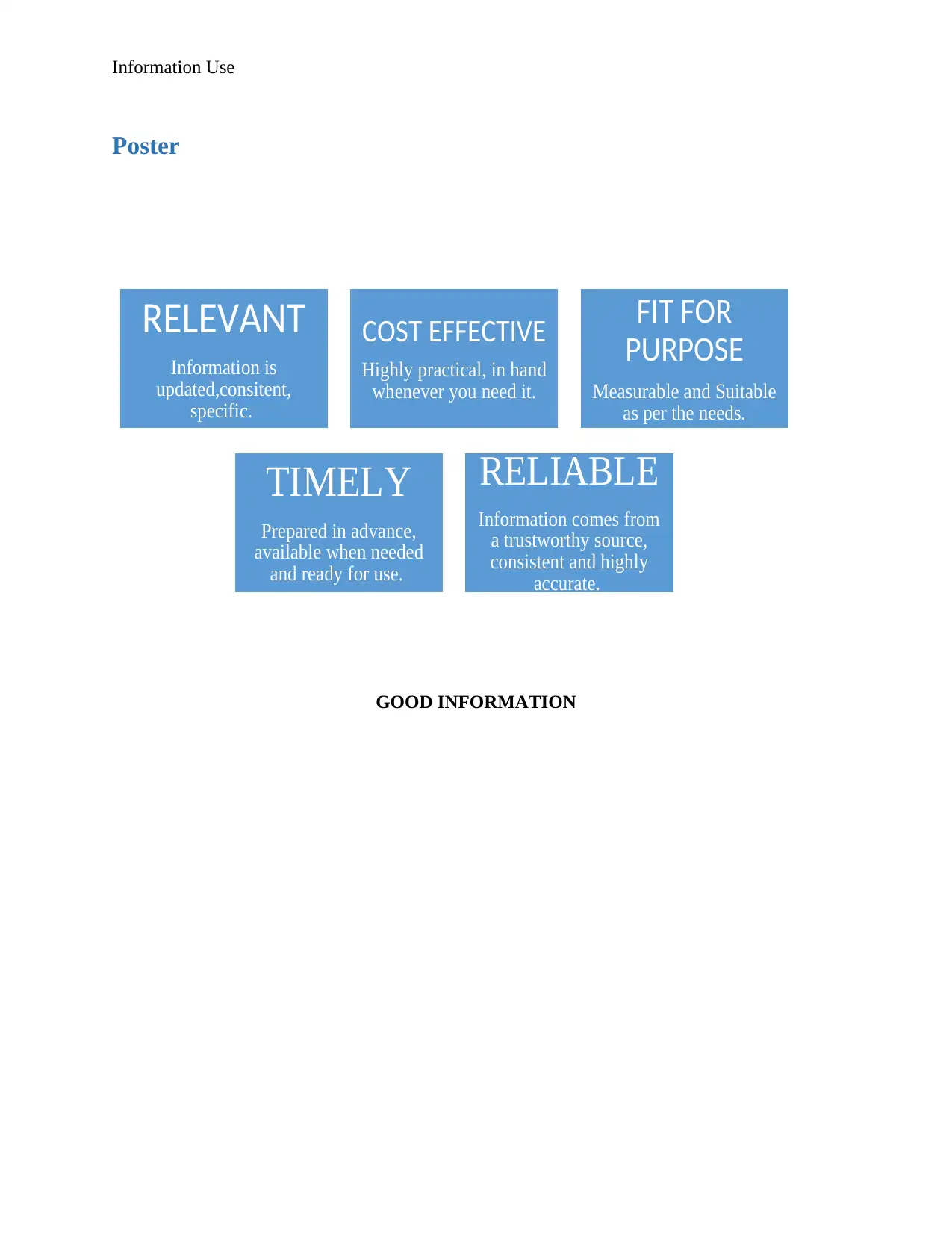
Poster
GOOD INFORMATION
RELEVANT
Information is
updated,consitent,
specific.
COST EFFECTIVE
Highly practical, in hand
whenever you need it.
FIT FOR
PURPOSE
Measurable and Suitable
as per the needs.
TIMELY
Prepared in advance,
available when needed
and ready for use.
RELIABLE
Information comes from
a trustworthy source,
consistent and highly
accurate.
Document Page
Information Use
Brochure
Sources and Types of Information
The following types of
information can be
helpful for the
organization. Namely,
qualitative for open ended
opinionss, descriptive,.
The organization can use
surveys and
questionnaires. The
organization can use
quantitative information
which is measurable, and
numeric. The organization
can get this from the
various graphs and
statistical data. The
organization can further
organize primary data by
researching from various
sources and from
secondary data by
reviewing journals, books,
internet etc.
Purpose of information
The organizations can use
the critical information in
various ways like:
Controlling and monitroing
activites or by identifying
the trends and patterns.
Further the organization
also practice desicion
making in order to gain
competitive advantage.The
organization can also
advance their technological
improvements, the
company or organization is
able to find out the various
opinions of their services
and products. This can be
done using the feedback
from the customer reviews.
Further the organizations
can provide a detailed staff
information and related
knowledge on their
positions, project, details
of the employees, financial
details and knowledge and
information associated and
revelant to the customers.
Furthermore, the
information can help the
tabler-icon-diamond-filled.svg

Paraphrase This Document

Need a fresh take? Get an instant paraphrase of this document with our AI Paraphraser
Document Page
Information Use
organizations to know
regarding the business
practices for the overseas
countries.
Document Page
Information Use
Document Page
Information Use
How to improve the quality of business information
The organization can move most of their processes online in order to save time of suppliers and
for providing convenience to the customers. This will also enable to the buyers and the
organization to go through the information. The organization will also be able to analyse the non-
financial information along with some commercial information. This will assist the organization
to identify their own gaps and shortcoming. The risks can be identified easily and the
organization can analyse their own performance on the global scale. For example, City-
Sandwiches has provided a provision for take away, online ordering, and delivery, ordering and
even has customized procedure for catering bookings.
The organization can further perform regular reviews of their personal data in order to uncover
anomalies. The organization should review the information from time to time which should be
updated and regulated timely. The organization needs to make sure that the information is
relevant and up-to-date. The organization will add relevant information concerned with their
sector, requirements, relevant legislature, overall business strategy etc. For example, City-
Sandwiches need to update their catering booking portal from time to time by including their
new facilities, products and services.
Lastly, the organization needs to appoint multiple data quality managers. The organizations
should determine all the employees that are capable of creating and updating the data. The
management of data must be shared by all the efficient employee who can access, capture,
manipulate as well as update the data. The organization should select efficient employees who
can lead nurturing campaigns, effective customer implementations, mail communications etc.
tabler-icon-diamond-filled.svg

Paraphrase This Document

Need a fresh take? Get an instant paraphrase of this document with our AI Paraphraser
Document Page
Information Use
For example, the City-Sandwich has selected specific managers for their Sandwich bars who are
capable of understanding the timely requirements of the organization.
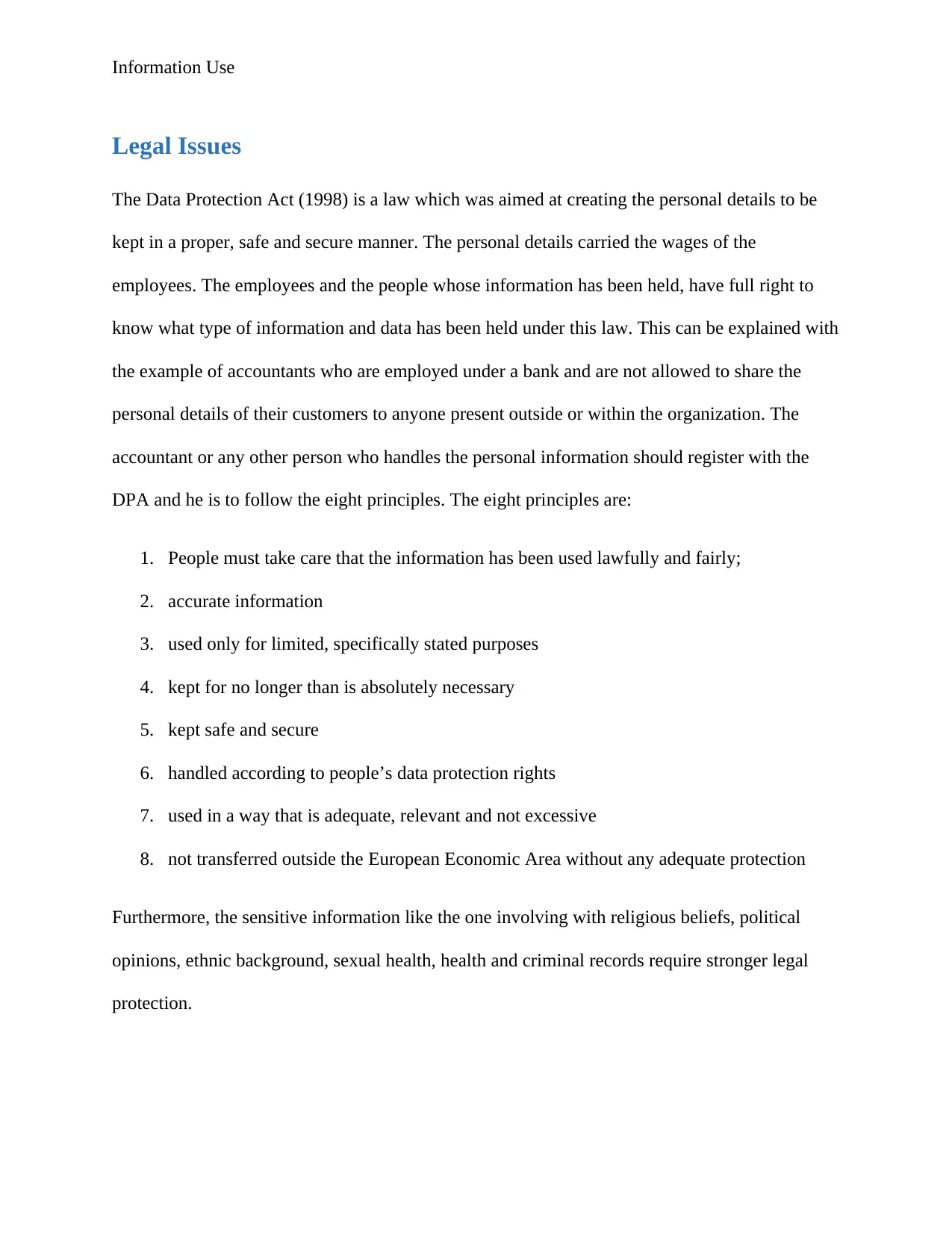
Information flow diagram
Internal information flows
Downwards
In this particular information flow, the information is passed from the senior authorities to their
employees and subordinated in order to make changes in the organization. The employees are
guided about almost all the necessary details using this particular approach.
Administration
Sales R and D Distributi
on
Suppliers
Customers
ManufacturingPurchasingMarketingPersonal
Document Page
Information Use
Upwards
In this particular approach the information is passed from the employees or subordinated to the
senior management. The employees pass on the information and problems to their seniors and
keep them inform regarding the ongoing issues in the organization. The management is informed
by the employees regarding the issues in machinery or computer use (Johnston, H. R., & Vitale,
M. R., 1988).
Across
The information is passed on from the different parts of the organization in order to improve
their objectives and goals. For instance, the other departments will inform the finance
department in case of cost cutting so as to manage the budget.
Document Page
Information Use
Legal Issues
The Data Protection Act (1998) is a law which was aimed at creating the personal details to be
kept in a proper, safe and secure manner. The personal details carried the wages of the
employees. The employees and the people whose information has been held, have full right to
know what type of information and data has been held under this law. This can be explained with
the example of accountants who are employed under a bank and are not allowed to share the
personal details of their customers to anyone present outside or within the organization. The
accountant or any other person who handles the personal information should register with the
DPA and he is to follow the eight principles. The eight principles are:
1. People must take care that the information has been used lawfully and fairly;
2. accurate information
3. used only for limited, specifically stated purposes
4. kept for no longer than is absolutely necessary
5. kept safe and secure
6. handled according to people’s data protection rights
7. used in a way that is adequate, relevant and not excessive
8. not transferred outside the European Economic Area without any adequate protection
Furthermore, the sensitive information like the one involving with religious beliefs, political
opinions, ethnic background, sexual health, health and criminal records require stronger legal
protection.
tabler-icon-diamond-filled.svg

Paraphrase This Document

Need a fresh take? Get an instant paraphrase of this document with our AI Paraphraser
Document Page
Information Use
Freedom of Information Act 2000
The Freedom of Information Act 2000, allows all the organization to access through the official
information. The organization have the right to ask for the information which has been selected
with the schools, NHS, colleges, local government etc. Within a limited span of period, the
public authority can provide them with the required information. For example, the any employee
present in the organization is suffering some critical health issues, it is the responsibility of the
organization to contact the NHS for asking the data and information regarding the employee. In
case the public authorities find it to be against the act, they will refuse to provide any information
to the organization which asked the information.
Computer Misuse Act 1990
The Computer Misuse Act 1990 is an act designed especially for framing the rules and control
regarding the internet fraud and computer crime. As per the Computer Misuse Act 1990, the
usage of other IDs and passwords for accessing one’s computer is illegal and against the law. It
is considered to be an unauthorised access for committing the serious crime. Further the act of
unauthorised modification of any computer content is also considered under the misuse act as the
person whose information is being misused is not aware of such actions. This can be explained
by the fact that files and data is usually destroyed on logging in to the access somebody else’s
account and virus is then installed (Elbra, T., 1990).
Copyright considerations: This Act allows the organization to control the usage of their
material, products and services along with their distribution. This act also help the organizations
and businesses to protect their products and have a direct claim on them. A fee is charged in
Document Page
Information Use
order to copyright the product. The Act is also very helpful for the organizations as it allows
them to have a direct copyright on their own services and products, this way the rival companies
cannot steal the idea and sell it by presenting as their own. Further, the organizations are stopped
from being able resell the particular product of interest at a higher cost. This way the Act is
highly useful for smaller businesses in order to stop the copying of the merchandise.
Ethical Issues
Emails: The spamming or sending of emails or harassing emails of large quantity is usually
banned from the organization. But in case of private purpose, the limited use of email is
generally given allowance.
Whistle blowing: Whistle blowing is seen to protect the users of the organization who are seen
to grab attention of their management as compared to the other users while misusing the
management’s system. The first person who will be able to detect any kind of misuse being done
on the system will be the IT administrators of the company (Jubb, P. B., 1999).
Internet Use: The websites that are considered as inappropriate like gaming or gambling are
usually banned in the organization by using a certain code of practice or by using any filtering
software. The educational institutions like colleges and schools are seen to use software filter for
banning the candidates to visit untrusted websites so as to limit the circulation of virus attacks
while accessing the computer system. Furthermore, these educational institutions, also have
limited internet uses in case the student use it for personal purpose. The companies and
organization that are seen to provide their own web server are seen to follow strict rules in order
to define what exactly can be posted on the server.
chevron_up_icon
1 out of 15
circle_padding
hide_on_mobile
zoom_out_icon
[object Object]