MAR015-2 Intercultural Management: Power Distance & Ethics
VerifiedAdded on 2023/06/17
|8
|1946
|66
Literature Review
AI Summary
This literature review provides a comparative analysis of intercultural business management practices, focusing on the cultural differences between England and Romania. It examines the concepts of high and low power distance, highlighting their impact on business practices in both countries. The review also explores various persuasion techniques used in business, considering the cultural nuances that influence their effectiveness. Furthermore, it discusses the effects of cultural differences in the workplace, emphasizing the importance of ethical practices in managing diverse teams and fostering a harmonious work environment. The review concludes by underscoring the significance of understanding and respecting cultural differences in international business to achieve mutual respect and develop win-win strategies for all cultures involved.
INTERCULTURAL
BUSINESS MANAGEMENT
BUSINESS MANAGEMENT

Paraphrase This Document
Need a fresh take? Get an instant paraphrase of this document with our AI Paraphraser
TABLE OF CONTENT
INTRODUCTION ..........................................................................................................................3
MAIN BODY...................................................................................................................................3
Comparison of high and low power distance between England and Romania towards their
business practices.........................................................................................................................3
Persuasion techniques comparison in different countries............................................................4
Effects of culture differences at workplace.................................................................................5
Ethical practices in different cultures..........................................................................................6
CONCLUSION................................................................................................................................7
REFERENCES................................................................................................................................8
INTRODUCTION ..........................................................................................................................3
MAIN BODY...................................................................................................................................3
Comparison of high and low power distance between England and Romania towards their
business practices.........................................................................................................................3
Persuasion techniques comparison in different countries............................................................4
Effects of culture differences at workplace.................................................................................5
Ethical practices in different cultures..........................................................................................6
CONCLUSION................................................................................................................................7
REFERENCES................................................................................................................................8
INTRODUCTION
The intercultural management is the understanding and respecting of the other cultures
which are in the international market. This is a practice which acknowledges the cultural
differences toward being acknowledged and managed openly and rather safely. In the
intercultural management of business needs to develop a sustainable solution for the intercultural
problems which are present for the creation of the mutual respect and helps in the development
of the win-win strategy for all the present cultures in the business. There are different approaches
which a business utilizes for effectiveness in the international management. In this project a
comparison between the cultural difference of England and Romania ha been explained for
understanding their differences in business practices. This project also discusses the different
types of persuasion techniques which are used by the people for the understanding of techniques
and persuasion. This project will also study the effects of cultural differences in a workplace and
the importance of ethical practices towards different cultures.
MAIN BODY
Comparison of high and low power distance between England and Romania towards their
business practices
There are major differences in the culture of England and Romania due to the differences
in the human behaviour and way of living. England has a low power distance, in which power
distance is the dimension that is the part of the Hofstede theory which helps in the identifying the
differences in the society. It expresses the attitude of the culture towards the inequalities amongst
the individuals. It is also defined as to what extent I the less powerful members of the institutions
and organization in the country expecting and accepting the distribution of power in the
distributed in-equally (Constantin, Stanescu and Stanescu, 2020). In comparison to UK in
Romania the score of power distance is very high which means that the people are willing to
accept the hierarchical order which has a place that needs not be further justified (Beugelsdijk
and Welzel, 2018). Hierarchy in an organization is noticed to be reflection to the inheritance of
inequalities, centralization towards being popular and subordination of the expected. In this
country autocratic leadership is considered to be very successful.
The intercultural management is the understanding and respecting of the other cultures
which are in the international market. This is a practice which acknowledges the cultural
differences toward being acknowledged and managed openly and rather safely. In the
intercultural management of business needs to develop a sustainable solution for the intercultural
problems which are present for the creation of the mutual respect and helps in the development
of the win-win strategy for all the present cultures in the business. There are different approaches
which a business utilizes for effectiveness in the international management. In this project a
comparison between the cultural difference of England and Romania ha been explained for
understanding their differences in business practices. This project also discusses the different
types of persuasion techniques which are used by the people for the understanding of techniques
and persuasion. This project will also study the effects of cultural differences in a workplace and
the importance of ethical practices towards different cultures.
MAIN BODY
Comparison of high and low power distance between England and Romania towards their
business practices
There are major differences in the culture of England and Romania due to the differences
in the human behaviour and way of living. England has a low power distance, in which power
distance is the dimension that is the part of the Hofstede theory which helps in the identifying the
differences in the society. It expresses the attitude of the culture towards the inequalities amongst
the individuals. It is also defined as to what extent I the less powerful members of the institutions
and organization in the country expecting and accepting the distribution of power in the
distributed in-equally (Constantin, Stanescu and Stanescu, 2020). In comparison to UK in
Romania the score of power distance is very high which means that the people are willing to
accept the hierarchical order which has a place that needs not be further justified (Beugelsdijk
and Welzel, 2018). Hierarchy in an organization is noticed to be reflection to the inheritance of
inequalities, centralization towards being popular and subordination of the expected. In this
country autocratic leadership is considered to be very successful.
⊘ This is a preview!⊘
Do you want full access?
Subscribe today to unlock all pages.

Trusted by 1+ million students worldwide
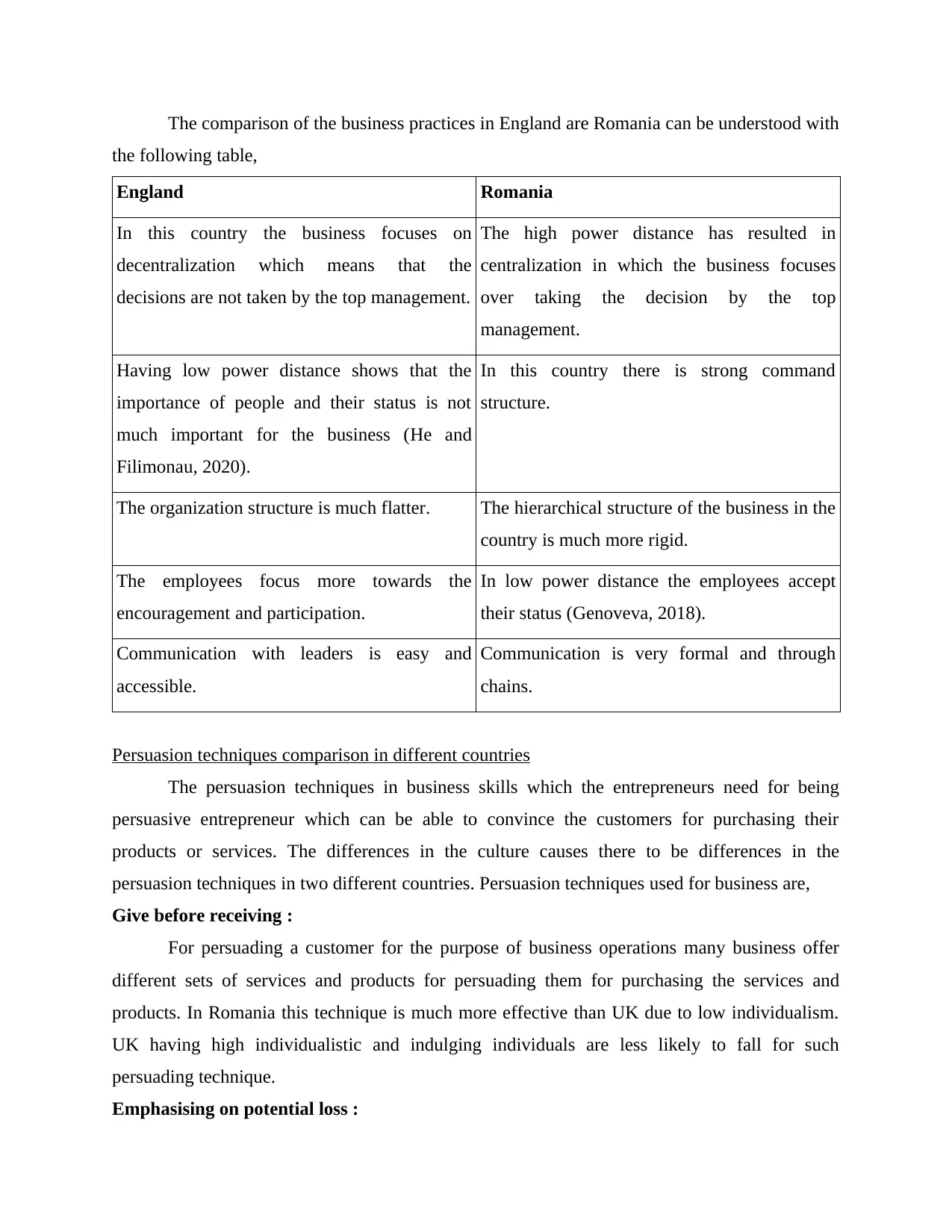
The comparison of the business practices in England are Romania can be understood with
the following table,
England Romania
In this country the business focuses on
decentralization which means that the
decisions are not taken by the top management.
The high power distance has resulted in
centralization in which the business focuses
over taking the decision by the top
management.
Having low power distance shows that the
importance of people and their status is not
much important for the business (He and
Filimonau, 2020).
In this country there is strong command
structure.
The organization structure is much flatter. The hierarchical structure of the business in the
country is much more rigid.
The employees focus more towards the
encouragement and participation.
In low power distance the employees accept
their status (Genoveva, 2018).
Communication with leaders is easy and
accessible.
Communication is very formal and through
chains.
Persuasion techniques comparison in different countries
The persuasion techniques in business skills which the entrepreneurs need for being
persuasive entrepreneur which can be able to convince the customers for purchasing their
products or services. The differences in the culture causes there to be differences in the
persuasion techniques in two different countries. Persuasion techniques used for business are,
Give before receiving :
For persuading a customer for the purpose of business operations many business offer
different sets of services and products for persuading them for purchasing the services and
products. In Romania this technique is much more effective than UK due to low individualism.
UK having high individualistic and indulging individuals are less likely to fall for such
persuading technique.
Emphasising on potential loss :
the following table,
England Romania
In this country the business focuses on
decentralization which means that the
decisions are not taken by the top management.
The high power distance has resulted in
centralization in which the business focuses
over taking the decision by the top
management.
Having low power distance shows that the
importance of people and their status is not
much important for the business (He and
Filimonau, 2020).
In this country there is strong command
structure.
The organization structure is much flatter. The hierarchical structure of the business in the
country is much more rigid.
The employees focus more towards the
encouragement and participation.
In low power distance the employees accept
their status (Genoveva, 2018).
Communication with leaders is easy and
accessible.
Communication is very formal and through
chains.
Persuasion techniques comparison in different countries
The persuasion techniques in business skills which the entrepreneurs need for being
persuasive entrepreneur which can be able to convince the customers for purchasing their
products or services. The differences in the culture causes there to be differences in the
persuasion techniques in two different countries. Persuasion techniques used for business are,
Give before receiving :
For persuading a customer for the purpose of business operations many business offer
different sets of services and products for persuading them for purchasing the services and
products. In Romania this technique is much more effective than UK due to low individualism.
UK having high individualistic and indulging individuals are less likely to fall for such
persuading technique.
Emphasising on potential loss :
Paraphrase This Document
Need a fresh take? Get an instant paraphrase of this document with our AI Paraphraser
Realising the customers that they are suffering a loss from not purchasing the products is
a technique of persuasion. This is more effective in Romania as the culture in this country the
people are done not risk towards uncertainty thus are easy to convince when they face some kind
of fear of risk. For UK these techniques are less effective as they are literacy rate in UK and thus
they can easily identify the risk of loss.
Appealing to their reputations :
There are customers which purchase particular product or services because they are
entitled to reputation towards the purchasing of such products. Those people who think about
their reputation more than other are more likely to being consistent in getting persuaded towards
their decision-making in business. In UK these techniques is very effective as there the
individualism in people are high and also the culture is much more masculine in nature in
comparison to Romania where the people are less individualistic and masculine.
Effects of culture differences at workplace
Having differences in the culture effects the work place in many ways. In the current era
the workforce is made up of different race, ages, gender and also religion. Due to having these
differences in the culture many organizations are able to identify changes in the workforce. Their
work is towards building the work environment towards the diversity and differences to be
appreciated and valued. This helps the organization in the creation of the full potential of their
employees. It is their duty of the organization to fit together the employees in the organization
and be different towards the mosaic of harmonization in a way of maximization of the
capabilities and talents of each employee (Adamczyk, 2017). Diversity in the organization can
lead to having a competitive advantage of the organization which is helpful for the organization
to be skilful and managed for the negative affects towards the unwelcoming work environment.
The diversity of work culture needs there for being beneficial for the organization in the
numerous ways for the productivity and efficiency. There is a management of the diversity in the
organization for the people to feel valued and be helpful for the consideration of the importance
of the differences in the matter. Having the diversity and giving equal importance and
opportunity can develop unity and productivity of the organization. It is considered that
employees which bring different skills and opinions towards the table are helpful for the
realization of the value which is important for different reasons. This feeling is valued for having
a very positive impact which helps in the improving the morale of each worker towards the
a technique of persuasion. This is more effective in Romania as the culture in this country the
people are done not risk towards uncertainty thus are easy to convince when they face some kind
of fear of risk. For UK these techniques are less effective as they are literacy rate in UK and thus
they can easily identify the risk of loss.
Appealing to their reputations :
There are customers which purchase particular product or services because they are
entitled to reputation towards the purchasing of such products. Those people who think about
their reputation more than other are more likely to being consistent in getting persuaded towards
their decision-making in business. In UK these techniques is very effective as there the
individualism in people are high and also the culture is much more masculine in nature in
comparison to Romania where the people are less individualistic and masculine.
Effects of culture differences at workplace
Having differences in the culture effects the work place in many ways. In the current era
the workforce is made up of different race, ages, gender and also religion. Due to having these
differences in the culture many organizations are able to identify changes in the workforce. Their
work is towards building the work environment towards the diversity and differences to be
appreciated and valued. This helps the organization in the creation of the full potential of their
employees. It is their duty of the organization to fit together the employees in the organization
and be different towards the mosaic of harmonization in a way of maximization of the
capabilities and talents of each employee (Adamczyk, 2017). Diversity in the organization can
lead to having a competitive advantage of the organization which is helpful for the organization
to be skilful and managed for the negative affects towards the unwelcoming work environment.
The diversity of work culture needs there for being beneficial for the organization in the
numerous ways for the productivity and efficiency. There is a management of the diversity in the
organization for the people to feel valued and be helpful for the consideration of the importance
of the differences in the matter. Having the diversity and giving equal importance and
opportunity can develop unity and productivity of the organization. It is considered that
employees which bring different skills and opinions towards the table are helpful for the
realization of the value which is important for different reasons. This feeling is valued for having
a very positive impact which helps in the improving the morale of each worker towards the
business the encouragement of the positivity and productivity at the work place. Businesses are
also aware of the impacts of the cultural diversity on the various factors such as communication.
It is essential for the business to understand that being able to communicate effectively is key to
being successful in different countries with different cultures.
Ethical practices in different cultures
Ethics are the set of moral and principles which are present for the business to utilize for
their practices. Culture and ethics are related in the context that the cooperation and management
of the conflicts in the business is much easier when people share a belief of convictions. This is
the reason why the ethics are much more important in an organization to manage the cultural
differences. It is considered that the standards and values are the internal part of the culture
which is the bedrock towards supporting and development of an organization. Importance of
ethics in the different cultures is that,
There needs to be ethics in both the cultures which are discussed. For UK the ethical
practices are essential as the business in this country has to deal with issues in the management
of the cultural differences in the organization. This differences in the culture has the potential of
obstructing the progress of the business (Farooq, Hao and Liu, 2019). Ethics is very important
for the businesses in UK as it turns into a liberation tool which can help the business to manage
culture of the organization. Ethic helps the business to hold equal rights towards the
responsibility of the future generations which is helpful for the organization for the development
of the speech and democracy. It is the objective development of the organizational management
in the business.
Having the ethics in the culture helps the business to stimulate the effects on the culture
in the following ways,
Determination of the ways in which people communicate.
Determination of the ways of interaction of people.
It is useful for determination of the relations between the people.
It is essential for guiding the business in its day to day practices.
Determination of the appropriate behaviour of people of different cultures.
also aware of the impacts of the cultural diversity on the various factors such as communication.
It is essential for the business to understand that being able to communicate effectively is key to
being successful in different countries with different cultures.
Ethical practices in different cultures
Ethics are the set of moral and principles which are present for the business to utilize for
their practices. Culture and ethics are related in the context that the cooperation and management
of the conflicts in the business is much easier when people share a belief of convictions. This is
the reason why the ethics are much more important in an organization to manage the cultural
differences. It is considered that the standards and values are the internal part of the culture
which is the bedrock towards supporting and development of an organization. Importance of
ethics in the different cultures is that,
There needs to be ethics in both the cultures which are discussed. For UK the ethical
practices are essential as the business in this country has to deal with issues in the management
of the cultural differences in the organization. This differences in the culture has the potential of
obstructing the progress of the business (Farooq, Hao and Liu, 2019). Ethics is very important
for the businesses in UK as it turns into a liberation tool which can help the business to manage
culture of the organization. Ethic helps the business to hold equal rights towards the
responsibility of the future generations which is helpful for the organization for the development
of the speech and democracy. It is the objective development of the organizational management
in the business.
Having the ethics in the culture helps the business to stimulate the effects on the culture
in the following ways,
Determination of the ways in which people communicate.
Determination of the ways of interaction of people.
It is useful for determination of the relations between the people.
It is essential for guiding the business in its day to day practices.
Determination of the appropriate behaviour of people of different cultures.
⊘ This is a preview!⊘
Do you want full access?
Subscribe today to unlock all pages.
Trusted by 1+ million students worldwide
Culture is an integral part of the ethics and ethics is an integral part of ethics. In this the
culture of the community impacts the progress and development of laws and principles of the
extent of the organization policies and operations.
CONCLUSION
With the help of this project it can be concluded that there are major differences in the
culture of England and Romania which effects the businesses practices in these countries. This
project helped in the analysation of the differences in power distance in these two countries. This
project also provided the differences in the techniques of persuasion techniques in these
countries. In this project the cultural differences and ethical work practices are discussed.
culture of the community impacts the progress and development of laws and principles of the
extent of the organization policies and operations.
CONCLUSION
With the help of this project it can be concluded that there are major differences in the
culture of England and Romania which effects the businesses practices in these countries. This
project helped in the analysation of the differences in power distance in these two countries. This
project also provided the differences in the techniques of persuasion techniques in these
countries. In this project the cultural differences and ethical work practices are discussed.
Paraphrase This Document
Need a fresh take? Get an instant paraphrase of this document with our AI Paraphraser
REFERENCES
Books and Journals
Adamczyk, M., 2017. The importance of cultural differences in international business. The
Central European Review of Economics and Management (CEREM). 1(2). pp.151-170.
Beugelsdijk, S. and Welzel, C., 2018. Dimensions and dynamics of national culture:
Synthesizing Hofstede with Inglehart. Journal of cross-cultural psychology. 49(10).
pp.1469-1505.
Constantin, P.N., Stanescu, R. and Stanescu, M., 2020. Social entrepreneurship and sport in
Romania: how can former athletes contribute to sustainable social change?.
Sustainability. 12(11). p.4688.
Farooq, Q., Hao, Y. and Liu, X., 2019. Understanding corporate social responsibility with
cross‐cultural differences: A deeper look at religiosity. Corporate Social Responsibility
and Environmental Management. 26(4). pp.965-971.
Genoveva306, B., 2018. STUDY REGARDING CULTURAL DIVERSITY AND
ORGANIZATIONAL BEHAVIOR IN ROMANIA. Recent Advances in Information
Technology, Tourism, Economics, Management and Agriculture, p.874.
He, L. and Filimonau, V., 2020. The effect of national culture on pro-environmental
behavioural intentions of tourists in the UK and China. Tourism Management
Perspectives. 35. p.100716.
Online
Country Comparison, 2021. [Online]. Available through:
<https://www.hofstede-insights.com/country-comparison/romania,the-uk/>
Books and Journals
Adamczyk, M., 2017. The importance of cultural differences in international business. The
Central European Review of Economics and Management (CEREM). 1(2). pp.151-170.
Beugelsdijk, S. and Welzel, C., 2018. Dimensions and dynamics of national culture:
Synthesizing Hofstede with Inglehart. Journal of cross-cultural psychology. 49(10).
pp.1469-1505.
Constantin, P.N., Stanescu, R. and Stanescu, M., 2020. Social entrepreneurship and sport in
Romania: how can former athletes contribute to sustainable social change?.
Sustainability. 12(11). p.4688.
Farooq, Q., Hao, Y. and Liu, X., 2019. Understanding corporate social responsibility with
cross‐cultural differences: A deeper look at religiosity. Corporate Social Responsibility
and Environmental Management. 26(4). pp.965-971.
Genoveva306, B., 2018. STUDY REGARDING CULTURAL DIVERSITY AND
ORGANIZATIONAL BEHAVIOR IN ROMANIA. Recent Advances in Information
Technology, Tourism, Economics, Management and Agriculture, p.874.
He, L. and Filimonau, V., 2020. The effect of national culture on pro-environmental
behavioural intentions of tourists in the UK and China. Tourism Management
Perspectives. 35. p.100716.
Online
Country Comparison, 2021. [Online]. Available through:
<https://www.hofstede-insights.com/country-comparison/romania,the-uk/>

1 out of 8


Related Documents


Your All-in-One AI-Powered Toolkit for Academic Success.
+13062052269
info@desklib.com
Available 24*7 on WhatsApp / Email
![[object Object]](/_next/static/media/star-bottom.7253800d.svg)
Unlock your academic potential
Copyright © 2020–2026 A2Z Services. All Rights Reserved. Developed and managed by ZUCOL.