University Finance: Intermediate Managerial Accounting Homework
VerifiedAdded on 2023/06/03
|10
|1126
|140
Homework Assignment
AI Summary
This document presents a comprehensive solution to an intermediate managerial accounting assignment. The assignment addresses key concepts such as cost estimation, including the high-low method, and the assumptions underlying cost functions. It analyzes overhead costs using machine-hours and kilowatt-hours as cost drivers, determining the best predictor for July. Additionally, the assignment explores cost estimation techniques, such as the conference method, and applies these concepts to various scenarios involving different cost behaviors, like fixed, variable, and mixed costs, represented graphically. The solution also includes an activity-based costing problem, comparing the profitability of adding a new product line to an existing assembly line, and providing recommendations based on the analysis. The assignment covers various aspects of managerial accounting, providing a detailed understanding of cost behavior and decision-making.
Running head: INTERMEDIATE MANAGERIAL ACCOUNTING
Intermediate Managerial Accounting
Name of the Student:
Name of the University:
Author’s Note:
Course ID:
Intermediate Managerial Accounting
Name of the Student:
Name of the University:
Author’s Note:
Course ID:
Paraphrase This Document
Need a fresh take? Get an instant paraphrase of this document with our AI Paraphraser

1INTERMEDIATE MANAGERIAL ACCOUNTING
Table of Contents
Answer to Question 3.1:.............................................................................................................3
Answer to Question 3.2:.............................................................................................................3
Requirement 1:.......................................................................................................................3
Requirement 2:.......................................................................................................................3
Answer to Question 3.3:.............................................................................................................4
Requirement 1:.......................................................................................................................4
Requirement 2:.......................................................................................................................4
Requirement 3:.......................................................................................................................4
Answer to Question 3.4:.............................................................................................................5
Requirement 1:.......................................................................................................................5
Requirement 2:.......................................................................................................................5
Requirement 3:.......................................................................................................................5
Requirement 4:.......................................................................................................................5
Requirement 5:.......................................................................................................................5
Requirement 6:.......................................................................................................................6
Requirement 7:.......................................................................................................................6
Requirement 8:.......................................................................................................................6
Requirement 9:.......................................................................................................................6
Answer to Question 3.5:.............................................................................................................6
Requirement 1:.......................................................................................................................6
Table of Contents
Answer to Question 3.1:.............................................................................................................3
Answer to Question 3.2:.............................................................................................................3
Requirement 1:.......................................................................................................................3
Requirement 2:.......................................................................................................................3
Answer to Question 3.3:.............................................................................................................4
Requirement 1:.......................................................................................................................4
Requirement 2:.......................................................................................................................4
Requirement 3:.......................................................................................................................4
Answer to Question 3.4:.............................................................................................................5
Requirement 1:.......................................................................................................................5
Requirement 2:.......................................................................................................................5
Requirement 3:.......................................................................................................................5
Requirement 4:.......................................................................................................................5
Requirement 5:.......................................................................................................................5
Requirement 6:.......................................................................................................................6
Requirement 7:.......................................................................................................................6
Requirement 8:.......................................................................................................................6
Requirement 9:.......................................................................................................................6
Answer to Question 3.5:.............................................................................................................6
Requirement 1:.......................................................................................................................6

2INTERMEDIATE MANAGERIAL ACCOUNTING
Requirement 2:.......................................................................................................................7
Requirement 3:.......................................................................................................................7
Requirement 4:.......................................................................................................................7
Requirement 5:.......................................................................................................................7
Requirement 6:.......................................................................................................................8
References:.................................................................................................................................9
Requirement 2:.......................................................................................................................7
Requirement 3:.......................................................................................................................7
Requirement 4:.......................................................................................................................7
Requirement 5:.......................................................................................................................7
Requirement 6:.......................................................................................................................8
References:.................................................................................................................................9
⊘ This is a preview!⊘
Do you want full access?
Subscribe today to unlock all pages.

Trusted by 1+ million students worldwide

3INTERMEDIATE MANAGERIAL ACCOUNTING
Answer to Question 3.1:
The managers are often deemed to estimate cost functions relying on two
assumptions, which are stated briefly as follows:
The changes in the single activity level or the cost driver describe the changes in
associated overall costs.
A linear cost function approximates the cost function within the pertinent range. The
pertinent range is termed as the activity range where there is association between
overall cost and activity level. In case of a linear cost function depicted graphically,
the overall cost in opposition to a single activity level to that cost is a straight line
within the pertinent range (Butler & Ghosh, 2015).
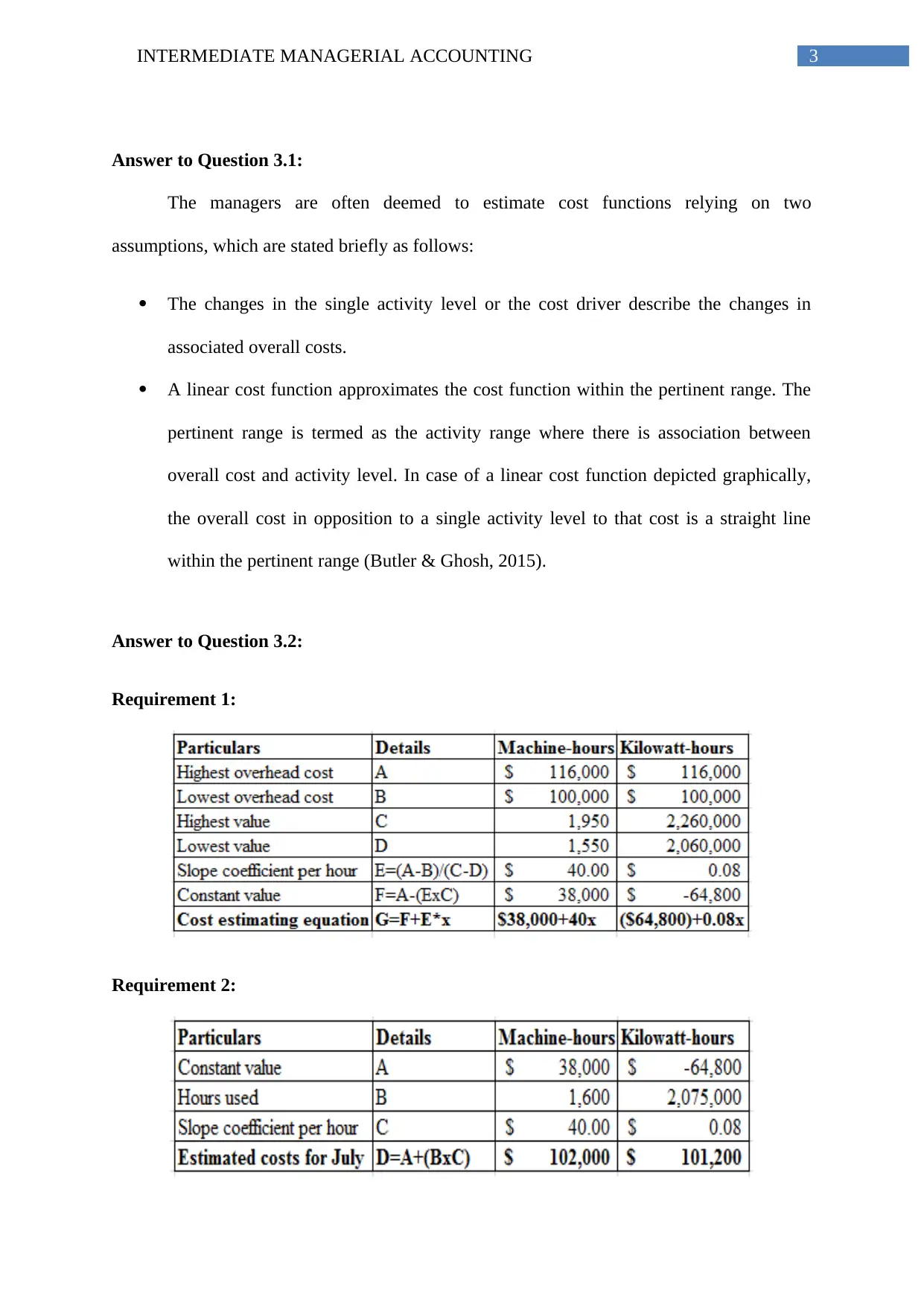
Answer to Question 3.2:
Requirement 1:
Requirement 2:
Answer to Question 3.1:
The managers are often deemed to estimate cost functions relying on two
assumptions, which are stated briefly as follows:
The changes in the single activity level or the cost driver describe the changes in
associated overall costs.
A linear cost function approximates the cost function within the pertinent range. The
pertinent range is termed as the activity range where there is association between
overall cost and activity level. In case of a linear cost function depicted graphically,
the overall cost in opposition to a single activity level to that cost is a straight line
within the pertinent range (Butler & Ghosh, 2015).
Answer to Question 3.2:
Requirement 1:
Requirement 2:
Paraphrase This Document
Need a fresh take? Get an instant paraphrase of this document with our AI Paraphraser

4INTERMEDIATE MANAGERIAL ACCOUNTING
Kilowatt-hour is the best predictor for the month of July, since it provides the
anticipated cost nearer to the actual cost incurred.
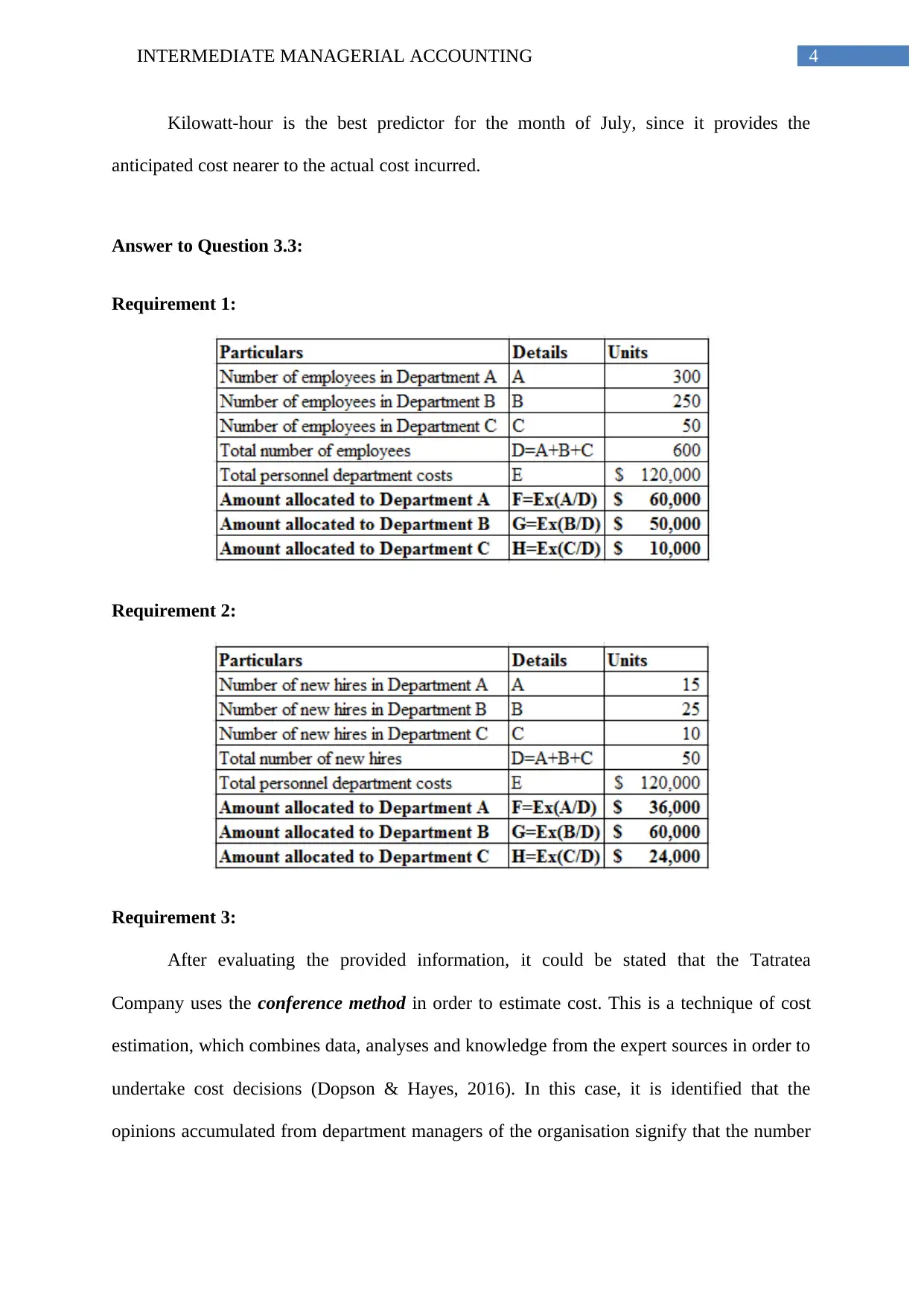
Answer to Question 3.3:
Requirement 1:
Requirement 2:
Requirement 3:
After evaluating the provided information, it could be stated that the Tatratea
Company uses the conference method in order to estimate cost. This is a technique of cost
estimation, which combines data, analyses and knowledge from the expert sources in order to
undertake cost decisions (Dopson & Hayes, 2016). In this case, it is identified that the
opinions accumulated from department managers of the organisation signify that the number
Kilowatt-hour is the best predictor for the month of July, since it provides the
anticipated cost nearer to the actual cost incurred.
Answer to Question 3.3:
Requirement 1:
Requirement 2:
Requirement 3:
After evaluating the provided information, it could be stated that the Tatratea
Company uses the conference method in order to estimate cost. This is a technique of cost
estimation, which combines data, analyses and knowledge from the expert sources in order to
undertake cost decisions (Dopson & Hayes, 2016). In this case, it is identified that the
opinions accumulated from department managers of the organisation signify that the number

5INTERMEDIATE MANAGERIAL ACCOUNTING
of new hires within a department might be used to predict personnel costs as well. This
clearly clarifies the presence of the conference method of cost estimation.
Answer to Question 3.4:
Requirement 1:
Graph (k) best describes the situation, since there would be no depreciation charge, if
the machine is not used. Instead, it would rise with rise in machine hours.
Requirement 2:
Graph (b) best illustrates the situation, as flat line signifies a fixed bill for a particular
number of kilowatt-hours used and after that, it rises with rise in kilowatt-hours usage.
Requirement 3:
This situation is best represented by Graph (b), as consumption rises by 1,000,000
litres; the bill remains constant at $1,000 flat fee and after that, for next 10,000 litres, it rises
at an increasing rate.
Requirement 4:
Graph (d) best represents this situation, as lubricant cost rises with rise in kilogram of
lubricant at falling rate up to a particular point. After this, rise could be observed at a fixed
rate depicting minimum cost of $9.20 per kilogram.
Requirement 5:
The scenario is effectively represented by Graph (i), as the depreciation charge would
remain constant as computed by using the straight-line method. Even if there is no usage of
the machine, depreciation charge would be made (Weygandt, Kimmel & Kieso, 2015).
of new hires within a department might be used to predict personnel costs as well. This
clearly clarifies the presence of the conference method of cost estimation.
Answer to Question 3.4:
Requirement 1:
Graph (k) best describes the situation, since there would be no depreciation charge, if
the machine is not used. Instead, it would rise with rise in machine hours.
Requirement 2:
Graph (b) best illustrates the situation, as flat line signifies a fixed bill for a particular
number of kilowatt-hours used and after that, it rises with rise in kilowatt-hours usage.
Requirement 3:
This situation is best represented by Graph (b), as consumption rises by 1,000,000
litres; the bill remains constant at $1,000 flat fee and after that, for next 10,000 litres, it rises
at an increasing rate.
Requirement 4:
Graph (d) best represents this situation, as lubricant cost rises with rise in kilogram of
lubricant at falling rate up to a particular point. After this, rise could be observed at a fixed
rate depicting minimum cost of $9.20 per kilogram.
Requirement 5:
The scenario is effectively represented by Graph (i), as the depreciation charge would
remain constant as computed by using the straight-line method. Even if there is no usage of
the machine, depreciation charge would be made (Weygandt, Kimmel & Kieso, 2015).
⊘ This is a preview!⊘
Do you want full access?
Subscribe today to unlock all pages.

Trusted by 1+ million students worldwide

6INTERMEDIATE MANAGERIAL ACCOUNTING
Requirement 6:
Graph (l) denotes this situation effectively, as rent on a manufacturing plant of
constant amount up to 200,000 labour hours are worked, after which no rent needs to be paid.
Requirement 7:
Graph (g) best fits this scenario due to the fixed salary for one individual for the
initial 1,000 machine hours, fixed salary for an additional individual for the next 1,000
machine hours and so forth. Therefore, salary remains constant for a single individual at zero
machine hours and rises at an increasing rate for next 1,000 hours cyclically.
Requirement 8:
Graph (k) could be used for denoting this situation, since there would be no direct
material cost at zero production level and it would rise at an increasing rate based on the
quantity of material usage.
Requirement 9:
Graph (e) helps in representing the situation, as minimum rent of $100,000 needs to
be incurred up to 200,000 hours. However, it minimises by $1 for every single direct
manufacturing labour hour worked in additional of 200,000 hours up to $20,000, after which
it remains constant.
Answer to Question 3.5:
Requirement 1:
Requirement 6:
Graph (l) denotes this situation effectively, as rent on a manufacturing plant of
constant amount up to 200,000 labour hours are worked, after which no rent needs to be paid.
Requirement 7:
Graph (g) best fits this scenario due to the fixed salary for one individual for the
initial 1,000 machine hours, fixed salary for an additional individual for the next 1,000
machine hours and so forth. Therefore, salary remains constant for a single individual at zero
machine hours and rises at an increasing rate for next 1,000 hours cyclically.
Requirement 8:
Graph (k) could be used for denoting this situation, since there would be no direct
material cost at zero production level and it would rise at an increasing rate based on the
quantity of material usage.
Requirement 9:
Graph (e) helps in representing the situation, as minimum rent of $100,000 needs to
be incurred up to 200,000 hours. However, it minimises by $1 for every single direct
manufacturing labour hour worked in additional of 200,000 hours up to $20,000, after which
it remains constant.
Answer to Question 3.5:
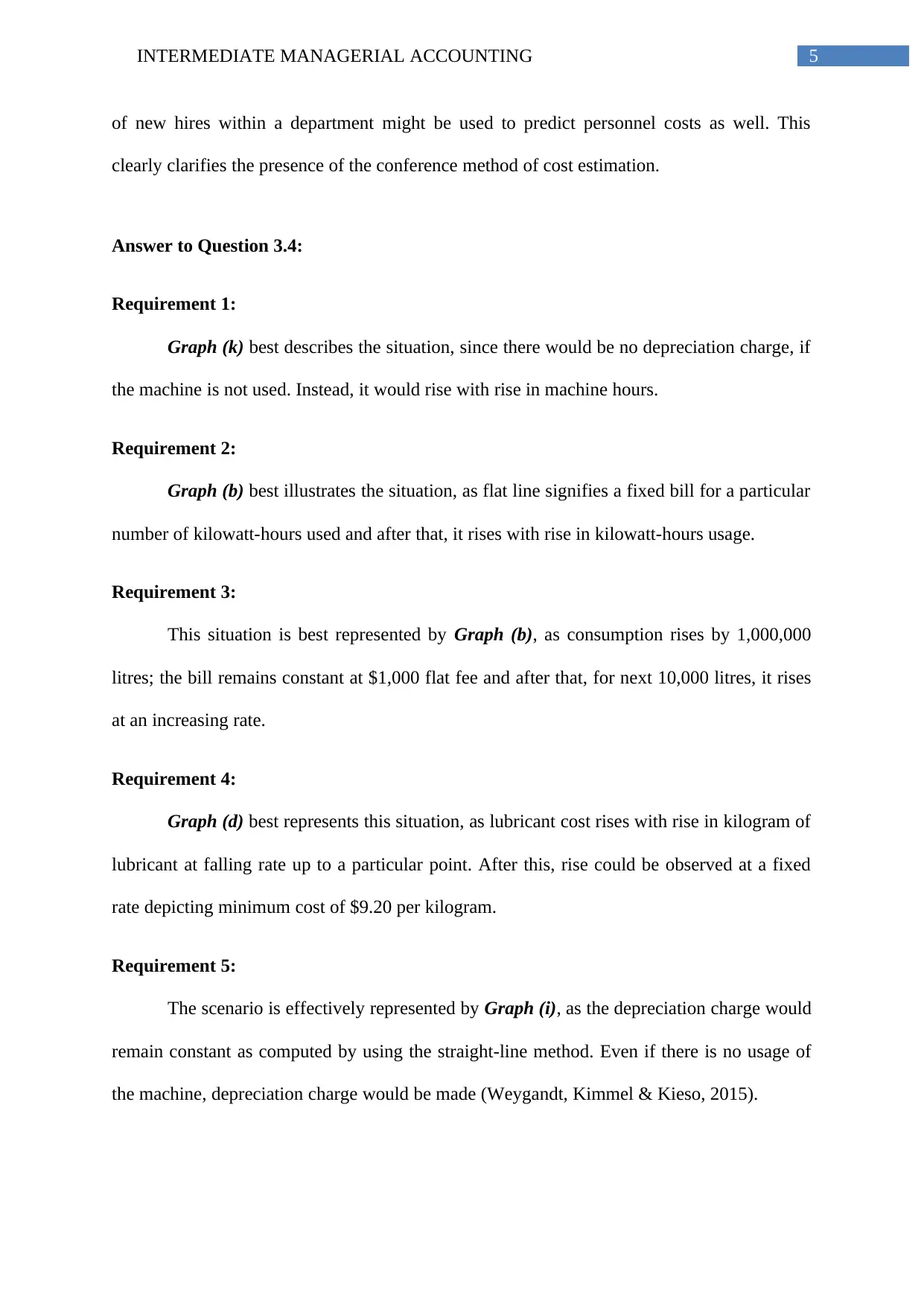
Requirement 1:
Paraphrase This Document
Need a fresh take? Get an instant paraphrase of this document with our AI Paraphraser

7INTERMEDIATE MANAGERIAL ACCOUNTING
Requirement 2:
Requirement 3:
Requirement 4:
Requirement 5:
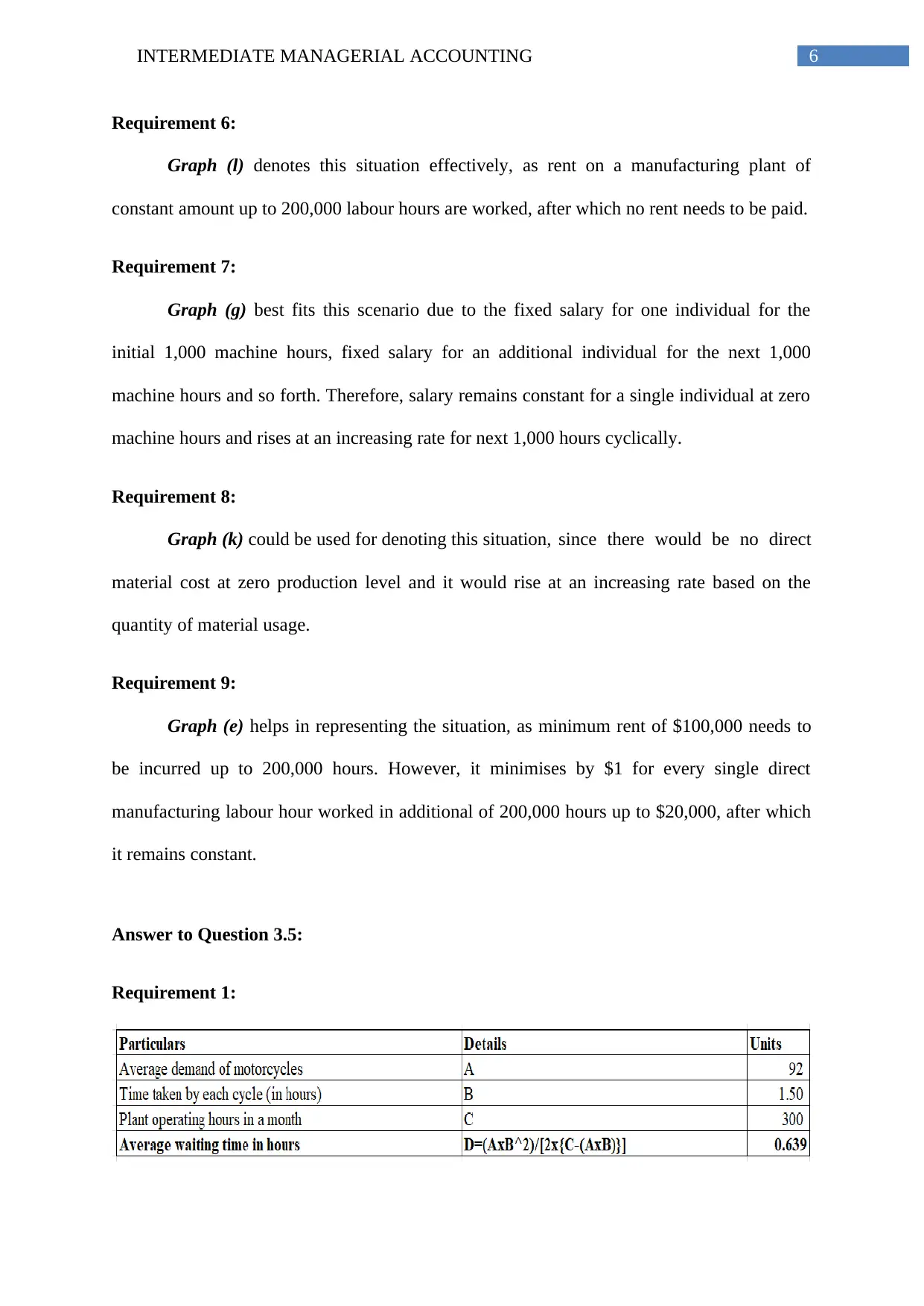
Requirement 2:
Requirement 3:
Requirement 4:
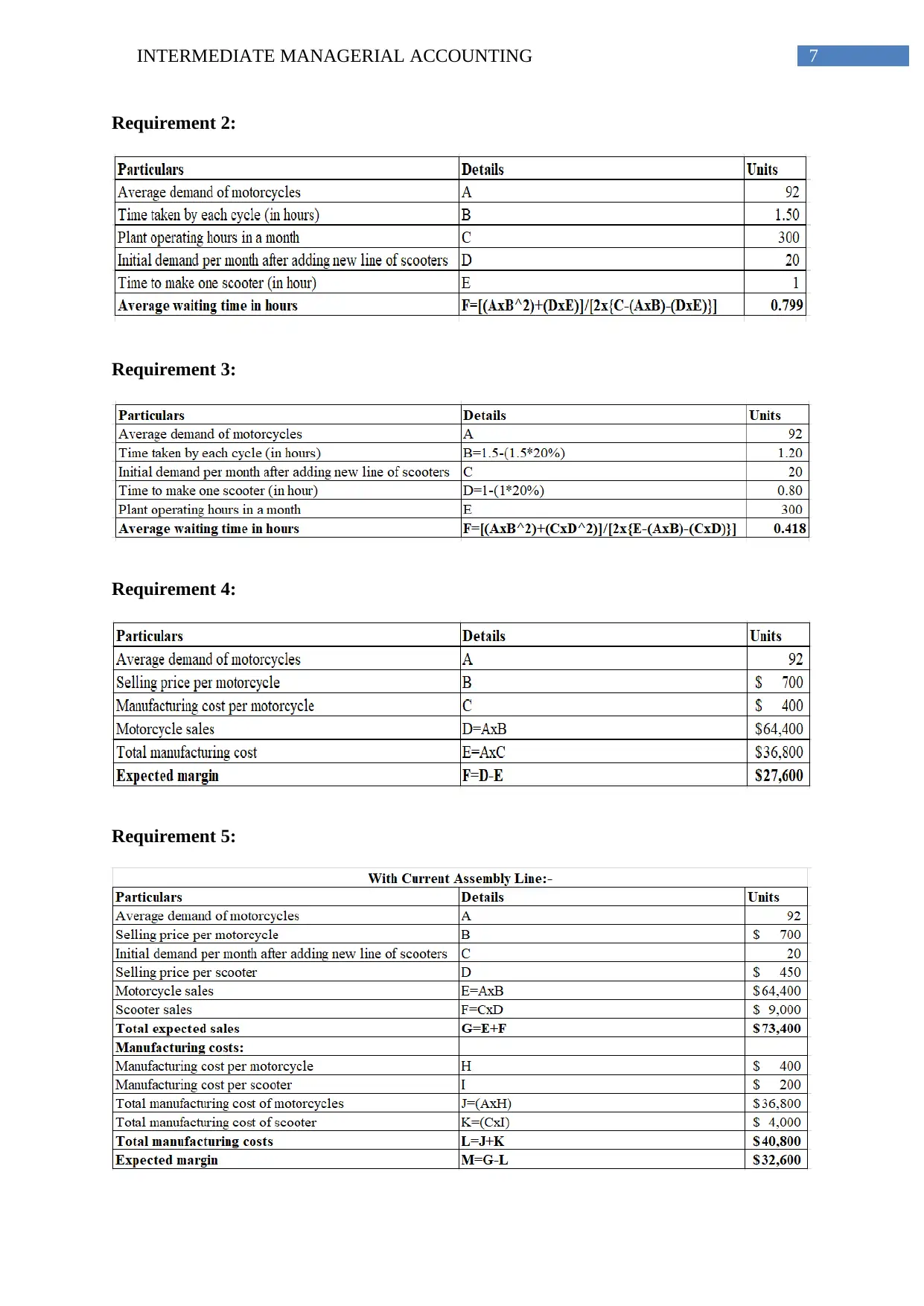
Requirement 5:

8INTERMEDIATE MANAGERIAL ACCOUNTING
Requirement 6:
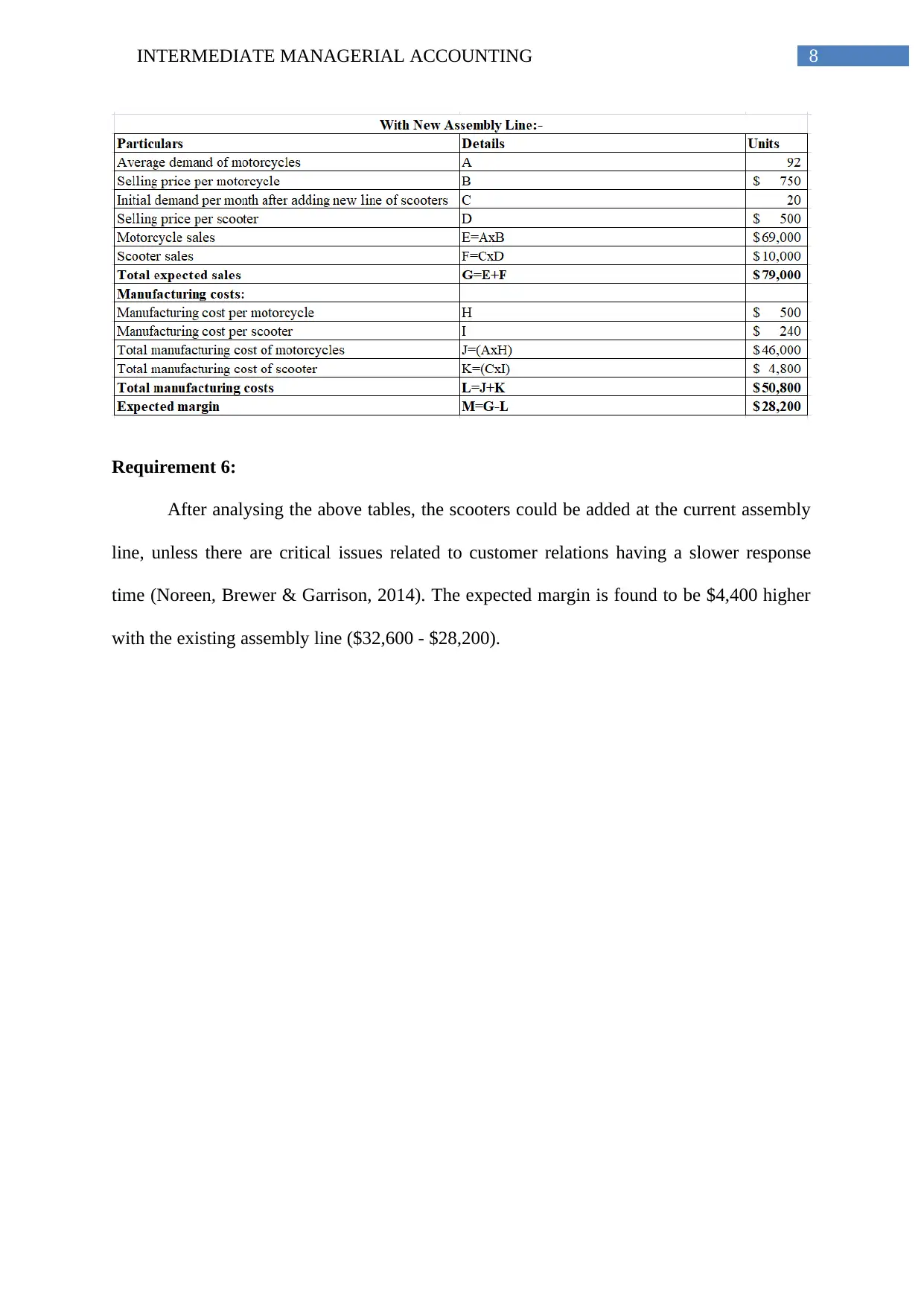
After analysing the above tables, the scooters could be added at the current assembly
line, unless there are critical issues related to customer relations having a slower response
time (Noreen, Brewer & Garrison, 2014). The expected margin is found to be $4,400 higher
with the existing assembly line ($32,600 - $28,200).
Requirement 6:
After analysing the above tables, the scooters could be added at the current assembly
line, unless there are critical issues related to customer relations having a slower response
time (Noreen, Brewer & Garrison, 2014). The expected margin is found to be $4,400 higher
with the existing assembly line ($32,600 - $28,200).
⊘ This is a preview!⊘
Do you want full access?
Subscribe today to unlock all pages.

Trusted by 1+ million students worldwide

9INTERMEDIATE MANAGERIAL ACCOUNTING
References:
Butler, S. A., & Ghosh, D. (2015). Individual differences in managerial accounting
judgments and decision making. The British Accounting Review, 47(1), 33-45.
Dopson, L. R., & Hayes, D. K. (2016). Managerial accounting for the hospitality industry.
Wiley Global Education.
Noreen, E. W., Brewer, P. C., & Garrison, R. H. (2014). Managerial accounting for
managers. New York: McGraw-Hill/Irwin.
Weygandt, J. J., Kimmel, P. D., & Kieso, D. E. (2015). Financial & managerial accounting.
John Wiley & Sons.
References:
Butler, S. A., & Ghosh, D. (2015). Individual differences in managerial accounting
judgments and decision making. The British Accounting Review, 47(1), 33-45.
Dopson, L. R., & Hayes, D. K. (2016). Managerial accounting for the hospitality industry.
Wiley Global Education.
Noreen, E. W., Brewer, P. C., & Garrison, R. H. (2014). Managerial accounting for
managers. New York: McGraw-Hill/Irwin.
Weygandt, J. J., Kimmel, P. D., & Kieso, D. E. (2015). Financial & managerial accounting.
John Wiley & Sons.
1 out of 10
Related Documents
Your All-in-One AI-Powered Toolkit for Academic Success.
+13062052269
info@desklib.com
Available 24*7 on WhatsApp / Email
Unlock your academic potential
Copyright © 2020–2026 A2Z Services. All Rights Reserved. Developed and managed by ZUCOL.