Internal Audit's Role in Ensuring Quality Financial Reporting
VerifiedAdded on 2023/06/04
|6
|1547
|201
Essay
AI Summary
This essay delves into the significant implications of internal audits on the quality of financial reporting within a company. It highlights how internal audits contribute to reducing errors and irregularities in financial reports, thereby increasing investor confidence and enhancing the effectiveness of corporate control. The paper emphasizes the role of internal audits in ensuring accurate, reliable, and objective information is available to management and stakeholders for informed decision-making. Furthermore, it discusses how internal audits act as a control mechanism to safeguard companies from malpractices, leading to improved profitability and productivity. The essay concludes with recommendations for companies to enhance the competence of their internal audit staff through training, leveraging public accountants, hiring IT-proficient personnel, and establishing clear guidelines for internal audit functions to ensure adherence to Generally Accepted Accounting Principles (GAAP).
Implications of Internal Audit on Quality Financial Reporting 1
IMPLICATIONS OF INTERNAL AUDIT ON QUALITY FINANCIAL REPORTING
by (Student’s Name)
Professor’s Name
Institution
Location of Institution
Course
Date
IMPLICATIONS OF INTERNAL AUDIT ON QUALITY FINANCIAL REPORTING
by (Student’s Name)
Professor’s Name
Institution
Location of Institution
Course
Date
Paraphrase This Document
Need a fresh take? Get an instant paraphrase of this document with our AI Paraphraser

Implications of Internal Audit on Quality Financial Reporting 2
Conclusion and Recommendations
Generally, there are usually certain two elements which have an impact on the quality of
financial reports of a particular company. Such factors include internal factors such as the
management, audit committee, board of directors and the internal audit. The other factors are
considered to be external and they include, the regulators, capital market managers, financial
statements analysts, shareholders, and the judicial system. Such aspects often have a great impact
on the quality of financial reports, however, the internal audit has major implications on the
quality of financial reports. The internal audit generally has certain implications on the quality of
financial reporting. For example, the internal audit helps in the reduction of various errors in the
financial reports and thus blocks the irregularities in the financial reports (Abbott, Daugherty,
Parker and Peters, 2016 p.35). The reduction of such errors will have certain implications such as
an increase in the investors’ confidence and this is especially in the reliability of financial
reporting and the effectiveness of the corporate control.
According to Christ, Masli, Sharp and Wood, (2015 p.45), the other impact of the internal
audit on a good quality financial reports is that it will increase the level of accuracy of the report
and hence confidence in the financial statements will also be increased and this is an essential
benefit to the company. The internal audit has a responsibility of ensuring that a neutral, reliable
and objective information has been provided to an organization and this is particularly important
to the management of the particular organization (Marshall, Schroeder and Yohn, 2017 p.50). It,
therefore, implies that the key effect of the internal audit on the quality financial report is that it
provides information which is reliable and objective and therefore can be dependent upon by the
top level management and other stakeholders of the company such as investors for making
certain decisions regarding the various activities of the company.
Conclusion and Recommendations
Generally, there are usually certain two elements which have an impact on the quality of
financial reports of a particular company. Such factors include internal factors such as the
management, audit committee, board of directors and the internal audit. The other factors are
considered to be external and they include, the regulators, capital market managers, financial
statements analysts, shareholders, and the judicial system. Such aspects often have a great impact
on the quality of financial reports, however, the internal audit has major implications on the
quality of financial reports. The internal audit generally has certain implications on the quality of
financial reporting. For example, the internal audit helps in the reduction of various errors in the
financial reports and thus blocks the irregularities in the financial reports (Abbott, Daugherty,
Parker and Peters, 2016 p.35). The reduction of such errors will have certain implications such as
an increase in the investors’ confidence and this is especially in the reliability of financial
reporting and the effectiveness of the corporate control.
According to Christ, Masli, Sharp and Wood, (2015 p.45), the other impact of the internal
audit on a good quality financial reports is that it will increase the level of accuracy of the report
and hence confidence in the financial statements will also be increased and this is an essential
benefit to the company. The internal audit has a responsibility of ensuring that a neutral, reliable
and objective information has been provided to an organization and this is particularly important
to the management of the particular organization (Marshall, Schroeder and Yohn, 2017 p.50). It,
therefore, implies that the key effect of the internal audit on the quality financial report is that it
provides information which is reliable and objective and therefore can be dependent upon by the
top level management and other stakeholders of the company such as investors for making
certain decisions regarding the various activities of the company.

Implications of Internal Audit on Quality Financial Reporting 3
The internal audit plays a crucial role in the verification of profits in an organization especially
in regards to financial fraud (Gaynor, Kelton, Mercer and Yohn, 2016 p.15). Therefore it can be
concluded that the key implications of the internal audit on a good financial report is that it acts
as a control mechanism whose primary aim is to save the particular company form certain
malpractices and irregularities. Such an organization will, therefore, be in a position of
accomplishing most of its objectives and this through an improvement of profit and productivity
levels.
A good quality of financial reports offers diverse benefits to various stakeholders of the
company and this includes also the company itself. Such stakeholders may include, the investors
and shareholders among others. A typical example of the benefit of a quality financial reporting
to the investors is the increase in confidence on the particular firm and it, therefore, means that
the investors will typically put a lot of their investments into the company to increase their
returns on investment (Indriasih and Koeswayo, 2014 p.45). With such an increase in the
investment into the particular company, there will be a rise in profits being ploughed back into
the company. More customers, on the other hand, will be attracted to the company and this will
also result in more profits being generated.
The shareholders will also benefit from good quality financial reporting since their wealth
will be maximized and this is attributed to the fact that the shareholders' wealth maximization
will be part of the primary goals of the good quality financial reporting (Pizzini, Lin, and
Ziegenfuss, 2014 p.45). The society also benefits from a good quality financial reporting and this
is because they will be provided with information regarding various elements of the particular
company to enable them to make certain decisions which generally influences the activities of
the firm. The other stakeholders of the company will also be provided with adequate information
The internal audit plays a crucial role in the verification of profits in an organization especially
in regards to financial fraud (Gaynor, Kelton, Mercer and Yohn, 2016 p.15). Therefore it can be
concluded that the key implications of the internal audit on a good financial report is that it acts
as a control mechanism whose primary aim is to save the particular company form certain
malpractices and irregularities. Such an organization will, therefore, be in a position of
accomplishing most of its objectives and this through an improvement of profit and productivity
levels.
A good quality of financial reports offers diverse benefits to various stakeholders of the
company and this includes also the company itself. Such stakeholders may include, the investors
and shareholders among others. A typical example of the benefit of a quality financial reporting
to the investors is the increase in confidence on the particular firm and it, therefore, means that
the investors will typically put a lot of their investments into the company to increase their
returns on investment (Indriasih and Koeswayo, 2014 p.45). With such an increase in the
investment into the particular company, there will be a rise in profits being ploughed back into
the company. More customers, on the other hand, will be attracted to the company and this will
also result in more profits being generated.
The shareholders will also benefit from good quality financial reporting since their wealth
will be maximized and this is attributed to the fact that the shareholders' wealth maximization
will be part of the primary goals of the good quality financial reporting (Pizzini, Lin, and
Ziegenfuss, 2014 p.45). The society also benefits from a good quality financial reporting and this
is because they will be provided with information regarding various elements of the particular
company to enable them to make certain decisions which generally influences the activities of
the firm. The other stakeholders of the company will also be provided with adequate information
⊘ This is a preview!⊘
Do you want full access?
Subscribe today to unlock all pages.

Trusted by 1+ million students worldwide

Implications of Internal Audit on Quality Financial Reporting 4
relating to the performances of the company and this is especially in regards to the management
such as how the management is carrying out its fiduciary duties with due diligence and in an
ethical manner.
Based on the implications and benefits of the internal audit on a good quality financial
reports, it is recommended for a company to enhance the competency level of its internal audit
staff and this should entail both the in-house and ex-house training. The other way to improve on
the competence of the audit staff should be availing a variety of opportunities which comprises
of special education training on internal audit (Tepalagul and Lin, 2015 p.110). Additionally, the
audit process of the various financial statements should be conducted by certain public
accountants and this should entail the preparation of the process by choosing on the public
accounting company who will be responsible for the auditing of the financial statements. The
selection of the public accounting firm should be displayed in the annual work program of the
audit committees.
The other recommendation is that the company should hire certain complete members of
staff of the internal audit who are competent and thus have a comprehension of the information
technology. The competence level of the internal audit staff should either be based on the
experience level or as a fresh graduate (Knechel and Salterio, 2016 p.100). Also, the
enhancement of the operational experience should be part of the recruitment requirement of the
internal audit position to enhance the competence level and thus produce a quality financial
report of the particular companies. Further, the board of directors of the particular company
should also include certain financial experts who have the ability to offer adequate assistance to
the internal audit function quality. Such experts will also provide an understanding of the internal
relating to the performances of the company and this is especially in regards to the management
such as how the management is carrying out its fiduciary duties with due diligence and in an
ethical manner.
Based on the implications and benefits of the internal audit on a good quality financial
reports, it is recommended for a company to enhance the competency level of its internal audit
staff and this should entail both the in-house and ex-house training. The other way to improve on
the competence of the audit staff should be availing a variety of opportunities which comprises
of special education training on internal audit (Tepalagul and Lin, 2015 p.110). Additionally, the
audit process of the various financial statements should be conducted by certain public
accountants and this should entail the preparation of the process by choosing on the public
accounting company who will be responsible for the auditing of the financial statements. The
selection of the public accounting firm should be displayed in the annual work program of the
audit committees.
The other recommendation is that the company should hire certain complete members of
staff of the internal audit who are competent and thus have a comprehension of the information
technology. The competence level of the internal audit staff should either be based on the
experience level or as a fresh graduate (Knechel and Salterio, 2016 p.100). Also, the
enhancement of the operational experience should be part of the recruitment requirement of the
internal audit position to enhance the competence level and thus produce a quality financial
report of the particular companies. Further, the board of directors of the particular company
should also include certain financial experts who have the ability to offer adequate assistance to
the internal audit function quality. Such experts will also provide an understanding of the internal
Paraphrase This Document
Need a fresh take? Get an instant paraphrase of this document with our AI Paraphraser

Implications of Internal Audit on Quality Financial Reporting 5
audit reports and thus give clear responses to the various recommendations which have been
made in the financial reports.
The internal audit should also be done based on the Generally Accepted Accounting
Principles and this is because an effective auditing process will be typically conducted to obtain
relevant audit evidence which will offer a fair judgment on the financial reports. Finally, a
particular company should formulate certain laws and rules in regards to the internal audit
function quality which must be adhered to by all the auditors responsible for quality audit reports
and this could either be the internal or external auditors of the company in question.
audit reports and thus give clear responses to the various recommendations which have been
made in the financial reports.
The internal audit should also be done based on the Generally Accepted Accounting
Principles and this is because an effective auditing process will be typically conducted to obtain
relevant audit evidence which will offer a fair judgment on the financial reports. Finally, a
particular company should formulate certain laws and rules in regards to the internal audit
function quality which must be adhered to by all the auditors responsible for quality audit reports
and this could either be the internal or external auditors of the company in question.

Implications of Internal Audit on Quality Financial Reporting 6
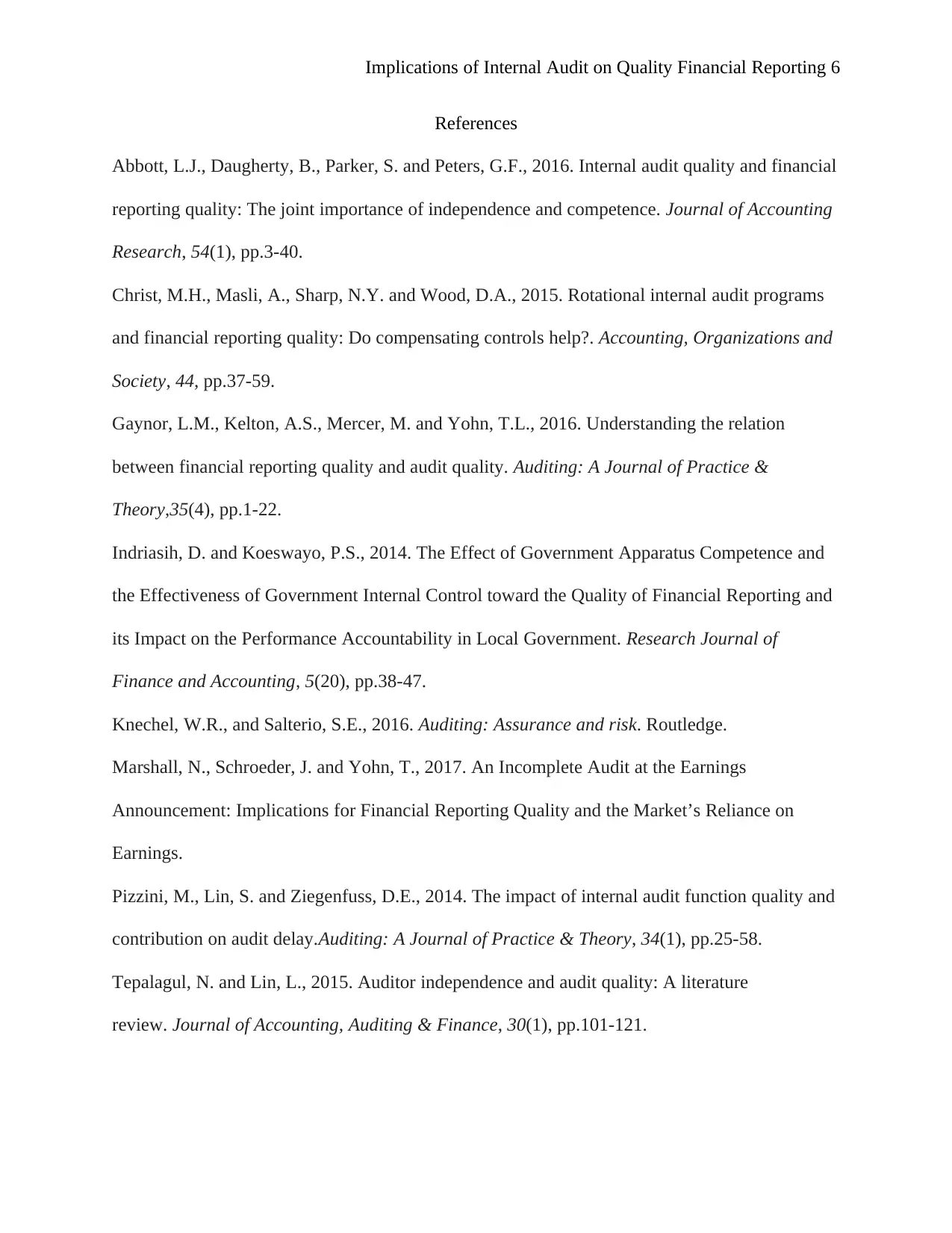
References
Abbott, L.J., Daugherty, B., Parker, S. and Peters, G.F., 2016. Internal audit quality and financial
reporting quality: The joint importance of independence and competence. Journal of Accounting
Research, 54(1), pp.3-40.
Christ, M.H., Masli, A., Sharp, N.Y. and Wood, D.A., 2015. Rotational internal audit programs
and financial reporting quality: Do compensating controls help?. Accounting, Organizations and
Society, 44, pp.37-59.
Gaynor, L.M., Kelton, A.S., Mercer, M. and Yohn, T.L., 2016. Understanding the relation
between financial reporting quality and audit quality. Auditing: A Journal of Practice &
Theory,35(4), pp.1-22.
Indriasih, D. and Koeswayo, P.S., 2014. The Effect of Government Apparatus Competence and
the Effectiveness of Government Internal Control toward the Quality of Financial Reporting and
its Impact on the Performance Accountability in Local Government. Research Journal of
Finance and Accounting, 5(20), pp.38-47.
Knechel, W.R., and Salterio, S.E., 2016. Auditing: Assurance and risk. Routledge.
Marshall, N., Schroeder, J. and Yohn, T., 2017. An Incomplete Audit at the Earnings
Announcement: Implications for Financial Reporting Quality and the Market’s Reliance on
Earnings.
Pizzini, M., Lin, S. and Ziegenfuss, D.E., 2014. The impact of internal audit function quality and
contribution on audit delay.Auditing: A Journal of Practice & Theory, 34(1), pp.25-58.
Tepalagul, N. and Lin, L., 2015. Auditor independence and audit quality: A literature
review. Journal of Accounting, Auditing & Finance, 30(1), pp.101-121.
References
Abbott, L.J., Daugherty, B., Parker, S. and Peters, G.F., 2016. Internal audit quality and financial
reporting quality: The joint importance of independence and competence. Journal of Accounting
Research, 54(1), pp.3-40.
Christ, M.H., Masli, A., Sharp, N.Y. and Wood, D.A., 2015. Rotational internal audit programs
and financial reporting quality: Do compensating controls help?. Accounting, Organizations and
Society, 44, pp.37-59.
Gaynor, L.M., Kelton, A.S., Mercer, M. and Yohn, T.L., 2016. Understanding the relation
between financial reporting quality and audit quality. Auditing: A Journal of Practice &
Theory,35(4), pp.1-22.
Indriasih, D. and Koeswayo, P.S., 2014. The Effect of Government Apparatus Competence and
the Effectiveness of Government Internal Control toward the Quality of Financial Reporting and
its Impact on the Performance Accountability in Local Government. Research Journal of
Finance and Accounting, 5(20), pp.38-47.
Knechel, W.R., and Salterio, S.E., 2016. Auditing: Assurance and risk. Routledge.
Marshall, N., Schroeder, J. and Yohn, T., 2017. An Incomplete Audit at the Earnings
Announcement: Implications for Financial Reporting Quality and the Market’s Reliance on
Earnings.
Pizzini, M., Lin, S. and Ziegenfuss, D.E., 2014. The impact of internal audit function quality and
contribution on audit delay.Auditing: A Journal of Practice & Theory, 34(1), pp.25-58.
Tepalagul, N. and Lin, L., 2015. Auditor independence and audit quality: A literature
review. Journal of Accounting, Auditing & Finance, 30(1), pp.101-121.
⊘ This is a preview!⊘
Do you want full access?
Subscribe today to unlock all pages.

Trusted by 1+ million students worldwide
1 out of 6
Related Documents
Your All-in-One AI-Powered Toolkit for Academic Success.
+13062052269
info@desklib.com
Available 24*7 on WhatsApp / Email
Unlock your academic potential
Copyright © 2020–2026 A2Z Services. All Rights Reserved. Developed and managed by ZUCOL.