Investigating Internal Communication Challenges: A Business Research
VerifiedAdded on 2023/06/13
|13
|3617
|274
Report
AI Summary
This research report investigates the internal communication challenges faced by a company with multiple business units. It focuses on three major themes: internal communication management, internal communication channels, and the monitoring and measurement of internal communication. The report identifies non-effective internal communication as a key business issue, impacting employee performance and motivation. The literature review covers internal communication dimensions, management strategies, measurement techniques (including audits and employee surveys), and the impact of poor communication. Research questions address the tools used, challenges faced, impacts of poor communication, and improvement methods. The research methodology employs cluster sampling across various departments, aiming to provide recommendations for solving the identified communication issues. Desklib provides access to this and other solved assignments.
Running head: RESEARCH 0
BUSINESS RESEARCH
BUSINESS RESEARCH

Paraphrase This Document
Need a fresh take? Get an instant paraphrase of this document with our AI Paraphraser
RESEARCH 1
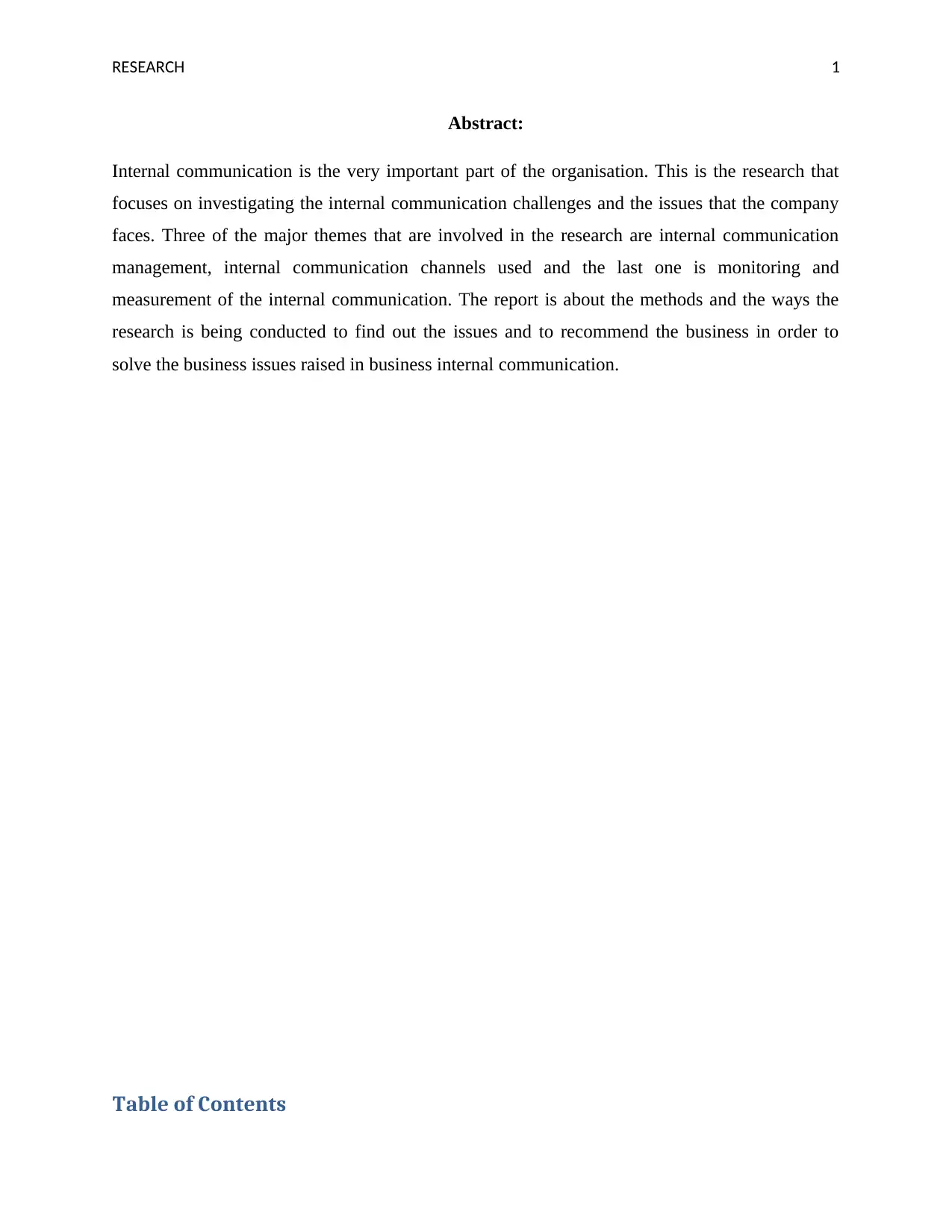
Abstract:
Internal communication is the very important part of the organisation. This is the research that
focuses on investigating the internal communication challenges and the issues that the company
faces. Three of the major themes that are involved in the research are internal communication
management, internal communication channels used and the last one is monitoring and
measurement of the internal communication. The report is about the methods and the ways the
research is being conducted to find out the issues and to recommend the business in order to
solve the business issues raised in business internal communication.
Table of Contents
Abstract:
Internal communication is the very important part of the organisation. This is the research that
focuses on investigating the internal communication challenges and the issues that the company
faces. Three of the major themes that are involved in the research are internal communication
management, internal communication channels used and the last one is monitoring and
measurement of the internal communication. The report is about the methods and the ways the
research is being conducted to find out the issues and to recommend the business in order to
solve the business issues raised in business internal communication.
Table of Contents
RESEARCH 2
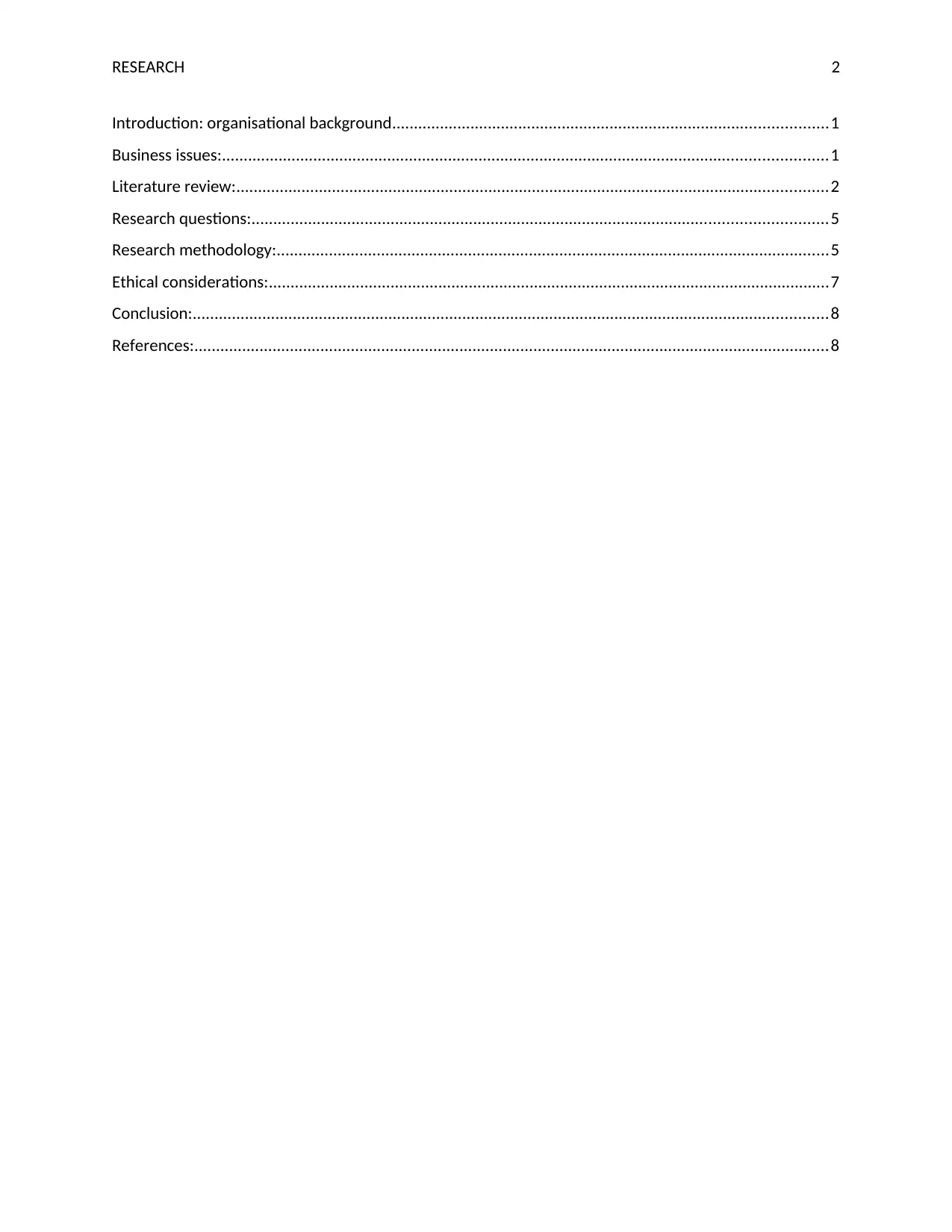
Introduction: organisational background....................................................................................................1
Business issues:...........................................................................................................................................1
Literature review:........................................................................................................................................2
Research questions:....................................................................................................................................5
Research methodology:...............................................................................................................................5
Ethical considerations:.................................................................................................................................7
Conclusion:..................................................................................................................................................8
References:..................................................................................................................................................8
Introduction: organisational background....................................................................................................1
Business issues:...........................................................................................................................................1
Literature review:........................................................................................................................................2
Research questions:....................................................................................................................................5
Research methodology:...............................................................................................................................5
Ethical considerations:.................................................................................................................................7
Conclusion:..................................................................................................................................................8
References:..................................................................................................................................................8
⊘ This is a preview!⊘
Do you want full access?
Subscribe today to unlock all pages.

Trusted by 1+ million students worldwide
RESEARCH 3
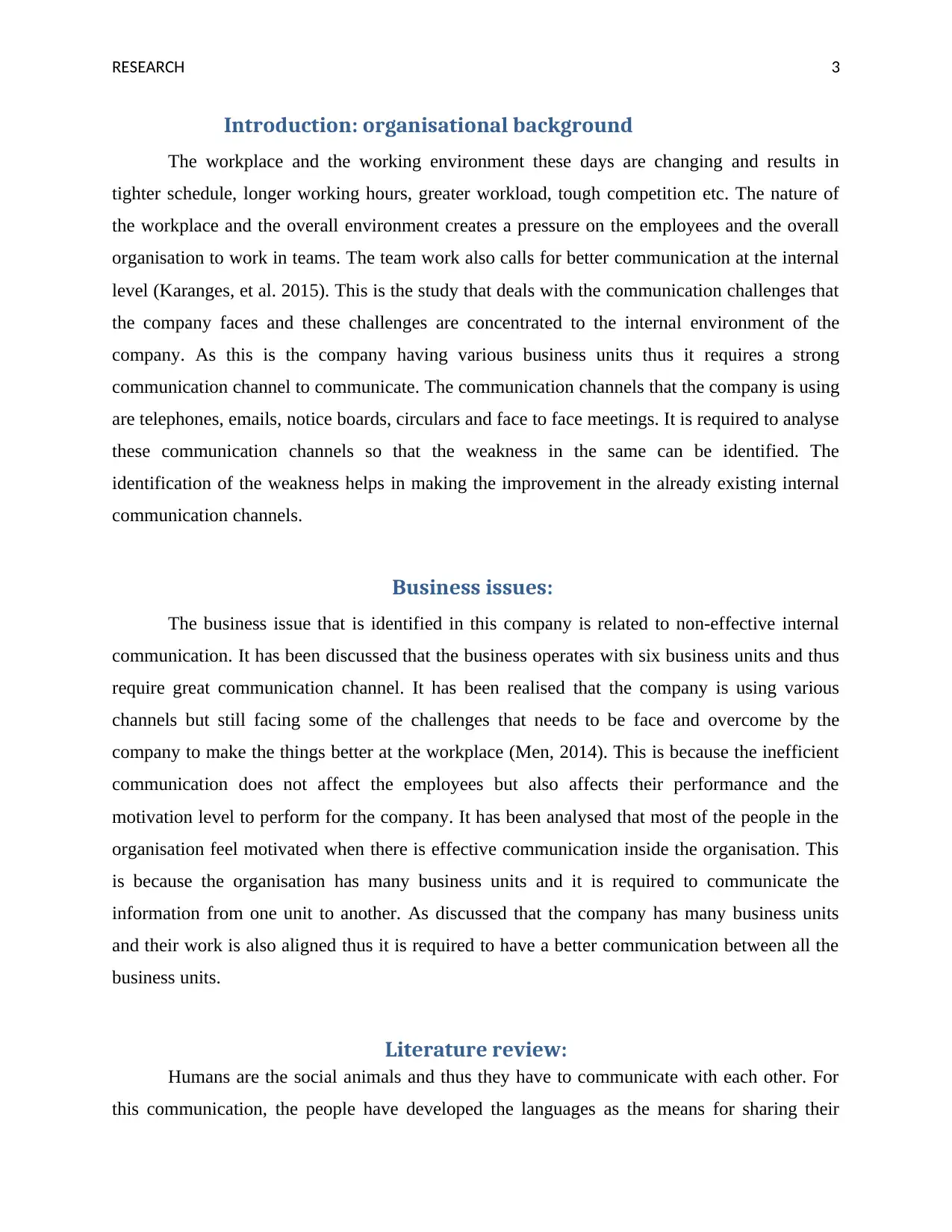
Introduction: organisational background
The workplace and the working environment these days are changing and results in
tighter schedule, longer working hours, greater workload, tough competition etc. The nature of
the workplace and the overall environment creates a pressure on the employees and the overall
organisation to work in teams. The team work also calls for better communication at the internal
level (Karanges, et al. 2015). This is the study that deals with the communication challenges that
the company faces and these challenges are concentrated to the internal environment of the
company. As this is the company having various business units thus it requires a strong
communication channel to communicate. The communication channels that the company is using
are telephones, emails, notice boards, circulars and face to face meetings. It is required to analyse
these communication channels so that the weakness in the same can be identified. The
identification of the weakness helps in making the improvement in the already existing internal
communication channels.
Business issues:
The business issue that is identified in this company is related to non-effective internal
communication. It has been discussed that the business operates with six business units and thus
require great communication channel. It has been realised that the company is using various
channels but still facing some of the challenges that needs to be face and overcome by the
company to make the things better at the workplace (Men, 2014). This is because the inefficient
communication does not affect the employees but also affects their performance and the
motivation level to perform for the company. It has been analysed that most of the people in the
organisation feel motivated when there is effective communication inside the organisation. This
is because the organisation has many business units and it is required to communicate the
information from one unit to another. As discussed that the company has many business units
and their work is also aligned thus it is required to have a better communication between all the
business units.
Literature review:
Humans are the social animals and thus they have to communicate with each other. For
this communication, the people have developed the languages as the means for sharing their
Introduction: organisational background
The workplace and the working environment these days are changing and results in
tighter schedule, longer working hours, greater workload, tough competition etc. The nature of
the workplace and the overall environment creates a pressure on the employees and the overall
organisation to work in teams. The team work also calls for better communication at the internal
level (Karanges, et al. 2015). This is the study that deals with the communication challenges that
the company faces and these challenges are concentrated to the internal environment of the
company. As this is the company having various business units thus it requires a strong
communication channel to communicate. The communication channels that the company is using
are telephones, emails, notice boards, circulars and face to face meetings. It is required to analyse
these communication channels so that the weakness in the same can be identified. The
identification of the weakness helps in making the improvement in the already existing internal
communication channels.
Business issues:
The business issue that is identified in this company is related to non-effective internal
communication. It has been discussed that the business operates with six business units and thus
require great communication channel. It has been realised that the company is using various
channels but still facing some of the challenges that needs to be face and overcome by the
company to make the things better at the workplace (Men, 2014). This is because the inefficient
communication does not affect the employees but also affects their performance and the
motivation level to perform for the company. It has been analysed that most of the people in the
organisation feel motivated when there is effective communication inside the organisation. This
is because the organisation has many business units and it is required to communicate the
information from one unit to another. As discussed that the company has many business units
and their work is also aligned thus it is required to have a better communication between all the
business units.
Literature review:
Humans are the social animals and thus they have to communicate with each other. For
this communication, the people have developed the languages as the means for sharing their
Paraphrase This Document
Need a fresh take? Get an instant paraphrase of this document with our AI Paraphraser
RESEARCH 4
view and the opinions (Welch, 2015). Barriers to this communication can also arise at any of the
stages of the communication and these barriers results in confusion and misunderstanding
between the two parties who are involved in the interaction.
In terms of organisational point of view, it has been realised that internal communication is the
very important aspect of the organisations. There is lot of information that needs to be shared
amongst the employees in the organisations. If the person or the employee is good in
communication then it becomes easy for the individual to share their opinions and views in the
organisational and this develop a confidence amongst the employees if their opinions are heard
carefully (Malhotra & Ackfeldt, 2016). The major focus of this case is the internal
communication that is occurring in the organisation. There are there major aspects that are
covered in the literature review; the first one of the internal communication, the second one is the
internal communication measurement and the last one of the internal communication channels
that has been used in the organisation (Heide & Simonsson, 2014). Discussion of all the three
parts is very important as each of them are related to each other and are relevant to be discussed
to analyse the internal communication issues.
Internal communication:
Internal communication of the organisation does not only include the official communication but
also includes the informal and unofficial communication of the organisation. Official
communication in any of the organisation can be done as per the policies and the procedures of
the organisation. Unofficial communication can be termed as the communication that deals with
the conversation or the information sharing process that occurred between the employees of the
company. The internal communication has four dimensions in the organisation (Welch &
Jackson, 2007). The first dimension is internal line management, the second one is internal team
peer communication, the third one is internal project peer communication and the last one is
internal corporate communication. Internal line management is the communication between the
managers and their subordinates (Zondi & Cassim, 2015). Internal team peer communication is
the communication that is in the form of the team meetings and discussions. Internal project peer
communication is the type of communication that occurs between the employees who works in a
single project. The last one is the most formal communication that is the internal corporate
communication. This communication happens between top management and the employees of
view and the opinions (Welch, 2015). Barriers to this communication can also arise at any of the
stages of the communication and these barriers results in confusion and misunderstanding
between the two parties who are involved in the interaction.
In terms of organisational point of view, it has been realised that internal communication is the
very important aspect of the organisations. There is lot of information that needs to be shared
amongst the employees in the organisations. If the person or the employee is good in
communication then it becomes easy for the individual to share their opinions and views in the
organisational and this develop a confidence amongst the employees if their opinions are heard
carefully (Malhotra & Ackfeldt, 2016). The major focus of this case is the internal
communication that is occurring in the organisation. There are there major aspects that are
covered in the literature review; the first one of the internal communication, the second one is the
internal communication measurement and the last one of the internal communication channels
that has been used in the organisation (Heide & Simonsson, 2014). Discussion of all the three
parts is very important as each of them are related to each other and are relevant to be discussed
to analyse the internal communication issues.
Internal communication:
Internal communication of the organisation does not only include the official communication but
also includes the informal and unofficial communication of the organisation. Official
communication in any of the organisation can be done as per the policies and the procedures of
the organisation. Unofficial communication can be termed as the communication that deals with
the conversation or the information sharing process that occurred between the employees of the
company. The internal communication has four dimensions in the organisation (Welch &
Jackson, 2007). The first dimension is internal line management, the second one is internal team
peer communication, the third one is internal project peer communication and the last one is
internal corporate communication. Internal line management is the communication between the
managers and their subordinates (Zondi & Cassim, 2015). Internal team peer communication is
the communication that is in the form of the team meetings and discussions. Internal project peer
communication is the type of communication that occurs between the employees who works in a
single project. The last one is the most formal communication that is the internal corporate
communication. This communication happens between top management and the employees of
RESEARCH 5
the company and it is considered as the one way communication (Elving, 2005). These 4
dimension of the internal communication in the organisation focus on rotating the information in
the al the direction and the areas of the study. Effective communication at the organisation leads
to enhancement in innovation level of the employees, improved and increased productivity and
in turn results in organisation success.
Internal communication management:
Management of the internal communication at the organisation is the very important aspect and
the function to be conducted. Their process of management includes participation of the people
in the right direction along with the content and the communication itself. All these aspects are
directly influenced and affected by the hierarchical structure of the company (Jablin & Putnam,
2000). The human capital of the organisation is the very important tool for making the
communication better. It has been realised that lack of trust is the major issue that the company
faces from the employee’s side when any of the communication is made.
Internal communication measurement:
In order to analyse the issues in the internal communication of the organisation, it is required to
measure the communication process that is currently being used by the company. It is very much
important for the organisations that have invested recently in their communication portal or
launched a new one (Smidts, Pruyn & Van Riel, 2001). The term measurement can be perceived
by many different aspects. It has been realised that the communication can be measured with
different sides. The one is measuring the employees in terms of their needs and the other one is
measuring the output of the communication department of the company. This helps in justifying
the investment that has been made on the communication process. The third one is tracking of
the communication channels that have been used by the company. The last measurement can be
done in the context of the content that is being delivered or communicated as there should be no
modifications in the content from the sender to the receiver (Zondi & Cassim, 2015).
Audits are considered as the most feasible tool for measuring the internal communication.
Communication audits are parallel to other audits and thus have some of the common
characteristics like accrual of information, development of management system, etc. the similar
approach can be applied in the communication audit as well (Smidts, Pruyn & Van Riel, 2001).
the company and it is considered as the one way communication (Elving, 2005). These 4
dimension of the internal communication in the organisation focus on rotating the information in
the al the direction and the areas of the study. Effective communication at the organisation leads
to enhancement in innovation level of the employees, improved and increased productivity and
in turn results in organisation success.
Internal communication management:
Management of the internal communication at the organisation is the very important aspect and
the function to be conducted. Their process of management includes participation of the people
in the right direction along with the content and the communication itself. All these aspects are
directly influenced and affected by the hierarchical structure of the company (Jablin & Putnam,
2000). The human capital of the organisation is the very important tool for making the
communication better. It has been realised that lack of trust is the major issue that the company
faces from the employee’s side when any of the communication is made.
Internal communication measurement:
In order to analyse the issues in the internal communication of the organisation, it is required to
measure the communication process that is currently being used by the company. It is very much
important for the organisations that have invested recently in their communication portal or
launched a new one (Smidts, Pruyn & Van Riel, 2001). The term measurement can be perceived
by many different aspects. It has been realised that the communication can be measured with
different sides. The one is measuring the employees in terms of their needs and the other one is
measuring the output of the communication department of the company. This helps in justifying
the investment that has been made on the communication process. The third one is tracking of
the communication channels that have been used by the company. The last measurement can be
done in the context of the content that is being delivered or communicated as there should be no
modifications in the content from the sender to the receiver (Zondi & Cassim, 2015).
Audits are considered as the most feasible tool for measuring the internal communication.
Communication audits are parallel to other audits and thus have some of the common
characteristics like accrual of information, development of management system, etc. the similar
approach can be applied in the communication audit as well (Smidts, Pruyn & Van Riel, 2001).
⊘ This is a preview!⊘
Do you want full access?
Subscribe today to unlock all pages.
Trusted by 1+ million students worldwide
RESEARCH 6
Along with the process of auditing, other methods like surveys of the employees can be
conducted in order to analyse the attitude and the behaviour of the people or the employees
towards the communication process. It does not only helps in measuring the satisfaction level of
the employees also measures the commitment level of the employees towards the organisation.
Internal communication channels:
With the advancement in the technology, it has been realised that world is getting very small
these days. The introduction and advances of the technology along with the existing ones opens a
path for the organisation to make use of the same as the internal communication channels in the
firm. It helps the organisation to ignore the issues like time and geographical distances. The most
common channels the companies use are face to face meetings, telephone, computer based
transfers and videoconferences (Kalla, 2005). Along with these four, the companies can also
make use of newsletters, fax, billboards, messages etc. for sharing the information. Media
richness is the major topic that has been discussed in many literatures these days.
Impact of poor communication:
Poor communication at the internal level of the company affects the people and their
performance a lot. If there is no effective communication then the actions cannot be completed as
they are intended to be (Jo Hatch & Schultz, 1997). It has been realised that if the different
departments of the company are not in touch with each other and the managers are not sharing
the information to the subordinates then it becomes very difficult for the people to work and
understand the process. In addition to it, poor communication also results in deviated decision
making. Decisions making is the most important part of the organisation and if the decision are
not correct and not being circulated properly because of the poor communication then there is no
use of making the decisions. It has been analysed that communication is the most important part
not only in the organisation in the overall society (Zondi & Cassim, 2015). This is because if the
effectiveness of the communication decreases then it results in misunderstandings.
Along with the process of auditing, other methods like surveys of the employees can be
conducted in order to analyse the attitude and the behaviour of the people or the employees
towards the communication process. It does not only helps in measuring the satisfaction level of
the employees also measures the commitment level of the employees towards the organisation.
Internal communication channels:
With the advancement in the technology, it has been realised that world is getting very small
these days. The introduction and advances of the technology along with the existing ones opens a
path for the organisation to make use of the same as the internal communication channels in the
firm. It helps the organisation to ignore the issues like time and geographical distances. The most
common channels the companies use are face to face meetings, telephone, computer based
transfers and videoconferences (Kalla, 2005). Along with these four, the companies can also
make use of newsletters, fax, billboards, messages etc. for sharing the information. Media
richness is the major topic that has been discussed in many literatures these days.
Impact of poor communication:
Poor communication at the internal level of the company affects the people and their
performance a lot. If there is no effective communication then the actions cannot be completed as
they are intended to be (Jo Hatch & Schultz, 1997). It has been realised that if the different
departments of the company are not in touch with each other and the managers are not sharing
the information to the subordinates then it becomes very difficult for the people to work and
understand the process. In addition to it, poor communication also results in deviated decision
making. Decisions making is the most important part of the organisation and if the decision are
not correct and not being circulated properly because of the poor communication then there is no
use of making the decisions. It has been analysed that communication is the most important part
not only in the organisation in the overall society (Zondi & Cassim, 2015). This is because if the
effectiveness of the communication decreases then it results in misunderstandings.
Paraphrase This Document
Need a fresh take? Get an instant paraphrase of this document with our AI Paraphraser
RESEARCH 7
It is required to conduct the research in order to analyse the issues of communication in the
organisation so that the improvement strategies can be implemented on the same. This helps in
rectifying the problems that can occur because of inefficient communication.
Research questions:
This is the section of the report that deals with the questions that needs to be answered
after the research (Taylor, Bogdan & DeVault, 2015). This section also helps in providing the
base to the research. The overall research revolves around these questions only. Following are
some of the most relevant questions that are related to this research.
1. What are the internal communication tools that are used by the company?
2. What are the challenges that the company is facing in internal communication?
3. What are the impacts of poor communication at the workplace?
4. What are the improvements methods that the company can use in order to improve the
communication internally?
Research methodology:
This is the section that gives the clear idea about the overall research and the methods
that are being used to conduct the research (Smith, 2015). This part of the research clearly
defines the structure of the overall research and act as the blueprint or the guideline for the
researcher. Defining the elements of this section allow the researcher to conduct the research
very easily.
Sampling:
It is the method that has been used for selecting the sample out of the population. The sample
needs to be targeted for conducting the research (Bryman & Bell,2015). The sampling method
that can be used here in this research is cluster sampling. It is the sampling method in which the
samples are divided into the group and the member from each groups are selected on random
basis. In this research the sample from various departments such as operations, human resource,
marketing, finance department, customer care and resource department.
Sample size:
It is required to conduct the research in order to analyse the issues of communication in the
organisation so that the improvement strategies can be implemented on the same. This helps in
rectifying the problems that can occur because of inefficient communication.
Research questions:
This is the section of the report that deals with the questions that needs to be answered
after the research (Taylor, Bogdan & DeVault, 2015). This section also helps in providing the
base to the research. The overall research revolves around these questions only. Following are
some of the most relevant questions that are related to this research.
1. What are the internal communication tools that are used by the company?
2. What are the challenges that the company is facing in internal communication?
3. What are the impacts of poor communication at the workplace?
4. What are the improvements methods that the company can use in order to improve the
communication internally?
Research methodology:
This is the section that gives the clear idea about the overall research and the methods
that are being used to conduct the research (Smith, 2015). This part of the research clearly
defines the structure of the overall research and act as the blueprint or the guideline for the
researcher. Defining the elements of this section allow the researcher to conduct the research
very easily.
Sampling:
It is the method that has been used for selecting the sample out of the population. The sample
needs to be targeted for conducting the research (Bryman & Bell,2015). The sampling method
that can be used here in this research is cluster sampling. It is the sampling method in which the
samples are divided into the group and the member from each groups are selected on random
basis. In this research the sample from various departments such as operations, human resource,
marketing, finance department, customer care and resource department.
Sample size:
RESEARCH 8
Sample size can be defined as the number that needs to be used on which the research needs to
be conducted. It is the most crucial part of the research as it is he only as sample is the one on
which the whole research is dependent (Sekaran & Bougie, 2016).
Sample size for this research is 40.
Operations: 10 people
Human resource: 3 people
Marketing: 10 people
Finance: 6 people
Customer care: 3 people
Resource department: 8 people
Research methods:
There are two types of research methods that are quantitative and qualitative. It has been realised
that in this research, qualitative methods are being used. This is because it results in in depth
research about the causes and effects of the problem (Flick, 2015). In terms of conducting the
qualitative study tow of the methods can be used for gathering the content. These two methods
are:
Literature review: it is the technique that helps in analysing the content or the studies that has
already been conducted regarding the topic (Sekaran & Bougie, 2016). It has been realised that
reviewing the literature helps the researcher to develop an in depth understating about the topic.
This also provides him the direction of his own research. This is the data collection method that
is secondary in nature. This is because the data that has been collected from the literature review
is used to support the primary data and it is already presented in the secondary sources.
Interviews:
Interview is another important method that can be used in this research to gather the information
or collect the data (Ledford & Gast, 2018). It has been analysed that the interviews will be
conducted in the company’s conference hall for 3 days. It will take around 20 minutes to conduct
Sample size can be defined as the number that needs to be used on which the research needs to
be conducted. It is the most crucial part of the research as it is he only as sample is the one on
which the whole research is dependent (Sekaran & Bougie, 2016).
Sample size for this research is 40.
Operations: 10 people
Human resource: 3 people
Marketing: 10 people
Finance: 6 people
Customer care: 3 people
Resource department: 8 people
Research methods:
There are two types of research methods that are quantitative and qualitative. It has been realised
that in this research, qualitative methods are being used. This is because it results in in depth
research about the causes and effects of the problem (Flick, 2015). In terms of conducting the
qualitative study tow of the methods can be used for gathering the content. These two methods
are:
Literature review: it is the technique that helps in analysing the content or the studies that has
already been conducted regarding the topic (Sekaran & Bougie, 2016). It has been realised that
reviewing the literature helps the researcher to develop an in depth understating about the topic.
This also provides him the direction of his own research. This is the data collection method that
is secondary in nature. This is because the data that has been collected from the literature review
is used to support the primary data and it is already presented in the secondary sources.
Interviews:
Interview is another important method that can be used in this research to gather the information
or collect the data (Ledford & Gast, 2018). It has been analysed that the interviews will be
conducted in the company’s conference hall for 3 days. It will take around 20 minutes to conduct
⊘ This is a preview!⊘
Do you want full access?
Subscribe today to unlock all pages.
Trusted by 1+ million students worldwide
RESEARCH 9
an overall interview. The researcher will ask open ended questions with the employees and the
employees have to give the answers to the same. It is the primary source of data as the data
collected from the interviews are updated and very new.
Data analysis:
Data analysis techniques are used to analyse the data that has been gathered by the data
collection tool. The tool that has been used in this research is content analysis. Content analysis
helps in analysing the content that has been gathered by the data collection tools. This is the
easiest and the suitable option to analyse the data from literature review and interviews.
Ethical considerations:
The ethical considerations in this research are related to the data collection methods. As
the data needs to be collected from the interview thus the information and the details of the
participants should be kept safe and shouldn’t be leaked.it is required to make the participants
clear about the topic of the research and the purpose of the research as well. This clarity is very
important to get the answers of the questions asked in the interview (Panneerselvam, 2014). Any
irrelevant question should not be asked with the participants and the dignity and decorum of the
formal interview should be maintained.
Conclusion:
It has been concluded from the report that internal communication is the very important
part of the organisational communication and it is crucial to have the effective communication
process in the organisation at the internal level. There is lot of information that needs to be
shared amongst the employees in the organisations. If the person or the employee is good in
communication then it becomes easy for the individual to share their opinions and views in the
organisational and this develop a confidence amongst the employees if their opinions are heard
carefully. The major focus of this case is the internal communication that is occurring in the
organisation. There are there major aspects that are covered in the literature review; the first one
an overall interview. The researcher will ask open ended questions with the employees and the
employees have to give the answers to the same. It is the primary source of data as the data
collected from the interviews are updated and very new.
Data analysis:
Data analysis techniques are used to analyse the data that has been gathered by the data
collection tool. The tool that has been used in this research is content analysis. Content analysis
helps in analysing the content that has been gathered by the data collection tools. This is the
easiest and the suitable option to analyse the data from literature review and interviews.
Ethical considerations:
The ethical considerations in this research are related to the data collection methods. As
the data needs to be collected from the interview thus the information and the details of the
participants should be kept safe and shouldn’t be leaked.it is required to make the participants
clear about the topic of the research and the purpose of the research as well. This clarity is very
important to get the answers of the questions asked in the interview (Panneerselvam, 2014). Any
irrelevant question should not be asked with the participants and the dignity and decorum of the
formal interview should be maintained.
Conclusion:
It has been concluded from the report that internal communication is the very important
part of the organisational communication and it is crucial to have the effective communication
process in the organisation at the internal level. There is lot of information that needs to be
shared amongst the employees in the organisations. If the person or the employee is good in
communication then it becomes easy for the individual to share their opinions and views in the
organisational and this develop a confidence amongst the employees if their opinions are heard
carefully. The major focus of this case is the internal communication that is occurring in the
organisation. There are there major aspects that are covered in the literature review; the first one
Paraphrase This Document
Need a fresh take? Get an instant paraphrase of this document with our AI Paraphraser
RESEARCH 10
of the internal communication, the second one is the internal communication measurement and
the last one of the internal communication channels that has been used in the organisation.
Discussion of all the three parts is very important as each of them are related to each other and
are relevant to be discussed to analyse the internal communication issues. This report clearly
defines the methods that need to be used in order to conduct the overall research along with the
ethical considerations.
of the internal communication, the second one is the internal communication measurement and
the last one of the internal communication channels that has been used in the organisation.
Discussion of all the three parts is very important as each of them are related to each other and
are relevant to be discussed to analyse the internal communication issues. This report clearly
defines the methods that need to be used in order to conduct the overall research along with the
ethical considerations.
RESEARCH 11
References:
Bryman, A., & Bell, E. (2015). Business research methods. Oxford University Press, USA.
Elving, W. J. (2005). The role of communication in organisational change. Corporate
communications: an international journal, 10(2), 129-138.
Flick, U. (2015). Introducing research methodology: A beginner's guide to doing a research
project. Sage.
Heide, M., & Simonsson, C. (2014). Developing internal crisis communication: New roles and
practices of communication professionals. Corporate Communications: An International
Journal, 19(2), 128-146.
Jablin, F. M., & Putnam, L. L. (Eds.). (2000). The new handbook of organizational
communication: Advances in theory, research, and methods. Sage Publications.
Jo Hatch, M., & Schultz, M. (1997). Relations between organizational culture, identity and
image. European Journal of marketing, 31(5/6), 356-365.
Kalla, H. K. (2005). Integrated internal communications: a multidisciplinary
perspective. Corporate Communications: An International Journal, 10(4), 302-314.
Karanges, E., Johnston, K., Beatson, A., & Lings, I. (2015). The influence of internal
communication on employee engagement: A pilot study. Public Relations Review, 41(1),
129-131.
Ledford, J. R., & Gast, D. L. (2018). Single case research methodology: Applications in special
education and behavioral sciences. Routledge.
Malhotra, N., & Ackfeldt, A. L. (2016). Internal communication and prosocial service behaviors
of front-line employees: Investigating mediating mechanisms. Journal of Business
Research, 69(10), 4132-4139.
References:
Bryman, A., & Bell, E. (2015). Business research methods. Oxford University Press, USA.
Elving, W. J. (2005). The role of communication in organisational change. Corporate
communications: an international journal, 10(2), 129-138.
Flick, U. (2015). Introducing research methodology: A beginner's guide to doing a research
project. Sage.
Heide, M., & Simonsson, C. (2014). Developing internal crisis communication: New roles and
practices of communication professionals. Corporate Communications: An International
Journal, 19(2), 128-146.
Jablin, F. M., & Putnam, L. L. (Eds.). (2000). The new handbook of organizational
communication: Advances in theory, research, and methods. Sage Publications.
Jo Hatch, M., & Schultz, M. (1997). Relations between organizational culture, identity and
image. European Journal of marketing, 31(5/6), 356-365.
Kalla, H. K. (2005). Integrated internal communications: a multidisciplinary
perspective. Corporate Communications: An International Journal, 10(4), 302-314.
Karanges, E., Johnston, K., Beatson, A., & Lings, I. (2015). The influence of internal
communication on employee engagement: A pilot study. Public Relations Review, 41(1),
129-131.
Ledford, J. R., & Gast, D. L. (2018). Single case research methodology: Applications in special
education and behavioral sciences. Routledge.
Malhotra, N., & Ackfeldt, A. L. (2016). Internal communication and prosocial service behaviors
of front-line employees: Investigating mediating mechanisms. Journal of Business
Research, 69(10), 4132-4139.
⊘ This is a preview!⊘
Do you want full access?
Subscribe today to unlock all pages.
Trusted by 1+ million students worldwide

1 out of 13


Related Documents


Your All-in-One AI-Powered Toolkit for Academic Success.
+13062052269
info@desklib.com
Available 24*7 on WhatsApp / Email
![[object Object]](/_next/static/media/star-bottom.7253800d.svg)
Unlock your academic potential
Copyright © 2020–2026 A2Z Services. All Rights Reserved. Developed and managed by ZUCOL.