Legal Advice: Torture under Criminal Code Act for Michael A. Case
VerifiedAdded on 2022/11/23
|11
|2589
|282
Report
AI Summary
This document is an internal memorandum providing legal advice regarding a case involving alleged torture. The client, Michael A., claims to have been subjected to physical, mental, psychological, and emotional torture by the defendant, Shane. The memorandum analyzes the factual background, including the circumstances of the alleged torture, and identifies the key issues, which center on whether the defendant can be held guilty under section 320A of the Criminal Code Act. The analysis examines the elements of torture, including the intentional infliction of severe pain or suffering, and considers relevant case law, such as R v Burns and R v Ping. The memorandum concludes that the defendant is highly likely to be convicted under section 320A of the Criminal Code Act, given the evidence of intentional infliction of pain and suffering, and provides a detailed legal analysis of the case.
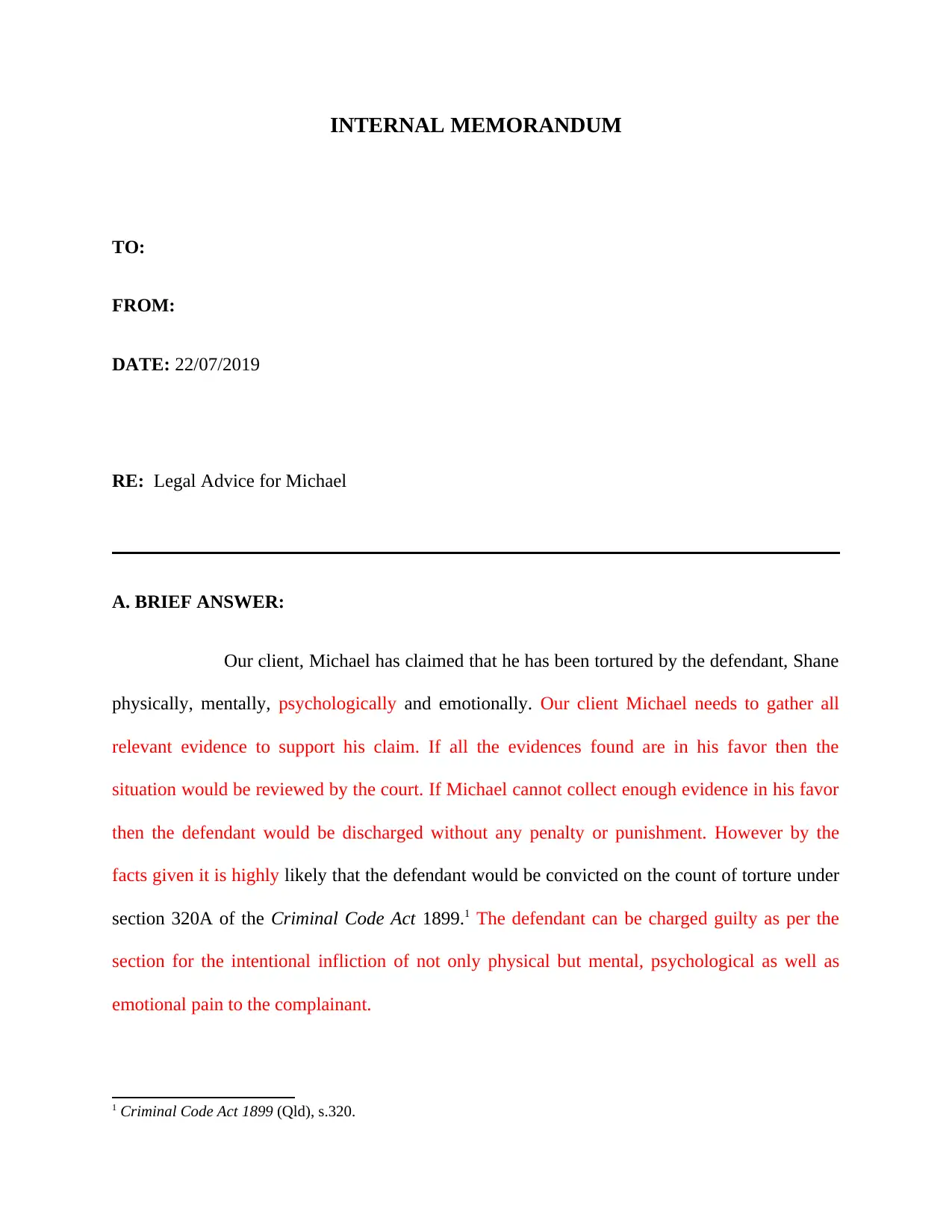
INTERNAL MEMORANDUM
TO:
FROM:
DATE: 22/07/2019
RE: Legal Advice for Michael
A. BRIEF ANSWER:
Our client, Michael has claimed that he has been tortured by the defendant, Shane
physically, mentally, psychologically and emotionally. Our client Michael needs to gather all
relevant evidence to support his claim. If all the evidences found are in his favor then the
situation would be reviewed by the court. If Michael cannot collect enough evidence in his favor
then the defendant would be discharged without any penalty or punishment. However by the
facts given it is highly likely that the defendant would be convicted on the count of torture under
section 320A of the Criminal Code Act 1899.1 The defendant can be charged guilty as per the
section for the intentional infliction of not only physical but mental, psychological as well as
emotional pain to the complainant.
1 Criminal Code Act 1899 (Qld), s.320.
TO:
FROM:
DATE: 22/07/2019
RE: Legal Advice for Michael
A. BRIEF ANSWER:
Our client, Michael has claimed that he has been tortured by the defendant, Shane
physically, mentally, psychologically and emotionally. Our client Michael needs to gather all
relevant evidence to support his claim. If all the evidences found are in his favor then the
situation would be reviewed by the court. If Michael cannot collect enough evidence in his favor
then the defendant would be discharged without any penalty or punishment. However by the
facts given it is highly likely that the defendant would be convicted on the count of torture under
section 320A of the Criminal Code Act 1899.1 The defendant can be charged guilty as per the
section for the intentional infliction of not only physical but mental, psychological as well as
emotional pain to the complainant.
1 Criminal Code Act 1899 (Qld), s.320.

Paraphrase This Document
Need a fresh take? Get an instant paraphrase of this document with our AI Paraphraser
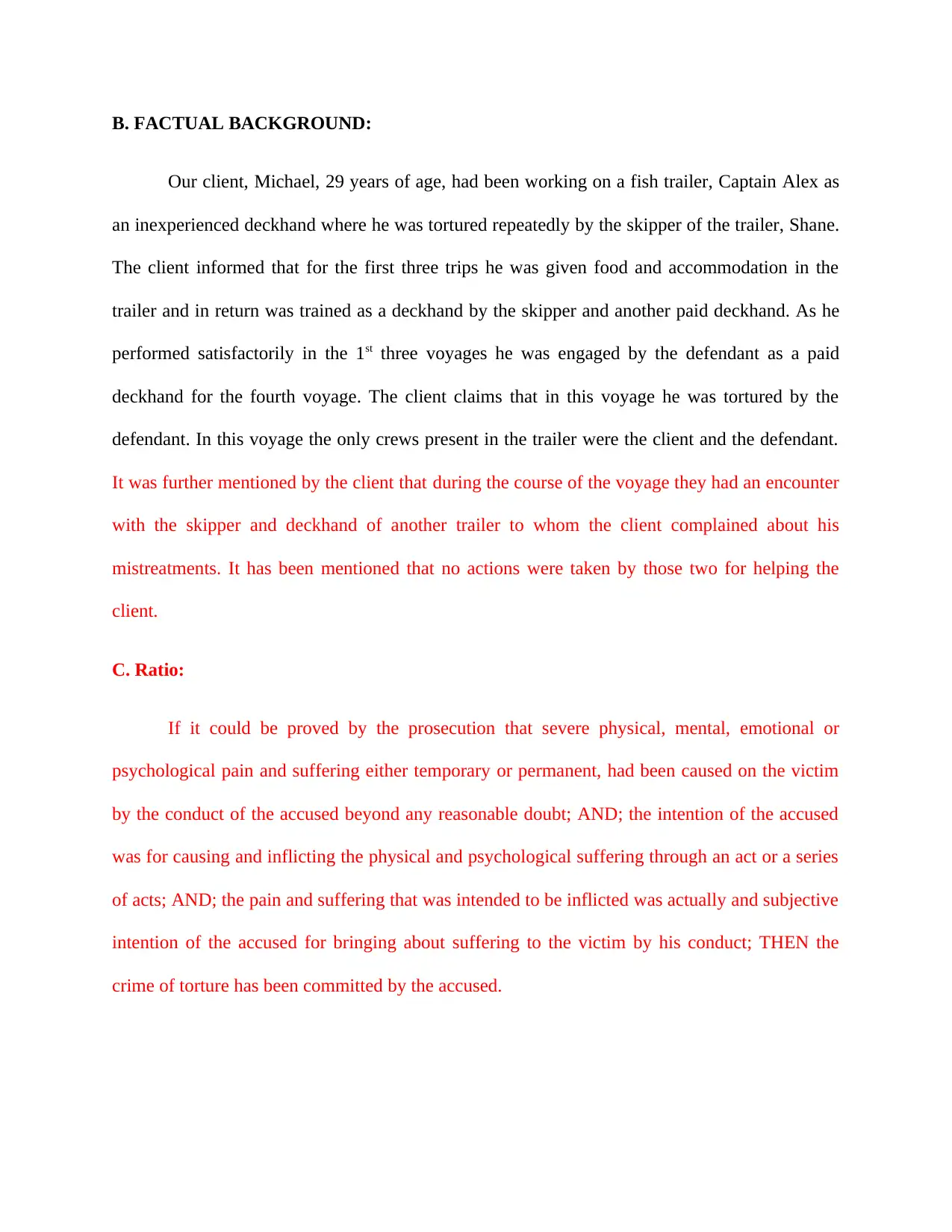
B. FACTUAL BACKGROUND:
Our client, Michael, 29 years of age, had been working on a fish trailer, Captain Alex as
an inexperienced deckhand where he was tortured repeatedly by the skipper of the trailer, Shane.
The client informed that for the first three trips he was given food and accommodation in the
trailer and in return was trained as a deckhand by the skipper and another paid deckhand. As he
performed satisfactorily in the 1st three voyages he was engaged by the defendant as a paid
deckhand for the fourth voyage. The client claims that in this voyage he was tortured by the
defendant. In this voyage the only crews present in the trailer were the client and the defendant.
It was further mentioned by the client that during the course of the voyage they had an encounter
with the skipper and deckhand of another trailer to whom the client complained about his
mistreatments. It has been mentioned that no actions were taken by those two for helping the
client.
C. Ratio:
If it could be proved by the prosecution that severe physical, mental, emotional or
psychological pain and suffering either temporary or permanent, had been caused on the victim
by the conduct of the accused beyond any reasonable doubt; AND; the intention of the accused
was for causing and inflicting the physical and psychological suffering through an act or a series
of acts; AND; the pain and suffering that was intended to be inflicted was actually and subjective
intention of the accused for bringing about suffering to the victim by his conduct; THEN the
crime of torture has been committed by the accused.
Our client, Michael, 29 years of age, had been working on a fish trailer, Captain Alex as
an inexperienced deckhand where he was tortured repeatedly by the skipper of the trailer, Shane.
The client informed that for the first three trips he was given food and accommodation in the
trailer and in return was trained as a deckhand by the skipper and another paid deckhand. As he
performed satisfactorily in the 1st three voyages he was engaged by the defendant as a paid
deckhand for the fourth voyage. The client claims that in this voyage he was tortured by the
defendant. In this voyage the only crews present in the trailer were the client and the defendant.
It was further mentioned by the client that during the course of the voyage they had an encounter
with the skipper and deckhand of another trailer to whom the client complained about his
mistreatments. It has been mentioned that no actions were taken by those two for helping the
client.
C. Ratio:
If it could be proved by the prosecution that severe physical, mental, emotional or
psychological pain and suffering either temporary or permanent, had been caused on the victim
by the conduct of the accused beyond any reasonable doubt; AND; the intention of the accused
was for causing and inflicting the physical and psychological suffering through an act or a series
of acts; AND; the pain and suffering that was intended to be inflicted was actually and subjective
intention of the accused for bringing about suffering to the victim by his conduct; THEN the
crime of torture has been committed by the accused.
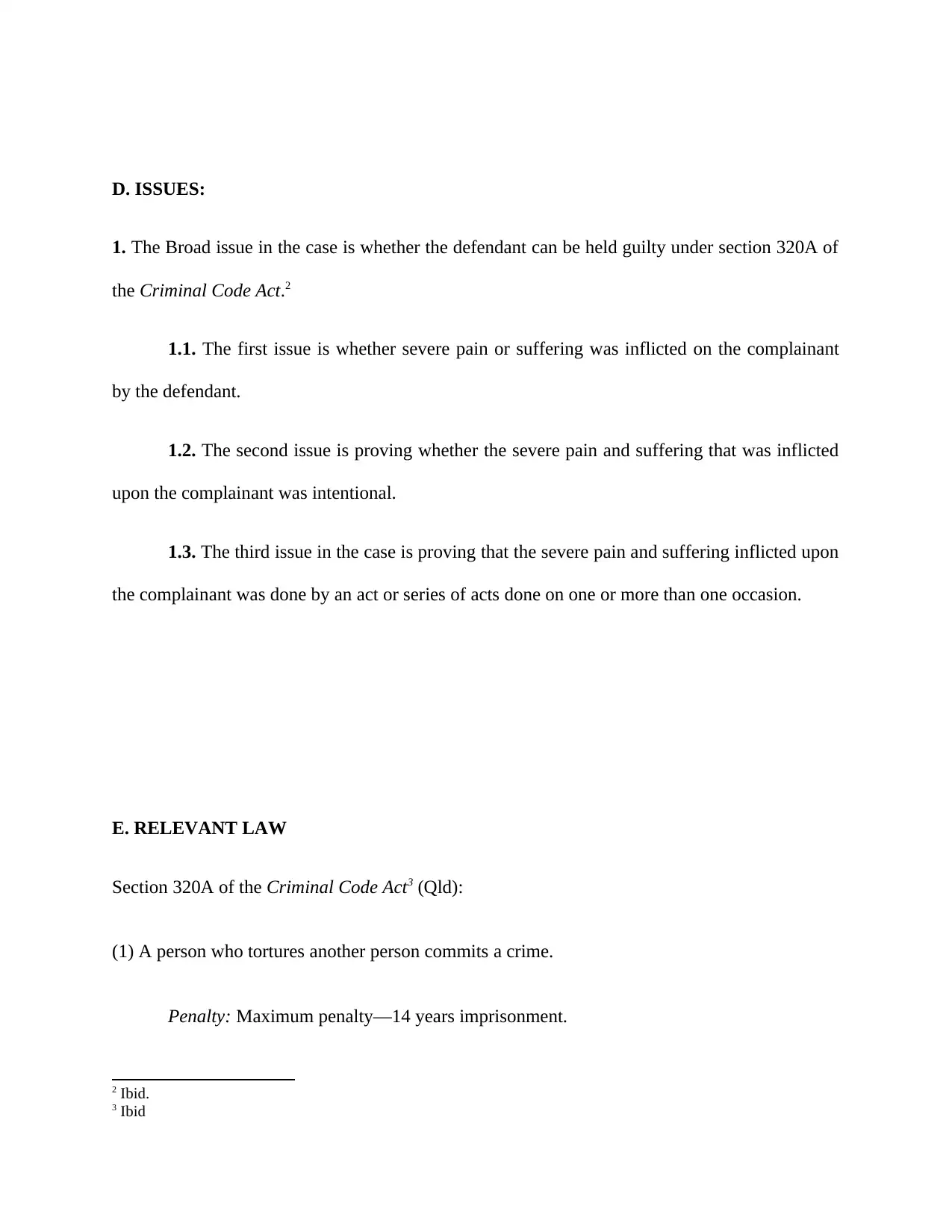
D. ISSUES:
1. The Broad issue in the case is whether the defendant can be held guilty under section 320A of
the Criminal Code Act.2
1.1. The first issue is whether severe pain or suffering was inflicted on the complainant
by the defendant.
1.2. The second issue is proving whether the severe pain and suffering that was inflicted
upon the complainant was intentional.
1.3. The third issue in the case is proving that the severe pain and suffering inflicted upon
the complainant was done by an act or series of acts done on one or more than one occasion.
E. RELEVANT LAW
Section 320A of the Criminal Code Act3 (Qld):
(1) A person who tortures another person commits a crime.
Penalty: Maximum penalty—14 years imprisonment.
2 Ibid.
3 Ibid
1. The Broad issue in the case is whether the defendant can be held guilty under section 320A of
the Criminal Code Act.2
1.1. The first issue is whether severe pain or suffering was inflicted on the complainant
by the defendant.
1.2. The second issue is proving whether the severe pain and suffering that was inflicted
upon the complainant was intentional.
1.3. The third issue in the case is proving that the severe pain and suffering inflicted upon
the complainant was done by an act or series of acts done on one or more than one occasion.
E. RELEVANT LAW
Section 320A of the Criminal Code Act3 (Qld):
(1) A person who tortures another person commits a crime.
Penalty: Maximum penalty—14 years imprisonment.
2 Ibid.
3 Ibid
⊘ This is a preview!⊘
Do you want full access?
Subscribe today to unlock all pages.

Trusted by 1+ million students worldwide
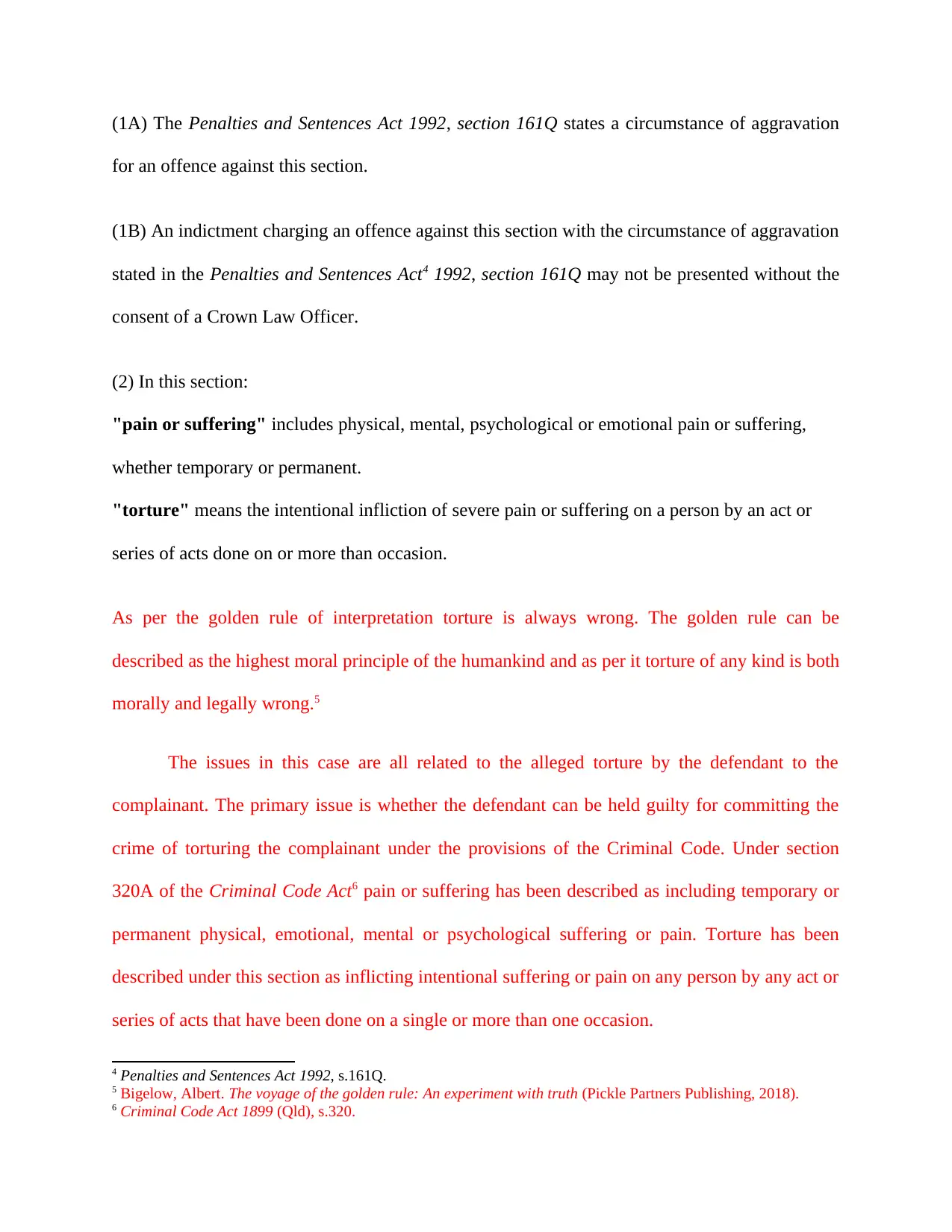
(1A) The Penalties and Sentences Act 1992, section 161Q states a circumstance of aggravation
for an offence against this section.
(1B) An indictment charging an offence against this section with the circumstance of aggravation
stated in the Penalties and Sentences Act4 1992, section 161Q may not be presented without the
consent of a Crown Law Officer.
(2) In this section:
"pain or suffering" includes physical, mental, psychological or emotional pain or suffering,
whether temporary or permanent.
"torture" means the intentional infliction of severe pain or suffering on a person by an act or
series of acts done on or more than occasion.
As per the golden rule of interpretation torture is always wrong. The golden rule can be
described as the highest moral principle of the humankind and as per it torture of any kind is both
morally and legally wrong.5
The issues in this case are all related to the alleged torture by the defendant to the
complainant. The primary issue is whether the defendant can be held guilty for committing the
crime of torturing the complainant under the provisions of the Criminal Code. Under section
320A of the Criminal Code Act6 pain or suffering has been described as including temporary or
permanent physical, emotional, mental or psychological suffering or pain. Torture has been
described under this section as inflicting intentional suffering or pain on any person by any act or
series of acts that have been done on a single or more than one occasion.
4 Penalties and Sentences Act 1992, s.161Q.
5 Bigelow, Albert. The voyage of the golden rule: An experiment with truth (Pickle Partners Publishing, 2018).
6 Criminal Code Act 1899 (Qld), s.320.
for an offence against this section.
(1B) An indictment charging an offence against this section with the circumstance of aggravation
stated in the Penalties and Sentences Act4 1992, section 161Q may not be presented without the
consent of a Crown Law Officer.
(2) In this section:
"pain or suffering" includes physical, mental, psychological or emotional pain or suffering,
whether temporary or permanent.
"torture" means the intentional infliction of severe pain or suffering on a person by an act or
series of acts done on or more than occasion.
As per the golden rule of interpretation torture is always wrong. The golden rule can be
described as the highest moral principle of the humankind and as per it torture of any kind is both
morally and legally wrong.5
The issues in this case are all related to the alleged torture by the defendant to the
complainant. The primary issue is whether the defendant can be held guilty for committing the
crime of torturing the complainant under the provisions of the Criminal Code. Under section
320A of the Criminal Code Act6 pain or suffering has been described as including temporary or
permanent physical, emotional, mental or psychological suffering or pain. Torture has been
described under this section as inflicting intentional suffering or pain on any person by any act or
series of acts that have been done on a single or more than one occasion.
4 Penalties and Sentences Act 1992, s.161Q.
5 Bigelow, Albert. The voyage of the golden rule: An experiment with truth (Pickle Partners Publishing, 2018).
6 Criminal Code Act 1899 (Qld), s.320.
Paraphrase This Document
Need a fresh take? Get an instant paraphrase of this document with our AI Paraphraser
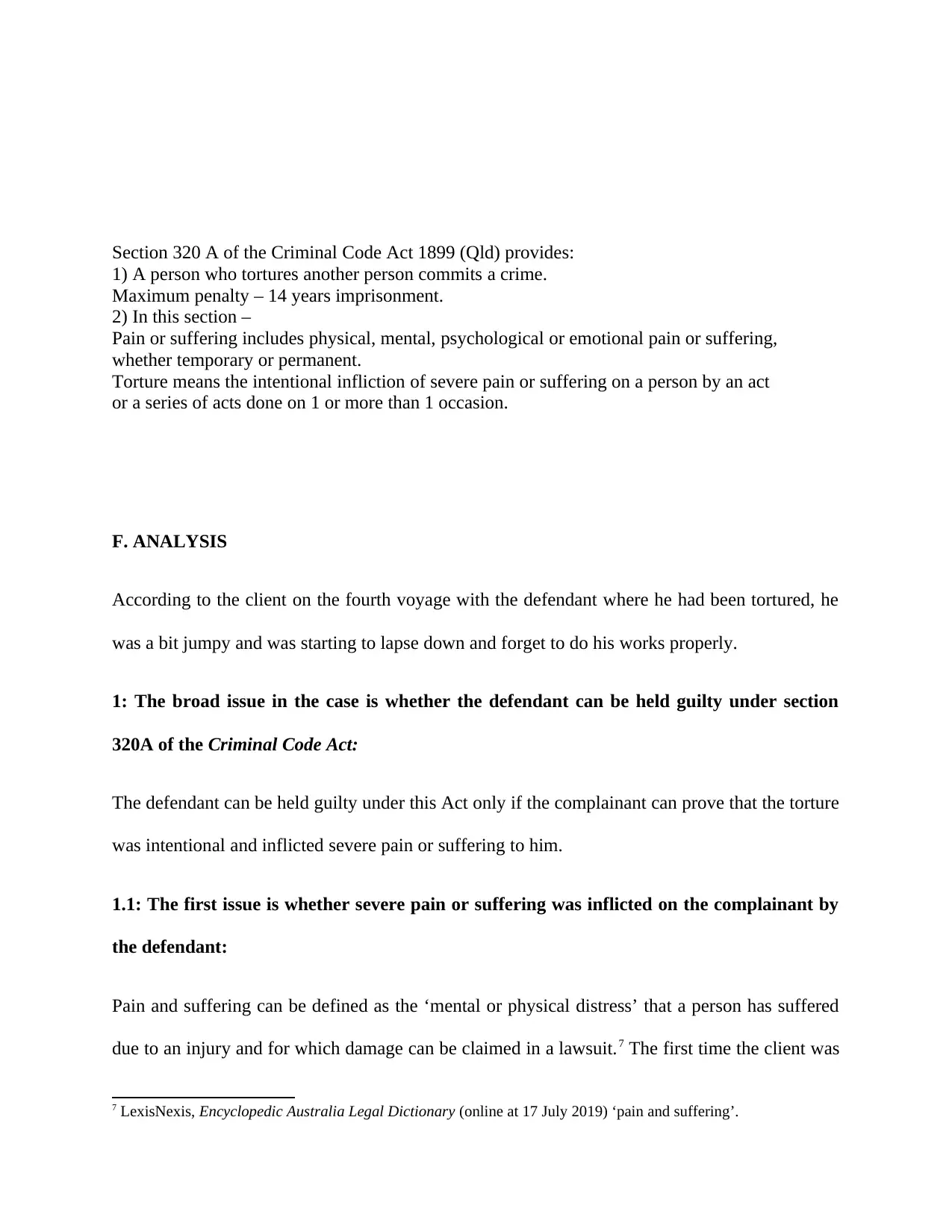
Section 320 A of the Criminal Code Act 1899 (Qld) provides:
1) A person who tortures another person commits a crime.
Maximum penalty – 14 years imprisonment.
2) In this section –
Pain or suffering includes physical, mental, psychological or emotional pain or suffering,
whether temporary or permanent.
Torture means the intentional infliction of severe pain or suffering on a person by an act
or a series of acts done on 1 or more than 1 occasion.
F. ANALYSIS
According to the client on the fourth voyage with the defendant where he had been tortured, he
was a bit jumpy and was starting to lapse down and forget to do his works properly.
1: The broad issue in the case is whether the defendant can be held guilty under section
320A of the Criminal Code Act:
The defendant can be held guilty under this Act only if the complainant can prove that the torture
was intentional and inflicted severe pain or suffering to him.
1.1: The first issue is whether severe pain or suffering was inflicted on the complainant by
the defendant:
Pain and suffering can be defined as the ‘mental or physical distress’ that a person has suffered
due to an injury and for which damage can be claimed in a lawsuit.7 The first time the client was
7 LexisNexis, Encyclopedic Australia Legal Dictionary (online at 17 July 2019) ‘pain and suffering’.
1) A person who tortures another person commits a crime.
Maximum penalty – 14 years imprisonment.
2) In this section –
Pain or suffering includes physical, mental, psychological or emotional pain or suffering,
whether temporary or permanent.
Torture means the intentional infliction of severe pain or suffering on a person by an act
or a series of acts done on 1 or more than 1 occasion.
F. ANALYSIS
According to the client on the fourth voyage with the defendant where he had been tortured, he
was a bit jumpy and was starting to lapse down and forget to do his works properly.
1: The broad issue in the case is whether the defendant can be held guilty under section
320A of the Criminal Code Act:
The defendant can be held guilty under this Act only if the complainant can prove that the torture
was intentional and inflicted severe pain or suffering to him.
1.1: The first issue is whether severe pain or suffering was inflicted on the complainant by
the defendant:
Pain and suffering can be defined as the ‘mental or physical distress’ that a person has suffered
due to an injury and for which damage can be claimed in a lawsuit.7 The first time the client was
7 LexisNexis, Encyclopedic Australia Legal Dictionary (online at 17 July 2019) ‘pain and suffering’.
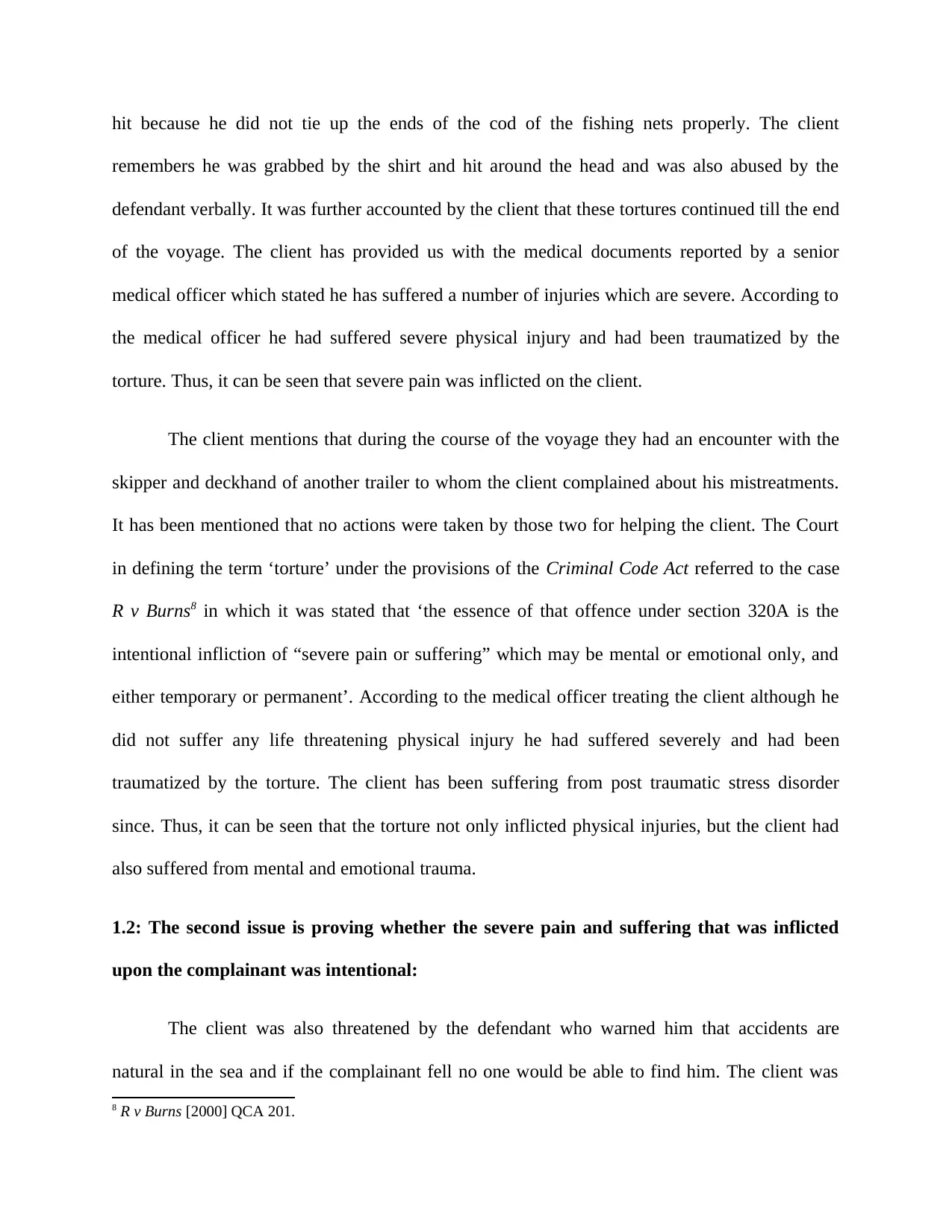
hit because he did not tie up the ends of the cod of the fishing nets properly. The client
remembers he was grabbed by the shirt and hit around the head and was also abused by the
defendant verbally. It was further accounted by the client that these tortures continued till the end
of the voyage. The client has provided us with the medical documents reported by a senior
medical officer which stated he has suffered a number of injuries which are severe. According to
the medical officer he had suffered severe physical injury and had been traumatized by the
torture. Thus, it can be seen that severe pain was inflicted on the client.
The client mentions that during the course of the voyage they had an encounter with the
skipper and deckhand of another trailer to whom the client complained about his mistreatments.
It has been mentioned that no actions were taken by those two for helping the client. The Court
in defining the term ‘torture’ under the provisions of the Criminal Code Act referred to the case
R v Burns8 in which it was stated that ‘the essence of that offence under section 320A is the
intentional infliction of “severe pain or suffering” which may be mental or emotional only, and
either temporary or permanent’. According to the medical officer treating the client although he
did not suffer any life threatening physical injury he had suffered severely and had been
traumatized by the torture. The client has been suffering from post traumatic stress disorder
since. Thus, it can be seen that the torture not only inflicted physical injuries, but the client had
also suffered from mental and emotional trauma.
1.2: The second issue is proving whether the severe pain and suffering that was inflicted
upon the complainant was intentional:
The client was also threatened by the defendant who warned him that accidents are
natural in the sea and if the complainant fell no one would be able to find him. The client was
8 R v Burns [2000] QCA 201.
remembers he was grabbed by the shirt and hit around the head and was also abused by the
defendant verbally. It was further accounted by the client that these tortures continued till the end
of the voyage. The client has provided us with the medical documents reported by a senior
medical officer which stated he has suffered a number of injuries which are severe. According to
the medical officer he had suffered severe physical injury and had been traumatized by the
torture. Thus, it can be seen that severe pain was inflicted on the client.
The client mentions that during the course of the voyage they had an encounter with the
skipper and deckhand of another trailer to whom the client complained about his mistreatments.
It has been mentioned that no actions were taken by those two for helping the client. The Court
in defining the term ‘torture’ under the provisions of the Criminal Code Act referred to the case
R v Burns8 in which it was stated that ‘the essence of that offence under section 320A is the
intentional infliction of “severe pain or suffering” which may be mental or emotional only, and
either temporary or permanent’. According to the medical officer treating the client although he
did not suffer any life threatening physical injury he had suffered severely and had been
traumatized by the torture. The client has been suffering from post traumatic stress disorder
since. Thus, it can be seen that the torture not only inflicted physical injuries, but the client had
also suffered from mental and emotional trauma.
1.2: The second issue is proving whether the severe pain and suffering that was inflicted
upon the complainant was intentional:
The client was also threatened by the defendant who warned him that accidents are
natural in the sea and if the complainant fell no one would be able to find him. The client was
8 R v Burns [2000] QCA 201.
⊘ This is a preview!⊘
Do you want full access?
Subscribe today to unlock all pages.
Trusted by 1+ million students worldwide
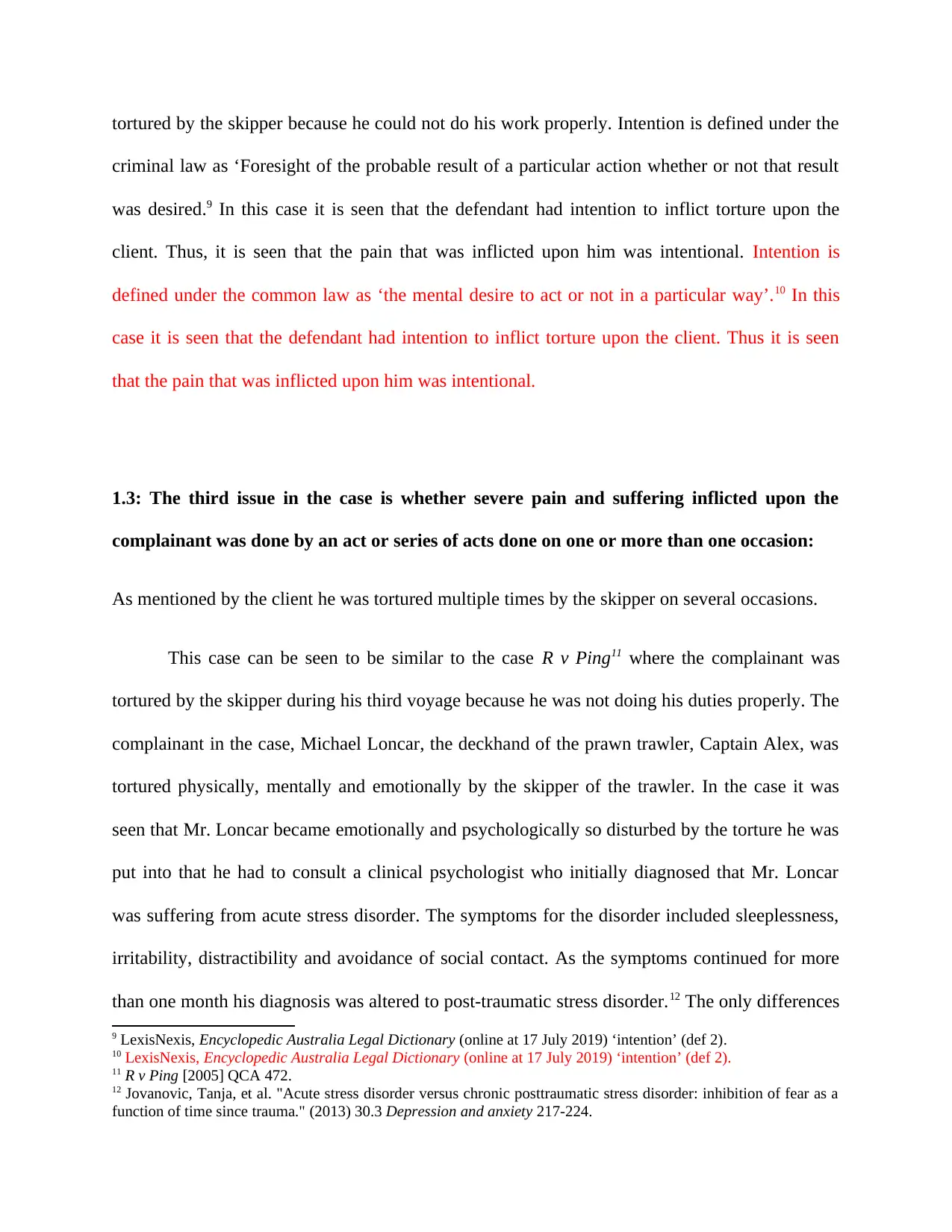
tortured by the skipper because he could not do his work properly. Intention is defined under the
criminal law as ‘Foresight of the probable result of a particular action whether or not that result
was desired.9 In this case it is seen that the defendant had intention to inflict torture upon the
client. Thus, it is seen that the pain that was inflicted upon him was intentional. Intention is
defined under the common law as ‘the mental desire to act or not in a particular way’.10 In this
case it is seen that the defendant had intention to inflict torture upon the client. Thus it is seen
that the pain that was inflicted upon him was intentional.
1.3: The third issue in the case is whether severe pain and suffering inflicted upon the
complainant was done by an act or series of acts done on one or more than one occasion:
As mentioned by the client he was tortured multiple times by the skipper on several occasions.
This case can be seen to be similar to the case R v Ping11 where the complainant was
tortured by the skipper during his third voyage because he was not doing his duties properly. The
complainant in the case, Michael Loncar, the deckhand of the prawn trawler, Captain Alex, was
tortured physically, mentally and emotionally by the skipper of the trawler. In the case it was
seen that Mr. Loncar became emotionally and psychologically so disturbed by the torture he was
put into that he had to consult a clinical psychologist who initially diagnosed that Mr. Loncar
was suffering from acute stress disorder. The symptoms for the disorder included sleeplessness,
irritability, distractibility and avoidance of social contact. As the symptoms continued for more
than one month his diagnosis was altered to post-traumatic stress disorder.12 The only differences
9 LexisNexis, Encyclopedic Australia Legal Dictionary (online at 17 July 2019) ‘intention’ (def 2).
10 LexisNexis, Encyclopedic Australia Legal Dictionary (online at 17 July 2019) ‘intention’ (def 2).
11 R v Ping [2005] QCA 472.
12 Jovanovic, Tanja, et al. "Acute stress disorder versus chronic posttraumatic stress disorder: inhibition of fear as a
function of time since trauma." (2013) 30.3 Depression and anxiety 217-224.
criminal law as ‘Foresight of the probable result of a particular action whether or not that result
was desired.9 In this case it is seen that the defendant had intention to inflict torture upon the
client. Thus, it is seen that the pain that was inflicted upon him was intentional. Intention is
defined under the common law as ‘the mental desire to act or not in a particular way’.10 In this
case it is seen that the defendant had intention to inflict torture upon the client. Thus it is seen
that the pain that was inflicted upon him was intentional.
1.3: The third issue in the case is whether severe pain and suffering inflicted upon the
complainant was done by an act or series of acts done on one or more than one occasion:
As mentioned by the client he was tortured multiple times by the skipper on several occasions.
This case can be seen to be similar to the case R v Ping11 where the complainant was
tortured by the skipper during his third voyage because he was not doing his duties properly. The
complainant in the case, Michael Loncar, the deckhand of the prawn trawler, Captain Alex, was
tortured physically, mentally and emotionally by the skipper of the trawler. In the case it was
seen that Mr. Loncar became emotionally and psychologically so disturbed by the torture he was
put into that he had to consult a clinical psychologist who initially diagnosed that Mr. Loncar
was suffering from acute stress disorder. The symptoms for the disorder included sleeplessness,
irritability, distractibility and avoidance of social contact. As the symptoms continued for more
than one month his diagnosis was altered to post-traumatic stress disorder.12 The only differences
9 LexisNexis, Encyclopedic Australia Legal Dictionary (online at 17 July 2019) ‘intention’ (def 2).
10 LexisNexis, Encyclopedic Australia Legal Dictionary (online at 17 July 2019) ‘intention’ (def 2).
11 R v Ping [2005] QCA 472.
12 Jovanovic, Tanja, et al. "Acute stress disorder versus chronic posttraumatic stress disorder: inhibition of fear as a
function of time since trauma." (2013) 30.3 Depression and anxiety 217-224.
Paraphrase This Document
Need a fresh take? Get an instant paraphrase of this document with our AI Paraphraser
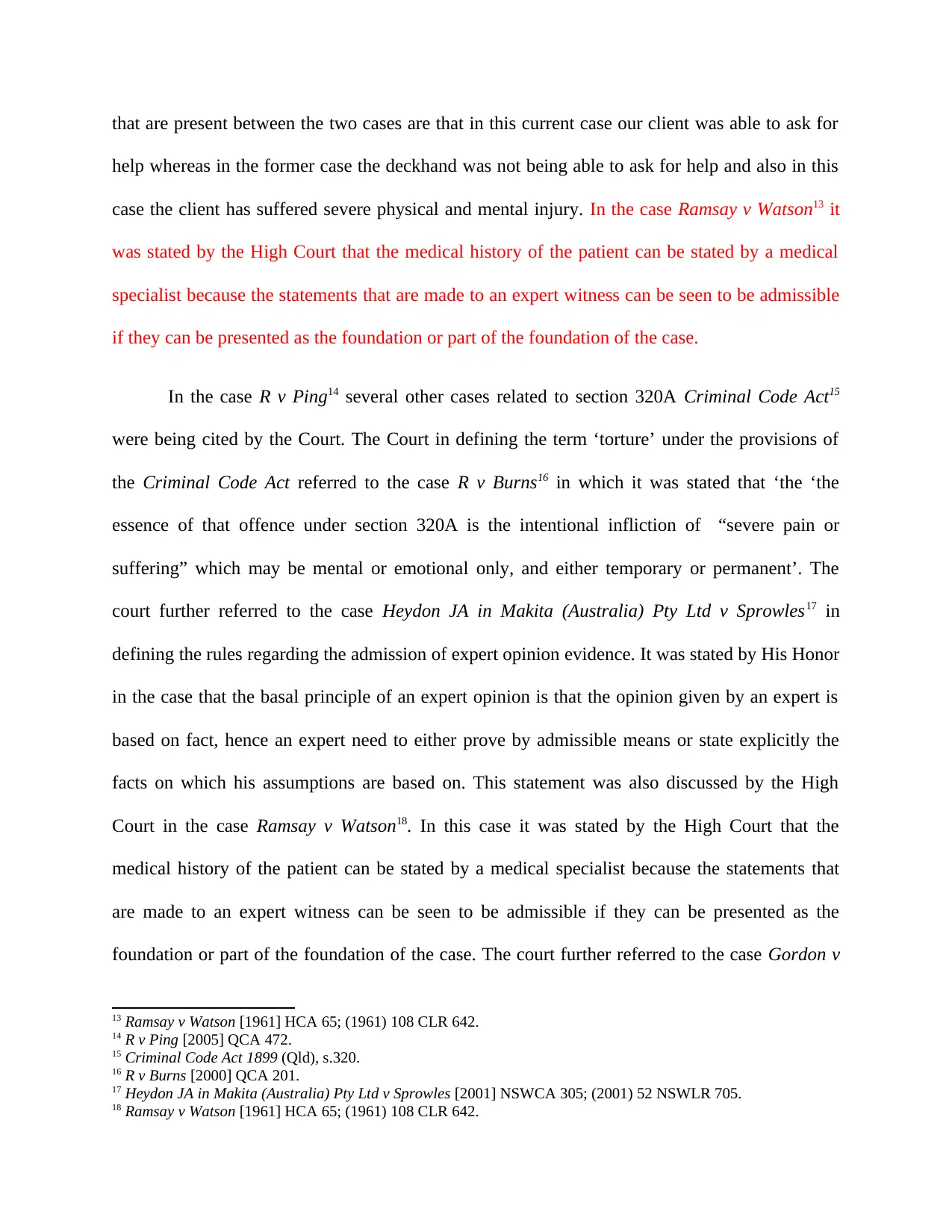
that are present between the two cases are that in this current case our client was able to ask for
help whereas in the former case the deckhand was not being able to ask for help and also in this
case the client has suffered severe physical and mental injury. In the case Ramsay v Watson13 it
was stated by the High Court that the medical history of the patient can be stated by a medical
specialist because the statements that are made to an expert witness can be seen to be admissible
if they can be presented as the foundation or part of the foundation of the case.
In the case R v Ping14 several other cases related to section 320A Criminal Code Act15
were being cited by the Court. The Court in defining the term ‘torture’ under the provisions of
the Criminal Code Act referred to the case R v Burns16 in which it was stated that ‘the ‘the
essence of that offence under section 320A is the intentional infliction of “severe pain or
suffering” which may be mental or emotional only, and either temporary or permanent’. The
court further referred to the case Heydon JA in Makita (Australia) Pty Ltd v Sprowles17 in
defining the rules regarding the admission of expert opinion evidence. It was stated by His Honor
in the case that the basal principle of an expert opinion is that the opinion given by an expert is
based on fact, hence an expert need to either prove by admissible means or state explicitly the
facts on which his assumptions are based on. This statement was also discussed by the High
Court in the case Ramsay v Watson18. In this case it was stated by the High Court that the
medical history of the patient can be stated by a medical specialist because the statements that
are made to an expert witness can be seen to be admissible if they can be presented as the
foundation or part of the foundation of the case. The court further referred to the case Gordon v
13 Ramsay v Watson [1961] HCA 65; (1961) 108 CLR 642.
14 R v Ping [2005] QCA 472.
15 Criminal Code Act 1899 (Qld), s.320.
16 R v Burns [2000] QCA 201.
17 Heydon JA in Makita (Australia) Pty Ltd v Sprowles [2001] NSWCA 305; (2001) 52 NSWLR 705.
18 Ramsay v Watson [1961] HCA 65; (1961) 108 CLR 642.
help whereas in the former case the deckhand was not being able to ask for help and also in this
case the client has suffered severe physical and mental injury. In the case Ramsay v Watson13 it
was stated by the High Court that the medical history of the patient can be stated by a medical
specialist because the statements that are made to an expert witness can be seen to be admissible
if they can be presented as the foundation or part of the foundation of the case.
In the case R v Ping14 several other cases related to section 320A Criminal Code Act15
were being cited by the Court. The Court in defining the term ‘torture’ under the provisions of
the Criminal Code Act referred to the case R v Burns16 in which it was stated that ‘the ‘the
essence of that offence under section 320A is the intentional infliction of “severe pain or
suffering” which may be mental or emotional only, and either temporary or permanent’. The
court further referred to the case Heydon JA in Makita (Australia) Pty Ltd v Sprowles17 in
defining the rules regarding the admission of expert opinion evidence. It was stated by His Honor
in the case that the basal principle of an expert opinion is that the opinion given by an expert is
based on fact, hence an expert need to either prove by admissible means or state explicitly the
facts on which his assumptions are based on. This statement was also discussed by the High
Court in the case Ramsay v Watson18. In this case it was stated by the High Court that the
medical history of the patient can be stated by a medical specialist because the statements that
are made to an expert witness can be seen to be admissible if they can be presented as the
foundation or part of the foundation of the case. The court further referred to the case Gordon v
13 Ramsay v Watson [1961] HCA 65; (1961) 108 CLR 642.
14 R v Ping [2005] QCA 472.
15 Criminal Code Act 1899 (Qld), s.320.
16 R v Burns [2000] QCA 201.
17 Heydon JA in Makita (Australia) Pty Ltd v Sprowles [2001] NSWCA 305; (2001) 52 NSWLR 705.
18 Ramsay v Watson [1961] HCA 65; (1961) 108 CLR 642.
R19 where it was discussed that the rule for an expert opinion is same for the opinion of a
psychiatrist.
In the case R v Ping20 it was held by the court that the appellant was guilty of torturing the
complainant physically, mentally and emotionally under section 320A of Criminal Code21 and
hence was sentenced to an imprisonment for a term of three years.
Thus, it is seen in reviewing the case R v Ping22 that in this case the client would need to
prove that as per section 320A of the Act the defendant had inflicted severe pain and sufferings
upon him. As per the medical reports the severity of the physical injuries as well as the mental
trauma the client had gone through can be proved through the evidence of the medical officers
consulted.
G. Conclusion:
The defendant can be charged guilty as per section 320A of the Criminal Code Act23 for
the infliction of not only physical but mental, psychological as well as emotional pain to the
complainant.
H. Overall Advice:
It is advised that Michael gather all relevant evidence to support his claim. If the evidence
in his favour. Then, this situation should be reviewed. If the evidence is not in his favour. It is
advised that Michael do not proceed any legal action.
19 Gordon v R [1982] 41 ALR 64.
20 R v Ping [2005] QCA 472.
21 Criminal Code Act 1899 (Qld), s.320A.
22 R v Ping [2005] QCA 472.
23 Criminal Code Act 1899 (Qld), s.320A.
psychiatrist.
In the case R v Ping20 it was held by the court that the appellant was guilty of torturing the
complainant physically, mentally and emotionally under section 320A of Criminal Code21 and
hence was sentenced to an imprisonment for a term of three years.
Thus, it is seen in reviewing the case R v Ping22 that in this case the client would need to
prove that as per section 320A of the Act the defendant had inflicted severe pain and sufferings
upon him. As per the medical reports the severity of the physical injuries as well as the mental
trauma the client had gone through can be proved through the evidence of the medical officers
consulted.
G. Conclusion:
The defendant can be charged guilty as per section 320A of the Criminal Code Act23 for
the infliction of not only physical but mental, psychological as well as emotional pain to the
complainant.
H. Overall Advice:
It is advised that Michael gather all relevant evidence to support his claim. If the evidence
in his favour. Then, this situation should be reviewed. If the evidence is not in his favour. It is
advised that Michael do not proceed any legal action.
19 Gordon v R [1982] 41 ALR 64.
20 R v Ping [2005] QCA 472.
21 Criminal Code Act 1899 (Qld), s.320A.
22 R v Ping [2005] QCA 472.
23 Criminal Code Act 1899 (Qld), s.320A.
⊘ This is a preview!⊘
Do you want full access?
Subscribe today to unlock all pages.
Trusted by 1+ million students worldwide
Bibliography
Articles/Books/Journal
Bigelow, Albert. The voyage of the golden rule: An experiment with truth (Pickle Partners
Publishing, 2018)
Jovanovic, Tanja, et al. "Acute stress disorder versus chronic posttraumatic stress disorder:
inhibition of fear as a function of time since trauma." (2013) 30.3 Depression and anxiety 217-
224
LexisNexis, Encyclopedic Australia Legal Dictionary (online at 17 July 2019) ‘pain and
suffering’.
LexisNexis, Encyclopedic Australia Legal Dictionary (online at 17 July 2019) ‘Intention’ (def 2)
Cases
Gordon v R (1982) 41 ALR 64
Heydon JA in Makita (Australia) Pty Ltd v Sprowles [2001] NSWCA 305; (2001) 52 NSWLR
705
R v Burns [2000] QCA 201; CA No 399 of 1999
R v Ping [2005] QCA 472
Ramsay v Watson [1961] HCA 65; (1961) 108 CLR 642
Articles/Books/Journal
Bigelow, Albert. The voyage of the golden rule: An experiment with truth (Pickle Partners
Publishing, 2018)
Jovanovic, Tanja, et al. "Acute stress disorder versus chronic posttraumatic stress disorder:
inhibition of fear as a function of time since trauma." (2013) 30.3 Depression and anxiety 217-
224
LexisNexis, Encyclopedic Australia Legal Dictionary (online at 17 July 2019) ‘pain and
suffering’.
LexisNexis, Encyclopedic Australia Legal Dictionary (online at 17 July 2019) ‘Intention’ (def 2)
Cases
Gordon v R (1982) 41 ALR 64
Heydon JA in Makita (Australia) Pty Ltd v Sprowles [2001] NSWCA 305; (2001) 52 NSWLR
705
R v Burns [2000] QCA 201; CA No 399 of 1999
R v Ping [2005] QCA 472
Ramsay v Watson [1961] HCA 65; (1961) 108 CLR 642
Paraphrase This Document
Need a fresh take? Get an instant paraphrase of this document with our AI Paraphraser

Legislation
Criminal Code Act 1899 (Qld)
Penalties and Sentences Act 1992
Criminal Code Act 1899 (Qld)
Penalties and Sentences Act 1992

1 out of 11


Your All-in-One AI-Powered Toolkit for Academic Success.
+13062052269
info@desklib.com
Available 24*7 on WhatsApp / Email
![[object Object]](/_next/static/media/star-bottom.7253800d.svg)
Unlock your academic potential
Copyright © 2020–2026 A2Z Services. All Rights Reserved. Developed and managed by ZUCOL.