Ford-Mazda Partnership: An International Business Case Study Report
VerifiedAdded on 2021/06/17
|12
|3939
|353
Report
AI Summary
This report provides a comprehensive analysis of Mazda Motor Corporation's international business strategies, focusing on its historical partnership with Ford Motor Company and its subsequent independent operations. The report examines the challenges Mazda faced, including financial struggles and the impact of the global financial crisis, and highlights the significance of the Ford-Mazda alliance. It delves into the identification of major stakeholders, the struggles Mazda encountered after the dissolution of the partnership, and the role of SKYACTIV technology in meeting customer demands. The report evaluates alternative solutions, including operating independently and forming a partnership with Toyota, and concludes with a recommended solution and managerial implications, providing insights into Mazda's strategic decisions and market performance within the global automotive industry. The report emphasizes the need for Mazda to meet the demands of global customers and to constantly analyze market trends to stay competitive. The report is available on Desklib, a platform that provides past papers and solved assignments for students.
RUNNING HEAD: International Business
International Business
International Business

Paraphrase This Document
Need a fresh take? Get an instant paraphrase of this document with our AI Paraphraser
International Business 1
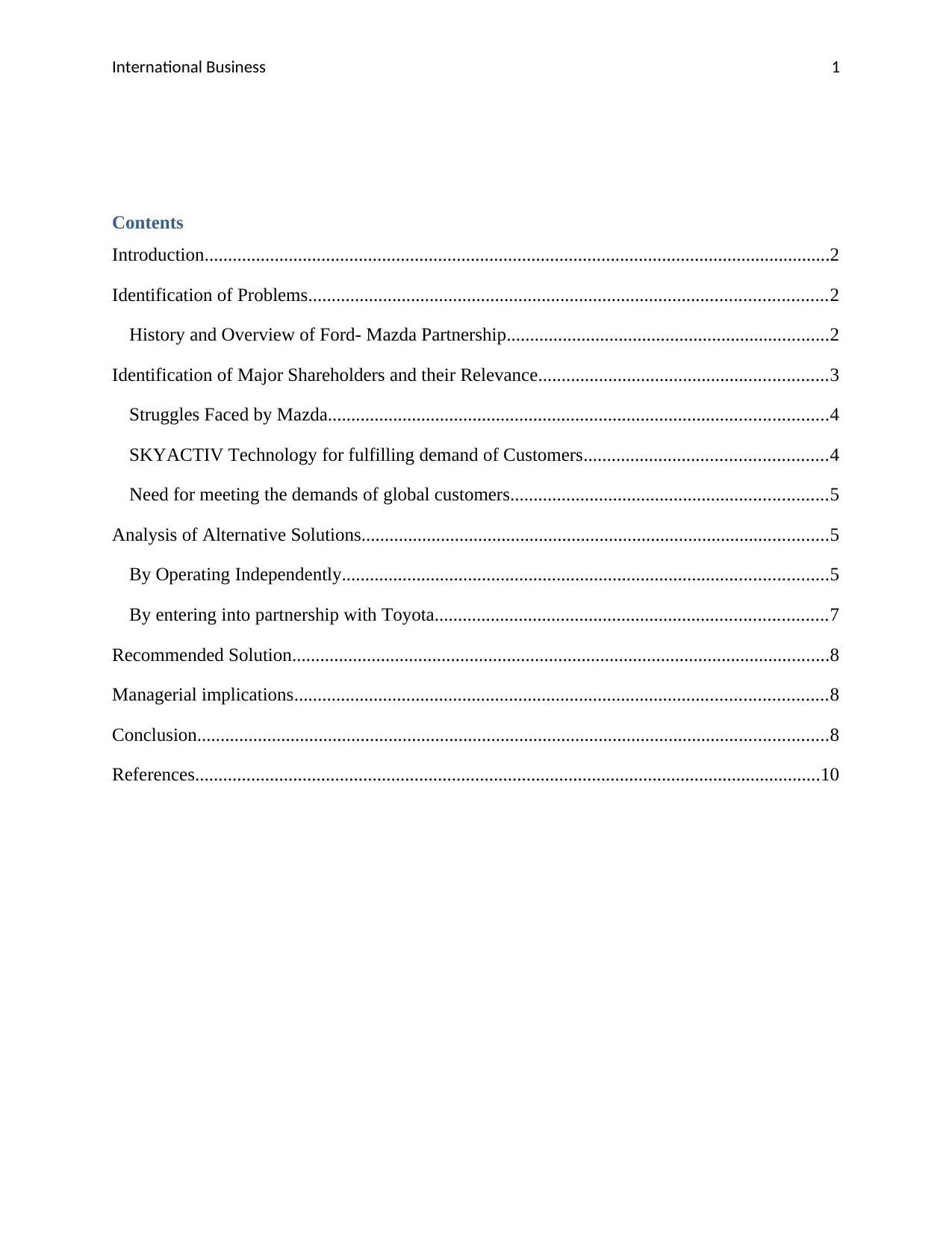
Contents
Introduction......................................................................................................................................2
Identification of Problems...............................................................................................................2
History and Overview of Ford- Mazda Partnership.....................................................................2
Identification of Major Shareholders and their Relevance..............................................................3
Struggles Faced by Mazda...........................................................................................................4
SKYACTIV Technology for fulfilling demand of Customers....................................................4
Need for meeting the demands of global customers....................................................................5
Analysis of Alternative Solutions....................................................................................................5
By Operating Independently........................................................................................................5
By entering into partnership with Toyota....................................................................................7
Recommended Solution...................................................................................................................8
Managerial implications..................................................................................................................8
Conclusion.......................................................................................................................................8
References......................................................................................................................................10
Contents
Introduction......................................................................................................................................2
Identification of Problems...............................................................................................................2
History and Overview of Ford- Mazda Partnership.....................................................................2
Identification of Major Shareholders and their Relevance..............................................................3
Struggles Faced by Mazda...........................................................................................................4
SKYACTIV Technology for fulfilling demand of Customers....................................................4
Need for meeting the demands of global customers....................................................................5
Analysis of Alternative Solutions....................................................................................................5
By Operating Independently........................................................................................................5
By entering into partnership with Toyota....................................................................................7
Recommended Solution...................................................................................................................8
Managerial implications..................................................................................................................8
Conclusion.......................................................................................................................................8
References......................................................................................................................................10
International Business 2
Introduction
Mazda Motor Corporation is a Japanese multinational automaker based in Fuchu, Japan. The
core belief of the company is reflected in its taglines “Zoom- Zoom” and “Driving Matters” as it
continued to compete in the global automotive industry. Mazda Motor Corporation entered into
partnership by devoting best resources and personnel. Being a small scale company, they are
enabled to clearly focus on the identification of their brand. This essay reviews, critiques and
summarizes the case study on Mazda Motor Corporation which provides how it survived by way
of partnering with giants.
The review of the case study provided that the company aimed at becoming the first choice of
the customer. For achieving this aim, Mazda Motor Corporation entered into partnership with
Ford Motor Company in the year 1979 by helping Ford in lean manufacturing and small- car
engineering, in exchange for marketing know- how and finance (Rothacher, 2015). In the year
2010, the termination of this 30 year alliance took place as a result of the global financial crisis.
In the year 2015, a long- term partnership was entered into by Mazda with Toyota Motor
Corporation for sharing technologies and coping with the cost pressures.
Identification of Problems
The problem with Mazda Motor Corporation was that it was a small company which experienced
difficulty in competing with the competitors in the automotive industry. After the global
financial crises, it suffered from net profit loses for four consecutive years while operating
independently. However, it was still not making adequate investment in the R&D sector for
introducing the trending technology in the vehicles.
History and Overview of Ford- Mazda Partnership
The history of the company highlights that after slowing down of the demand for cork, the
artificial- cork manufacturing company shifted to vehicle production. The shift also resulted in
renaming of the company from Toyo Cork Kogyo Co. Ltd. to Mazda Motor Corporation in the
year 1984. The first two- door passenger car was launched by the company, Mazda R360 in 1960
followed by a four- door passenger car, Mazda Carol, in 1962. In 1967 and 1970, it started
exporting vehicles to Europe and United States which made it a significant competitor of the
rival who had already established global presence. However, the company experienced heavy
Introduction
Mazda Motor Corporation is a Japanese multinational automaker based in Fuchu, Japan. The
core belief of the company is reflected in its taglines “Zoom- Zoom” and “Driving Matters” as it
continued to compete in the global automotive industry. Mazda Motor Corporation entered into
partnership by devoting best resources and personnel. Being a small scale company, they are
enabled to clearly focus on the identification of their brand. This essay reviews, critiques and
summarizes the case study on Mazda Motor Corporation which provides how it survived by way
of partnering with giants.
The review of the case study provided that the company aimed at becoming the first choice of
the customer. For achieving this aim, Mazda Motor Corporation entered into partnership with
Ford Motor Company in the year 1979 by helping Ford in lean manufacturing and small- car
engineering, in exchange for marketing know- how and finance (Rothacher, 2015). In the year
2010, the termination of this 30 year alliance took place as a result of the global financial crisis.
In the year 2015, a long- term partnership was entered into by Mazda with Toyota Motor
Corporation for sharing technologies and coping with the cost pressures.
Identification of Problems
The problem with Mazda Motor Corporation was that it was a small company which experienced
difficulty in competing with the competitors in the automotive industry. After the global
financial crises, it suffered from net profit loses for four consecutive years while operating
independently. However, it was still not making adequate investment in the R&D sector for
introducing the trending technology in the vehicles.
History and Overview of Ford- Mazda Partnership
The history of the company highlights that after slowing down of the demand for cork, the
artificial- cork manufacturing company shifted to vehicle production. The shift also resulted in
renaming of the company from Toyo Cork Kogyo Co. Ltd. to Mazda Motor Corporation in the
year 1984. The first two- door passenger car was launched by the company, Mazda R360 in 1960
followed by a four- door passenger car, Mazda Carol, in 1962. In 1967 and 1970, it started
exporting vehicles to Europe and United States which made it a significant competitor of the
rival who had already established global presence. However, the company experienced heavy
⊘ This is a preview!⊘
Do you want full access?
Subscribe today to unlock all pages.

Trusted by 1+ million students worldwide
International Business 3
financial turmoil in 1970s due to swaying of customers from vehicles having inefficient rotary
engines (Cranswick, 2016). Ford showed trust in the potential of Mazda and bailed out its
struggles by acquiring 7% shares of Mazda in 1979 (Niminet, 2014_. This marked the beginning
of the financial relationship that lasted for 30 years (Harvard Business Review, 2017).
Both the company lacked financial resources but converted this situation in their favor by
creative an incentive to share technology. Mazda used the brand name of Ford for selling the
trucks internationally in 1976. The cumulative production of Mazda reached 10 million units by
1979 with the constant efforts of both the companies for generating synergies. Platforms and
parts were shared by the companies for reducing costs and improving efficiency. Mazda
provided Ford with operational efficiencies and small parts for boosting production (Guo, Jiang
& Yang, 2014). The operational and financial benefits arising out of the partnership led to the
increased stake of Ford in Mazda by 20% throughout 1980s. With the further worsening of the
financial struggles in Mazda, Ford increased its share to 33.4% in the year 1996 (Cavazos,
Rutherford & Patterson, 2016). This was the time when new CEO, Henry Wallace, was
appointed in Mazda who made every effort for the implementation of innovation program for
fostering the development of new products and establishing market leadership which resulted in
healthy profits and sales volume throughout 1990s. By 2000, the sales volume of Mazda reached
2,55,526 units in North America, 3,07,000 units in Japan and 2,10,677 units in Europe (Nawrot,
2014). However, the automotive industry was under the pressure of looming economic crisis
which in turn threatened the success of Mazda. According to the review, the partnership with
Ford was correct decision by Mazda as during the term of partnership, the sales were high and
Mazda did not face many difficulties in its operations.
Identification of Major Shareholders and their Relevance
Therefore, the major stakeholder identified in the case study is the customers. The customer is
the most important stakeholder on which the sales of cars depend. The fall in buying capacity of
the customers resulted in the global financial crisis. It resulted in the dissolution of Ford- Mazda
partnership after 30 years in 2008. All across the globe, the crises led to a significant fall in the
automobile sales due to increasing prices for raw materials and automotive fuels. The dissolution
of partnership was not an instant decision but took place over a period of time. The fall in
demand during recession led to reduction in size and selling of inefficient assets by the
financial turmoil in 1970s due to swaying of customers from vehicles having inefficient rotary
engines (Cranswick, 2016). Ford showed trust in the potential of Mazda and bailed out its
struggles by acquiring 7% shares of Mazda in 1979 (Niminet, 2014_. This marked the beginning
of the financial relationship that lasted for 30 years (Harvard Business Review, 2017).
Both the company lacked financial resources but converted this situation in their favor by
creative an incentive to share technology. Mazda used the brand name of Ford for selling the
trucks internationally in 1976. The cumulative production of Mazda reached 10 million units by
1979 with the constant efforts of both the companies for generating synergies. Platforms and
parts were shared by the companies for reducing costs and improving efficiency. Mazda
provided Ford with operational efficiencies and small parts for boosting production (Guo, Jiang
& Yang, 2014). The operational and financial benefits arising out of the partnership led to the
increased stake of Ford in Mazda by 20% throughout 1980s. With the further worsening of the
financial struggles in Mazda, Ford increased its share to 33.4% in the year 1996 (Cavazos,
Rutherford & Patterson, 2016). This was the time when new CEO, Henry Wallace, was
appointed in Mazda who made every effort for the implementation of innovation program for
fostering the development of new products and establishing market leadership which resulted in
healthy profits and sales volume throughout 1990s. By 2000, the sales volume of Mazda reached
2,55,526 units in North America, 3,07,000 units in Japan and 2,10,677 units in Europe (Nawrot,
2014). However, the automotive industry was under the pressure of looming economic crisis
which in turn threatened the success of Mazda. According to the review, the partnership with
Ford was correct decision by Mazda as during the term of partnership, the sales were high and
Mazda did not face many difficulties in its operations.
Identification of Major Shareholders and their Relevance
Therefore, the major stakeholder identified in the case study is the customers. The customer is
the most important stakeholder on which the sales of cars depend. The fall in buying capacity of
the customers resulted in the global financial crisis. It resulted in the dissolution of Ford- Mazda
partnership after 30 years in 2008. All across the globe, the crises led to a significant fall in the
automobile sales due to increasing prices for raw materials and automotive fuels. The dissolution
of partnership was not an instant decision but took place over a period of time. The fall in
demand during recession led to reduction in size and selling of inefficient assets by the
Paraphrase This Document
Need a fresh take? Get an instant paraphrase of this document with our AI Paraphraser
International Business 4
automotive companies. In 2008, Ford also sold 20% of its stake in Mazda while Mazda bought
back its 6.8% shares from Ford. Ford was left with only 3% ownership in Mazda after it slowly
divested its stake (Kobayashi, Jin & Schroeder, 2015).
Struggles Faced by Mazda
After the dissolution of strategic partnership between Ford and Mazda, the survival of Mazda as
an independent automotive manufacturer became doubtful. Since the survival of Mazda was
already doubtful without Ford, Mazda should have not ended partnership with Ford. Ford had the
capability of reviving Mazda from the financial crisis easily but such dissolution created hurdles
in the growth of Mazda. This was true as the Mazda’s business activity was negatively affected
due to declined demand in the automotive industry as a consequence of global financial crisis.
There was a significant decline in sales of Mazda in North America, Japan, and Europe in 2010-
11.since Mazda was engaged in the exportation of automotive products after its assembling in
Japan, it was very much sensitive to rates of foreign exchange. In 2010- 11, the exchange rate of
U.S. dollar yen dropped to US$1 = ¥86 in comparison to US$1 = ¥114 in 2007- 08 (BLE, 2016).
In the same period of time, the slumping sales and poor economic conditions also resulted in
decline in the operating profits of Mazda. Mazda suffered from the consecutive net profit losses
from FY 2008- 09 to 2011- 12. Mazda had to search for an option for the purpose of reviving its
business from the lack of financial resources accumulated losses.
SKYACTIV Technology for fulfilling demand of Customers
For the purpose of overcoming the struggles as an independent manufacturer, ultimately Mazda
decided to alter its identity as a rotary engine manufacturer as it had the advantage of having
reduced vibration and higher power- to weight ratio. SKYACTIV technology was introduced by
Mazda in 2010, with the help of which the vehicles were equipped with outstanding crash safety,
high fuel efficiency and balanced precision handling. Since the technology was already
successful, Mazda 6 and CX- 5 gained traction and caused steady rise in the global sales of
Mazda in 2012. The stock price of Mazda also achieved new heights which appeared to be the
result of SKYACTIV technology for bringing resurgence to the independent business. This
revealed that Mazda had capability of operating as an independent manufacturer but relied on
Ford for such a long time. But in case if it had took required steps for staying competitive in the
market, it would have achieved new heights in the global automotive industry. In its aim to
become the continuously chosen brand by the customers, it lagged behind the larger firms that
automotive companies. In 2008, Ford also sold 20% of its stake in Mazda while Mazda bought
back its 6.8% shares from Ford. Ford was left with only 3% ownership in Mazda after it slowly
divested its stake (Kobayashi, Jin & Schroeder, 2015).
Struggles Faced by Mazda
After the dissolution of strategic partnership between Ford and Mazda, the survival of Mazda as
an independent automotive manufacturer became doubtful. Since the survival of Mazda was
already doubtful without Ford, Mazda should have not ended partnership with Ford. Ford had the
capability of reviving Mazda from the financial crisis easily but such dissolution created hurdles
in the growth of Mazda. This was true as the Mazda’s business activity was negatively affected
due to declined demand in the automotive industry as a consequence of global financial crisis.
There was a significant decline in sales of Mazda in North America, Japan, and Europe in 2010-
11.since Mazda was engaged in the exportation of automotive products after its assembling in
Japan, it was very much sensitive to rates of foreign exchange. In 2010- 11, the exchange rate of
U.S. dollar yen dropped to US$1 = ¥86 in comparison to US$1 = ¥114 in 2007- 08 (BLE, 2016).
In the same period of time, the slumping sales and poor economic conditions also resulted in
decline in the operating profits of Mazda. Mazda suffered from the consecutive net profit losses
from FY 2008- 09 to 2011- 12. Mazda had to search for an option for the purpose of reviving its
business from the lack of financial resources accumulated losses.
SKYACTIV Technology for fulfilling demand of Customers
For the purpose of overcoming the struggles as an independent manufacturer, ultimately Mazda
decided to alter its identity as a rotary engine manufacturer as it had the advantage of having
reduced vibration and higher power- to weight ratio. SKYACTIV technology was introduced by
Mazda in 2010, with the help of which the vehicles were equipped with outstanding crash safety,
high fuel efficiency and balanced precision handling. Since the technology was already
successful, Mazda 6 and CX- 5 gained traction and caused steady rise in the global sales of
Mazda in 2012. The stock price of Mazda also achieved new heights which appeared to be the
result of SKYACTIV technology for bringing resurgence to the independent business. This
revealed that Mazda had capability of operating as an independent manufacturer but relied on
Ford for such a long time. But in case if it had took required steps for staying competitive in the
market, it would have achieved new heights in the global automotive industry. In its aim to
become the continuously chosen brand by the customers, it lagged behind the larger firms that
International Business 5
made the active implementation of consolidation strategies for lowering unit production costs,
strengthening customer responsiveness and innovation and increasing shares in the foreign
market (Yamamoto & Nogami, 2016).
After its revival through SKYACTIV technology, it faced competition from foreign importers
and domestic automotive manufacturers. In 2013, automotive industry became Japan’s core
industry with a number of small and large automotive companies headquartered and founded in
Japan. Through the adoption of unique global strategies, the global Japanese giants such as
Suzuki, Toyota, Honda, Nissan and Daihatsu were capable of recording higher sales than Mazda.
In order to be competitive, Mazda had to shift the focus to international markets for survival.
However, the global automotive industry presented great risks and competition for automotive
manufacturers (Kuriyama, 2017).
Need for meeting the demands of global customers
The success of a company in the automobile market necessitated its presence in the global
market. Automakers faced a number of challenges such as cost pressures, complexity, digital
demands, diverging markets and a shifting industry landscape. The competition increased
severely as in 2015, there were around 1,500 companies manufacturing vehicles at the global
scale. They were required to make adjustments in the business strategies along with shifting
resources and investments and developing new skills for constantly achieving profits and growth
in the automotive industry across the globe. Mazda should have constantly analyzed the trends of
the market to understand the strategies of the competitors for achieving success but it not made
additional efforts and continued on its existing strategies which made it suffer from difficulties
(Montoya & Cuervo-Cazurra, 2014).
Analysis of Alternative Solutions
By Operating Independently
After the financial crisis in 2008, it became difficult for the small companies to survive
independently as the global automotive industry witnessed a complete transformation. This was
the time when the major companies such as Fiat and Volkswagen made the acquisition of smaller
companies for increasing their manufacturing capabilities and diversifying their product lineups.
For securing brand value and technology, struggling European brands such as Jaguar Land Rover
made the active implementation of consolidation strategies for lowering unit production costs,
strengthening customer responsiveness and innovation and increasing shares in the foreign
market (Yamamoto & Nogami, 2016).
After its revival through SKYACTIV technology, it faced competition from foreign importers
and domestic automotive manufacturers. In 2013, automotive industry became Japan’s core
industry with a number of small and large automotive companies headquartered and founded in
Japan. Through the adoption of unique global strategies, the global Japanese giants such as
Suzuki, Toyota, Honda, Nissan and Daihatsu were capable of recording higher sales than Mazda.
In order to be competitive, Mazda had to shift the focus to international markets for survival.
However, the global automotive industry presented great risks and competition for automotive
manufacturers (Kuriyama, 2017).
Need for meeting the demands of global customers
The success of a company in the automobile market necessitated its presence in the global
market. Automakers faced a number of challenges such as cost pressures, complexity, digital
demands, diverging markets and a shifting industry landscape. The competition increased
severely as in 2015, there were around 1,500 companies manufacturing vehicles at the global
scale. They were required to make adjustments in the business strategies along with shifting
resources and investments and developing new skills for constantly achieving profits and growth
in the automotive industry across the globe. Mazda should have constantly analyzed the trends of
the market to understand the strategies of the competitors for achieving success but it not made
additional efforts and continued on its existing strategies which made it suffer from difficulties
(Montoya & Cuervo-Cazurra, 2014).
Analysis of Alternative Solutions
By Operating Independently
After the financial crisis in 2008, it became difficult for the small companies to survive
independently as the global automotive industry witnessed a complete transformation. This was
the time when the major companies such as Fiat and Volkswagen made the acquisition of smaller
companies for increasing their manufacturing capabilities and diversifying their product lineups.
For securing brand value and technology, struggling European brands such as Jaguar Land Rover
⊘ This is a preview!⊘
Do you want full access?
Subscribe today to unlock all pages.
Trusted by 1+ million students worldwide
International Business 6
and Volvo were purchased by Tata Motors and Geely. After partnership with Ford, Mazda
avoided mergers and acquisitions (M&A) and opted to stay in its own control for decision
making and operations. This was the time when Mazda also had opportunity to enter into M&A
with a giant for the easy survival but no action was taken in this regard (Wynn-Williams, 2009).
For surviving in the increasingly competitive landscape, auto companies keep their focus on
research and development (R&D) for achieving the fist- mover status. Volkswagen, Toyota,
General Motors and Ford spent huge sums of money on R&D for the development of new
platforms which can be utilized between different automotive brands and models as it can allow
saving of time and money (Morschett, Klein & Zentes, 2015). By 2017, platform called MQB
was utilized in around 4 million cars from 40 different models under Volkswagen. Same
platform was shared between Audi’s A3 and Volkswagen’s Golf despite of the difference in
brand and exteriors. Taking into consideration billions of dollars spent by competitors on R&D,
Mazda also specified its intentions of investing ¥100.0 billion in FY 2014- 15 which was
subsequently increased from ¥ 99.4 billion during FY 2013- 14 (Mazda, 2018). The R&D
investment value committed by it was still lower than its rivals due to which it suffered from the
risk of falling further behind. This was a wrong decision by Mazda of not making adequate
investment in R&D as it was operating independently. Not being able to offer competitive
technology in the market would have resulted in heavy losses which could even lead to closure
of the company (Andrevski, Brass & Ferrier, 2016).
With the passage of time, new energy vehicles (NEVs) such as electric, hybrid and fuel- battery-
equipped cars gained popularity in the developed markets. In 2015, the figures revealed that
hybrid cars sales constituted 4 % of the total vehicle sales in United States. This encouraged
other countries for pushing for the sales of NEVs. For making NEVs attractive, tax exemption
programs were introduced in China and other European countries. By 2020, the total number of
NEVs is expected to reach 20 million (Jacobs, 2015). The rapid expansion of NEV market
necessitated the emerging companies such as BYD and Tesla for release products having
capability to compete in the NEV market. Mazda still lagged behind the competitors in the
adoption of NEV technology and continued to stick to its existing technology. It further provided
that petroleum resources will remain the main energy for global automobile market in 2020. It
will only adopt an approach with the help of which it will be able to reduce carbon dioxide
and Volvo were purchased by Tata Motors and Geely. After partnership with Ford, Mazda
avoided mergers and acquisitions (M&A) and opted to stay in its own control for decision
making and operations. This was the time when Mazda also had opportunity to enter into M&A
with a giant for the easy survival but no action was taken in this regard (Wynn-Williams, 2009).
For surviving in the increasingly competitive landscape, auto companies keep their focus on
research and development (R&D) for achieving the fist- mover status. Volkswagen, Toyota,
General Motors and Ford spent huge sums of money on R&D for the development of new
platforms which can be utilized between different automotive brands and models as it can allow
saving of time and money (Morschett, Klein & Zentes, 2015). By 2017, platform called MQB
was utilized in around 4 million cars from 40 different models under Volkswagen. Same
platform was shared between Audi’s A3 and Volkswagen’s Golf despite of the difference in
brand and exteriors. Taking into consideration billions of dollars spent by competitors on R&D,
Mazda also specified its intentions of investing ¥100.0 billion in FY 2014- 15 which was
subsequently increased from ¥ 99.4 billion during FY 2013- 14 (Mazda, 2018). The R&D
investment value committed by it was still lower than its rivals due to which it suffered from the
risk of falling further behind. This was a wrong decision by Mazda of not making adequate
investment in R&D as it was operating independently. Not being able to offer competitive
technology in the market would have resulted in heavy losses which could even lead to closure
of the company (Andrevski, Brass & Ferrier, 2016).
With the passage of time, new energy vehicles (NEVs) such as electric, hybrid and fuel- battery-
equipped cars gained popularity in the developed markets. In 2015, the figures revealed that
hybrid cars sales constituted 4 % of the total vehicle sales in United States. This encouraged
other countries for pushing for the sales of NEVs. For making NEVs attractive, tax exemption
programs were introduced in China and other European countries. By 2020, the total number of
NEVs is expected to reach 20 million (Jacobs, 2015). The rapid expansion of NEV market
necessitated the emerging companies such as BYD and Tesla for release products having
capability to compete in the NEV market. Mazda still lagged behind the competitors in the
adoption of NEV technology and continued to stick to its existing technology. It further provided
that petroleum resources will remain the main energy for global automobile market in 2020. It
will only adopt an approach with the help of which it will be able to reduce carbon dioxide
Paraphrase This Document
Need a fresh take? Get an instant paraphrase of this document with our AI Paraphraser
International Business 7
emissions in the environment by vehicles. As a consequence, NEV technology was acquired by
Mazda from Toyota and made the use of Toyota’s hybrid drivetrain technology for Mazda3
Sedan (Suntrayuth, 2015). In case such decision was not taken on time, this would have brought
serious repercussions for Mazda in the form of winding up of company as it had to maintain
competency in the market in some way or the other. Not entering into partnership at this time
would have resulted in lagging behind of the business which might be irrecoverable.
For sharing knowledge and developing competitive advantage, strategic alliances are formed by
many automotive companies as an alternative to M&A. BMW and Toyota, Honda and GM,
BYD and Daimler AG are the examples of strategic alliances entered into by companies. Mazda
had conservative perspective on alliances since Ford partnership due to the fact that termination
of such alliances or unintended changes will result in adverse effect on financial position and
business results of the group. Mazda relied on Structural Reform Plan and SKYACTIV
technology for competing in the global automotive industry. The Structural Reform Plan
provided some initiatives for the future of the company: increasing business innovation through
SKYACTIV technology, accelerating cost improvement through Monotsukuri Innovation,
reinforcing business in the emerging markets and establishing global production footprint and
promoting global alliances. The plan became a success and raised the sales volume and operating
income of Mazda. The growth was believed to be a result of strong performance with the
introduction of SKYACTIV technology and economic environment of automotive industry.
By entering into partnership with Toyota
Economies of scale were still sacrificed after the introduction of Structured Reform Plan which
led to an increase in the domestic operational costs. These concerns were addressed by Mazda
by way of announcing long- term strategic partnership with Toyota (Burton, 2015). In this
partnership, there was an agreement between both the companies for collaborating on future
products and sharing technological developments for staying ahead in the competitive
environment. Both the companies took the advantage from this partnership as Toyota gained
knowledge of SKYACTIV diesel and petrol expertise of Mazda while Mazda was in hope to take
advantage from hydrogen fuel cell and hybrid technology of Toyota (Yamamoto & Nogami,
2016). In other words, both the alternative solutions were adopted by Mazda firstly by operating
as an independent manufacturer and secondly by entering into partnership with Toyota.
emissions in the environment by vehicles. As a consequence, NEV technology was acquired by
Mazda from Toyota and made the use of Toyota’s hybrid drivetrain technology for Mazda3
Sedan (Suntrayuth, 2015). In case such decision was not taken on time, this would have brought
serious repercussions for Mazda in the form of winding up of company as it had to maintain
competency in the market in some way or the other. Not entering into partnership at this time
would have resulted in lagging behind of the business which might be irrecoverable.
For sharing knowledge and developing competitive advantage, strategic alliances are formed by
many automotive companies as an alternative to M&A. BMW and Toyota, Honda and GM,
BYD and Daimler AG are the examples of strategic alliances entered into by companies. Mazda
had conservative perspective on alliances since Ford partnership due to the fact that termination
of such alliances or unintended changes will result in adverse effect on financial position and
business results of the group. Mazda relied on Structural Reform Plan and SKYACTIV
technology for competing in the global automotive industry. The Structural Reform Plan
provided some initiatives for the future of the company: increasing business innovation through
SKYACTIV technology, accelerating cost improvement through Monotsukuri Innovation,
reinforcing business in the emerging markets and establishing global production footprint and
promoting global alliances. The plan became a success and raised the sales volume and operating
income of Mazda. The growth was believed to be a result of strong performance with the
introduction of SKYACTIV technology and economic environment of automotive industry.
By entering into partnership with Toyota
Economies of scale were still sacrificed after the introduction of Structured Reform Plan which
led to an increase in the domestic operational costs. These concerns were addressed by Mazda
by way of announcing long- term strategic partnership with Toyota (Burton, 2015). In this
partnership, there was an agreement between both the companies for collaborating on future
products and sharing technological developments for staying ahead in the competitive
environment. Both the companies took the advantage from this partnership as Toyota gained
knowledge of SKYACTIV diesel and petrol expertise of Mazda while Mazda was in hope to take
advantage from hydrogen fuel cell and hybrid technology of Toyota (Yamamoto & Nogami,
2016). In other words, both the alternative solutions were adopted by Mazda firstly by operating
as an independent manufacturer and secondly by entering into partnership with Toyota.
International Business 8
The global financial crisis resulted in rapid changes in the industrial trends. The business
strategies of the competitors had been altered while Mazda still maintained its pace. The
achievement of sustainable growth is very important for Mazda along with the establishment of
strong financial base for effectively handling foreign exchange fluctuations (Weiss, 2014). Other
automotive manufacturers maintained distances with Mazda by constantly focusing on R&D
investment, strategic alliances and increasing focus on economies of scale. However, Mazda
made revisions in the business strategies and goals in the year 2017.
Recommended Solution
It is recommended that Mazda should take all the possible steps for grabbing the opportunities
offered by the market trends. Saving some amounts from investing in R&D may result in greater
irrecoverable losses. It should introduce competitive technology in the market and should aim to
make constant innovations. Moreover, it should make efforts for taking partnership with Toyota
to another level which in turn will lead to greater amount of profits for both the companies.
Managerial implications
Managerial implications provide that the ultimate goal of Mazda i.e. to become a continually
chosen choice of the customers will be met with the help of partnership with Toyota. Now
Mazda is able to offer competitive technology to its customers due to constant support from
Toyota. The performance has significantly improved in the market and is expected to meet the
standard performance in future. Mazda is further required to switch to pro-active approach for
staying competitive in market.
Conclusion
Therefore, it can be concluded that Mazda is applying the lessons learned from its partnership
with Ford for becoming successful in its partnership with Toyota. It seems that establishing
partnership with Toyota is the correct growth strategy for Mazda as it is a small company and
suffers from lack of investment resources. The review of the case study assists in summarizing
that the key goal of Mazda Motor Corporation is to become a continually chosen brand by the
customers. For achieving this aim, Mazda enters into partnership with the giants in the
automotive industry such as Ford and Toyota so that it can obtain the benefit of latest technology
The global financial crisis resulted in rapid changes in the industrial trends. The business
strategies of the competitors had been altered while Mazda still maintained its pace. The
achievement of sustainable growth is very important for Mazda along with the establishment of
strong financial base for effectively handling foreign exchange fluctuations (Weiss, 2014). Other
automotive manufacturers maintained distances with Mazda by constantly focusing on R&D
investment, strategic alliances and increasing focus on economies of scale. However, Mazda
made revisions in the business strategies and goals in the year 2017.
Recommended Solution
It is recommended that Mazda should take all the possible steps for grabbing the opportunities
offered by the market trends. Saving some amounts from investing in R&D may result in greater
irrecoverable losses. It should introduce competitive technology in the market and should aim to
make constant innovations. Moreover, it should make efforts for taking partnership with Toyota
to another level which in turn will lead to greater amount of profits for both the companies.
Managerial implications
Managerial implications provide that the ultimate goal of Mazda i.e. to become a continually
chosen choice of the customers will be met with the help of partnership with Toyota. Now
Mazda is able to offer competitive technology to its customers due to constant support from
Toyota. The performance has significantly improved in the market and is expected to meet the
standard performance in future. Mazda is further required to switch to pro-active approach for
staying competitive in market.
Conclusion
Therefore, it can be concluded that Mazda is applying the lessons learned from its partnership
with Ford for becoming successful in its partnership with Toyota. It seems that establishing
partnership with Toyota is the correct growth strategy for Mazda as it is a small company and
suffers from lack of investment resources. The review of the case study assists in summarizing
that the key goal of Mazda Motor Corporation is to become a continually chosen brand by the
customers. For achieving this aim, Mazda enters into partnership with the giants in the
automotive industry such as Ford and Toyota so that it can obtain the benefit of latest technology
⊘ This is a preview!⊘
Do you want full access?
Subscribe today to unlock all pages.
Trusted by 1+ million students worldwide
International Business 9
in the market and is therefore not required to invest heavy amounts in R&D. At the time when
Mazda operated independently, it suffered from a number of adverse effects. Competitors
invested huge amounts in R&D, entered into M&A and introduction of new technologies for
staying competitive in the market. However, Mazda is still in the hope to survive just by way of
entering into partnership with the giant Toyota. Both the solution were of optimum significance
for Mazda as operating as an independent manufacturer assisted Mazda in analyzing its
competencies and entering into partnership will now act as a step for attaining success.
in the market and is therefore not required to invest heavy amounts in R&D. At the time when
Mazda operated independently, it suffered from a number of adverse effects. Competitors
invested huge amounts in R&D, entered into M&A and introduction of new technologies for
staying competitive in the market. However, Mazda is still in the hope to survive just by way of
entering into partnership with the giant Toyota. Both the solution were of optimum significance
for Mazda as operating as an independent manufacturer assisted Mazda in analyzing its
competencies and entering into partnership will now act as a step for attaining success.
Paraphrase This Document
Need a fresh take? Get an instant paraphrase of this document with our AI Paraphraser
International Business 10
References
Andrevski, G., Brass, D.J. and Ferrier, W.J., 2016. Alliance portfolio configurations and
competitive action frequency. Journal of Management, 42(4), pp.811-837.
BLE, G.W.N., 2016. On the Road to Asia: Japanese. Winning in Asia, Japanese Style: Market
and Nonmarket Strategies for Success, p.123.
Burton, N., 2015. Toyota MR2: The Complete Story. Crowood.
Cavazos, D.E., Rutherford, M.A. and Patterson, K., 2016. Applying an Attribution-Based View
of Reputation to Examine Firm Responses to Government Product Ratings. Corporate
Reputation Review, 19(1), pp.59-76.
Cranswick, M., 2016. Mazda Rotary-engined Cars: From Cosmo 110S to RX-8. Veloce
Publishing Ltd.
Guo, C., Jiang, C.X. and Yang, Q., 2014. The development of organizational capabilities and
corporate entrepreneurial processes: The case of Chinese automobile firms. Thunderbird
International Business Review, 56(6), pp.483-500.
Harvard Business Review. 2017. Mazda Motor Corporation: Surviving by Partnering with the
Giants, [Online]. Available at: https://hbr.org/product/mazda-motor-corporation-surviving-by-
partnering-with-the-giants/W17498-PDF-ENG [Accessed on: 1 May 2018].
Jacobs, A.J., 2015. The New Domestic Automakers in the United States and Canada: History,
Impacts, and Prospects. Lexington Books.
Kobayashi, H., Jin, Y. and Schroeder, M., 2015. ASEAN economic community and the regional
automotive industry: impact of ASEAN economic integration on two types of automotive
production in Southeast Asia. International Journal of Automotive Technology and
Management, 15(3), pp.268-291.
Kuriyama, N., 2017. Resilience of Japanese Automobile Investment in Thailand during the 1997
Asian Financial Crisis. In Japanese Human Resource Management (pp. 107-126). Palgrave
Macmillan, Cham.
References
Andrevski, G., Brass, D.J. and Ferrier, W.J., 2016. Alliance portfolio configurations and
competitive action frequency. Journal of Management, 42(4), pp.811-837.
BLE, G.W.N., 2016. On the Road to Asia: Japanese. Winning in Asia, Japanese Style: Market
and Nonmarket Strategies for Success, p.123.
Burton, N., 2015. Toyota MR2: The Complete Story. Crowood.
Cavazos, D.E., Rutherford, M.A. and Patterson, K., 2016. Applying an Attribution-Based View
of Reputation to Examine Firm Responses to Government Product Ratings. Corporate
Reputation Review, 19(1), pp.59-76.
Cranswick, M., 2016. Mazda Rotary-engined Cars: From Cosmo 110S to RX-8. Veloce
Publishing Ltd.
Guo, C., Jiang, C.X. and Yang, Q., 2014. The development of organizational capabilities and
corporate entrepreneurial processes: The case of Chinese automobile firms. Thunderbird
International Business Review, 56(6), pp.483-500.
Harvard Business Review. 2017. Mazda Motor Corporation: Surviving by Partnering with the
Giants, [Online]. Available at: https://hbr.org/product/mazda-motor-corporation-surviving-by-
partnering-with-the-giants/W17498-PDF-ENG [Accessed on: 1 May 2018].
Jacobs, A.J., 2015. The New Domestic Automakers in the United States and Canada: History,
Impacts, and Prospects. Lexington Books.
Kobayashi, H., Jin, Y. and Schroeder, M., 2015. ASEAN economic community and the regional
automotive industry: impact of ASEAN economic integration on two types of automotive
production in Southeast Asia. International Journal of Automotive Technology and
Management, 15(3), pp.268-291.
Kuriyama, N., 2017. Resilience of Japanese Automobile Investment in Thailand during the 1997
Asian Financial Crisis. In Japanese Human Resource Management (pp. 107-126). Palgrave
Macmillan, Cham.
International Business 11
Mazda. 2018. About, [Online]. Available at: http://www.mazda.com/en/about/profile/?id=30
[Accessed on: 1 May 2018].
Montoya, M. and Cuervo-Cazurra, A., 2014. Building Chinese Cars in Mexico: The Grupo
Salinas-FAW Alliance.
Morschett, D., Klein, H. S. and Zentes, J. 2015. Strategic International Management: Text and
Cases. Springer.
Nawrot, K.A., 2014. The role of innovation in development-experiences in leapfrogging and
catching up through regional clustering: East Asian perspective. Aktual'ni Problemy Ekonomiky=
Actual Problems in Economics, (161), p.73.
Niminet, L.A., 2014. Regulation and enforcement of competition policy. Studies and Scientific
Researches. Economics Edition, (20).
Rothacher, A., 2015. Global alliances, production changes and mature markets: Japanese FDI in
the European car industry and their implications for bilateral trade policies. Asia Europe
Journal, 13(2), pp.163-174.
Suntrayuth, S., 2015. A Drive to Scandal. NIDA Case Research Journal, 7(1), pp.68-95.
Weiss, S.E., 2014. Negotiating the Negotiating the Renault-NissanRenault-Nissan Alliance:
Insights from Renault’s Alliance: Insights from Renault’s ExperienceExperience. Negotiation
Excellence: Successful Deal Making, p.325.
Wynn-Williams, M., 2009. Surfing the global tide: automotive giants and how to survive them.
Springer.
Yamamoto, R. and Nogami, S., 2016. Definition of Success/Failure in Business
Alliance. International Information Institute (Tokyo). Information, 19(6B), p.2233.
Mazda. 2018. About, [Online]. Available at: http://www.mazda.com/en/about/profile/?id=30
[Accessed on: 1 May 2018].
Montoya, M. and Cuervo-Cazurra, A., 2014. Building Chinese Cars in Mexico: The Grupo
Salinas-FAW Alliance.
Morschett, D., Klein, H. S. and Zentes, J. 2015. Strategic International Management: Text and
Cases. Springer.
Nawrot, K.A., 2014. The role of innovation in development-experiences in leapfrogging and
catching up through regional clustering: East Asian perspective. Aktual'ni Problemy Ekonomiky=
Actual Problems in Economics, (161), p.73.
Niminet, L.A., 2014. Regulation and enforcement of competition policy. Studies and Scientific
Researches. Economics Edition, (20).
Rothacher, A., 2015. Global alliances, production changes and mature markets: Japanese FDI in
the European car industry and their implications for bilateral trade policies. Asia Europe
Journal, 13(2), pp.163-174.
Suntrayuth, S., 2015. A Drive to Scandal. NIDA Case Research Journal, 7(1), pp.68-95.
Weiss, S.E., 2014. Negotiating the Negotiating the Renault-NissanRenault-Nissan Alliance:
Insights from Renault’s Alliance: Insights from Renault’s ExperienceExperience. Negotiation
Excellence: Successful Deal Making, p.325.
Wynn-Williams, M., 2009. Surfing the global tide: automotive giants and how to survive them.
Springer.
Yamamoto, R. and Nogami, S., 2016. Definition of Success/Failure in Business
Alliance. International Information Institute (Tokyo). Information, 19(6B), p.2233.
⊘ This is a preview!⊘
Do you want full access?
Subscribe today to unlock all pages.
Trusted by 1+ million students worldwide

1 out of 12


Related Documents


Your All-in-One AI-Powered Toolkit for Academic Success.
+13062052269
info@desklib.com
Available 24*7 on WhatsApp / Email
![[object Object]](/_next/static/media/star-bottom.7253800d.svg)
Unlock your academic potential
Copyright © 2020–2026 A2Z Services. All Rights Reserved. Developed and managed by ZUCOL.