Exploring Types of Modifications and Qualifications in Audit Reports
VerifiedAdded on 2023/04/19
|5
|4407
|358
Report
AI Summary
This report provides an overview of audit report modifications and qualifications, focusing on explaining the different types of opinions an auditor might issue. It discusses the importance of understanding these modifications for stakeholders and their reliance on financial statements. The report likely covers topics such as qualified opinions, adverse opinions, and disclaimers of opinion, detailing the circumstances under which each type of modification is appropriate. The analysis draws from relevant auditing standards and academic literature to provide a comprehensive understanding of how audit reports can be modified to reflect the auditor's findings and their impact on the reliability of financial information. This document is available on Desklib, a platform offering a wide range of study tools and solved assignments for students.
International Journal of Economics and Financial
Issues
ISSN: 2146-4138
available at http: www.econjournals.com
International Journal of Economics and Financial Issues, 2017, 7(3), 304-308.
International Journal of Economics and Financial Issues | Vol 7 • Issue 3 • 2017304
The Impact of Audit Reports on Financial Information Content
Alireza Vaziri1*, Kayhan Azadi2
1Department of Accounting, Islamic Azad University, Rasht Branch, Rasht, Iran, 2Department of Accounting, Islamic Azad
University, Rasht Branch, Rasht, Iran. *Email: ARV.vaziry@gmail.com
ABSTRACT
Investors fund in order to access to more wealth. Financial information of companies is one of the important factors considered by investors in making
decision. According to accounting standards, the major goal of providing forms and financial reports is providing useful information about financial
position and the results of operations of commercial unit for user decision making. Several factors influence on financial information provided by
companies. One of these factors can be audit reports. Therefore, major goal of this research is investigating the effects of audit reports on financial
information reported in Tehran Stock Exchange. Method of this research is practical in goal and is descriptive in type. The types of auditor and auditor’s
assessment (audit organizations or institutions) were proposed as independent variables and financial information (stocks return) was proposed as
dependent variable. In this research 117 accepted companies in Tehran Stock Exchange during 2009-2014 were selected as statistical sample. Research
hypotheses were tested by fitting of linear regression models of combined data. The results showed that the type of auditor and auditor’s assessment
have a significant relationship with stocks return (financial information).
Keywords: The Type of Auditors, Stocks Return, The Type of Auditor’s Assessment, Tehran Stock Exchange
JEL Classifications: E44, M42
1. INTRODUCTION
The existence of vivid and reliable financial information that is
the product of a comprehensive reporting system is considered
as the main elements of assessment of situation and function of
a company and decision-making about the securities exchange
issued by that. In the recent professional societies, from the
perspective of users, the information is considered to be reliable
that an independent organization on the company’s reporting
process and at the gravity center of this process, i.e., to monitor
the financial statements. An example of such independent
organizations are audit firms that mainly in the business units,
the internal control structure of the reporting unit and the final
product of the internal control system, the financial statements are
reviewed and monitored (Hassas and Jafari, 2010). On the other
hand, in the commercial world, transactions and economic events
are documented via assembling evidence by accountants and
recorded in the accounts. The results of transactions and economic
events are available to interested parties out of extracted accounts
and within framework of financial reports. However, the biased
information, misleading, irrelevant or incomplete may cause the
wrong decision-making. Complexity of economics’ issues and
the process of converting them into information also cause the
possibility of appearance of errors in processing information and
as a result, it makes trouble to recognize the quality on presented
reports for the reports’ users. On the other hand, conflict of interest
between producers of fiscal statements and users from them causes
a concern for users. Besides, the lack of direct access of users and
their distances to information producer causes uncertainty and
ambiguity of the financial reports’ users to them. In this situation
the audit is formed on the basis of the above needs and it is a tool
to eliminate the doubt and ambiguity of financial reporting by
confirming their quality. It should be noted that in some conditions
in reporting environment, allowing direct assessment of data
quality by users is very difficult. Despite these circumstances, it
makes indirect evaluation of information quality very necessary.
This is a situation where there is justifying the need for auditing
by independent auditors and making opinion, could be due to a
conflict of interest, important economic consequences, complexity
and lack of direct access. Auditors validate presented financial
information and users can be sure that the using information enjoys
good quality (Hajiha and FeizAbadi, 2013). According to this, the
Issues
ISSN: 2146-4138
available at http: www.econjournals.com
International Journal of Economics and Financial Issues, 2017, 7(3), 304-308.
International Journal of Economics and Financial Issues | Vol 7 • Issue 3 • 2017304
The Impact of Audit Reports on Financial Information Content
Alireza Vaziri1*, Kayhan Azadi2
1Department of Accounting, Islamic Azad University, Rasht Branch, Rasht, Iran, 2Department of Accounting, Islamic Azad
University, Rasht Branch, Rasht, Iran. *Email: ARV.vaziry@gmail.com
ABSTRACT
Investors fund in order to access to more wealth. Financial information of companies is one of the important factors considered by investors in making
decision. According to accounting standards, the major goal of providing forms and financial reports is providing useful information about financial
position and the results of operations of commercial unit for user decision making. Several factors influence on financial information provided by
companies. One of these factors can be audit reports. Therefore, major goal of this research is investigating the effects of audit reports on financial
information reported in Tehran Stock Exchange. Method of this research is practical in goal and is descriptive in type. The types of auditor and auditor’s
assessment (audit organizations or institutions) were proposed as independent variables and financial information (stocks return) was proposed as
dependent variable. In this research 117 accepted companies in Tehran Stock Exchange during 2009-2014 were selected as statistical sample. Research
hypotheses were tested by fitting of linear regression models of combined data. The results showed that the type of auditor and auditor’s assessment
have a significant relationship with stocks return (financial information).
Keywords: The Type of Auditors, Stocks Return, The Type of Auditor’s Assessment, Tehran Stock Exchange
JEL Classifications: E44, M42
1. INTRODUCTION
The existence of vivid and reliable financial information that is
the product of a comprehensive reporting system is considered
as the main elements of assessment of situation and function of
a company and decision-making about the securities exchange
issued by that. In the recent professional societies, from the
perspective of users, the information is considered to be reliable
that an independent organization on the company’s reporting
process and at the gravity center of this process, i.e., to monitor
the financial statements. An example of such independent
organizations are audit firms that mainly in the business units,
the internal control structure of the reporting unit and the final
product of the internal control system, the financial statements are
reviewed and monitored (Hassas and Jafari, 2010). On the other
hand, in the commercial world, transactions and economic events
are documented via assembling evidence by accountants and
recorded in the accounts. The results of transactions and economic
events are available to interested parties out of extracted accounts
and within framework of financial reports. However, the biased
information, misleading, irrelevant or incomplete may cause the
wrong decision-making. Complexity of economics’ issues and
the process of converting them into information also cause the
possibility of appearance of errors in processing information and
as a result, it makes trouble to recognize the quality on presented
reports for the reports’ users. On the other hand, conflict of interest
between producers of fiscal statements and users from them causes
a concern for users. Besides, the lack of direct access of users and
their distances to information producer causes uncertainty and
ambiguity of the financial reports’ users to them. In this situation
the audit is formed on the basis of the above needs and it is a tool
to eliminate the doubt and ambiguity of financial reporting by
confirming their quality. It should be noted that in some conditions
in reporting environment, allowing direct assessment of data
quality by users is very difficult. Despite these circumstances, it
makes indirect evaluation of information quality very necessary.
This is a situation where there is justifying the need for auditing
by independent auditors and making opinion, could be due to a
conflict of interest, important economic consequences, complexity
and lack of direct access. Auditors validate presented financial
information and users can be sure that the using information enjoys
good quality (Hajiha and FeizAbadi, 2013). According to this, the

Paraphrase This Document
Need a fresh take? Get an instant paraphrase of this document with our AI Paraphraser
Vaziri and Azadi: The Impact of Audit Reports on Financial Information Content
International Journal of Economics and Financial Issues | Vol 7 • Issue 3 • 2017 305
current research is a review of subjective literature of audit report
and the content of reported financial information will influence on
listed companies in Tehran’s Stock Exchange. Then, the impact
of audit report and content of reported financial information and
of companies listed on Tehran Stock Exchange will be discussed.
2. PROBLEM STATEMENT
Today shareholders can use audited financial statements as an
important tool to notice how to operate their assets and ensure the
accuracy of managers’ performance. The usefulness of content of
numbers and submitted figures in the financial statements that is
the final product of accounting is the most controversial issue of
subjects in scientific meetings. In general, the first and foremost
goal is to provide financial statements. From the information
reported to investors and creditors and other current and potential
clients for investment decisions, accreditation and other similar
decisions become beneficial. One of the most useful accounting
information is efficient figure of shares. On the other hand, the
possibility of bad intention in setting and preparation of the
financial statements by the board, led to the need for the audit
profession and individuals called auditor to be felt. Existence of
vivid and comparable financial information is one of the main
pillars to respond the executives and essential needs of economic
decision-making. Done researches show that more disclosure and
transparency will follow many advantages for companies: Long-
term investment by the investors, improving access to new capital,
less capital expenditures, credible and responsible management
and ultimately higher stock price (Banimahd et al., 2014).
In addition, to take the advantage of financial information in
decision-making of mentioned groups, that accounting targets
and financial reporting require to reveal related information to
appropriate species and access this information become feasible for
everyone. Increase of disclosure about information for users who
aren’t able to determine the company future prospects is useful and
this advantage is through reducing the risk of misallocation of their
capital. Moreover, one of the crucial conditions for the confidence
of investors and creditors in constructive economic activity
is sufficient information to make decisions about purchasing,
holding or selling stock and assess the performance of companies’
managers (Hasani and Hoseini, 2010).
Auditor’s report on the process of decision-making by users
of financial statements is considered as one of the most useful
tools. When auditors is not to make an acceptable opinion on the
information given in financial statements, his opinion validate the
financial statements and information contained in the financial
statements remain unchanged, or to be more precise, the registered
information will be approved. If qualified opinion a failed or lacks
of opinion without an impartial financial expert questions all or
part of the information contained in the financial statements.
The effect of the auditing profession’s activities and its role in
the stock returns of companies listed in Tehran Stock Exchange
and the investment process relies on the information provided by
companies’ managers as an evaluator reference and it is judged by
the auditor. Through this result potential and actual shareholders
are reflected (Jamei et al., 2012).
Auditing profession has effective role on improving
informational system and inspiring confidence of each country’s
financial reports. With the increase in the number of users
of the auditor’s report as customers of public goods, has led
the quality of auditors’ work to be paid attention. Quality of
auditors’ work and their remark, can improve the country’s
financial informational system and finally making decision
for an optimal economy. In the recent years the formation of
CPAs, (Certified Public Accountants) a part of the activities
of audit organization has been assigned to private institutions
of its community (Moradzadeh and Rahmannejad, 2011). The
content of accounting information and auditor’s opinion and its
role in decision-making of readers, especially investors in the
stock exchange were the subjects that has been investigated and
studied over the past four decades in the markets of Australia,
Canada, England, France, Spain and the Islamic Republic of
Iran. Now the main question is whether the type of the auditor
and the auditor’s opinion has an impact on stock’s returns?
3. EXPRESSING MODELS AND VARIABLES
OF THE RESEARCH
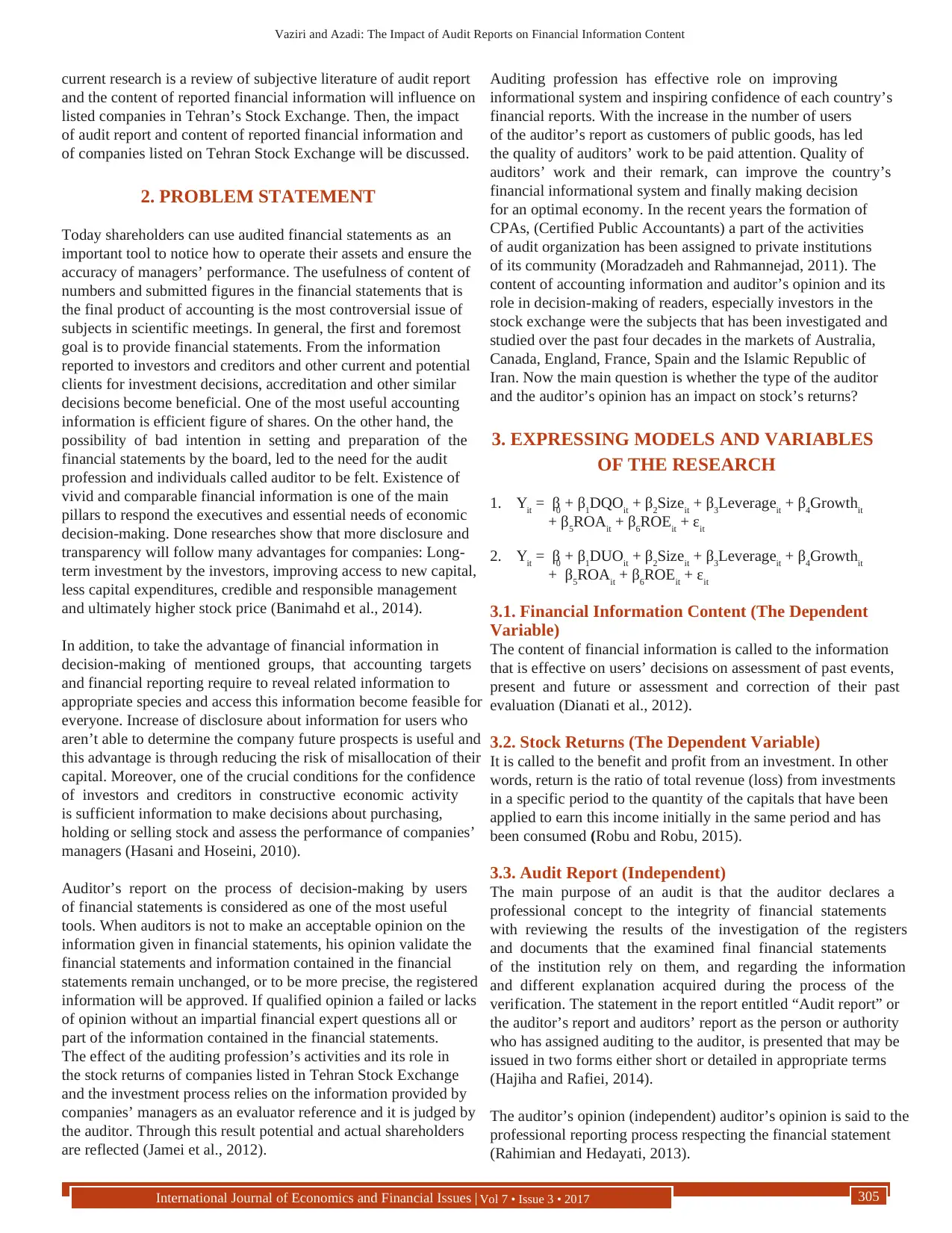
1. Yit = β0 + β1DQOit + β2Sizeit + β3Leverageit + β4Growthit
+ β5ROAit + β6ROEit + εit
2. Yit = β0 + β1DUOit + β2Sizeit + β3Leverageit + β4Growthit
+ β5ROAit + β6ROEit + εit
3.1. Financial Information Content (The Dependent
Variable)
The content of financial information is called to the information
that is effective on users’ decisions on assessment of past events,
present and future or assessment and correction of their past
evaluation (Dianati et al., 2012).
3.2. Stock Returns (The Dependent Variable)
It is called to the benefit and profit from an investment. In other
words, return is the ratio of total revenue (loss) from investments
in a specific period to the quantity of the capitals that have been
applied to earn this income initially in the same period and has
been consumed (Robu and Robu, 2015).
3.3. Audit Report (Independent)
The main purpose of an audit is that the auditor declares a
professional concept to the integrity of financial statements
with reviewing the results of the investigation of the registers
and documents that the examined final financial statements
of the institution rely on them, and regarding the information
and different explanation acquired during the process of the
verification. The statement in the report entitled “Audit report” or
the auditor’s report and auditors’ report as the person or authority
who has assigned auditing to the auditor, is presented that may be
issued in two forms either short or detailed in appropriate terms
(Hajiha and Rafiei, 2014).
The auditor’s opinion (independent) auditor’s opinion is said to the
professional reporting process respecting the financial statement
(Rahimian and Hedayati, 2013).
International Journal of Economics and Financial Issues | Vol 7 • Issue 3 • 2017 305
current research is a review of subjective literature of audit report
and the content of reported financial information will influence on
listed companies in Tehran’s Stock Exchange. Then, the impact
of audit report and content of reported financial information and
of companies listed on Tehran Stock Exchange will be discussed.
2. PROBLEM STATEMENT
Today shareholders can use audited financial statements as an
important tool to notice how to operate their assets and ensure the
accuracy of managers’ performance. The usefulness of content of
numbers and submitted figures in the financial statements that is
the final product of accounting is the most controversial issue of
subjects in scientific meetings. In general, the first and foremost
goal is to provide financial statements. From the information
reported to investors and creditors and other current and potential
clients for investment decisions, accreditation and other similar
decisions become beneficial. One of the most useful accounting
information is efficient figure of shares. On the other hand, the
possibility of bad intention in setting and preparation of the
financial statements by the board, led to the need for the audit
profession and individuals called auditor to be felt. Existence of
vivid and comparable financial information is one of the main
pillars to respond the executives and essential needs of economic
decision-making. Done researches show that more disclosure and
transparency will follow many advantages for companies: Long-
term investment by the investors, improving access to new capital,
less capital expenditures, credible and responsible management
and ultimately higher stock price (Banimahd et al., 2014).
In addition, to take the advantage of financial information in
decision-making of mentioned groups, that accounting targets
and financial reporting require to reveal related information to
appropriate species and access this information become feasible for
everyone. Increase of disclosure about information for users who
aren’t able to determine the company future prospects is useful and
this advantage is through reducing the risk of misallocation of their
capital. Moreover, one of the crucial conditions for the confidence
of investors and creditors in constructive economic activity
is sufficient information to make decisions about purchasing,
holding or selling stock and assess the performance of companies’
managers (Hasani and Hoseini, 2010).
Auditor’s report on the process of decision-making by users
of financial statements is considered as one of the most useful
tools. When auditors is not to make an acceptable opinion on the
information given in financial statements, his opinion validate the
financial statements and information contained in the financial
statements remain unchanged, or to be more precise, the registered
information will be approved. If qualified opinion a failed or lacks
of opinion without an impartial financial expert questions all or
part of the information contained in the financial statements.
The effect of the auditing profession’s activities and its role in
the stock returns of companies listed in Tehran Stock Exchange
and the investment process relies on the information provided by
companies’ managers as an evaluator reference and it is judged by
the auditor. Through this result potential and actual shareholders
are reflected (Jamei et al., 2012).
Auditing profession has effective role on improving
informational system and inspiring confidence of each country’s
financial reports. With the increase in the number of users
of the auditor’s report as customers of public goods, has led
the quality of auditors’ work to be paid attention. Quality of
auditors’ work and their remark, can improve the country’s
financial informational system and finally making decision
for an optimal economy. In the recent years the formation of
CPAs, (Certified Public Accountants) a part of the activities
of audit organization has been assigned to private institutions
of its community (Moradzadeh and Rahmannejad, 2011). The
content of accounting information and auditor’s opinion and its
role in decision-making of readers, especially investors in the
stock exchange were the subjects that has been investigated and
studied over the past four decades in the markets of Australia,
Canada, England, France, Spain and the Islamic Republic of
Iran. Now the main question is whether the type of the auditor
and the auditor’s opinion has an impact on stock’s returns?
3. EXPRESSING MODELS AND VARIABLES
OF THE RESEARCH
1. Yit = β0 + β1DQOit + β2Sizeit + β3Leverageit + β4Growthit
+ β5ROAit + β6ROEit + εit
2. Yit = β0 + β1DUOit + β2Sizeit + β3Leverageit + β4Growthit
+ β5ROAit + β6ROEit + εit
3.1. Financial Information Content (The Dependent
Variable)
The content of financial information is called to the information
that is effective on users’ decisions on assessment of past events,
present and future or assessment and correction of their past
evaluation (Dianati et al., 2012).
3.2. Stock Returns (The Dependent Variable)
It is called to the benefit and profit from an investment. In other
words, return is the ratio of total revenue (loss) from investments
in a specific period to the quantity of the capitals that have been
applied to earn this income initially in the same period and has
been consumed (Robu and Robu, 2015).
3.3. Audit Report (Independent)
The main purpose of an audit is that the auditor declares a
professional concept to the integrity of financial statements
with reviewing the results of the investigation of the registers
and documents that the examined final financial statements
of the institution rely on them, and regarding the information
and different explanation acquired during the process of the
verification. The statement in the report entitled “Audit report” or
the auditor’s report and auditors’ report as the person or authority
who has assigned auditing to the auditor, is presented that may be
issued in two forms either short or detailed in appropriate terms
(Hajiha and Rafiei, 2014).
The auditor’s opinion (independent) auditor’s opinion is said to the
professional reporting process respecting the financial statement
(Rahimian and Hedayati, 2013).
Vaziri and Azadi: The Impact of Audit Reports on Financial Information Content
International Journal of Economics and Financial Issues | Vol 7 • Issue 3 • 2017306
The type of auditor (independent) the type of auditor is said to
the type of audit institutions that include large and small audit
institutions (Jahanshad and Navaei, 2013).
4. RESEARCH LITERATURE
Callen and Khan (2013) in their research surveyed the quality
of accounting information and delay information affecting this
information on the stock price and its relationship with the future
stock returns. They stated that whatever the quality of accounting
is reduced, the relevance and reliability of it will be reduced and
consequently, prediction accuracy of cash flows and returns will
be reduced for investors.
Noor-ul-Haq et al. (2012) examined the relationship between
economic power and the state auditor in 46 countries. They
showed that whatever the quality of government is politically
and economically powerful, then choosing four large auditing
institutions is plausible. They also confirmed the affluent countries
that have accepted international financial reporting standards,
choosing four large auditing institutions is plausible. The results
of their research confirmed that whatever the government of a
country is stronger the demand is more for higher-quality audit
services (Kadilli, 2015).
Leventis and Dimitropoulos (2010) audit services pricing, the
interest quality and the board independence were examined for 97
companies, between the years 2000 and 2004. The results of this
study show that there is a positive relationship between auditor
independence and audit services pricing. Moreover, there is a
positive relationship between audit services pricing and interest
management that the result is for the companies with small size
(Kausar et al., 2015).
Chen et al. (2010) examined the effect of auditor size (as a factor
of audit quality) on interest management and capital costs for
the two categories of Chinese companies. A group of companies
owned by the states and others non-state-owned companies. The
results of this study showed that the impact of auditing quality in
reducing interest management is stronger in private companies
than public companies. In addition, cost of capital, that investor
consider for the information risk as a value. Private companies
are more influenced by the quality audit than public companies.
5. RESEARCH HYPOTHESES
H1: There is a significant relationship between type of auditor’s
opinion and stock returns.
H2: There is a significant relationship between type of auditor
(audit organization or institution) and stock returns.
6. RESEARCH METHODOLOGY
This study is considered descriptive in terms of type of research
and applicable, in terms of category of researches based on
purpose. The statistical community this research includes all the
companies listed in Tehran Stock Exchange from 2009 and after
that until 2014 which were present in stock exchange including
463 companies. In this study, sampling method is elimination
systematic as following conditions:
1. Not to be among insurance companies, investment, leasing,
banks and financial institutions, financial moderators, because
these companies have the nature of the different activities
2. The companies that their financial data can be written during
this 6 years and in this period have not had out of stock
exchange and entered stock exchange or even have not have
stock exchange interruptions and other transactions
3. In order to ensure comparability and avoid the heterogeneity
of its fiscal year ending March 18th and financial year should
not be changed during the years 2009-2014
4. Financial statements and explanatory notes are available
accompanying them.
In this study, the panel data is applied using software Eviews 7.
7. THE RESULTS OF HYPOTHESIS TEST
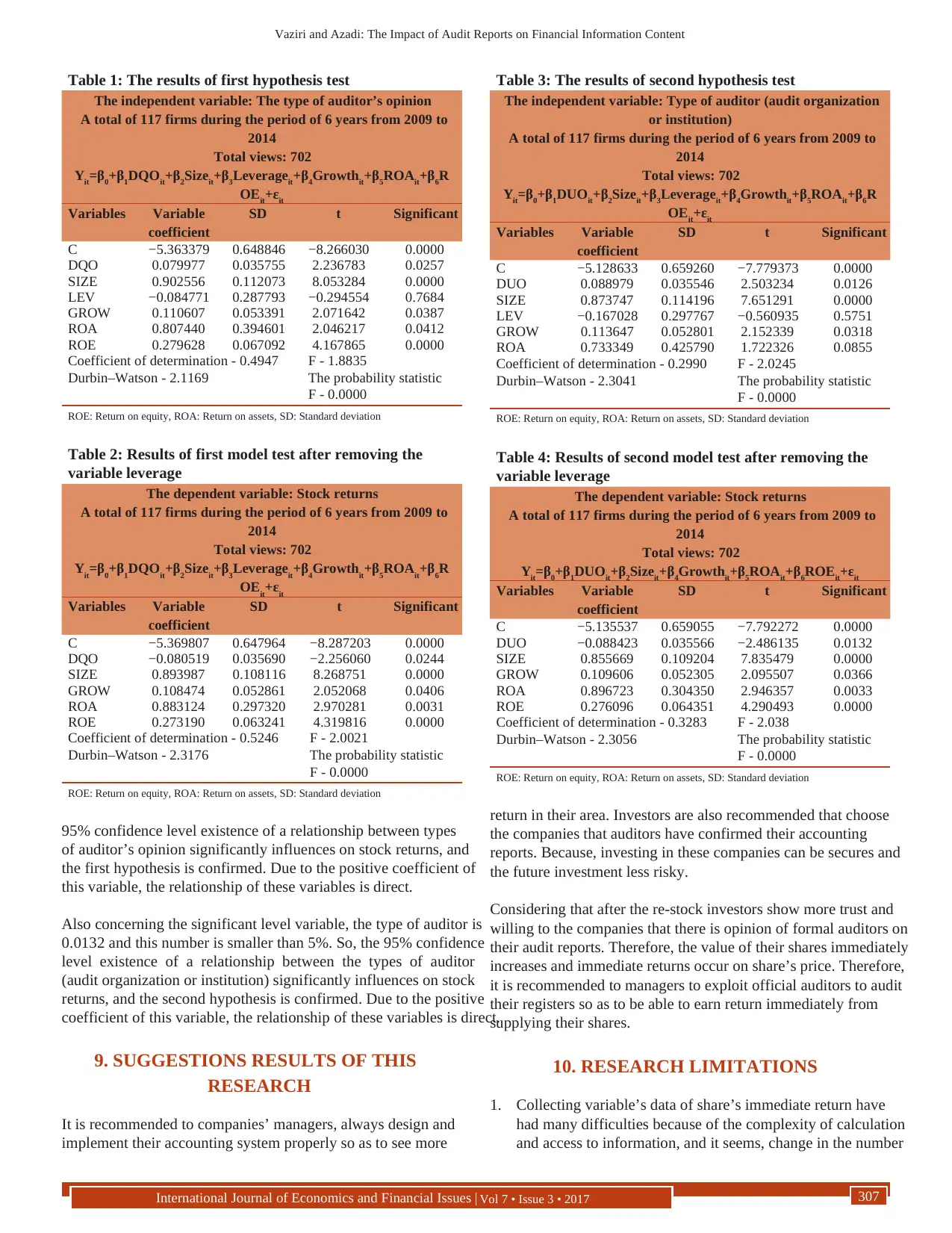
7.1. The Results of First Hypothesis Test
After the initial analysis of the regression model output as the
Table 1 were determined after an examination of the research’s
variables, it was revealed that fiscal leverage is not effective on
stock exchange’s returns in this model that with elimination of this
variable the underneath right model was analyzed.
As it is observed in Table 2, based on the results of initial model’s
estimation, regarding to P value. Statistic F is proved that the model
is approved by 99% confidence.
Durbin–Watson with 2.3176 shows lack of correlation between
the errors. In addition, according to the obtained coefficient of
determination, used variables in the model explains totally 0.52%
of the dependent variable’s behavior.
7.2. The Results of Second Hypothesis Test
After the initial analysis of the regression model output as the
Table 3 were determined after an examination of the research’s
variables, it was revealed that fiscal leverage is not effective on
stock exchange’s returns in this model that with elimination of this
variable the underneath right model was analyzed.
As it is observed in Table 4, based on the results of initial model’s
estimation, regarding to P value. Statistic F is proved that the model
is approved by 99% confidence.
Durbin–Watson with 2.30 shows lack of correlation between
the errors. In addition, according to the obtained coefficient of
determination, used variables in the model explains totally 0.32%
of the dependent variable’s behavior.
8. CONCLUSION
Concerning the significant level variable, the type of auditor’s
opinion is 0.0244 and this number is smaller than 5%. So, the
International Journal of Economics and Financial Issues | Vol 7 • Issue 3 • 2017306
The type of auditor (independent) the type of auditor is said to
the type of audit institutions that include large and small audit
institutions (Jahanshad and Navaei, 2013).
4. RESEARCH LITERATURE
Callen and Khan (2013) in their research surveyed the quality
of accounting information and delay information affecting this
information on the stock price and its relationship with the future
stock returns. They stated that whatever the quality of accounting
is reduced, the relevance and reliability of it will be reduced and
consequently, prediction accuracy of cash flows and returns will
be reduced for investors.
Noor-ul-Haq et al. (2012) examined the relationship between
economic power and the state auditor in 46 countries. They
showed that whatever the quality of government is politically
and economically powerful, then choosing four large auditing
institutions is plausible. They also confirmed the affluent countries
that have accepted international financial reporting standards,
choosing four large auditing institutions is plausible. The results
of their research confirmed that whatever the government of a
country is stronger the demand is more for higher-quality audit
services (Kadilli, 2015).
Leventis and Dimitropoulos (2010) audit services pricing, the
interest quality and the board independence were examined for 97
companies, between the years 2000 and 2004. The results of this
study show that there is a positive relationship between auditor
independence and audit services pricing. Moreover, there is a
positive relationship between audit services pricing and interest
management that the result is for the companies with small size
(Kausar et al., 2015).
Chen et al. (2010) examined the effect of auditor size (as a factor
of audit quality) on interest management and capital costs for
the two categories of Chinese companies. A group of companies
owned by the states and others non-state-owned companies. The
results of this study showed that the impact of auditing quality in
reducing interest management is stronger in private companies
than public companies. In addition, cost of capital, that investor
consider for the information risk as a value. Private companies
are more influenced by the quality audit than public companies.
5. RESEARCH HYPOTHESES
H1: There is a significant relationship between type of auditor’s
opinion and stock returns.
H2: There is a significant relationship between type of auditor
(audit organization or institution) and stock returns.
6. RESEARCH METHODOLOGY
This study is considered descriptive in terms of type of research
and applicable, in terms of category of researches based on
purpose. The statistical community this research includes all the
companies listed in Tehran Stock Exchange from 2009 and after
that until 2014 which were present in stock exchange including
463 companies. In this study, sampling method is elimination
systematic as following conditions:
1. Not to be among insurance companies, investment, leasing,
banks and financial institutions, financial moderators, because
these companies have the nature of the different activities
2. The companies that their financial data can be written during
this 6 years and in this period have not had out of stock
exchange and entered stock exchange or even have not have
stock exchange interruptions and other transactions
3. In order to ensure comparability and avoid the heterogeneity
of its fiscal year ending March 18th and financial year should
not be changed during the years 2009-2014
4. Financial statements and explanatory notes are available
accompanying them.
In this study, the panel data is applied using software Eviews 7.
7. THE RESULTS OF HYPOTHESIS TEST
7.1. The Results of First Hypothesis Test
After the initial analysis of the regression model output as the
Table 1 were determined after an examination of the research’s
variables, it was revealed that fiscal leverage is not effective on
stock exchange’s returns in this model that with elimination of this
variable the underneath right model was analyzed.
As it is observed in Table 2, based on the results of initial model’s
estimation, regarding to P value. Statistic F is proved that the model
is approved by 99% confidence.
Durbin–Watson with 2.3176 shows lack of correlation between
the errors. In addition, according to the obtained coefficient of
determination, used variables in the model explains totally 0.52%
of the dependent variable’s behavior.
7.2. The Results of Second Hypothesis Test
After the initial analysis of the regression model output as the
Table 3 were determined after an examination of the research’s
variables, it was revealed that fiscal leverage is not effective on
stock exchange’s returns in this model that with elimination of this
variable the underneath right model was analyzed.
As it is observed in Table 4, based on the results of initial model’s
estimation, regarding to P value. Statistic F is proved that the model
is approved by 99% confidence.
Durbin–Watson with 2.30 shows lack of correlation between
the errors. In addition, according to the obtained coefficient of
determination, used variables in the model explains totally 0.32%
of the dependent variable’s behavior.
8. CONCLUSION
Concerning the significant level variable, the type of auditor’s
opinion is 0.0244 and this number is smaller than 5%. So, the
⊘ This is a preview!⊘
Do you want full access?
Subscribe today to unlock all pages.

Trusted by 1+ million students worldwide
Vaziri and Azadi: The Impact of Audit Reports on Financial Information Content
International Journal of Economics and Financial Issues | Vol 7 • Issue 3 • 2017 307
95% confidence level existence of a relationship between types
of auditor’s opinion significantly influences on stock returns, and
the first hypothesis is confirmed. Due to the positive coefficient of
this variable, the relationship of these variables is direct.
Also concerning the significant level variable, the type of auditor is
0.0132 and this number is smaller than 5%. So, the 95% confidence
level existence of a relationship between the types of auditor
(audit organization or institution) significantly influences on stock
returns, and the second hypothesis is confirmed. Due to the positive
coefficient of this variable, the relationship of these variables is direct.
9. SUGGESTIONS RESULTS OF THIS
RESEARCH
It is recommended to companies’ managers, always design and
implement their accounting system properly so as to see more
return in their area. Investors are also recommended that choose
the companies that auditors have confirmed their accounting
reports. Because, investing in these companies can be secures and
the future investment less risky.
Considering that after the re-stock investors show more trust and
willing to the companies that there is opinion of formal auditors on
their audit reports. Therefore, the value of their shares immediately
increases and immediate returns occur on share’s price. Therefore,
it is recommended to managers to exploit official auditors to audit
their registers so as to be able to earn return immediately from
supplying their shares.
10. RESEARCH LIMITATIONS
1. Collecting variable’s data of share’s immediate return have
had many difficulties because of the complexity of calculation
and access to information, and it seems, change in the number
Table 3: The results of second hypothesis test
The independent variable: Type of auditor (audit organization
or institution)
A total of 117 firms during the period of 6 years from 2009 to
2014
Total views: 702
Yit=β0+β1DUOit+β2Sizeit+β3Leverageit+β4Growthit+β5ROAit+β6R
OEit+εit
Variables Variable
coefficient
SD t Significant
C −5.128633 0.659260 −7.779373 0.0000
DUO 0.088979 0.035546 2.503234 0.0126
SIZE 0.873747 0.114196 7.651291 0.0000
LEV −0.167028 0.297767 −0.560935 0.5751
GROW 0.113647 0.052801 2.152339 0.0318
ROA 0.733349 0.425790 1.722326 0.0855
Coefficient of determination - 0.2990 F - 2.0245
Durbin–Watson - 2.3041 The probability statistic
F - 0.0000
ROE: Return on equity, ROA: Return on assets, SD: Standard deviation
Table 4: Results of second model test after removing the
variable leverage
The dependent variable: Stock returns
A total of 117 firms during the period of 6 years from 2009 to
2014
Total views: 702
Yit=β0+β1DUOit+β2Sizeit+β4Growthit+β5ROAit+β6ROEit+εit
Variables Variable
coefficient
SD t Significant
C −5.135537 0.659055 −7.792272 0.0000
DUO −0.088423 0.035566 −2.486135 0.0132
SIZE 0.855669 0.109204 7.835479 0.0000
GROW 0.109606 0.052305 2.095507 0.0366
ROA 0.896723 0.304350 2.946357 0.0033
ROE 0.276096 0.064351 4.290493 0.0000
Coefficient of determination - 0.3283 F - 2.038
Durbin–Watson - 2.3056 The probability statistic
F - 0.0000
ROE: Return on equity, ROA: Return on assets, SD: Standard deviation
Table 2: Results of first model test after removing the
variable leverage
The dependent variable: Stock returns
A total of 117 firms during the period of 6 years from 2009 to
2014
Total views: 702
Yit=β0+β1DQOit+β2Sizeit+β3Leverageit+β4Growthit+β5ROAit+β6R
OEit+εit
Variables Variable
coefficient
SD t Significant
C −5.369807 0.647964 −8.287203 0.0000
DQO −0.080519 0.035690 −2.256060 0.0244
SIZE 0.893987 0.108116 8.268751 0.0000
GROW 0.108474 0.052861 2.052068 0.0406
ROA 0.883124 0.297320 2.970281 0.0031
ROE 0.273190 0.063241 4.319816 0.0000
Coefficient of determination - 0.5246 F - 2.0021
Durbin–Watson - 2.3176 The probability statistic
F - 0.0000
ROE: Return on equity, ROA: Return on assets, SD: Standard deviation
Table 1: The results of first hypothesis test
The independent variable: The type of auditor’s opinion
A total of 117 firms during the period of 6 years from 2009 to
2014
Total views: 702
Yit=β0+β1DQOit+β2Sizeit+β3Leverageit+β4Growthit+β5ROAit+β6R
OEit+εit
Variables Variable
coefficient
SD t Significant
C −5.363379 0.648846 −8.266030 0.0000
DQO 0.079977 0.035755 2.236783 0.0257
SIZE 0.902556 0.112073 8.053284 0.0000
LEV −0.084771 0.287793 −0.294554 0.7684
GROW 0.110607 0.053391 2.071642 0.0387
ROA 0.807440 0.394601 2.046217 0.0412
ROE 0.279628 0.067092 4.167865 0.0000
Coefficient of determination - 0.4947 F - 1.8835
Durbin–Watson - 2.1169 The probability statistic
F - 0.0000
ROE: Return on equity, ROA: Return on assets, SD: Standard deviation
International Journal of Economics and Financial Issues | Vol 7 • Issue 3 • 2017 307
95% confidence level existence of a relationship between types
of auditor’s opinion significantly influences on stock returns, and
the first hypothesis is confirmed. Due to the positive coefficient of
this variable, the relationship of these variables is direct.
Also concerning the significant level variable, the type of auditor is
0.0132 and this number is smaller than 5%. So, the 95% confidence
level existence of a relationship between the types of auditor
(audit organization or institution) significantly influences on stock
returns, and the second hypothesis is confirmed. Due to the positive
coefficient of this variable, the relationship of these variables is direct.
9. SUGGESTIONS RESULTS OF THIS
RESEARCH
It is recommended to companies’ managers, always design and
implement their accounting system properly so as to see more
return in their area. Investors are also recommended that choose
the companies that auditors have confirmed their accounting
reports. Because, investing in these companies can be secures and
the future investment less risky.
Considering that after the re-stock investors show more trust and
willing to the companies that there is opinion of formal auditors on
their audit reports. Therefore, the value of their shares immediately
increases and immediate returns occur on share’s price. Therefore,
it is recommended to managers to exploit official auditors to audit
their registers so as to be able to earn return immediately from
supplying their shares.
10. RESEARCH LIMITATIONS
1. Collecting variable’s data of share’s immediate return have
had many difficulties because of the complexity of calculation
and access to information, and it seems, change in the number
Table 3: The results of second hypothesis test
The independent variable: Type of auditor (audit organization
or institution)
A total of 117 firms during the period of 6 years from 2009 to
2014
Total views: 702
Yit=β0+β1DUOit+β2Sizeit+β3Leverageit+β4Growthit+β5ROAit+β6R
OEit+εit
Variables Variable
coefficient
SD t Significant
C −5.128633 0.659260 −7.779373 0.0000
DUO 0.088979 0.035546 2.503234 0.0126
SIZE 0.873747 0.114196 7.651291 0.0000
LEV −0.167028 0.297767 −0.560935 0.5751
GROW 0.113647 0.052801 2.152339 0.0318
ROA 0.733349 0.425790 1.722326 0.0855
Coefficient of determination - 0.2990 F - 2.0245
Durbin–Watson - 2.3041 The probability statistic
F - 0.0000
ROE: Return on equity, ROA: Return on assets, SD: Standard deviation
Table 4: Results of second model test after removing the
variable leverage
The dependent variable: Stock returns
A total of 117 firms during the period of 6 years from 2009 to
2014
Total views: 702
Yit=β0+β1DUOit+β2Sizeit+β4Growthit+β5ROAit+β6ROEit+εit
Variables Variable
coefficient
SD t Significant
C −5.135537 0.659055 −7.792272 0.0000
DUO −0.088423 0.035566 −2.486135 0.0132
SIZE 0.855669 0.109204 7.835479 0.0000
GROW 0.109606 0.052305 2.095507 0.0366
ROA 0.896723 0.304350 2.946357 0.0033
ROE 0.276096 0.064351 4.290493 0.0000
Coefficient of determination - 0.3283 F - 2.038
Durbin–Watson - 2.3056 The probability statistic
F - 0.0000
ROE: Return on equity, ROA: Return on assets, SD: Standard deviation
Table 2: Results of first model test after removing the
variable leverage
The dependent variable: Stock returns
A total of 117 firms during the period of 6 years from 2009 to
2014
Total views: 702
Yit=β0+β1DQOit+β2Sizeit+β3Leverageit+β4Growthit+β5ROAit+β6R
OEit+εit
Variables Variable
coefficient
SD t Significant
C −5.369807 0.647964 −8.287203 0.0000
DQO −0.080519 0.035690 −2.256060 0.0244
SIZE 0.893987 0.108116 8.268751 0.0000
GROW 0.108474 0.052861 2.052068 0.0406
ROA 0.883124 0.297320 2.970281 0.0031
ROE 0.273190 0.063241 4.319816 0.0000
Coefficient of determination - 0.5246 F - 2.0021
Durbin–Watson - 2.3176 The probability statistic
F - 0.0000
ROE: Return on equity, ROA: Return on assets, SD: Standard deviation
Table 1: The results of first hypothesis test
The independent variable: The type of auditor’s opinion
A total of 117 firms during the period of 6 years from 2009 to
2014
Total views: 702
Yit=β0+β1DQOit+β2Sizeit+β3Leverageit+β4Growthit+β5ROAit+β6R
OEit+εit
Variables Variable
coefficient
SD t Significant
C −5.363379 0.648846 −8.266030 0.0000
DQO 0.079977 0.035755 2.236783 0.0257
SIZE 0.902556 0.112073 8.053284 0.0000
LEV −0.084771 0.287793 −0.294554 0.7684
GROW 0.110607 0.053391 2.071642 0.0387
ROA 0.807440 0.394601 2.046217 0.0412
ROE 0.279628 0.067092 4.167865 0.0000
Coefficient of determination - 0.4947 F - 1.8835
Durbin–Watson - 2.1169 The probability statistic
F - 0.0000
ROE: Return on equity, ROA: Return on assets, SD: Standard deviation
Paraphrase This Document
Need a fresh take? Get an instant paraphrase of this document with our AI Paraphraser
Vaziri and Azadi: The Impact of Audit Reports on Financial Information Content
International Journal of Economics and Financial Issues | Vol 7 • Issue 3 • 2017308
of days after the meeting could change the results.
2. Management and political problems and macro-economic
indexes such as changes in the company’s managers after a
general meeting is an issue that can affect the research’s results
by interfering in share’s returns.
REFERENCES
Banimahd, B., Yahya, H.Y., Yazdanian, N. (2014), Earnings management
and auditor’s opinion: Evidence from the private sector auditing.
Journal of Management Accounting, 21, 32-17.
Callen, J., Khan, M. (2013), Accounting quality, stock price delay
and future stock returns. Temporary Accounting Research, 30(1),
269-295.
Chen, H., Chen, J.Z., Lobo, G.J., Wang, Y. (2010), Effects of audit quality
on earnings management and cost of equity capital: Evidence from
China. Contemporary Accounting Research, 28(3), 892-925.
Dianati, Z., Alemi, M.R., Samiran, B.P. (2012), Relationship between
quality of financial information and risk measures in the Tehran
stock exchange. Journal of Stock Exchange Quarterly, 17(5), 41-23.
Hajiha, Z., Feizabadi, F. (2013), Relationship between liquidity ratios
and profitability and ability to pay obligations. Journal of Financial
Accounting and Auditing Research, 19, 127-151.
Hajiha, Z., Rafiei, A. (2014), The impact on the quality of the internal
audit function when the independent audit report. Journal of Financial
Accounting and Auditing, 6(24), 137-121.
Hasani, M., Hosseini, M.B. (2010), Exploring the relationship between
accounting information disclosure level and volatility of stock prices
in companies listed on Tehran stock exchange. Journal of Economics
and Business, 75, 84-75.
Hassas, Y.Y., Jafari, V. (2010), Effect of rotating audit firms audit report
on the quality of listed companies in Tehran stock exchange. Journal
of Stock Exchange Quarterly, 9, 42-25.
Houqe, N., Zijl, M., Tony van. Monem, Reza. (2012), Government quality,
auditor choice and adoption of IFRS: A cross country analysis,
Journal of Accounting Research, No. 4, PP. 233-251.
Jahanshad, A., Navaei, L.M. (2013), The effect of auditor tenure and type
of conservative profit auditing and reporting. Journal of Financial
Accounting and Auditing Research, 18, 107-128.
Jamei, R., Halshi, M., Abdollah, H.E. (2012), Evaluate the performance
of managers on independent auditor’s report on companies listed
on the Tehran stock exchange. Journal of Accounting and Audit
Review, 19(4), 1-14.
Kadilli, A. (2015), Predictability of stock returns of financial companies
and the role of investor sentiment: A multi-country analysis. Journal
of Financial Stability, 5(3), 1-62.
Kausar, A., Shroff, N., White, H. (2015), Real effects of the audit choice.
Journal of Accounting and Economics, 8, 1-63.
Leventis S., Dimitropoulos, P.E. ( 2010), Audit pricing, quality of earning
and board independence: The cose of the Athens stock exchange,
International Journal of Cardiology 26, pp. 325-332.
Moradzadeh, F.M., Rahmannejad, G. (2011), Evaluate the effect of the
auditor on the value relevance of earnings in companies listed on
the Tehran stock exchange. Journal of Accounting Management,
1, 62-51.
Rahimian, N., Hedayati, A. (2013), The factors affecting the auditor’s
professional opinion. Journal of Chartered Accountant, 12, 85-77.
Robu, M.A., Robu, I.B. (2015), The influence of the audit report on the
relevance of accounting information reported by listed Romanian
companies. Procedia Economics and Finance, 20, 562-570.
International Journal of Economics and Financial Issues | Vol 7 • Issue 3 • 2017308
of days after the meeting could change the results.
2. Management and political problems and macro-economic
indexes such as changes in the company’s managers after a
general meeting is an issue that can affect the research’s results
by interfering in share’s returns.
REFERENCES
Banimahd, B., Yahya, H.Y., Yazdanian, N. (2014), Earnings management
and auditor’s opinion: Evidence from the private sector auditing.
Journal of Management Accounting, 21, 32-17.
Callen, J., Khan, M. (2013), Accounting quality, stock price delay
and future stock returns. Temporary Accounting Research, 30(1),
269-295.
Chen, H., Chen, J.Z., Lobo, G.J., Wang, Y. (2010), Effects of audit quality
on earnings management and cost of equity capital: Evidence from
China. Contemporary Accounting Research, 28(3), 892-925.
Dianati, Z., Alemi, M.R., Samiran, B.P. (2012), Relationship between
quality of financial information and risk measures in the Tehran
stock exchange. Journal of Stock Exchange Quarterly, 17(5), 41-23.
Hajiha, Z., Feizabadi, F. (2013), Relationship between liquidity ratios
and profitability and ability to pay obligations. Journal of Financial
Accounting and Auditing Research, 19, 127-151.
Hajiha, Z., Rafiei, A. (2014), The impact on the quality of the internal
audit function when the independent audit report. Journal of Financial
Accounting and Auditing, 6(24), 137-121.
Hasani, M., Hosseini, M.B. (2010), Exploring the relationship between
accounting information disclosure level and volatility of stock prices
in companies listed on Tehran stock exchange. Journal of Economics
and Business, 75, 84-75.
Hassas, Y.Y., Jafari, V. (2010), Effect of rotating audit firms audit report
on the quality of listed companies in Tehran stock exchange. Journal
of Stock Exchange Quarterly, 9, 42-25.
Houqe, N., Zijl, M., Tony van. Monem, Reza. (2012), Government quality,
auditor choice and adoption of IFRS: A cross country analysis,
Journal of Accounting Research, No. 4, PP. 233-251.
Jahanshad, A., Navaei, L.M. (2013), The effect of auditor tenure and type
of conservative profit auditing and reporting. Journal of Financial
Accounting and Auditing Research, 18, 107-128.
Jamei, R., Halshi, M., Abdollah, H.E. (2012), Evaluate the performance
of managers on independent auditor’s report on companies listed
on the Tehran stock exchange. Journal of Accounting and Audit
Review, 19(4), 1-14.
Kadilli, A. (2015), Predictability of stock returns of financial companies
and the role of investor sentiment: A multi-country analysis. Journal
of Financial Stability, 5(3), 1-62.
Kausar, A., Shroff, N., White, H. (2015), Real effects of the audit choice.
Journal of Accounting and Economics, 8, 1-63.
Leventis S., Dimitropoulos, P.E. ( 2010), Audit pricing, quality of earning
and board independence: The cose of the Athens stock exchange,
International Journal of Cardiology 26, pp. 325-332.
Moradzadeh, F.M., Rahmannejad, G. (2011), Evaluate the effect of the
auditor on the value relevance of earnings in companies listed on
the Tehran stock exchange. Journal of Accounting Management,
1, 62-51.
Rahimian, N., Hedayati, A. (2013), The factors affecting the auditor’s
professional opinion. Journal of Chartered Accountant, 12, 85-77.
Robu, M.A., Robu, I.B. (2015), The influence of the audit report on the
relevance of accounting information reported by listed Romanian
companies. Procedia Economics and Finance, 20, 562-570.

1 out of 5


Related Documents


Your All-in-One AI-Powered Toolkit for Academic Success.
+13062052269
info@desklib.com
Available 24*7 on WhatsApp / Email
![[object Object]](/_next/static/media/star-bottom.7253800d.svg)
Unlock your academic potential
Copyright © 2020–2026 A2Z Services. All Rights Reserved. Developed and managed by ZUCOL.