Analyzing Legal and Ethical Issues in International Business
VerifiedAdded on 2023/04/19
|7
|1794
|69
Case Study
AI Summary
This case study examines the legal and ethical issues arising from a company's aggressive marketing campaign and a seemingly outlandish offer. It analyzes the key legal factors, including false advertising and ethical responsibilities in business communications. The study delves into the four elements of a valid contract—offer, consideration, acceptance, and mutuality—and their relevance to the scenario. It also explores the objective theory of contracts, focusing on how a third party would interpret the agreement based on observable actions. The analysis explains why the court likely deemed the agreement invalid, emphasizing the absence of essential contract elements and the implausibility of the offer. Furthermore, it distinguishes the case from reward situations involving unilateral contracts and provides recommendations for companies considering high-value giveaways in marketing campaigns, including the use of social media advertising and clear disclaimers to avoid consumer confusion and mistrust. Desklib provides this document as well as numerous other study resources.
Running head: INTERNATIONAL LEGAL AND ETHICAL ISSUES IN BUSINESS
INTERNATIONAL LEGAL AND ETHICAL ISSUES IN BUSINESS
Name of the student
University Name
Author note
INTERNATIONAL LEGAL AND ETHICAL ISSUES IN BUSINESS
Name of the student
University Name
Author note
Paraphrase This Document
Need a fresh take? Get an instant paraphrase of this document with our AI Paraphraser

1
INTERNATIONAL LEGAL AND ETHICAL ISSUES IN BUSINESS
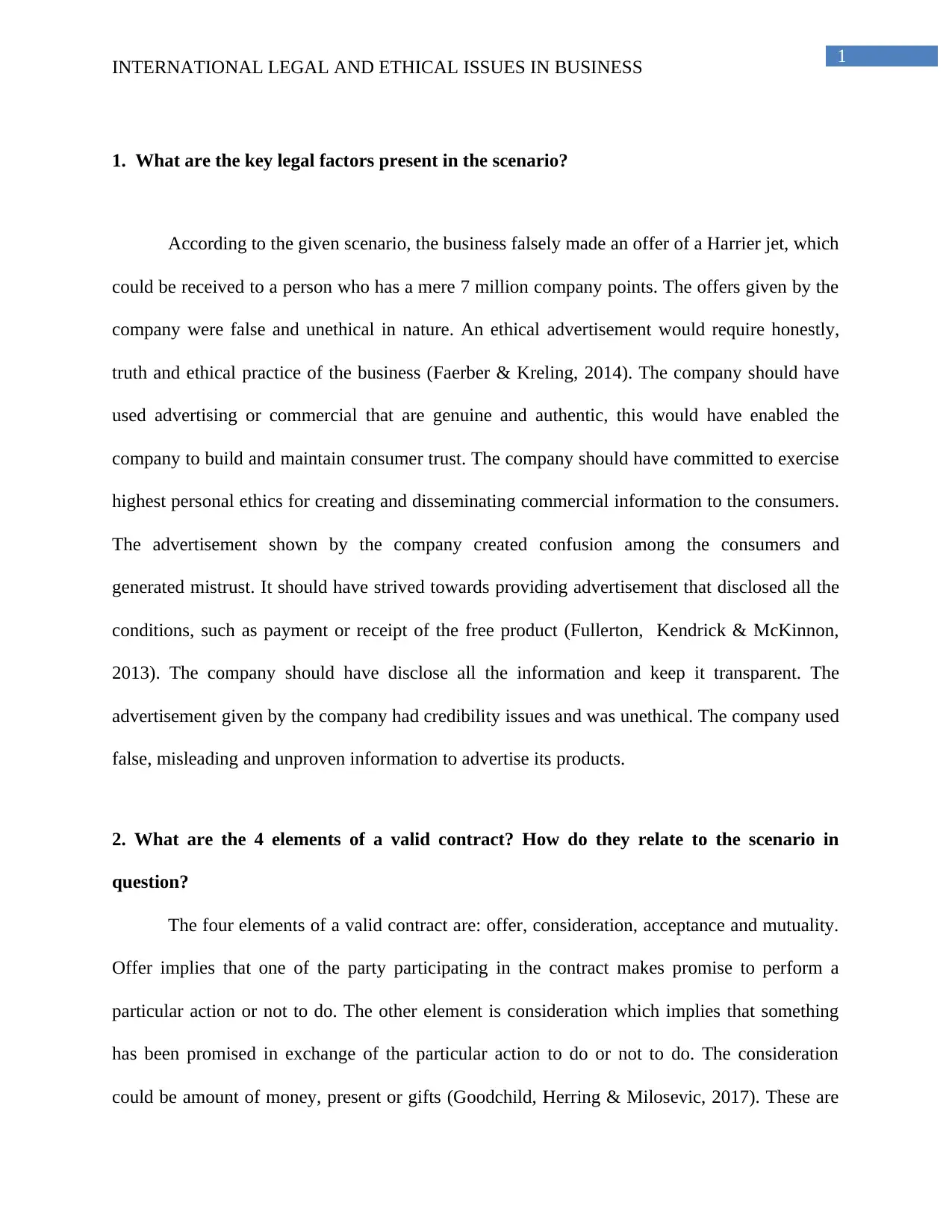
1. What are the key legal factors present in the scenario?
According to the given scenario, the business falsely made an offer of a Harrier jet, which
could be received to a person who has a mere 7 million company points. The offers given by the
company were false and unethical in nature. An ethical advertisement would require honestly,
truth and ethical practice of the business (Faerber & Kreling, 2014). The company should have
used advertising or commercial that are genuine and authentic, this would have enabled the
company to build and maintain consumer trust. The company should have committed to exercise
highest personal ethics for creating and disseminating commercial information to the consumers.
The advertisement shown by the company created confusion among the consumers and
generated mistrust. It should have strived towards providing advertisement that disclosed all the
conditions, such as payment or receipt of the free product (Fullerton, Kendrick & McKinnon,
2013). The company should have disclose all the information and keep it transparent. The
advertisement given by the company had credibility issues and was unethical. The company used
false, misleading and unproven information to advertise its products.
2. What are the 4 elements of a valid contract? How do they relate to the scenario in
question?
The four elements of a valid contract are: offer, consideration, acceptance and mutuality.
Offer implies that one of the party participating in the contract makes promise to perform a
particular action or not to do. The other element is consideration which implies that something
has been promised in exchange of the particular action to do or not to do. The consideration
could be amount of money, present or gifts (Goodchild, Herring & Milosevic, 2017). These are
INTERNATIONAL LEGAL AND ETHICAL ISSUES IN BUSINESS
1. What are the key legal factors present in the scenario?
According to the given scenario, the business falsely made an offer of a Harrier jet, which
could be received to a person who has a mere 7 million company points. The offers given by the
company were false and unethical in nature. An ethical advertisement would require honestly,
truth and ethical practice of the business (Faerber & Kreling, 2014). The company should have
used advertising or commercial that are genuine and authentic, this would have enabled the
company to build and maintain consumer trust. The company should have committed to exercise
highest personal ethics for creating and disseminating commercial information to the consumers.
The advertisement shown by the company created confusion among the consumers and
generated mistrust. It should have strived towards providing advertisement that disclosed all the
conditions, such as payment or receipt of the free product (Fullerton, Kendrick & McKinnon,
2013). The company should have disclose all the information and keep it transparent. The
advertisement given by the company had credibility issues and was unethical. The company used
false, misleading and unproven information to advertise its products.
2. What are the 4 elements of a valid contract? How do they relate to the scenario in
question?
The four elements of a valid contract are: offer, consideration, acceptance and mutuality.
Offer implies that one of the party participating in the contract makes promise to perform a
particular action or not to do. The other element is consideration which implies that something
has been promised in exchange of the particular action to do or not to do. The consideration
could be amount of money, present or gifts (Goodchild, Herring & Milosevic, 2017). These are

2
INTERNATIONAL LEGAL AND ETHICAL ISSUES IN BUSINESS
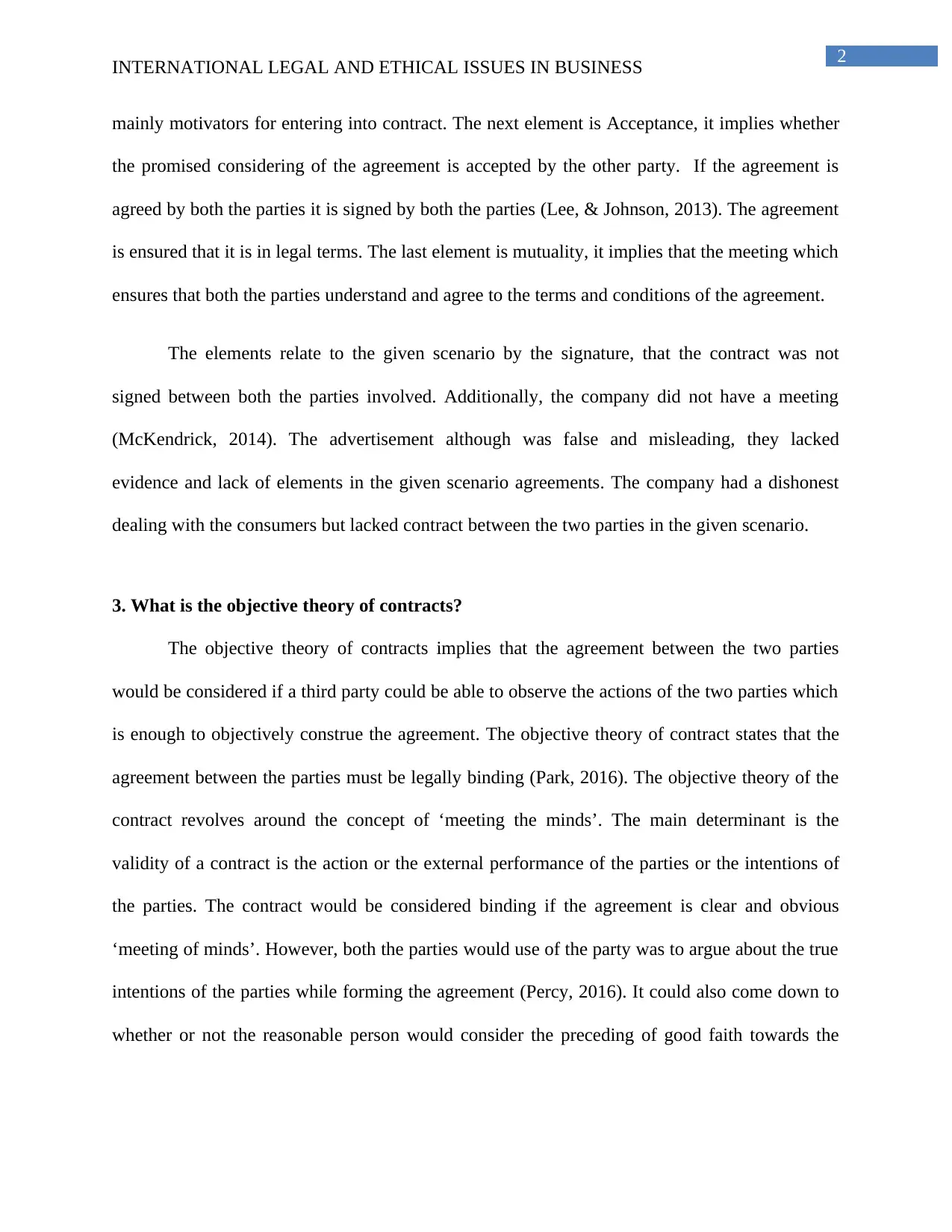
mainly motivators for entering into contract. The next element is Acceptance, it implies whether
the promised considering of the agreement is accepted by the other party. If the agreement is
agreed by both the parties it is signed by both the parties (Lee, & Johnson, 2013). The agreement
is ensured that it is in legal terms. The last element is mutuality, it implies that the meeting which
ensures that both the parties understand and agree to the terms and conditions of the agreement.
The elements relate to the given scenario by the signature, that the contract was not
signed between both the parties involved. Additionally, the company did not have a meeting
(McKendrick, 2014). The advertisement although was false and misleading, they lacked
evidence and lack of elements in the given scenario agreements. The company had a dishonest
dealing with the consumers but lacked contract between the two parties in the given scenario.
3. What is the objective theory of contracts?
The objective theory of contracts implies that the agreement between the two parties
would be considered if a third party could be able to observe the actions of the two parties which
is enough to objectively construe the agreement. The objective theory of contract states that the
agreement between the parties must be legally binding (Park, 2016). The objective theory of the
contract revolves around the concept of ‘meeting the minds’. The main determinant is the
validity of a contract is the action or the external performance of the parties or the intentions of
the parties. The contract would be considered binding if the agreement is clear and obvious
‘meeting of minds’. However, both the parties would use of the party was to argue about the true
intentions of the parties while forming the agreement (Percy, 2016). It could also come down to
whether or not the reasonable person would consider the preceding of good faith towards the
INTERNATIONAL LEGAL AND ETHICAL ISSUES IN BUSINESS
mainly motivators for entering into contract. The next element is Acceptance, it implies whether
the promised considering of the agreement is accepted by the other party. If the agreement is
agreed by both the parties it is signed by both the parties (Lee, & Johnson, 2013). The agreement
is ensured that it is in legal terms. The last element is mutuality, it implies that the meeting which
ensures that both the parties understand and agree to the terms and conditions of the agreement.
The elements relate to the given scenario by the signature, that the contract was not
signed between both the parties involved. Additionally, the company did not have a meeting
(McKendrick, 2014). The advertisement although was false and misleading, they lacked
evidence and lack of elements in the given scenario agreements. The company had a dishonest
dealing with the consumers but lacked contract between the two parties in the given scenario.
3. What is the objective theory of contracts?
The objective theory of contracts implies that the agreement between the two parties
would be considered if a third party could be able to observe the actions of the two parties which
is enough to objectively construe the agreement. The objective theory of contract states that the
agreement between the parties must be legally binding (Park, 2016). The objective theory of the
contract revolves around the concept of ‘meeting the minds’. The main determinant is the
validity of a contract is the action or the external performance of the parties or the intentions of
the parties. The contract would be considered binding if the agreement is clear and obvious
‘meeting of minds’. However, both the parties would use of the party was to argue about the true
intentions of the parties while forming the agreement (Percy, 2016). It could also come down to
whether or not the reasonable person would consider the preceding of good faith towards the
⊘ This is a preview!⊘
Do you want full access?
Subscribe today to unlock all pages.

Trusted by 1+ million students worldwide

3
INTERNATIONAL LEGAL AND ETHICAL ISSUES IN BUSINESS
validity of the agreement or considering whether or not the deal was ‘too good to be true’ and to
the obvious advantage to one party (Sheehan, 2013).
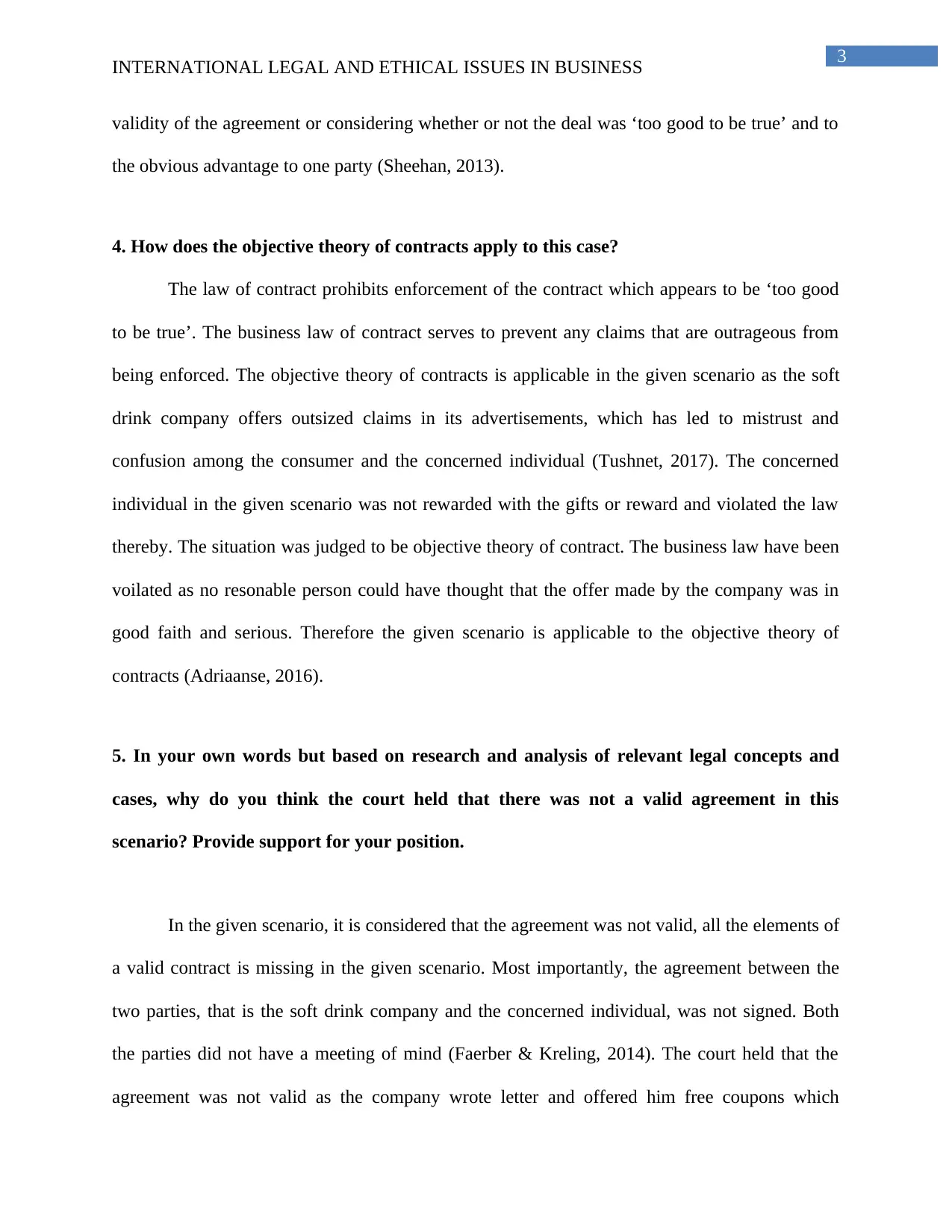
4. How does the objective theory of contracts apply to this case?
The law of contract prohibits enforcement of the contract which appears to be ‘too good
to be true’. The business law of contract serves to prevent any claims that are outrageous from
being enforced. The objective theory of contracts is applicable in the given scenario as the soft
drink company offers outsized claims in its advertisements, which has led to mistrust and
confusion among the consumer and the concerned individual (Tushnet, 2017). The concerned
individual in the given scenario was not rewarded with the gifts or reward and violated the law
thereby. The situation was judged to be objective theory of contract. The business law have been
voilated as no resonable person could have thought that the offer made by the company was in
good faith and serious. Therefore the given scenario is applicable to the objective theory of
contracts (Adriaanse, 2016).
5. In your own words but based on research and analysis of relevant legal concepts and
cases, why do you think the court held that there was not a valid agreement in this
scenario? Provide support for your position.
In the given scenario, it is considered that the agreement was not valid, all the elements of
a valid contract is missing in the given scenario. Most importantly, the agreement between the
two parties, that is the soft drink company and the concerned individual, was not signed. Both
the parties did not have a meeting of mind (Faerber & Kreling, 2014). The court held that the
agreement was not valid as the company wrote letter and offered him free coupons which
INTERNATIONAL LEGAL AND ETHICAL ISSUES IN BUSINESS
validity of the agreement or considering whether or not the deal was ‘too good to be true’ and to
the obvious advantage to one party (Sheehan, 2013).
4. How does the objective theory of contracts apply to this case?
The law of contract prohibits enforcement of the contract which appears to be ‘too good
to be true’. The business law of contract serves to prevent any claims that are outrageous from
being enforced. The objective theory of contracts is applicable in the given scenario as the soft
drink company offers outsized claims in its advertisements, which has led to mistrust and
confusion among the consumer and the concerned individual (Tushnet, 2017). The concerned
individual in the given scenario was not rewarded with the gifts or reward and violated the law
thereby. The situation was judged to be objective theory of contract. The business law have been
voilated as no resonable person could have thought that the offer made by the company was in
good faith and serious. Therefore the given scenario is applicable to the objective theory of
contracts (Adriaanse, 2016).
5. In your own words but based on research and analysis of relevant legal concepts and
cases, why do you think the court held that there was not a valid agreement in this
scenario? Provide support for your position.
In the given scenario, it is considered that the agreement was not valid, all the elements of
a valid contract is missing in the given scenario. Most importantly, the agreement between the
two parties, that is the soft drink company and the concerned individual, was not signed. Both
the parties did not have a meeting of mind (Faerber & Kreling, 2014). The court held that the
agreement was not valid as the company wrote letter and offered him free coupons which
Paraphrase This Document
Need a fresh take? Get an instant paraphrase of this document with our AI Paraphraser

4
INTERNATIONAL LEGAL AND ETHICAL ISSUES IN BUSINESS
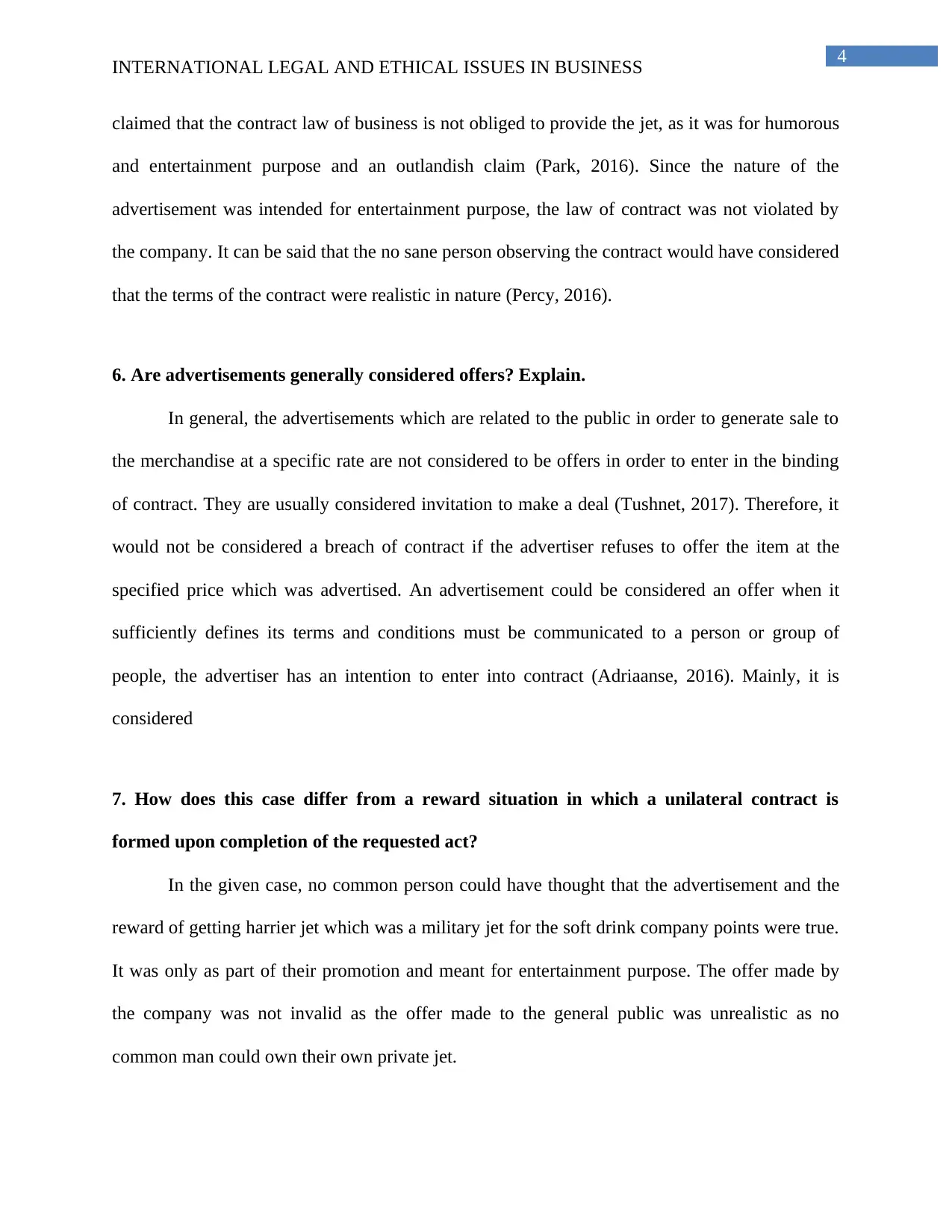
claimed that the contract law of business is not obliged to provide the jet, as it was for humorous
and entertainment purpose and an outlandish claim (Park, 2016). Since the nature of the
advertisement was intended for entertainment purpose, the law of contract was not violated by
the company. It can be said that the no sane person observing the contract would have considered
that the terms of the contract were realistic in nature (Percy, 2016).
6. Are advertisements generally considered offers? Explain.
In general, the advertisements which are related to the public in order to generate sale to
the merchandise at a specific rate are not considered to be offers in order to enter in the binding
of contract. They are usually considered invitation to make a deal (Tushnet, 2017). Therefore, it
would not be considered a breach of contract if the advertiser refuses to offer the item at the
specified price which was advertised. An advertisement could be considered an offer when it
sufficiently defines its terms and conditions must be communicated to a person or group of
people, the advertiser has an intention to enter into contract (Adriaanse, 2016). Mainly, it is
considered
7. How does this case differ from a reward situation in which a unilateral contract is
formed upon completion of the requested act?
In the given case, no common person could have thought that the advertisement and the
reward of getting harrier jet which was a military jet for the soft drink company points were true.
It was only as part of their promotion and meant for entertainment purpose. The offer made by
the company was not invalid as the offer made to the general public was unrealistic as no
common man could own their own private jet.
INTERNATIONAL LEGAL AND ETHICAL ISSUES IN BUSINESS
claimed that the contract law of business is not obliged to provide the jet, as it was for humorous
and entertainment purpose and an outlandish claim (Park, 2016). Since the nature of the
advertisement was intended for entertainment purpose, the law of contract was not violated by
the company. It can be said that the no sane person observing the contract would have considered
that the terms of the contract were realistic in nature (Percy, 2016).
6. Are advertisements generally considered offers? Explain.
In general, the advertisements which are related to the public in order to generate sale to
the merchandise at a specific rate are not considered to be offers in order to enter in the binding
of contract. They are usually considered invitation to make a deal (Tushnet, 2017). Therefore, it
would not be considered a breach of contract if the advertiser refuses to offer the item at the
specified price which was advertised. An advertisement could be considered an offer when it
sufficiently defines its terms and conditions must be communicated to a person or group of
people, the advertiser has an intention to enter into contract (Adriaanse, 2016). Mainly, it is
considered
7. How does this case differ from a reward situation in which a unilateral contract is
formed upon completion of the requested act?
In the given case, no common person could have thought that the advertisement and the
reward of getting harrier jet which was a military jet for the soft drink company points were true.
It was only as part of their promotion and meant for entertainment purpose. The offer made by
the company was not invalid as the offer made to the general public was unrealistic as no
common man could own their own private jet.

5
INTERNATIONAL LEGAL AND ETHICAL ISSUES IN BUSINESS
8. What recommendations (at least 2) would you make for a company considering an
aggressive marketing campaign with giveaways of high value items? Explain the rationale
behind each recommendation.
It is recommended that the company could have used social network advertising. It is
considered as the best consumer research tool (Percy, 2016). The advertisements can be posted
on the social media platforms. It is also recommended that the company should properly tune the
message; there should be fine tuning of the message. There should be a warning message saying
that it is for entertainment purpose, this could avoid confusion and mistrust (Sheehan, 2013).
INTERNATIONAL LEGAL AND ETHICAL ISSUES IN BUSINESS
8. What recommendations (at least 2) would you make for a company considering an
aggressive marketing campaign with giveaways of high value items? Explain the rationale
behind each recommendation.
It is recommended that the company could have used social network advertising. It is
considered as the best consumer research tool (Percy, 2016). The advertisements can be posted
on the social media platforms. It is also recommended that the company should properly tune the
message; there should be fine tuning of the message. There should be a warning message saying
that it is for entertainment purpose, this could avoid confusion and mistrust (Sheehan, 2013).
⊘ This is a preview!⊘
Do you want full access?
Subscribe today to unlock all pages.

Trusted by 1+ million students worldwide

6
INTERNATIONAL LEGAL AND ETHICAL ISSUES IN BUSINESS
References
Faerber, A. E., & Kreling, D. H. (2014). Content analysis of false and misleading claims in
television advertising for prescription and nonprescription drugs. Journal of general
internal medicine, 29(1), 110-118.
Fullerton, J. A., Kendrick, A., & McKinnon, L. M. (2013). Advertising ethics: Student attitudes
and behavioral intent. Journalism & Mass Communication Educator, 68(1), 33-49.
Goodchild, A., Herring, C., & Milosevic, Z. (2017). Business Contracts for B2B. ISDO, 30.
Lee, M., & Johnson, C. (2013). Principles of advertising: a global perspective. Routledge.
McKendrick, E. (2014). Contract law: text, cases, and materials. Oxford University Press (UK).
Park, W. W. (2016). Arbitration of International Contract Disputes. Bus. Law., 39, 1783.
Percy, L. (2016). Strategic advertising management. Oxford University Press.
Sheehan, K. B. (2013). Controversies in contemporary advertising. Sage Publications.
Tushnet, M. (2017). Comparative constitutional law. In The Oxford handbook of comparative
law.
Adriaanse, M. J. (2016). Construction contract law. Macmillan International Higher Education.
INTERNATIONAL LEGAL AND ETHICAL ISSUES IN BUSINESS
References
Faerber, A. E., & Kreling, D. H. (2014). Content analysis of false and misleading claims in
television advertising for prescription and nonprescription drugs. Journal of general
internal medicine, 29(1), 110-118.
Fullerton, J. A., Kendrick, A., & McKinnon, L. M. (2013). Advertising ethics: Student attitudes
and behavioral intent. Journalism & Mass Communication Educator, 68(1), 33-49.
Goodchild, A., Herring, C., & Milosevic, Z. (2017). Business Contracts for B2B. ISDO, 30.
Lee, M., & Johnson, C. (2013). Principles of advertising: a global perspective. Routledge.
McKendrick, E. (2014). Contract law: text, cases, and materials. Oxford University Press (UK).
Park, W. W. (2016). Arbitration of International Contract Disputes. Bus. Law., 39, 1783.
Percy, L. (2016). Strategic advertising management. Oxford University Press.
Sheehan, K. B. (2013). Controversies in contemporary advertising. Sage Publications.
Tushnet, M. (2017). Comparative constitutional law. In The Oxford handbook of comparative
law.
Adriaanse, M. J. (2016). Construction contract law. Macmillan International Higher Education.
1 out of 7
Related Documents
Your All-in-One AI-Powered Toolkit for Academic Success.
+13062052269
info@desklib.com
Available 24*7 on WhatsApp / Email
Unlock your academic potential
Copyright © 2020–2026 A2Z Services. All Rights Reserved. Developed and managed by ZUCOL.