SPT 565 Module Three: International Sports Management Report Analysis

Verified

Added on  2023/06/03

|4
|738
|414
Report
AI Summary
This report analyzes key aspects of international sports management, focusing on national and organizational cultures and their interplay. It examines how cultural differences impact sports businesses operating in different countries, using the example of a US-based sports business in Japan. The report also evaluates the role of Corporate Social Responsibility (CSR) in overseas business operations, highlighting its advantages and providing an example of H&M's CSR policies. The analysis includes definitions of national and organizational culture, an exploration of how these cultures overlap and separate in a global business context, and a discussion of CSR's impact on reputation, employee relations, and market competitiveness. The assignment fulfills the requirements of SPT 565 Module Three, providing insights into current trends and future developments in international sports management.
Document Page
Running head: INTERNATIONAL SPORTS MANAGEMENT
INTERNATIONAL SPORTS MANAGEMENT
Name of the Student
Name of the University
Author note
tabler-icon-diamond-filled.svg

Paraphrase This Document

Need a fresh take? Get an instant paraphrase of this document with our AI Paraphraser
Document Page
2INTERNATIONAL SPORTS MANAGEMENT
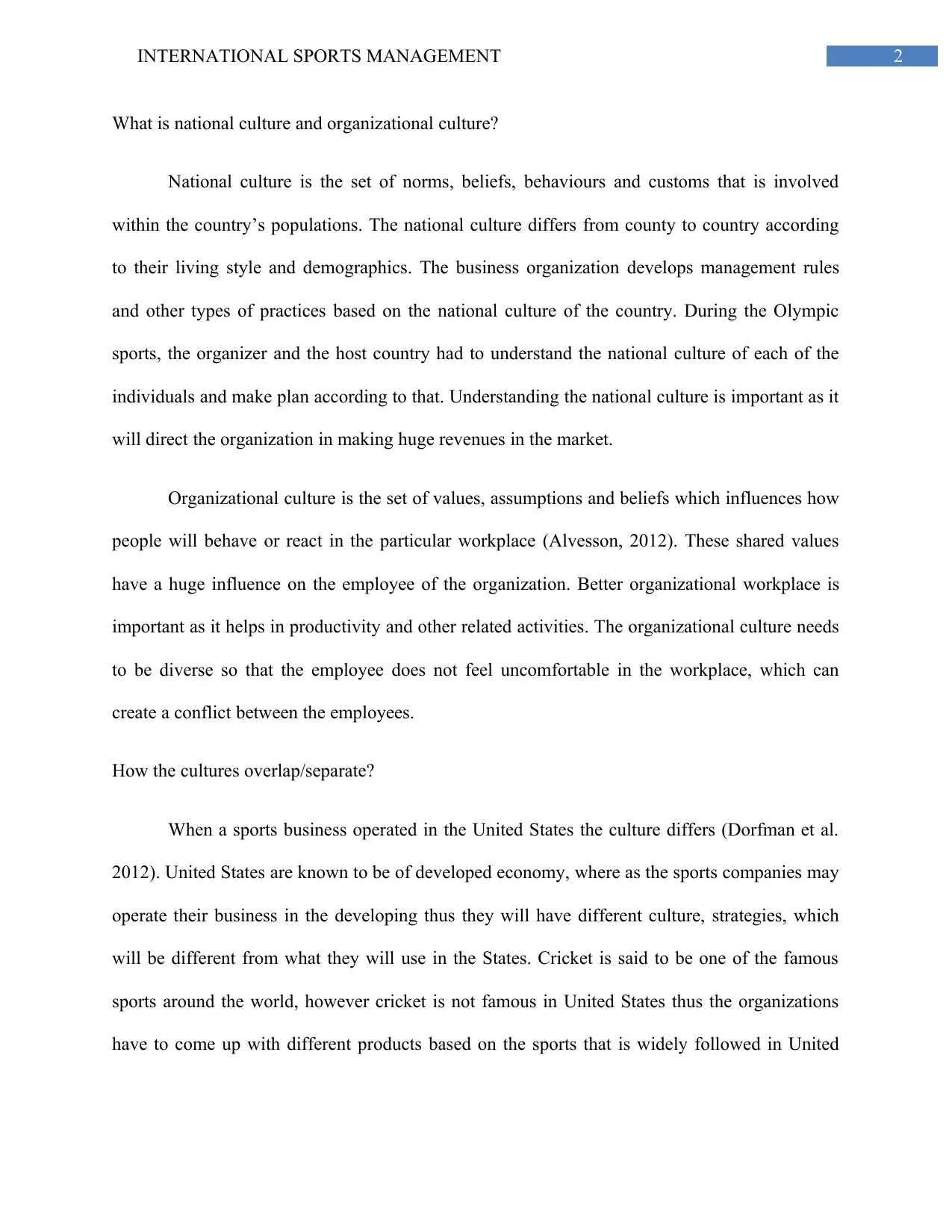
What is national culture and organizational culture?
National culture is the set of norms, beliefs, behaviours and customs that is involved
within the country’s populations. The national culture differs from county to country according
to their living style and demographics. The business organization develops management rules
and other types of practices based on the national culture of the country. During the Olympic
sports, the organizer and the host country had to understand the national culture of each of the
individuals and make plan according to that. Understanding the national culture is important as it
will direct the organization in making huge revenues in the market.
Organizational culture is the set of values, assumptions and beliefs which influences how
people will behave or react in the particular workplace (Alvesson, 2012). These shared values
have a huge influence on the employee of the organization. Better organizational workplace is
important as it helps in productivity and other related activities. The organizational culture needs
to be diverse so that the employee does not feel uncomfortable in the workplace, which can
create a conflict between the employees.
How the cultures overlap/separate?
When a sports business operated in the United States the culture differs (Dorfman et al.
2012). United States are known to be of developed economy, where as the sports companies may
operate their business in the developing thus they will have different culture, strategies, which
will be different from what they will use in the States. Cricket is said to be one of the famous
sports around the world, however cricket is not famous in United States thus the organizations
have to come up with different products based on the sports that is widely followed in United
Document Page
3INTERNATIONAL SPORTS MANAGEMENT
States. The culture between the United States and other countries differ thus the operations of the
organization will also differ.
Corporate Social Responsibility in international market:
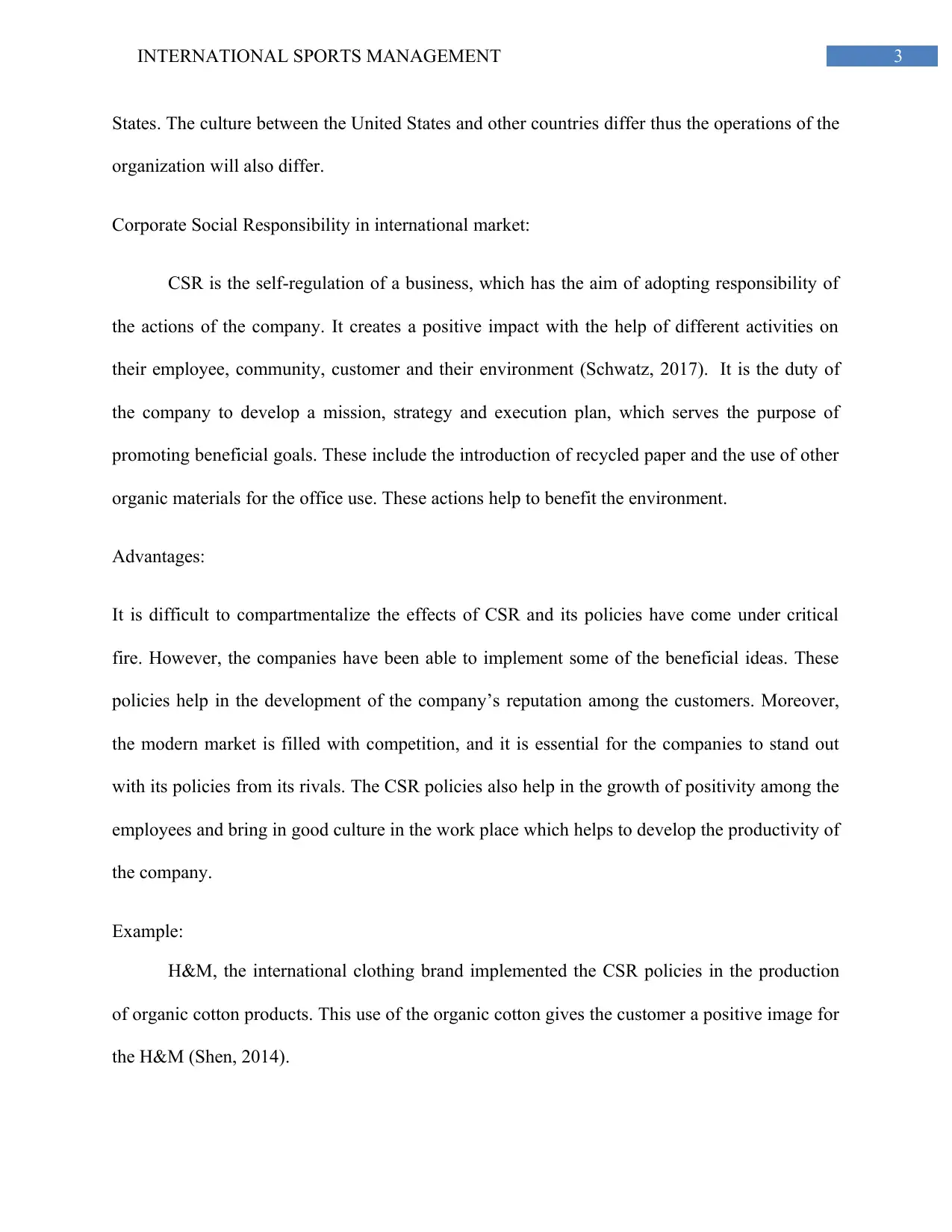
CSR is the self-regulation of a business, which has the aim of adopting responsibility of
the actions of the company. It creates a positive impact with the help of different activities on
their employee, community, customer and their environment (Schwatz, 2017). It is the duty of
the company to develop a mission, strategy and execution plan, which serves the purpose of
promoting beneficial goals. These include the introduction of recycled paper and the use of other
organic materials for the office use. These actions help to benefit the environment.
Advantages:
It is difficult to compartmentalize the effects of CSR and its policies have come under critical
fire. However, the companies have been able to implement some of the beneficial ideas. These
policies help in the development of the company’s reputation among the customers. Moreover,
the modern market is filled with competition, and it is essential for the companies to stand out
with its policies from its rivals. The CSR policies also help in the growth of positivity among the
employees and bring in good culture in the work place which helps to develop the productivity of
the company.
Example:
H&M, the international clothing brand implemented the CSR policies in the production
of organic cotton products. This use of the organic cotton gives the customer a positive image for
the H&M (Shen, 2014).
Document Page
4INTERNATIONAL SPORTS MANAGEMENT
References:
Schwartz, M. S. (2017). Corporate social responsibility. Routledge.
Shen, B. (2014). Sustainable fashion supply chain: Lessons from H&M. Sustainability, 6(9),
6236-6249.
Alvesson, M. (2012). Understanding organizational culture. Sage.
Dorfman, P., Javidan, M., Hanges, P., Dastmalchian, A., & House, R. (2012). GLOBE: A twenty
year journey into the intriguing world of culture and leadership. Journal of World
Business, 47(4), 504-518.
chevron_up_icon
1 out of 4
circle_padding
hide_on_mobile
zoom_out_icon
[object Object]