ITECH1100: IoT Disruption & Business Process in Insurance Industry
VerifiedAdded on 2023/03/30
|10
|1872
|477
Report
AI Summary
This report examines the transformative impact of the Internet of Things (IoT) on the insurance industry. It begins by introducing the insurance industry and IoT technology, then brainstorms potential benefits such as improved customer data, fraud detection, and personalized products. The report also addresses regulatory and ethical considerations, highlighting concerns about data security and compliance with Lawrence Lessig's regulatory factors (architecture, market, law, and norms). Furthermore, it discusses the disruptive potential of IoT in automating processes and enhancing data security. The report includes business process models illustrating the transition from 'AS-IS' manual processes to 'TO-BE' automated processes with IoT. Finally, the report concludes that the implementation of IoT technology promises to enhance the effectiveness and efficiency of the insurance industry.
Running head: INTERNET OF THINGS IN INSURANCE INDUSTRY
Internet of Things in Insurance Industry
Name of the student:
Name of the university:
Author Note:
Internet of Things in Insurance Industry
Name of the student:
Name of the university:
Author Note:

Paraphrase This Document
Need a fresh take? Get an instant paraphrase of this document with our AI Paraphraser
1IOT IN INSURANCE INDUSTRY
Table of Contents
1. Introduction............................................................................................................................2
2. Brainstorming.........................................................................................................................3
3. Regulation and Ethics............................................................................................................4
4. Disruption...............................................................................................................................5
5. Business Process Model.........................................................................................................6
5.1 The AS-IS Model.............................................................................................................6
5.2 The TO-BE Model...........................................................................................................7
6. Conclusion..............................................................................................................................7
7. References..............................................................................................................................8
Table of Contents
1. Introduction............................................................................................................................2
2. Brainstorming.........................................................................................................................3
3. Regulation and Ethics............................................................................................................4
4. Disruption...............................................................................................................................5
5. Business Process Model.........................................................................................................6
5.1 The AS-IS Model.............................................................................................................6
5.2 The TO-BE Model...........................................................................................................7
6. Conclusion..............................................................................................................................7
7. References..............................................................................................................................8
2IOT IN INSURANCE INDUSTRY
1. Introduction
The industry
The insurance industry is said to be a set of companies that provides protection to
sustainable customers from financial loss. This is a type of risk management technique that is
adhered by the normal people for preventing themselves front the state of financial loss. This
industry provides mainly three varieties of insurance policies that are identified as life
insurance, health insurance and liability insurance (Kshetri, 2017). The preliminary
possession of the insurance corporations can be viewed in two forms that are shareholder
possession and policyholder possession. The insurance industries seeks to indemnify an
insurer with a policy of reimbursement, pay on behalf policy and lastly an indemnification
policy. The first policy is the state of policy for which an insurer is paid for his or her loss.
Secondly, the insurance is said to be the reimbursement of the policy in which the financial
loss is reimbursed for the loss of the insurer.
The technology
The IoT is said to be the technology of the interrelated devices of computing or the
mechanical as well as the digital machines, which incorporates with the identifiers that are
unique and comprises of the capability of transferring information within overall network.
This procedure is followed without the requirement of the human-to-human interaction as
well as human to computer interaction (Sun et al., 2016). This technology is said to be an
eco-system that comprises of the smart devices that are enabled by web, which uses
embedded processors, communication hardware as well as sensors for the collection of the
data, which are collected from the environment. The deployment of the IoT applications
largely depends on the connectivity, communication as well as networking protocols within
the internet enabled devices. The primary benefits of this technology is to provide a critical
1. Introduction
The industry
The insurance industry is said to be a set of companies that provides protection to
sustainable customers from financial loss. This is a type of risk management technique that is
adhered by the normal people for preventing themselves front the state of financial loss. This
industry provides mainly three varieties of insurance policies that are identified as life
insurance, health insurance and liability insurance (Kshetri, 2017). The preliminary
possession of the insurance corporations can be viewed in two forms that are shareholder
possession and policyholder possession. The insurance industries seeks to indemnify an
insurer with a policy of reimbursement, pay on behalf policy and lastly an indemnification
policy. The first policy is the state of policy for which an insurer is paid for his or her loss.
Secondly, the insurance is said to be the reimbursement of the policy in which the financial
loss is reimbursed for the loss of the insurer.
The technology
The IoT is said to be the technology of the interrelated devices of computing or the
mechanical as well as the digital machines, which incorporates with the identifiers that are
unique and comprises of the capability of transferring information within overall network.
This procedure is followed without the requirement of the human-to-human interaction as
well as human to computer interaction (Sun et al., 2016). This technology is said to be an
eco-system that comprises of the smart devices that are enabled by web, which uses
embedded processors, communication hardware as well as sensors for the collection of the
data, which are collected from the environment. The deployment of the IoT applications
largely depends on the connectivity, communication as well as networking protocols within
the internet enabled devices. The primary benefits of this technology is to provide a critical
⊘ This is a preview!⊘
Do you want full access?
Subscribe today to unlock all pages.

Trusted by 1+ million students worldwide
3IOT IN INSURANCE INDUSTRY
monitoring as well as maintenance of the overall processes of the business as well as to
improve the experience of the customer.
2. Brainstorming
The primary impact of this technology focuses on the data of the customers that will
allow the insurers to understand their customers better gaining the potential data values of the
customers. This information may be stated as much more accurate to the insuring bodies for
providing insurance. Moreover, the data of the customers will be placed in a much safer
position regarding the usage of the IoT services (De Cremer, Nguyen & Simkin, 2017). This
will also enhance the insurers for detecting frauds and design personalized products regarding
the customers that will facilitate them in a much more effective level. This will further
enhance the customers to provide accurate estimates regarding the customer’s insurance. This
technology will provide better security to the customer’s data that are present within the
database of the insurance company. Moreover, once the data of a particular customer is stored
within the database of an insurance company it can easily be stated that the person again
going for other kind of insurance will not provide the necessary data as it can be extracted
from the database server of the insurance company itself. This ease the human work for the
overall procedure (Leverett, Clayton & Anderson, 2017). However, the implementation of the
technology in the sector of the insurance industry can provide effective welfare to the
customers or the society that are associated with the industry.
In addition to this, the technology will also support the environmental factor such as
the reduction usage of the paper within the insurance industry. The technology is said to
provide an enhanced characteristic in the cutting costs of the insurers (Friess, 2016). The
overall procedure of the automation can provide the decrease in the claims of the cost by
monitoring as well as maintenance of the overall processes of the business as well as to
improve the experience of the customer.
2. Brainstorming
The primary impact of this technology focuses on the data of the customers that will
allow the insurers to understand their customers better gaining the potential data values of the
customers. This information may be stated as much more accurate to the insuring bodies for
providing insurance. Moreover, the data of the customers will be placed in a much safer
position regarding the usage of the IoT services (De Cremer, Nguyen & Simkin, 2017). This
will also enhance the insurers for detecting frauds and design personalized products regarding
the customers that will facilitate them in a much more effective level. This will further
enhance the customers to provide accurate estimates regarding the customer’s insurance. This
technology will provide better security to the customer’s data that are present within the
database of the insurance company. Moreover, once the data of a particular customer is stored
within the database of an insurance company it can easily be stated that the person again
going for other kind of insurance will not provide the necessary data as it can be extracted
from the database server of the insurance company itself. This ease the human work for the
overall procedure (Leverett, Clayton & Anderson, 2017). However, the implementation of the
technology in the sector of the insurance industry can provide effective welfare to the
customers or the society that are associated with the industry.
In addition to this, the technology will also support the environmental factor such as
the reduction usage of the paper within the insurance industry. The technology is said to
provide an enhanced characteristic in the cutting costs of the insurers (Friess, 2016). The
overall procedure of the automation can provide the decrease in the claims of the cost by
Paraphrase This Document
Need a fresh take? Get an instant paraphrase of this document with our AI Paraphraser
4IOT IN INSURANCE INDUSTRY
30%. The paper work as well as cost cutting is said to be the most depicted factors in regards
to the implementation of this technology in the sector of insurance industry (Cortés, 2015).
Moreover, the automated cash preservation system may also be stated as the
innovated technology within the insurance industry that can ease the customers associated
with this industry to easily pay their premiums as well as their dues within the insurance
industry. This may help the customers that are residing very far from the insurance cash
deposit offices as well as cannot wait for long in a queue regarding their age as well as certain
disabilities (Elnagdy, Qiu & Gai, 2016). Thus this innovation can put a positive influence
regarding the social aspect of insurance industries.
3. Regulation and Ethics
As stated in the above study it can be depicted that the environmental factors
associated with this implementation of this technology can put a serious impact for the
implementation of the IoT technology. As the safety of the data is not under control by the
enacted IoT technology this can be taken as a serious issue in the insurance industry
(Gilchrist, 2016). The four factors are identified as the major constraints for the changes in
technology of the internet of things in this type of industry are pictured in accordance to
Lawrence Lessig’s regulations. These are stated as follows:
Architecture: The overall infrastructure of the insurance industry must be depicted in
an ease of access manner that can be easily accessed by the organization as well as the
individuals that are trying to take insurance from the industry (Haas, Haas & Weinert,
2015). The automation procedure of applying for the insurance as well as the easily
access of the customer’s data for the verification procedure has enhanced the growth
of this industry.
30%. The paper work as well as cost cutting is said to be the most depicted factors in regards
to the implementation of this technology in the sector of insurance industry (Cortés, 2015).
Moreover, the automated cash preservation system may also be stated as the
innovated technology within the insurance industry that can ease the customers associated
with this industry to easily pay their premiums as well as their dues within the insurance
industry. This may help the customers that are residing very far from the insurance cash
deposit offices as well as cannot wait for long in a queue regarding their age as well as certain
disabilities (Elnagdy, Qiu & Gai, 2016). Thus this innovation can put a positive influence
regarding the social aspect of insurance industries.
3. Regulation and Ethics
As stated in the above study it can be depicted that the environmental factors
associated with this implementation of this technology can put a serious impact for the
implementation of the IoT technology. As the safety of the data is not under control by the
enacted IoT technology this can be taken as a serious issue in the insurance industry
(Gilchrist, 2016). The four factors are identified as the major constraints for the changes in
technology of the internet of things in this type of industry are pictured in accordance to
Lawrence Lessig’s regulations. These are stated as follows:
Architecture: The overall infrastructure of the insurance industry must be depicted in
an ease of access manner that can be easily accessed by the organization as well as the
individuals that are trying to take insurance from the industry (Haas, Haas & Weinert,
2015). The automation procedure of applying for the insurance as well as the easily
access of the customer’s data for the verification procedure has enhanced the growth
of this industry.
5IOT IN INSURANCE INDUSTRY
Market: The marketing of the different schemes as depicted in an insurance industry
is also said to be strategic as well as automated via the usage of the social media and
different modes digitally (Catlin et al., 2018). This tends to provide the industry to
build the strong customer base regarding the users of this industry.
Law: As there is a financial involvement regarding the insurance industry there are
certain laws that are to be adhered by the customers as well as the industry to maintain
a legal and smooth relationship among them (Roblek, Meško & Krapež, 2016).
Norms: The facilities as provided by the technology in the insurance industry it can be
depicted well that the society will be very much influenced by the implementation of
this technology. This can be said to be the identification of the usability norms
regarding the technological implementation of the IoT in this industry (DuBravac &
Ratti, 2015). The stated facilities that this technological disruption will provide to the
old people as well as to the persons with disabilities may be stated as the norms that
are taken in consideration with the insurance industry for providing better facilities.
4. Disruption
The disruption of the IoT technology in the insurance industry can be said as the
automation procedure of the group in providing effective facilities to the consumers as well
as the industries that are facilitated by the insurance industry. This technology is believed to
amplify the insurance industry business processes thus facilitating the organization as well as
its customers that are emphasized to be provided with enhanced services. The technological
disruption of IoT is also said to be the enhanced data preserving facility as provided by the
insurance industry. This technology is said to provide an enhanced level of security to the
data or the customer information that is to be well enhanced within the organization. The
safety feature of the data as well as organization of the saved data is said to be the most
Market: The marketing of the different schemes as depicted in an insurance industry
is also said to be strategic as well as automated via the usage of the social media and
different modes digitally (Catlin et al., 2018). This tends to provide the industry to
build the strong customer base regarding the users of this industry.
Law: As there is a financial involvement regarding the insurance industry there are
certain laws that are to be adhered by the customers as well as the industry to maintain
a legal and smooth relationship among them (Roblek, Meško & Krapež, 2016).
Norms: The facilities as provided by the technology in the insurance industry it can be
depicted well that the society will be very much influenced by the implementation of
this technology. This can be said to be the identification of the usability norms
regarding the technological implementation of the IoT in this industry (DuBravac &
Ratti, 2015). The stated facilities that this technological disruption will provide to the
old people as well as to the persons with disabilities may be stated as the norms that
are taken in consideration with the insurance industry for providing better facilities.
4. Disruption
The disruption of the IoT technology in the insurance industry can be said as the
automation procedure of the group in providing effective facilities to the consumers as well
as the industries that are facilitated by the insurance industry. This technology is believed to
amplify the insurance industry business processes thus facilitating the organization as well as
its customers that are emphasized to be provided with enhanced services. The technological
disruption of IoT is also said to be the enhanced data preserving facility as provided by the
insurance industry. This technology is said to provide an enhanced level of security to the
data or the customer information that is to be well enhanced within the organization. The
safety feature of the data as well as organization of the saved data is said to be the most
⊘ This is a preview!⊘
Do you want full access?
Subscribe today to unlock all pages.
Trusted by 1+ million students worldwide
6IOT IN INSURANCE INDUSTRY
important innovation that is to be provided with the technological influence of the internet of
technology within this industrial sector.
5. Business Process Model
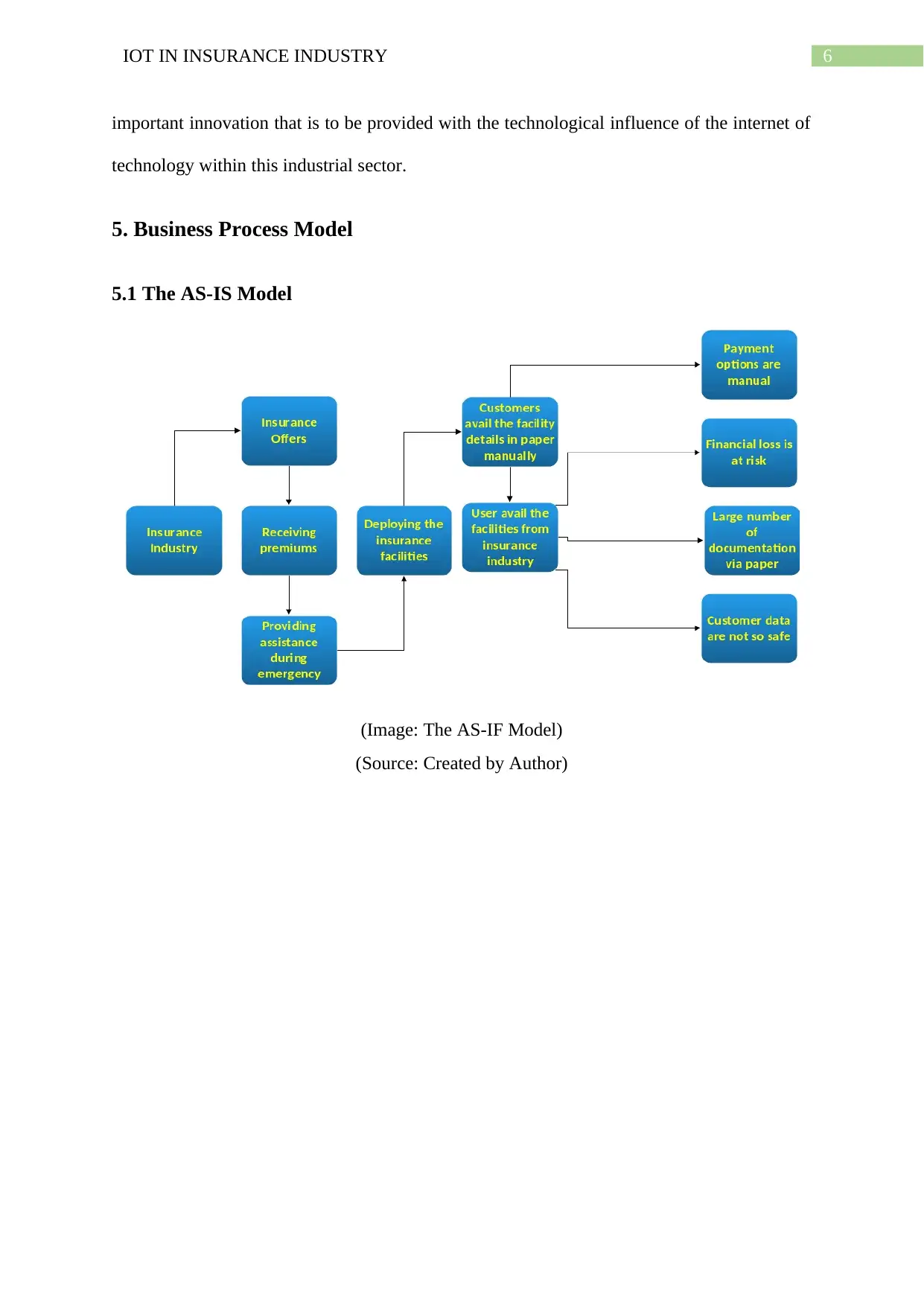
5.1 The AS-IS Model
(Image: The AS-IF Model)
(Source: Created by Author)
important innovation that is to be provided with the technological influence of the internet of
technology within this industrial sector.
5. Business Process Model
5.1 The AS-IS Model
(Image: The AS-IF Model)
(Source: Created by Author)
Paraphrase This Document
Need a fresh take? Get an instant paraphrase of this document with our AI Paraphraser
7IOT IN INSURANCE INDUSTRY
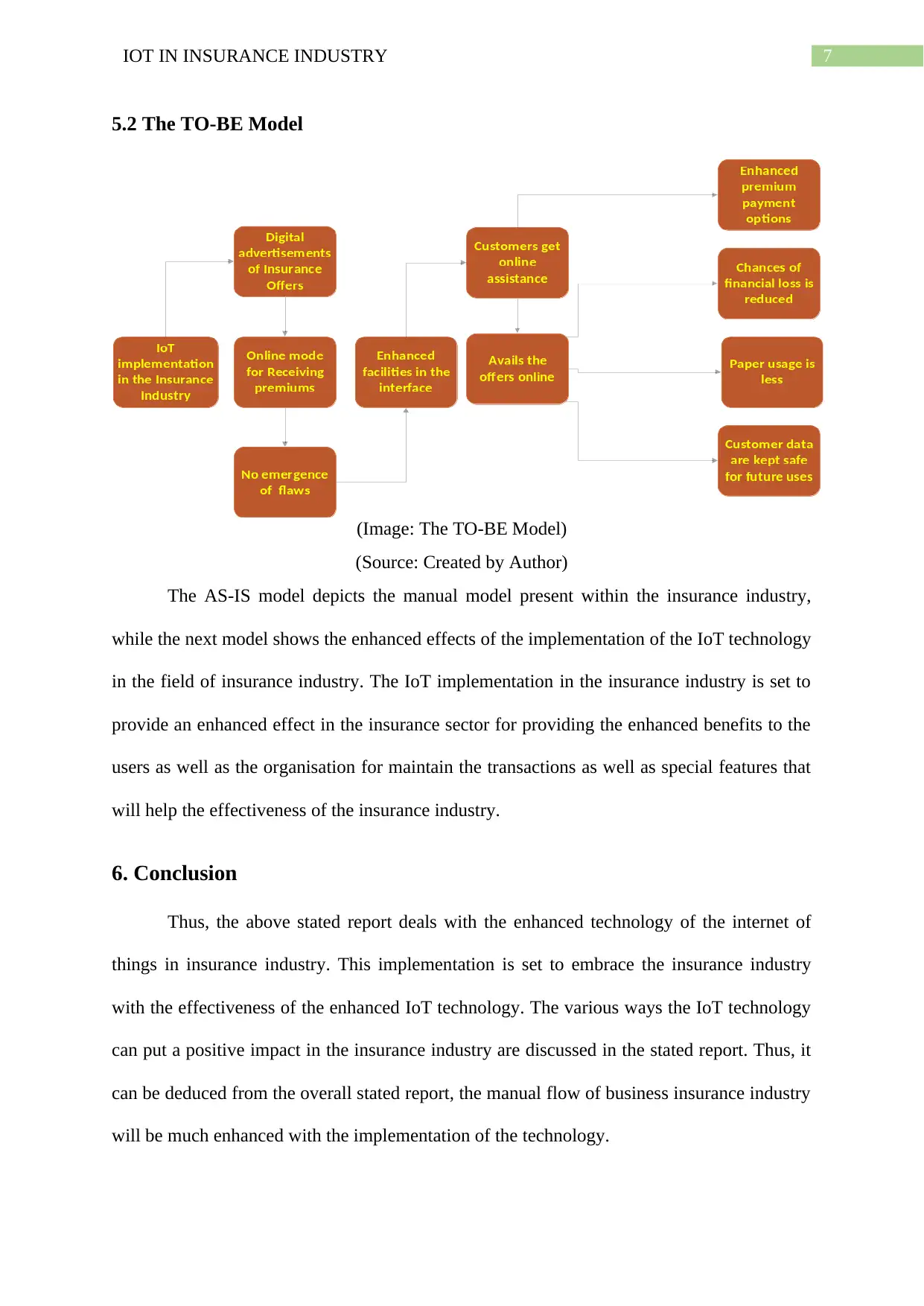
5.2 The TO-BE Model
(Image: The TO-BE Model)
(Source: Created by Author)
The AS-IS model depicts the manual model present within the insurance industry,
while the next model shows the enhanced effects of the implementation of the IoT technology
in the field of insurance industry. The IoT implementation in the insurance industry is set to
provide an enhanced effect in the insurance sector for providing the enhanced benefits to the
users as well as the organisation for maintain the transactions as well as special features that
will help the effectiveness of the insurance industry.
6. Conclusion
Thus, the above stated report deals with the enhanced technology of the internet of
things in insurance industry. This implementation is set to embrace the insurance industry
with the effectiveness of the enhanced IoT technology. The various ways the IoT technology
can put a positive impact in the insurance industry are discussed in the stated report. Thus, it
can be deduced from the overall stated report, the manual flow of business insurance industry
will be much enhanced with the implementation of the technology.
5.2 The TO-BE Model
(Image: The TO-BE Model)
(Source: Created by Author)
The AS-IS model depicts the manual model present within the insurance industry,
while the next model shows the enhanced effects of the implementation of the IoT technology
in the field of insurance industry. The IoT implementation in the insurance industry is set to
provide an enhanced effect in the insurance sector for providing the enhanced benefits to the
users as well as the organisation for maintain the transactions as well as special features that
will help the effectiveness of the insurance industry.
6. Conclusion
Thus, the above stated report deals with the enhanced technology of the internet of
things in insurance industry. This implementation is set to embrace the insurance industry
with the effectiveness of the enhanced IoT technology. The various ways the IoT technology
can put a positive impact in the insurance industry are discussed in the stated report. Thus, it
can be deduced from the overall stated report, the manual flow of business insurance industry
will be much enhanced with the implementation of the technology.
8IOT IN INSURANCE INDUSTRY
7. References
Catlin, T., Lorenz, J. T., Nandan, J., Sharma, S., & Waschto, A. (2018). Insurance beyond
digital: The rise of ecosystems and platforms. McKinsey & Company.
Cortés, B., Boza, A., Pérez, D., & Cuenca, L. (2015). Internet of things applications on
supply chain management. International Journal of Computer, Electrical,
Automation, Control and Information Engineering, 9(12), 2493-2498.
De Cremer, D., Nguyen, B., & Simkin, L. (2017). The integrity challenge of the Internet-of-
Things (IoT): on understanding its dark side. Journal of Marketing Management,
33(1-2), 145-158.
DuBravac, S., & Ratti, C. (2015). The Internet of Things: Evolution or Revolution?. Part1
series, 1.
Elnagdy, S. A., Qiu, M., & Gai, K. (2016, June). Understanding taxonomy of cyber risks for
cybersecurity insurance of financial industry in cloud computing. In 2016 IEEE 3rd
International Conference on Cyber Security and Cloud Computing (CSCloud) (pp.
295-300). IEEE.
Friess, P. (2016). Digitising the industry-internet of things connecting the physical, digital
and virtual worlds. River Publishers.
Gilchrist, A. (2016). Industry 4.0: the industrial internet of things. Apress.
Haas, A., Haas, M., & Weinert, M. (2015, July). The Internet of Things is already here, but
who bears the risks. In World Risk and Insurance Economics Congress (pp. 1-30).
Kshetri, N. (2017). The economics of the Internet of Things in the Global South. Third World
Quarterly, 38(2), 311-339.
7. References
Catlin, T., Lorenz, J. T., Nandan, J., Sharma, S., & Waschto, A. (2018). Insurance beyond
digital: The rise of ecosystems and platforms. McKinsey & Company.
Cortés, B., Boza, A., Pérez, D., & Cuenca, L. (2015). Internet of things applications on
supply chain management. International Journal of Computer, Electrical,
Automation, Control and Information Engineering, 9(12), 2493-2498.
De Cremer, D., Nguyen, B., & Simkin, L. (2017). The integrity challenge of the Internet-of-
Things (IoT): on understanding its dark side. Journal of Marketing Management,
33(1-2), 145-158.
DuBravac, S., & Ratti, C. (2015). The Internet of Things: Evolution or Revolution?. Part1
series, 1.
Elnagdy, S. A., Qiu, M., & Gai, K. (2016, June). Understanding taxonomy of cyber risks for
cybersecurity insurance of financial industry in cloud computing. In 2016 IEEE 3rd
International Conference on Cyber Security and Cloud Computing (CSCloud) (pp.
295-300). IEEE.
Friess, P. (2016). Digitising the industry-internet of things connecting the physical, digital
and virtual worlds. River Publishers.
Gilchrist, A. (2016). Industry 4.0: the industrial internet of things. Apress.
Haas, A., Haas, M., & Weinert, M. (2015, July). The Internet of Things is already here, but
who bears the risks. In World Risk and Insurance Economics Congress (pp. 1-30).
Kshetri, N. (2017). The economics of the Internet of Things in the Global South. Third World
Quarterly, 38(2), 311-339.
⊘ This is a preview!⊘
Do you want full access?
Subscribe today to unlock all pages.
Trusted by 1+ million students worldwide
9IOT IN INSURANCE INDUSTRY
Leverett, É., Clayton, R., & Anderson, R. (2017, May). Standardisation and Certification of
the ‘Internet of Things’. In Proceedings of WEIS (pp. 1-24).
Roblek, V., Meško, M., & Krapež, A. (2016). A complex view of industry 4.0. Sage Open,
6(2), 2158244016653987.
Sun, W., Zhu, J., Duan, N., Gao, P., Hu, G. Q., Dong, W. S., ... & Huang, J. C. (2016, July).
Moving object map analytics: A framework enabling contextual spatial-temporal
analytics of internet of things applications. In 2016 IEEE International Conference on
Service Operations and Logistics, and Informatics (SOLI) (pp. 101-106). IEEE.
Leverett, É., Clayton, R., & Anderson, R. (2017, May). Standardisation and Certification of
the ‘Internet of Things’. In Proceedings of WEIS (pp. 1-24).
Roblek, V., Meško, M., & Krapež, A. (2016). A complex view of industry 4.0. Sage Open,
6(2), 2158244016653987.
Sun, W., Zhu, J., Duan, N., Gao, P., Hu, G. Q., Dong, W. S., ... & Huang, J. C. (2016, July).
Moving object map analytics: A framework enabling contextual spatial-temporal
analytics of internet of things applications. In 2016 IEEE International Conference on
Service Operations and Logistics, and Informatics (SOLI) (pp. 101-106). IEEE.

1 out of 10


Related Documents


Your All-in-One AI-Powered Toolkit for Academic Success.
+13062052269
info@desklib.com
Available 24*7 on WhatsApp / Email
![[object Object]](/_next/static/media/star-bottom.7253800d.svg)
Unlock your academic potential
Copyright © 2020–2026 A2Z Services. All Rights Reserved. Developed and managed by ZUCOL.