Analyzing the Role of the Internet in Social and Political Change

Verified

Added on  2020/05/01

|6
|1410
|56
Essay
AI Summary
This essay examines the significant role of the internet and social media in driving social and political change. It explores how online platforms facilitate political activism, enabling strategies like online petitions, forums, and fundraising to influence political processes. The essay highlights how these platforms overcome obstacles to participation, such as time constraints and financial limitations, fostering broader engagement and allowing for the dissemination of information and networking among supporters. The essay also analyzes the impact of the Environmental Justice movement, demonstrating how it has utilized the internet to give voice to marginalized communities, promote environmental awareness, and advocate for policy changes. The movement has led to changes in cultural practices and legal frameworks, highlighting the internet's role in shaping both social and political landscapes. The essay concludes by emphasizing the effectiveness of the internet and social media in promoting social and political change within communities.

Document Page
Running head: GLOBAL STRUCTURE
Global Structure
Name:
Institution
tabler-icon-diamond-filled.svg

Paraphrase This Document

Need a fresh take? Get an instant paraphrase of this document with our AI Paraphraser
Document Page
GLOBAL STRUCTURE 2
The role of the internet in generating social and political change
In a systematic study, Butsch (2007) points out that with the advancement of new
technology, the internet and specifically social media is adopted for different uses in both
political and social platforms. Online money-bombs, virtual petitions, forums for debating issues,
and emails for recruitments for protests and meetings are all strategies adopted by political
activists in engaging the citizen with the aim of influencing various political processes.
Eltantawy and Wiest (2007) also denote that social movements across the political arena are
among technological platforms adopted in effecting change while influencing party politics.
However, little is known on how what difference it makes or how it is used to achieve the
projected results.
Internet or social media is used to overcome obstactacles to social and political
participation Leenders and Heydemann (2012). For instance, online groups overcome challenges
like time constrains, low income, and lack of skills within the participants. Online movements
allow people to choose what and when to click without any charge on membership dues. It hence
encourages participation with the aim of allowing the participants to share opinions, keep
informed, donate finances, and sign petitions. Hawkins (2013) also denotes that successful online
political or social groups use networking and internet communication in teaching the support on
new skills hence getting them involved in the real world. The strategy as well allows the use of
actions models in disseminating information and get in touch with other social or political
supporters. Effective political groups also adopt technology use to engage the public in getting
decision making support. For instance, hosting forums for discussion and asking participants to
Document Page
GLOBAL STRUCTURE 3
give their opinions about highlighted issues sustains support for the course as the members will
see the organization as responsive and democratic to their feedback.
Social media is also used to help movements to downplay controversies while stressing
on big ideas according to Butsch (2007). Rather than promoting detailed platforms on specialized
causes, internet savvy political activists in focusing to sell big ideas that can promote change to
the world. In such cases, they get chances of stressing themes that can unify rather than divide
people from various backgrounds. In other words, successful social movements avoid issues that
can divide supporters as they manage what is featured in their message. They hence adopt
priorities that unite supporters while learning what might reduce enthusiasm.
Hawkins (2013) also denotes that the ability of social media in leveraging internet
communication strategies with effectiveness help in changing dynamics between political parties
and movements. Political and social movements have always pressured parties while internet
movements have quick and heavy impacts. As a result, savvy movement use earned media,
advertising, and viral campaigns in building support for their issues while forcing political
parties to take up their cause. Other parties also use social media as platforms for raising
financial support for their activities, an aspect that has been seen to be successful as long as there
is a will of the people towards achieving the same objective. In conclusion, internet and social
media can effectively be use in promoting both social and political change in the community.
Effect of Environmental Justice Movement on the Social Change
According to Refle (2015) social movements are groups of people organized with a
purpose of working towards a specified goal like creating a change, resist a change or to offering
Document Page
GLOBAL STRUCTURE 4
a global voice as a result, the social movements always create social change among the
individuals. Miladi (2016) defines social change as significant alterations on behavioral patterns
and culture on a specific group of people for a given period as a result of a social movement. The
most common social movements include Brights Movement, environmental Justice Movement,
and many others. The paper examines how the Environmental Justice movement has affected the
social change and how its elements incorporated into the mainstream of politics and culture.
Environmental justice movements formed in United States, with a purpose of improving
and maintain an environment that is clean and healthful through reducing the pollutions since
human and environment affect each other. Banerjee (2013) explains that the movement
championed by African-Americans, Latinos, Asians and Native Americans that lived in the
polluted environment as a result of frequent hazardous dumps of waste on their ecology, that
thereafter perceived as a form of environmental racism. The occupants characterized by their
frequent protestations against the government that led to a number of violence and destructions
of properties.
Environmental justice movement has gained momentum and brought different social
changes across the world through giving voice to those that lived in the most damaged and
polluted lands to air their grievances resulting into more communal solidarity. The continual
fight for clean environments, reduction on the loss of lives and address on abuses on land
dispossession. Hawkins (2013) observes that the social movement improved both the economic
and human rights of the victims that lived in those polluted and damaged lands globally as the
movements are connected. The campaign has formed a vast continuum of activism passed from
tabler-icon-diamond-filled.svg

Paraphrase This Document

Need a fresh take? Get an instant paraphrase of this document with our AI Paraphraser
Document Page
GLOBAL STRUCTURE 5
one individual to another through different generations that adopt different styles, organizational
structure, and policies to achieve.
The environmental movement has dominated in some legal issues and debates that have
seen the formation of many policies and bill of rights and global activists to protect the social
justice and nature according to Jamison (2010). The bills and acts have seen the reclamation of
lands exhausted through mining of mineral resources, the provision of title deeds to the blacks
and climate change. As a result, the occupants have learned and adopted one another living with
respect. The policies have also to some extent changed the culture of some communities such as
the Anglo-Saxon, the Zulus, known for their hunting and fishing activities restricted by the anti-
gaming policies. Such policies have forced the communities to change their cultural events such
as wearing animal skins, to wearing clothes and to other economic activities that do not affect the
environment as explained by Welstead (2017). Most of the countries have recognized the
formally formed social movements that are legitimate and offered various supports such as
resources and legal protections; therefore it has moved from a more mobilizing agent for populist
protest to a more goal-oriented professional organization.
Document Page
GLOBAL STRUCTURE 6
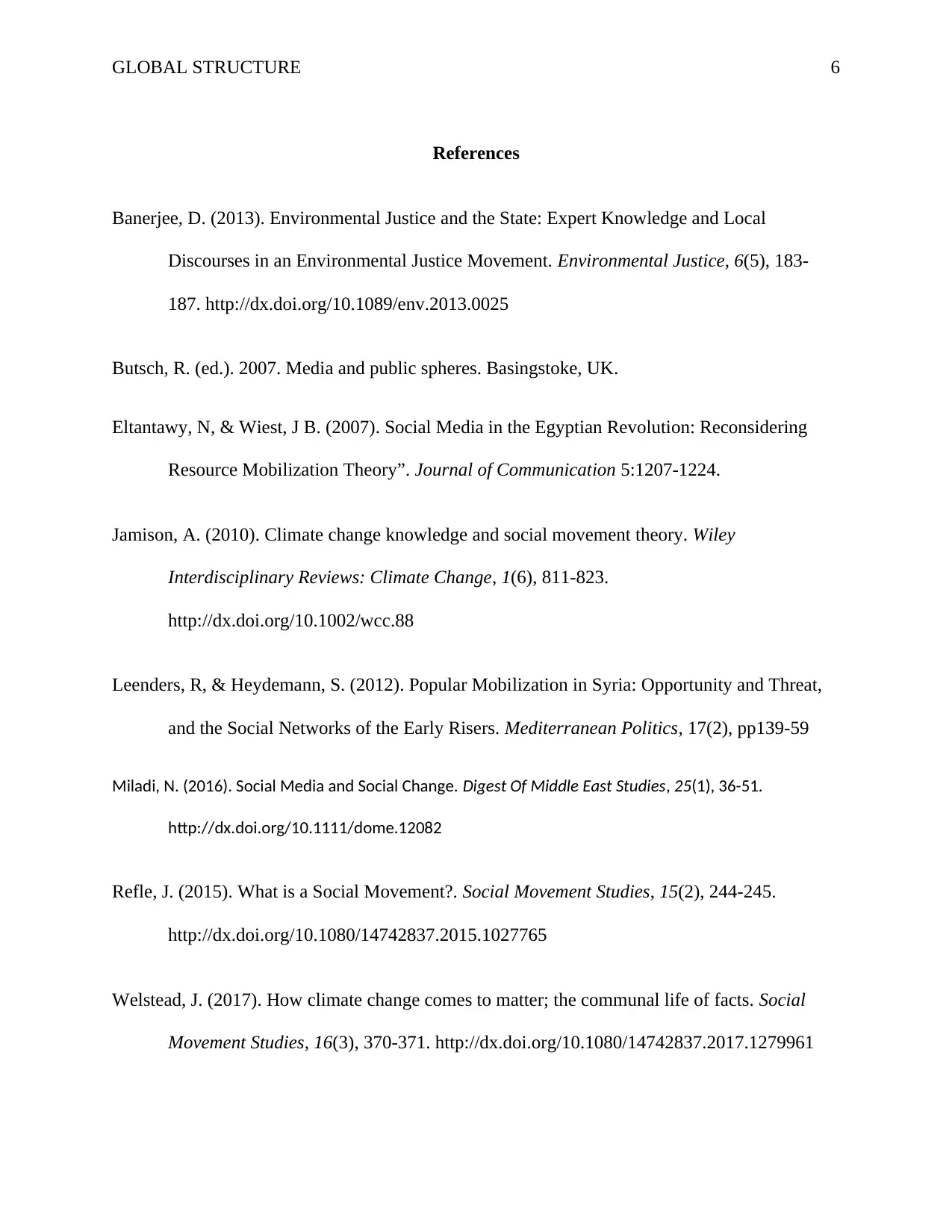
References
Banerjee, D. (2013). Environmental Justice and the State: Expert Knowledge and Local
Discourses in an Environmental Justice Movement. Environmental Justice, 6(5), 183-
187. http://dx.doi.org/10.1089/env.2013.0025
Butsch, R. (ed.). 2007. Media and public spheres. Basingstoke, UK.
Eltantawy, N, & Wiest, J B. (2007). Social Media in the Egyptian Revolution: Reconsidering
Resource Mobilization Theory”. Journal of Communication 5:1207-1224.
Jamison, A. (2010). Climate change knowledge and social movement theory. Wiley
Interdisciplinary Reviews: Climate Change, 1(6), 811-823.
http://dx.doi.org/10.1002/wcc.88
Leenders, R, & Heydemann, S. (2012). Popular Mobilization in Syria: Opportunity and Threat,
and the Social Networks of the Early Risers. Mediterranean Politics, 17(2), pp139-59
Miladi, N. (2016). Social Media and Social Change. Digest Of Middle East Studies, 25(1), 36-51.
http://dx.doi.org/10.1111/dome.12082
Refle, J. (2015). What is a Social Movement?. Social Movement Studies, 15(2), 244-245.
http://dx.doi.org/10.1080/14742837.2015.1027765
Welstead, J. (2017). How climate change comes to matter; the communal life of facts. Social
Movement Studies, 16(3), 370-371. http://dx.doi.org/10.1080/14742837.2017.1279961
chevron_up_icon
1 out of 6
circle_padding
hide_on_mobile
zoom_out_icon
[object Object]