Ethical Principles in Accounting: Case Studies and Violations

Verified

Added on  2020/03/23

|4
|705
|335
Report
AI Summary
This report delves into the realm of ethical principles within the accounting profession, examining various scenarios to determine whether ethical standards have been violated. It focuses on three specific cases: an auditor acting as a treasurer, a payment dispute between an auditing firm and a client, and an accountant providing clients to an insurance firm. The report analyzes each situation, identifying violations of ethical principles such as conflicts of interest and preferential treatment. It emphasizes the importance of upholding ethical conduct and prioritizing professional duties over personal financial gains. The report references several sources to support its analysis and conclusions, offering a comprehensive understanding of ethical considerations in accounting.
Document Page
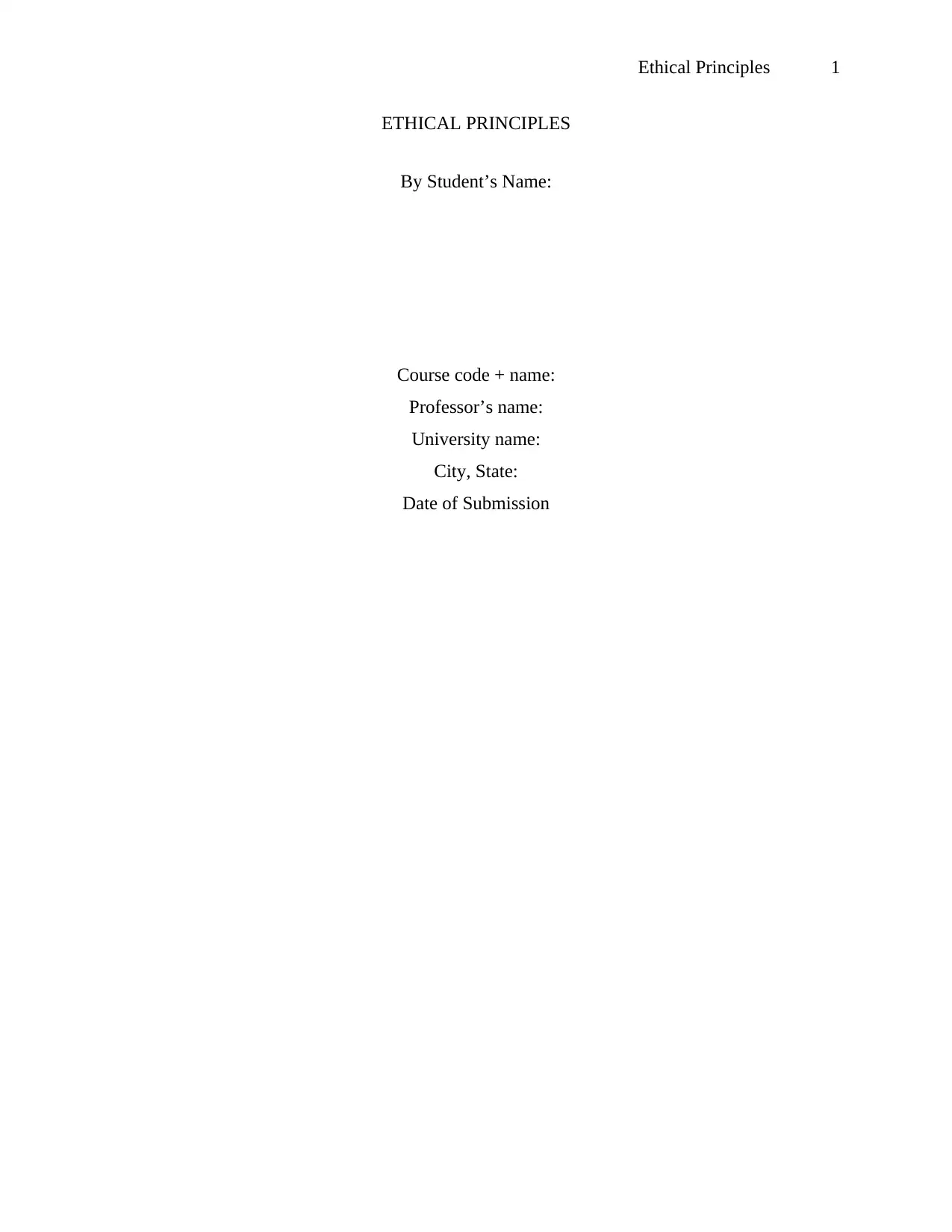
Ethical Principles 1
ETHICAL PRINCIPLES
By Student’s Name:
Course code + name:
Professor’s name:
University name:
City, State:
Date of Submission
tabler-icon-diamond-filled.svg

Paraphrase This Document

Need a fresh take? Get an instant paraphrase of this document with our AI Paraphraser
Document Page
Ethical Principles 2
Ethical principles comprise of a set of regulations that govern the general conduct of
individuals both in general behavior or at the work place. This discussion will be centered on
various circumstances which have been provided and an analysis can be done to determine
whether ethical standards were violated or not. The types of scenarios that have been presented
are anchored on the professional field of accounting.
The first scenario describes an auditor of a firm who has been selected to be the treasurer
of a firm. The treasurer does not execute the mandate upon an athletic club in his capacity as an
auditor. This implies that the auditor is out to conceal information concerning the company
accounts so that he can benefit from that venture. The ethical principle that was violated is the
one which states that any employee should not be engaged in any other activities or forms of
employment that are in conflict with their main duty. Another principle that Amy violates is that
his company is treating a private institution preferentially. (Childress 2015, p. 334-345)
In the second case, there are two institutions where one is an auditing firm. Apparently
the auditing firm which is Gordon Accountants has discharged its duty of verifying the accounts
of Simtec Limited within the appropriate time that was allocated. It is not clear whether there
was an initial agreement by the firms to pay the dues in the stipulated timelines. If there was such
an agreement, then it would be unethical for Simtec Company to withhold the payment until
Gordon Accountants submit their report. On the other hand it would be a gross violation for the
audit firm to demand for payment before completing its duty (Gill 2013, p. 89-100). The ethical
principle that guides this case is that all employees should always give ethical principles and the
law the fidelity that they deserve against the individual gains that the companies wish to derive
from such duties. Besides, there is another principle which reinforces the fact that the company
Document Page
Ethical Principles 3
employees should not put their financial gains ahead of the execution of duty in a conscious
manner. (Howie 2012, p. 87-90)
Lastly, there is a case of an accountant by the name David Dale. He has been asked by an
insurance firm known as Cheap Insurance Company to provide clients for the latter. In this case,
there is no form of violation of the ethical principles. Insurance is a virtue that should be
encouraged by the firms to safeguard the lives of their employees. If the accountant has clients
that do not have policies yet, there is no wrong in linking them to a firm that can provide the
services. In the issue of commissions, the accountant is entitled to it because he has contributed
towards the business prospects of the insurance firm. Ideally, the commissions would only be a
payment to appreciate such efforts. Given that the insurance firm would get some revenue from
the clients, it is only prudent that the company shares part of it with the contributors to their
business. (Zsolnai 2011, 54-55)
Document Page
Ethical Principles 4
References
Childress, J. F. (2015). Belmont revisited: Ethical principles for research with human subjects.
Washington, D.C: Georgetown Univ. Press. 67(7), 334-345
Gill, D. W. (2013). Doing Right: Practicing Ethical Principles. Westmont: InterVarsity Press.
78(43), 89-100
Howie, J. (2012). Ethical principles and practice. Carbondale: Southern Illinois University
Press. 32(9), 87-90
Zsolnai, L. (2011). Ethical principles and economic transformation-- a Buddhist approach.
Dordrecht: Springer. 13(34), 54-55
chevron_up_icon
1 out of 4
circle_padding
hide_on_mobile
zoom_out_icon
[object Object]