Business Entities: Comparing LLC and Partnership - ACTY 6320 Report
VerifiedAdded on 2022/09/26
|9
|3365
|16
Report
AI Summary
This report provides a comprehensive overview of different business ownership structures, including Limited Liability Companies (LLCs) and various types of partnerships (general and limited), with a focus on their characteristics, advantages, and disadvantages. It explores the legal considerations and incorporation processes within the context of New Zealand law, offering insights into how these structures impact liability, capital raising, ownership, and management. The report includes a detailed comparison table to highlight the key differences between LLCs, general partnerships, and limited partnerships, ultimately recommending the most suitable structure for business owners like Mr. and Mrs. Millionaire. The report highlights the importance of understanding business ownership to comply with legal requirements and make informed decisions. The report also touches upon the process of incorporating these types of entities, referencing relevant legislation and legal cases.
Introduction
There are various forms of business ownerships that venture capitalist have to put into
consideration when starting a business. The decision on what sort of business to start is essential to the
owner of the company, and thus careful deliberation on the needs of the business owner(s) and the
business should be considered before starting a business. All forms of business ownership have legal
considerations that have to be followed when the business is being set up. The business owner must
understand the rules of the land that govern the creation and operations of the business they intend to
open. This paper discusses the various forms of business ownership, including partnership and limited
liability companies. Also, the paper will discuss the merits and demerits of each kind of business and
how they can be created in New Zealand (Walker et al., 2012)
The understanding of the nature of business is essential for investors who aim to start a
business as it helps them make a decision on the form of business ownership that is most appropriate
for their business needs. In addition, the comprehension of the nature of business is essential. It enables
business owners and investors to fulfil their legal requirements and compliances in order to operate a
given business. This, in turn, helps them to avoid conflicts with the government authorities.
It is crucial to identify the number of business owners as it leads to seamless running and
management of the business. Mr. and Mrs. Millionaire should make it clear on the type of business that
they want to start. The number of business owners is useful because it has a bearing on the type of
business that should be created. For instance, an individual who wants to open a business alone would
consider starting a sole proprietorship. Mr. and Mrs. Millionaire have options to start either a limited
liability company or a partnership. Below is an in-depth analysis of both Limited Liability Company and a
Partnership form of business to help Mr. and Mrs. Millionaire in making an informed decision.
Limited Liability Company
A limited liability company is a form of business that allows the business to operate as a
separate entity from its owners. This form of business enables companies to exist as a legal person with
the ability to do trading, enter into trade agreements with other parties and have the ability to sue.
Limited liability company allows the owners to go about their business while the company exist without
interfere. An example of a legal case that shows this is Salomon vs. Salomon. The existence of a limited
liability company as a separate entity from its owners makes it attractive to business person as
compared to other forms of business (James, 1993) Below are some of the characteristics of a limited
liability company.
a) The term 'limited' that is usually added at the end of the name of the company means that in
case the business goes into bankruptcy, the owner's assets cannot be used to meet the abilities
of the company since they both operate as separate legal entities
b) It is easy to fund or raise capital for a limited liability company which can be done through the
issuance of debentures and shares that offer both convenience and flexibility to stakeholders as
compared to a partnership form of business.
c) Limited liability companies find it easier to access credit facilities. Limited Liability Company
have high chances to obtain a loan from financial institutions as compared to sole
proprietorships or partnerships because they can get the collateral that is required by financial
institutions before they offer a credit facility.
There are various forms of business ownerships that venture capitalist have to put into
consideration when starting a business. The decision on what sort of business to start is essential to the
owner of the company, and thus careful deliberation on the needs of the business owner(s) and the
business should be considered before starting a business. All forms of business ownership have legal
considerations that have to be followed when the business is being set up. The business owner must
understand the rules of the land that govern the creation and operations of the business they intend to
open. This paper discusses the various forms of business ownership, including partnership and limited
liability companies. Also, the paper will discuss the merits and demerits of each kind of business and
how they can be created in New Zealand (Walker et al., 2012)
The understanding of the nature of business is essential for investors who aim to start a
business as it helps them make a decision on the form of business ownership that is most appropriate
for their business needs. In addition, the comprehension of the nature of business is essential. It enables
business owners and investors to fulfil their legal requirements and compliances in order to operate a
given business. This, in turn, helps them to avoid conflicts with the government authorities.
It is crucial to identify the number of business owners as it leads to seamless running and
management of the business. Mr. and Mrs. Millionaire should make it clear on the type of business that
they want to start. The number of business owners is useful because it has a bearing on the type of
business that should be created. For instance, an individual who wants to open a business alone would
consider starting a sole proprietorship. Mr. and Mrs. Millionaire have options to start either a limited
liability company or a partnership. Below is an in-depth analysis of both Limited Liability Company and a
Partnership form of business to help Mr. and Mrs. Millionaire in making an informed decision.
Limited Liability Company
A limited liability company is a form of business that allows the business to operate as a
separate entity from its owners. This form of business enables companies to exist as a legal person with
the ability to do trading, enter into trade agreements with other parties and have the ability to sue.
Limited liability company allows the owners to go about their business while the company exist without
interfere. An example of a legal case that shows this is Salomon vs. Salomon. The existence of a limited
liability company as a separate entity from its owners makes it attractive to business person as
compared to other forms of business (James, 1993) Below are some of the characteristics of a limited
liability company.
a) The term 'limited' that is usually added at the end of the name of the company means that in
case the business goes into bankruptcy, the owner's assets cannot be used to meet the abilities
of the company since they both operate as separate legal entities
b) It is easy to fund or raise capital for a limited liability company which can be done through the
issuance of debentures and shares that offer both convenience and flexibility to stakeholders as
compared to a partnership form of business.
c) Limited liability companies find it easier to access credit facilities. Limited Liability Company
have high chances to obtain a loan from financial institutions as compared to sole
proprietorships or partnerships because they can get the collateral that is required by financial
institutions before they offer a credit facility.

Paraphrase This Document
Need a fresh take? Get an instant paraphrase of this document with our AI Paraphraser
d) Additionally, it is straightforward to change the ownership of limited liability companies as it can
be done through the sale of shares which is different in partnerships where the whole business
has to be dissolved for a change of ownership to occur.
e) Unless a limited liability company is ended through the court, it enjoys continuity of life even
when a shareholder dies.
f) In New Zealand a limited liability company can operate as a legal entity as long as its names
appears in the New Zealand registry for limited liability companies. The business has the
capability to continue even in the absence of the shareholders who run the business separately
from their activities, as indicated in the case of Salomon versus Salomon.
Advantages of Limited Liability Companies
a) Limited Liability Company exist as a separate entity, thereby shielding its owners from any
obligation should the company run into problems (Pickering, 1968).
b) A limited liability company will attract professional management and Talent due to its business
structure.
c) A limited liability company relishes various sources of capital, including debentures and shares.
Disadvantages of Limited Liability Companies
a) There are lengthy procedures that are needed to fulfil legal requirements and compliances for
the business to start.
b) The existence of a limited liability company as a separate entity denies its shareholders the
chance to participate in the management of the business actively.
c) A limited liability company has to publish its financial statements and avail them to the public
which may expose some business secrets.
Incorporation of Limited Liability Companies
When incorporating a limited liability company in New Zealand, one has to have an online
account with the company’s register which is then followed by reserving the desired name that should
meet the minimum requirement of a company name. The next step is collecting all the needed
information about the business, that is, the business registered official address, business contact, a
register of the business directors, registration for taxation and the registration of shares and its
stakeholders. Finally, the company has to state by which month it will be filing its returns and submit
their constitution that would stipulate the rights, duties and powers bestowed upon the directors.
When the company name that was earlier reserved is approved, one can proceed to complete
the online application of the limited liability company. A 20-day window is given for directors and
stakeholders to sign and return the filed consent forms. Once the registrar of companies receives the
signed consent forms from directors and stakeholders, the application process is complete, and they
proceed with the issuance of a certificate of incorporation.
Partnerships
There are two types of Partnerships, general or ordinary organization and limited partnerships.
A general partnerships type of business structure exists where at least two people meet up to deal with
the business effectively, just as offer benefits. Much the same as in a limited liability company, a
be done through the sale of shares which is different in partnerships where the whole business
has to be dissolved for a change of ownership to occur.
e) Unless a limited liability company is ended through the court, it enjoys continuity of life even
when a shareholder dies.
f) In New Zealand a limited liability company can operate as a legal entity as long as its names
appears in the New Zealand registry for limited liability companies. The business has the
capability to continue even in the absence of the shareholders who run the business separately
from their activities, as indicated in the case of Salomon versus Salomon.
Advantages of Limited Liability Companies
a) Limited Liability Company exist as a separate entity, thereby shielding its owners from any
obligation should the company run into problems (Pickering, 1968).
b) A limited liability company will attract professional management and Talent due to its business
structure.
c) A limited liability company relishes various sources of capital, including debentures and shares.
Disadvantages of Limited Liability Companies
a) There are lengthy procedures that are needed to fulfil legal requirements and compliances for
the business to start.
b) The existence of a limited liability company as a separate entity denies its shareholders the
chance to participate in the management of the business actively.
c) A limited liability company has to publish its financial statements and avail them to the public
which may expose some business secrets.
Incorporation of Limited Liability Companies
When incorporating a limited liability company in New Zealand, one has to have an online
account with the company’s register which is then followed by reserving the desired name that should
meet the minimum requirement of a company name. The next step is collecting all the needed
information about the business, that is, the business registered official address, business contact, a
register of the business directors, registration for taxation and the registration of shares and its
stakeholders. Finally, the company has to state by which month it will be filing its returns and submit
their constitution that would stipulate the rights, duties and powers bestowed upon the directors.
When the company name that was earlier reserved is approved, one can proceed to complete
the online application of the limited liability company. A 20-day window is given for directors and
stakeholders to sign and return the filed consent forms. Once the registrar of companies receives the
signed consent forms from directors and stakeholders, the application process is complete, and they
proceed with the issuance of a certificate of incorporation.
Partnerships
There are two types of Partnerships, general or ordinary organization and limited partnerships.
A general partnerships type of business structure exists where at least two people meet up to deal with
the business effectively, just as offer benefits. Much the same as in a limited liability company, a
partnership is a lawful business structure. This type of business structure is exceptionally adaptable, and
accomplices could make courses of action on how they need offers and benefits shared. Likewise, least
expenses are engaged with this sort of business possession, as there are negligible legal necessities for
registrations. Additionally, capital is shared among the partners. Thus, weight capital is made lighter
through sharing. The two regular sorts of partnerships par are clarified below as follows.
General Partnership
It is otherwise called standard association. In a general Partnerships type of business structure,
the partners are mutually and severally at risk for the commitments of the business. This implies that
the obligation of each partner is boundless. Mr. and Mrs. Millionaire half can go into this type of
business ownership, where the two of them will be at risk for all the obligations of their business.
Limited Partnerships
A Limited Partnership is an organization enlisted under the Limited Partnership Act as
accommodated in the Limited Partnership Act 2008. In Limited Partnership, there must be one general
partner and one limited partner. This implies a partner can't be both a limited and a general partner. A
general organization can be changed to a limited partnership and the other way around, yet a
partnership can't be both.
Advantages of Partnerships
a) It's anything but difficult to begin since there are barely any legitimate prerequisites included.
b) Capital is shared among the partners, therefore, diminishing the weight.
c) There is a part of sharing dangers and misfortunes.
Disadvantages of Partnerships
a) The risk of a particular partner is limited; henceforth, they expect the commitments of the
business.
b) The passing of a partner prompts disintegration of the association.
c) Access to assets for partnership type of business is a test as a large portion of them do not have
the guarantee expected to get to credit offices from banks.
d) Choosing the business may be delayed since each accomplice ought to be consulted.
e) A mix-up made by one partner influences the entire business.
Incorporation of Partnerships
Limited Partnership
The initial step is to accumulate the data expected to consolidate a limited association, and this
incorporates proposing the name which ought to have the words constrained organization, ought not to
be hostile neither should it repudiate an institution, at that point the location of the limited association
which involves a registered office, administration address, postal and email address. Likewise,
accreditation by the general accomplice of an operator is required, to find out that they have consented
to go into organization. The last data right now guaranteeing that there is at any rate a general and a
limited accomplice, and subtleties of their complete names, living arrangement and messages locations,
date and spot of birth and an assent structure (Limited Partnership Act 2008 section 1 segment 8). The
accomplices could make courses of action on how they need offers and benefits shared. Likewise, least
expenses are engaged with this sort of business possession, as there are negligible legal necessities for
registrations. Additionally, capital is shared among the partners. Thus, weight capital is made lighter
through sharing. The two regular sorts of partnerships par are clarified below as follows.
General Partnership
It is otherwise called standard association. In a general Partnerships type of business structure,
the partners are mutually and severally at risk for the commitments of the business. This implies that
the obligation of each partner is boundless. Mr. and Mrs. Millionaire half can go into this type of
business ownership, where the two of them will be at risk for all the obligations of their business.
Limited Partnerships
A Limited Partnership is an organization enlisted under the Limited Partnership Act as
accommodated in the Limited Partnership Act 2008. In Limited Partnership, there must be one general
partner and one limited partner. This implies a partner can't be both a limited and a general partner. A
general organization can be changed to a limited partnership and the other way around, yet a
partnership can't be both.
Advantages of Partnerships
a) It's anything but difficult to begin since there are barely any legitimate prerequisites included.
b) Capital is shared among the partners, therefore, diminishing the weight.
c) There is a part of sharing dangers and misfortunes.
Disadvantages of Partnerships
a) The risk of a particular partner is limited; henceforth, they expect the commitments of the
business.
b) The passing of a partner prompts disintegration of the association.
c) Access to assets for partnership type of business is a test as a large portion of them do not have
the guarantee expected to get to credit offices from banks.
d) Choosing the business may be delayed since each accomplice ought to be consulted.
e) A mix-up made by one partner influences the entire business.
Incorporation of Partnerships
Limited Partnership
The initial step is to accumulate the data expected to consolidate a limited association, and this
incorporates proposing the name which ought to have the words constrained organization, ought not to
be hostile neither should it repudiate an institution, at that point the location of the limited association
which involves a registered office, administration address, postal and email address. Likewise,
accreditation by the general accomplice of an operator is required, to find out that they have consented
to go into organization. The last data right now guaranteeing that there is at any rate a general and a
limited accomplice, and subtleties of their complete names, living arrangement and messages locations,
date and spot of birth and an assent structure (Limited Partnership Act 2008 section 1 segment 8). The
⊘ This is a preview!⊘
Do you want full access?
Subscribe today to unlock all pages.

Trusted by 1+ million students worldwide
following stage is to have an online record with the limited organization registers; at that point, do an
online application as guided in the strategies. An endorsement of enlistment is then given to the
candidate on culmination.
General/Ordinary Partnership
This exists when people do business in like manner, with the point of making benefit. The risk of
each accomplice right now business proprietorship is obligated together for all the obligations of the
business. Not at all like a limited association or a constrained risk organization, shouldn’t a general
association be enrolled in any administration office. Be that as it may, the organization is managed by
articles, nonappearance of which a composed association understanding applies. Organization
understandings express the name of the firm and a short portrayal of the business in question, the
extent of the company, capital commitment of each accomplice, benefit-sharing guidelines and
techniques for contest goals, disintegration methodology just as who is to sign keeps an eye in the
interest of the association.
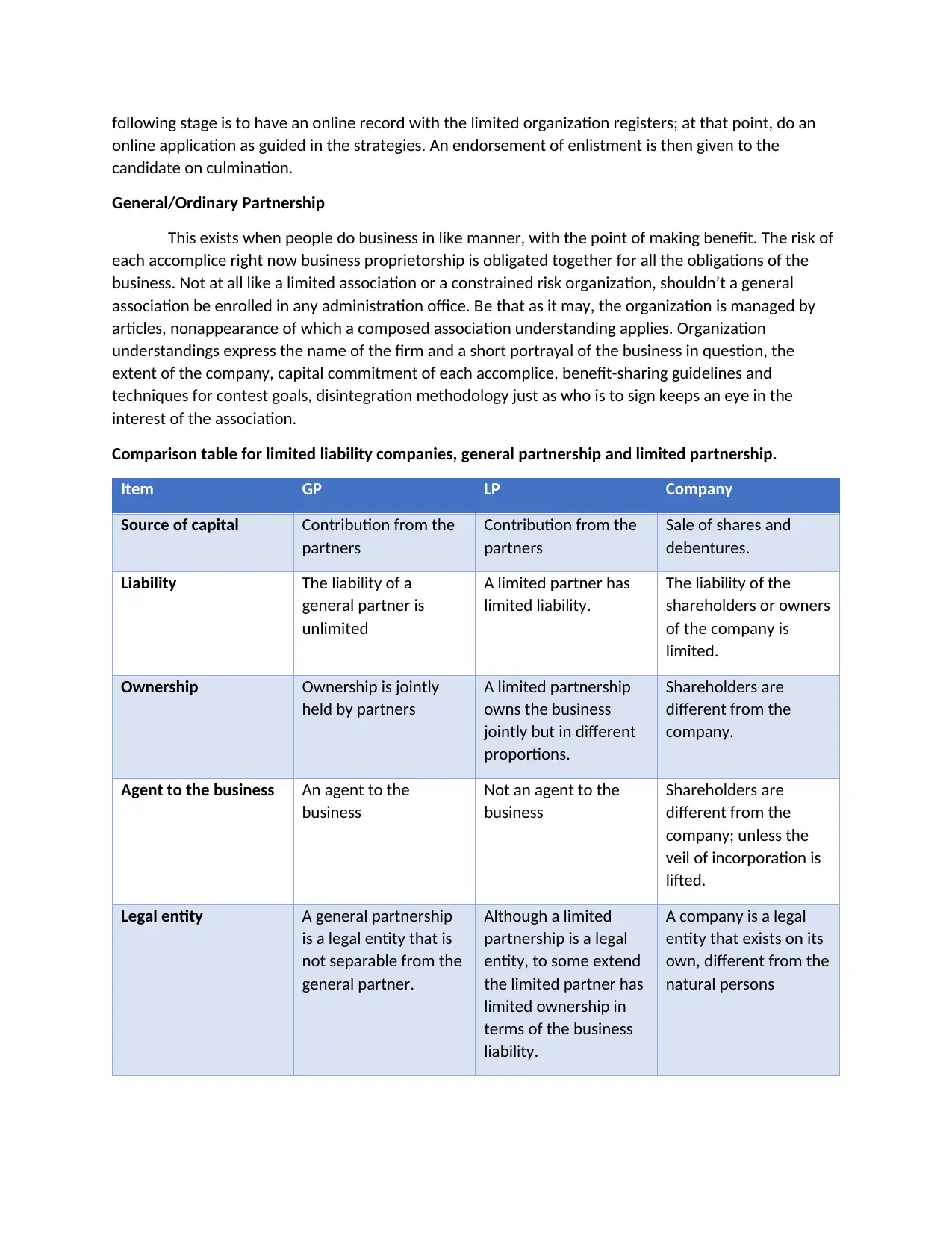
Comparison table for limited liability companies, general partnership and limited partnership.
Item GP LP Company
Source of capital Contribution from the
partners
Contribution from the
partners
Sale of shares and
debentures.
Liability The liability of a
general partner is
unlimited
A limited partner has
limited liability.
The liability of the
shareholders or owners
of the company is
limited.
Ownership Ownership is jointly
held by partners
A limited partnership
owns the business
jointly but in different
proportions.
Shareholders are
different from the
company.
Agent to the business An agent to the
business
Not an agent to the
business
Shareholders are
different from the
company; unless the
veil of incorporation is
lifted.
Legal entity A general partnership
is a legal entity that is
not separable from the
general partner.
Although a limited
partnership is a legal
entity, to some extend
the limited partner has
limited ownership in
terms of the business
liability.
A company is a legal
entity that exists on its
own, different from the
natural persons
online application as guided in the strategies. An endorsement of enlistment is then given to the
candidate on culmination.
General/Ordinary Partnership
This exists when people do business in like manner, with the point of making benefit. The risk of
each accomplice right now business proprietorship is obligated together for all the obligations of the
business. Not at all like a limited association or a constrained risk organization, shouldn’t a general
association be enrolled in any administration office. Be that as it may, the organization is managed by
articles, nonappearance of which a composed association understanding applies. Organization
understandings express the name of the firm and a short portrayal of the business in question, the
extent of the company, capital commitment of each accomplice, benefit-sharing guidelines and
techniques for contest goals, disintegration methodology just as who is to sign keeps an eye in the
interest of the association.
Comparison table for limited liability companies, general partnership and limited partnership.
Item GP LP Company
Source of capital Contribution from the
partners
Contribution from the
partners
Sale of shares and
debentures.
Liability The liability of a
general partner is
unlimited
A limited partner has
limited liability.
The liability of the
shareholders or owners
of the company is
limited.
Ownership Ownership is jointly
held by partners
A limited partnership
owns the business
jointly but in different
proportions.
Shareholders are
different from the
company.
Agent to the business An agent to the
business
Not an agent to the
business
Shareholders are
different from the
company; unless the
veil of incorporation is
lifted.
Legal entity A general partnership
is a legal entity that is
not separable from the
general partner.
Although a limited
partnership is a legal
entity, to some extend
the limited partner has
limited ownership in
terms of the business
liability.
A company is a legal
entity that exists on its
own, different from the
natural persons
Paraphrase This Document
Need a fresh take? Get an instant paraphrase of this document with our AI Paraphraser

Conclusion
From the investigation of the two sorts of business structures; partnerships and organizations, it
is evident that the limited obligation organization is more appealing and positive for the financial
specialist than the general and constrained organization. Even though there is an increasingly lawful
methodology to be conformed to before enlisting an organization, most financial specialists would like
to exchange an organization than some other type of business proprietorship structure because of the
comfort this structure offers them. My recommendation to Mr. Millionaire and his significant other is
considered enrolling a constrained organization, which will provide them with a chance to employ
separate administration of the organization not at all like in an association where they should effectively
manage the activities of the business. It is additionally simple to change responsibility for business
through the offer of the organization shares.
From the investigation of the two sorts of business structures; partnerships and organizations, it
is evident that the limited obligation organization is more appealing and positive for the financial
specialist than the general and constrained organization. Even though there is an increasingly lawful
methodology to be conformed to before enlisting an organization, most financial specialists would like
to exchange an organization than some other type of business proprietorship structure because of the
comfort this structure offers them. My recommendation to Mr. Millionaire and his significant other is
considered enrolling a constrained organization, which will provide them with a chance to employ
separate administration of the organization not at all like in an association where they should effectively
manage the activities of the business. It is additionally simple to change responsibility for business
through the offer of the organization shares.

References
James, N. (1993). Separate Legal Personality: Legal Reality and Metaphor. Bond L. Rev., 5, i.
Pickering, M. A. (1968). The company as a separate legal entity. The Modern Law Review, 31(5), 481-
511.
Walker, G., Pekmezovic, A., Hanrahan, P. F., Ramsay, I., & Stapledon, G. P. (2012). Commercial
Applications of Company Law in New Zealand. COMMERCIAL APPLICATIONS OF COMPANY LAW IN NEW
ZEALAND, CCH New Zealand, Auckland,.
James, N. (1993). Separate Legal Personality: Legal Reality and Metaphor. Bond L. Rev., 5, i.
Pickering, M. A. (1968). The company as a separate legal entity. The Modern Law Review, 31(5), 481-
511.
Walker, G., Pekmezovic, A., Hanrahan, P. F., Ramsay, I., & Stapledon, G. P. (2012). Commercial
Applications of Company Law in New Zealand. COMMERCIAL APPLICATIONS OF COMPANY LAW IN NEW
ZEALAND, CCH New Zealand, Auckland,.
⊘ This is a preview!⊘
Do you want full access?
Subscribe today to unlock all pages.
Trusted by 1+ million students worldwide
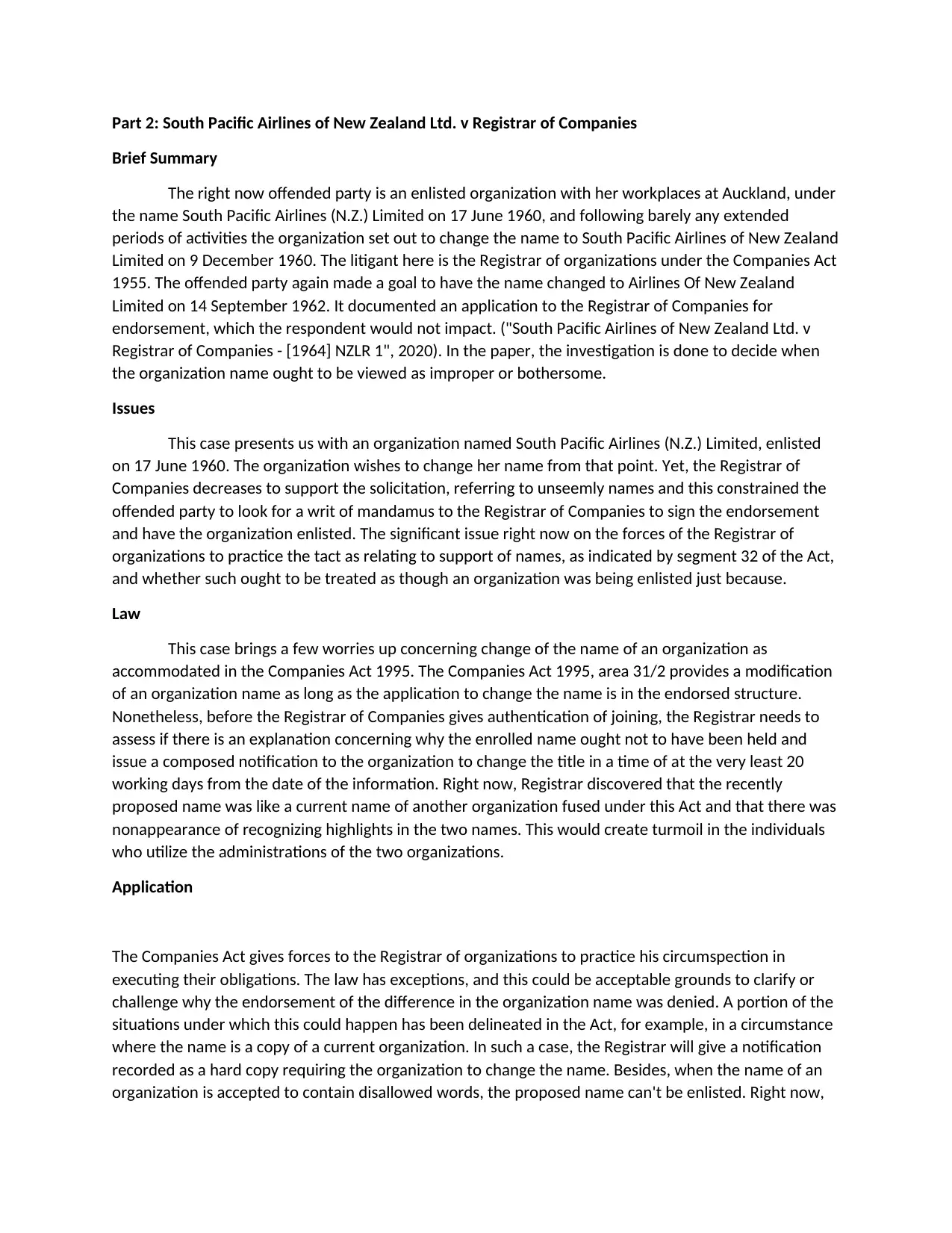
Part 2: South Pacific Airlines of New Zealand Ltd. v Registrar of Companies
Brief Summary
The right now offended party is an enlisted organization with her workplaces at Auckland, under
the name South Pacific Airlines (N.Z.) Limited on 17 June 1960, and following barely any extended
periods of activities the organization set out to change the name to South Pacific Airlines of New Zealand
Limited on 9 December 1960. The litigant here is the Registrar of organizations under the Companies Act
1955. The offended party again made a goal to have the name changed to Airlines Of New Zealand
Limited on 14 September 1962. It documented an application to the Registrar of Companies for
endorsement, which the respondent would not impact. ("South Pacific Airlines of New Zealand Ltd. v
Registrar of Companies - [1964] NZLR 1", 2020). In the paper, the investigation is done to decide when
the organization name ought to be viewed as improper or bothersome.
Issues
This case presents us with an organization named South Pacific Airlines (N.Z.) Limited, enlisted
on 17 June 1960. The organization wishes to change her name from that point. Yet, the Registrar of
Companies decreases to support the solicitation, referring to unseemly names and this constrained the
offended party to look for a writ of mandamus to the Registrar of Companies to sign the endorsement
and have the organization enlisted. The significant issue right now on the forces of the Registrar of
organizations to practice the tact as relating to support of names, as indicated by segment 32 of the Act,
and whether such ought to be treated as though an organization was being enlisted just because.
Law
This case brings a few worries up concerning change of the name of an organization as
accommodated in the Companies Act 1995. The Companies Act 1995, area 31/2 provides a modification
of an organization name as long as the application to change the name is in the endorsed structure.
Nonetheless, before the Registrar of Companies gives authentication of joining, the Registrar needs to
assess if there is an explanation concerning why the enrolled name ought not to have been held and
issue a composed notification to the organization to change the title in a time of at the very least 20
working days from the date of the information. Right now, Registrar discovered that the recently
proposed name was like a current name of another organization fused under this Act and that there was
nonappearance of recognizing highlights in the two names. This would create turmoil in the individuals
who utilize the administrations of the two organizations.
Application
The Companies Act gives forces to the Registrar of organizations to practice his circumspection in
executing their obligations. The law has exceptions, and this could be acceptable grounds to clarify or
challenge why the endorsement of the difference in the organization name was denied. A portion of the
situations under which this could happen has been delineated in the Act, for example, in a circumstance
where the name is a copy of a current organization. In such a case, the Registrar will give a notification
recorded as a hard copy requiring the organization to change the name. Besides, when the name of an
organization is accepted to contain disallowed words, the proposed name can't be enlisted. Right now,
Brief Summary
The right now offended party is an enlisted organization with her workplaces at Auckland, under
the name South Pacific Airlines (N.Z.) Limited on 17 June 1960, and following barely any extended
periods of activities the organization set out to change the name to South Pacific Airlines of New Zealand
Limited on 9 December 1960. The litigant here is the Registrar of organizations under the Companies Act
1955. The offended party again made a goal to have the name changed to Airlines Of New Zealand
Limited on 14 September 1962. It documented an application to the Registrar of Companies for
endorsement, which the respondent would not impact. ("South Pacific Airlines of New Zealand Ltd. v
Registrar of Companies - [1964] NZLR 1", 2020). In the paper, the investigation is done to decide when
the organization name ought to be viewed as improper or bothersome.
Issues
This case presents us with an organization named South Pacific Airlines (N.Z.) Limited, enlisted
on 17 June 1960. The organization wishes to change her name from that point. Yet, the Registrar of
Companies decreases to support the solicitation, referring to unseemly names and this constrained the
offended party to look for a writ of mandamus to the Registrar of Companies to sign the endorsement
and have the organization enlisted. The significant issue right now on the forces of the Registrar of
organizations to practice the tact as relating to support of names, as indicated by segment 32 of the Act,
and whether such ought to be treated as though an organization was being enlisted just because.
Law
This case brings a few worries up concerning change of the name of an organization as
accommodated in the Companies Act 1995. The Companies Act 1995, area 31/2 provides a modification
of an organization name as long as the application to change the name is in the endorsed structure.
Nonetheless, before the Registrar of Companies gives authentication of joining, the Registrar needs to
assess if there is an explanation concerning why the enrolled name ought not to have been held and
issue a composed notification to the organization to change the title in a time of at the very least 20
working days from the date of the information. Right now, Registrar discovered that the recently
proposed name was like a current name of another organization fused under this Act and that there was
nonappearance of recognizing highlights in the two names. This would create turmoil in the individuals
who utilize the administrations of the two organizations.
Application
The Companies Act gives forces to the Registrar of organizations to practice his circumspection in
executing their obligations. The law has exceptions, and this could be acceptable grounds to clarify or
challenge why the endorsement of the difference in the organization name was denied. A portion of the
situations under which this could happen has been delineated in the Act, for example, in a circumstance
where the name is a copy of a current organization. In such a case, the Registrar will give a notification
recorded as a hard copy requiring the organization to change the name. Besides, when the name of an
organization is accepted to contain disallowed words, the proposed name can't be enlisted. Right now,
Paraphrase This Document
Need a fresh take? Get an instant paraphrase of this document with our AI Paraphraser

Registrar accepted that the proposed organization name was bothersome. Once more, there was no
earlier solicitation of saving the organization name with the workplace of the Registrar of organizations,
which is one of the conditions that ought to be consented to. Once more, the choice of the Registrar of
Companies not to support the difference in name is difficulties dependent on the elements put into
thought, given that solitary the closeness of names was viewed as not at all like different contemplations
which would permit the difference in name.
Conclusion
The grounds on which an organization name is viewed as unwanted are sketched out, and this
case additionally difficulties the utilization of the closeness of names in assessing nuisance of a name.
Considering likeness of the name in seclusion would make issues, and therefore an additional mile is
thought of. The decision put forth right now not give the criteria where the name was viewed as
unfortunate, as the Registrar of organizations accepted. Notwithstanding, there are a few reasons that
could add up to the Registrar of organizations to think about a name unfortunate. Once any of such
rights are distinguished, then the difference in organization name can't be passed.
The nuisance of this name was not decided on the grounds of close likeness to a current name,
however on the way that there was potential disarray prone to exude from the utilization of similar
names with the other organization. Thus, a misleading is probably going to happen from the use of the
comparable names, and this is likewise another ground to presume that a signature is bothersome. The
enlistment centre ought to in this way consider the degree to which disarray may emerge from the
likeness of names, and researching the idea of exercises every one of the two organizations is engaged
with. Setting up whether each organization works together in New Zealand would likewise help with
explaining whether a turmoil would be caused since specific organizations could be in a similar line of
business and this may deceive the open that one is an auxiliary of the other, which probably won't be
the situation. It is in this way not adequate to have the Registrar neglect to practice his caution on the
endorsement of names based on the closeness of names; however, rather this ought to be supported by
different reasons.
earlier solicitation of saving the organization name with the workplace of the Registrar of organizations,
which is one of the conditions that ought to be consented to. Once more, the choice of the Registrar of
Companies not to support the difference in name is difficulties dependent on the elements put into
thought, given that solitary the closeness of names was viewed as not at all like different contemplations
which would permit the difference in name.
Conclusion
The grounds on which an organization name is viewed as unwanted are sketched out, and this
case additionally difficulties the utilization of the closeness of names in assessing nuisance of a name.
Considering likeness of the name in seclusion would make issues, and therefore an additional mile is
thought of. The decision put forth right now not give the criteria where the name was viewed as
unfortunate, as the Registrar of organizations accepted. Notwithstanding, there are a few reasons that
could add up to the Registrar of organizations to think about a name unfortunate. Once any of such
rights are distinguished, then the difference in organization name can't be passed.
The nuisance of this name was not decided on the grounds of close likeness to a current name,
however on the way that there was potential disarray prone to exude from the utilization of similar
names with the other organization. Thus, a misleading is probably going to happen from the use of the
comparable names, and this is likewise another ground to presume that a signature is bothersome. The
enlistment centre ought to in this way consider the degree to which disarray may emerge from the
likeness of names, and researching the idea of exercises every one of the two organizations is engaged
with. Setting up whether each organization works together in New Zealand would likewise help with
explaining whether a turmoil would be caused since specific organizations could be in a similar line of
business and this may deceive the open that one is an auxiliary of the other, which probably won't be
the situation. It is in this way not adequate to have the Registrar neglect to practice his caution on the
endorsement of names based on the closeness of names; however, rather this ought to be supported by
different reasons.

References
South Pacific Airlines of New Zealand Ltd. v Registrar of Companies - [1964] NZLR 1. (2020). Retrieved 5
April 2020, from http://www.lawreports.nz/south-pacific-airlines-of-new-zealand-ltd-v-registrar-of-
companies-1964-nzlr-1/
South Pacific Airlines of New Zealand Ltd. v Registrar of Companies - [1964] NZLR 1. (2020). Retrieved 5
April 2020, from http://www.lawreports.nz/south-pacific-airlines-of-new-zealand-ltd-v-registrar-of-
companies-1964-nzlr-1/
⊘ This is a preview!⊘
Do you want full access?
Subscribe today to unlock all pages.
Trusted by 1+ million students worldwide

1 out of 9


Related Documents


Your All-in-One AI-Powered Toolkit for Academic Success.
+13062052269
info@desklib.com
Available 24*7 on WhatsApp / Email
![[object Object]](/_next/static/media/star-bottom.7253800d.svg)
Unlock your academic potential
Copyright © 2020–2026 A2Z Services. All Rights Reserved. Developed and managed by ZUCOL.