Analyzing Inventory Management Issues at DB Schenker Sydney
VerifiedAdded on  2023/06/14
|5
|1023
|238
Report
AI Summary
This report delves into the inventory challenges faced by DB Schenker, highlighting the detrimental effects of poor inventory management on customer service and profitability. A key problem identified is corruption within the company, leading to financial losses and mistreatment of employees. The report aims to address these issues by proposing solutions such as employee education on the negative impacts of corruption, stricter accountability for top staff, and the implementation of an automatic inventory management system. The Theory of Constraints (TOC) is employed, utilizing dynamic buffer technology and LEAN pull replenishment to efficiently manage inventory levels and mitigate forecasting errors. Ultimately, the report seeks to provide a comprehensive analysis and actionable recommendations to improve DB Schenker's inventory management practices and overall operational efficiency.
Running head:INVENTORY ISSUES IN DB SCHENKER
Inventory Issues in DbSchenker
Name
Institution
Course
Date
Inventory Issues in DbSchenker
Name
Institution
Course
Date
Paraphrase This Document
Need a fresh take? Get an instant paraphrase of this document with our AI Paraphraser

INVENTORY ISSUES IN DB SCHENKER 2
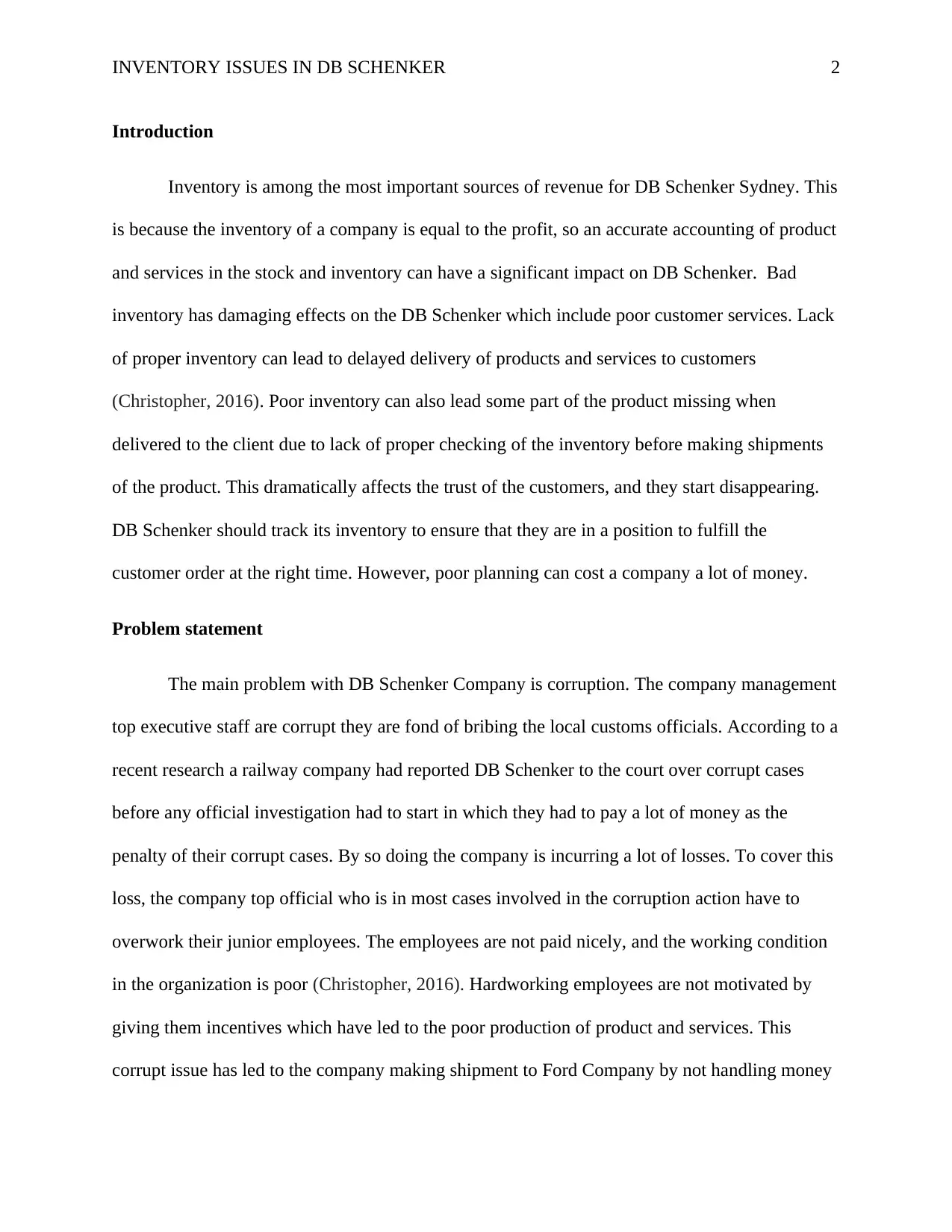
Introduction
Inventory is among the most important sources of revenue for DB Schenker Sydney. This
is because the inventory of a company is equal to the profit, so an accurate accounting of product
and services in the stock and inventory can have a significant impact on DB Schenker. Bad
inventory has damaging effects on the DB Schenker which include poor customer services. Lack
of proper inventory can lead to delayed delivery of products and services to customers
(Christopher, 2016). Poor inventory can also lead some part of the product missing when
delivered to the client due to lack of proper checking of the inventory before making shipments
of the product. This dramatically affects the trust of the customers, and they start disappearing.
DB Schenker should track its inventory to ensure that they are in a position to fulfill the
customer order at the right time. However, poor planning can cost a company a lot of money.
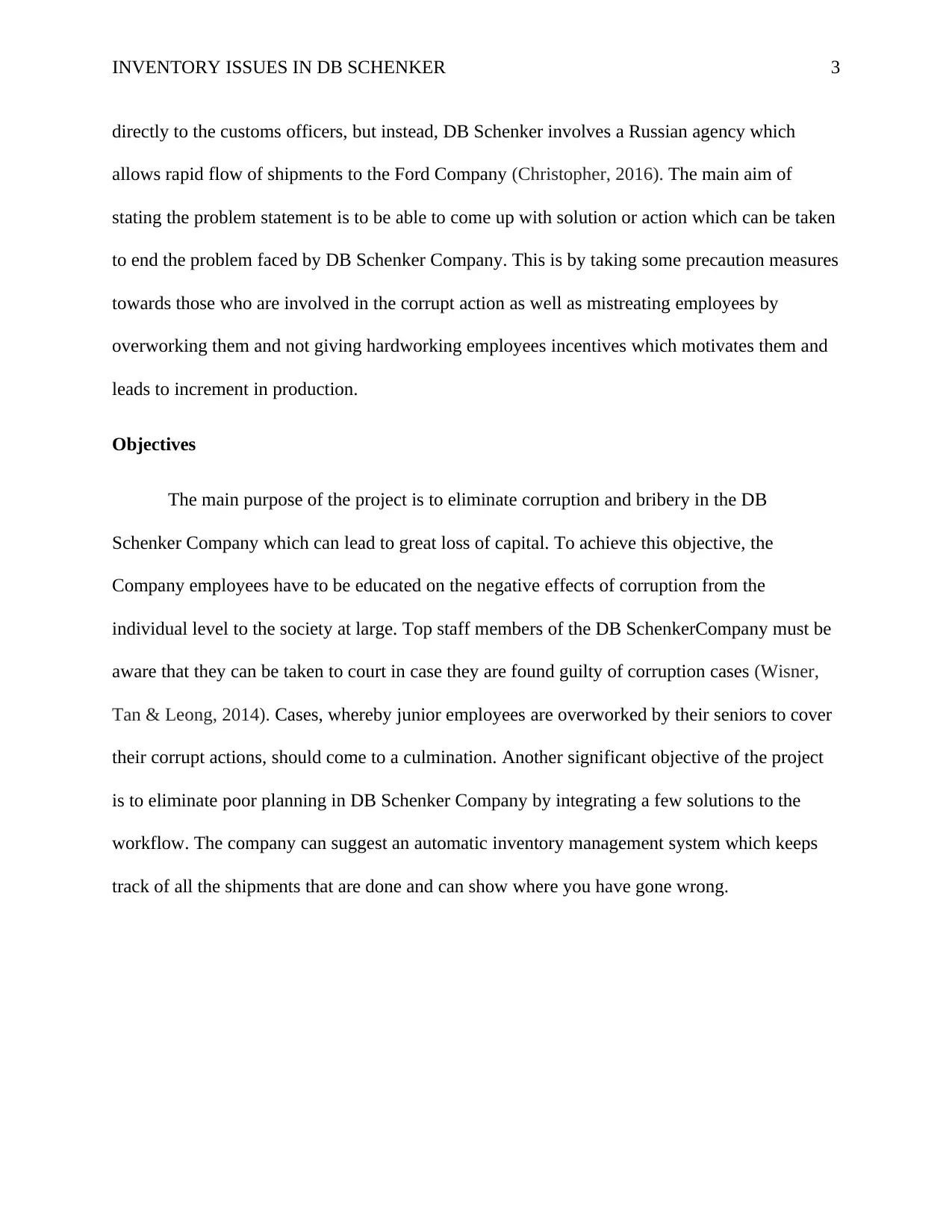
Problem statement
The main problem with DB Schenker Company is corruption. The company management
top executive staff are corrupt they are fond of bribing the local customs officials. According to a
recent research a railway company had reported DB Schenker to the court over corrupt cases
before any official investigation had to start in which they had to pay a lot of money as the
penalty of their corrupt cases. By so doing the company is incurring a lot of losses. To cover this
loss, the company top official who is in most cases involved in the corruption action have to
overwork their junior employees. The employees are not paid nicely, and the working condition
in the organization is poor (Christopher, 2016). Hardworking employees are not motivated by
giving them incentives which have led to the poor production of product and services. This
corrupt issue has led to the company making shipment to Ford Company by not handling money
Introduction
Inventory is among the most important sources of revenue for DB Schenker Sydney. This
is because the inventory of a company is equal to the profit, so an accurate accounting of product
and services in the stock and inventory can have a significant impact on DB Schenker. Bad
inventory has damaging effects on the DB Schenker which include poor customer services. Lack
of proper inventory can lead to delayed delivery of products and services to customers
(Christopher, 2016). Poor inventory can also lead some part of the product missing when
delivered to the client due to lack of proper checking of the inventory before making shipments
of the product. This dramatically affects the trust of the customers, and they start disappearing.
DB Schenker should track its inventory to ensure that they are in a position to fulfill the
customer order at the right time. However, poor planning can cost a company a lot of money.
Problem statement
The main problem with DB Schenker Company is corruption. The company management
top executive staff are corrupt they are fond of bribing the local customs officials. According to a
recent research a railway company had reported DB Schenker to the court over corrupt cases
before any official investigation had to start in which they had to pay a lot of money as the
penalty of their corrupt cases. By so doing the company is incurring a lot of losses. To cover this
loss, the company top official who is in most cases involved in the corruption action have to
overwork their junior employees. The employees are not paid nicely, and the working condition
in the organization is poor (Christopher, 2016). Hardworking employees are not motivated by
giving them incentives which have led to the poor production of product and services. This
corrupt issue has led to the company making shipment to Ford Company by not handling money

INVENTORY ISSUES IN DB SCHENKER 3
directly to the customs officers, but instead, DB Schenker involves a Russian agency which
allows rapid flow of shipments to the Ford Company (Christopher, 2016). The main aim of
stating the problem statement is to be able to come up with solution or action which can be taken
to end the problem faced by DB Schenker Company. This is by taking some precaution measures
towards those who are involved in the corrupt action as well as mistreating employees by
overworking them and not giving hardworking employees incentives which motivates them and
leads to increment in production.
Objectives
The main purpose of the project is to eliminate corruption and bribery in the DB
Schenker Company which can lead to great loss of capital. To achieve this objective, the
Company employees have to be educated on the negative effects of corruption from the
individual level to the society at large. Top staff members of the DB SchenkerCompany must be
aware that they can be taken to court in case they are found guilty of corruption cases (Wisner,
Tan & Leong, 2014). Cases, whereby junior employees are overworked by their seniors to cover
their corrupt actions, should come to a culmination. Another significant objective of the project
is to eliminate poor planning in DB Schenker Company by integrating a few solutions to the
workflow. The company can suggest an automatic inventory management system which keeps
track of all the shipments that are done and can show where you have gone wrong.
directly to the customs officers, but instead, DB Schenker involves a Russian agency which
allows rapid flow of shipments to the Ford Company (Christopher, 2016). The main aim of
stating the problem statement is to be able to come up with solution or action which can be taken
to end the problem faced by DB Schenker Company. This is by taking some precaution measures
towards those who are involved in the corrupt action as well as mistreating employees by
overworking them and not giving hardworking employees incentives which motivates them and
leads to increment in production.
Objectives
The main purpose of the project is to eliminate corruption and bribery in the DB
Schenker Company which can lead to great loss of capital. To achieve this objective, the
Company employees have to be educated on the negative effects of corruption from the
individual level to the society at large. Top staff members of the DB SchenkerCompany must be
aware that they can be taken to court in case they are found guilty of corruption cases (Wisner,
Tan & Leong, 2014). Cases, whereby junior employees are overworked by their seniors to cover
their corrupt actions, should come to a culmination. Another significant objective of the project
is to eliminate poor planning in DB Schenker Company by integrating a few solutions to the
workflow. The company can suggest an automatic inventory management system which keeps
track of all the shipments that are done and can show where you have gone wrong.
⊘ This is a preview!⊘
Do you want full access?
Subscribe today to unlock all pages.

Trusted by 1+ million students worldwide

INVENTORY ISSUES IN DB SCHENKER 4
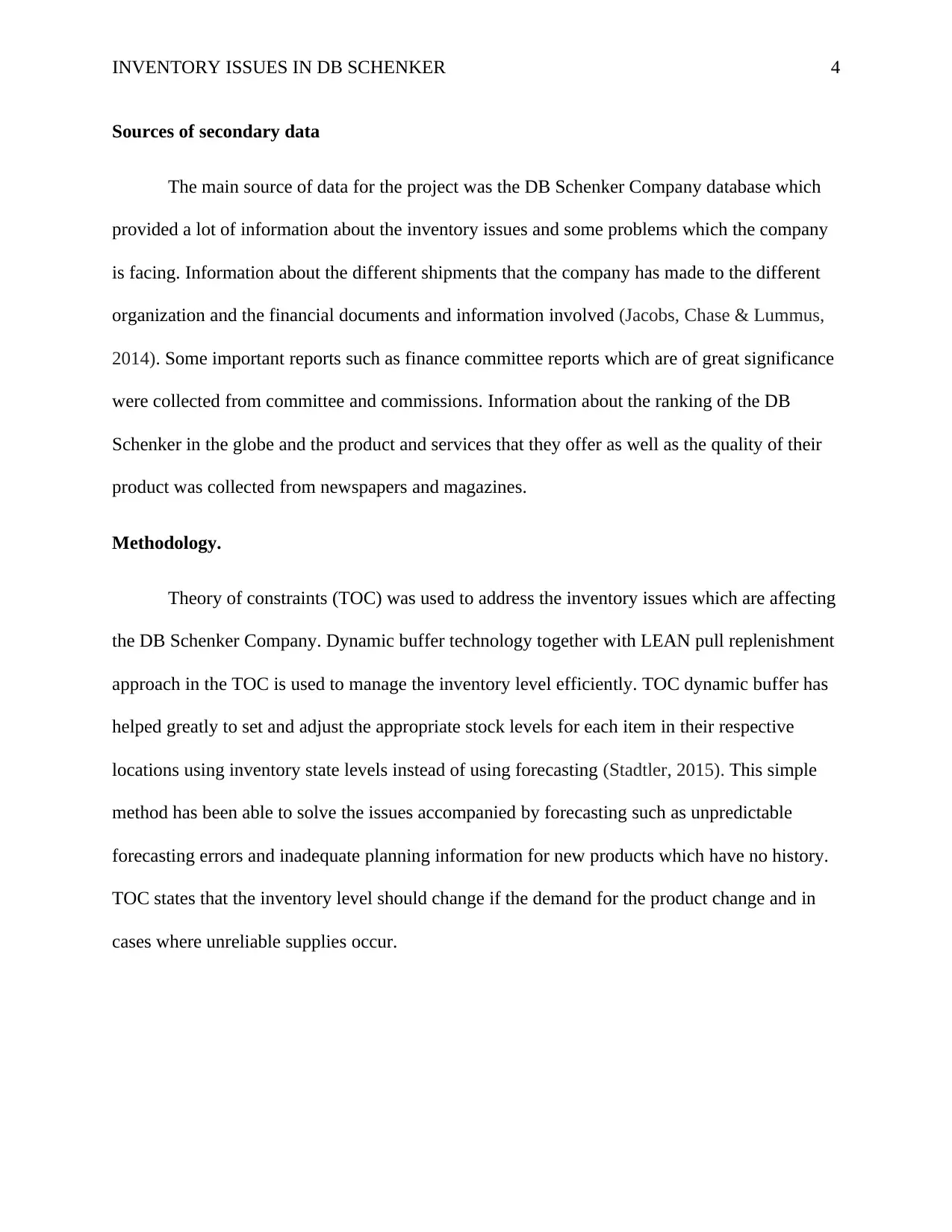
Sources of secondary data
The main source of data for the project was the DB Schenker Company database which
provided a lot of information about the inventory issues and some problems which the company
is facing. Information about the different shipments that the company has made to the different
organization and the financial documents and information involved (Jacobs, Chase & Lummus,
2014). Some important reports such as finance committee reports which are of great significance
were collected from committee and commissions. Information about the ranking of the DB
Schenker in the globe and the product and services that they offer as well as the quality of their
product was collected from newspapers and magazines.
Methodology.
Theory of constraints (TOC) was used to address the inventory issues which are affecting
the DB Schenker Company. Dynamic buffer technology together with LEAN pull replenishment
approach in the TOC is used to manage the inventory level efficiently. TOC dynamic buffer has
helped greatly to set and adjust the appropriate stock levels for each item in their respective
locations using inventory state levels instead of using forecasting (Stadtler, 2015). This simple
method has been able to solve the issues accompanied by forecasting such as unpredictable
forecasting errors and inadequate planning information for new products which have no history.
TOC states that the inventory level should change if the demand for the product change and in
cases where unreliable supplies occur.
Sources of secondary data
The main source of data for the project was the DB Schenker Company database which
provided a lot of information about the inventory issues and some problems which the company
is facing. Information about the different shipments that the company has made to the different
organization and the financial documents and information involved (Jacobs, Chase & Lummus,
2014). Some important reports such as finance committee reports which are of great significance
were collected from committee and commissions. Information about the ranking of the DB
Schenker in the globe and the product and services that they offer as well as the quality of their
product was collected from newspapers and magazines.
Methodology.
Theory of constraints (TOC) was used to address the inventory issues which are affecting
the DB Schenker Company. Dynamic buffer technology together with LEAN pull replenishment
approach in the TOC is used to manage the inventory level efficiently. TOC dynamic buffer has
helped greatly to set and adjust the appropriate stock levels for each item in their respective
locations using inventory state levels instead of using forecasting (Stadtler, 2015). This simple
method has been able to solve the issues accompanied by forecasting such as unpredictable
forecasting errors and inadequate planning information for new products which have no history.
TOC states that the inventory level should change if the demand for the product change and in
cases where unreliable supplies occur.
Paraphrase This Document
Need a fresh take? Get an instant paraphrase of this document with our AI Paraphraser

INVENTORY ISSUES IN DB SCHENKER 5
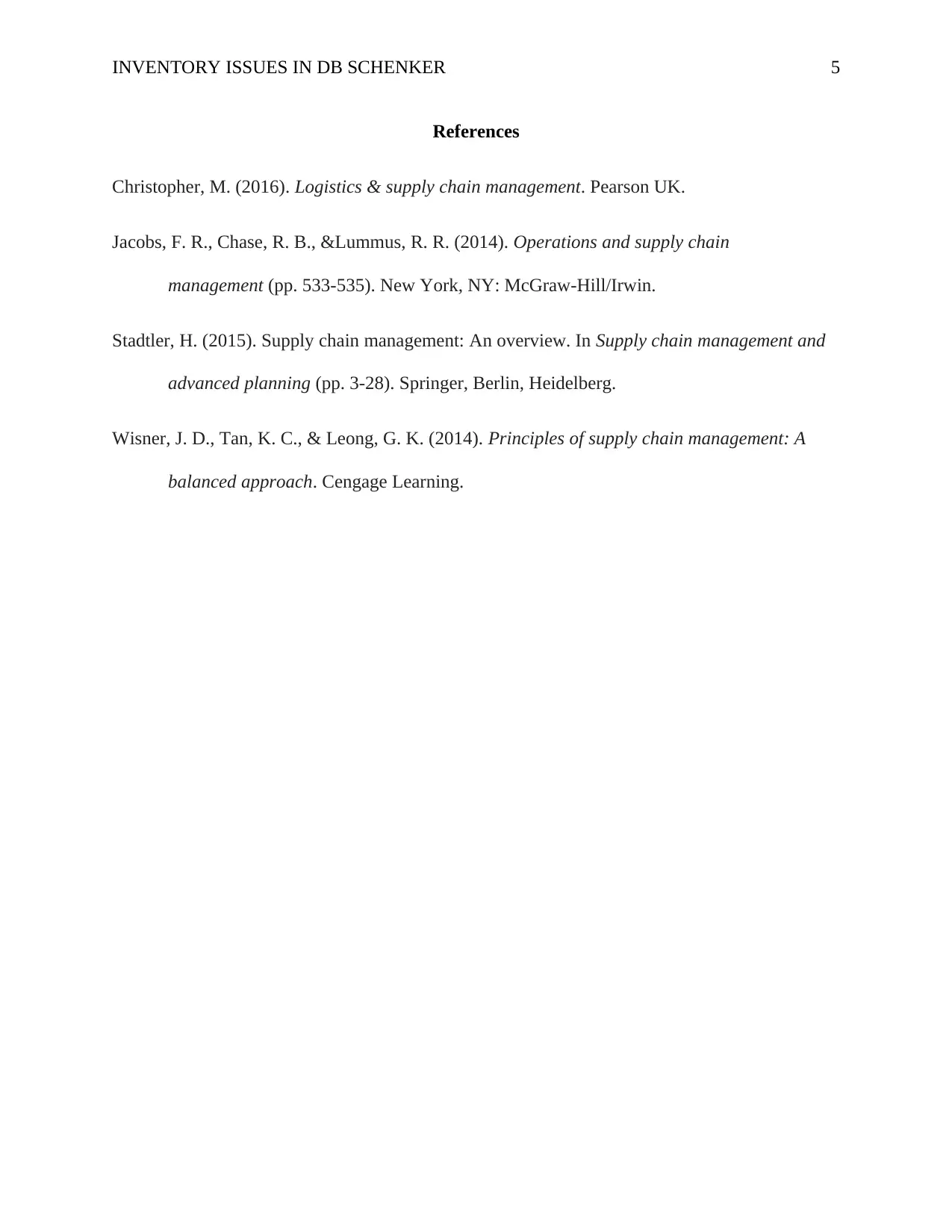
References
Christopher, M. (2016). Logistics & supply chain management. Pearson UK.
Jacobs, F. R., Chase, R. B., &Lummus, R. R. (2014). Operations and supply chain
management (pp. 533-535). New York, NY: McGraw-Hill/Irwin.
Stadtler, H. (2015). Supply chain management: An overview. In Supply chain management and
advanced planning (pp. 3-28). Springer, Berlin, Heidelberg.
Wisner, J. D., Tan, K. C., & Leong, G. K. (2014). Principles of supply chain management: A
balanced approach. Cengage Learning.
References
Christopher, M. (2016). Logistics & supply chain management. Pearson UK.
Jacobs, F. R., Chase, R. B., &Lummus, R. R. (2014). Operations and supply chain
management (pp. 533-535). New York, NY: McGraw-Hill/Irwin.
Stadtler, H. (2015). Supply chain management: An overview. In Supply chain management and
advanced planning (pp. 3-28). Springer, Berlin, Heidelberg.
Wisner, J. D., Tan, K. C., & Leong, G. K. (2014). Principles of supply chain management: A
balanced approach. Cengage Learning.
1 out of 5
Your All-in-One AI-Powered Toolkit for Academic Success.
 +13062052269
info@desklib.com
Available 24*7 on WhatsApp / Email
Unlock your academic potential
Copyright © 2020–2026 A2Z Services. All Rights Reserved. Developed and managed by ZUCOL.