Literature Review: Investigating Impact of Foster Carer Detachment
VerifiedAdded on 2023/05/29
|26
|8539
|338
Literature Review
AI Summary
This literature review investigates the impact of foster carer detachment on short-term foster carers in the United Kingdom. It highlights that short-term foster carers face challenges related to detachment due to the emotional bonds formed with the children. The study explores the emotional and psychological pain experienced by carers, leading them to develop coping mechanisms to avoid attachment. It identifies strengths and limitations of the research approach, including the relevance of the articles and the lack of in-depth analysis on detachment interpretation. The review delves into the relevance of the research question, policy involvement, theoretical background, and practical issues associated with foster care detachment. It discusses the impact of detachment on emotional wellbeing, personality, and ongoing concerns for the children's well-being. The review concludes by offering recommendations for managing detachment experiences and suggests areas for future research, emphasizing the need to ensure the mental, physical, and psychological wellbeing of foster carers to guarantee quality foster care services. Desklib offers similar solved assignments and past papers for students.
IMPACT OF FOSTER CARER DETACHMENT
Investigating the Impact of Foster Carer Detachment on Short-term Foster Carers in the
United Kingdom
i
Investigating the Impact of Foster Carer Detachment on Short-term Foster Carers in the
United Kingdom
i

Paraphrase This Document
Need a fresh take? Get an instant paraphrase of this document with our AI Paraphraser
IMPACT OF FOSTER CARER DETACHMENT
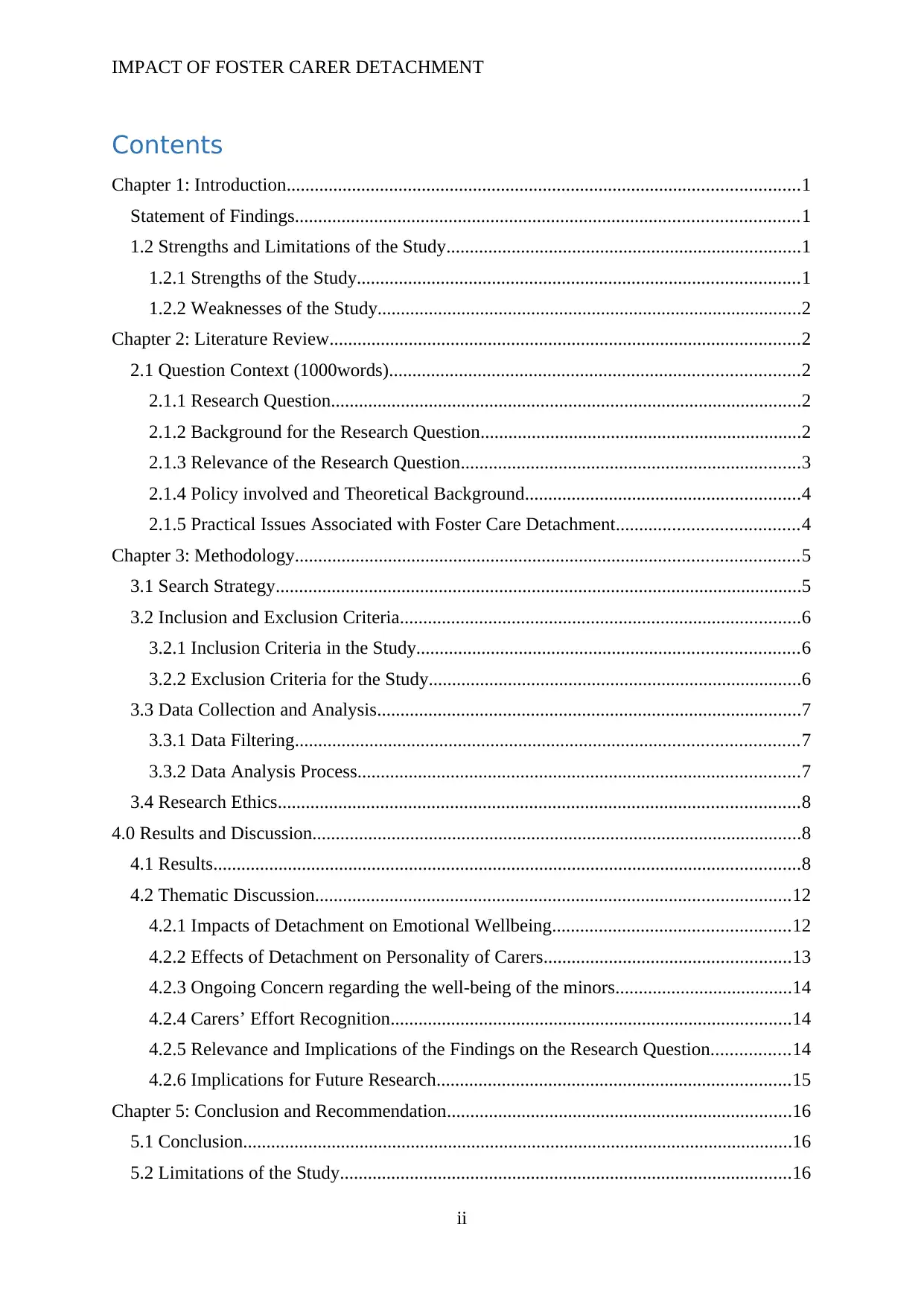
Contents
Chapter 1: Introduction..............................................................................................................1
Statement of Findings............................................................................................................1
1.2 Strengths and Limitations of the Study............................................................................1
1.2.1 Strengths of the Study...............................................................................................1
1.2.2 Weaknesses of the Study...........................................................................................2
Chapter 2: Literature Review.....................................................................................................2
2.1 Question Context (1000words)........................................................................................2
2.1.1 Research Question.....................................................................................................2
2.1.2 Background for the Research Question.....................................................................2
2.1.3 Relevance of the Research Question.........................................................................3
2.1.4 Policy involved and Theoretical Background...........................................................4
2.1.5 Practical Issues Associated with Foster Care Detachment.......................................4
Chapter 3: Methodology............................................................................................................5
3.1 Search Strategy.................................................................................................................5
3.2 Inclusion and Exclusion Criteria......................................................................................6
3.2.1 Inclusion Criteria in the Study..................................................................................6
3.2.2 Exclusion Criteria for the Study................................................................................6
3.3 Data Collection and Analysis...........................................................................................7
3.3.1 Data Filtering............................................................................................................7
3.3.2 Data Analysis Process...............................................................................................7
3.4 Research Ethics................................................................................................................8
4.0 Results and Discussion.........................................................................................................8
4.1 Results..............................................................................................................................8
4.2 Thematic Discussion......................................................................................................12
4.2.1 Impacts of Detachment on Emotional Wellbeing...................................................12
4.2.2 Effects of Detachment on Personality of Carers.....................................................13
4.2.3 Ongoing Concern regarding the well-being of the minors......................................14
4.2.4 Carers’ Effort Recognition......................................................................................14
4.2.5 Relevance and Implications of the Findings on the Research Question.................14
4.2.6 Implications for Future Research............................................................................15
Chapter 5: Conclusion and Recommendation..........................................................................16
5.1 Conclusion......................................................................................................................16
5.2 Limitations of the Study.................................................................................................16
ii
Contents
Chapter 1: Introduction..............................................................................................................1
Statement of Findings............................................................................................................1
1.2 Strengths and Limitations of the Study............................................................................1
1.2.1 Strengths of the Study...............................................................................................1
1.2.2 Weaknesses of the Study...........................................................................................2
Chapter 2: Literature Review.....................................................................................................2
2.1 Question Context (1000words)........................................................................................2
2.1.1 Research Question.....................................................................................................2
2.1.2 Background for the Research Question.....................................................................2
2.1.3 Relevance of the Research Question.........................................................................3
2.1.4 Policy involved and Theoretical Background...........................................................4
2.1.5 Practical Issues Associated with Foster Care Detachment.......................................4
Chapter 3: Methodology............................................................................................................5
3.1 Search Strategy.................................................................................................................5
3.2 Inclusion and Exclusion Criteria......................................................................................6
3.2.1 Inclusion Criteria in the Study..................................................................................6
3.2.2 Exclusion Criteria for the Study................................................................................6
3.3 Data Collection and Analysis...........................................................................................7
3.3.1 Data Filtering............................................................................................................7
3.3.2 Data Analysis Process...............................................................................................7
3.4 Research Ethics................................................................................................................8
4.0 Results and Discussion.........................................................................................................8
4.1 Results..............................................................................................................................8
4.2 Thematic Discussion......................................................................................................12
4.2.1 Impacts of Detachment on Emotional Wellbeing...................................................12
4.2.2 Effects of Detachment on Personality of Carers.....................................................13
4.2.3 Ongoing Concern regarding the well-being of the minors......................................14
4.2.4 Carers’ Effort Recognition......................................................................................14
4.2.5 Relevance and Implications of the Findings on the Research Question.................14
4.2.6 Implications for Future Research............................................................................15
Chapter 5: Conclusion and Recommendation..........................................................................16
5.1 Conclusion......................................................................................................................16
5.2 Limitations of the Study.................................................................................................16
ii

IMPACT OF FOSTER CARER DETACHMENT
5.3 Recommendations..........................................................................................................17
References................................................................................................................................18
iii
5.3 Recommendations..........................................................................................................17
References................................................................................................................................18
iii
⊘ This is a preview!⊘
Do you want full access?
Subscribe today to unlock all pages.

Trusted by 1+ million students worldwide
IMPACT OF FOSTER CARER DETACHMENT
Chapter 1: Introduction
Statement of Findings
Short-term foster carers are likely to experience challenges that are linked to detachment
from the children under their care. The role of foster carers is to provide a parental role in the
lives of foster children. Detachment can have a serious impact on minors as it can affect their
future ability to love and form attachment in their adulthood. The findings of the study
indicate that the feelings of attachment that carers develop towards foster children make it
harder for them to let go after the period of care ends. As a result, short-term foster carers fear
detachment from the children due to the emotional and psychological pain and heartbreak
that arises from the experience. The foster parents are likely to develop feelings of
insignificance since their dedication to the children is short-lived and may end up not seeing
the minor ever again. As such, the foster carers develop a coping mechanism where they
avoid attachment at all cost since they will end up losing the foster child in the near future.
The process of detachment can be mentally exhausting and emotionally consuming as the
foster carers try to adjust to the constant loss they have to experience every time the foster
child in their care is given a permanent home.
1.2 Strengths and Limitations of the Study
1.2.1 Strengths of the Study
The research conducted a study of articles that focus on short-term foster carers who are
allocated children for a short period before they are returned back to their parents or are given
a long-term foster patent. The articles selected were given a timeline from 2009, which
ensures that the findings of the research are still relevant in the current context of foster care.
The study also focuses on the wide range of impacts from different perspectives including
emotional effects and psychological impacts which gives it a realistic approach towards the
lives of short-term foster carers. The focus on journal articles also gives the findings of the
research credibility and increases the reliability of conclusions drawn from the study. ()
suggested that reliability is a key component of research and proves that the results are
consistent. The ability to obtain data from credible sources increased the validity and
reliability of the research. The research also relied on primary sources which have conducted
a field study providing more objective results. As a result, the findings drawn was based on a
real-life experience that had been investigated by the authors of the journal articles. Lastly,
1
Chapter 1: Introduction
Statement of Findings
Short-term foster carers are likely to experience challenges that are linked to detachment
from the children under their care. The role of foster carers is to provide a parental role in the
lives of foster children. Detachment can have a serious impact on minors as it can affect their
future ability to love and form attachment in their adulthood. The findings of the study
indicate that the feelings of attachment that carers develop towards foster children make it
harder for them to let go after the period of care ends. As a result, short-term foster carers fear
detachment from the children due to the emotional and psychological pain and heartbreak
that arises from the experience. The foster parents are likely to develop feelings of
insignificance since their dedication to the children is short-lived and may end up not seeing
the minor ever again. As such, the foster carers develop a coping mechanism where they
avoid attachment at all cost since they will end up losing the foster child in the near future.
The process of detachment can be mentally exhausting and emotionally consuming as the
foster carers try to adjust to the constant loss they have to experience every time the foster
child in their care is given a permanent home.
1.2 Strengths and Limitations of the Study
1.2.1 Strengths of the Study
The research conducted a study of articles that focus on short-term foster carers who are
allocated children for a short period before they are returned back to their parents or are given
a long-term foster patent. The articles selected were given a timeline from 2009, which
ensures that the findings of the research are still relevant in the current context of foster care.
The study also focuses on the wide range of impacts from different perspectives including
emotional effects and psychological impacts which gives it a realistic approach towards the
lives of short-term foster carers. The focus on journal articles also gives the findings of the
research credibility and increases the reliability of conclusions drawn from the study. ()
suggested that reliability is a key component of research and proves that the results are
consistent. The ability to obtain data from credible sources increased the validity and
reliability of the research. The research also relied on primary sources which have conducted
a field study providing more objective results. As a result, the findings drawn was based on a
real-life experience that had been investigated by the authors of the journal articles. Lastly,
1
Paraphrase This Document
Need a fresh take? Get an instant paraphrase of this document with our AI Paraphraser
IMPACT OF FOSTER CARER DETACHMENT
the articles selected were peer-reviewed which means that they can be trusted to provide
quality and reliable data.
1.2.2 Weaknesses of the Study
Investigating foster care provides a complex challenge that is difficult to research and provide
credible conclusions from a single investigation (Kerrane & Hogg 2013). The research sought
to investigate the effects of detachment on short-term carers. However, the perception of
detachment and understanding of the impacts is likely to vary from one individual to another
and the specifics have not been discussed in this research. As a result, the study does not
provide an in-depth analysis of the interpretation of detachment and how it is likely to affect
the ability to analyse its impacts on the foster carer.
The study selected a secondary research approach where data was obtained from articles that
discussed the investigation of other scholars. However, it was evident that there were few
articles that provided the specific analysis that the research was looking for. In particular, it
was discovered that very few articles address the issue of foster care detachment. Therefore,
the findings of the research do not provide a clear picture of the issue of short-term foster
carer detachment. Therefore, it would be necessary for a field investigation to be carried to
provide an in-depth understanding of the impact of detachment on foster carers. Moreover,
the use of secondary sources prevents first-hand interaction with the foster carer which would
have been critical in understanding the various emotions and psychological outcomes they
experience as a result of detachment.
Chapter 2: Literature Review
2.1 Question Context (1000words)
2.1.1 Research Question
What is the Impact of Foster Carer Detachment on Short-Term Foster Carers in the United
Kingdom?
2.1.2 Background for the Research Question
Foster care is a common practice in the UK due to the focus of ensuring children are well
cared for and protected in society from potential abuse or irresponsibility (Pemberton, 2011).
Therefore, foster care has been considered as an important part of social care with the goal of
promoting the wellbeing of the child and proper upbringing that will lead to responsible
2
the articles selected were peer-reviewed which means that they can be trusted to provide
quality and reliable data.
1.2.2 Weaknesses of the Study
Investigating foster care provides a complex challenge that is difficult to research and provide
credible conclusions from a single investigation (Kerrane & Hogg 2013). The research sought
to investigate the effects of detachment on short-term carers. However, the perception of
detachment and understanding of the impacts is likely to vary from one individual to another
and the specifics have not been discussed in this research. As a result, the study does not
provide an in-depth analysis of the interpretation of detachment and how it is likely to affect
the ability to analyse its impacts on the foster carer.
The study selected a secondary research approach where data was obtained from articles that
discussed the investigation of other scholars. However, it was evident that there were few
articles that provided the specific analysis that the research was looking for. In particular, it
was discovered that very few articles address the issue of foster care detachment. Therefore,
the findings of the research do not provide a clear picture of the issue of short-term foster
carer detachment. Therefore, it would be necessary for a field investigation to be carried to
provide an in-depth understanding of the impact of detachment on foster carers. Moreover,
the use of secondary sources prevents first-hand interaction with the foster carer which would
have been critical in understanding the various emotions and psychological outcomes they
experience as a result of detachment.
Chapter 2: Literature Review
2.1 Question Context (1000words)
2.1.1 Research Question
What is the Impact of Foster Carer Detachment on Short-Term Foster Carers in the United
Kingdom?
2.1.2 Background for the Research Question
Foster care is a common practice in the UK due to the focus of ensuring children are well
cared for and protected in society from potential abuse or irresponsibility (Pemberton, 2011).
Therefore, foster care has been considered as an important part of social care with the goal of
promoting the wellbeing of the child and proper upbringing that will lead to responsible
2
IMPACT OF FOSTER CARER DETACHMENT
adulthood. According to George (2014), foster caregivers are charged with the role of giving
day-to-day care to the minor. This means that they should have a good emotional as well as
psychological attachment to the minors. However, a challenge arises when the foster children
need to be returned to their parents or have been assigned a permanent foster parent. As a
result, short-term foster carers have to learn how to attach and later detach when the foster
child is gone (Kirton, 2007). Foster carers often develop an emotional bond with the child
and consider them as part of their family. The carer is tasked with the responsibility of loving
and caring for the foster child only to be later expected to let go of the child after the period
which can sometimes be several months or years. As such, the process of detachment can be
a traumatising experience for the carers. Although the process of detachment is considered as
necessary to enable the child to be readily integrated into their old or new family, an in-depth
study on the corresponding effects related to the process is largely lacking (Kirton, 2007).
Hence, it is on this basis that the research question is considered worth investigating.
2.1.3 Relevance of the Research Question
Conducting an investigation into the effects of detachment on short-term carers is relevant as
it will provide an in-depth understanding of the challenges that they go through in their
profession. Since the wellbeing of the foster carer is considered critical to providing quality
fostering services, it is necessary to understand the factors that are likely to have a negative
impact on their capacity to provide quality care to foster children. The investigation of
detachment on short-term foster carers will help shed light on the challenges they face while
caring for foster children which can inform on how their experiences are likely to affect the
outcomes of foster care. The psychosocial theory presents that individuals grow through the
contact they have with others (Plimmer, 2014). As such, the interaction between foster carers
and children impacts how they grow. As a result, understanding how the wellbeing of carers
is affected by detachment can help understand how the negative outcomes can influence care
foster children to receive and their future outcomes.
The implementation of intervention strategies that target foster carers depends on the
identification of challenges and patterns in behaviour in the fostering profession (Smyke et
al., 2009). Therefore, since detachment is one of the factors that affect the mental wellbeing
of carers, an investigation on the factor is likely to provide insights on how to develop
intervention strategies that will be effective at improving the level of care delivered by foster
parents. The social cognitive theory outlines how close relationships with minors affects their
3
adulthood. According to George (2014), foster caregivers are charged with the role of giving
day-to-day care to the minor. This means that they should have a good emotional as well as
psychological attachment to the minors. However, a challenge arises when the foster children
need to be returned to their parents or have been assigned a permanent foster parent. As a
result, short-term foster carers have to learn how to attach and later detach when the foster
child is gone (Kirton, 2007). Foster carers often develop an emotional bond with the child
and consider them as part of their family. The carer is tasked with the responsibility of loving
and caring for the foster child only to be later expected to let go of the child after the period
which can sometimes be several months or years. As such, the process of detachment can be
a traumatising experience for the carers. Although the process of detachment is considered as
necessary to enable the child to be readily integrated into their old or new family, an in-depth
study on the corresponding effects related to the process is largely lacking (Kirton, 2007).
Hence, it is on this basis that the research question is considered worth investigating.
2.1.3 Relevance of the Research Question
Conducting an investigation into the effects of detachment on short-term carers is relevant as
it will provide an in-depth understanding of the challenges that they go through in their
profession. Since the wellbeing of the foster carer is considered critical to providing quality
fostering services, it is necessary to understand the factors that are likely to have a negative
impact on their capacity to provide quality care to foster children. The investigation of
detachment on short-term foster carers will help shed light on the challenges they face while
caring for foster children which can inform on how their experiences are likely to affect the
outcomes of foster care. The psychosocial theory presents that individuals grow through the
contact they have with others (Plimmer, 2014). As such, the interaction between foster carers
and children impacts how they grow. As a result, understanding how the wellbeing of carers
is affected by detachment can help understand how the negative outcomes can influence care
foster children to receive and their future outcomes.
The implementation of intervention strategies that target foster carers depends on the
identification of challenges and patterns in behaviour in the fostering profession (Smyke et
al., 2009). Therefore, since detachment is one of the factors that affect the mental wellbeing
of carers, an investigation on the factor is likely to provide insights on how to develop
intervention strategies that will be effective at improving the level of care delivered by foster
parents. The social cognitive theory outlines how close relationships with minors affects their
3
⊘ This is a preview!⊘
Do you want full access?
Subscribe today to unlock all pages.
Trusted by 1+ million students worldwide
IMPACT OF FOSTER CARER DETACHMENT
behaviour and social outcomes. Hence, the interaction between the foster carer and the child
is critical to ensuring proper development. As such, exploring detachment can contribute to
ways of improving the influence foster carers have to realise positive outcomes in children.
2.1.4 Policy involved and Theoretical Background
In the UK, agencies concerned with child protection have been given the responsibility of
protecting children rights as they transform into adults. For instance, in reference to the
Children Act 2004 that focuses on protecting the needs of children in the UK, care providers
are required to handle every child needs to be handled in regard to their background while
ensuring that their needs and preferences are given priority (Sarumi, 2011). Children who go
through abuse and neglect can find protection through foster parenting and care. Children’s
Commissioner, on the other hand, is a non-departmental public body in the UK that has the
role of protecting and also promoting children rights. The Children’s Commissioner was
established as part of the Children Act 2004 with the main agenda of promoting the interests
and views of children (Thomas, 2010). These legal bodies promote better foster care while
focusing on the needs and interests of every child which contributes to the achievement of
their dreams. They provide foster carers with details of what is required of them during care
provision.
Theoretically, foster carers tend to create social relationships with children as an important
part of the growth and transformation of children into reasonable adults. This can be
explained by the use of theories such as the psychological theory created by Erik Erikson
which asserts that an individual perceived self-growth through interaction with other people
(Cote & Levine, 2014). Foster carers also in the process form social relationships which may
lead to emotional drain during detachment. The transpersonal theory is another theoretical
perspective that explains the importance of forming social relationships and interactions with
other people and how this enhances development (Friedman & Hartelius, 2015).
2.1.5 Practical Issues Associated with Foster Care Detachment
The research question will provide critical insights towards the process of detachment and the
challenges that foster carers experience while caring for foster children. Short-term carers
tend to offer their services to a wide range of children. As such, their wellbeing is critical to
the overall quality of care that foster carers provide to foster children. Therefore, it becomes
critical to ensure their mental, physical and psychological wellbeing is maintained to
guarantee quality foster care services. Understanding how they are affected by detachment
4
behaviour and social outcomes. Hence, the interaction between the foster carer and the child
is critical to ensuring proper development. As such, exploring detachment can contribute to
ways of improving the influence foster carers have to realise positive outcomes in children.
2.1.4 Policy involved and Theoretical Background
In the UK, agencies concerned with child protection have been given the responsibility of
protecting children rights as they transform into adults. For instance, in reference to the
Children Act 2004 that focuses on protecting the needs of children in the UK, care providers
are required to handle every child needs to be handled in regard to their background while
ensuring that their needs and preferences are given priority (Sarumi, 2011). Children who go
through abuse and neglect can find protection through foster parenting and care. Children’s
Commissioner, on the other hand, is a non-departmental public body in the UK that has the
role of protecting and also promoting children rights. The Children’s Commissioner was
established as part of the Children Act 2004 with the main agenda of promoting the interests
and views of children (Thomas, 2010). These legal bodies promote better foster care while
focusing on the needs and interests of every child which contributes to the achievement of
their dreams. They provide foster carers with details of what is required of them during care
provision.
Theoretically, foster carers tend to create social relationships with children as an important
part of the growth and transformation of children into reasonable adults. This can be
explained by the use of theories such as the psychological theory created by Erik Erikson
which asserts that an individual perceived self-growth through interaction with other people
(Cote & Levine, 2014). Foster carers also in the process form social relationships which may
lead to emotional drain during detachment. The transpersonal theory is another theoretical
perspective that explains the importance of forming social relationships and interactions with
other people and how this enhances development (Friedman & Hartelius, 2015).
2.1.5 Practical Issues Associated with Foster Care Detachment
The research question will provide critical insights towards the process of detachment and the
challenges that foster carers experience while caring for foster children. Short-term carers
tend to offer their services to a wide range of children. As such, their wellbeing is critical to
the overall quality of care that foster carers provide to foster children. Therefore, it becomes
critical to ensure their mental, physical and psychological wellbeing is maintained to
guarantee quality foster care services. Understanding how they are affected by detachment
4
Paraphrase This Document
Need a fresh take? Get an instant paraphrase of this document with our AI Paraphraser
IMPACT OF FOSTER CARER DETACHMENT
will be essential in identifying the approaches that should be implemented with the
challenges they face when letting go of foster children. The findings obtained from the
review of the literature will provide critical insight into the management of detachment
experience. The foremost stage would include getting a proper understanding of the
detachment process as an important section of addressing the challenges that carers face
during the phase. Understanding the impact of detachment will play a major role in finding
out emotional impacts on the carers. The main objective of this review is to look into the
effects of detachment by focusing on the emotions of carers, outcomes and possible solutions
for managing the detachment effects. The information achieved from the research will make a
big contribution to literature and enhance awareness of the challenges that accompany foster
care.
Chapter 3: Methodology
3.1 Search Strategy
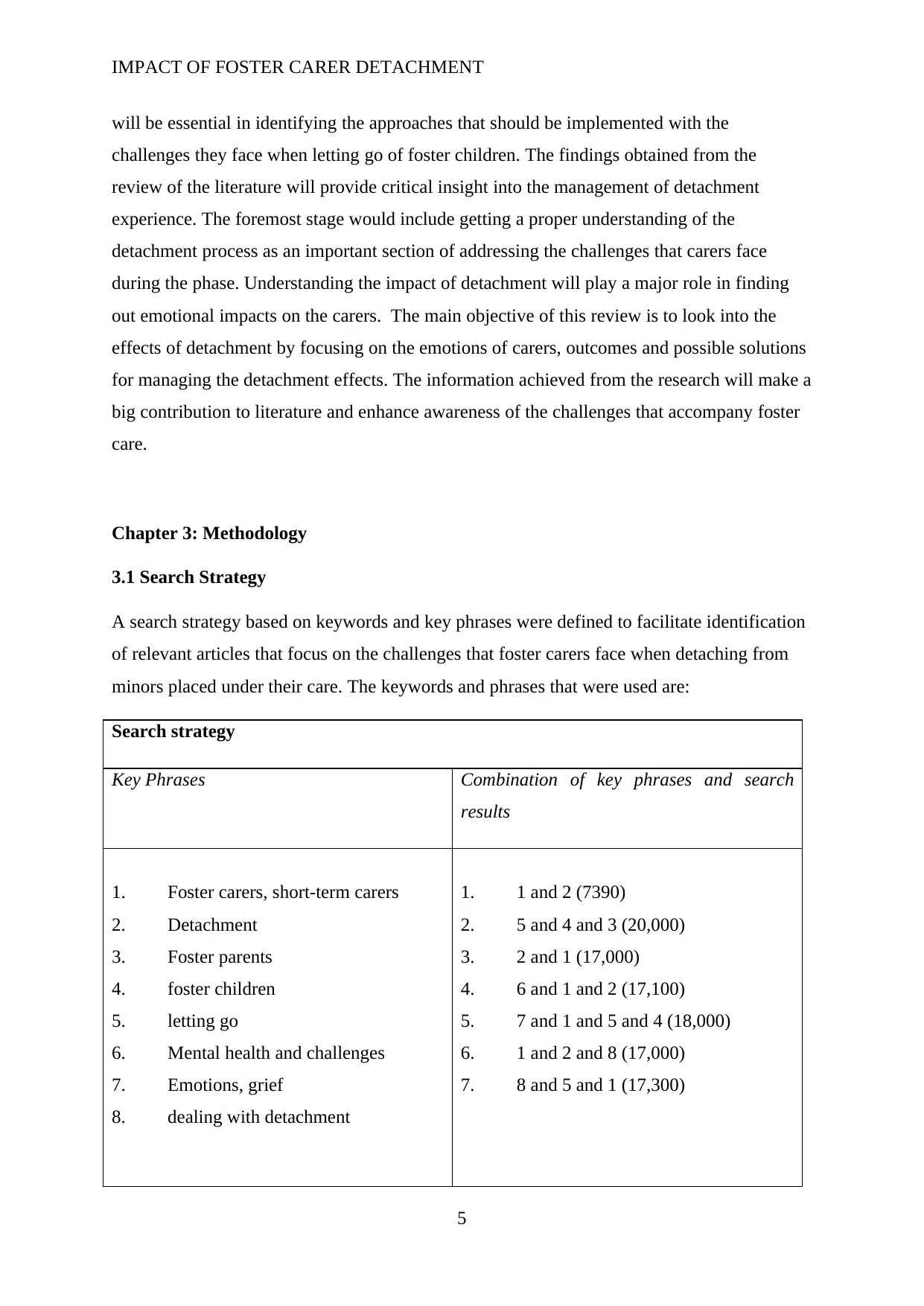
A search strategy based on keywords and key phrases were defined to facilitate identification
of relevant articles that focus on the challenges that foster carers face when detaching from
minors placed under their care. The keywords and phrases that were used are:
Search strategy
Key Phrases Combination of key phrases and search
results
1. Foster carers, short-term carers
2. Detachment
3. Foster parents
4. foster children
5. letting go
6. Mental health and challenges
7. Emotions, grief
8. dealing with detachment
1. 1 and 2 (7390)
2. 5 and 4 and 3 (20,000)
3. 2 and 1 (17,000)
4. 6 and 1 and 2 (17,100)
5. 7 and 1 and 5 and 4 (18,000)
6. 1 and 2 and 8 (17,000)
7. 8 and 5 and 1 (17,300)
5
will be essential in identifying the approaches that should be implemented with the
challenges they face when letting go of foster children. The findings obtained from the
review of the literature will provide critical insight into the management of detachment
experience. The foremost stage would include getting a proper understanding of the
detachment process as an important section of addressing the challenges that carers face
during the phase. Understanding the impact of detachment will play a major role in finding
out emotional impacts on the carers. The main objective of this review is to look into the
effects of detachment by focusing on the emotions of carers, outcomes and possible solutions
for managing the detachment effects. The information achieved from the research will make a
big contribution to literature and enhance awareness of the challenges that accompany foster
care.
Chapter 3: Methodology
3.1 Search Strategy
A search strategy based on keywords and key phrases were defined to facilitate identification
of relevant articles that focus on the challenges that foster carers face when detaching from
minors placed under their care. The keywords and phrases that were used are:
Search strategy
Key Phrases Combination of key phrases and search
results
1. Foster carers, short-term carers
2. Detachment
3. Foster parents
4. foster children
5. letting go
6. Mental health and challenges
7. Emotions, grief
8. dealing with detachment
1. 1 and 2 (7390)
2. 5 and 4 and 3 (20,000)
3. 2 and 1 (17,000)
4. 6 and 1 and 2 (17,100)
5. 7 and 1 and 5 and 4 (18,000)
6. 1 and 2 and 8 (17,000)
7. 8 and 5 and 1 (17,300)
5
IMPACT OF FOSTER CARER DETACHMENT
Some of the phrases that were formed included:
1. Foster carers and detachment.
2. Letting go of foster children for foster parents.
3. Impacts of detachment on short-term foster carers.
4. Mental health and challenges of short-term foster carers after detachment
5. Emotions foster carers go through when letting go of foster children
6. How short-term foster carers deal with detachment.
7. Managing grief of letting go for foster carers.
The keywords were modified during the search in order to provide more results on the
subject. The process involved modifying the keywords and phrases such as altering the order
and including other words. For instance, phrases such as ‘challenges,’ ‘issues,’ and rationale
were useful in refining the search.
3.2 Inclusion and Exclusion Criteria
3.2.1 Inclusion Criteria in the Study
The search was conducted on online databases that contain information on foster parenting
with a focus on the United Kingdom and included the NHS database and legal documents on
children protection. The criterion for inclusion was any articles that provided quality
information on the experience of carers during foster parenting. In particular, the articles
selected focused on those that discussed emotional, psychological, mental, and other personal
outcomes that arise due to detachment from foster children. Other articles included were
those that sought to provide a legal background to fostering. Moreover, articles that focused
on the challenges that foster parents face were also considered. The inclusion criteria also
focused on the inclusion of articles with the latest and relevant information with respect to the
research question. It was deemed appropriate to select articles published later than 2009
unless they have key legislative or permanent information.
3.2.2 Exclusion Criteria for the Study
Sources that did not talk about detachment from the point of view of the carer were excluded
from the research. Articles that discussed the general implications of the detachment of the
foster carers without focusing on the effect on were also excluded. Moreover, sources that
6
Some of the phrases that were formed included:
1. Foster carers and detachment.
2. Letting go of foster children for foster parents.
3. Impacts of detachment on short-term foster carers.
4. Mental health and challenges of short-term foster carers after detachment
5. Emotions foster carers go through when letting go of foster children
6. How short-term foster carers deal with detachment.
7. Managing grief of letting go for foster carers.
The keywords were modified during the search in order to provide more results on the
subject. The process involved modifying the keywords and phrases such as altering the order
and including other words. For instance, phrases such as ‘challenges,’ ‘issues,’ and rationale
were useful in refining the search.
3.2 Inclusion and Exclusion Criteria
3.2.1 Inclusion Criteria in the Study
The search was conducted on online databases that contain information on foster parenting
with a focus on the United Kingdom and included the NHS database and legal documents on
children protection. The criterion for inclusion was any articles that provided quality
information on the experience of carers during foster parenting. In particular, the articles
selected focused on those that discussed emotional, psychological, mental, and other personal
outcomes that arise due to detachment from foster children. Other articles included were
those that sought to provide a legal background to fostering. Moreover, articles that focused
on the challenges that foster parents face were also considered. The inclusion criteria also
focused on the inclusion of articles with the latest and relevant information with respect to the
research question. It was deemed appropriate to select articles published later than 2009
unless they have key legislative or permanent information.
3.2.2 Exclusion Criteria for the Study
Sources that did not talk about detachment from the point of view of the carer were excluded
from the research. Articles that discussed the general implications of the detachment of the
foster carers without focusing on the effect on were also excluded. Moreover, sources that
6
⊘ This is a preview!⊘
Do you want full access?
Subscribe today to unlock all pages.
Trusted by 1+ million students worldwide
IMPACT OF FOSTER CARER DETACHMENT
failed to discuss aspects such as the mental, physical or psychological impact of the foster
carer detachment were excluded from the selection. It was also necessary to exclude articles
that discussed issues surrounding foster parenting in general. This was due to the primary
focus on detachment rather than the relationships between the children and the foster parents.
3.3 Data Collection and Analysis
3.3.1 Data Filtering
To obtain quality data, it was necessary to define a data filtering procedure. The search
strategy facilitated the searching of articles in databases. However, the selection of the
articles that would be relevant for the research was based on a filtering technique. A filtering
strategy is necessary to discard any material that is not relevant and determine those that
provide adequate information for use in the research. The filtering process involved the
removal of articles that did not meet the inclusion criteria while also utilising the exclusion
criteria to narrow down the number of articles selected for use in the review. The filtering
approach used involved reading through the titles and abstracts of the articles obtained during
the search process. The researcher determined from the titles and abstracts those that seemed
appropriate and selected them. The next step entailed involved a full analysis of the selected
articles to establish whether they met the inclusion and exclusion criteria defined. From there,
the researcher remained with a few articles that were considered relevant to the research.
3.3.2 Data Analysis Process
The process of analysing data is heavily influenced by the nature of data that the research
collected Thomas (2013). Hence, it becomes critical to identify clearly the type of data that
the research used in order to develop an approach for analysis. In the research, the data
collected was mainly theoretical and descriptive which implies that qualitative data was to be
used for analysis. Therefore, it would be necessary to apply a qualitative analysis to facilitate
the interpretation and analysis of the data collected. In this case, the data collected was
qualitative which provided a theoretical and descriptive account of foster carer detachment.
Therefore a qualitative analysis was conducted. Qualitative analysis is a process that entails
the comparison of information from the data collected with relevant theories with the goal of
obtaining credible conclusions that are applicable to the research. Qualitative analysis allows
for making qualitative conclusions and inferences without necessarily relying on numeric and
quantitative data in research. The analysis of the qualitative data was conducted using a
thematic discussion which involved the identification of patterns in the data and proceeding
7
failed to discuss aspects such as the mental, physical or psychological impact of the foster
carer detachment were excluded from the selection. It was also necessary to exclude articles
that discussed issues surrounding foster parenting in general. This was due to the primary
focus on detachment rather than the relationships between the children and the foster parents.
3.3 Data Collection and Analysis
3.3.1 Data Filtering
To obtain quality data, it was necessary to define a data filtering procedure. The search
strategy facilitated the searching of articles in databases. However, the selection of the
articles that would be relevant for the research was based on a filtering technique. A filtering
strategy is necessary to discard any material that is not relevant and determine those that
provide adequate information for use in the research. The filtering process involved the
removal of articles that did not meet the inclusion criteria while also utilising the exclusion
criteria to narrow down the number of articles selected for use in the review. The filtering
approach used involved reading through the titles and abstracts of the articles obtained during
the search process. The researcher determined from the titles and abstracts those that seemed
appropriate and selected them. The next step entailed involved a full analysis of the selected
articles to establish whether they met the inclusion and exclusion criteria defined. From there,
the researcher remained with a few articles that were considered relevant to the research.
3.3.2 Data Analysis Process
The process of analysing data is heavily influenced by the nature of data that the research
collected Thomas (2013). Hence, it becomes critical to identify clearly the type of data that
the research used in order to develop an approach for analysis. In the research, the data
collected was mainly theoretical and descriptive which implies that qualitative data was to be
used for analysis. Therefore, it would be necessary to apply a qualitative analysis to facilitate
the interpretation and analysis of the data collected. In this case, the data collected was
qualitative which provided a theoretical and descriptive account of foster carer detachment.
Therefore a qualitative analysis was conducted. Qualitative analysis is a process that entails
the comparison of information from the data collected with relevant theories with the goal of
obtaining credible conclusions that are applicable to the research. Qualitative analysis allows
for making qualitative conclusions and inferences without necessarily relying on numeric and
quantitative data in research. The analysis of the qualitative data was conducted using a
thematic discussion which involved the identification of patterns in the data and proceeding
7
Paraphrase This Document
Need a fresh take? Get an instant paraphrase of this document with our AI Paraphraser
IMPACT OF FOSTER CARER DETACHMENT
to develop relevant themes. In order to analyse the data, the first step is to ensure that the data
is valid through the test-retest technique. Analysing the journals for relevant information on
the detachment process and its effects is important in the data analysis as is ensuring that the
information is credible and collected from peer-reviewed sources. The thematic approach
involved the researcher reading through the articles to familiarise with their content. The
researcher proceeded to identify the key patterns in the articles while attempting to develop a
relationship between them. The next stage entailed studying the common patterns and coming
with themes that provide a strong link between the findings of the different articles. The
themes were written down and an extensive discussion conducted on them. In doing so, the
researcher was able to develop relevant conclusion from the findings that could be used in
answering the research question.
3.4 Research Ethics
Ethics forms a critical part of the research process. Markowitz, Alison, Conrad & Grossman
(2011) posited that the collection of data using secondary sources facilitates a highly ethical
approach to the research process. For instance, secondary sources enable the researcher to
avoid the issues of confidentiality and maintaining the anonymity of the participants.
However, this does not imply that secondary research is exempted from the observance of
ethical practices. For instance, Aveyard, Sharp & Wooliams (2011) argued that there are legal
procedures that govern the process of data collection to ensure that the best data is collected.
Moreover, it is important that the researcher maintains impartiality and avoids bias
throughout the research process. Therefore, it will be critical to ensure that impartiality is
maintained and procedures are taken to avoid bias that could lead to inaccurate findings. The
approach will ensure validity and reliability are upheld in conducting the research.
4.0 Results and Discussion
4.1 Results
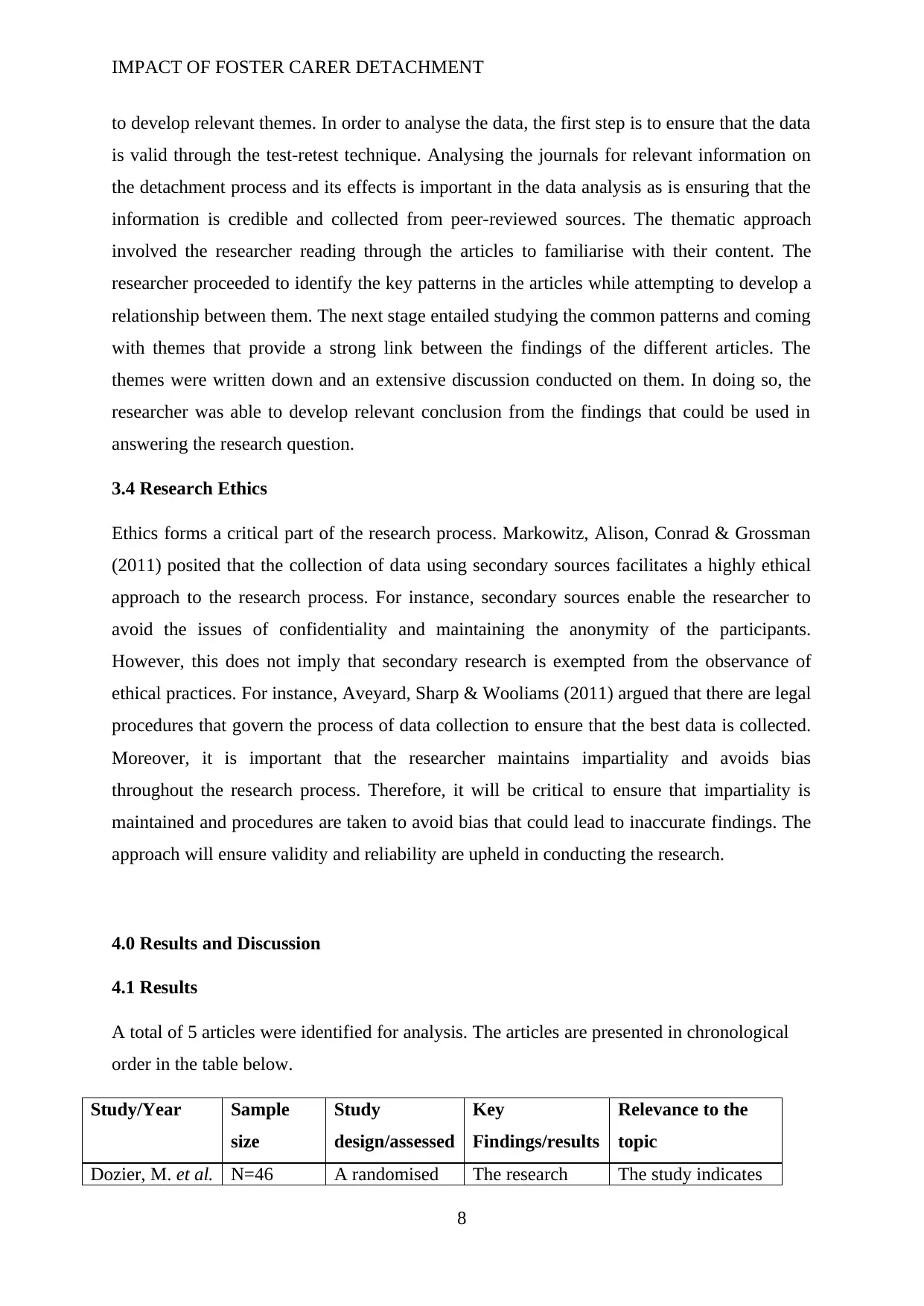
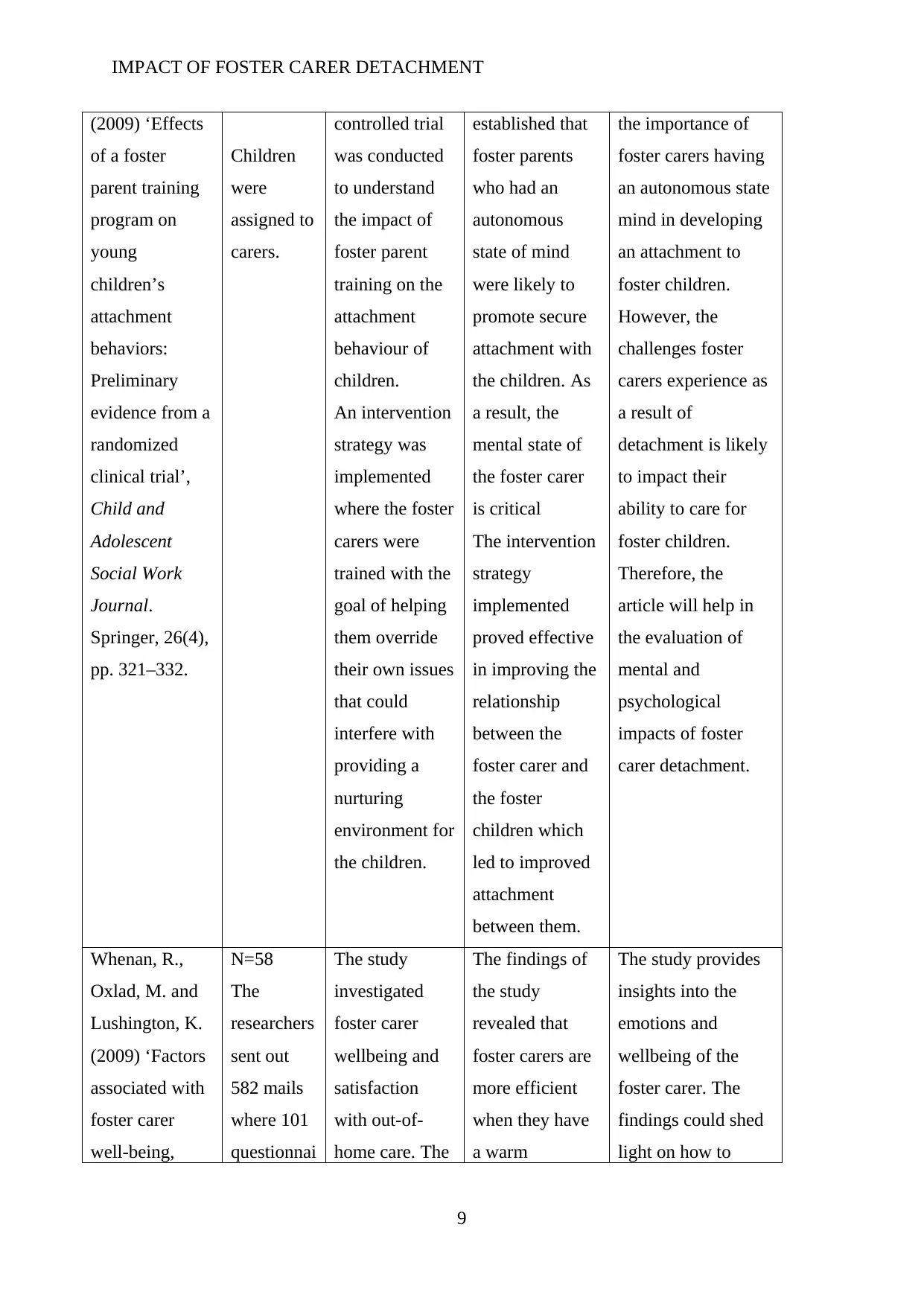
A total of 5 articles were identified for analysis. The articles are presented in chronological
order in the table below.
Study/Year Sample
size
Study
design/assessed
Key
Findings/results
Relevance to the
topic
Dozier, M. et al. N=46 A randomised The research The study indicates
8
to develop relevant themes. In order to analyse the data, the first step is to ensure that the data
is valid through the test-retest technique. Analysing the journals for relevant information on
the detachment process and its effects is important in the data analysis as is ensuring that the
information is credible and collected from peer-reviewed sources. The thematic approach
involved the researcher reading through the articles to familiarise with their content. The
researcher proceeded to identify the key patterns in the articles while attempting to develop a
relationship between them. The next stage entailed studying the common patterns and coming
with themes that provide a strong link between the findings of the different articles. The
themes were written down and an extensive discussion conducted on them. In doing so, the
researcher was able to develop relevant conclusion from the findings that could be used in
answering the research question.
3.4 Research Ethics
Ethics forms a critical part of the research process. Markowitz, Alison, Conrad & Grossman
(2011) posited that the collection of data using secondary sources facilitates a highly ethical
approach to the research process. For instance, secondary sources enable the researcher to
avoid the issues of confidentiality and maintaining the anonymity of the participants.
However, this does not imply that secondary research is exempted from the observance of
ethical practices. For instance, Aveyard, Sharp & Wooliams (2011) argued that there are legal
procedures that govern the process of data collection to ensure that the best data is collected.
Moreover, it is important that the researcher maintains impartiality and avoids bias
throughout the research process. Therefore, it will be critical to ensure that impartiality is
maintained and procedures are taken to avoid bias that could lead to inaccurate findings. The
approach will ensure validity and reliability are upheld in conducting the research.
4.0 Results and Discussion
4.1 Results
A total of 5 articles were identified for analysis. The articles are presented in chronological
order in the table below.
Study/Year Sample
size
Study
design/assessed
Key
Findings/results
Relevance to the
topic
Dozier, M. et al. N=46 A randomised The research The study indicates
8
IMPACT OF FOSTER CARER DETACHMENT
(2009) ‘Effects
of a foster
parent training
program on
young
children’s
attachment
behaviors:
Preliminary
evidence from a
randomized
clinical trial’,
Child and
Adolescent
Social Work
Journal.
Springer, 26(4),
pp. 321–332.
Children
were
assigned to
carers.
controlled trial
was conducted
to understand
the impact of
foster parent
training on the
attachment
behaviour of
children.
An intervention
strategy was
implemented
where the foster
carers were
trained with the
goal of helping
them override
their own issues
that could
interfere with
providing a
nurturing
environment for
the children.
established that
foster parents
who had an
autonomous
state of mind
were likely to
promote secure
attachment with
the children. As
a result, the
mental state of
the foster carer
is critical
The intervention
strategy
implemented
proved effective
in improving the
relationship
between the
foster carer and
the foster
children which
led to improved
attachment
between them.
the importance of
foster carers having
an autonomous state
mind in developing
an attachment to
foster children.
However, the
challenges foster
carers experience as
a result of
detachment is likely
to impact their
ability to care for
foster children.
Therefore, the
article will help in
the evaluation of
mental and
psychological
impacts of foster
carer detachment.
Whenan, R.,
Oxlad, M. and
Lushington, K.
(2009) ‘Factors
associated with
foster carer
well-being,
N=58
The
researchers
sent out
582 mails
where 101
questionnai
The study
investigated
foster carer
wellbeing and
satisfaction
with out-of-
home care. The
The findings of
the study
revealed that
foster carers are
more efficient
when they have
a warm
The study provides
insights into the
emotions and
wellbeing of the
foster carer. The
findings could shed
light on how to
9
(2009) ‘Effects
of a foster
parent training
program on
young
children’s
attachment
behaviors:
Preliminary
evidence from a
randomized
clinical trial’,
Child and
Adolescent
Social Work
Journal.
Springer, 26(4),
pp. 321–332.
Children
were
assigned to
carers.
controlled trial
was conducted
to understand
the impact of
foster parent
training on the
attachment
behaviour of
children.
An intervention
strategy was
implemented
where the foster
carers were
trained with the
goal of helping
them override
their own issues
that could
interfere with
providing a
nurturing
environment for
the children.
established that
foster parents
who had an
autonomous
state of mind
were likely to
promote secure
attachment with
the children. As
a result, the
mental state of
the foster carer
is critical
The intervention
strategy
implemented
proved effective
in improving the
relationship
between the
foster carer and
the foster
children which
led to improved
attachment
between them.
the importance of
foster carers having
an autonomous state
mind in developing
an attachment to
foster children.
However, the
challenges foster
carers experience as
a result of
detachment is likely
to impact their
ability to care for
foster children.
Therefore, the
article will help in
the evaluation of
mental and
psychological
impacts of foster
carer detachment.
Whenan, R.,
Oxlad, M. and
Lushington, K.
(2009) ‘Factors
associated with
foster carer
well-being,
N=58
The
researchers
sent out
582 mails
where 101
questionnai
The study
investigated
foster carer
wellbeing and
satisfaction
with out-of-
home care. The
The findings of
the study
revealed that
foster carers are
more efficient
when they have
a warm
The study provides
insights into the
emotions and
wellbeing of the
foster carer. The
findings could shed
light on how to
9
⊘ This is a preview!⊘
Do you want full access?
Subscribe today to unlock all pages.
Trusted by 1+ million students worldwide

1 out of 26


Related Documents


Your All-in-One AI-Powered Toolkit for Academic Success.
+13062052269
info@desklib.com
Available 24*7 on WhatsApp / Email
![[object Object]](/_next/static/media/star-bottom.7253800d.svg)
Unlock your academic potential
Copyright © 2020–2026 A2Z Services. All Rights Reserved. Developed and managed by ZUCOL.