Investment Management Homework - Finance Course, Semester 1
VerifiedAdded on 2020/03/16
|8
|1317
|49
Homework Assignment
AI Summary
This assignment delves into key concepts of investment management, beginning with the time value of money and nominal cash flow calculations. The solution demonstrates the impact of inflation on expenditures and evaluates different payment offers from contractors. Furthermore, the assignment explores taxation concepts, specifically the purpose and impact of tax depreciation in after-tax discounted cash flow. It contrasts straight-line depreciation with the units of production depreciation method, highlighting the merits of each approach. The analysis includes detailed calculations and explanations, providing a comprehensive understanding of the financial principles involved. The assignment emphasizes the importance of considering both nominal and discounted cash flows in making informed investment decisions. References from academic journals and books are provided to support the analysis.
Running Head: Investment Management
Investment Management
Paraphrase This Document
Need a fresh take? Get an instant paraphrase of this document with our AI Paraphraser

Investment Management 1
Contents
Part 1: Value of Money in Time......................................................................................................2
Part 2: Taxation Concepts Discussion.............................................................................................5
Purpose and Impact of Tax Depreciation in After-Tax Discounted Cash Flow..........................5
Relative merits of Straight Line Depreciation vs. Units of Production Depreciation.................5
References........................................................................................................................................7
Contents
Part 1: Value of Money in Time......................................................................................................2
Part 2: Taxation Concepts Discussion.............................................................................................5
Purpose and Impact of Tax Depreciation in After-Tax Discounted Cash Flow..........................5
Relative merits of Straight Line Depreciation vs. Units of Production Depreciation.................5
References........................................................................................................................................7

Investment Management 2
Part 1: Value of Money in Time
Question- a)
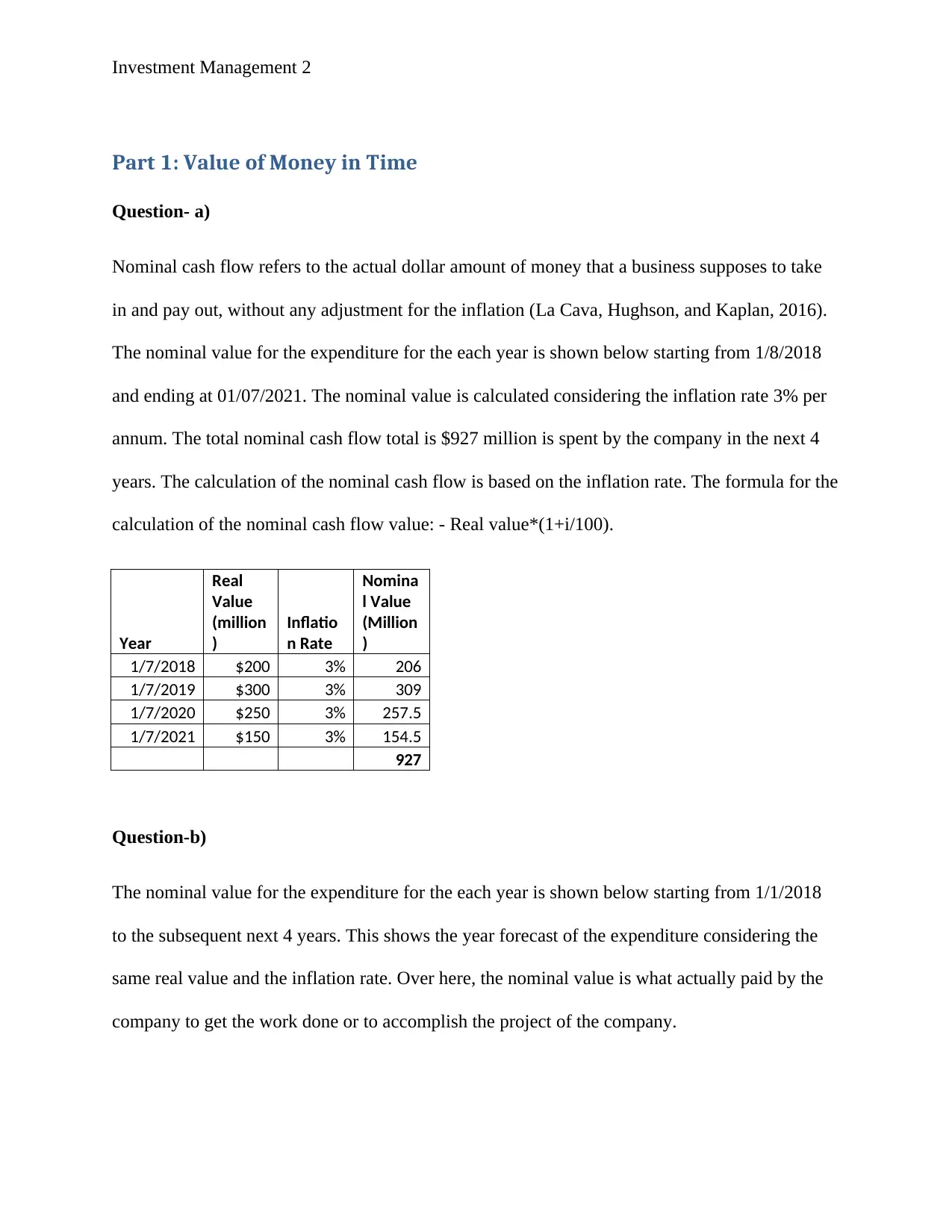
Nominal cash flow refers to the actual dollar amount of money that a business supposes to take
in and pay out, without any adjustment for the inflation (La Cava, Hughson, and Kaplan, 2016).
The nominal value for the expenditure for the each year is shown below starting from 1/8/2018
and ending at 01/07/2021. The nominal value is calculated considering the inflation rate 3% per
annum. The total nominal cash flow total is $927 million is spent by the company in the next 4
years. The calculation of the nominal cash flow is based on the inflation rate. The formula for the
calculation of the nominal cash flow value: - Real value*(1+i/100).
Year
Real
Value
(million
)
Inflatio
n Rate
Nomina
l Value
(Million
)
1/7/2018 $200 3% 206
1/7/2019 $300 3% 309
1/7/2020 $250 3% 257.5
1/7/2021 $150 3% 154.5
927
Question-b)
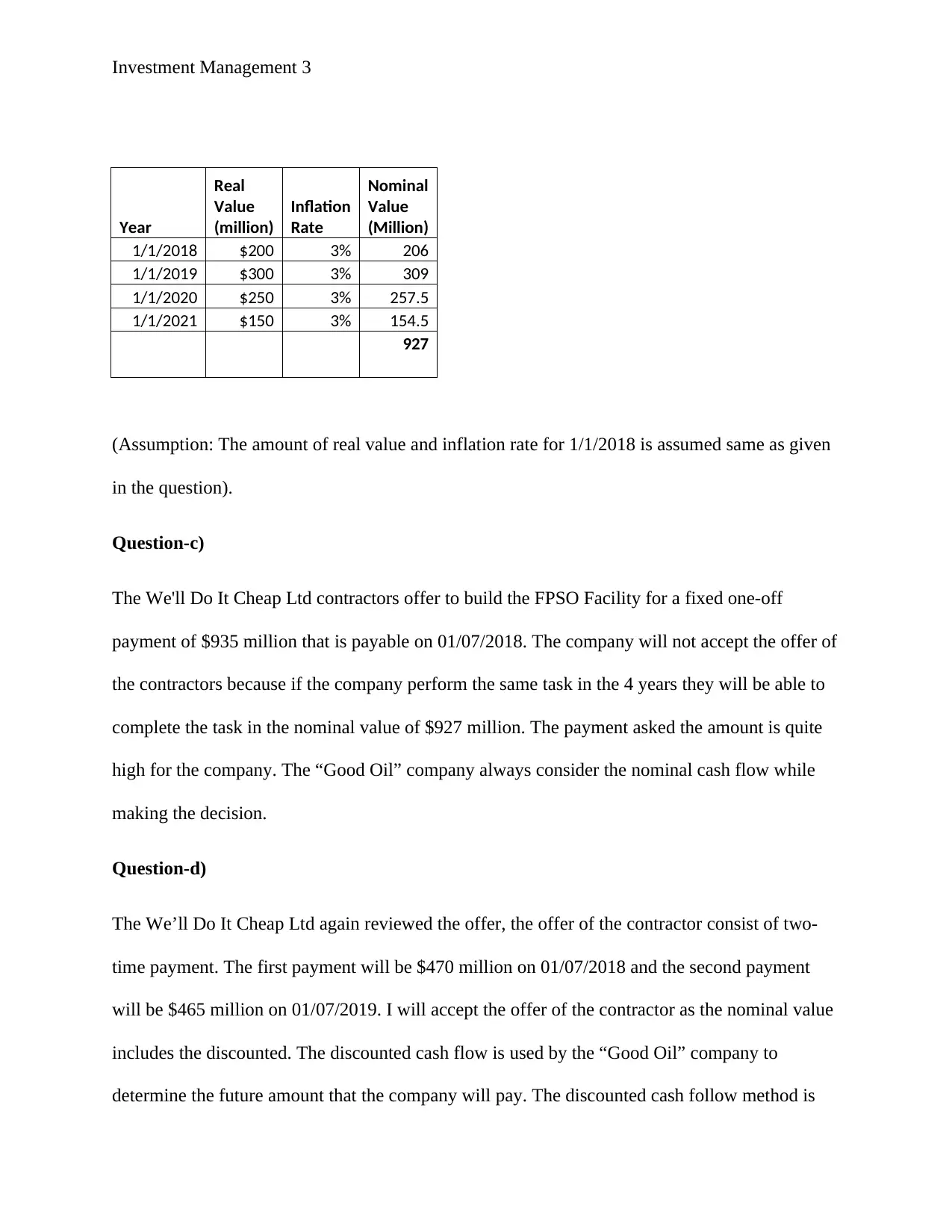
The nominal value for the expenditure for the each year is shown below starting from 1/1/2018
to the subsequent next 4 years. This shows the year forecast of the expenditure considering the
same real value and the inflation rate. Over here, the nominal value is what actually paid by the
company to get the work done or to accomplish the project of the company.
Part 1: Value of Money in Time
Question- a)
Nominal cash flow refers to the actual dollar amount of money that a business supposes to take
in and pay out, without any adjustment for the inflation (La Cava, Hughson, and Kaplan, 2016).
The nominal value for the expenditure for the each year is shown below starting from 1/8/2018
and ending at 01/07/2021. The nominal value is calculated considering the inflation rate 3% per
annum. The total nominal cash flow total is $927 million is spent by the company in the next 4
years. The calculation of the nominal cash flow is based on the inflation rate. The formula for the
calculation of the nominal cash flow value: - Real value*(1+i/100).
Year
Real
Value
(million
)
Inflatio
n Rate
Nomina
l Value
(Million
)
1/7/2018 $200 3% 206
1/7/2019 $300 3% 309
1/7/2020 $250 3% 257.5
1/7/2021 $150 3% 154.5
927
Question-b)
The nominal value for the expenditure for the each year is shown below starting from 1/1/2018
to the subsequent next 4 years. This shows the year forecast of the expenditure considering the
same real value and the inflation rate. Over here, the nominal value is what actually paid by the
company to get the work done or to accomplish the project of the company.
⊘ This is a preview!⊘
Do you want full access?
Subscribe today to unlock all pages.

Trusted by 1+ million students worldwide

Investment Management 3
Year
Real
Value
(million)
Inflation
Rate
Nominal
Value
(Million)
1/1/2018 $200 3% 206
1/1/2019 $300 3% 309
1/1/2020 $250 3% 257.5
1/1/2021 $150 3% 154.5
927
(Assumption: The amount of real value and inflation rate for 1/1/2018 is assumed same as given
in the question).
Question-c)
The We'll Do It Cheap Ltd contractors offer to build the FPSO Facility for a fixed one-off
payment of $935 million that is payable on 01/07/2018. The company will not accept the offer of
the contractors because if the company perform the same task in the 4 years they will be able to
complete the task in the nominal value of $927 million. The payment asked the amount is quite
high for the company. The “Good Oil” company always consider the nominal cash flow while
making the decision.
Question-d)
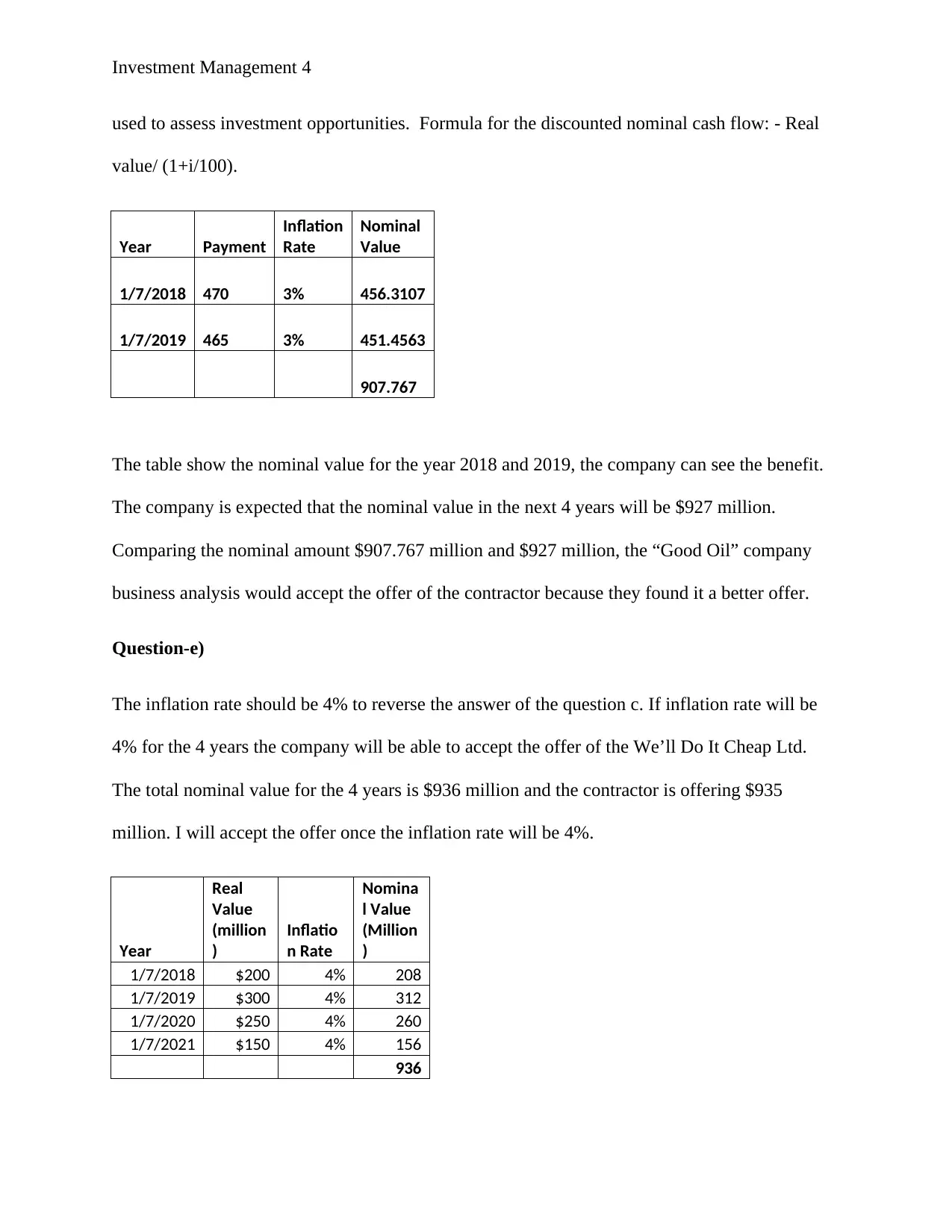
The We’ll Do It Cheap Ltd again reviewed the offer, the offer of the contractor consist of two-
time payment. The first payment will be $470 million on 01/07/2018 and the second payment
will be $465 million on 01/07/2019. I will accept the offer of the contractor as the nominal value
includes the discounted. The discounted cash flow is used by the “Good Oil” company to
determine the future amount that the company will pay. The discounted cash follow method is
Year
Real
Value
(million)
Inflation
Rate
Nominal
Value
(Million)
1/1/2018 $200 3% 206
1/1/2019 $300 3% 309
1/1/2020 $250 3% 257.5
1/1/2021 $150 3% 154.5
927
(Assumption: The amount of real value and inflation rate for 1/1/2018 is assumed same as given
in the question).
Question-c)
The We'll Do It Cheap Ltd contractors offer to build the FPSO Facility for a fixed one-off
payment of $935 million that is payable on 01/07/2018. The company will not accept the offer of
the contractors because if the company perform the same task in the 4 years they will be able to
complete the task in the nominal value of $927 million. The payment asked the amount is quite
high for the company. The “Good Oil” company always consider the nominal cash flow while
making the decision.
Question-d)
The We’ll Do It Cheap Ltd again reviewed the offer, the offer of the contractor consist of two-
time payment. The first payment will be $470 million on 01/07/2018 and the second payment
will be $465 million on 01/07/2019. I will accept the offer of the contractor as the nominal value
includes the discounted. The discounted cash flow is used by the “Good Oil” company to
determine the future amount that the company will pay. The discounted cash follow method is
Paraphrase This Document
Need a fresh take? Get an instant paraphrase of this document with our AI Paraphraser

Investment Management 4
used to assess investment opportunities. Formula for the discounted nominal cash flow: - Real
value/ (1+i/100).
Year Payment
Inflation
Rate
Nominal
Value
1/7/2018 470 3% 456.3107
1/7/2019 465 3% 451.4563
907.767
The table show the nominal value for the year 2018 and 2019, the company can see the benefit.
The company is expected that the nominal value in the next 4 years will be $927 million.
Comparing the nominal amount $907.767 million and $927 million, the “Good Oil” company
business analysis would accept the offer of the contractor because they found it a better offer.
Question-e)
The inflation rate should be 4% to reverse the answer of the question c. If inflation rate will be
4% for the 4 years the company will be able to accept the offer of the We’ll Do It Cheap Ltd.
The total nominal value for the 4 years is $936 million and the contractor is offering $935
million. I will accept the offer once the inflation rate will be 4%.
Year
Real
Value
(million
)
Inflatio
n Rate
Nomina
l Value
(Million
)
1/7/2018 $200 4% 208
1/7/2019 $300 4% 312
1/7/2020 $250 4% 260
1/7/2021 $150 4% 156
936
used to assess investment opportunities. Formula for the discounted nominal cash flow: - Real
value/ (1+i/100).
Year Payment
Inflation
Rate
Nominal
Value
1/7/2018 470 3% 456.3107
1/7/2019 465 3% 451.4563
907.767
The table show the nominal value for the year 2018 and 2019, the company can see the benefit.
The company is expected that the nominal value in the next 4 years will be $927 million.
Comparing the nominal amount $907.767 million and $927 million, the “Good Oil” company
business analysis would accept the offer of the contractor because they found it a better offer.
Question-e)
The inflation rate should be 4% to reverse the answer of the question c. If inflation rate will be
4% for the 4 years the company will be able to accept the offer of the We’ll Do It Cheap Ltd.
The total nominal value for the 4 years is $936 million and the contractor is offering $935
million. I will accept the offer once the inflation rate will be 4%.
Year
Real
Value
(million
)
Inflatio
n Rate
Nomina
l Value
(Million
)
1/7/2018 $200 4% 208
1/7/2019 $300 4% 312
1/7/2020 $250 4% 260
1/7/2021 $150 4% 156
936

Investment Management 5
Part 2: Taxation Concepts Discussion
Purpose and Impact of Tax Depreciation in After-Tax Discounted Cash Flow
Deprecation is a non-cash accounting charge; it is a tax-deductible expense. Depreciation
reduces the tax cost which has a positive impact on cash flow. Deprecation is a deduction in
included in income before taxes. It is presented as an adjustment in settling the net income to
operating cash flow (Doidge, and Dyck, 2015).
The tax Depreciation in After-Tax Discounted Cash Flow is used by the investors to gain the tax
benefits provided by the tax authorities in relation to depreciation expense. As the depreciation is
a noncash expense the company may take the tax advantage of it by inflating the expenses in the
tax reports.
Relative merits of Straight Line Depreciation vs. Units of Production
Depreciation
Merits of Straight Line Depreciation
The calculation of depreciation through straight-line depreciation is easy and simpler
(Halim, Sharif, and Jaaman 2016).
It can be applied to all long-term assets.
This method is the usable accounting method and widely acceptable across the world.
The quantum of depreciation and the rate of the depreciation remain fixed throughout the
complete useful economic life of the assets (Bello, I.K., 2014).
Merits of Unit of production depreciation
Part 2: Taxation Concepts Discussion
Purpose and Impact of Tax Depreciation in After-Tax Discounted Cash Flow
Deprecation is a non-cash accounting charge; it is a tax-deductible expense. Depreciation
reduces the tax cost which has a positive impact on cash flow. Deprecation is a deduction in
included in income before taxes. It is presented as an adjustment in settling the net income to
operating cash flow (Doidge, and Dyck, 2015).
The tax Depreciation in After-Tax Discounted Cash Flow is used by the investors to gain the tax
benefits provided by the tax authorities in relation to depreciation expense. As the depreciation is
a noncash expense the company may take the tax advantage of it by inflating the expenses in the
tax reports.
Relative merits of Straight Line Depreciation vs. Units of Production
Depreciation
Merits of Straight Line Depreciation
The calculation of depreciation through straight-line depreciation is easy and simpler
(Halim, Sharif, and Jaaman 2016).
It can be applied to all long-term assets.
This method is the usable accounting method and widely acceptable across the world.
The quantum of depreciation and the rate of the depreciation remain fixed throughout the
complete useful economic life of the assets (Bello, I.K., 2014).
Merits of Unit of production depreciation
⊘ This is a preview!⊘
Do you want full access?
Subscribe today to unlock all pages.

Trusted by 1+ million students worldwide

Investment Management 6
This method is based on the quantum of usage of the assets, the basic principle says the
more usage- the more will be an amount of the tear and wear of the assets (Gillespie,
2014).
The aim of this method is to overcome the restrictions of the straight line method of the
depreciation.
The quantum of depreciation gets reasonably and suitably coordinated with the level of
the production each year (DRURY, 2013).
The biggest merit of this method is more accurate than the other methods of depreciation
cost. This method gives a better picture and helps in assessing the true picture of assets to
the owners.
This method is based on the quantum of usage of the assets, the basic principle says the
more usage- the more will be an amount of the tear and wear of the assets (Gillespie,
2014).
The aim of this method is to overcome the restrictions of the straight line method of the
depreciation.
The quantum of depreciation gets reasonably and suitably coordinated with the level of
the production each year (DRURY, 2013).
The biggest merit of this method is more accurate than the other methods of depreciation
cost. This method gives a better picture and helps in assessing the true picture of assets to
the owners.
Paraphrase This Document
Need a fresh take? Get an instant paraphrase of this document with our AI Paraphraser

Investment Management 7
References
Bello, I.K., 2014, depreciation measurement in cost method of valuation in lagos metropolis. Am.
J. Soc. Mgmt. Sci, 5(2), pp.73-83.
DRURY, C.M., 2013, Management and cost accounting. Springer.
Gillespie, A., 2014, Foundations of economics. Oxford University Press, USA.
La Cava, G., Hughson, H. and Kaplan, G., 2016, The household cash flow channel of monetary
policy. Reserve Bank of Australia Research Discussion Papers, (2016-12).
Doidge, C. and Dyck, A., 2015, Taxes and corporate policies: Evidence from a quasi natural
experiment. The Journal of Finance, 70(1), pp.45-89.
Halim, N.A., Sharif, S.N.B. and Jaaman S.H., 2016, June, Empirical testing of robust
optimization profit sharing ratio with straight line depreciation in Aitab instrument. In AIP
Conference Proceedings (Vol. 1750, No. 1, p. 030002). AIP Publishing.
References
Bello, I.K., 2014, depreciation measurement in cost method of valuation in lagos metropolis. Am.
J. Soc. Mgmt. Sci, 5(2), pp.73-83.
DRURY, C.M., 2013, Management and cost accounting. Springer.
Gillespie, A., 2014, Foundations of economics. Oxford University Press, USA.
La Cava, G., Hughson, H. and Kaplan, G., 2016, The household cash flow channel of monetary
policy. Reserve Bank of Australia Research Discussion Papers, (2016-12).
Doidge, C. and Dyck, A., 2015, Taxes and corporate policies: Evidence from a quasi natural
experiment. The Journal of Finance, 70(1), pp.45-89.
Halim, N.A., Sharif, S.N.B. and Jaaman S.H., 2016, June, Empirical testing of robust
optimization profit sharing ratio with straight line depreciation in Aitab instrument. In AIP
Conference Proceedings (Vol. 1750, No. 1, p. 030002). AIP Publishing.
1 out of 8
Related Documents
Your All-in-One AI-Powered Toolkit for Academic Success.
+13062052269
info@desklib.com
Available 24*7 on WhatsApp / Email
Unlock your academic potential
Copyright © 2020–2026 A2Z Services. All Rights Reserved. Developed and managed by ZUCOL.