Ion Channels: Project Proposal on Purification, Assay and Activation

Verified

Added on  2023/06/15

|5
|789
|162
Project
AI Summary
This project proposal outlines a strategy for Hot Heads Biotech, Inc. (HHI) to identify chemical agents that stimulate temperature sensation for Nintendo's HEAT™ virtual reality gaming system. The proposal details a three-step approach: (1) purification of Transient Receptor Potential (TRP) ion channels from a cloned cell line using cell lysis, ultracentrifugation, and chromatography; (2) performing patch clamp assays to measure the inward and outward movement of cations through the TRP channels, quantifying the electric current required to maintain membrane potential; and (3) identifying ion channel activators from a library of environmental irritants and pungent natural compounds, with iodoacetamide (IA) and 2-amioethyl methanethiosulphonate (MTSEA) selected as potential candidates and mustard oil/cinnamaldehyde as controls, using patch clamp techniques to validate effectiveness.
Document Page
Running head: ION CHANNELS
Ion Channels
Name of the Student
Name of the University
Author Note
tabler-icon-diamond-filled.svg

Paraphrase This Document

Need a fresh take? Get an instant paraphrase of this document with our AI Paraphraser
Document Page
1
ION CHANNELS
Step 1:
Purification of ion channels
The cell line that contains Transient Receptor Potential (TRP) as cloned by HHI will
be grown the cell medium. If the cloning is done inside the bacterial cell, then the cell will
allowed to grow as fresh culture in Lurea Broth upon achievement of the exponential phase
(as determined via optical density of spectrophotometry, OD600), it will be induced via IPTF
(Isopropyl beta-D-1-thiogalactopyranoside). The included cell will be precipitated under
coldd centrifuged and then the cells will be lysed. The homogenate will be treated with
DNAase and lysozyme. The membranes will be then ultra centrifuged. The isolation of the
membrane will then be followed by the isolation of the ion-channel. Chromatography will be
performed in order to detect the proper organization of the ion channels. If the channel was
found intact then purified ion channel protein will be infected inside the liposome under the
action of micelle formation (Sukharev 2002).
Step 2
Patch Clamp Assay
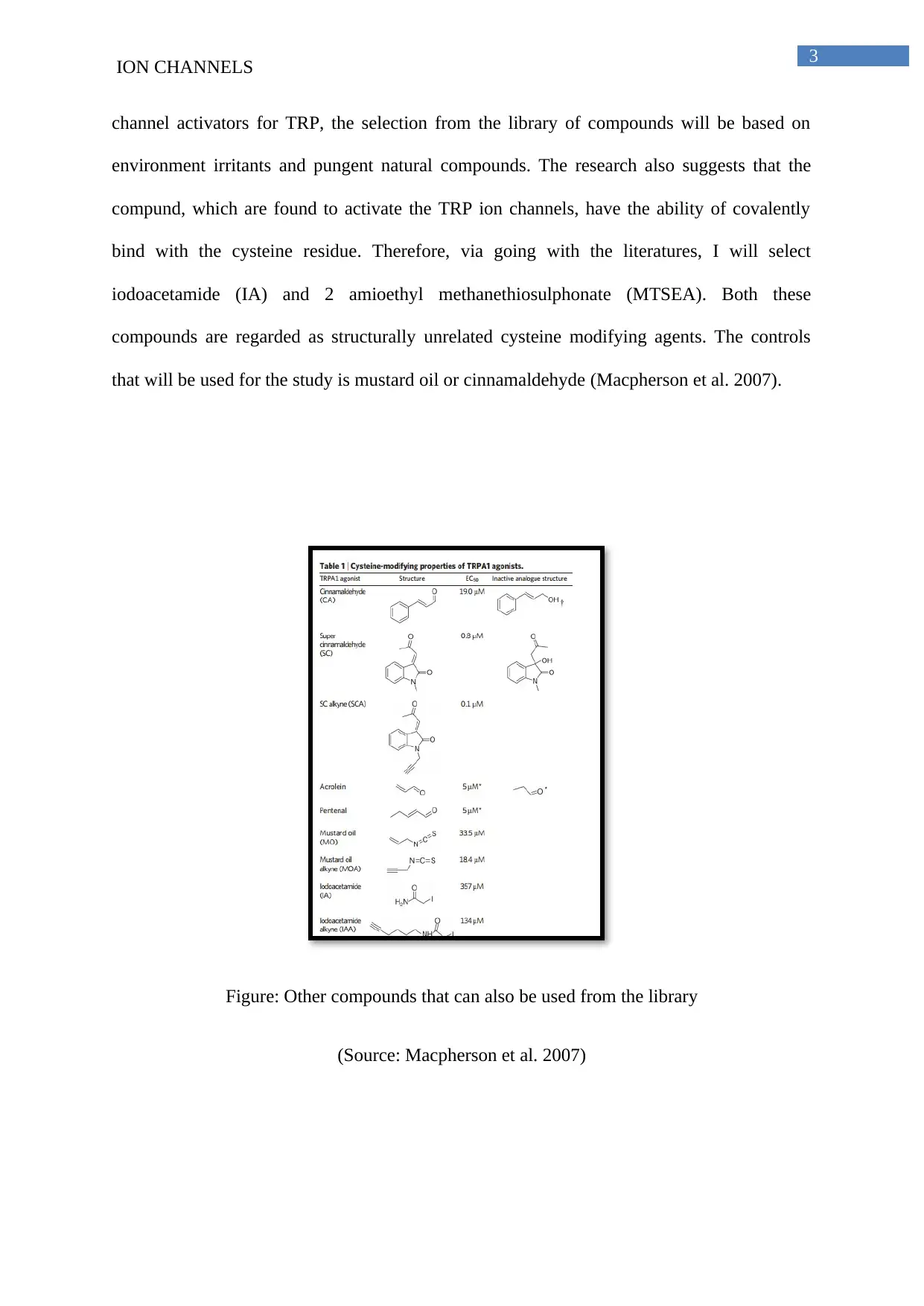
Patch Clamp technique helps to note the opening, closing and regulation of single ion
channel. In this technique, the inward and the outward movement of cations of transient
receptor potential (TRP) ion channels will be measured. The quantification will be based on
the amount of electric current required to maintain the membrane potential to a particular
"clamped" value. In order to secure the electro neutrality and to maintain the membrane
potential at constant level, the influx of each positive ion (Ca2+) inside the cell via a channel
Document Page
2
ION CHANNELS
in the patch membrane will be balance via the addition of an electron (e-) inside the cytosol.
The insertion of the electron will be done via microelectrode that will be kept inserted into
the cytosol. The microelectrode will also help to measure the number of electron entering into
the cytosol in order to counter balance the inflow of the ions via the membrane channels. On
the other hand, exit of each ion will balance by the withdrawal of the electron from the
cytosol. This path clamp technique will be employed on the membrane of liposome within
which the TRP will be isolated. However, patch clamp technique can also be employed over
whole cell (Lodish et al. 2000).
Figure: Model of Patch clamp technique
(Source: Lodish et al. 2000)
Step: 3
Identification of ion channel activators
TRP family of ion channel is activated via several noxious stimuli like cold
temperatures, pungent natural compounds and other environment irritants. So to indentify the
Document Page
3
ION CHANNELS
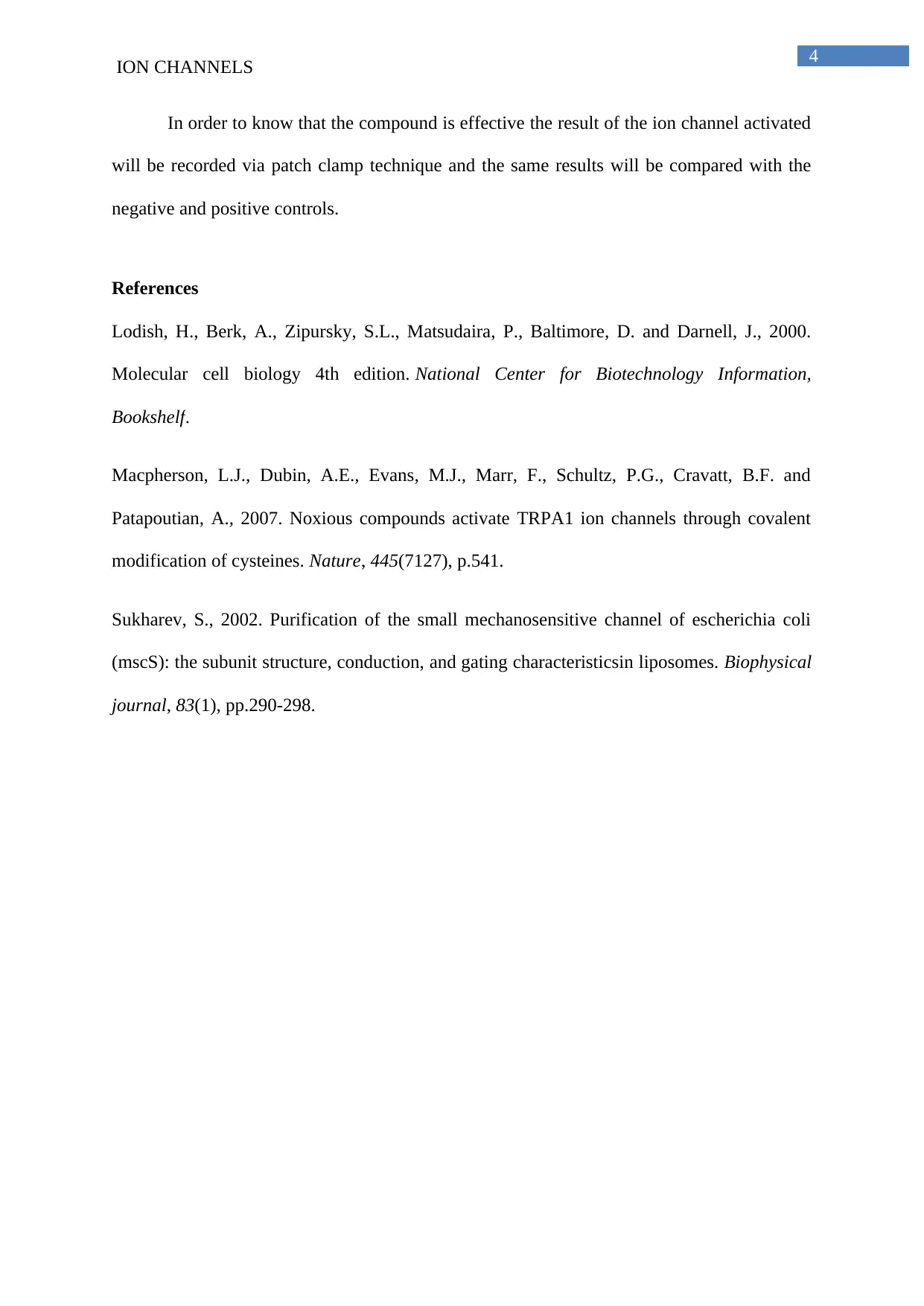
channel activators for TRP, the selection from the library of compounds will be based on
environment irritants and pungent natural compounds. The research also suggests that the
compund, which are found to activate the TRP ion channels, have the ability of covalently
bind with the cysteine residue. Therefore, via going with the literatures, I will select
iodoacetamide (IA) and 2 amioethyl methanethiosulphonate (MTSEA). Both these
compounds are regarded as structurally unrelated cysteine modifying agents. The controls
that will be used for the study is mustard oil or cinnamaldehyde (Macpherson et al. 2007).
Figure: Other compounds that can also be used from the library
(Source: Macpherson et al. 2007)
tabler-icon-diamond-filled.svg

Paraphrase This Document

Need a fresh take? Get an instant paraphrase of this document with our AI Paraphraser
Document Page
4
ION CHANNELS
In order to know that the compound is effective the result of the ion channel activated
will be recorded via patch clamp technique and the same results will be compared with the
negative and positive controls.
References
Lodish, H., Berk, A., Zipursky, S.L., Matsudaira, P., Baltimore, D. and Darnell, J., 2000.
Molecular cell biology 4th edition. National Center for Biotechnology Information,
Bookshelf.
Macpherson, L.J., Dubin, A.E., Evans, M.J., Marr, F., Schultz, P.G., Cravatt, B.F. and
Patapoutian, A., 2007. Noxious compounds activate TRPA1 ion channels through covalent
modification of cysteines. Nature, 445(7127), p.541.
Sukharev, S., 2002. Purification of the small mechanosensitive channel of escherichia coli
(mscS): the subunit structure, conduction, and gating characteristicsin liposomes. Biophysical
journal, 83(1), pp.290-298.
chevron_up_icon
1 out of 5
circle_padding
hide_on_mobile
zoom_out_icon
[object Object]