An In-Depth Analysis of IoT Connectivity Technologies
VerifiedAdded on 2021/06/17
|9
|2979
|69
Report
AI Summary
This report provides a comprehensive overview of IoT connectivity, examining various aspects of the technology. It begins with an introduction to IoT connectivity, highlighting its applications in areas such as alarm systems, wearable devices, and medical appliances. The report then delves into the different connectivity offerings available, including unlicensed, low-power wide area (LPWA), cellular, and extra-terrestrial options, discussing their advantages and disadvantages. It explores the IoT application connectivity architecture, emphasizing the role of devices, gateways, and protocols like Bluetooth. The report also investigates new business models for IoT connectivity, focusing on the importance of consistent connectivity and the interactions within the IoT ecosystem. Furthermore, it details various IoT protocols used in connectivity, categorizing them and providing examples like Wi-Fi, Thread, Bluetooth, and RFID. The report concludes by emphasizing the importance of continuous improvement in IoT connectivity to maximize the efficiency of IoT technology.

IoT Connectivity

Paraphrase This Document
Need a fresh take? Get an instant paraphrase of this document with our AI Paraphraser
Table of Contents
Introduction to IoT Connectivity............................................................................................................1
Assortment of connectivity offerings.....................................................................................................2
IoT application connectivity architecture..............................................................................................4
Exploring New Business Models for IOT connectivity............................................................................5
IoT protocols used in connectivity.........................................................................................................5
Potential improvement areas in IoT connectivity..................................................................................6
References.............................................................................................................................................7
Introduction to IoT Connectivity
The network combination of certain smart working devices that communicate with each other in a
normal way over the internet or some medium is being considered as the internet of things, and is
contributing continuously in the way we perform things in our daily life.
It has been implemented in our day to day life in such way that the basic things are also
being covered, and all these activities states a good example of strong connectivity such as-
1. IOT Alarm Systems- These are the smart alarm systems that work actively and senses any
activity, held in the surroundings that are unusual [1]. This helps the house owners as well as
the parking owners to be on a safer side.
2. Wearable Devices- Nowadays there are such devices that are being manufactured to trace
the activities or to trace the moments of any moving body. These are generally being used
on animals, so as to locate their moments and them as well.
3. Medical Appliances and devices- In the medical field, some devices are being tied to the
patient and are kept near to them, to measure the heart rate and blood pressure along with
the rate of breathing. It senses the overall working of the organs, and helps to locate the
cause of disease easily.
1
Introduction to IoT Connectivity............................................................................................................1
Assortment of connectivity offerings.....................................................................................................2
IoT application connectivity architecture..............................................................................................4
Exploring New Business Models for IOT connectivity............................................................................5
IoT protocols used in connectivity.........................................................................................................5
Potential improvement areas in IoT connectivity..................................................................................6
References.............................................................................................................................................7
Introduction to IoT Connectivity
The network combination of certain smart working devices that communicate with each other in a
normal way over the internet or some medium is being considered as the internet of things, and is
contributing continuously in the way we perform things in our daily life.
It has been implemented in our day to day life in such way that the basic things are also
being covered, and all these activities states a good example of strong connectivity such as-
1. IOT Alarm Systems- These are the smart alarm systems that work actively and senses any
activity, held in the surroundings that are unusual [1]. This helps the house owners as well as
the parking owners to be on a safer side.
2. Wearable Devices- Nowadays there are such devices that are being manufactured to trace
the activities or to trace the moments of any moving body. These are generally being used
on animals, so as to locate their moments and them as well.
3. Medical Appliances and devices- In the medical field, some devices are being tied to the
patient and are kept near to them, to measure the heart rate and blood pressure along with
the rate of breathing. It senses the overall working of the organs, and helps to locate the
cause of disease easily.
1
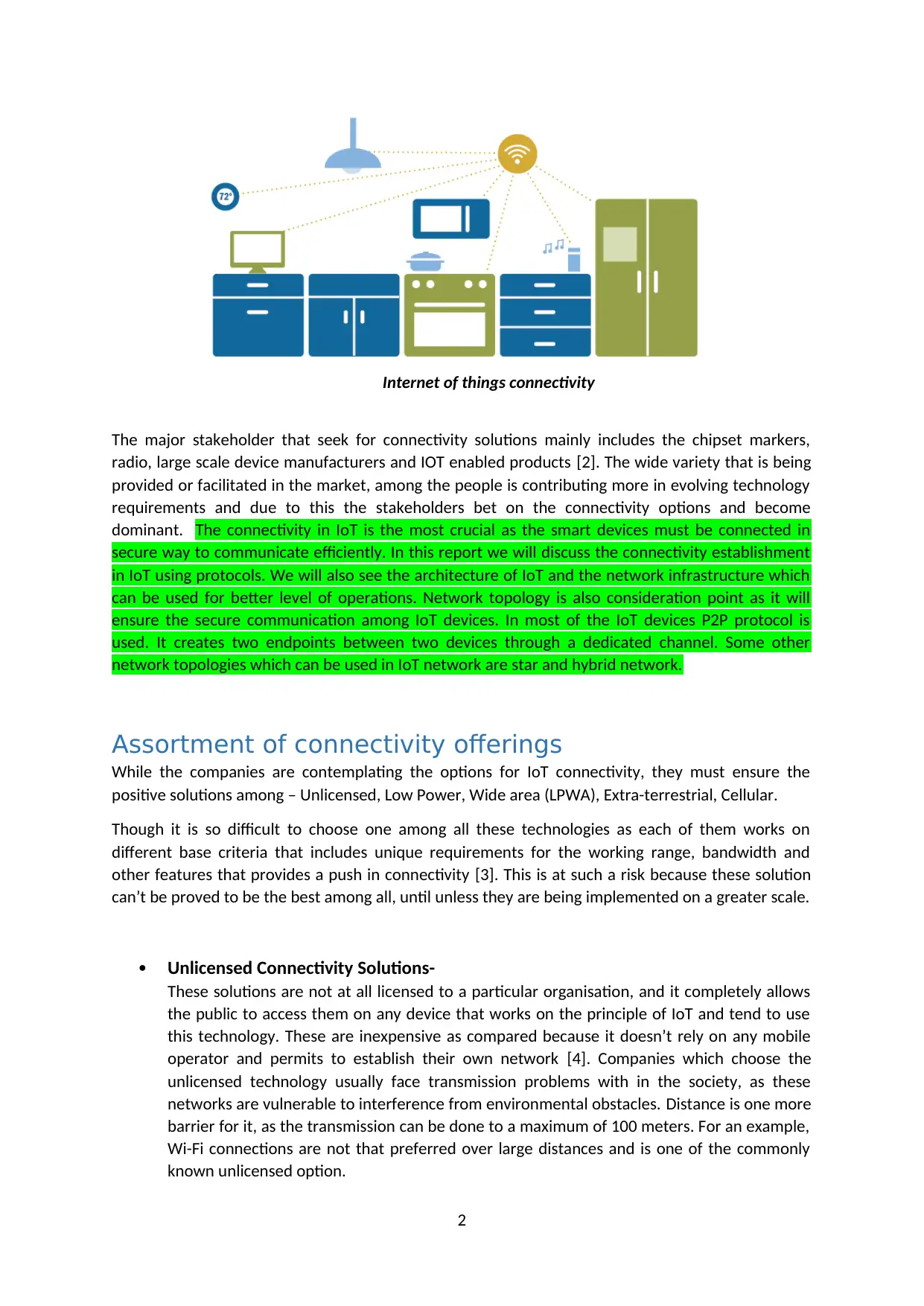
Internet of things connectivity
The major stakeholder that seek for connectivity solutions mainly includes the chipset markers,
radio, large scale device manufacturers and IOT enabled products [2]. The wide variety that is being
provided or facilitated in the market, among the people is contributing more in evolving technology
requirements and due to this the stakeholders bet on the connectivity options and become
dominant. The connectivity in IoT is the most crucial as the smart devices must be connected in
secure way to communicate efficiently. In this report we will discuss the connectivity establishment
in IoT using protocols. We will also see the architecture of IoT and the network infrastructure which
can be used for better level of operations. Network topology is also consideration point as it will
ensure the secure communication among IoT devices. In most of the IoT devices P2P protocol is
used. It creates two endpoints between two devices through a dedicated channel. Some other
network topologies which can be used in IoT network are star and hybrid network.
Assortment of connectivity offerings
While the companies are contemplating the options for IoT connectivity, they must ensure the
positive solutions among – Unlicensed, Low Power, Wide area (LPWA), Extra-terrestrial, Cellular.
Though it is so difficult to choose one among all these technologies as each of them works on
different base criteria that includes unique requirements for the working range, bandwidth and
other features that provides a push in connectivity [3]. This is at such a risk because these solution
can’t be proved to be the best among all, until unless they are being implemented on a greater scale.
Unlicensed Connectivity Solutions-
These solutions are not at all licensed to a particular organisation, and it completely allows
the public to access them on any device that works on the principle of IoT and tend to use
this technology. These are inexpensive as compared because it doesn’t rely on any mobile
operator and permits to establish their own network [4]. Companies which choose the
unlicensed technology usually face transmission problems with in the society, as these
networks are vulnerable to interference from environmental obstacles. Distance is one more
barrier for it, as the transmission can be done to a maximum of 100 meters. For an example,
Wi-Fi connections are not that preferred over large distances and is one of the commonly
known unlicensed option.
2
The major stakeholder that seek for connectivity solutions mainly includes the chipset markers,
radio, large scale device manufacturers and IOT enabled products [2]. The wide variety that is being
provided or facilitated in the market, among the people is contributing more in evolving technology
requirements and due to this the stakeholders bet on the connectivity options and become
dominant. The connectivity in IoT is the most crucial as the smart devices must be connected in
secure way to communicate efficiently. In this report we will discuss the connectivity establishment
in IoT using protocols. We will also see the architecture of IoT and the network infrastructure which
can be used for better level of operations. Network topology is also consideration point as it will
ensure the secure communication among IoT devices. In most of the IoT devices P2P protocol is
used. It creates two endpoints between two devices through a dedicated channel. Some other
network topologies which can be used in IoT network are star and hybrid network.
Assortment of connectivity offerings
While the companies are contemplating the options for IoT connectivity, they must ensure the
positive solutions among – Unlicensed, Low Power, Wide area (LPWA), Extra-terrestrial, Cellular.
Though it is so difficult to choose one among all these technologies as each of them works on
different base criteria that includes unique requirements for the working range, bandwidth and
other features that provides a push in connectivity [3]. This is at such a risk because these solution
can’t be proved to be the best among all, until unless they are being implemented on a greater scale.
Unlicensed Connectivity Solutions-
These solutions are not at all licensed to a particular organisation, and it completely allows
the public to access them on any device that works on the principle of IoT and tend to use
this technology. These are inexpensive as compared because it doesn’t rely on any mobile
operator and permits to establish their own network [4]. Companies which choose the
unlicensed technology usually face transmission problems with in the society, as these
networks are vulnerable to interference from environmental obstacles. Distance is one more
barrier for it, as the transmission can be done to a maximum of 100 meters. For an example,
Wi-Fi connections are not that preferred over large distances and is one of the commonly
known unlicensed option.
2
⊘ This is a preview!⊘
Do you want full access?
Subscribe today to unlock all pages.

Trusted by 1+ million students worldwide
Low-power, Wide-area Connectivity
This technology is a bit new among the industries as compared to others. It comprises of two
major characteristics-
Low Power- They allow the devices to work consistently over many years, by assuming that
they collect data on hourly basis and it hardly impacts the battery degradation [5].
Wide Area- As far as distance is concerned, it delivers the signal transmission to at least
500meters range from the gateway device to the final end point. Coverage is lowest in
underground circumstances and in urban areas as well.
In both the situations, the technology is reliable as well as cost effective [6]. LPWA tends to
be the major solution that provides the path to meet the level of significant IoT connectivity.
It is growing with a high rate and has made its impact over a wide range. By the year 2022, it
is being stated that most of the IoT devices will be working on LPWA networks, as it will
provide an environment where connectivity choices will be less confusing [7].
Cellular Connectivity
Currently the 4G LTE technology provides high bandwidth of 100mb per second along with a
large area of transmission (up to 10kms). This states that in such a case the reliability as well
as the availability of the network provided, both are good. But there’s a downside as well
because the 4G networks are also associated with the high initial cost. The 4D networks has
a higher rate of power-consumption and this establishes a limitation for those IoT devices
that has less power backup [8].
Only some of the working industries are successful to rely on private networks, rest
of the organisations failed just because they lacked in somewhere or the other significant
requirements. Either it was the overall production, overall budget or the capabilities to meet
the performance requirement [9]. Sometimes it also leads to heavy load on transmission, at
places that are crowded and number of users are much more than expected.
Extra-terrestrial Connectivity
This type of connectivity includes the microwave technologies and satellite signal
transmission as well. Due to its high cost and feasibility, the major stakeholder organisations
use it only where cellular and fibre networks are not in option. Such an example is clearly
shown in army or national defence colonies, where they might be using a different networks
for unnamed drones or for security. Due to this private network policies, only some working
organisations use this connectivity option just for their personalised IoT appliances [10].
Depending upon the basic requirements of a particular network and the expectation of the
organisation, the cost of the whole project is being calculated for each and every scenario. After the
study of every IoT solution, the best one is found and implemented keeping in mind that the cost
should not exceed the company’s budget.
Supporting Ecosystems
Some of the solutions for connectivity are easier to deploy as they are a strong surrounding
support system that helps it and provide an ease in working. If we consider a network that is
being used on the basic principle of LPWA, in such case there are a limited users that have
3
This technology is a bit new among the industries as compared to others. It comprises of two
major characteristics-
Low Power- They allow the devices to work consistently over many years, by assuming that
they collect data on hourly basis and it hardly impacts the battery degradation [5].
Wide Area- As far as distance is concerned, it delivers the signal transmission to at least
500meters range from the gateway device to the final end point. Coverage is lowest in
underground circumstances and in urban areas as well.
In both the situations, the technology is reliable as well as cost effective [6]. LPWA tends to
be the major solution that provides the path to meet the level of significant IoT connectivity.
It is growing with a high rate and has made its impact over a wide range. By the year 2022, it
is being stated that most of the IoT devices will be working on LPWA networks, as it will
provide an environment where connectivity choices will be less confusing [7].
Cellular Connectivity
Currently the 4G LTE technology provides high bandwidth of 100mb per second along with a
large area of transmission (up to 10kms). This states that in such a case the reliability as well
as the availability of the network provided, both are good. But there’s a downside as well
because the 4G networks are also associated with the high initial cost. The 4D networks has
a higher rate of power-consumption and this establishes a limitation for those IoT devices
that has less power backup [8].
Only some of the working industries are successful to rely on private networks, rest
of the organisations failed just because they lacked in somewhere or the other significant
requirements. Either it was the overall production, overall budget or the capabilities to meet
the performance requirement [9]. Sometimes it also leads to heavy load on transmission, at
places that are crowded and number of users are much more than expected.
Extra-terrestrial Connectivity
This type of connectivity includes the microwave technologies and satellite signal
transmission as well. Due to its high cost and feasibility, the major stakeholder organisations
use it only where cellular and fibre networks are not in option. Such an example is clearly
shown in army or national defence colonies, where they might be using a different networks
for unnamed drones or for security. Due to this private network policies, only some working
organisations use this connectivity option just for their personalised IoT appliances [10].
Depending upon the basic requirements of a particular network and the expectation of the
organisation, the cost of the whole project is being calculated for each and every scenario. After the
study of every IoT solution, the best one is found and implemented keeping in mind that the cost
should not exceed the company’s budget.
Supporting Ecosystems
Some of the solutions for connectivity are easier to deploy as they are a strong surrounding
support system that helps it and provide an ease in working. If we consider a network that is
being used on the basic principle of LPWA, in such case there are a limited users that have
3
Paraphrase This Document
Need a fresh take? Get an instant paraphrase of this document with our AI Paraphraser
access to much strong network connection that is reliable for years. Hence it will grow its
numbers so that more networks could be developed.
Commercial Readiness
There are various connectivity solutions that are not still being implemented over a large
scale. Some of these solutions have very low power requirements, but they couldn’t be used
widely as no organisation has taken a risk by implementing them commercially. Hence the
solutions that are significantly used in networks over years are establishing their roots over
various industries but the new solutions that might be proved better than other existing
solutions are not given a try just because of the onetime risk involved.
IoT application connectivity architecture
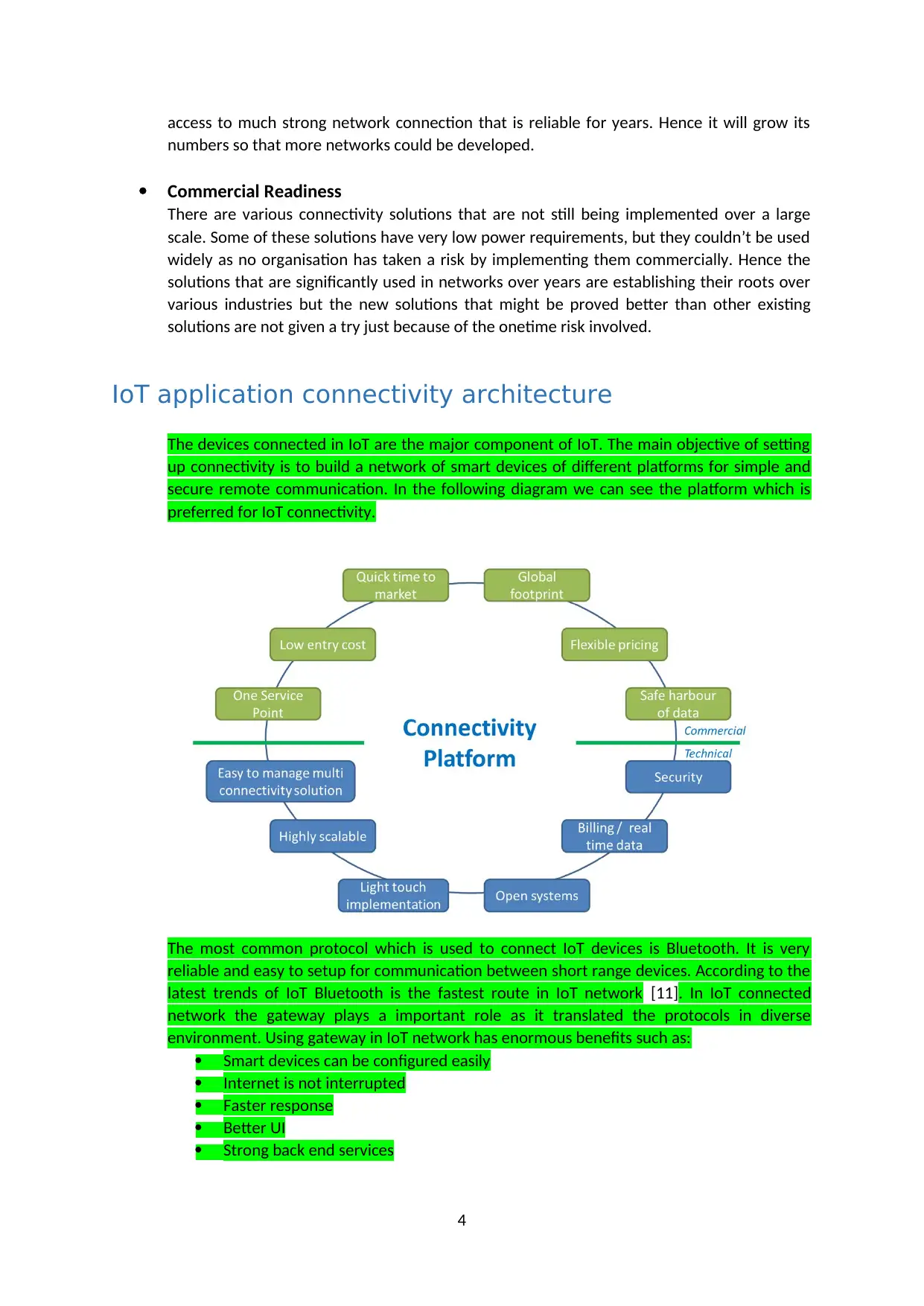
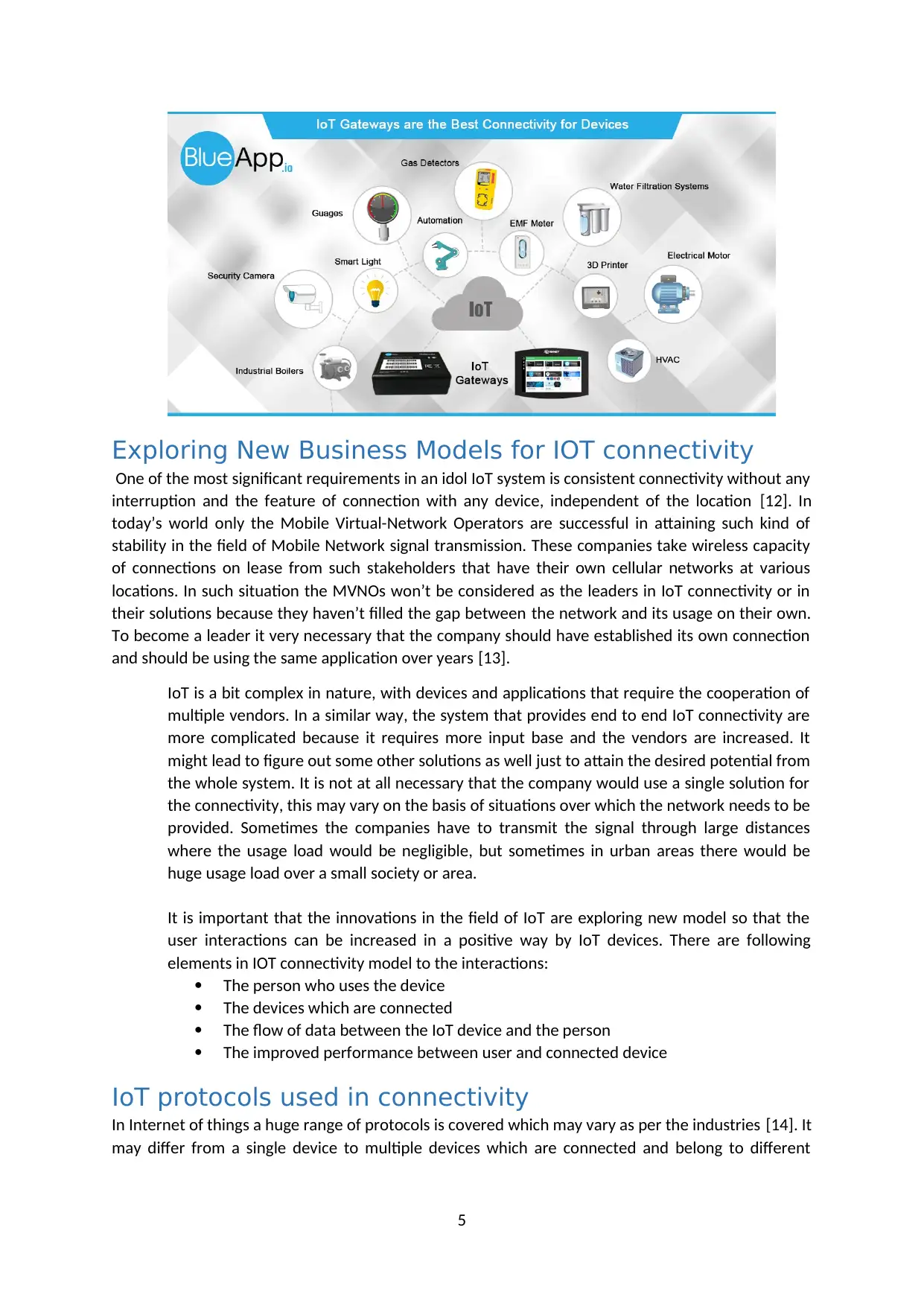
The devices connected in IoT are the major component of IoT. The main objective of setting
up connectivity is to build a network of smart devices of different platforms for simple and
secure remote communication. In the following diagram we can see the platform which is
preferred for IoT connectivity.
The most common protocol which is used to connect IoT devices is Bluetooth. It is very
reliable and easy to setup for communication between short range devices. According to the
latest trends of IoT Bluetooth is the fastest route in IoT network [11]. In IoT connected
network the gateway plays a important role as it translated the protocols in diverse
environment. Using gateway in IoT network has enormous benefits such as:
Smart devices can be configured easily
Internet is not interrupted
Faster response
Better UI
Strong back end services
4
numbers so that more networks could be developed.
Commercial Readiness
There are various connectivity solutions that are not still being implemented over a large
scale. Some of these solutions have very low power requirements, but they couldn’t be used
widely as no organisation has taken a risk by implementing them commercially. Hence the
solutions that are significantly used in networks over years are establishing their roots over
various industries but the new solutions that might be proved better than other existing
solutions are not given a try just because of the onetime risk involved.
IoT application connectivity architecture
The devices connected in IoT are the major component of IoT. The main objective of setting
up connectivity is to build a network of smart devices of different platforms for simple and
secure remote communication. In the following diagram we can see the platform which is
preferred for IoT connectivity.
The most common protocol which is used to connect IoT devices is Bluetooth. It is very
reliable and easy to setup for communication between short range devices. According to the
latest trends of IoT Bluetooth is the fastest route in IoT network [11]. In IoT connected
network the gateway plays a important role as it translated the protocols in diverse
environment. Using gateway in IoT network has enormous benefits such as:
Smart devices can be configured easily
Internet is not interrupted
Faster response
Better UI
Strong back end services
4
Exploring New Business Models for IOT connectivity
One of the most significant requirements in an idol IoT system is consistent connectivity without any
interruption and the feature of connection with any device, independent of the location [12]. In
today’s world only the Mobile Virtual-Network Operators are successful in attaining such kind of
stability in the field of Mobile Network signal transmission. These companies take wireless capacity
of connections on lease from such stakeholders that have their own cellular networks at various
locations. In such situation the MVNOs won’t be considered as the leaders in IoT connectivity or in
their solutions because they haven’t filled the gap between the network and its usage on their own.
To become a leader it very necessary that the company should have established its own connection
and should be using the same application over years [13].
IoT is a bit complex in nature, with devices and applications that require the cooperation of
multiple vendors. In a similar way, the system that provides end to end IoT connectivity are
more complicated because it requires more input base and the vendors are increased. It
might lead to figure out some other solutions as well just to attain the desired potential from
the whole system. It is not at all necessary that the company would use a single solution for
the connectivity, this may vary on the basis of situations over which the network needs to be
provided. Sometimes the companies have to transmit the signal through large distances
where the usage load would be negligible, but sometimes in urban areas there would be
huge usage load over a small society or area.
It is important that the innovations in the field of IoT are exploring new model so that the
user interactions can be increased in a positive way by IoT devices. There are following
elements in IOT connectivity model to the interactions:
The person who uses the device
The devices which are connected
The flow of data between the IoT device and the person
The improved performance between user and connected device
IoT protocols used in connectivity
In Internet of things a huge range of protocols is covered which may vary as per the industries [14]. It
may differ from a single device to multiple devices which are connected and belong to different
5
One of the most significant requirements in an idol IoT system is consistent connectivity without any
interruption and the feature of connection with any device, independent of the location [12]. In
today’s world only the Mobile Virtual-Network Operators are successful in attaining such kind of
stability in the field of Mobile Network signal transmission. These companies take wireless capacity
of connections on lease from such stakeholders that have their own cellular networks at various
locations. In such situation the MVNOs won’t be considered as the leaders in IoT connectivity or in
their solutions because they haven’t filled the gap between the network and its usage on their own.
To become a leader it very necessary that the company should have established its own connection
and should be using the same application over years [13].
IoT is a bit complex in nature, with devices and applications that require the cooperation of
multiple vendors. In a similar way, the system that provides end to end IoT connectivity are
more complicated because it requires more input base and the vendors are increased. It
might lead to figure out some other solutions as well just to attain the desired potential from
the whole system. It is not at all necessary that the company would use a single solution for
the connectivity, this may vary on the basis of situations over which the network needs to be
provided. Sometimes the companies have to transmit the signal through large distances
where the usage load would be negligible, but sometimes in urban areas there would be
huge usage load over a small society or area.
It is important that the innovations in the field of IoT are exploring new model so that the
user interactions can be increased in a positive way by IoT devices. There are following
elements in IOT connectivity model to the interactions:
The person who uses the device
The devices which are connected
The flow of data between the IoT device and the person
The improved performance between user and connected device
IoT protocols used in connectivity
In Internet of things a huge range of protocols is covered which may vary as per the industries [14]. It
may differ from a single device to multiple devices which are connected and belong to different
5
⊘ This is a preview!⊘
Do you want full access?
Subscribe today to unlock all pages.
Trusted by 1+ million students worldwide
platform. Some of the main protocols which are shown in below table are commonly used in IoT
architecture:
Category of protocol Example
Identification IPv6, URIs, EPC
Infrastructure IPv4, IPv6, RPL
Discovery mDNS, DNS-SD
Transport Wifi, LPWAN
Device management OMA-DM, TR-069
Semantic JSON-LD
Data protocol Websocket, MQTT
Multi-layered framework Weave, IoTivity
The purpose of using different communication protocols is to maximize the efficiency of IoT
technology. Wifi is very common protocol which is very important in our day to day life. It is very
simple to connect multiple devices using Wifi. It has a varied range also and it can pass the signals
through wall or other obstacles. Wifi is not secure but can be used to save power [15]. Thread is also
a communication protocol which is very efficient and reliable. It is used in case of machine to
machine protocol. This protocol was specially designed to connect home appliances. Bluetooth is
also M2M type of communication protocol which uses 2.4GHz bandwidth. It is a traditional way of
communication protocol. To track any IoT device RFID protocol is used. It is common in wide range
of IoT applications. One more protocol which is very important in current context, is NFC (Near field
communication). It is very much similar to RFID. But NFC devices can communicate by simply tapping
the devices. This protocol is used to save the efforts and time in IoT. It is short range type of protocol
Potential improvement areas in IoT connectivity
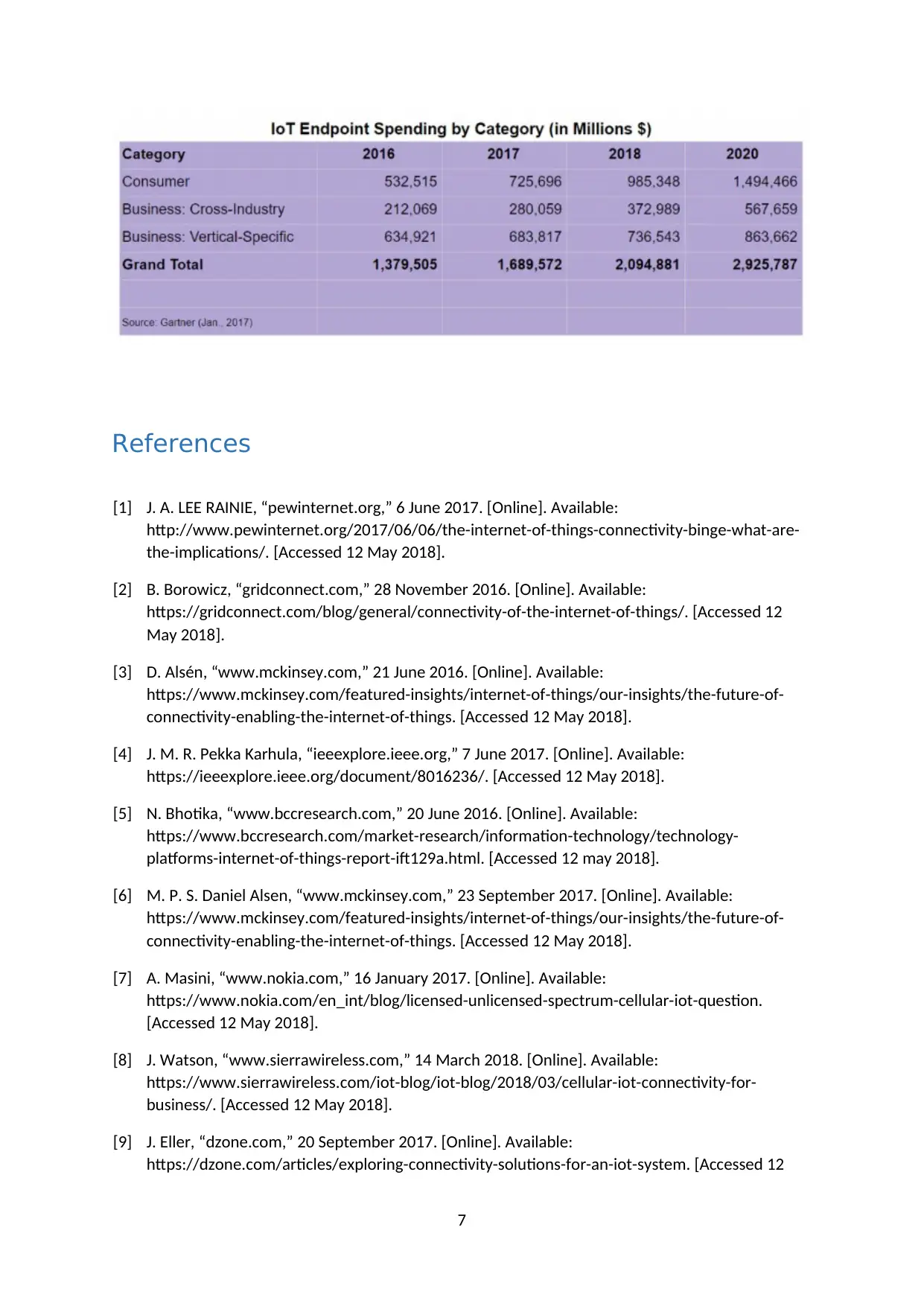
Internet of Things is today’s the most demanding area which is expected a huge growth in coming
years both for business applications and industry [16]. As per the analytic report published in 2017,
there were around three categories of IoT devices: consumer, industry based and vertical specific
industry. In first category of consumer IoT devices we can include television, smart wearable and
automotive devices. In industry based IoT devices, LED lighting, security systems and HVAC can be
concluded. In vertical specific category mainly manufacturing and real time location devices are
included. Due to increasing demand of IoT, the improvement areas for better performance in ROI
are consistently increasing. Investing on IoT connectivity without the security features is not a good
approach, so it is mandate that by following simple standards the security features must be
implemented to achieve the objective of IOT connectivity. As per the Gartner the IoT devices selling
is explained as:
6
architecture:
Category of protocol Example
Identification IPv6, URIs, EPC
Infrastructure IPv4, IPv6, RPL
Discovery mDNS, DNS-SD
Transport Wifi, LPWAN
Device management OMA-DM, TR-069
Semantic JSON-LD
Data protocol Websocket, MQTT
Multi-layered framework Weave, IoTivity
The purpose of using different communication protocols is to maximize the efficiency of IoT
technology. Wifi is very common protocol which is very important in our day to day life. It is very
simple to connect multiple devices using Wifi. It has a varied range also and it can pass the signals
through wall or other obstacles. Wifi is not secure but can be used to save power [15]. Thread is also
a communication protocol which is very efficient and reliable. It is used in case of machine to
machine protocol. This protocol was specially designed to connect home appliances. Bluetooth is
also M2M type of communication protocol which uses 2.4GHz bandwidth. It is a traditional way of
communication protocol. To track any IoT device RFID protocol is used. It is common in wide range
of IoT applications. One more protocol which is very important in current context, is NFC (Near field
communication). It is very much similar to RFID. But NFC devices can communicate by simply tapping
the devices. This protocol is used to save the efforts and time in IoT. It is short range type of protocol
Potential improvement areas in IoT connectivity
Internet of Things is today’s the most demanding area which is expected a huge growth in coming
years both for business applications and industry [16]. As per the analytic report published in 2017,
there were around three categories of IoT devices: consumer, industry based and vertical specific
industry. In first category of consumer IoT devices we can include television, smart wearable and
automotive devices. In industry based IoT devices, LED lighting, security systems and HVAC can be
concluded. In vertical specific category mainly manufacturing and real time location devices are
included. Due to increasing demand of IoT, the improvement areas for better performance in ROI
are consistently increasing. Investing on IoT connectivity without the security features is not a good
approach, so it is mandate that by following simple standards the security features must be
implemented to achieve the objective of IOT connectivity. As per the Gartner the IoT devices selling
is explained as:
6
Paraphrase This Document
Need a fresh take? Get an instant paraphrase of this document with our AI Paraphraser
References
[1] J. A. LEE RAINIE, “pewinternet.org,” 6 June 2017. [Online]. Available:
http://www.pewinternet.org/2017/06/06/the-internet-of-things-connectivity-binge-what-are-
the-implications/. [Accessed 12 May 2018].
[2] B. Borowicz, “gridconnect.com,” 28 November 2016. [Online]. Available:
https://gridconnect.com/blog/general/connectivity-of-the-internet-of-things/. [Accessed 12
May 2018].
[3] D. Alsén, “www.mckinsey.com,” 21 June 2016. [Online]. Available:
https://www.mckinsey.com/featured-insights/internet-of-things/our-insights/the-future-of-
connectivity-enabling-the-internet-of-things. [Accessed 12 May 2018].
[4] J. M. R. Pekka Karhula, “ieeexplore.ieee.org,” 7 June 2017. [Online]. Available:
https://ieeexplore.ieee.org/document/8016236/. [Accessed 12 May 2018].
[5] N. Bhotika, “www.bccresearch.com,” 20 June 2016. [Online]. Available:
https://www.bccresearch.com/market-research/information-technology/technology-
platforms-internet-of-things-report-ift129a.html. [Accessed 12 may 2018].
[6] M. P. S. Daniel Alsen, “www.mckinsey.com,” 23 September 2017. [Online]. Available:
https://www.mckinsey.com/featured-insights/internet-of-things/our-insights/the-future-of-
connectivity-enabling-the-internet-of-things. [Accessed 12 May 2018].
[7] A. Masini, “www.nokia.com,” 16 January 2017. [Online]. Available:
https://www.nokia.com/en_int/blog/licensed-unlicensed-spectrum-cellular-iot-question.
[Accessed 12 May 2018].
[8] J. Watson, “www.sierrawireless.com,” 14 March 2018. [Online]. Available:
https://www.sierrawireless.com/iot-blog/iot-blog/2018/03/cellular-iot-connectivity-for-
business/. [Accessed 12 May 2018].
[9] J. Eller, “dzone.com,” 20 September 2017. [Online]. Available:
https://dzone.com/articles/exploring-connectivity-solutions-for-an-iot-system. [Accessed 12
7
[1] J. A. LEE RAINIE, “pewinternet.org,” 6 June 2017. [Online]. Available:
http://www.pewinternet.org/2017/06/06/the-internet-of-things-connectivity-binge-what-are-
the-implications/. [Accessed 12 May 2018].
[2] B. Borowicz, “gridconnect.com,” 28 November 2016. [Online]. Available:
https://gridconnect.com/blog/general/connectivity-of-the-internet-of-things/. [Accessed 12
May 2018].
[3] D. Alsén, “www.mckinsey.com,” 21 June 2016. [Online]. Available:
https://www.mckinsey.com/featured-insights/internet-of-things/our-insights/the-future-of-
connectivity-enabling-the-internet-of-things. [Accessed 12 May 2018].
[4] J. M. R. Pekka Karhula, “ieeexplore.ieee.org,” 7 June 2017. [Online]. Available:
https://ieeexplore.ieee.org/document/8016236/. [Accessed 12 May 2018].
[5] N. Bhotika, “www.bccresearch.com,” 20 June 2016. [Online]. Available:
https://www.bccresearch.com/market-research/information-technology/technology-
platforms-internet-of-things-report-ift129a.html. [Accessed 12 may 2018].
[6] M. P. S. Daniel Alsen, “www.mckinsey.com,” 23 September 2017. [Online]. Available:
https://www.mckinsey.com/featured-insights/internet-of-things/our-insights/the-future-of-
connectivity-enabling-the-internet-of-things. [Accessed 12 May 2018].
[7] A. Masini, “www.nokia.com,” 16 January 2017. [Online]. Available:
https://www.nokia.com/en_int/blog/licensed-unlicensed-spectrum-cellular-iot-question.
[Accessed 12 May 2018].
[8] J. Watson, “www.sierrawireless.com,” 14 March 2018. [Online]. Available:
https://www.sierrawireless.com/iot-blog/iot-blog/2018/03/cellular-iot-connectivity-for-
business/. [Accessed 12 May 2018].
[9] J. Eller, “dzone.com,” 20 September 2017. [Online]. Available:
https://dzone.com/articles/exploring-connectivity-solutions-for-an-iot-system. [Accessed 12
7

May 2018].
[10] G. Audin, “www.nojitter.com,” 5 January 2018. [Online]. Available:
https://www.nojitter.com/post/240173199/examining-iot-connection-options. [Accessed 12
May 2018].
[11] Vensi, “internet-of-things-connectivity-architecture,” Blueapp, 21 April 2017. [Online].
Available: http://blueapp.io/blog/internet-of-things-connectivity-architecture/. [Accessed 19
May 2018].
[12] S. Fabode, “medium.com,” 7 December 2016. [Online]. Available: https://medium.com/startup-
grind/new-business-models-for-iot-and-iiot-businesses-2e5177d11a4a. [Accessed 12 May
2018].
[13] B. wire, “www.businesswire.com,” 5 February 2018. [Online]. Available:
https://www.businesswire.com/news/home/20180205005876/en/Global-Internet-Things-IoT-
Connectivity-Protocols-Research. [Accessed 12 May 2018].
[14] M. A. A. Shadi Al-Sarawi, “ieeexplore.ieee.org,” 12 March 2017. [Online]. Available:
https://ieeexplore.ieee.org/document/8079928/. [Accessed 12 May 2018].
[15] N. Lethaby, “www.ti.com,” 5 October 2017. [Online]. Available:
http://www.ti.com/lit/wp/swry010a/swry010a.pdf. [Accessed 12 May 2018].
[16] R. Meyers, “unifiedinbox.com,” 7 July 2017. [Online]. Available:
https://unifiedinbox.com/internet-things-potential-growth-areas/. [Accessed 12 May 2018].
[17] M. Ligade, “medium.com,” 18 December 2016. [Online]. Available:
https://medium.com/@maheshwar.ligade/architecture-for-iot-applications-d50ece031d38.
[Accessed 12 May 2018].
8
[10] G. Audin, “www.nojitter.com,” 5 January 2018. [Online]. Available:
https://www.nojitter.com/post/240173199/examining-iot-connection-options. [Accessed 12
May 2018].
[11] Vensi, “internet-of-things-connectivity-architecture,” Blueapp, 21 April 2017. [Online].
Available: http://blueapp.io/blog/internet-of-things-connectivity-architecture/. [Accessed 19
May 2018].
[12] S. Fabode, “medium.com,” 7 December 2016. [Online]. Available: https://medium.com/startup-
grind/new-business-models-for-iot-and-iiot-businesses-2e5177d11a4a. [Accessed 12 May
2018].
[13] B. wire, “www.businesswire.com,” 5 February 2018. [Online]. Available:
https://www.businesswire.com/news/home/20180205005876/en/Global-Internet-Things-IoT-
Connectivity-Protocols-Research. [Accessed 12 May 2018].
[14] M. A. A. Shadi Al-Sarawi, “ieeexplore.ieee.org,” 12 March 2017. [Online]. Available:
https://ieeexplore.ieee.org/document/8079928/. [Accessed 12 May 2018].
[15] N. Lethaby, “www.ti.com,” 5 October 2017. [Online]. Available:
http://www.ti.com/lit/wp/swry010a/swry010a.pdf. [Accessed 12 May 2018].
[16] R. Meyers, “unifiedinbox.com,” 7 July 2017. [Online]. Available:
https://unifiedinbox.com/internet-things-potential-growth-areas/. [Accessed 12 May 2018].
[17] M. Ligade, “medium.com,” 18 December 2016. [Online]. Available:
https://medium.com/@maheshwar.ligade/architecture-for-iot-applications-d50ece031d38.
[Accessed 12 May 2018].
8
⊘ This is a preview!⊘
Do you want full access?
Subscribe today to unlock all pages.
Trusted by 1+ million students worldwide

1 out of 9


Related Documents


Your All-in-One AI-Powered Toolkit for Academic Success.
+13062052269
info@desklib.com
Available 24*7 on WhatsApp / Email
![[object Object]](/_next/static/media/star-bottom.7253800d.svg)
Unlock your academic potential
Copyright © 2020–2026 A2Z Services. All Rights Reserved. Developed and managed by ZUCOL.